False Memories: Examining Research on Memory and Imagination

Verified

Added on  2023/06/03

|5
|885
|477
Literature Review
AI Summary
This literature review delves into the phenomenon of false memories, examining research by Conway and Loveday, who define false memories as the recall of events that likely did not occur, emphasizing the role of imagination in memory construction. The review then explores Patihis et al.'s study on Highly Superior Autobiographical Memory (HSAM) individuals, challenging the notion that they are immune to memory distortions. The authors found that even individuals with exceptional memory are susceptible to memory distortions. The review highlights the importance of understanding memory as a reconstructive process and the implications of these findings for cognitive psychology and memory research. The review concludes with references to the cited articles by Conway & Loveday (2015) and Patihis et al. (2013).
Document Page
Running head: FALSE MEMORIES
False memories
Name of the student
Name of the university
tabler-icon-diamond-filled.svg

Paraphrase This Document

Need a fresh take? Get an instant paraphrase of this document with our AI Paraphraser
Document Page
1FALSE MEMORIES
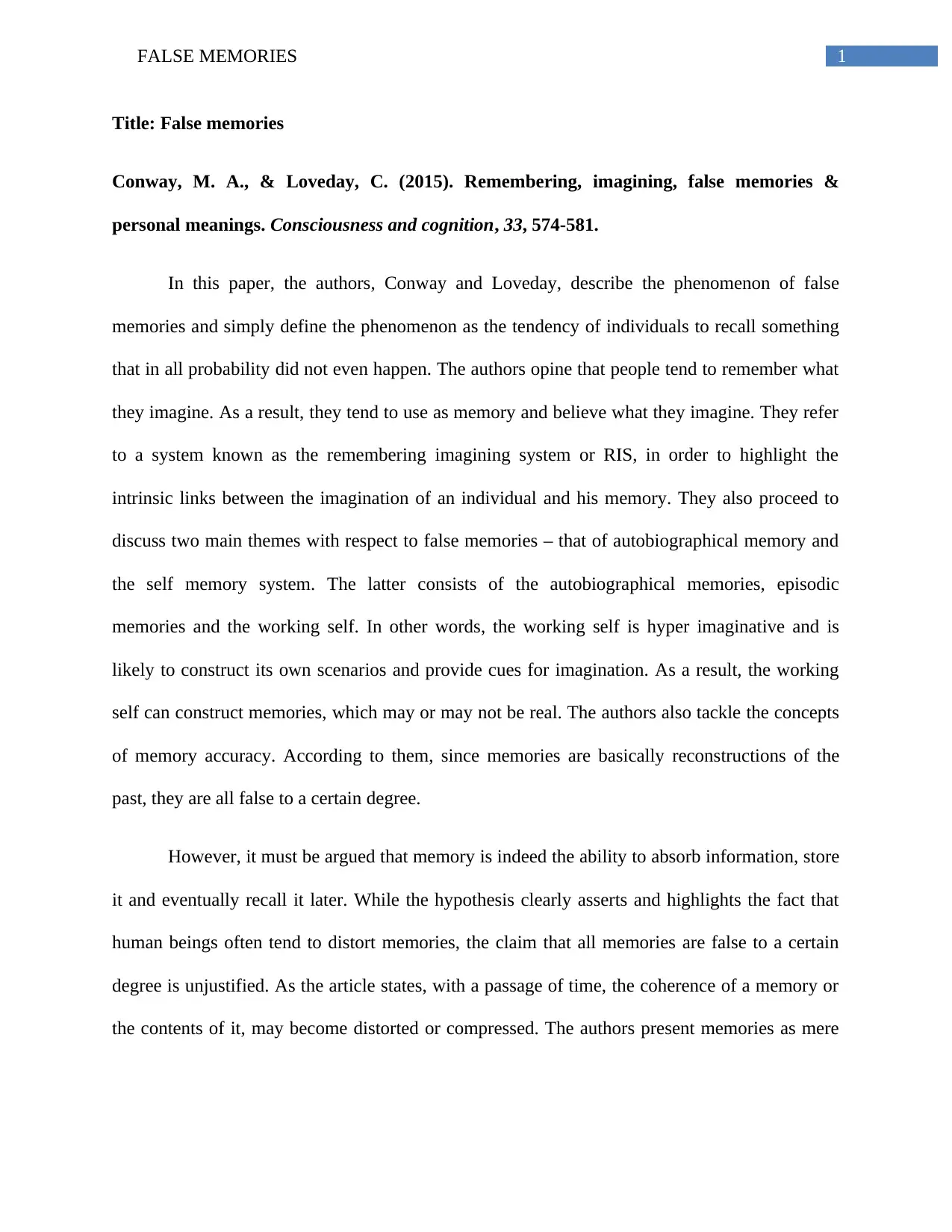
Title: False memories
Conway, M. A., & Loveday, C. (2015). Remembering, imagining, false memories &
personal meanings. Consciousness and cognition, 33, 574-581.
In this paper, the authors, Conway and Loveday, describe the phenomenon of false
memories and simply define the phenomenon as the tendency of individuals to recall something
that in all probability did not even happen. The authors opine that people tend to remember what
they imagine. As a result, they tend to use as memory and believe what they imagine. They refer
to a system known as the remembering imagining system or RIS, in order to highlight the
intrinsic links between the imagination of an individual and his memory. They also proceed to
discuss two main themes with respect to false memories – that of autobiographical memory and
the self memory system. The latter consists of the autobiographical memories, episodic
memories and the working self. In other words, the working self is hyper imaginative and is
likely to construct its own scenarios and provide cues for imagination. As a result, the working
self can construct memories, which may or may not be real. The authors also tackle the concepts
of memory accuracy. According to them, since memories are basically reconstructions of the
past, they are all false to a certain degree.
However, it must be argued that memory is indeed the ability to absorb information, store
it and eventually recall it later. While the hypothesis clearly asserts and highlights the fact that
human beings often tend to distort memories, the claim that all memories are false to a certain
degree is unjustified. As the article states, with a passage of time, the coherence of a memory or
the contents of it, may become distorted or compressed. The authors present memories as mere
Document Page
2FALSE MEMORIES
mental constructions, which may be understating the value of a memory (Conway & Loveday,
2015).
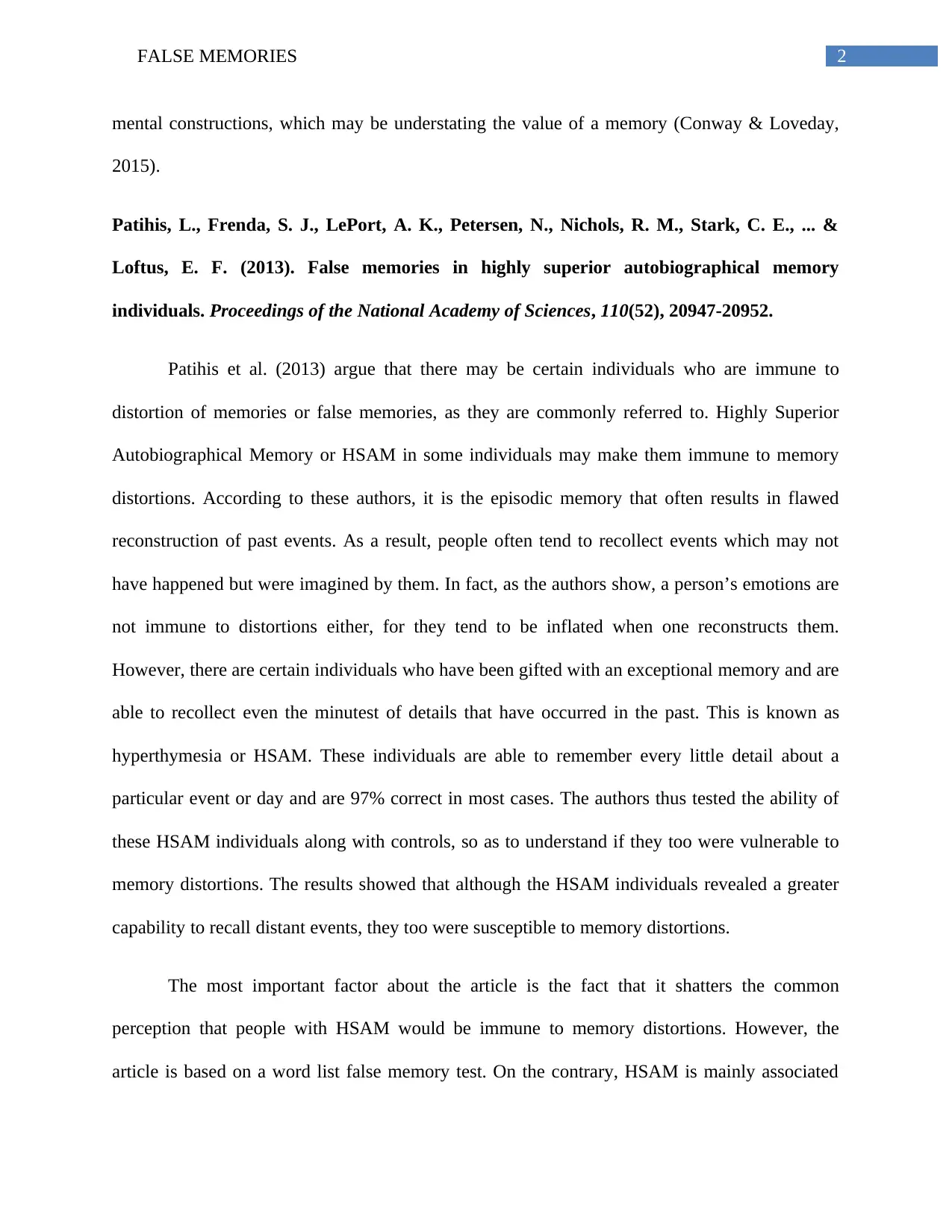
Patihis, L., Frenda, S. J., LePort, A. K., Petersen, N., Nichols, R. M., Stark, C. E., ... &
Loftus, E. F. (2013). False memories in highly superior autobiographical memory
individuals. Proceedings of the National Academy of Sciences, 110(52), 20947-20952.
Patihis et al. (2013) argue that there may be certain individuals who are immune to
distortion of memories or false memories, as they are commonly referred to. Highly Superior
Autobiographical Memory or HSAM in some individuals may make them immune to memory
distortions. According to these authors, it is the episodic memory that often results in flawed
reconstruction of past events. As a result, people often tend to recollect events which may not
have happened but were imagined by them. In fact, as the authors show, a person’s emotions are
not immune to distortions either, for they tend to be inflated when one reconstructs them.
However, there are certain individuals who have been gifted with an exceptional memory and are
able to recollect even the minutest of details that have occurred in the past. This is known as
hyperthymesia or HSAM. These individuals are able to remember every little detail about a
particular event or day and are 97% correct in most cases. The authors thus tested the ability of
these HSAM individuals along with controls, so as to understand if they too were vulnerable to
memory distortions. The results showed that although the HSAM individuals revealed a greater
capability to recall distant events, they too were susceptible to memory distortions.
The most important factor about the article is the fact that it shatters the common
perception that people with HSAM would be immune to memory distortions. However, the
article is based on a word list false memory test. On the contrary, HSAM is mainly associated
Document Page
3FALSE MEMORIES
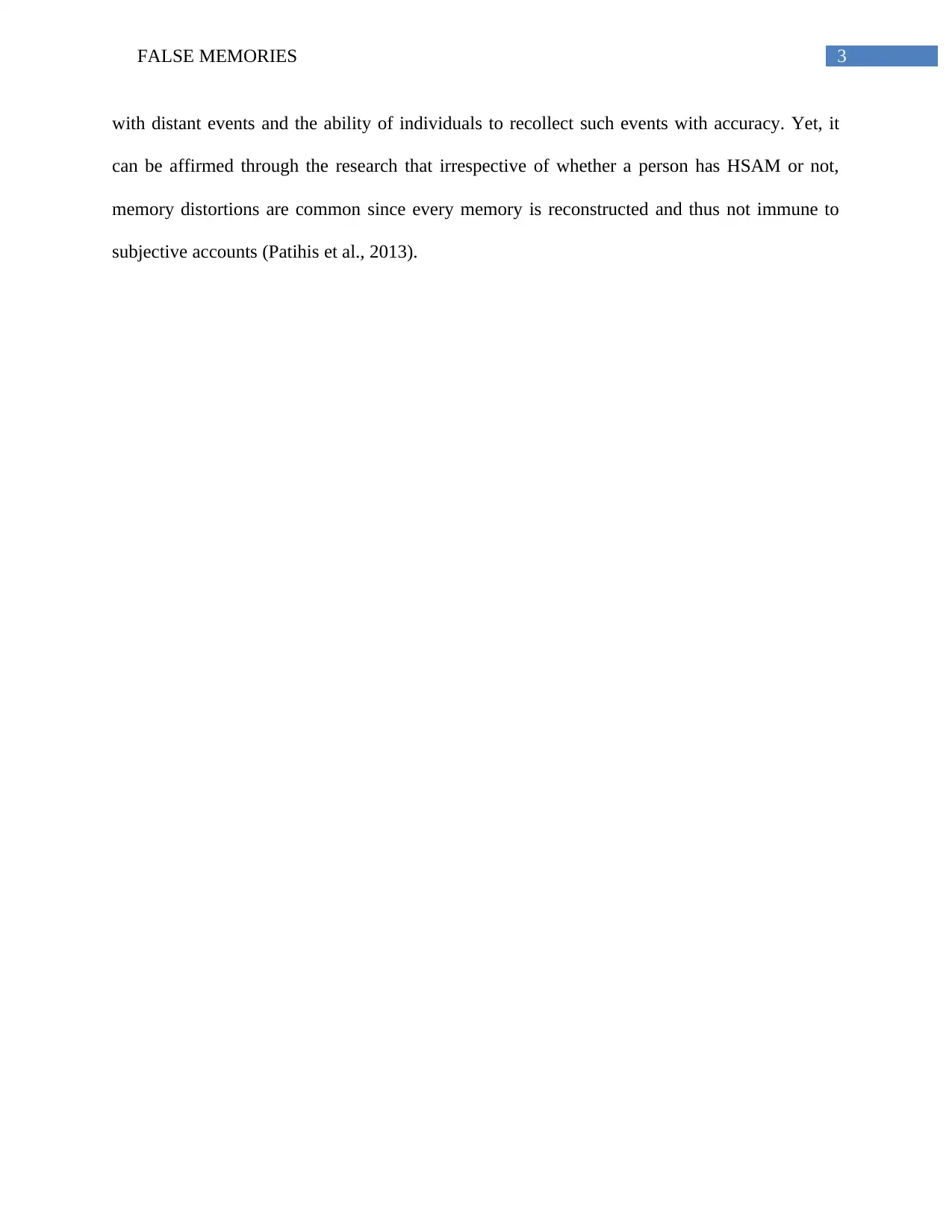
with distant events and the ability of individuals to recollect such events with accuracy. Yet, it
can be affirmed through the research that irrespective of whether a person has HSAM or not,
memory distortions are common since every memory is reconstructed and thus not immune to
subjective accounts (Patihis et al., 2013).
tabler-icon-diamond-filled.svg

Paraphrase This Document

Need a fresh take? Get an instant paraphrase of this document with our AI Paraphraser
Document Page
4FALSE MEMORIES
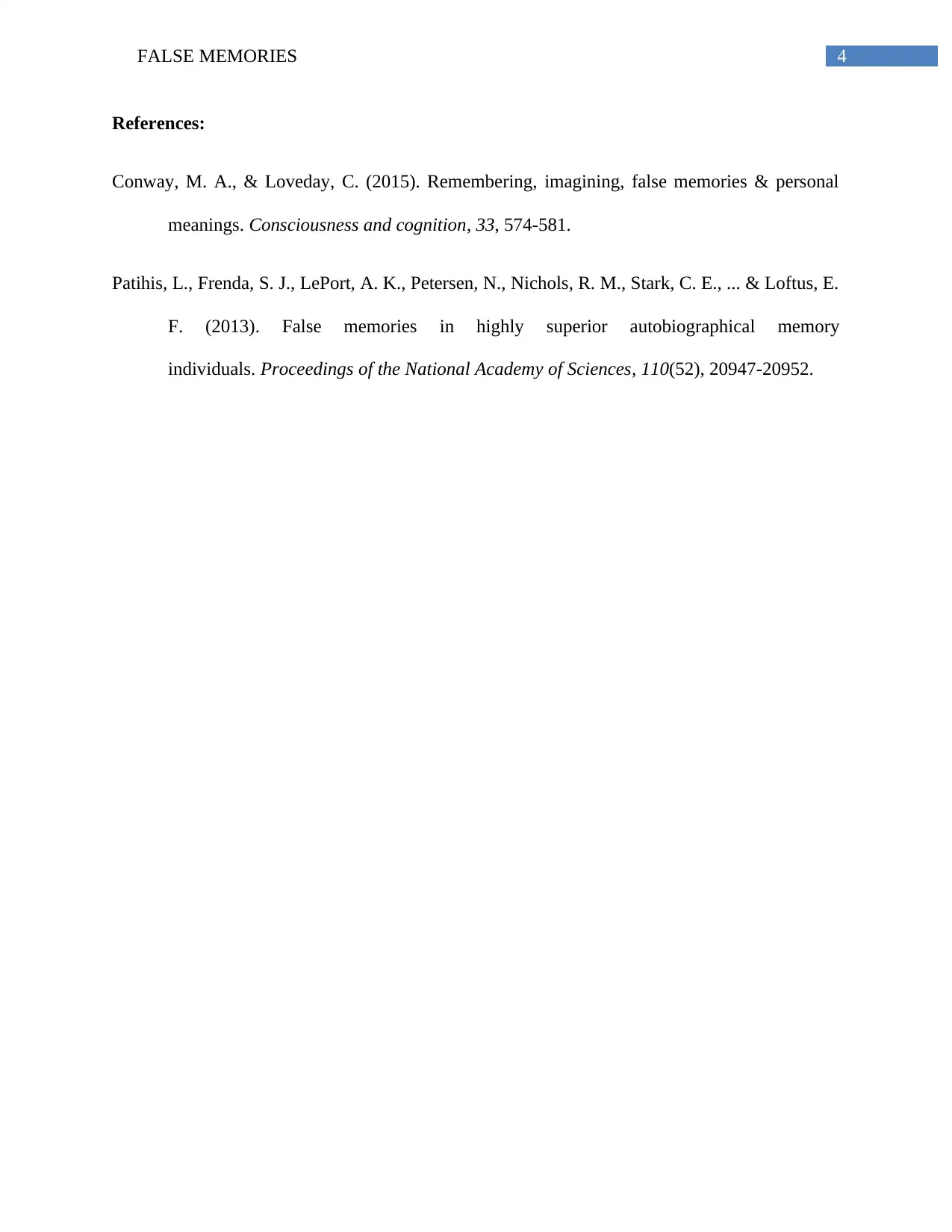
References:
Conway, M. A., & Loveday, C. (2015). Remembering, imagining, false memories & personal
meanings. Consciousness and cognition, 33, 574-581.
Patihis, L., Frenda, S. J., LePort, A. K., Petersen, N., Nichols, R. M., Stark, C. E., ... & Loftus, E.
F. (2013). False memories in highly superior autobiographical memory
individuals. Proceedings of the National Academy of Sciences, 110(52), 20947-20952.
chevron_up_icon
1 out of 5
circle_padding
hide_on_mobile
zoom_out_icon
[object Object]