Psychology for Health and Social Care
VerifiedAdded on 2019/12/03
|15
|6539
|206
Report
AI Summary
This report addresses the role of psychology in health and social care, exploring lifespan development perspectives, key features of life stages, and the nature-nurture debate. It then delves into a case study of Peter, a mental health nurse, analyzing the reasons behind his stress, applying psycho-dynamism to challenge negative thoughts, utilizing evolutionary theory to understand patient depression, and employing humanistic and cognitive behavioral therapy approaches to foster collaborative doctor-patient relationships. The report concludes by summarizing the importance of psychology in healthcare and the effectiveness of various therapeutic approaches.

Psychology for Health and
Social Care
1
Social Care
1

Paraphrase This Document
Need a fresh take? Get an instant paraphrase of this document with our AI Paraphraser
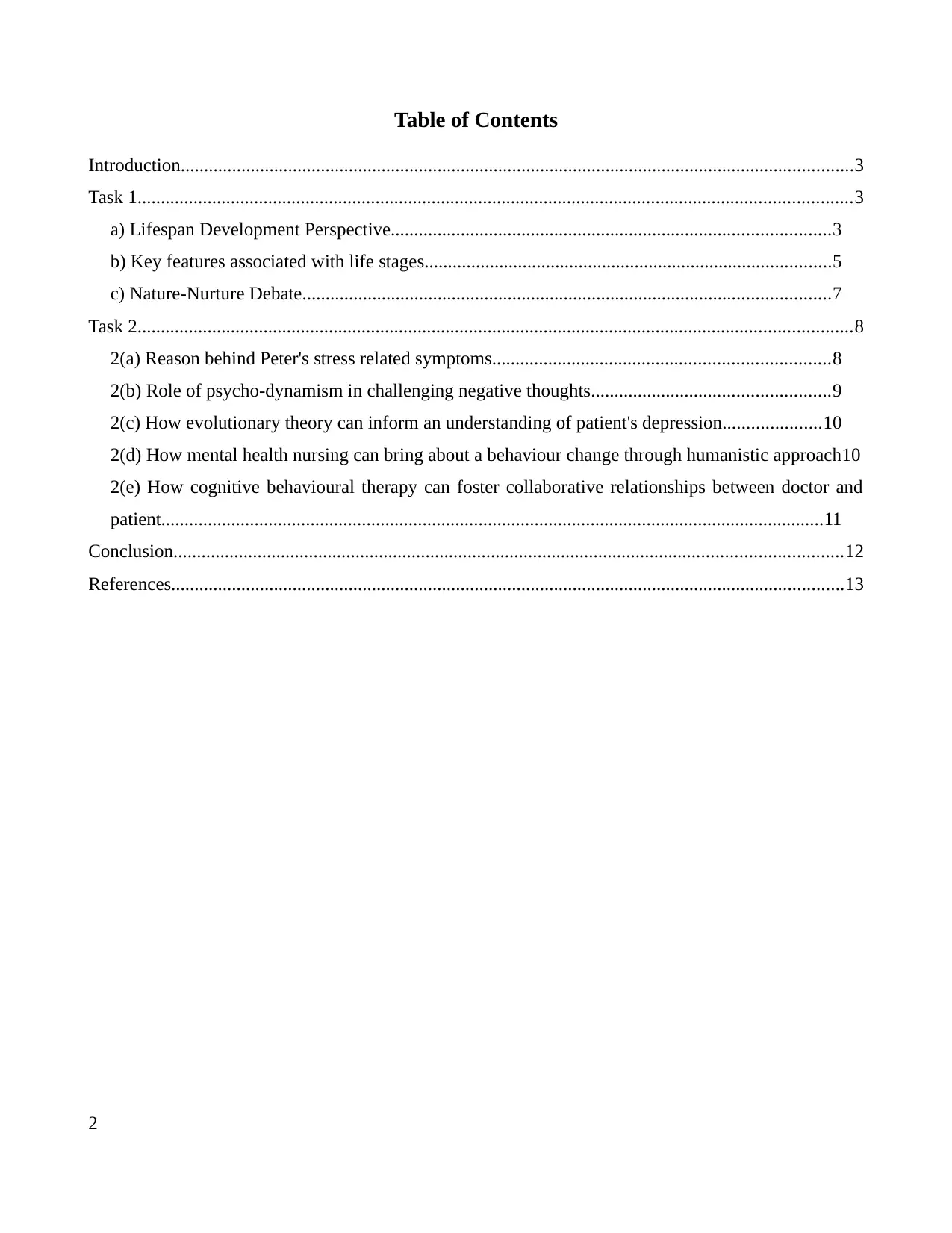
Table of Contents
Introduction................................................................................................................................................3
Task 1.........................................................................................................................................................3
a) Lifespan Development Perspective..............................................................................................3
b) Key features associated with life stages.......................................................................................5
c) Nature-Nurture Debate.................................................................................................................7
Task 2.........................................................................................................................................................8
2(a) Reason behind Peter's stress related symptoms........................................................................8
2(b) Role of psycho-dynamism in challenging negative thoughts...................................................9
2(c) How evolutionary theory can inform an understanding of patient's depression.....................10
2(d) How mental health nursing can bring about a behaviour change through humanistic approach10
2(e) How cognitive behavioural therapy can foster collaborative relationships between doctor and
patient..............................................................................................................................................11
Conclusion...............................................................................................................................................12
References................................................................................................................................................13
2
Introduction................................................................................................................................................3
Task 1.........................................................................................................................................................3
a) Lifespan Development Perspective..............................................................................................3
b) Key features associated with life stages.......................................................................................5
c) Nature-Nurture Debate.................................................................................................................7
Task 2.........................................................................................................................................................8
2(a) Reason behind Peter's stress related symptoms........................................................................8
2(b) Role of psycho-dynamism in challenging negative thoughts...................................................9
2(c) How evolutionary theory can inform an understanding of patient's depression.....................10
2(d) How mental health nursing can bring about a behaviour change through humanistic approach10
2(e) How cognitive behavioural therapy can foster collaborative relationships between doctor and
patient..............................................................................................................................................11
Conclusion...............................................................................................................................................12
References................................................................................................................................................13
2
INTRODUCTION
Health and social care industry is very important part of a society, as it is directly related with
working of individuals in the community and their effectiveness in carrying out their tasks and
activities on a daily basis (Moule and Hek, 2011). In this sector, a critical component is that of the
psychology. It sometimes aids doctors and health care practitioners; while in some cases it acts as a
hindering force. Present research study appreciates and assesses the role of psychology in health and
social care practices. In addition to this, the investigation also discusses about various classical theories
and concepts to explain life-span development in a much better and in an effective manner.
TASK 1
a) Lifespan Development Perspective
Lifespan development perspective can be defined as a form of human development which is
determined by a wide variety of aspects and frameworks. This essentially means that, the theory of
lifespan development includes view points of an individual right from their birth to childhood till old
age (Thoits, 2011). Therefore it includes the likes of intellectual development, physical, emotional
development, etc. Thus herein it can be said that the theory of lifespan development can lead to a much
better understanding of different stages of development that the concerned individual goes through
(Aspinwall and Tedeschi, 2010). The lifespan development theory would shed light over aspects such
as physical or tangible development, like their body structure, muscles, etc. In addition to it, the theory
also provides insights into intellectual, i.e. mental development that the concerned person goes through.
For instance it helps in understanding the improvement in mental status and condition of an individual.
Furthermore, it also provides great insights into emotional development that the concerned person
undergoes through (Greene, 2011). In essence, it may not be wrong to say that lifespan development is
a perspective for understanding 'human ageing' in a much better and effective manner. For gaining a
better understanding of how human grows old, it is imperative that their life should be evaluated or
assessed from a variety of viewpoints or perspectives. This would provide a much effective
understanding and comprehension of the way people develop and grow. Lifespan development
perspective sheds light on transformation of an individual throughout their life.
Over the years, there have been many theories and models that have explained the phenomenon
of lifespan development in a very subtle yet in an effective manner (Cummings, Greene and Karraker,
2014). One of them is that of Behaviourist perspective. It states that, people and their behaviour are
3
Health and social care industry is very important part of a society, as it is directly related with
working of individuals in the community and their effectiveness in carrying out their tasks and
activities on a daily basis (Moule and Hek, 2011). In this sector, a critical component is that of the
psychology. It sometimes aids doctors and health care practitioners; while in some cases it acts as a
hindering force. Present research study appreciates and assesses the role of psychology in health and
social care practices. In addition to this, the investigation also discusses about various classical theories
and concepts to explain life-span development in a much better and in an effective manner.
TASK 1
a) Lifespan Development Perspective
Lifespan development perspective can be defined as a form of human development which is
determined by a wide variety of aspects and frameworks. This essentially means that, the theory of
lifespan development includes view points of an individual right from their birth to childhood till old
age (Thoits, 2011). Therefore it includes the likes of intellectual development, physical, emotional
development, etc. Thus herein it can be said that the theory of lifespan development can lead to a much
better understanding of different stages of development that the concerned individual goes through
(Aspinwall and Tedeschi, 2010). The lifespan development theory would shed light over aspects such
as physical or tangible development, like their body structure, muscles, etc. In addition to it, the theory
also provides insights into intellectual, i.e. mental development that the concerned person goes through.
For instance it helps in understanding the improvement in mental status and condition of an individual.
Furthermore, it also provides great insights into emotional development that the concerned person
undergoes through (Greene, 2011). In essence, it may not be wrong to say that lifespan development is
a perspective for understanding 'human ageing' in a much better and effective manner. For gaining a
better understanding of how human grows old, it is imperative that their life should be evaluated or
assessed from a variety of viewpoints or perspectives. This would provide a much effective
understanding and comprehension of the way people develop and grow. Lifespan development
perspective sheds light on transformation of an individual throughout their life.
Over the years, there have been many theories and models that have explained the phenomenon
of lifespan development in a very subtle yet in an effective manner (Cummings, Greene and Karraker,
2014). One of them is that of Behaviourist perspective. It states that, people and their behaviour are
3
⊘ This is a preview!⊘
Do you want full access?
Subscribe today to unlock all pages.

Trusted by 1+ million students worldwide
largely controlled by the environment in which they live. Over the years various authors have
contributed to this lifespan development perspective. It includes the likes of Watson (1913) who
established his own behavioural school of psychology (Kinderman and Tai, 2009). Thorndike (1905)
formalized the law of effect; while Skinner (1936) wrote The Behaviour of Organisms (Kinderman and
Tai, 2009). Therefore, according to this theory, growth and development of people is the result of
activities of environment that they are a part of. In this sense, it may not be wrong to say that people
respond to stimuli, i.e. environmental forces, as they learn from it only. Behaviourist theory rejects the
idea and concept that people have free will; rather it is the environment which determines their
behaviour and responses (Kinderman and Tai, 2009).
Psycho-dynamic Perspective, on the other hand states that people do not learn from their
environment, rather they all act and react on the basis of their childhood experiences. This theory was
developed by Sigmund Freud but included many other contributors as well, such as Jung (1964), Adler
(1927), Erikson (1950), etc. People have very little free will to make their own choices and decisions
rather they extensively are dependent upon their unconscious mind and childhood experiences.
Humanistic theory in this context states that behaviour of an individual largely is connected with their
inner feelings, desires and self-image. One of the main contributors to development of this theory was
Carl Rogers, whose works largely were inspired by Otto Rank. This theory was further developed by
Abraham Maslow. This means that people behave in a way, only by reflecting on their feelings, desires
and needs (McGorry, 2010). The humanistic perspective herein states that growth and development of
an individual would be very different from some another person, as feelings and desires of no two
persons are ever similar. According to Cognitive theory of human development, the only way to gain
better understanding of people is to identify how their brain works, i.e. to assess and evaluate their
memory, perception, attention, etc. It was developed by Jean Piaget (Piaget, 1970).
Another theory of life span development perspective is that of Evolutionary psychology.
Though it is considered that Charles Darwin was the father of this theory, but many believe that authors
such as William James also have had a major role to play in development of the theory. It is a
theoretical approach and studies and evaluates the psychological structured through a modern
evolutionary perspective (Rigby, 2011). This theory basically studies and identifies various human
traits and characteristics that have evolved as a result of evolved adaptations. It means that theorists and
psychologists through the said approach assess the functional products of natural selection or sexual
selection. Various psychologists in this context argue that the mind has a modular structure which is
4
contributed to this lifespan development perspective. It includes the likes of Watson (1913) who
established his own behavioural school of psychology (Kinderman and Tai, 2009). Thorndike (1905)
formalized the law of effect; while Skinner (1936) wrote The Behaviour of Organisms (Kinderman and
Tai, 2009). Therefore, according to this theory, growth and development of people is the result of
activities of environment that they are a part of. In this sense, it may not be wrong to say that people
respond to stimuli, i.e. environmental forces, as they learn from it only. Behaviourist theory rejects the
idea and concept that people have free will; rather it is the environment which determines their
behaviour and responses (Kinderman and Tai, 2009).
Psycho-dynamic Perspective, on the other hand states that people do not learn from their
environment, rather they all act and react on the basis of their childhood experiences. This theory was
developed by Sigmund Freud but included many other contributors as well, such as Jung (1964), Adler
(1927), Erikson (1950), etc. People have very little free will to make their own choices and decisions
rather they extensively are dependent upon their unconscious mind and childhood experiences.
Humanistic theory in this context states that behaviour of an individual largely is connected with their
inner feelings, desires and self-image. One of the main contributors to development of this theory was
Carl Rogers, whose works largely were inspired by Otto Rank. This theory was further developed by
Abraham Maslow. This means that people behave in a way, only by reflecting on their feelings, desires
and needs (McGorry, 2010). The humanistic perspective herein states that growth and development of
an individual would be very different from some another person, as feelings and desires of no two
persons are ever similar. According to Cognitive theory of human development, the only way to gain
better understanding of people is to identify how their brain works, i.e. to assess and evaluate their
memory, perception, attention, etc. It was developed by Jean Piaget (Piaget, 1970).
Another theory of life span development perspective is that of Evolutionary psychology.
Though it is considered that Charles Darwin was the father of this theory, but many believe that authors
such as William James also have had a major role to play in development of the theory. It is a
theoretical approach and studies and evaluates the psychological structured through a modern
evolutionary perspective (Rigby, 2011). This theory basically studies and identifies various human
traits and characteristics that have evolved as a result of evolved adaptations. It means that theorists and
psychologists through the said approach assess the functional products of natural selection or sexual
selection. Various psychologists in this context argue that the mind has a modular structure which is
4
Paraphrase This Document
Need a fresh take? Get an instant paraphrase of this document with our AI Paraphraser
pretty much similar to that of the human body. Different modular structures perform different kinds of
functions. Therefore it may not be wrong to say that main reason behind the way people behave the
way they do is the result of physiological adaptations that have evolved so as to resolve various issues
faced by humans (Marlatt, 2011). Therefore it may not be wrong to say that human behaviour is the
result of adaptations that have evolved over a time period of many years.
Contextual theory is another approach to better explain the concept of lifespan development.
Some of the key contributors to the said theory are Howard Gardner and Sternberg (Verbitsky and
Kalashnikov, 2012). It refers to the study of organisms interacting in and with historical and current
situational context. In this regard it can be said that this theory states that people react or behave in
different scenarios on basis of their past experiences and the current situation. In this sense, it may not
be wrong to say that it is a philosophy where any event is interpreted as an ongoing act inseparable
from its current and historical context (Sternberg, 2015). According to various authors, it can be said
that every situation or act has some or the other kind of relationship with past as well as the present.
The theory developed by Erik Erikson was giving more emphasis on psychosocial stages of
development. It can be also stated that to a certain extent Erikson's entire work was inspired by the
theory which was developed by Frued. In the theory developed by Erikson more focus was provided to
the conflict which takes place between ego of persons. Furthermore, he developed 8 stages which
includes infant, toddler, preschooler, school, adolescent, young adult, middle aged and older adults. He
also argued the fact that all needs and demand of infants are met by their parents only. Erikson stated
that more than father infants depends on their mothers. Stage one includes trust v/s mistrust in which
the basic virtue is trust and age group is 0 to one and a half. The second stage is of anatomy v/s shame
where virtue become the will. The third stage consists of intitaive v/s guilt, fourth one includes industry
v/s inferiority, fifth stage consist ego identity v/s role confusion. Six stage of theory belong to intimacy
v/s isolation, seventh stage includes generativity v/s stagnation and the last stage involves ego integrity
V/s despair
Jean Piaget is considered as the first and foremost psychologist which has developed a proper
study regarding cognitive development. His work includes the development of a child, observation of
his/her cognition and several test which helps in identification of a child's cognitive abilities. In other
words, his contribution is also called the development stage theory. There are various ways in which
this theory can be termed as different form other theories. One of the major difference is that rather
than focusing on learners, it focuses on development of a child. Another different was that it was more
focused on development instead of learning. The overall objective of this theory is to explain the entire
process in which infants develop into child and then individual's.
b) Key features associated with life stages
Over the years, numerous theories have been developed which shed light over different stages
of growth of an individual. These stages are – infancy, childhood, adolescence, adulthood and older
5
functions. Therefore it may not be wrong to say that main reason behind the way people behave the
way they do is the result of physiological adaptations that have evolved so as to resolve various issues
faced by humans (Marlatt, 2011). Therefore it may not be wrong to say that human behaviour is the
result of adaptations that have evolved over a time period of many years.
Contextual theory is another approach to better explain the concept of lifespan development.
Some of the key contributors to the said theory are Howard Gardner and Sternberg (Verbitsky and
Kalashnikov, 2012). It refers to the study of organisms interacting in and with historical and current
situational context. In this regard it can be said that this theory states that people react or behave in
different scenarios on basis of their past experiences and the current situation. In this sense, it may not
be wrong to say that it is a philosophy where any event is interpreted as an ongoing act inseparable
from its current and historical context (Sternberg, 2015). According to various authors, it can be said
that every situation or act has some or the other kind of relationship with past as well as the present.
The theory developed by Erik Erikson was giving more emphasis on psychosocial stages of
development. It can be also stated that to a certain extent Erikson's entire work was inspired by the
theory which was developed by Frued. In the theory developed by Erikson more focus was provided to
the conflict which takes place between ego of persons. Furthermore, he developed 8 stages which
includes infant, toddler, preschooler, school, adolescent, young adult, middle aged and older adults. He
also argued the fact that all needs and demand of infants are met by their parents only. Erikson stated
that more than father infants depends on their mothers. Stage one includes trust v/s mistrust in which
the basic virtue is trust and age group is 0 to one and a half. The second stage is of anatomy v/s shame
where virtue become the will. The third stage consists of intitaive v/s guilt, fourth one includes industry
v/s inferiority, fifth stage consist ego identity v/s role confusion. Six stage of theory belong to intimacy
v/s isolation, seventh stage includes generativity v/s stagnation and the last stage involves ego integrity
V/s despair
Jean Piaget is considered as the first and foremost psychologist which has developed a proper
study regarding cognitive development. His work includes the development of a child, observation of
his/her cognition and several test which helps in identification of a child's cognitive abilities. In other
words, his contribution is also called the development stage theory. There are various ways in which
this theory can be termed as different form other theories. One of the major difference is that rather
than focusing on learners, it focuses on development of a child. Another different was that it was more
focused on development instead of learning. The overall objective of this theory is to explain the entire
process in which infants develop into child and then individual's.
b) Key features associated with life stages
Over the years, numerous theories have been developed which shed light over different stages
of growth of an individual. These stages are – infancy, childhood, adolescence, adulthood and older
5
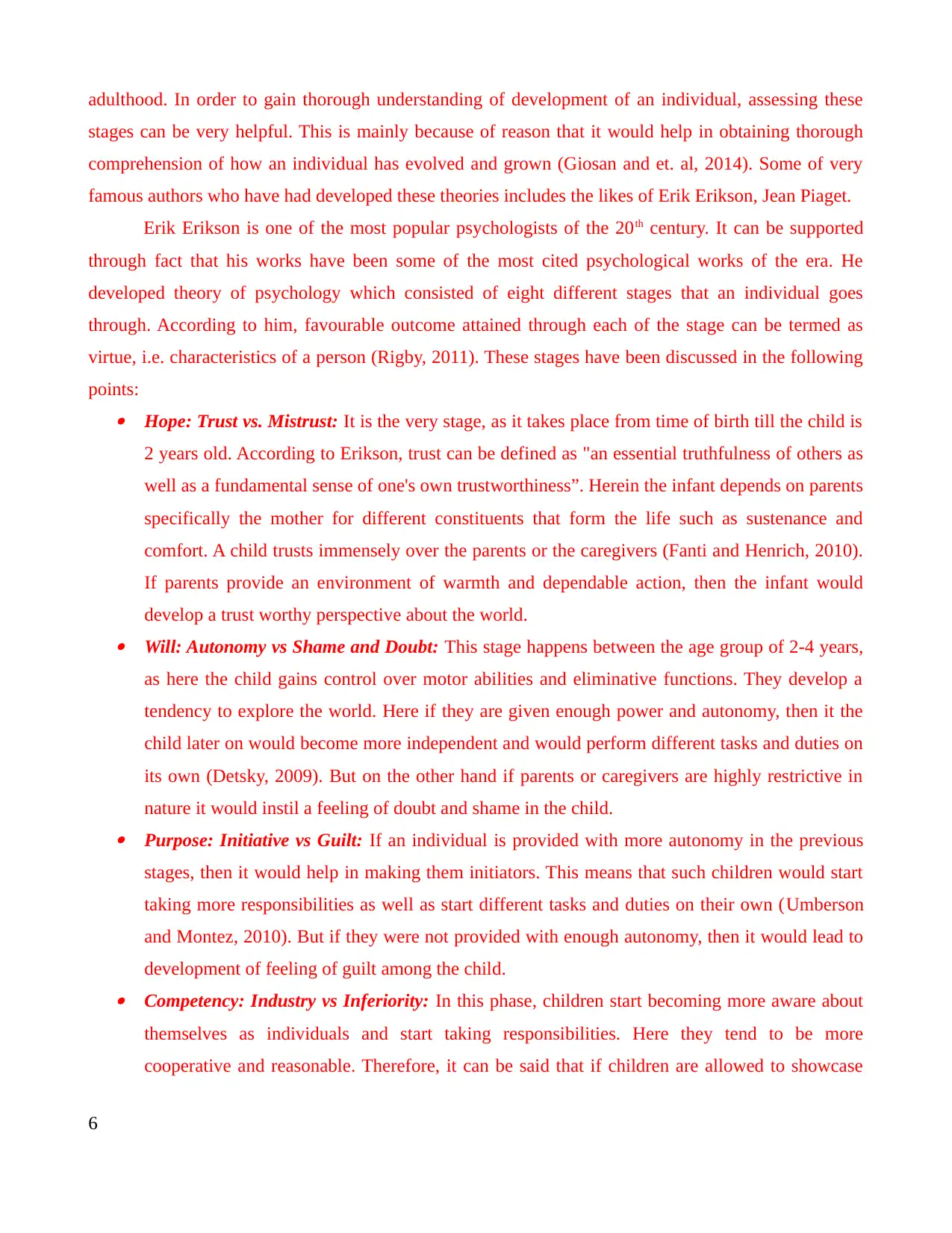
adulthood. In order to gain thorough understanding of development of an individual, assessing these
stages can be very helpful. This is mainly because of reason that it would help in obtaining thorough
comprehension of how an individual has evolved and grown (Giosan and et. al, 2014). Some of very
famous authors who have had developed these theories includes the likes of Erik Erikson, Jean Piaget.
Erik Erikson is one of the most popular psychologists of the 20th century. It can be supported
through fact that his works have been some of the most cited psychological works of the era. He
developed theory of psychology which consisted of eight different stages that an individual goes
through. According to him, favourable outcome attained through each of the stage can be termed as
virtue, i.e. characteristics of a person (Rigby, 2011). These stages have been discussed in the following
points: Hope: Trust vs. Mistrust: It is the very stage, as it takes place from time of birth till the child is
2 years old. According to Erikson, trust can be defined as "an essential truthfulness of others as
well as a fundamental sense of one's own trustworthiness”. Herein the infant depends on parents
specifically the mother for different constituents that form the life such as sustenance and
comfort. A child trusts immensely over the parents or the caregivers (Fanti and Henrich, 2010).
If parents provide an environment of warmth and dependable action, then the infant would
develop a trust worthy perspective about the world. Will: Autonomy vs Shame and Doubt: This stage happens between the age group of 2-4 years,
as here the child gains control over motor abilities and eliminative functions. They develop a
tendency to explore the world. Here if they are given enough power and autonomy, then it the
child later on would become more independent and would perform different tasks and duties on
its own (Detsky, 2009). But on the other hand if parents or caregivers are highly restrictive in
nature it would instil a feeling of doubt and shame in the child. Purpose: Initiative vs Guilt: If an individual is provided with more autonomy in the previous
stages, then it would help in making them initiators. This means that such children would start
taking more responsibilities as well as start different tasks and duties on their own (Umberson
and Montez, 2010). But if they were not provided with enough autonomy, then it would lead to
development of feeling of guilt among the child. Competency: Industry vs Inferiority: In this phase, children start becoming more aware about
themselves as individuals and start taking responsibilities. Here they tend to be more
cooperative and reasonable. Therefore, it can be said that if children are allowed to showcase
6
stages can be very helpful. This is mainly because of reason that it would help in obtaining thorough
comprehension of how an individual has evolved and grown (Giosan and et. al, 2014). Some of very
famous authors who have had developed these theories includes the likes of Erik Erikson, Jean Piaget.
Erik Erikson is one of the most popular psychologists of the 20th century. It can be supported
through fact that his works have been some of the most cited psychological works of the era. He
developed theory of psychology which consisted of eight different stages that an individual goes
through. According to him, favourable outcome attained through each of the stage can be termed as
virtue, i.e. characteristics of a person (Rigby, 2011). These stages have been discussed in the following
points: Hope: Trust vs. Mistrust: It is the very stage, as it takes place from time of birth till the child is
2 years old. According to Erikson, trust can be defined as "an essential truthfulness of others as
well as a fundamental sense of one's own trustworthiness”. Herein the infant depends on parents
specifically the mother for different constituents that form the life such as sustenance and
comfort. A child trusts immensely over the parents or the caregivers (Fanti and Henrich, 2010).
If parents provide an environment of warmth and dependable action, then the infant would
develop a trust worthy perspective about the world. Will: Autonomy vs Shame and Doubt: This stage happens between the age group of 2-4 years,
as here the child gains control over motor abilities and eliminative functions. They develop a
tendency to explore the world. Here if they are given enough power and autonomy, then it the
child later on would become more independent and would perform different tasks and duties on
its own (Detsky, 2009). But on the other hand if parents or caregivers are highly restrictive in
nature it would instil a feeling of doubt and shame in the child. Purpose: Initiative vs Guilt: If an individual is provided with more autonomy in the previous
stages, then it would help in making them initiators. This means that such children would start
taking more responsibilities as well as start different tasks and duties on their own (Umberson
and Montez, 2010). But if they were not provided with enough autonomy, then it would lead to
development of feeling of guilt among the child. Competency: Industry vs Inferiority: In this phase, children start becoming more aware about
themselves as individuals and start taking responsibilities. Here they tend to be more
cooperative and reasonable. Therefore, it can be said that if children are allowed to showcase
6
⊘ This is a preview!⊘
Do you want full access?
Subscribe today to unlock all pages.
Trusted by 1+ million students worldwide
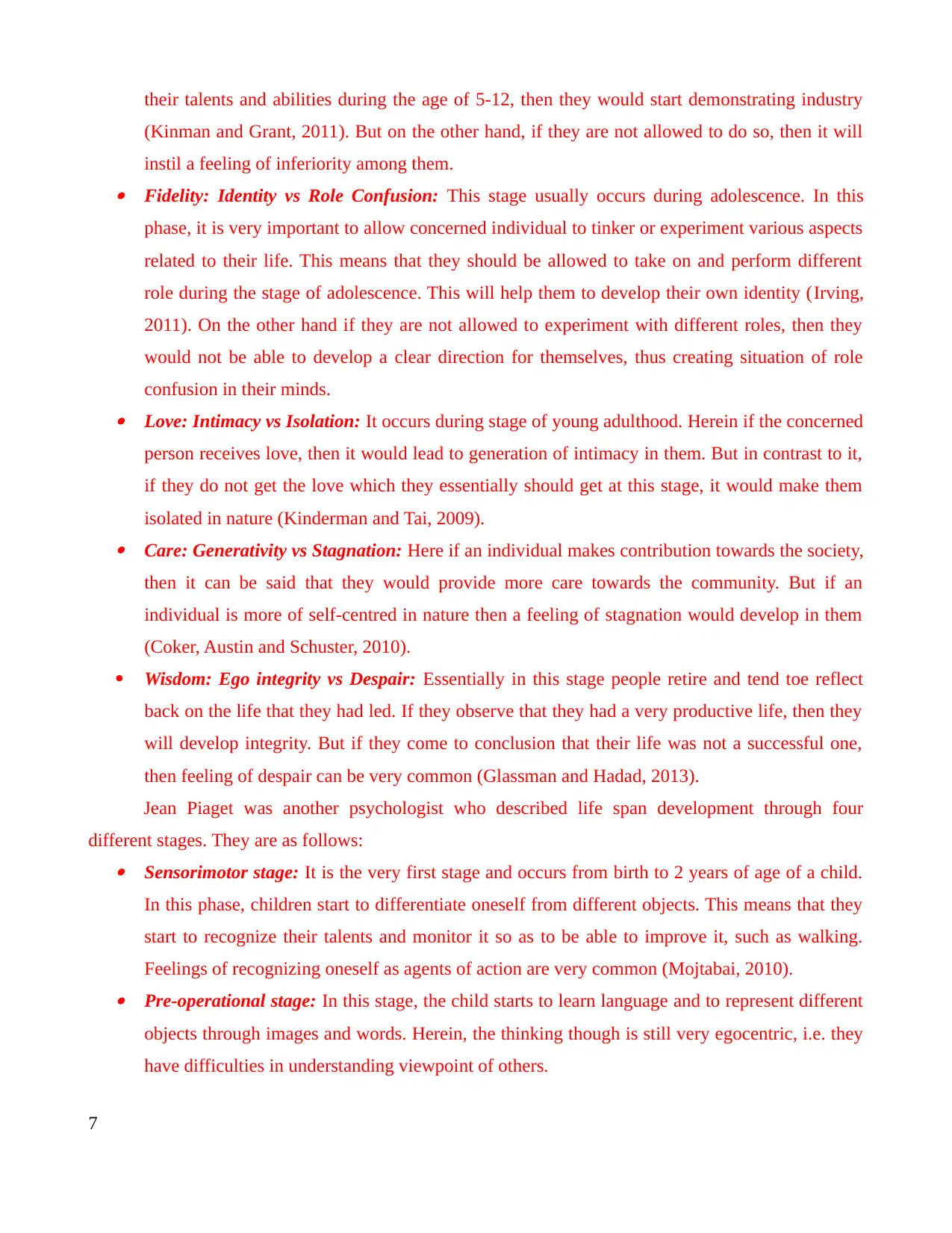
their talents and abilities during the age of 5-12, then they would start demonstrating industry
(Kinman and Grant, 2011). But on the other hand, if they are not allowed to do so, then it will
instil a feeling of inferiority among them. Fidelity: Identity vs Role Confusion: This stage usually occurs during adolescence. In this
phase, it is very important to allow concerned individual to tinker or experiment various aspects
related to their life. This means that they should be allowed to take on and perform different
role during the stage of adolescence. This will help them to develop their own identity (Irving,
2011). On the other hand if they are not allowed to experiment with different roles, then they
would not be able to develop a clear direction for themselves, thus creating situation of role
confusion in their minds. Love: Intimacy vs Isolation: It occurs during stage of young adulthood. Herein if the concerned
person receives love, then it would lead to generation of intimacy in them. But in contrast to it,
if they do not get the love which they essentially should get at this stage, it would make them
isolated in nature (Kinderman and Tai, 2009). Care: Generativity vs Stagnation: Here if an individual makes contribution towards the society,
then it can be said that they would provide more care towards the community. But if an
individual is more of self-centred in nature then a feeling of stagnation would develop in them
(Coker, Austin and Schuster, 2010).
Wisdom: Ego integrity vs Despair: Essentially in this stage people retire and tend toe reflect
back on the life that they had led. If they observe that they had a very productive life, then they
will develop integrity. But if they come to conclusion that their life was not a successful one,
then feeling of despair can be very common (Glassman and Hadad, 2013).
Jean Piaget was another psychologist who described life span development through four
different stages. They are as follows: Sensorimotor stage: It is the very first stage and occurs from birth to 2 years of age of a child.
In this phase, children start to differentiate oneself from different objects. This means that they
start to recognize their talents and monitor it so as to be able to improve it, such as walking.
Feelings of recognizing oneself as agents of action are very common (Mojtabai, 2010). Pre-operational stage: In this stage, the child starts to learn language and to represent different
objects through images and words. Herein, the thinking though is still very egocentric, i.e. they
have difficulties in understanding viewpoint of others.
7
(Kinman and Grant, 2011). But on the other hand, if they are not allowed to do so, then it will
instil a feeling of inferiority among them. Fidelity: Identity vs Role Confusion: This stage usually occurs during adolescence. In this
phase, it is very important to allow concerned individual to tinker or experiment various aspects
related to their life. This means that they should be allowed to take on and perform different
role during the stage of adolescence. This will help them to develop their own identity (Irving,
2011). On the other hand if they are not allowed to experiment with different roles, then they
would not be able to develop a clear direction for themselves, thus creating situation of role
confusion in their minds. Love: Intimacy vs Isolation: It occurs during stage of young adulthood. Herein if the concerned
person receives love, then it would lead to generation of intimacy in them. But in contrast to it,
if they do not get the love which they essentially should get at this stage, it would make them
isolated in nature (Kinderman and Tai, 2009). Care: Generativity vs Stagnation: Here if an individual makes contribution towards the society,
then it can be said that they would provide more care towards the community. But if an
individual is more of self-centred in nature then a feeling of stagnation would develop in them
(Coker, Austin and Schuster, 2010).
Wisdom: Ego integrity vs Despair: Essentially in this stage people retire and tend toe reflect
back on the life that they had led. If they observe that they had a very productive life, then they
will develop integrity. But if they come to conclusion that their life was not a successful one,
then feeling of despair can be very common (Glassman and Hadad, 2013).
Jean Piaget was another psychologist who described life span development through four
different stages. They are as follows: Sensorimotor stage: It is the very first stage and occurs from birth to 2 years of age of a child.
In this phase, children start to differentiate oneself from different objects. This means that they
start to recognize their talents and monitor it so as to be able to improve it, such as walking.
Feelings of recognizing oneself as agents of action are very common (Mojtabai, 2010). Pre-operational stage: In this stage, the child starts to learn language and to represent different
objects through images and words. Herein, the thinking though is still very egocentric, i.e. they
have difficulties in understanding viewpoint of others.
7
Paraphrase This Document
Need a fresh take? Get an instant paraphrase of this document with our AI Paraphraser
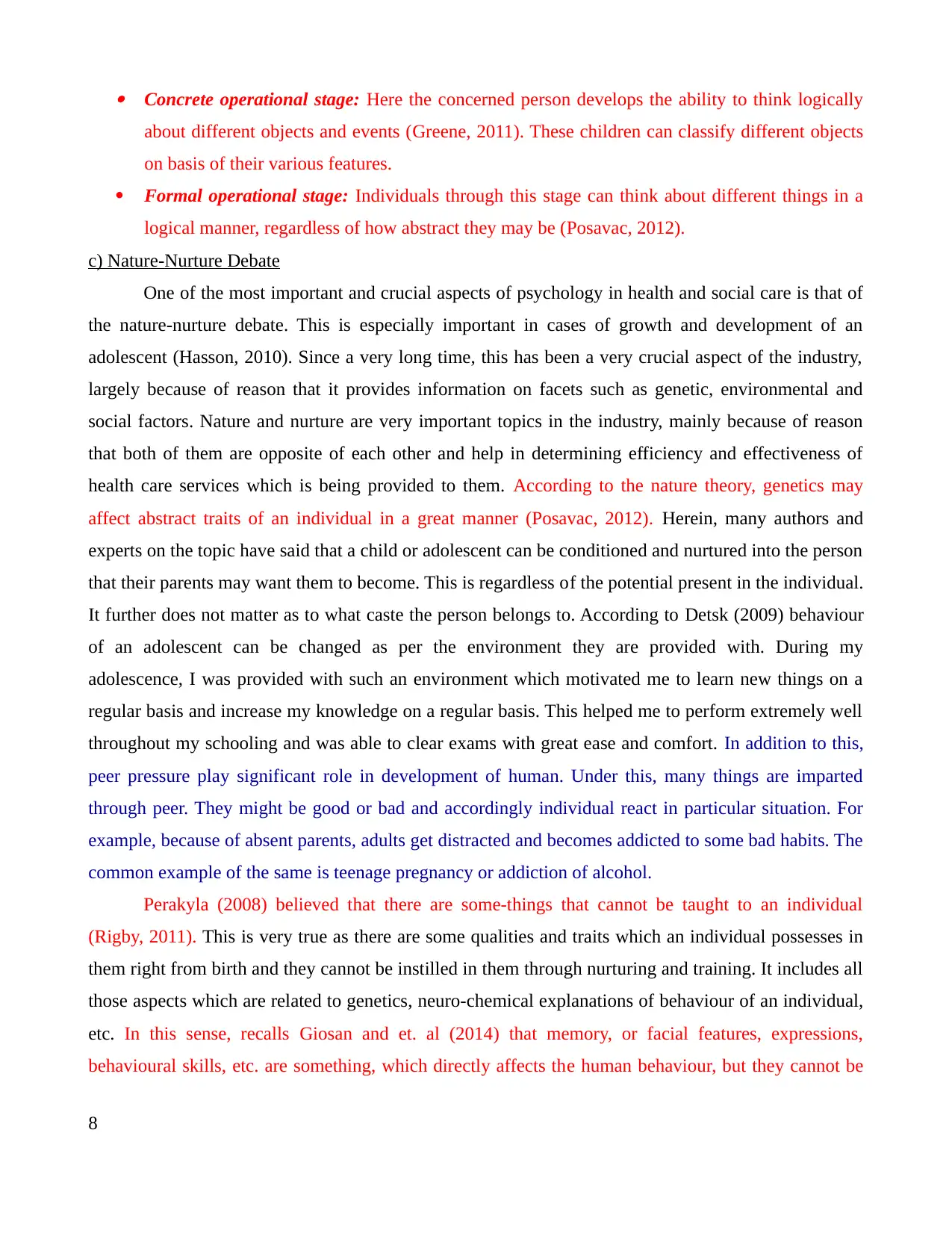
Concrete operational stage: Here the concerned person develops the ability to think logically
about different objects and events (Greene, 2011). These children can classify different objects
on basis of their various features.
Formal operational stage: Individuals through this stage can think about different things in a
logical manner, regardless of how abstract they may be (Posavac, 2012).
c) Nature-Nurture Debate
One of the most important and crucial aspects of psychology in health and social care is that of
the nature-nurture debate. This is especially important in cases of growth and development of an
adolescent (Hasson, 2010). Since a very long time, this has been a very crucial aspect of the industry,
largely because of reason that it provides information on facets such as genetic, environmental and
social factors. Nature and nurture are very important topics in the industry, mainly because of reason
that both of them are opposite of each other and help in determining efficiency and effectiveness of
health care services which is being provided to them. According to the nature theory, genetics may
affect abstract traits of an individual in a great manner (Posavac, 2012). Herein, many authors and
experts on the topic have said that a child or adolescent can be conditioned and nurtured into the person
that their parents may want them to become. This is regardless of the potential present in the individual.
It further does not matter as to what caste the person belongs to. According to Detsk (2009) behaviour
of an adolescent can be changed as per the environment they are provided with. During my
adolescence, I was provided with such an environment which motivated me to learn new things on a
regular basis and increase my knowledge on a regular basis. This helped me to perform extremely well
throughout my schooling and was able to clear exams with great ease and comfort. In addition to this,
peer pressure play significant role in development of human. Under this, many things are imparted
through peer. They might be good or bad and accordingly individual react in particular situation. For
example, because of absent parents, adults get distracted and becomes addicted to some bad habits. The
common example of the same is teenage pregnancy or addiction of alcohol.
Perakyla (2008) believed that there are some-things that cannot be taught to an individual
(Rigby, 2011). This is very true as there are some qualities and traits which an individual possesses in
them right from birth and they cannot be instilled in them through nurturing and training. It includes all
those aspects which are related to genetics, neuro-chemical explanations of behaviour of an individual,
etc. In this sense, recalls Giosan and et. al (2014) that memory, or facial features, expressions,
behavioural skills, etc. are something, which directly affects the human behaviour, but they cannot be
8
about different objects and events (Greene, 2011). These children can classify different objects
on basis of their various features.
Formal operational stage: Individuals through this stage can think about different things in a
logical manner, regardless of how abstract they may be (Posavac, 2012).
c) Nature-Nurture Debate
One of the most important and crucial aspects of psychology in health and social care is that of
the nature-nurture debate. This is especially important in cases of growth and development of an
adolescent (Hasson, 2010). Since a very long time, this has been a very crucial aspect of the industry,
largely because of reason that it provides information on facets such as genetic, environmental and
social factors. Nature and nurture are very important topics in the industry, mainly because of reason
that both of them are opposite of each other and help in determining efficiency and effectiveness of
health care services which is being provided to them. According to the nature theory, genetics may
affect abstract traits of an individual in a great manner (Posavac, 2012). Herein, many authors and
experts on the topic have said that a child or adolescent can be conditioned and nurtured into the person
that their parents may want them to become. This is regardless of the potential present in the individual.
It further does not matter as to what caste the person belongs to. According to Detsk (2009) behaviour
of an adolescent can be changed as per the environment they are provided with. During my
adolescence, I was provided with such an environment which motivated me to learn new things on a
regular basis and increase my knowledge on a regular basis. This helped me to perform extremely well
throughout my schooling and was able to clear exams with great ease and comfort. In addition to this,
peer pressure play significant role in development of human. Under this, many things are imparted
through peer. They might be good or bad and accordingly individual react in particular situation. For
example, because of absent parents, adults get distracted and becomes addicted to some bad habits. The
common example of the same is teenage pregnancy or addiction of alcohol.
Perakyla (2008) believed that there are some-things that cannot be taught to an individual
(Rigby, 2011). This is very true as there are some qualities and traits which an individual possesses in
them right from birth and they cannot be instilled in them through nurturing and training. It includes all
those aspects which are related to genetics, neuro-chemical explanations of behaviour of an individual,
etc. In this sense, recalls Giosan and et. al (2014) that memory, or facial features, expressions,
behavioural skills, etc. are something, which directly affects the human behaviour, but they cannot be
8
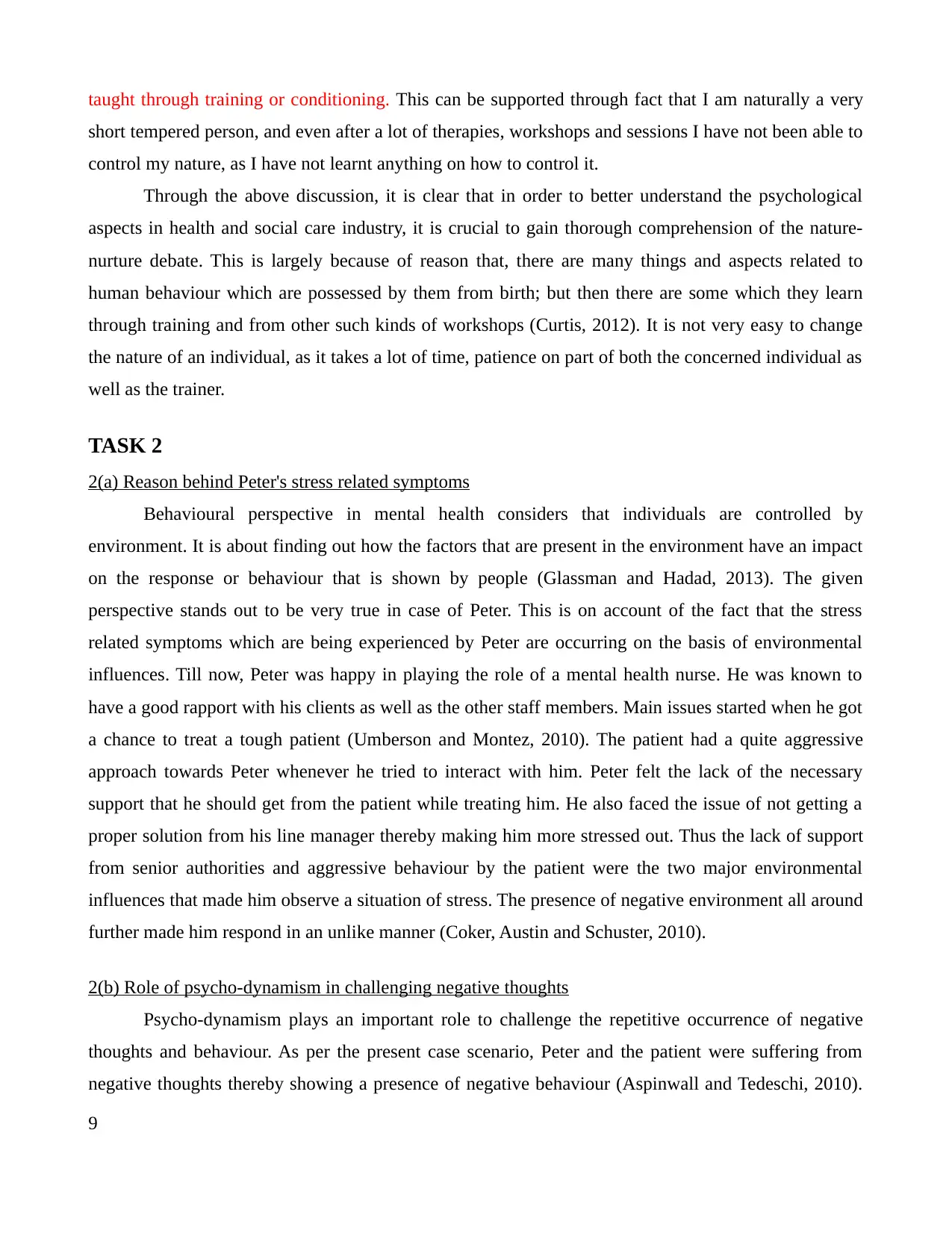
taught through training or conditioning. This can be supported through fact that I am naturally a very
short tempered person, and even after a lot of therapies, workshops and sessions I have not been able to
control my nature, as I have not learnt anything on how to control it.
Through the above discussion, it is clear that in order to better understand the psychological
aspects in health and social care industry, it is crucial to gain thorough comprehension of the nature-
nurture debate. This is largely because of reason that, there are many things and aspects related to
human behaviour which are possessed by them from birth; but then there are some which they learn
through training and from other such kinds of workshops (Curtis, 2012). It is not very easy to change
the nature of an individual, as it takes a lot of time, patience on part of both the concerned individual as
well as the trainer.
TASK 2
2(a) Reason behind Peter's stress related symptoms
Behavioural perspective in mental health considers that individuals are controlled by
environment. It is about finding out how the factors that are present in the environment have an impact
on the response or behaviour that is shown by people (Glassman and Hadad, 2013). The given
perspective stands out to be very true in case of Peter. This is on account of the fact that the stress
related symptoms which are being experienced by Peter are occurring on the basis of environmental
influences. Till now, Peter was happy in playing the role of a mental health nurse. He was known to
have a good rapport with his clients as well as the other staff members. Main issues started when he got
a chance to treat a tough patient (Umberson and Montez, 2010). The patient had a quite aggressive
approach towards Peter whenever he tried to interact with him. Peter felt the lack of the necessary
support that he should get from the patient while treating him. He also faced the issue of not getting a
proper solution from his line manager thereby making him more stressed out. Thus the lack of support
from senior authorities and aggressive behaviour by the patient were the two major environmental
influences that made him observe a situation of stress. The presence of negative environment all around
further made him respond in an unlike manner (Coker, Austin and Schuster, 2010).
2(b) Role of psycho-dynamism in challenging negative thoughts
Psycho-dynamism plays an important role to challenge the repetitive occurrence of negative
thoughts and behaviour. As per the present case scenario, Peter and the patient were suffering from
negative thoughts thereby showing a presence of negative behaviour (Aspinwall and Tedeschi, 2010).
9
short tempered person, and even after a lot of therapies, workshops and sessions I have not been able to
control my nature, as I have not learnt anything on how to control it.
Through the above discussion, it is clear that in order to better understand the psychological
aspects in health and social care industry, it is crucial to gain thorough comprehension of the nature-
nurture debate. This is largely because of reason that, there are many things and aspects related to
human behaviour which are possessed by them from birth; but then there are some which they learn
through training and from other such kinds of workshops (Curtis, 2012). It is not very easy to change
the nature of an individual, as it takes a lot of time, patience on part of both the concerned individual as
well as the trainer.
TASK 2
2(a) Reason behind Peter's stress related symptoms
Behavioural perspective in mental health considers that individuals are controlled by
environment. It is about finding out how the factors that are present in the environment have an impact
on the response or behaviour that is shown by people (Glassman and Hadad, 2013). The given
perspective stands out to be very true in case of Peter. This is on account of the fact that the stress
related symptoms which are being experienced by Peter are occurring on the basis of environmental
influences. Till now, Peter was happy in playing the role of a mental health nurse. He was known to
have a good rapport with his clients as well as the other staff members. Main issues started when he got
a chance to treat a tough patient (Umberson and Montez, 2010). The patient had a quite aggressive
approach towards Peter whenever he tried to interact with him. Peter felt the lack of the necessary
support that he should get from the patient while treating him. He also faced the issue of not getting a
proper solution from his line manager thereby making him more stressed out. Thus the lack of support
from senior authorities and aggressive behaviour by the patient were the two major environmental
influences that made him observe a situation of stress. The presence of negative environment all around
further made him respond in an unlike manner (Coker, Austin and Schuster, 2010).
2(b) Role of psycho-dynamism in challenging negative thoughts
Psycho-dynamism plays an important role to challenge the repetitive occurrence of negative
thoughts and behaviour. As per the present case scenario, Peter and the patient were suffering from
negative thoughts thereby showing a presence of negative behaviour (Aspinwall and Tedeschi, 2010).
9
⊘ This is a preview!⊘
Do you want full access?
Subscribe today to unlock all pages.
Trusted by 1+ million students worldwide
Here, the understanding and application of psycho-dynamism can aid to assess the unconscious motives
that have resulted in the generating aggressive behaviour which is shown by the patient towards Peter.
The theory can thus play a crucial role towards assessing as to what kind of childhood experience were
faced by patient that led to making the patient start suffering from depression. It can further assess in
finding out as to what factors have led to creation of anxiety in Peter. By using this approach, mental
health nurses such as Peter can try to understand unconscious mind(s) of their patients and then make
decision of the steps that are needed to be taken in order to ensure that they are able to improve health
condition of the patient by great margins (Mojtabai, 2010). In order to use the psycho-dynamism
theory, the nurse Peter would be required to identify and thoroughly understand reasons as to why the
patient developed feelings of depression. For the same, patient's case history can be evaluated; or even
communication sessions can be useful in this regard (Thoits, 2011). This would help Peter to gain
thorough information regarding behaviour of the care user and then determine methods through which
the problem can be dealt with easily and effectively. Main reason behind suggesting this approach to
Peter is that it would help him in developing good and positive relations or rapport with the patient
through which information regarding the cause behind depression can be obtained much easily and
effectively (McGorry, 2010). Herein, the nurse would also have to develop personal contacts and
relations with the patient so as to identify main cause behind their depression and then help to resolve
the situation.
2(c) How evolutionary theory can inform an understanding of patient's depression
The evolutionary therapy has been found to play a crucial role towards assessing the overall
tendency of depression that is faced by people. It has played a better role in comparing other
mechanistic theories whose major emphasis has been on aetiology of depression as well as the factors
that make them vulnerable towards suffering from it (Marlatt, 2011). Evolutionary therapy in majority
of the cases can play a crucial role to assess the depression that has been faced by the patients. This
approach does not lay emphasis on the process of depression but is likely to provide valuable insights
towards what has been the origin of such tendencies in the patient. This may further led to providing of
depression specific guidance to the health care professionals. This theory further plays a crucial role in
finding out the major reasons towards the mental depression that is being suffered by patients. Hence,
this approach is likely to aid in finding out the major reason behind depression so as to help the health
care professionals towards developing care strategies for the vulnerable masses (Braveman, Egerter and
Williams, 2011).
10
that have resulted in the generating aggressive behaviour which is shown by the patient towards Peter.
The theory can thus play a crucial role towards assessing as to what kind of childhood experience were
faced by patient that led to making the patient start suffering from depression. It can further assess in
finding out as to what factors have led to creation of anxiety in Peter. By using this approach, mental
health nurses such as Peter can try to understand unconscious mind(s) of their patients and then make
decision of the steps that are needed to be taken in order to ensure that they are able to improve health
condition of the patient by great margins (Mojtabai, 2010). In order to use the psycho-dynamism
theory, the nurse Peter would be required to identify and thoroughly understand reasons as to why the
patient developed feelings of depression. For the same, patient's case history can be evaluated; or even
communication sessions can be useful in this regard (Thoits, 2011). This would help Peter to gain
thorough information regarding behaviour of the care user and then determine methods through which
the problem can be dealt with easily and effectively. Main reason behind suggesting this approach to
Peter is that it would help him in developing good and positive relations or rapport with the patient
through which information regarding the cause behind depression can be obtained much easily and
effectively (McGorry, 2010). Herein, the nurse would also have to develop personal contacts and
relations with the patient so as to identify main cause behind their depression and then help to resolve
the situation.
2(c) How evolutionary theory can inform an understanding of patient's depression
The evolutionary therapy has been found to play a crucial role towards assessing the overall
tendency of depression that is faced by people. It has played a better role in comparing other
mechanistic theories whose major emphasis has been on aetiology of depression as well as the factors
that make them vulnerable towards suffering from it (Marlatt, 2011). Evolutionary therapy in majority
of the cases can play a crucial role to assess the depression that has been faced by the patients. This
approach does not lay emphasis on the process of depression but is likely to provide valuable insights
towards what has been the origin of such tendencies in the patient. This may further led to providing of
depression specific guidance to the health care professionals. This theory further plays a crucial role in
finding out the major reasons towards the mental depression that is being suffered by patients. Hence,
this approach is likely to aid in finding out the major reason behind depression so as to help the health
care professionals towards developing care strategies for the vulnerable masses (Braveman, Egerter and
Williams, 2011).
10
Paraphrase This Document
Need a fresh take? Get an instant paraphrase of this document with our AI Paraphraser
Studies have shown through evolutionary theory, a much better and improved understanding of
reason(s) behind a person's depression can be understood. This is mainly because of reason that it does
not observe depression to be a result of evolution in characteristics of human beings, but can also arise
out of guilt, shame or perceived rejection (Kinman and Grant, 2011). In this sense, it may not be wrong
to say that through the help of evolutionary theory, there are much better chances for the mental health
nurses to understand the main cause behind a person's depression and then to find the ways through
which it can be resolved. On the basis of evolutionary theory it can be said that it would help in
understanding how an individual has been able to cope with and adjust to changes that might have
happened in his life (Coker, Austin and Schuster, 2010). This means that through the theory focus
would be on assessing different life stages that a person might have to go through. There are chances
that if an individual is not able to adjust to a change in his situation, it might have resulted in
depression. Thus through evolutionary theory, significant amount of information regarding depression
of the patient (Aspinwall and Tedeschi, 2010).
2(d) How mental health nursing can bring about a behaviour change through humanistic approach
Mental health is very important for every individual, largely because of reason that it is a way
that can help them to lead an effective life and also accomplish their own goals and objectives. There
are a wide variety of ways through which a patient suffering from mental illness can be improved by
great margins and also enable them to fulfil their dreams and goals (Jetten and et. al, 2012). One of the
approaches through which mental health nursing can help to bring about a behavioural change in an
individual is that of the humanistic theory. According to the theory, self image, i.e. the way in which a
perceives oneself determines their behaviour (Kinman and Grant, 2011). Therefore if such a perception
is negative in nature, then there are chances that the concerned person may behave in a bad and
negative manner. In this context, it may not be wrong to say that to change and improve behaviour of a
mental health patient is to provide them with regular counselling so as to alter the image that they have
developed for themselves over a period of time. In this regard, the concerned individual has to be made
to understand that they in their own right are very unique and have the power or skills which are
needed to lead a much better life than what they may be leading currently (Irving, 2011).
Humanistic approach states that, an individual is responsible for their own happiness; and that
they possess the right amount as well as type of abilities that can make them happy. In this sense, it can
be said that using the humanistic theory would enable counsellor to put a lot of focus and pay
substantial amount of attention to the individual, which would provide them with much better feelings
11
reason(s) behind a person's depression can be understood. This is mainly because of reason that it does
not observe depression to be a result of evolution in characteristics of human beings, but can also arise
out of guilt, shame or perceived rejection (Kinman and Grant, 2011). In this sense, it may not be wrong
to say that through the help of evolutionary theory, there are much better chances for the mental health
nurses to understand the main cause behind a person's depression and then to find the ways through
which it can be resolved. On the basis of evolutionary theory it can be said that it would help in
understanding how an individual has been able to cope with and adjust to changes that might have
happened in his life (Coker, Austin and Schuster, 2010). This means that through the theory focus
would be on assessing different life stages that a person might have to go through. There are chances
that if an individual is not able to adjust to a change in his situation, it might have resulted in
depression. Thus through evolutionary theory, significant amount of information regarding depression
of the patient (Aspinwall and Tedeschi, 2010).
2(d) How mental health nursing can bring about a behaviour change through humanistic approach
Mental health is very important for every individual, largely because of reason that it is a way
that can help them to lead an effective life and also accomplish their own goals and objectives. There
are a wide variety of ways through which a patient suffering from mental illness can be improved by
great margins and also enable them to fulfil their dreams and goals (Jetten and et. al, 2012). One of the
approaches through which mental health nursing can help to bring about a behavioural change in an
individual is that of the humanistic theory. According to the theory, self image, i.e. the way in which a
perceives oneself determines their behaviour (Kinman and Grant, 2011). Therefore if such a perception
is negative in nature, then there are chances that the concerned person may behave in a bad and
negative manner. In this context, it may not be wrong to say that to change and improve behaviour of a
mental health patient is to provide them with regular counselling so as to alter the image that they have
developed for themselves over a period of time. In this regard, the concerned individual has to be made
to understand that they in their own right are very unique and have the power or skills which are
needed to lead a much better life than what they may be leading currently (Irving, 2011).
Humanistic approach states that, an individual is responsible for their own happiness; and that
they possess the right amount as well as type of abilities that can make them happy. In this sense, it can
be said that using the humanistic theory would enable counsellor to put a lot of focus and pay
substantial amount of attention to the individual, which would provide them with much better feelings
11
and then they can work to the best of their capabilities.
2(e) How cognitive behavioural therapy can foster collaborative relationships between doctor and
patient
Another very important theory of psychology is that of the cognitive behavioural therapy, which
states that human brains are computers, as they both process a large variety of information, store and
retrieve them whenever it is needed (Perakyla, 2008). For any kind of treatment to work effectively and
help in attainment of the desired targets, it is imperative that there exists a positive relation between
patient and the doctor. In this context, a cognitive behavioural theory can be very helpful and effective,
mainly because of reason that it would enable both doctor as well as the patient to coordinate with one
another and work for a common goal. During the case, it was observed that Peter, a mental health nurse
was finding it very difficult to interact with patients who are suffering from depression. Herein to use
the cognitive approach, Peter should try to communicate more and more with the patients, to gain an
understanding of the reasons behind their depression and such a mental condition (Greene, 2011).
By constant interaction between himself and the patient(s), Peter would be able to effectively
identify as well as understand the main reason(s) behind their depression and thus create a mutual
understanding and positive rapport amongst them (Giosan and et. al, 2014). This in turn will help in
providing the best and most effective treatment to patients and help to improve their mental condition
substantially. Main reason as to why this theory would be of great use to Peter is that it would enable
him to interact with the patient on a constant basis and thus provide them with best and effective care to
them. In this context, it may not be wrong to say that through Cognitive Behavioural Therapy, mental
health nurses such as Peter can work more efficiently and effectively. By using the person centred
psychological theory, there are chances that the patient might become dependent on Peter. This would
reduce the effectiveness of relations formed amongst them and thus the efficiency of overall health care
treatments being provided to the patient (McLeod, 2007). In this regard it may not be wrong to say that
use of such methods can prove to be very bad and dangerous for overall effectiveness of health care
measures being provided to the patient.
CONCLUSION
Psychology has a very important role to play in the health and social care industry, as it provides
extensive and effective services to the doctors and other care practitioners to work in such a manner
which cures the diseases of the patient. During the present study, it was observed that there are many
12
2(e) How cognitive behavioural therapy can foster collaborative relationships between doctor and
patient
Another very important theory of psychology is that of the cognitive behavioural therapy, which
states that human brains are computers, as they both process a large variety of information, store and
retrieve them whenever it is needed (Perakyla, 2008). For any kind of treatment to work effectively and
help in attainment of the desired targets, it is imperative that there exists a positive relation between
patient and the doctor. In this context, a cognitive behavioural theory can be very helpful and effective,
mainly because of reason that it would enable both doctor as well as the patient to coordinate with one
another and work for a common goal. During the case, it was observed that Peter, a mental health nurse
was finding it very difficult to interact with patients who are suffering from depression. Herein to use
the cognitive approach, Peter should try to communicate more and more with the patients, to gain an
understanding of the reasons behind their depression and such a mental condition (Greene, 2011).
By constant interaction between himself and the patient(s), Peter would be able to effectively
identify as well as understand the main reason(s) behind their depression and thus create a mutual
understanding and positive rapport amongst them (Giosan and et. al, 2014). This in turn will help in
providing the best and most effective treatment to patients and help to improve their mental condition
substantially. Main reason as to why this theory would be of great use to Peter is that it would enable
him to interact with the patient on a constant basis and thus provide them with best and effective care to
them. In this context, it may not be wrong to say that through Cognitive Behavioural Therapy, mental
health nurses such as Peter can work more efficiently and effectively. By using the person centred
psychological theory, there are chances that the patient might become dependent on Peter. This would
reduce the effectiveness of relations formed amongst them and thus the efficiency of overall health care
treatments being provided to the patient (McLeod, 2007). In this regard it may not be wrong to say that
use of such methods can prove to be very bad and dangerous for overall effectiveness of health care
measures being provided to the patient.
CONCLUSION
Psychology has a very important role to play in the health and social care industry, as it provides
extensive and effective services to the doctors and other care practitioners to work in such a manner
which cures the diseases of the patient. During the present study, it was observed that there are many
12
⊘ This is a preview!⊘
Do you want full access?
Subscribe today to unlock all pages.
Trusted by 1+ million students worldwide

1 out of 15


Related Documents


Your All-in-One AI-Powered Toolkit for Academic Success.
+13062052269
info@desklib.com
Available 24*7 on WhatsApp / Email
![[object Object]](/_next/static/media/star-bottom.7253800d.svg)
Unlock your academic potential
Copyright © 2020–2026 A2Z Services. All Rights Reserved. Developed and managed by ZUCOL.