Assessment 1: Psychology of Motivation and Emotion, ECU, Australia
VerifiedAdded on 2022/08/18
|11
|3117
|43
Essay
AI Summary
This essay explores the psychology of motivation and emotion, focusing on the application of motivational incentives and operant conditioning in healthcare settings and individual scenarios. The essay begins by examining the impact of motivational incentives on doctors, discussing stress factors and the importance of rewards, recognition, and financial incentives. It delves into incentive theory, behavioral economics, and Skinner's reinforcement theory. The essay then presents two scenarios: one involving a teacher with a sleeping disorder and another concerning a woman experiencing anxiety. It applies motivational incentives and operant conditioning to address these psychological issues, suggesting non-monetary rewards, flexible working hours, and positive reinforcement to improve the individuals' well-being and performance. The essay also considers the limitations of rewards and the impact of disincentives.
Running head: PSYCHOLOGY OF MOTIVATION AND EMOTION
PSYCHOLOGY OF MOTIVATION AND EMOTION
Name of the Student
Name of the University
Author Note
PSYCHOLOGY OF MOTIVATION AND EMOTION
Name of the Student
Name of the University
Author Note

Paraphrase This Document
Need a fresh take? Get an instant paraphrase of this document with our AI Paraphraser
1
PSYCHOLOGY OF MOTIVATION AND EMOTION
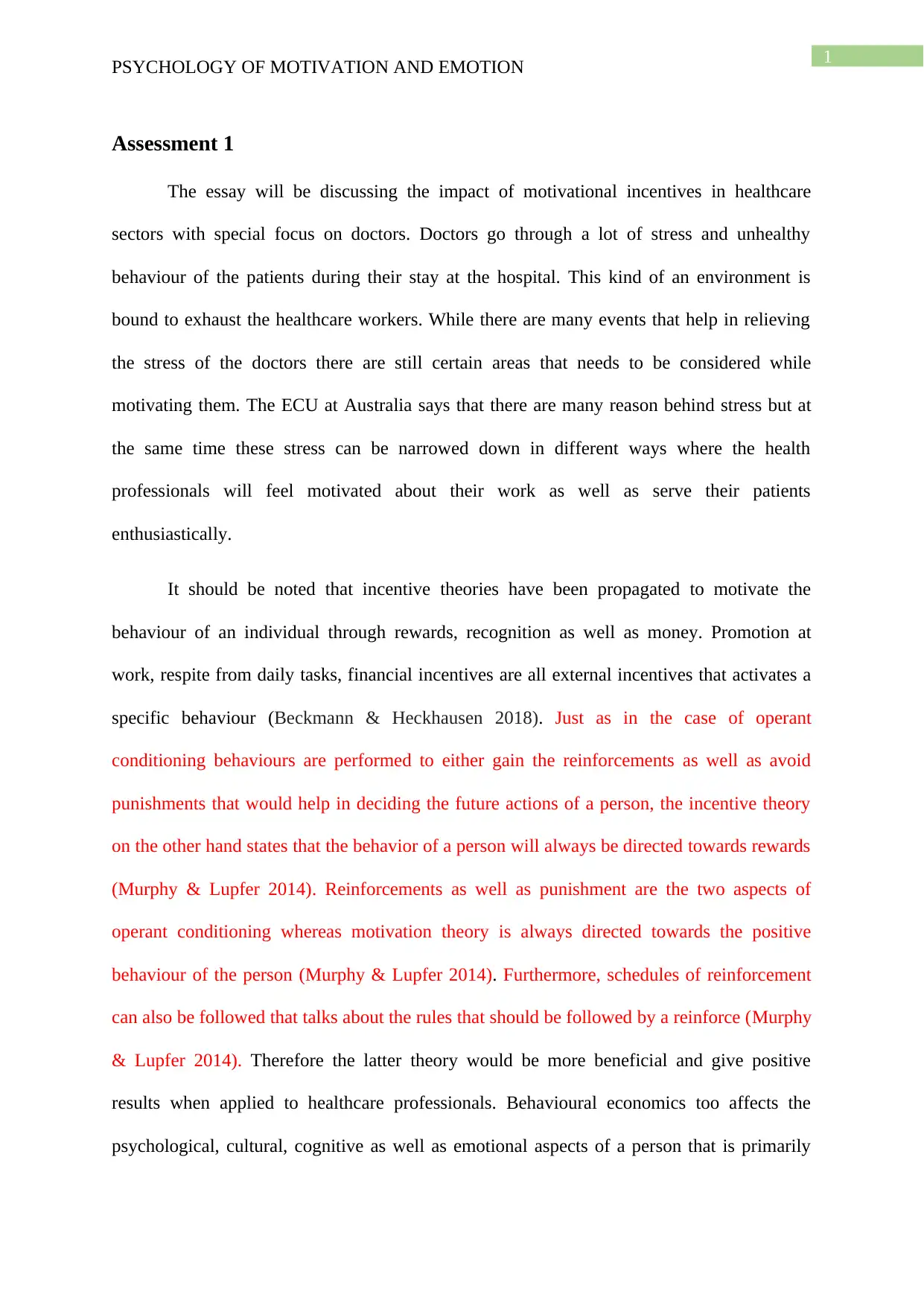
Assessment 1
The essay will be discussing the impact of motivational incentives in healthcare
sectors with special focus on doctors. Doctors go through a lot of stress and unhealthy
behaviour of the patients during their stay at the hospital. This kind of an environment is
bound to exhaust the healthcare workers. While there are many events that help in relieving
the stress of the doctors there are still certain areas that needs to be considered while
motivating them. The ECU at Australia says that there are many reason behind stress but at
the same time these stress can be narrowed down in different ways where the health
professionals will feel motivated about their work as well as serve their patients
enthusiastically.
It should be noted that incentive theories have been propagated to motivate the
behaviour of an individual through rewards, recognition as well as money. Promotion at
work, respite from daily tasks, financial incentives are all external incentives that activates a
specific behaviour (Beckmann & Heckhausen 2018). Just as in the case of operant
conditioning behaviours are performed to either gain the reinforcements as well as avoid
punishments that would help in deciding the future actions of a person, the incentive theory
on the other hand states that the behavior of a person will always be directed towards rewards
(Murphy & Lupfer 2014). Reinforcements as well as punishment are the two aspects of
operant conditioning whereas motivation theory is always directed towards the positive
behaviour of the person (Murphy & Lupfer 2014). Furthermore, schedules of reinforcement
can also be followed that talks about the rules that should be followed by a reinforce (Murphy
& Lupfer 2014). Therefore the latter theory would be more beneficial and give positive
results when applied to healthcare professionals. Behavioural economics too affects the
psychological, cultural, cognitive as well as emotional aspects of a person that is primarily
PSYCHOLOGY OF MOTIVATION AND EMOTION
Assessment 1
The essay will be discussing the impact of motivational incentives in healthcare
sectors with special focus on doctors. Doctors go through a lot of stress and unhealthy
behaviour of the patients during their stay at the hospital. This kind of an environment is
bound to exhaust the healthcare workers. While there are many events that help in relieving
the stress of the doctors there are still certain areas that needs to be considered while
motivating them. The ECU at Australia says that there are many reason behind stress but at
the same time these stress can be narrowed down in different ways where the health
professionals will feel motivated about their work as well as serve their patients
enthusiastically.
It should be noted that incentive theories have been propagated to motivate the
behaviour of an individual through rewards, recognition as well as money. Promotion at
work, respite from daily tasks, financial incentives are all external incentives that activates a
specific behaviour (Beckmann & Heckhausen 2018). Just as in the case of operant
conditioning behaviours are performed to either gain the reinforcements as well as avoid
punishments that would help in deciding the future actions of a person, the incentive theory
on the other hand states that the behavior of a person will always be directed towards rewards
(Murphy & Lupfer 2014). Reinforcements as well as punishment are the two aspects of
operant conditioning whereas motivation theory is always directed towards the positive
behaviour of the person (Murphy & Lupfer 2014). Furthermore, schedules of reinforcement
can also be followed that talks about the rules that should be followed by a reinforce (Murphy
& Lupfer 2014). Therefore the latter theory would be more beneficial and give positive
results when applied to healthcare professionals. Behavioural economics too affects the
psychological, cultural, cognitive as well as emotional aspects of a person that is primarily
2
PSYCHOLOGY OF MOTIVATION AND EMOTION
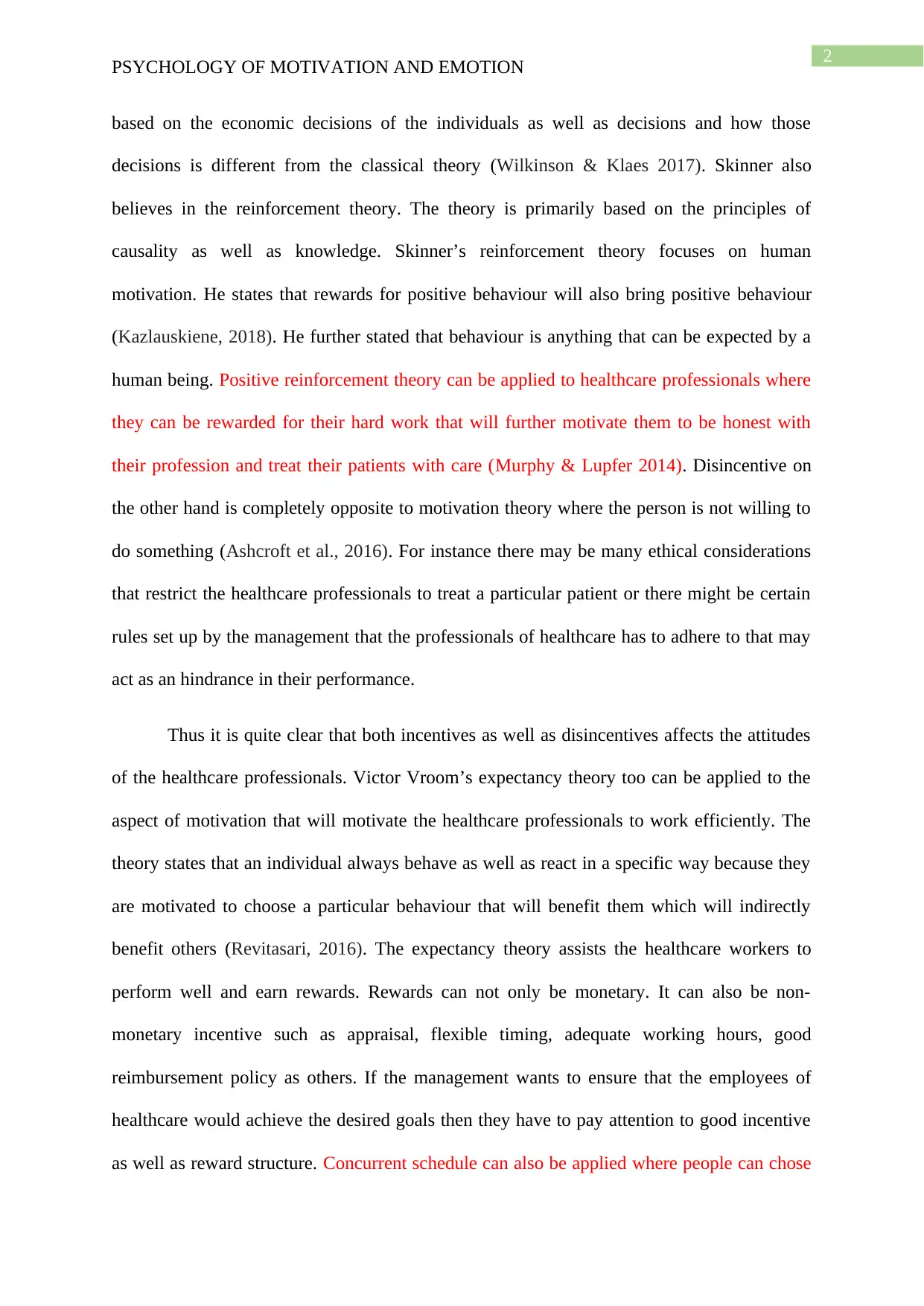
based on the economic decisions of the individuals as well as decisions and how those
decisions is different from the classical theory (Wilkinson & Klaes 2017). Skinner also
believes in the reinforcement theory. The theory is primarily based on the principles of
causality as well as knowledge. Skinner’s reinforcement theory focuses on human
motivation. He states that rewards for positive behaviour will also bring positive behaviour
(Kazlauskiene, 2018). He further stated that behaviour is anything that can be expected by a
human being. Positive reinforcement theory can be applied to healthcare professionals where
they can be rewarded for their hard work that will further motivate them to be honest with
their profession and treat their patients with care (Murphy & Lupfer 2014). Disincentive on
the other hand is completely opposite to motivation theory where the person is not willing to
do something (Ashcroft et al., 2016). For instance there may be many ethical considerations
that restrict the healthcare professionals to treat a particular patient or there might be certain
rules set up by the management that the professionals of healthcare has to adhere to that may
act as an hindrance in their performance.
Thus it is quite clear that both incentives as well as disincentives affects the attitudes
of the healthcare professionals. Victor Vroom’s expectancy theory too can be applied to the
aspect of motivation that will motivate the healthcare professionals to work efficiently. The
theory states that an individual always behave as well as react in a specific way because they
are motivated to choose a particular behaviour that will benefit them which will indirectly
benefit others (Revitasari, 2016). The expectancy theory assists the healthcare workers to
perform well and earn rewards. Rewards can not only be monetary. It can also be non-
monetary incentive such as appraisal, flexible timing, adequate working hours, good
reimbursement policy as others. If the management wants to ensure that the employees of
healthcare would achieve the desired goals then they have to pay attention to good incentive
as well as reward structure. Concurrent schedule can also be applied where people can chose
PSYCHOLOGY OF MOTIVATION AND EMOTION
based on the economic decisions of the individuals as well as decisions and how those
decisions is different from the classical theory (Wilkinson & Klaes 2017). Skinner also
believes in the reinforcement theory. The theory is primarily based on the principles of
causality as well as knowledge. Skinner’s reinforcement theory focuses on human
motivation. He states that rewards for positive behaviour will also bring positive behaviour
(Kazlauskiene, 2018). He further stated that behaviour is anything that can be expected by a
human being. Positive reinforcement theory can be applied to healthcare professionals where
they can be rewarded for their hard work that will further motivate them to be honest with
their profession and treat their patients with care (Murphy & Lupfer 2014). Disincentive on
the other hand is completely opposite to motivation theory where the person is not willing to
do something (Ashcroft et al., 2016). For instance there may be many ethical considerations
that restrict the healthcare professionals to treat a particular patient or there might be certain
rules set up by the management that the professionals of healthcare has to adhere to that may
act as an hindrance in their performance.
Thus it is quite clear that both incentives as well as disincentives affects the attitudes
of the healthcare professionals. Victor Vroom’s expectancy theory too can be applied to the
aspect of motivation that will motivate the healthcare professionals to work efficiently. The
theory states that an individual always behave as well as react in a specific way because they
are motivated to choose a particular behaviour that will benefit them which will indirectly
benefit others (Revitasari, 2016). The expectancy theory assists the healthcare workers to
perform well and earn rewards. Rewards can not only be monetary. It can also be non-
monetary incentive such as appraisal, flexible timing, adequate working hours, good
reimbursement policy as others. If the management wants to ensure that the employees of
healthcare would achieve the desired goals then they have to pay attention to good incentive
as well as reward structure. Concurrent schedule can also be applied where people can chose
⊘ This is a preview!⊘
Do you want full access?
Subscribe today to unlock all pages.

Trusted by 1+ million students worldwide

3
PSYCHOLOGY OF MOTIVATION AND EMOTION
between two and more alternatives of responses (Murphy & Lupfer 2014). The healthcare
professionals can also apply goal-setting theory that was propagated by Edwin Locke.
According to him if the person sets difficult goals for himself/herself then he will deliver a
good performance. Goal setting theory involves clarity in goals as well as work, commitment
towards work and feedback from the people surrounding them (Latham & Locke 2018).
Thus, the healthcare professionals should adopt the above theory that will motivate them to
work more and serve the people at the same time. However there are certain limitations to the
rewards and that is the concept of disincentives. The latter can demotivate healthcare
professionals to take up certain tasks. If a matter involves disclosing the confidentiality of a
specific patient then the doctors might feel hesitant to take up the task as he/she can later fall
into trouble. Prescribing certain medication to a patient that would lead to other consequences
may also act as a disincentive (Ashcroft et al., 2016).
Therefore, to conclude it is essential to apply motivational theory in the case of
healthcare professionals that would help in treating the patients and at the same time it would
also satisfy the professionals and motivate them to perform efficiently.
PSYCHOLOGY OF MOTIVATION AND EMOTION
between two and more alternatives of responses (Murphy & Lupfer 2014). The healthcare
professionals can also apply goal-setting theory that was propagated by Edwin Locke.
According to him if the person sets difficult goals for himself/herself then he will deliver a
good performance. Goal setting theory involves clarity in goals as well as work, commitment
towards work and feedback from the people surrounding them (Latham & Locke 2018).
Thus, the healthcare professionals should adopt the above theory that will motivate them to
work more and serve the people at the same time. However there are certain limitations to the
rewards and that is the concept of disincentives. The latter can demotivate healthcare
professionals to take up certain tasks. If a matter involves disclosing the confidentiality of a
specific patient then the doctors might feel hesitant to take up the task as he/she can later fall
into trouble. Prescribing certain medication to a patient that would lead to other consequences
may also act as a disincentive (Ashcroft et al., 2016).
Therefore, to conclude it is essential to apply motivational theory in the case of
healthcare professionals that would help in treating the patients and at the same time it would
also satisfy the professionals and motivate them to perform efficiently.
Paraphrase This Document
Need a fresh take? Get an instant paraphrase of this document with our AI Paraphraser
4
PSYCHOLOGY OF MOTIVATION AND EMOTION
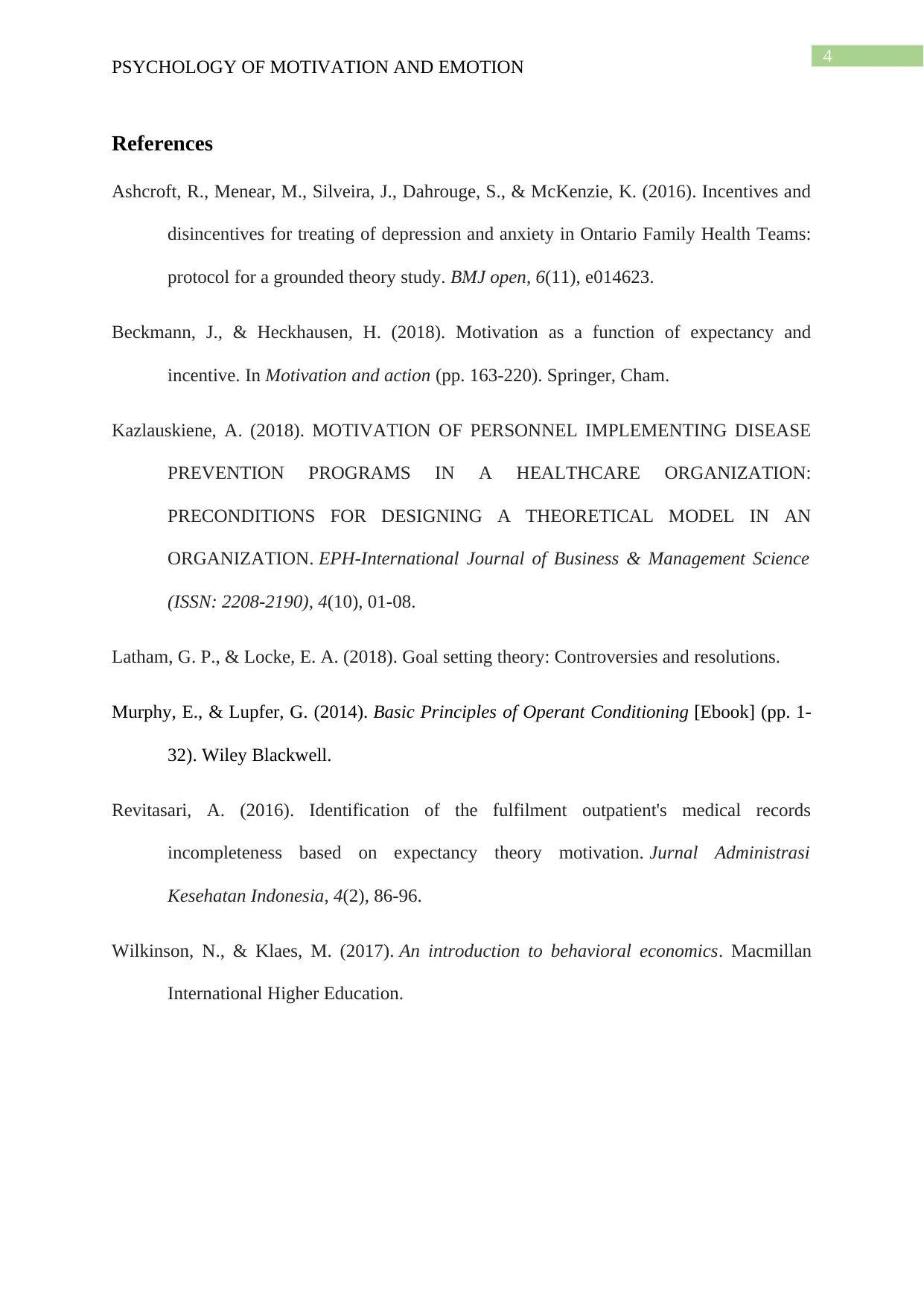
References
Ashcroft, R., Menear, M., Silveira, J., Dahrouge, S., & McKenzie, K. (2016). Incentives and
disincentives for treating of depression and anxiety in Ontario Family Health Teams:
protocol for a grounded theory study. BMJ open, 6(11), e014623.
Beckmann, J., & Heckhausen, H. (2018). Motivation as a function of expectancy and
incentive. In Motivation and action (pp. 163-220). Springer, Cham.
Kazlauskiene, A. (2018). MOTIVATION OF PERSONNEL IMPLEMENTING DISEASE
PREVENTION PROGRAMS IN A HEALTHCARE ORGANIZATION:
PRECONDITIONS FOR DESIGNING A THEORETICAL MODEL IN AN
ORGANIZATION. EPH-International Journal of Business & Management Science
(ISSN: 2208-2190), 4(10), 01-08.
Latham, G. P., & Locke, E. A. (2018). Goal setting theory: Controversies and resolutions.
Murphy, E., & Lupfer, G. (2014). Basic Principles of Operant Conditioning [Ebook] (pp. 1-
32). Wiley Blackwell.
Revitasari, A. (2016). Identification of the fulfilment outpatient's medical records
incompleteness based on expectancy theory motivation. Jurnal Administrasi
Kesehatan Indonesia, 4(2), 86-96.
Wilkinson, N., & Klaes, M. (2017). An introduction to behavioral economics. Macmillan
International Higher Education.
PSYCHOLOGY OF MOTIVATION AND EMOTION
References
Ashcroft, R., Menear, M., Silveira, J., Dahrouge, S., & McKenzie, K. (2016). Incentives and
disincentives for treating of depression and anxiety in Ontario Family Health Teams:
protocol for a grounded theory study. BMJ open, 6(11), e014623.
Beckmann, J., & Heckhausen, H. (2018). Motivation as a function of expectancy and
incentive. In Motivation and action (pp. 163-220). Springer, Cham.
Kazlauskiene, A. (2018). MOTIVATION OF PERSONNEL IMPLEMENTING DISEASE
PREVENTION PROGRAMS IN A HEALTHCARE ORGANIZATION:
PRECONDITIONS FOR DESIGNING A THEORETICAL MODEL IN AN
ORGANIZATION. EPH-International Journal of Business & Management Science
(ISSN: 2208-2190), 4(10), 01-08.
Latham, G. P., & Locke, E. A. (2018). Goal setting theory: Controversies and resolutions.
Murphy, E., & Lupfer, G. (2014). Basic Principles of Operant Conditioning [Ebook] (pp. 1-
32). Wiley Blackwell.
Revitasari, A. (2016). Identification of the fulfilment outpatient's medical records
incompleteness based on expectancy theory motivation. Jurnal Administrasi
Kesehatan Indonesia, 4(2), 86-96.
Wilkinson, N., & Klaes, M. (2017). An introduction to behavioral economics. Macmillan
International Higher Education.
5
PSYCHOLOGY OF MOTIVATION AND EMOTION
Assessment 2
Scenario 1
Many people go through a lot of psychological disorders in his/her lifetime. The
reason for these disorders can be a number of things that affects his health both mentally as
well as physically. Such disorders can include- anxiety disorders, depression, eating and
sleeping disorder, post-traumatic stress and others. This assignment will be focusing on two
different scenarios and will discuss about the situation that the person is going through and
how different theories can be applied to their situation to mitigate their problem.
There are many reasons that cause sleeping disorder in a person. This disorder can be
due to many physical disturbance that is mainly caused by the weak physical health of the
person. The person can also go through various medical issues or psychiatric disorders like
depression. The scenario that will be discussed here is about a man whose name is Michael.
He is thirty five years of age and marries but does not have any children. He is a teacher by
profession who works for time. Teachers are always expected to be vigilant and caring
towards the students who are under them. However, Michael has a sleeping disorder and find
it difficult to get up from sleep. Even when he is awake he does not teach the children instead
watch videos on his phone. This attitude of Michael even scares him and he is afraid that he
might lose his job if he continues in this manner. From the situation described above it is
quite clear that Michael has a sleeping disorder. This disorder can be a cause of depression.
As seen from above Michael is married but does not have a child. This can also be one of the
causes of his depression and his reason to fall asleep. Another reason of his depression can be
that being a teacher he has to be around many children so he might feel sad about his
childlessness. To avoid uncomfortable situation for himself as well as the students he might
be watching videos to distract himself while he is awake.
PSYCHOLOGY OF MOTIVATION AND EMOTION
Assessment 2
Scenario 1
Many people go through a lot of psychological disorders in his/her lifetime. The
reason for these disorders can be a number of things that affects his health both mentally as
well as physically. Such disorders can include- anxiety disorders, depression, eating and
sleeping disorder, post-traumatic stress and others. This assignment will be focusing on two
different scenarios and will discuss about the situation that the person is going through and
how different theories can be applied to their situation to mitigate their problem.
There are many reasons that cause sleeping disorder in a person. This disorder can be
due to many physical disturbance that is mainly caused by the weak physical health of the
person. The person can also go through various medical issues or psychiatric disorders like
depression. The scenario that will be discussed here is about a man whose name is Michael.
He is thirty five years of age and marries but does not have any children. He is a teacher by
profession who works for time. Teachers are always expected to be vigilant and caring
towards the students who are under them. However, Michael has a sleeping disorder and find
it difficult to get up from sleep. Even when he is awake he does not teach the children instead
watch videos on his phone. This attitude of Michael even scares him and he is afraid that he
might lose his job if he continues in this manner. From the situation described above it is
quite clear that Michael has a sleeping disorder. This disorder can be a cause of depression.
As seen from above Michael is married but does not have a child. This can also be one of the
causes of his depression and his reason to fall asleep. Another reason of his depression can be
that being a teacher he has to be around many children so he might feel sad about his
childlessness. To avoid uncomfortable situation for himself as well as the students he might
be watching videos to distract himself while he is awake.
⊘ This is a preview!⊘
Do you want full access?
Subscribe today to unlock all pages.
Trusted by 1+ million students worldwide
6
PSYCHOLOGY OF MOTIVATION AND EMOTION
The person suffering from sleeping disorder can be motivated by applying the theory
of motivational incentives as well as operant conditioning. The incentive theory of motivation
is a theory that believes in pulling people towards the right behaviour that will automatically
lead to rewards and at the same time it will also push them away from behaviours that would
lead to negative consequences. When a person is rewarded incentive then he feels motivated
to work more efficiently that would also increase the productivity of the employee within the
workplace (Cassar & Meier 2018). Motivational incentives can be of various kinds. It can
either be monetary as well as non-monetary. The latter kinds of incentives may include
appraisal, flexible working hours, appreciation and others. This theory aims to keep the
employee happy so that he can contribute to the organisation in an efficient way (Cassar &
Meier 2018). Operant conditioning is another theory that emphasizes on the role of
reinforcement in conditioning. It believes in the concept of reward as well as punishment that
would help in deciding the future of the person (Blackman, 2017). Skinner believes that
Reinforcement theory under operant conditioning should be applied to people who are going
through psychological disorders. It tries to strengthen as well as increase the probability that
help the person to respond positively (Murphy & Lupfer 2014). There are four types of
reinforcements such as- positive, negative, extinction as well as punishment (Blackman,
2017). Positive reinforcement should be frequently to motivate the people who are suffering
from the psychological disorders. The most common type of positive reinforcement are non-
monetary rewards that will help in satisfying the person (Murphy & Lupfer 2014).
Therefore the above two theories can be applied to Michael’s case. He should be
offered incentive motivation that would keep him happy so that he can deliver his job in a
productive manner. He can be offered non-monetary rewards such as flexible working hours
and more leave considering his problem of depression. He should also be praised for the work
that he doing for the institution. Motivational incentives will help him to come out of his
PSYCHOLOGY OF MOTIVATION AND EMOTION
The person suffering from sleeping disorder can be motivated by applying the theory
of motivational incentives as well as operant conditioning. The incentive theory of motivation
is a theory that believes in pulling people towards the right behaviour that will automatically
lead to rewards and at the same time it will also push them away from behaviours that would
lead to negative consequences. When a person is rewarded incentive then he feels motivated
to work more efficiently that would also increase the productivity of the employee within the
workplace (Cassar & Meier 2018). Motivational incentives can be of various kinds. It can
either be monetary as well as non-monetary. The latter kinds of incentives may include
appraisal, flexible working hours, appreciation and others. This theory aims to keep the
employee happy so that he can contribute to the organisation in an efficient way (Cassar &
Meier 2018). Operant conditioning is another theory that emphasizes on the role of
reinforcement in conditioning. It believes in the concept of reward as well as punishment that
would help in deciding the future of the person (Blackman, 2017). Skinner believes that
Reinforcement theory under operant conditioning should be applied to people who are going
through psychological disorders. It tries to strengthen as well as increase the probability that
help the person to respond positively (Murphy & Lupfer 2014). There are four types of
reinforcements such as- positive, negative, extinction as well as punishment (Blackman,
2017). Positive reinforcement should be frequently to motivate the people who are suffering
from the psychological disorders. The most common type of positive reinforcement are non-
monetary rewards that will help in satisfying the person (Murphy & Lupfer 2014).
Therefore the above two theories can be applied to Michael’s case. He should be
offered incentive motivation that would keep him happy so that he can deliver his job in a
productive manner. He can be offered non-monetary rewards such as flexible working hours
and more leave considering his problem of depression. He should also be praised for the work
that he doing for the institution. Motivational incentives will help him to come out of his
Paraphrase This Document
Need a fresh take? Get an instant paraphrase of this document with our AI Paraphraser
7
PSYCHOLOGY OF MOTIVATION AND EMOTION
depression and work efficiently (Cassar & Meier 2018). Motivational incentive will urge him
to do better work so that he can get the reward. Theory of operant conditioning can also be
applied in the case of Michael where he will be reinforced to do quality work. The above
approach will also distract him from the depression that he going through. He will also be
more considerate towards the students and spend time with them that will help him to come
out of his problem (Blackman, 2017). However, positive reinforcement should be applied in
his case. It will also help Michael to connect the action with the reward that he will be getting
after performing the task. Thus, the above two theories might help in solving the issue that
the school as well as Michael is facing.
Scenario 2
Anxiety as well as nervousness are other key psychological issue that is faced by a
person. This type of situation is known as avolition that shows a lack of motivation as well as
nervousness that a person faces while doing a particular task. This anxiety as well as
nervousness is caused as the person has low self-confidence as well as esteem. The scenario
that will be discussed here is of a woman who is thirty five years of age. Her name is
Margarite. She is married but again has no children. Unlike Michael, she works on a part-
time basis and also dreams of representing Australia in Triathlon that is commonly known as
the world master games. She enrolls herself in different local competitions and completes the
task with ease. However, she faces a difficulty in managing her nervousness before doing any
major competition. She desperately wants to get rid of this behaviour so that she can
represent her country. From the above scenario it is quite clear that Margarite is going
through anxiety attacks as she is unable to deal with major tasks. This can be due to the part-
time job that she is doing. During her part-time job she meets very few people therefore does
not have the courage to face a lot of people during Master Games as there are huge number of
spectators. Secondly she is also going through inferiority complex. As she is married and
PSYCHOLOGY OF MOTIVATION AND EMOTION
depression and work efficiently (Cassar & Meier 2018). Motivational incentive will urge him
to do better work so that he can get the reward. Theory of operant conditioning can also be
applied in the case of Michael where he will be reinforced to do quality work. The above
approach will also distract him from the depression that he going through. He will also be
more considerate towards the students and spend time with them that will help him to come
out of his problem (Blackman, 2017). However, positive reinforcement should be applied in
his case. It will also help Michael to connect the action with the reward that he will be getting
after performing the task. Thus, the above two theories might help in solving the issue that
the school as well as Michael is facing.
Scenario 2
Anxiety as well as nervousness are other key psychological issue that is faced by a
person. This type of situation is known as avolition that shows a lack of motivation as well as
nervousness that a person faces while doing a particular task. This anxiety as well as
nervousness is caused as the person has low self-confidence as well as esteem. The scenario
that will be discussed here is of a woman who is thirty five years of age. Her name is
Margarite. She is married but again has no children. Unlike Michael, she works on a part-
time basis and also dreams of representing Australia in Triathlon that is commonly known as
the world master games. She enrolls herself in different local competitions and completes the
task with ease. However, she faces a difficulty in managing her nervousness before doing any
major competition. She desperately wants to get rid of this behaviour so that she can
represent her country. From the above scenario it is quite clear that Margarite is going
through anxiety attacks as she is unable to deal with major tasks. This can be due to the part-
time job that she is doing. During her part-time job she meets very few people therefore does
not have the courage to face a lot of people during Master Games as there are huge number of
spectators. Secondly she is also going through inferiority complex. As she is married and
8
PSYCHOLOGY OF MOTIVATION AND EMOTION
childless she feels that she is incomplete and that people would be judging her for being
childless. These are the thoughts that might come to her when she goes for major
competitions that might affect her mentally and lower her performance.
The psychodynamic theory explains anxiety as the conflict between the id and the
super ego. Even the cognitive theory explains the anxiety as a tendency where a person
overestimate the potential danger that might come/her way. To get rid of anxiety disorder that
affects the professional as well as professional life of a person goal-setting theory propagated
by Edwin Locke should be used (Aarts, 2019). According to this theory the person can set
specific as well as challenging goals for himself/herself that would give him appropriate
feedbacks and the person will be able to perform the task in a much better way. By applying
the restoration section of conditioning will help Margarite to restore a response that has been
previously extinguished (Murphy & Lupfer 2014). The goal setting theory gives a clarity to
the person about the task that he/she would be doing (Aarts, 2019). Challenging oneself will
help the person to be more confident about himself/herself and the person will also be able to
realise the complexities that he faces while doing a difficult task. Furthermore, the inferiority
complex can be explained through the Adlerain therapy that was propagated by Adler which
was based on the theory of inferiority as well as superiority complex among people.
Inferiority complex is experienced by a person when the person is surrounded by capable
adults (Gabriel, 2017). According to the same theory a person can get away from his problem
of inferiority by following simple steps. The theory states that the person has to deal with his
past or present difficult situation to get out of the complex that he/she is suffering from
(Gabriel, 2017). Theory of incentive motivation can be applied for inferiority complex as
well.
Margarite also goes through inferiority complex because she is childless even after
marriage. She thinks that she is inferior from other adults who are capable of bearing
PSYCHOLOGY OF MOTIVATION AND EMOTION
childless she feels that she is incomplete and that people would be judging her for being
childless. These are the thoughts that might come to her when she goes for major
competitions that might affect her mentally and lower her performance.
The psychodynamic theory explains anxiety as the conflict between the id and the
super ego. Even the cognitive theory explains the anxiety as a tendency where a person
overestimate the potential danger that might come/her way. To get rid of anxiety disorder that
affects the professional as well as professional life of a person goal-setting theory propagated
by Edwin Locke should be used (Aarts, 2019). According to this theory the person can set
specific as well as challenging goals for himself/herself that would give him appropriate
feedbacks and the person will be able to perform the task in a much better way. By applying
the restoration section of conditioning will help Margarite to restore a response that has been
previously extinguished (Murphy & Lupfer 2014). The goal setting theory gives a clarity to
the person about the task that he/she would be doing (Aarts, 2019). Challenging oneself will
help the person to be more confident about himself/herself and the person will also be able to
realise the complexities that he faces while doing a difficult task. Furthermore, the inferiority
complex can be explained through the Adlerain therapy that was propagated by Adler which
was based on the theory of inferiority as well as superiority complex among people.
Inferiority complex is experienced by a person when the person is surrounded by capable
adults (Gabriel, 2017). According to the same theory a person can get away from his problem
of inferiority by following simple steps. The theory states that the person has to deal with his
past or present difficult situation to get out of the complex that he/she is suffering from
(Gabriel, 2017). Theory of incentive motivation can be applied for inferiority complex as
well.
Margarite also goes through inferiority complex because she is childless even after
marriage. She thinks that she is inferior from other adults who are capable of bearing
⊘ This is a preview!⊘
Do you want full access?
Subscribe today to unlock all pages.
Trusted by 1+ million students worldwide
9
PSYCHOLOGY OF MOTIVATION AND EMOTION
children. This type of thinking pattern naturally affects her mental as well as physical health
due to which she is unable to perform in an excellent manner when she is surrounded by
many people (Gabriel, 2017). Therefore, when motivational incentive theory will be applied
in her case then it will prove to be beneficial. To get the reward she will feel motivated to
drive way all her insecurities and perform her best in the task that she is taking up. The theory
will also help her to get away from behaviours that might not be beneficial for her (Gabriel,
(2017). Similarly, goal-setting theory can also be applied to her that will help her to take
difficult task and move herself to the edge. The theory will also help her to feel more
confident about herself and the work that she doing. By setting challenging goals for herself
she will be able to overcome her anxiety and become a confident individual (Aarts, 2019).
The above two theories will help Margarite to cope with her work as well as her desire to
participate in the Master Games. By applying the two theories she will be able to get rid of
her anxiety as well as inferiority complex.
PSYCHOLOGY OF MOTIVATION AND EMOTION
children. This type of thinking pattern naturally affects her mental as well as physical health
due to which she is unable to perform in an excellent manner when she is surrounded by
many people (Gabriel, 2017). Therefore, when motivational incentive theory will be applied
in her case then it will prove to be beneficial. To get the reward she will feel motivated to
drive way all her insecurities and perform her best in the task that she is taking up. The theory
will also help her to get away from behaviours that might not be beneficial for her (Gabriel,
(2017). Similarly, goal-setting theory can also be applied to her that will help her to take
difficult task and move herself to the edge. The theory will also help her to feel more
confident about herself and the work that she doing. By setting challenging goals for herself
she will be able to overcome her anxiety and become a confident individual (Aarts, 2019).
The above two theories will help Margarite to cope with her work as well as her desire to
participate in the Master Games. By applying the two theories she will be able to get rid of
her anxiety as well as inferiority complex.
Paraphrase This Document
Need a fresh take? Get an instant paraphrase of this document with our AI Paraphraser
10
PSYCHOLOGY OF MOTIVATION AND EMOTION
References
Aarts, H. (2019). Goal setting theory and the mystery of setting goals.
Blackman, D. E. (2017). Operant conditioning: an experimental analysis of behaviour.
Routledge.
Cassar, L., & Meier, S. (2018). Nonmonetary Incentives and the Implications of Work as a
Source of Meaning. Journal of Economic Perspectives, 32(3), 215-38.
Gabriel, J. M. O. (2017). Adlerian Individual Psychology Counselling Theory: Implications
for the Nigeria Context. Current Journal of Applied Science and Technology, 1-9.
PSYCHOLOGY OF MOTIVATION AND EMOTION
References
Aarts, H. (2019). Goal setting theory and the mystery of setting goals.
Blackman, D. E. (2017). Operant conditioning: an experimental analysis of behaviour.
Routledge.
Cassar, L., & Meier, S. (2018). Nonmonetary Incentives and the Implications of Work as a
Source of Meaning. Journal of Economic Perspectives, 32(3), 215-38.
Gabriel, J. M. O. (2017). Adlerian Individual Psychology Counselling Theory: Implications
for the Nigeria Context. Current Journal of Applied Science and Technology, 1-9.

1 out of 11


Related Documents


Your All-in-One AI-Powered Toolkit for Academic Success.
+13062052269
info@desklib.com
Available 24*7 on WhatsApp / Email
![[object Object]](/_next/static/media/star-bottom.7253800d.svg)
Unlock your academic potential
Copyright © 2020–2026 A2Z Services. All Rights Reserved. Developed and managed by ZUCOL.