Psychology Report: Review of Chapters on Play and Development
VerifiedAdded on 2021/04/17
|6
|1645
|33
Report
AI Summary
This report provides a comprehensive review of several chapters focusing on the multifaceted aspects of play in child development. The review begins with an exploration of play from various perspectives, including children, educators, and families, highlighting the importance of play in fostering creativity and cognitive skills. It delves into the critical role of imaginative play in motor skills and social development, emphasizing the impact of family involvement. The report also examines different theoretical perspectives on play, such as relaxation, surplus energy, and Piaget's theory, to understand children's behaviors. The review covers key points from each chapter, including the significance of natural environments for play, the importance of understanding children's viewpoints, and the implications of these insights for educators and parents. The report concludes with a summary of the main findings and implications, emphasizing the importance of providing children with opportunities for creative and self-directed play.

Running head: CHAPTER REVIEW
Chapter Review
Name of the Student:
Name of the University:
Author Note:
Chapter Review
Name of the Student:
Name of the University:
Author Note:
Paraphrase This Document
Need a fresh take? Get an instant paraphrase of this document with our AI Paraphraser

1
CHAPTER REVIEW
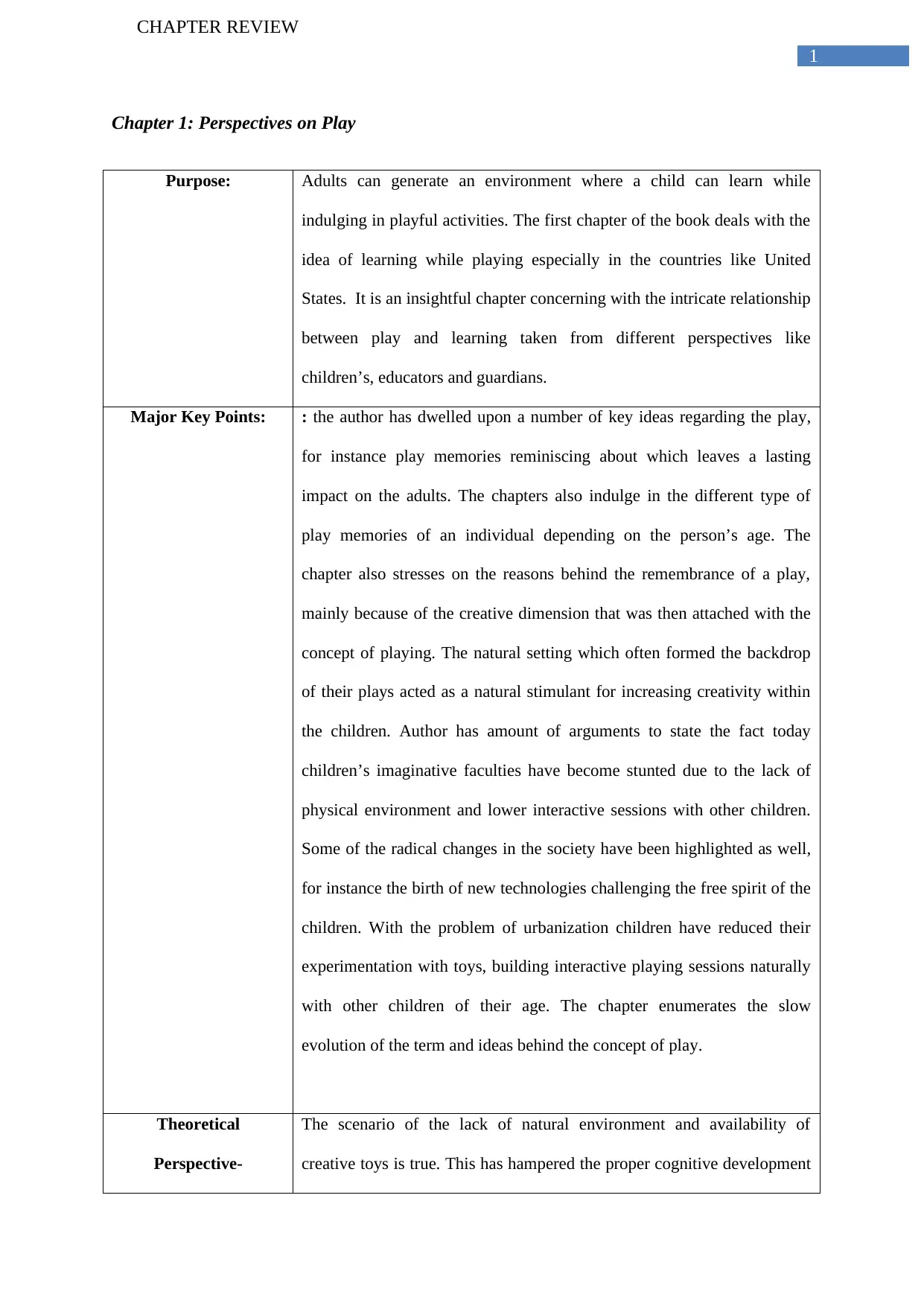
Chapter 1: Perspectives on Play
Purpose: Adults can generate an environment where a child can learn while
indulging in playful activities. The first chapter of the book deals with the
idea of learning while playing especially in the countries like United
States. It is an insightful chapter concerning with the intricate relationship
between play and learning taken from different perspectives like
children’s, educators and guardians.
Major Key Points: : the author has dwelled upon a number of key ideas regarding the play,
for instance play memories reminiscing about which leaves a lasting
impact on the adults. The chapters also indulge in the different type of
play memories of an individual depending on the person’s age. The
chapter also stresses on the reasons behind the remembrance of a play,
mainly because of the creative dimension that was then attached with the
concept of playing. The natural setting which often formed the backdrop
of their plays acted as a natural stimulant for increasing creativity within
the children. Author has amount of arguments to state the fact today
children’s imaginative faculties have become stunted due to the lack of
physical environment and lower interactive sessions with other children.
Some of the radical changes in the society have been highlighted as well,
for instance the birth of new technologies challenging the free spirit of the
children. With the problem of urbanization children have reduced their
experimentation with toys, building interactive playing sessions naturally
with other children of their age. The chapter enumerates the slow
evolution of the term and ideas behind the concept of play.
Theoretical
Perspective-
The scenario of the lack of natural environment and availability of
creative toys is true. This has hampered the proper cognitive development
CHAPTER REVIEW
Chapter 1: Perspectives on Play
Purpose: Adults can generate an environment where a child can learn while
indulging in playful activities. The first chapter of the book deals with the
idea of learning while playing especially in the countries like United
States. It is an insightful chapter concerning with the intricate relationship
between play and learning taken from different perspectives like
children’s, educators and guardians.
Major Key Points: : the author has dwelled upon a number of key ideas regarding the play,
for instance play memories reminiscing about which leaves a lasting
impact on the adults. The chapters also indulge in the different type of
play memories of an individual depending on the person’s age. The
chapter also stresses on the reasons behind the remembrance of a play,
mainly because of the creative dimension that was then attached with the
concept of playing. The natural setting which often formed the backdrop
of their plays acted as a natural stimulant for increasing creativity within
the children. Author has amount of arguments to state the fact today
children’s imaginative faculties have become stunted due to the lack of
physical environment and lower interactive sessions with other children.
Some of the radical changes in the society have been highlighted as well,
for instance the birth of new technologies challenging the free spirit of the
children. With the problem of urbanization children have reduced their
experimentation with toys, building interactive playing sessions naturally
with other children of their age. The chapter enumerates the slow
evolution of the term and ideas behind the concept of play.
Theoretical
Perspective-
The scenario of the lack of natural environment and availability of
creative toys is true. This has hampered the proper cognitive development

2
CHAPTER REVIEW
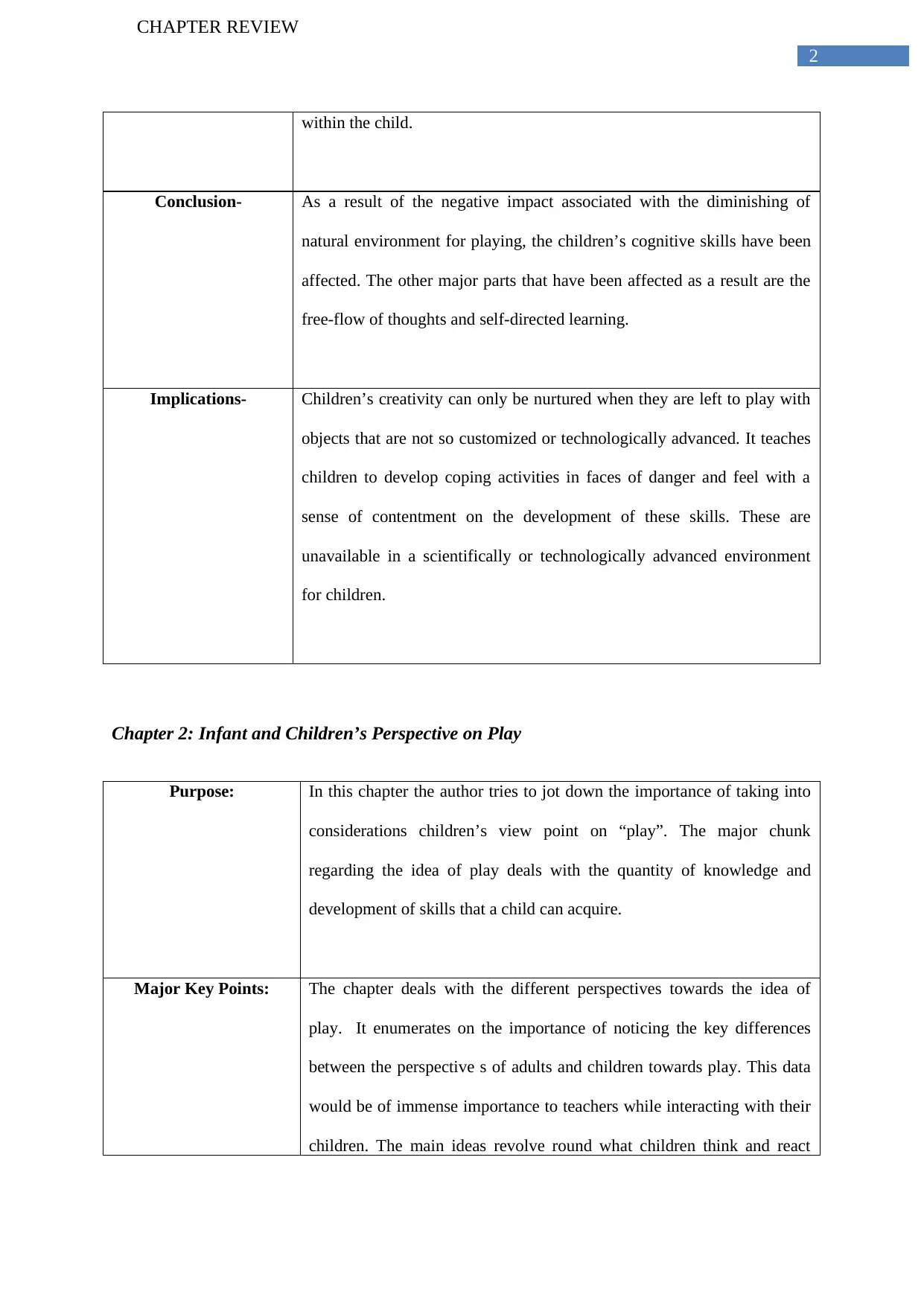
within the child.
Conclusion- As a result of the negative impact associated with the diminishing of
natural environment for playing, the children’s cognitive skills have been
affected. The other major parts that have been affected as a result are the
free-flow of thoughts and self-directed learning.
Implications- Children’s creativity can only be nurtured when they are left to play with
objects that are not so customized or technologically advanced. It teaches
children to develop coping activities in faces of danger and feel with a
sense of contentment on the development of these skills. These are
unavailable in a scientifically or technologically advanced environment
for children.
Chapter 2: Infant and Children’s Perspective on Play
Purpose: In this chapter the author tries to jot down the importance of taking into
considerations children’s view point on “play”. The major chunk
regarding the idea of play deals with the quantity of knowledge and
development of skills that a child can acquire.
Major Key Points: The chapter deals with the different perspectives towards the idea of
play. It enumerates on the importance of noticing the key differences
between the perspective s of adults and children towards play. This data
would be of immense importance to teachers while interacting with their
children. The main ideas revolve round what children think and react
CHAPTER REVIEW
within the child.
Conclusion- As a result of the negative impact associated with the diminishing of
natural environment for playing, the children’s cognitive skills have been
affected. The other major parts that have been affected as a result are the
free-flow of thoughts and self-directed learning.
Implications- Children’s creativity can only be nurtured when they are left to play with
objects that are not so customized or technologically advanced. It teaches
children to develop coping activities in faces of danger and feel with a
sense of contentment on the development of these skills. These are
unavailable in a scientifically or technologically advanced environment
for children.
Chapter 2: Infant and Children’s Perspective on Play
Purpose: In this chapter the author tries to jot down the importance of taking into
considerations children’s view point on “play”. The major chunk
regarding the idea of play deals with the quantity of knowledge and
development of skills that a child can acquire.
Major Key Points: The chapter deals with the different perspectives towards the idea of
play. It enumerates on the importance of noticing the key differences
between the perspective s of adults and children towards play. This data
would be of immense importance to teachers while interacting with their
children. The main ideas revolve round what children think and react
⊘ This is a preview!⊘
Do you want full access?
Subscribe today to unlock all pages.

Trusted by 1+ million students worldwide

3
CHAPTER REVIEW
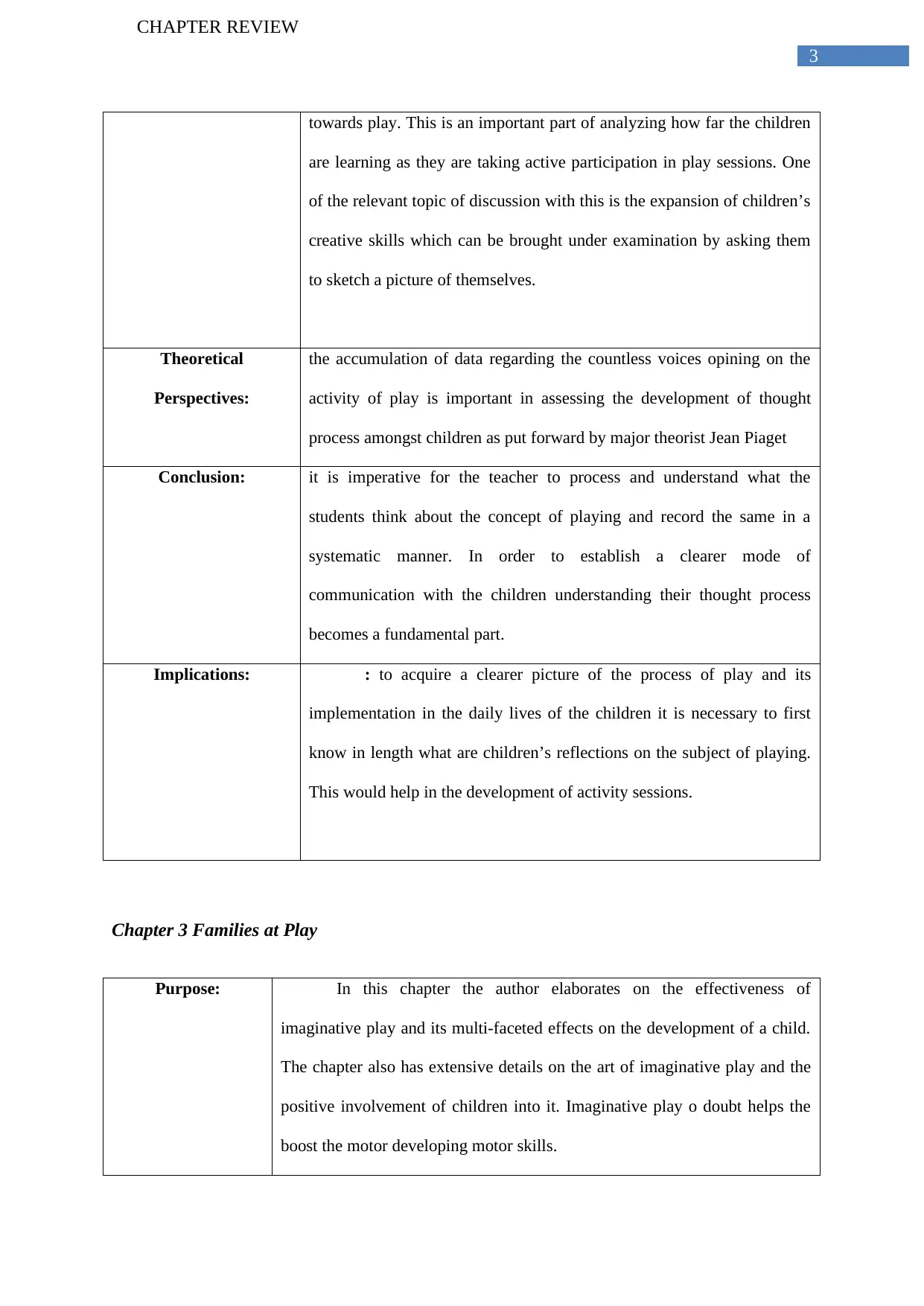
towards play. This is an important part of analyzing how far the children
are learning as they are taking active participation in play sessions. One
of the relevant topic of discussion with this is the expansion of children’s
creative skills which can be brought under examination by asking them
to sketch a picture of themselves.
Theoretical
Perspectives:
the accumulation of data regarding the countless voices opining on the
activity of play is important in assessing the development of thought
process amongst children as put forward by major theorist Jean Piaget
Conclusion: it is imperative for the teacher to process and understand what the
students think about the concept of playing and record the same in a
systematic manner. In order to establish a clearer mode of
communication with the children understanding their thought process
becomes a fundamental part.
Implications: : to acquire a clearer picture of the process of play and its
implementation in the daily lives of the children it is necessary to first
know in length what are children’s reflections on the subject of playing.
This would help in the development of activity sessions.
Chapter 3 Families at Play
Purpose: In this chapter the author elaborates on the effectiveness of
imaginative play and its multi-faceted effects on the development of a child.
The chapter also has extensive details on the art of imaginative play and the
positive involvement of children into it. Imaginative play o doubt helps the
boost the motor developing motor skills.
CHAPTER REVIEW
towards play. This is an important part of analyzing how far the children
are learning as they are taking active participation in play sessions. One
of the relevant topic of discussion with this is the expansion of children’s
creative skills which can be brought under examination by asking them
to sketch a picture of themselves.
Theoretical
Perspectives:
the accumulation of data regarding the countless voices opining on the
activity of play is important in assessing the development of thought
process amongst children as put forward by major theorist Jean Piaget
Conclusion: it is imperative for the teacher to process and understand what the
students think about the concept of playing and record the same in a
systematic manner. In order to establish a clearer mode of
communication with the children understanding their thought process
becomes a fundamental part.
Implications: : to acquire a clearer picture of the process of play and its
implementation in the daily lives of the children it is necessary to first
know in length what are children’s reflections on the subject of playing.
This would help in the development of activity sessions.
Chapter 3 Families at Play
Purpose: In this chapter the author elaborates on the effectiveness of
imaginative play and its multi-faceted effects on the development of a child.
The chapter also has extensive details on the art of imaginative play and the
positive involvement of children into it. Imaginative play o doubt helps the
boost the motor developing motor skills.
Paraphrase This Document
Need a fresh take? Get an instant paraphrase of this document with our AI Paraphraser

4
CHAPTER REVIEW
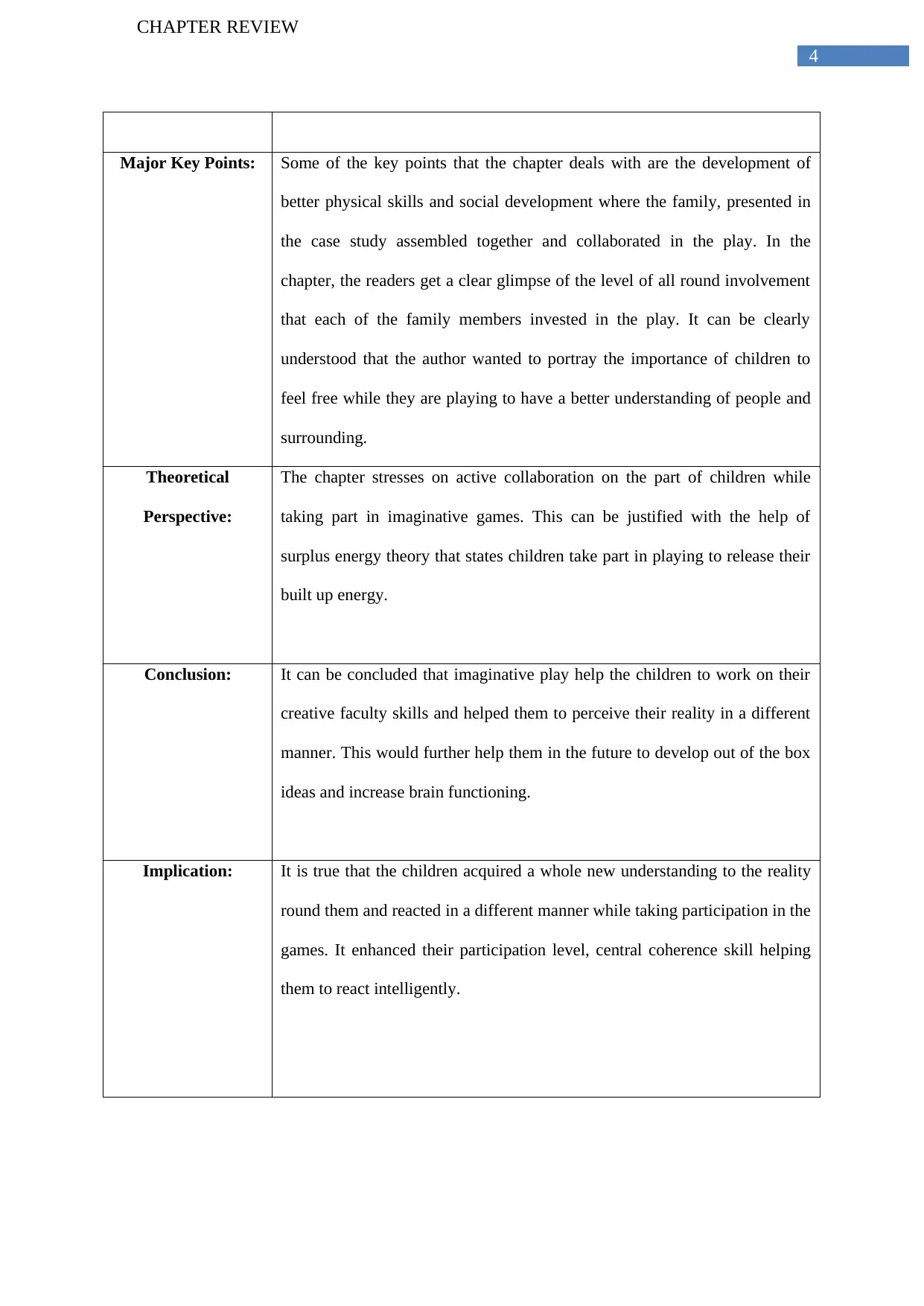
Major Key Points: Some of the key points that the chapter deals with are the development of
better physical skills and social development where the family, presented in
the case study assembled together and collaborated in the play. In the
chapter, the readers get a clear glimpse of the level of all round involvement
that each of the family members invested in the play. It can be clearly
understood that the author wanted to portray the importance of children to
feel free while they are playing to have a better understanding of people and
surrounding.
Theoretical
Perspective:
The chapter stresses on active collaboration on the part of children while
taking part in imaginative games. This can be justified with the help of
surplus energy theory that states children take part in playing to release their
built up energy.
Conclusion: It can be concluded that imaginative play help the children to work on their
creative faculty skills and helped them to perceive their reality in a different
manner. This would further help them in the future to develop out of the box
ideas and increase brain functioning.
Implication: It is true that the children acquired a whole new understanding to the reality
round them and reacted in a different manner while taking participation in the
games. It enhanced their participation level, central coherence skill helping
them to react intelligently.
CHAPTER REVIEW
Major Key Points: Some of the key points that the chapter deals with are the development of
better physical skills and social development where the family, presented in
the case study assembled together and collaborated in the play. In the
chapter, the readers get a clear glimpse of the level of all round involvement
that each of the family members invested in the play. It can be clearly
understood that the author wanted to portray the importance of children to
feel free while they are playing to have a better understanding of people and
surrounding.
Theoretical
Perspective:
The chapter stresses on active collaboration on the part of children while
taking part in imaginative games. This can be justified with the help of
surplus energy theory that states children take part in playing to release their
built up energy.
Conclusion: It can be concluded that imaginative play help the children to work on their
creative faculty skills and helped them to perceive their reality in a different
manner. This would further help them in the future to develop out of the box
ideas and increase brain functioning.
Implication: It is true that the children acquired a whole new understanding to the reality
round them and reacted in a different manner while taking participation in the
games. It enhanced their participation level, central coherence skill helping
them to react intelligently.

5
CHAPTER REVIEW
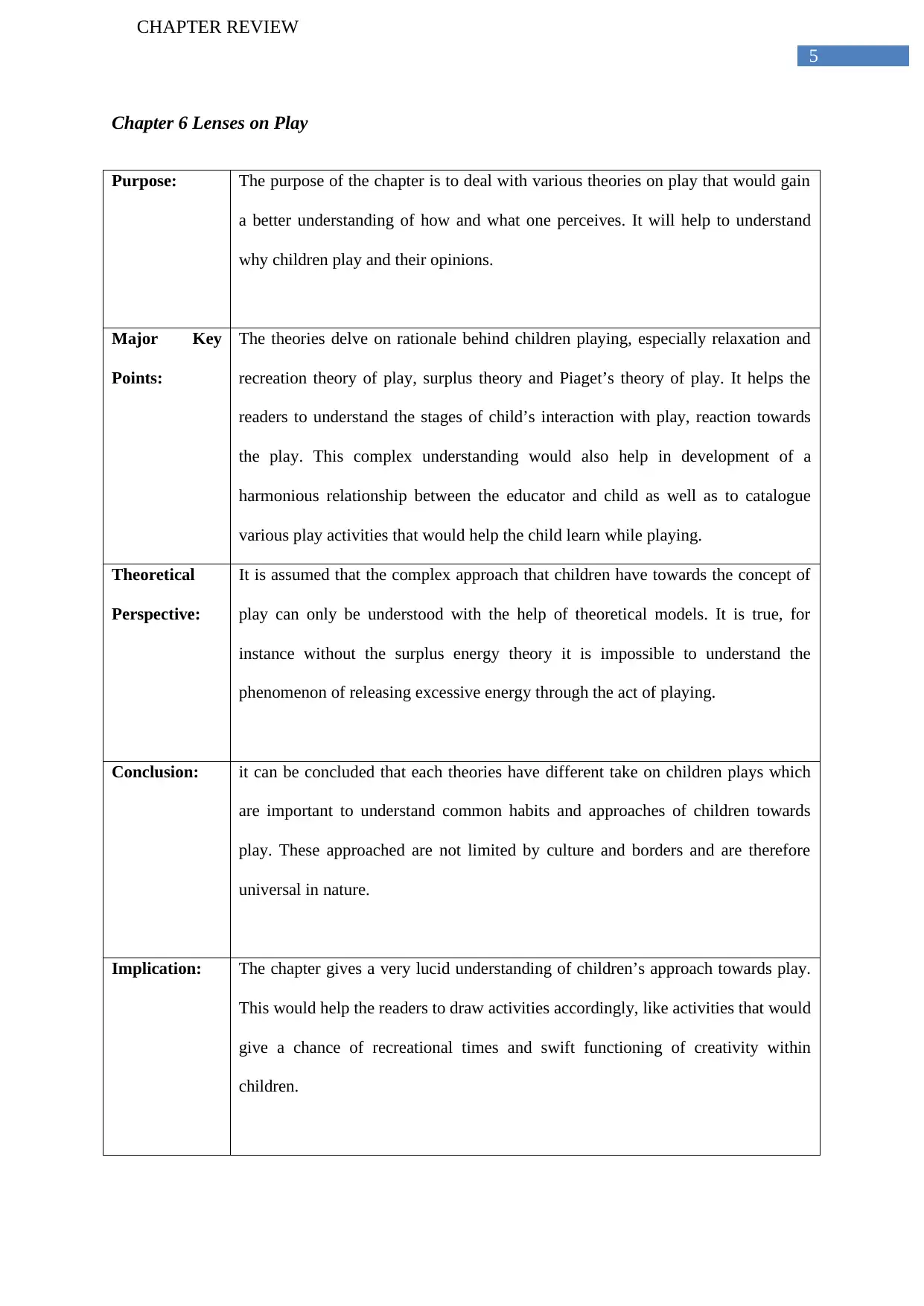
Chapter 6 Lenses on Play
Purpose: The purpose of the chapter is to deal with various theories on play that would gain
a better understanding of how and what one perceives. It will help to understand
why children play and their opinions.
Major Key
Points:
The theories delve on rationale behind children playing, especially relaxation and
recreation theory of play, surplus theory and Piaget’s theory of play. It helps the
readers to understand the stages of child’s interaction with play, reaction towards
the play. This complex understanding would also help in development of a
harmonious relationship between the educator and child as well as to catalogue
various play activities that would help the child learn while playing.
Theoretical
Perspective:
It is assumed that the complex approach that children have towards the concept of
play can only be understood with the help of theoretical models. It is true, for
instance without the surplus energy theory it is impossible to understand the
phenomenon of releasing excessive energy through the act of playing.
Conclusion: it can be concluded that each theories have different take on children plays which
are important to understand common habits and approaches of children towards
play. These approached are not limited by culture and borders and are therefore
universal in nature.
Implication: The chapter gives a very lucid understanding of children’s approach towards play.
This would help the readers to draw activities accordingly, like activities that would
give a chance of recreational times and swift functioning of creativity within
children.
CHAPTER REVIEW
Chapter 6 Lenses on Play
Purpose: The purpose of the chapter is to deal with various theories on play that would gain
a better understanding of how and what one perceives. It will help to understand
why children play and their opinions.
Major Key
Points:
The theories delve on rationale behind children playing, especially relaxation and
recreation theory of play, surplus theory and Piaget’s theory of play. It helps the
readers to understand the stages of child’s interaction with play, reaction towards
the play. This complex understanding would also help in development of a
harmonious relationship between the educator and child as well as to catalogue
various play activities that would help the child learn while playing.
Theoretical
Perspective:
It is assumed that the complex approach that children have towards the concept of
play can only be understood with the help of theoretical models. It is true, for
instance without the surplus energy theory it is impossible to understand the
phenomenon of releasing excessive energy through the act of playing.
Conclusion: it can be concluded that each theories have different take on children plays which
are important to understand common habits and approaches of children towards
play. These approached are not limited by culture and borders and are therefore
universal in nature.
Implication: The chapter gives a very lucid understanding of children’s approach towards play.
This would help the readers to draw activities accordingly, like activities that would
give a chance of recreational times and swift functioning of creativity within
children.
⊘ This is a preview!⊘
Do you want full access?
Subscribe today to unlock all pages.

Trusted by 1+ million students worldwide
1 out of 6
Related Documents
Your All-in-One AI-Powered Toolkit for Academic Success.
+13062052269
info@desklib.com
Available 24*7 on WhatsApp / Email
Unlock your academic potential
Copyright © 2020–2026 A2Z Services. All Rights Reserved. Developed and managed by ZUCOL.