PSM506 Psychology Assignment: Designing Underwriter Selection Process

Verified

Added on  2022/10/06

|9
|2085
|22
Report
AI Summary
This report addresses a psychology assignment focused on improving the underwriter selection process for a micro-lending firm. The current process, which relies on CVs and unstructured interviews, is critiqued for its inefficiencies and potential biases. The report proposes a new selection process incorporating situational judgment tests (SJTs) for initial screening, assessing candidates' judgment and decision-making skills. Subsequently, it recommends the use of assessment centers, specifically role-play exercises, to evaluate candidates' interpersonal, communication, and decision-making abilities, deemed crucial for the underwriter role. The report emphasizes the importance of validating the new selection process before implementation, including assessing the current process's merits and demerits, comparing it with the proposed methods, and gathering feedback from stakeholders. The overall aim is to create a more effective and fair selection process to improve the quality and retention of underwriters.

Document Page
Running head: PSYCHOLOGY
Psychology
Name of the Student
Name of the University
Author Note
tabler-icon-diamond-filled.svg

Paraphrase This Document

Need a fresh take? Get an instant paraphrase of this document with our AI Paraphraser
Document Page
1PSYCHOLOGY
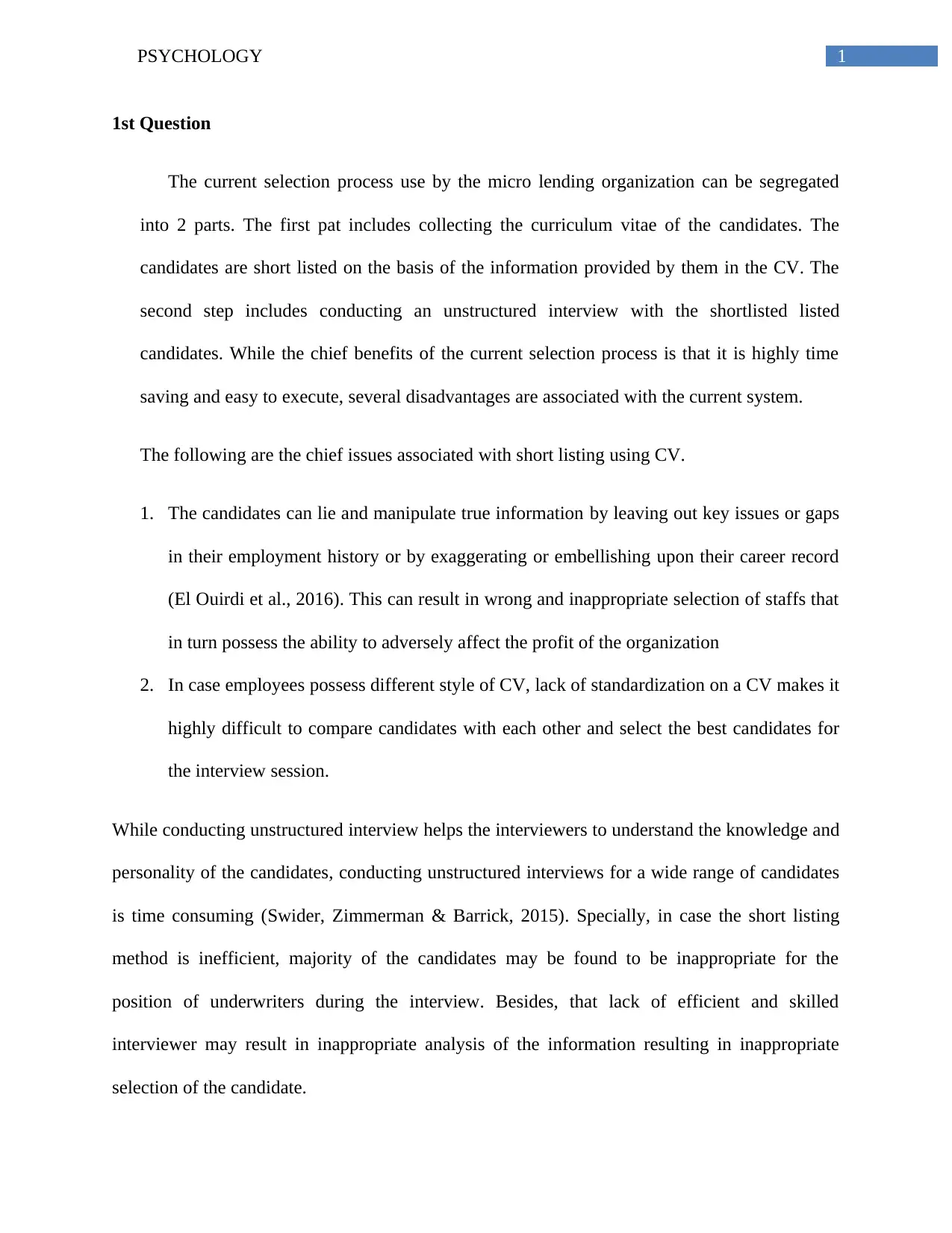
1st Question
The current selection process use by the micro lending organization can be segregated
into 2 parts. The first pat includes collecting the curriculum vitae of the candidates. The
candidates are short listed on the basis of the information provided by them in the CV. The
second step includes conducting an unstructured interview with the shortlisted listed
candidates. While the chief benefits of the current selection process is that it is highly time
saving and easy to execute, several disadvantages are associated with the current system.
The following are the chief issues associated with short listing using CV.
1. The candidates can lie and manipulate true information by leaving out key issues or gaps
in their employment history or by exaggerating or embellishing upon their career record
(El Ouirdi et al., 2016). This can result in wrong and inappropriate selection of staffs that
in turn possess the ability to adversely affect the profit of the organization
2. In case employees possess different style of CV, lack of standardization on a CV makes it
highly difficult to compare candidates with each other and select the best candidates for
the interview session.
While conducting unstructured interview helps the interviewers to understand the knowledge and
personality of the candidates, conducting unstructured interviews for a wide range of candidates
is time consuming (Swider, Zimmerman & Barrick, 2015). Specially, in case the short listing
method is inefficient, majority of the candidates may be found to be inappropriate for the
position of underwriters during the interview. Besides, that lack of efficient and skilled
interviewer may result in inappropriate analysis of the information resulting in inappropriate
selection of the candidate.
Document Page
2PSYCHOLOGY
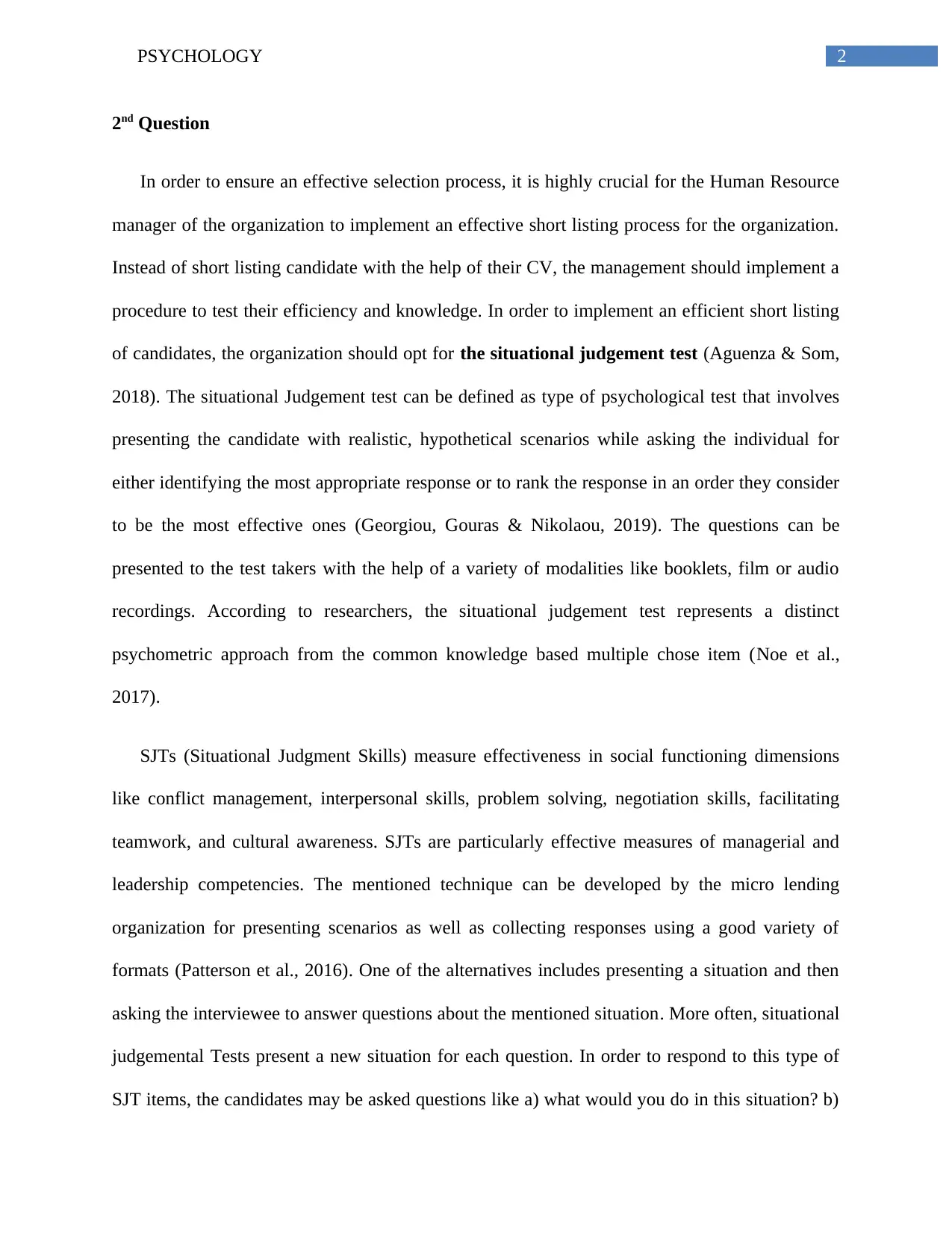
2nd Question
In order to ensure an effective selection process, it is highly crucial for the Human Resource
manager of the organization to implement an effective short listing process for the organization.
Instead of short listing candidate with the help of their CV, the management should implement a
procedure to test their efficiency and knowledge. In order to implement an efficient short listing
of candidates, the organization should opt for the situational judgement test (Aguenza & Som,
2018). The situational Judgement test can be defined as type of psychological test that involves
presenting the candidate with realistic, hypothetical scenarios while asking the individual for
either identifying the most appropriate response or to rank the response in an order they consider
to be the most effective ones (Georgiou, Gouras & Nikolaou, 2019). The questions can be
presented to the test takers with the help of a variety of modalities like booklets, film or audio
recordings. According to researchers, the situational judgement test represents a distinct
psychometric approach from the common knowledge based multiple chose item (Noe et al.,
2017).
SJTs (Situational Judgment Skills) measure effectiveness in social functioning dimensions
like conflict management, interpersonal skills, problem solving, negotiation skills, facilitating
teamwork, and cultural awareness. SJTs are particularly effective measures of managerial and
leadership competencies. The mentioned technique can be developed by the micro lending
organization for presenting scenarios as well as collecting responses using a good variety of
formats (Patterson et al., 2016). One of the alternatives includes presenting a situation and then
asking the interviewee to answer questions about the mentioned situation. More often, situational
judgemental Tests present a new situation for each question. In order to respond to this type of
SJT items, the candidates may be asked questions like a) what would you do in this situation? b)
Document Page
3PSYCHOLOGY
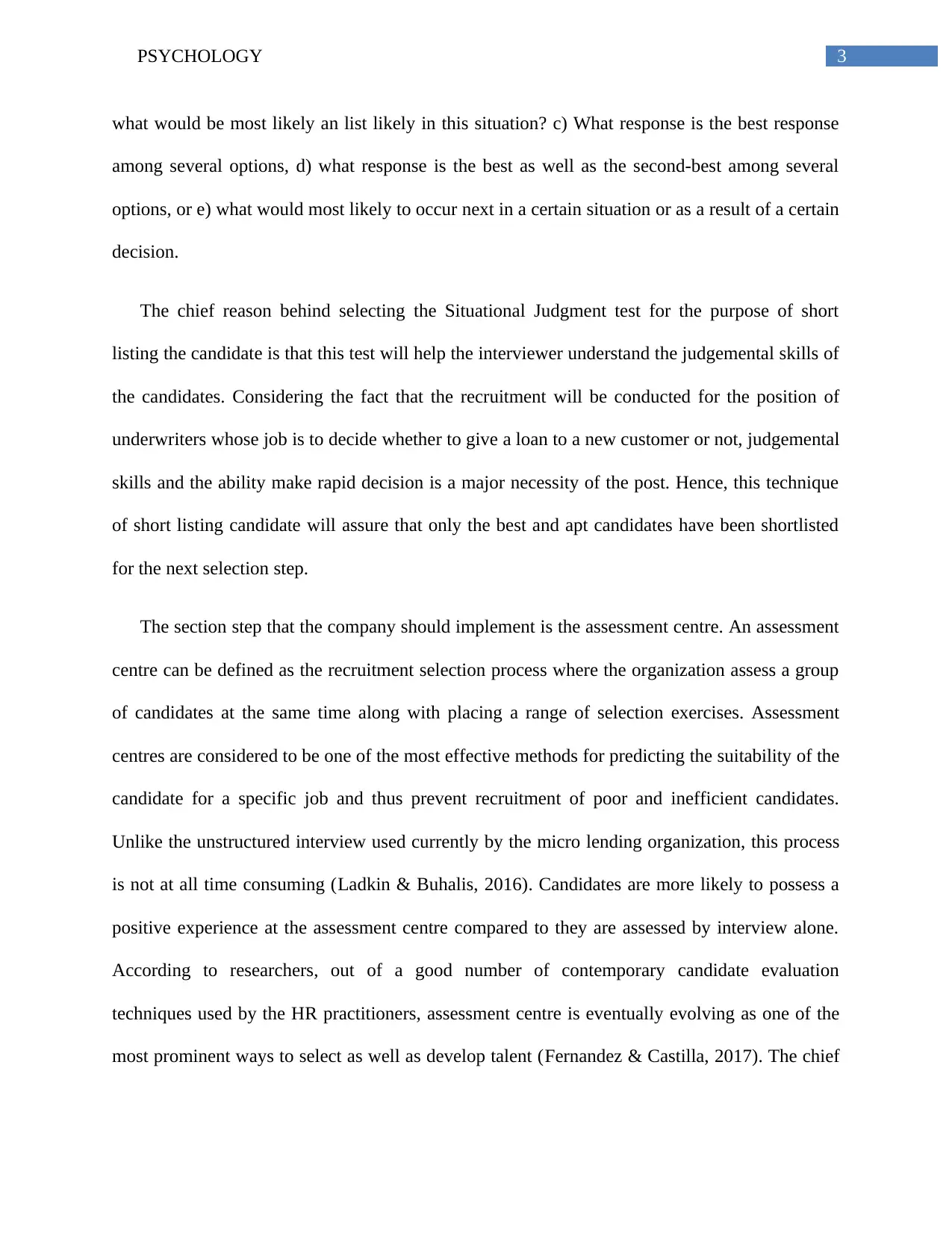
what would be most likely an list likely in this situation? c) What response is the best response
among several options, d) what response is the best as well as the second-best among several
options, or e) what would most likely to occur next in a certain situation or as a result of a certain
decision.
The chief reason behind selecting the Situational Judgment test for the purpose of short
listing the candidate is that this test will help the interviewer understand the judgemental skills of
the candidates. Considering the fact that the recruitment will be conducted for the position of
underwriters whose job is to decide whether to give a loan to a new customer or not, judgemental
skills and the ability make rapid decision is a major necessity of the post. Hence, this technique
of short listing candidate will assure that only the best and apt candidates have been shortlisted
for the next selection step.
The section step that the company should implement is the assessment centre. An assessment
centre can be defined as the recruitment selection process where the organization assess a group
of candidates at the same time along with placing a range of selection exercises. Assessment
centres are considered to be one of the most effective methods for predicting the suitability of the
candidate for a specific job and thus prevent recruitment of poor and inefficient candidates.
Unlike the unstructured interview used currently by the micro lending organization, this process
is not at all time consuming (Ladkin & Buhalis, 2016). Candidates are more likely to possess a
positive experience at the assessment centre compared to they are assessed by interview alone.
According to researchers, out of a good number of contemporary candidate evaluation
techniques used by the HR practitioners, assessment centre is eventually evolving as one of the
most prominent ways to select as well as develop talent (Fernandez & Castilla, 2017). The chief
tabler-icon-diamond-filled.svg

Paraphrase This Document

Need a fresh take? Get an instant paraphrase of this document with our AI Paraphraser
Document Page
4PSYCHOLOGY
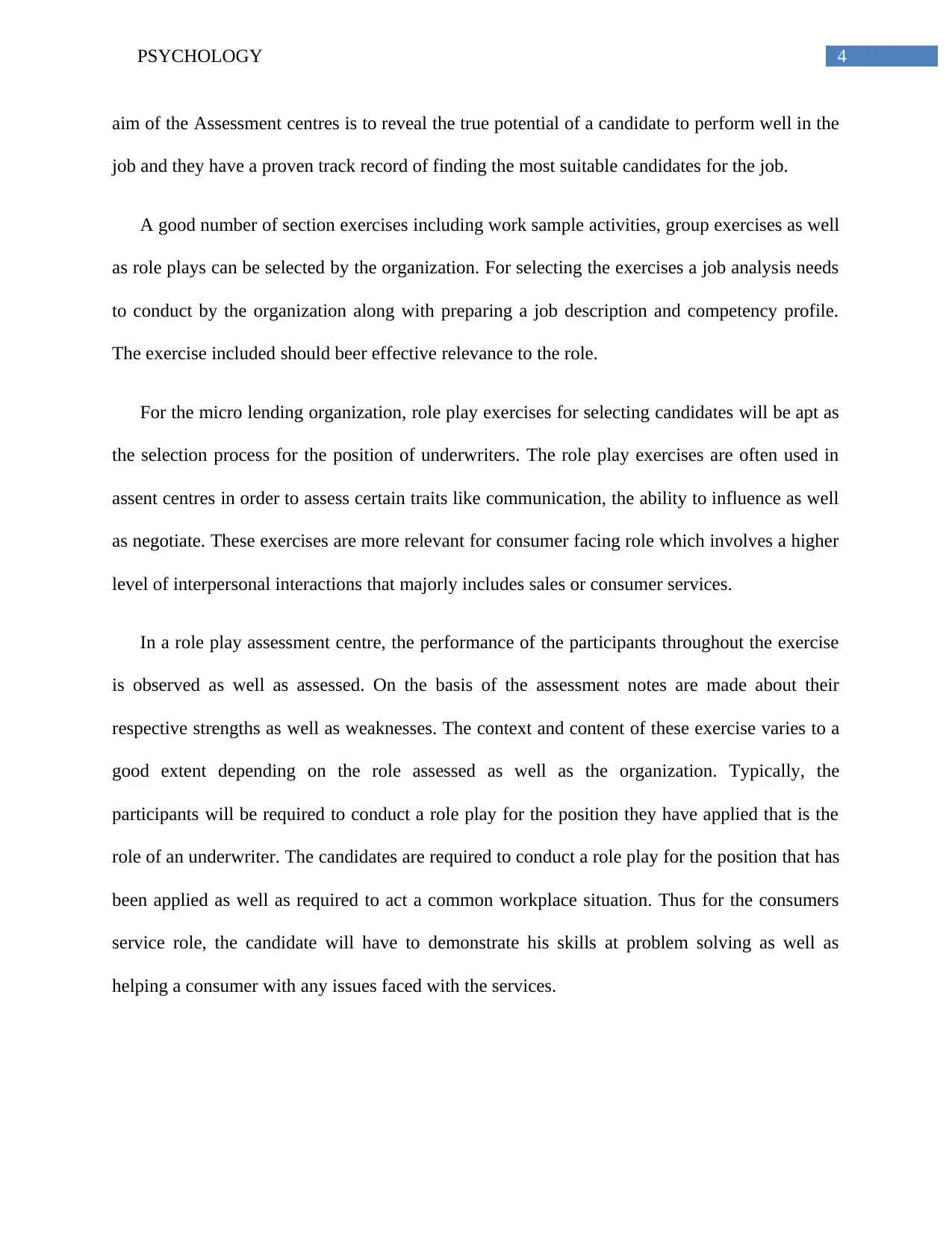
aim of the Assessment centres is to reveal the true potential of a candidate to perform well in the
job and they have a proven track record of finding the most suitable candidates for the job.
A good number of section exercises including work sample activities, group exercises as well
as role plays can be selected by the organization. For selecting the exercises a job analysis needs
to conduct by the organization along with preparing a job description and competency profile.
The exercise included should beer effective relevance to the role.
For the micro lending organization, role play exercises for selecting candidates will be apt as
the selection process for the position of underwriters. The role play exercises are often used in
assent centres in order to assess certain traits like communication, the ability to influence as well
as negotiate. These exercises are more relevant for consumer facing role which involves a higher
level of interpersonal interactions that majorly includes sales or consumer services.
In a role play assessment centre, the performance of the participants throughout the exercise
is observed as well as assessed. On the basis of the assessment notes are made about their
respective strengths as well as weaknesses. The context and content of these exercise varies to a
good extent depending on the role assessed as well as the organization. Typically, the
participants will be required to conduct a role play for the position they have applied that is the
role of an underwriter. The candidates are required to conduct a role play for the position that has
been applied as well as required to act a common workplace situation. Thus for the consumers
service role, the candidate will have to demonstrate his skills at problem solving as well as
helping a consumer with any issues faced with the services.
Document Page
5PSYCHOLOGY
The factor on the basis of which the participant will be assessed includes their
communication as well as interpersonal skills, ability handle pressure, resilience, negotiation
skill and the ability to conduct an effective conversation for achieving the desired outcomes.
The short listing method for potential candidates that should be implemented is Situation
Justification test. This is considered to be apt for the position which is underwriter since the SJT
test will help the interviewer to understand the instantaneous decision making skills of the
employee which is a major requirement while dealing with the lines. Employees who will
perform well in making effective decision will be more efficient while dealing with real time
client and making decision whether to provide role to the client or not.
3rd Question
The candidate shortlisted will be finally selected for the job role with the help of assessment
centre. The process chosen for assessing the candidate through assessment centre includes role
play. Since role plays are considered to be the most effective technique of assessing the
interpersonal, communication and decision making skills of the employees, employees wh will
perform well in the mentioned test have higher chances to be efficient while dealing with real
time consumers.
In order to ensure that the new selection process is fit for purpose before being
implemented in a live selection process, firstly, the current recruitment process and the
consequences of the same will be assessed and noted down. The merits and demerits of the
current recruitment process should be listed. Similarly the merits and demerits of the new
recruitment process will be listed down and compared (Punjaisri & Wilson, 2017). A meeting
Document Page
6PSYCHOLOGY
with the human resource manager and operational manager of the micro lending organization
will be conducted. The above discussed merits of the mentioned procedure will be discussed.
Along with this monitoring processes once the recruitment plan is being implemented will also
be made. For instance, one of the monitoring techniques should include collecting feedback from
the employees with the help of a survey. Along with that feedbacks can be collected from the
managers as well as team leader through interview.
tabler-icon-diamond-filled.svg

Paraphrase This Document

Need a fresh take? Get an instant paraphrase of this document with our AI Paraphraser
Document Page
7PSYCHOLOGY
Reference List
Punjaisri, K., & Wilson, A. (2017). The role of internal branding in the delivery of employee
brand promise. In Advances in corporate branding (pp. 91-108). Palgrave Macmillan, London
Ladkin, A., & Buhalis, D. (2016). Online and social media recruitment: Hospitality employer
and prospective employee considerations. International Journal of Contemporary Hospitality
Management, 28(2), 327-345.
Noe, R. A., Hollenbeck, J. R., Gerhart, B., & Wright, P. M. (2017). Human resource
management: Gaining a competitive advantage. New York, NY: McGraw-Hill Education.
El Ouirdi, M., El Ouirdi, A., Segers, J., & Pais, I. (2016). Technology adoption in employee
recruitment: The case of social media in Central and Eastern Europe. Computers in Human
Behavior, 57, 240-249.
Swider, B. W., Zimmerman, R. D., & Barrick, M. R. (2015). Searching for the right fit:
Development of applicant person-organization fit perceptions during the recruitment
process. Journal of Applied Psychology, 100(3), 880.
Aguenza, B. B., & Som, A. P. M. (2018). Motivational factors of employee retention and
engagement in organizations. IJAME.
Fernandez, R. M., & Castilla, E. J. (2017). How much is that network worth? Social capital in
employee referral networks. In Social Capital (pp. 85-104). Routledge.
Georgiou, K., Gouras, A., & Nikolaou, I. (2019). Gamification in employee selection: The
development of a gamified assessment. International Journal of Selection and Assessment, 27(2),
91-103.
Document Page
8PSYCHOLOGY
Patterson, F., Prescott-Clements, L., Zibarras, L., Edwards, H., Kerrin, M., & Cousans, F.
(2016). Recruiting for values in healthcare: a preliminary review of the evidence. Advances in
Health Sciences Education, 21(4), 859-881.
chevron_up_icon
1 out of 9
circle_padding
hide_on_mobile
zoom_out_icon
[object Object]