Psychopathy and Criminal Justice: A Report on Treatment

Verified

Added on  2022/09/06

|4
|399
|38
Report
AI Summary
This report delves into the complexities of psychopathy within the context of criminal justice. It begins by defining psychopathy and highlighting key traits such as a lack of empathy, which distinguishes psychopaths from the general population. The report then explores the implications of these traits, particularly in relation to criminal behavior. It examines the challenges of treating psychopathy, citing expert opinions on the limitations of current therapeutic approaches, and discusses the potential for manipulation within the therapeutic environment. The report also references the work of leading researchers and psychiatrists, adding depth to the discussion of this complex psychological disorder. It concludes by emphasizing the enduring nature of psychopathic tendencies and their lasting impact on the individual and society.
Document Page
Running head: CRIMINAL JUSTICE & CRIMINOLOGY
CRIMINAL JUSTICE AND CRIMINOLOGY
Name of the Student
Name of the University
Authors Note
tabler-icon-diamond-filled.svg

Paraphrase This Document

Need a fresh take? Get an instant paraphrase of this document with our AI Paraphraser
Document Page
1CRIMINAL JUSTICE & CRIMINOLOGY
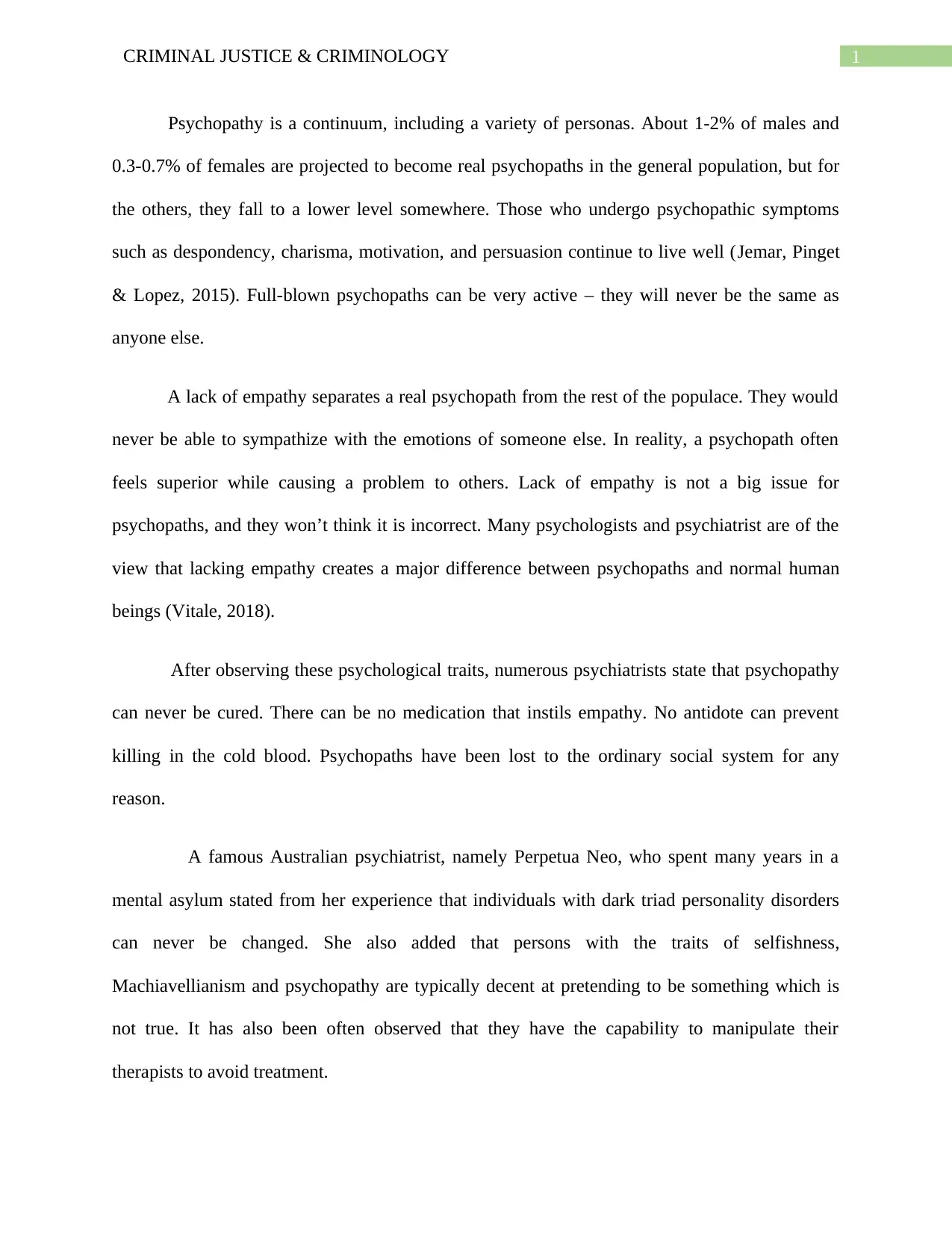
Psychopathy is a continuum, including a variety of personas. About 1-2% of males and
0.3-0.7% of females are projected to become real psychopaths in the general population, but for
the others, they fall to a lower level somewhere. Those who undergo psychopathic symptoms
such as despondency, charisma, motivation, and persuasion continue to live well (Jemar, Pinget
& Lopez, 2015). Full-blown psychopaths can be very active – they will never be the same as
anyone else.
A lack of empathy separates a real psychopath from the rest of the populace. They would
never be able to sympathize with the emotions of someone else. In reality, a psychopath often
feels superior while causing a problem to others. Lack of empathy is not a big issue for
psychopaths, and they won’t think it is incorrect. Many psychologists and psychiatrist are of the
view that lacking empathy creates a major difference between psychopaths and normal human
beings (Vitale, 2018).
After observing these psychological traits, numerous psychiatrists state that psychopathy
can never be cured. There can be no medication that instils empathy. No antidote can prevent
killing in the cold blood. Psychopaths have been lost to the ordinary social system for any
reason.
A famous Australian psychiatrist, namely Perpetua Neo, who spent many years in a
mental asylum stated from her experience that individuals with dark triad personality disorders
can never be changed. She also added that persons with the traits of selfishness,
Machiavellianism and psychopathy are typically decent at pretending to be something which is
not true. It has also been often observed that they have the capability to manipulate their
therapists to avoid treatment.
Document Page
2CRIMINAL JUSTICE & CRIMINOLOGY
Document Page
3CRIMINAL JUSTICE & CRIMINOLOGY
Reference
Jemar, G., Pinget, M., & Lopez, S. M. (2015). The Soulless Psychopath. European
Psychiatry, 30, 1408.
Vitale, J. (2018). Assessing and Treating Psychopaths. In The Practice of Correctional
Psychology (pp. 173-196). Springer, Cham.
chevron_up_icon
1 out of 4
circle_padding
hide_on_mobile
zoom_out_icon
[object Object]