Addressing Psychosocial Needs in Infertility Treatment: A Study
VerifiedAdded on 2023/01/16
|32
|11450
|52
Dissertation
AI Summary
This dissertation investigates the psychosocial needs of patients and couples undergoing infertility treatment, focusing on the challenges they face and the crucial role of nurses in providing support. The study begins with an introduction to the prevalence of infertility, its impact on couples, and the emotional distress associated with treatment failures, including stress, anxiety, and feelings of isolation. The methodology section outlines the search strategy, including database searches, key terms, and the use of Boolean operators. It also describes the critiquing tool used to assess the reliability of selected articles. The findings highlight the importance of psychological and counselling support, the application of Watson's theory of human caring, and the need for health education before IVF treatment. The critical review of data emphasizes the need for psychological support and counselling to help couples cope with infertility, addressing issues like low self-esteem and stress. The dissertation explores the experiences of patients, emphasizing the role of nurses in providing emotional support, reducing stress, and improving overall well-being, with recommendations for counselling sessions and the use of Watson's theory to enhance patient care.
Dissertation
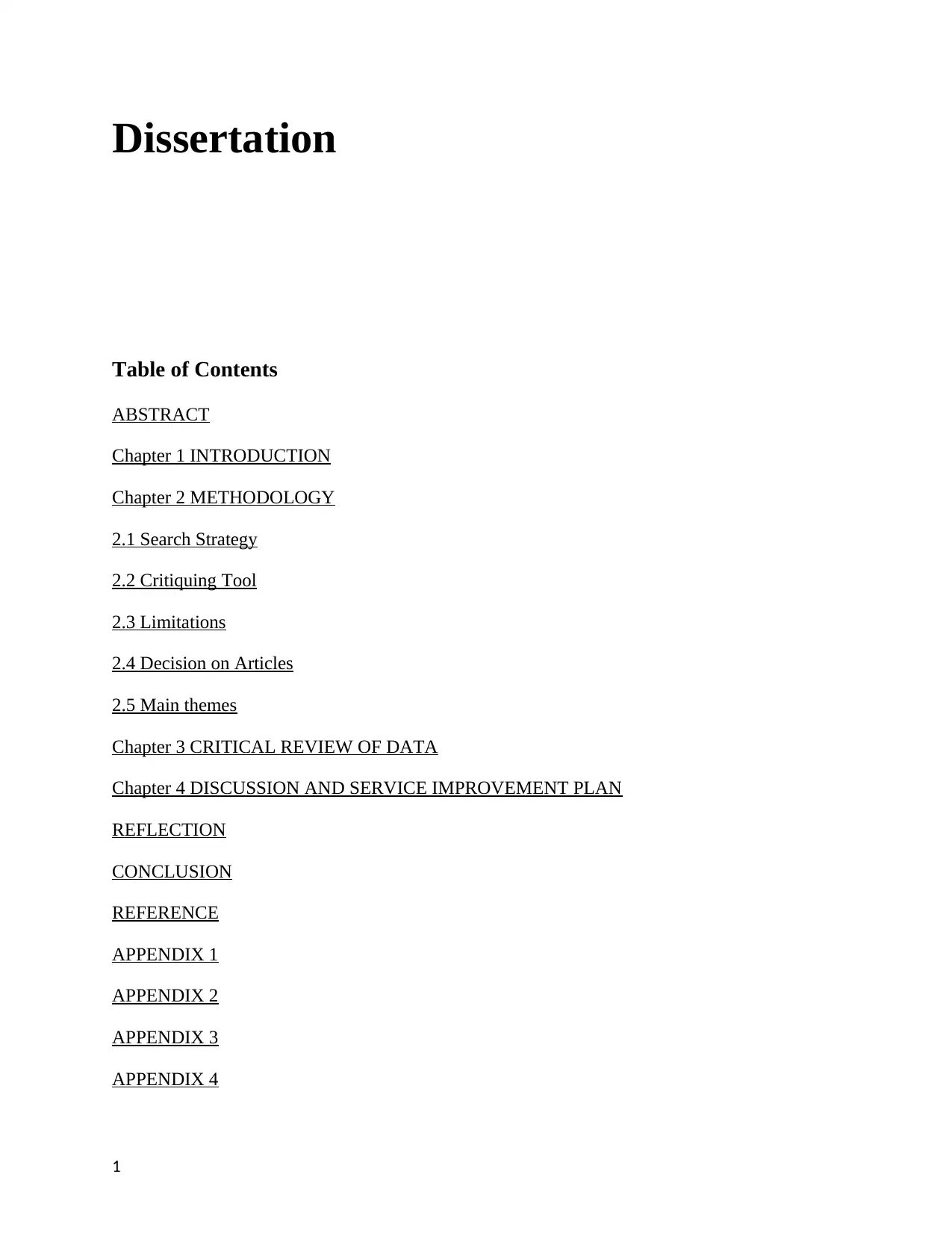
Table of Contents
ABSTRACT
Chapter 1 INTRODUCTION
Chapter 2 METHODOLOGY
2.1 Search Strategy
2.2 Critiquing Tool
2.3 Limitations
2.4 Decision on Articles
2.5 Main themes
Chapter 3 CRITICAL REVIEW OF DATA
Chapter 4 DISCUSSION AND SERVICE IMPROVEMENT PLAN
REFLECTION
CONCLUSION
REFERENCE
APPENDIX 1
APPENDIX 2
APPENDIX 3
APPENDIX 4
1
Table of Contents
ABSTRACT
Chapter 1 INTRODUCTION
Chapter 2 METHODOLOGY
2.1 Search Strategy
2.2 Critiquing Tool
2.3 Limitations
2.4 Decision on Articles
2.5 Main themes
Chapter 3 CRITICAL REVIEW OF DATA
Chapter 4 DISCUSSION AND SERVICE IMPROVEMENT PLAN
REFLECTION
CONCLUSION
REFERENCE
APPENDIX 1
APPENDIX 2
APPENDIX 3
APPENDIX 4
1

Paraphrase This Document
Need a fresh take? Get an instant paraphrase of this document with our AI Paraphraser
APPENDIX 5
REFERENCES
References
ABSTRACT
Purpose – to identify the psychological needs of patients or couples who are undergoing
infertility treatment and how nurses can overcome challenges.
Methods – A critical review of qualitative and quantitative data from articles and journals.
Findings- The main psychological needs of patients or couples are motivation and mental health
support. They want to get relief from stress and anxiety. Moreover, women highly need mental
support from nurses as they get demotivated after undergoing infertility treatment. Besides that,
social and psychological support has been required by couples. It has been stated that in order to
access supplementary services psychological support is needed.
Conclusion – It is summarised that psychological support is required to patient during infertility
treatment. This will enable in meeting their needs and successful treatment of infertility. Here,
2
REFERENCES
References
ABSTRACT
Purpose – to identify the psychological needs of patients or couples who are undergoing
infertility treatment and how nurses can overcome challenges.
Methods – A critical review of qualitative and quantitative data from articles and journals.
Findings- The main psychological needs of patients or couples are motivation and mental health
support. They want to get relief from stress and anxiety. Moreover, women highly need mental
support from nurses as they get demotivated after undergoing infertility treatment. Besides that,
social and psychological support has been required by couples. It has been stated that in order to
access supplementary services psychological support is needed.
Conclusion – It is summarised that psychological support is required to patient during infertility
treatment. This will enable in meeting their needs and successful treatment of infertility. Here,
2
Watson theory of human care can be used. It will be useful in decreasing stress. Alongside,
counselling sessions can also be provided to them to enhance psychological support. In addition
to it, theory of human caring decreases negative impact of infertility on women or couples.
Through that, it will be easy to deal with patients.
Summary:
What is known on subject already?
In recent times, infertility issue is highly rising among the women. This is making them unable to
give birth to child. However, women who have gone through infertility treatment remain stressed
and suffers from depression. Alongside, it is evaluated that anxiety is major cause for women of
infertility. It leads to fear among them. Due to this, their behaviour is influenced. They feel highly
stressed during treatment. It has been evaluated that women or couple undergoing infertility
treatment faces many issues.
What does this review add?
The review will summarise areas related to factors that lead to difficulties among women. Also, it
will show psychological impact leads to distress. Besides that, study will show how needs of
women can be identified and what type of strategies can be used.
Key Words: Infertility , Psychological, Conception, IVF
treatment, Treatment ,Wellbeing , Mental health , Distress
3
counselling sessions can also be provided to them to enhance psychological support. In addition
to it, theory of human caring decreases negative impact of infertility on women or couples.
Through that, it will be easy to deal with patients.
Summary:
What is known on subject already?
In recent times, infertility issue is highly rising among the women. This is making them unable to
give birth to child. However, women who have gone through infertility treatment remain stressed
and suffers from depression. Alongside, it is evaluated that anxiety is major cause for women of
infertility. It leads to fear among them. Due to this, their behaviour is influenced. They feel highly
stressed during treatment. It has been evaluated that women or couple undergoing infertility
treatment faces many issues.
What does this review add?
The review will summarise areas related to factors that lead to difficulties among women. Also, it
will show psychological impact leads to distress. Besides that, study will show how needs of
women can be identified and what type of strategies can be used.
Key Words: Infertility , Psychological, Conception, IVF
treatment, Treatment ,Wellbeing , Mental health , Distress
3
⊘ This is a preview!⊘
Do you want full access?
Subscribe today to unlock all pages.

Trusted by 1+ million students worldwide
Chapter 1 INTRODUCTION
Title: How does patient undergoing infertility treatment, nurses can provide support with
conception challenges which can address the psychosocial needs of the patient or couple?
Infertility is a disease which is affecting life style of people (Jodar et al., 2017). Married couples
are facing the problems of infertility because that women are not able to achieve the clinical
pregnancy. Treatment for infertility is complex and time-consuming. There are certain infertility
couples which are dealing with stress and trauma because of these diseases. As per
Bisht et.al (2017), infertility is affecting the 10 to 15 % couples. In case in which there is
unexpected loss for couples after infertility treatment, couples are only left with option of
adapting. Due to these, couples are dealing with stress and these stresses will affect the life style
of people. In many cases woman is undergoing treatment of infertility and in case of it fails,
women are facing many problems regarding their health. Childless women are undergoing stress
and trauma which will affect the psychosocial condition of women. The life of women is
affected, and they will face problems in life (Mehta et al., 2016). Women with infertility will
deal with the negative emotional pressure which will include shock, anger, and isolation. Many
women are using treatment of In Vitro Fertilization (IVF) even when treatment is complicated
and it will include many uncomfortable procedures for them. In many cases treatment of IVF
fails and these will affect health of women. In case of infertility among couples’ women are
affect but men are also affected and so, they will also face stress and trauma.
Infertility is affecting life of people because people are not able to expand their family which will
affect life of couples. Couple are opting for treatment related measures which will not affect the
life of people but in this case several treatments have been started. In order to fee from these
4
Title: How does patient undergoing infertility treatment, nurses can provide support with
conception challenges which can address the psychosocial needs of the patient or couple?
Infertility is a disease which is affecting life style of people (Jodar et al., 2017). Married couples
are facing the problems of infertility because that women are not able to achieve the clinical
pregnancy. Treatment for infertility is complex and time-consuming. There are certain infertility
couples which are dealing with stress and trauma because of these diseases. As per
Bisht et.al (2017), infertility is affecting the 10 to 15 % couples. In case in which there is
unexpected loss for couples after infertility treatment, couples are only left with option of
adapting. Due to these, couples are dealing with stress and these stresses will affect the life style
of people. In many cases woman is undergoing treatment of infertility and in case of it fails,
women are facing many problems regarding their health. Childless women are undergoing stress
and trauma which will affect the psychosocial condition of women. The life of women is
affected, and they will face problems in life (Mehta et al., 2016). Women with infertility will
deal with the negative emotional pressure which will include shock, anger, and isolation. Many
women are using treatment of In Vitro Fertilization (IVF) even when treatment is complicated
and it will include many uncomfortable procedures for them. In many cases treatment of IVF
fails and these will affect health of women. In case of infertility among couples’ women are
affect but men are also affected and so, they will also face stress and trauma.
Infertility is affecting life of people because people are not able to expand their family which will
affect life of couples. Couple are opting for treatment related measures which will not affect the
life of people but in this case several treatments have been started. In order to fee from these
4
Paraphrase This Document
Need a fresh take? Get an instant paraphrase of this document with our AI Paraphraser
problems people are using treatment, and they are not aware about the severe health problems
which will be faced by women so, these research project will provide knowledge regarding
treatment and the effect of treatment on health of people. Due to these conditions’ women are not
able to do work, and they are dealing with mental pressure and psychological conditions are
affected (Okafor Joe-Ikechebelu and Ikechebelu, 2017).
This dissertation will identify psychosocial needs of patient and couples undergoing infertility
treatment and challenges. Infertility is affecting life style of people and couples are dealing with
stress and trauma. People are dealing with stress and the physiological condition of couple are
affected. In case of treatment is not successful women will deal with problems of health.
Research have included research related method and strategies. It includes critical evaluation of
influence of infertility among married couples. In these type of case women needs support form
family which will help them to overcome these problems. The research has discussed the
treatment of infertility and the effect of the treatment on health of women.
These all have affected the health of women because women are not to handle stress and manage
the health conditions. Effects, factors and consequences are being discussed in report. It will
include certain condition is which woman are not able to survive because of failure in treatment
of infertility. These will not only affect the health of women but it will affect the health of male
as well. The aim this of study is to identify the psychosocial needs of patients or couples who are
undergoing infertility treatment and challenges faced by them.
5
which will be faced by women so, these research project will provide knowledge regarding
treatment and the effect of treatment on health of people. Due to these conditions’ women are not
able to do work, and they are dealing with mental pressure and psychological conditions are
affected (Okafor Joe-Ikechebelu and Ikechebelu, 2017).
This dissertation will identify psychosocial needs of patient and couples undergoing infertility
treatment and challenges. Infertility is affecting life style of people and couples are dealing with
stress and trauma. People are dealing with stress and the physiological condition of couple are
affected. In case of treatment is not successful women will deal with problems of health.
Research have included research related method and strategies. It includes critical evaluation of
influence of infertility among married couples. In these type of case women needs support form
family which will help them to overcome these problems. The research has discussed the
treatment of infertility and the effect of the treatment on health of women.
These all have affected the health of women because women are not to handle stress and manage
the health conditions. Effects, factors and consequences are being discussed in report. It will
include certain condition is which woman are not able to survive because of failure in treatment
of infertility. These will not only affect the health of women but it will affect the health of male
as well. The aim this of study is to identify the psychosocial needs of patients or couples who are
undergoing infertility treatment and challenges faced by them.
5

Chapter 2 METHODOLOGY
2.1 Search Strategy
Before the search was started, an area of interest was identified and PICOT (P--Patient/Problem,
I—Intervention, C—Comparison, O—Outcome) was created with the help of the supervisor. The
6
2.1 Search Strategy
Before the search was started, an area of interest was identified and PICOT (P--Patient/Problem,
I—Intervention, C—Comparison, O—Outcome) was created with the help of the supervisor. The
6
⊘ This is a preview!⊘
Do you want full access?
Subscribe today to unlock all pages.
Trusted by 1+ million students worldwide
PICOT approach can help in the definition and clarification of research questions and having the
question right increases the probability of a solution to the issue ( Thabane, Thomas, and Paul,
2010). The PICOT question identified as “How does patient undergoing infertility treatment,
nurses can provide support with conception challenges which can address the psychosocial needs
of the patient or couple?” A broad range of primary literatures have been explored utilizing
computer through UWE library initially and medical databases such as, British Nursing
Database, Cochrane Reviews, PubMed, MEDLINE and CINAHL. The key literature terms used
can be found in the Appendix……There are certain key terms, including some suffixes which
helps is relevant literature search (Pan et.al, 2019).
The initial search provided some undesirable results, therefore Boolean Operators and
trunctation were used. Strategies for optimizing searches are also suggested by using truncation,
Boolean operators and search limits using these methods may assist in more successful literature
reviews and may help with decision-making on evidence-based practice (Robb and Shellbarger,
2014). The basic Boolean search method ' ' and '' and ' ' or '' were used to broaden and specify the
content of the search. it results to further narrowed down the search results.
2.2 Critiquing Tool
The research critiquing is a structured method for the evaluation of research studies and the
reported results (Lee, 2016). CASP (Critical Appraisal Skills Program) helps to consistently
determine the reliability, validity and outcomes of published research (Knowles and Gray, 2011).
Different CASP checklists were established to review eight types of research. While there are
many critical evaluation methods that can be used as guidelines, the CASP tools are concise and
clearly cover the areas needed for critical evaluation of proof (Nadelson and Nadelson, 2014).
This tool will therefore be used for the methodological examination of the articles selected for
Chapter 03. Using the framework for reviewing a research article can be beneficial, more general
and specific questions will be asked when implemented within a critical evaluation system
(Baker, 2014).
7
question right increases the probability of a solution to the issue ( Thabane, Thomas, and Paul,
2010). The PICOT question identified as “How does patient undergoing infertility treatment,
nurses can provide support with conception challenges which can address the psychosocial needs
of the patient or couple?” A broad range of primary literatures have been explored utilizing
computer through UWE library initially and medical databases such as, British Nursing
Database, Cochrane Reviews, PubMed, MEDLINE and CINAHL. The key literature terms used
can be found in the Appendix……There are certain key terms, including some suffixes which
helps is relevant literature search (Pan et.al, 2019).
The initial search provided some undesirable results, therefore Boolean Operators and
trunctation were used. Strategies for optimizing searches are also suggested by using truncation,
Boolean operators and search limits using these methods may assist in more successful literature
reviews and may help with decision-making on evidence-based practice (Robb and Shellbarger,
2014). The basic Boolean search method ' ' and '' and ' ' or '' were used to broaden and specify the
content of the search. it results to further narrowed down the search results.
2.2 Critiquing Tool
The research critiquing is a structured method for the evaluation of research studies and the
reported results (Lee, 2016). CASP (Critical Appraisal Skills Program) helps to consistently
determine the reliability, validity and outcomes of published research (Knowles and Gray, 2011).
Different CASP checklists were established to review eight types of research. While there are
many critical evaluation methods that can be used as guidelines, the CASP tools are concise and
clearly cover the areas needed for critical evaluation of proof (Nadelson and Nadelson, 2014).
This tool will therefore be used for the methodological examination of the articles selected for
Chapter 03. Using the framework for reviewing a research article can be beneficial, more general
and specific questions will be asked when implemented within a critical evaluation system
(Baker, 2014).
7
Paraphrase This Document
Need a fresh take? Get an instant paraphrase of this document with our AI Paraphraser
2.3 Limitations
This research study also has got some potential limitations on it. At first, non-English
publications were excluded due to a lack of understanding other languages. In addition, in order
to effectively complete the research, abstract and peer reviewed were included which narrowed
down the search. Additionally, access to the literature was a barrier because of the nonexistence
of full text in many research articles. Moreover, it was difficult to accept 8 articles from the
supervisor, as initially, the articles were not fit in the PICOT question which was formed.
Primary research is included in this study and will have negative impact on research in the event
of a lack of discussion (Zhuoran Wanpeng, Tao and Coates, 2018). The research was also limited
to 10 years (2009-2019) in order to obtain the latest research papers. Furthermore, a research like
this was not carried out in the local context. Infertility is an issue here in Maldives and if a
research was carried out on, it could have been a benchmark for this dissertation.
2.4 Decision on Articles
2.5 Main themes
Main themes identified from the 8 articles are, to provide psychological and counselling support
to cope with infertility, Watson’s theory of human caring is recommended as a guide to nursing
patients with infertility treatment and health education and awareness before IVF treatment.
Theme Description
1 To provide psychological and counselling support to cope with infertility
2 Watsons theory of human caring is recommended as a guide to nursing patients with
8
This research study also has got some potential limitations on it. At first, non-English
publications were excluded due to a lack of understanding other languages. In addition, in order
to effectively complete the research, abstract and peer reviewed were included which narrowed
down the search. Additionally, access to the literature was a barrier because of the nonexistence
of full text in many research articles. Moreover, it was difficult to accept 8 articles from the
supervisor, as initially, the articles were not fit in the PICOT question which was formed.
Primary research is included in this study and will have negative impact on research in the event
of a lack of discussion (Zhuoran Wanpeng, Tao and Coates, 2018). The research was also limited
to 10 years (2009-2019) in order to obtain the latest research papers. Furthermore, a research like
this was not carried out in the local context. Infertility is an issue here in Maldives and if a
research was carried out on, it could have been a benchmark for this dissertation.
2.4 Decision on Articles
2.5 Main themes
Main themes identified from the 8 articles are, to provide psychological and counselling support
to cope with infertility, Watson’s theory of human caring is recommended as a guide to nursing
patients with infertility treatment and health education and awareness before IVF treatment.
Theme Description
1 To provide psychological and counselling support to cope with infertility
2 Watsons theory of human caring is recommended as a guide to nursing patients with
8
infertility treatment
3 Health education and awareness before IVF treatment
.
Chapter 3 CRITICAL REVIEW OF DATA
This chapter shows requirements of psychological and counselling support to cope up
with infertility and satisfy all needs of couples with infertility (Lawson, 2016). It will also show
importance of using different ways of satisfying psychological needs which can help couples
with infertility in understanding their behaviour and providing them support which they seek for.
Further, this literature review will analyse both impacts positive and negative and also will show
that whether physiological needs is beneficial or counselling support to cope with infertility.
Lastly it will analyse different types of counselling support which can be used to support couples
with infertility.
Theme 1: Providing psychological and counselling support to cope with infertility
Zagami. et.al., (2019) stated importance of some requirements which infertile couples
seek after unsuccessful fertility treatment. The main aim of this study and articles is to gain
direct knowledge of the experiences of all involved patients about infertility topic and provide all
those information for clinical interventions in order to cope with infertility. This study was
9
3 Health education and awareness before IVF treatment
.
Chapter 3 CRITICAL REVIEW OF DATA
This chapter shows requirements of psychological and counselling support to cope up
with infertility and satisfy all needs of couples with infertility (Lawson, 2016). It will also show
importance of using different ways of satisfying psychological needs which can help couples
with infertility in understanding their behaviour and providing them support which they seek for.
Further, this literature review will analyse both impacts positive and negative and also will show
that whether physiological needs is beneficial or counselling support to cope with infertility.
Lastly it will analyse different types of counselling support which can be used to support couples
with infertility.
Theme 1: Providing psychological and counselling support to cope with infertility
Zagami. et.al., (2019) stated importance of some requirements which infertile couples
seek after unsuccessful fertility treatment. The main aim of this study and articles is to gain
direct knowledge of the experiences of all involved patients about infertility topic and provide all
those information for clinical interventions in order to cope with infertility. This study was
9
⊘ This is a preview!⊘
Do you want full access?
Subscribe today to unlock all pages.
Trusted by 1+ million students worldwide
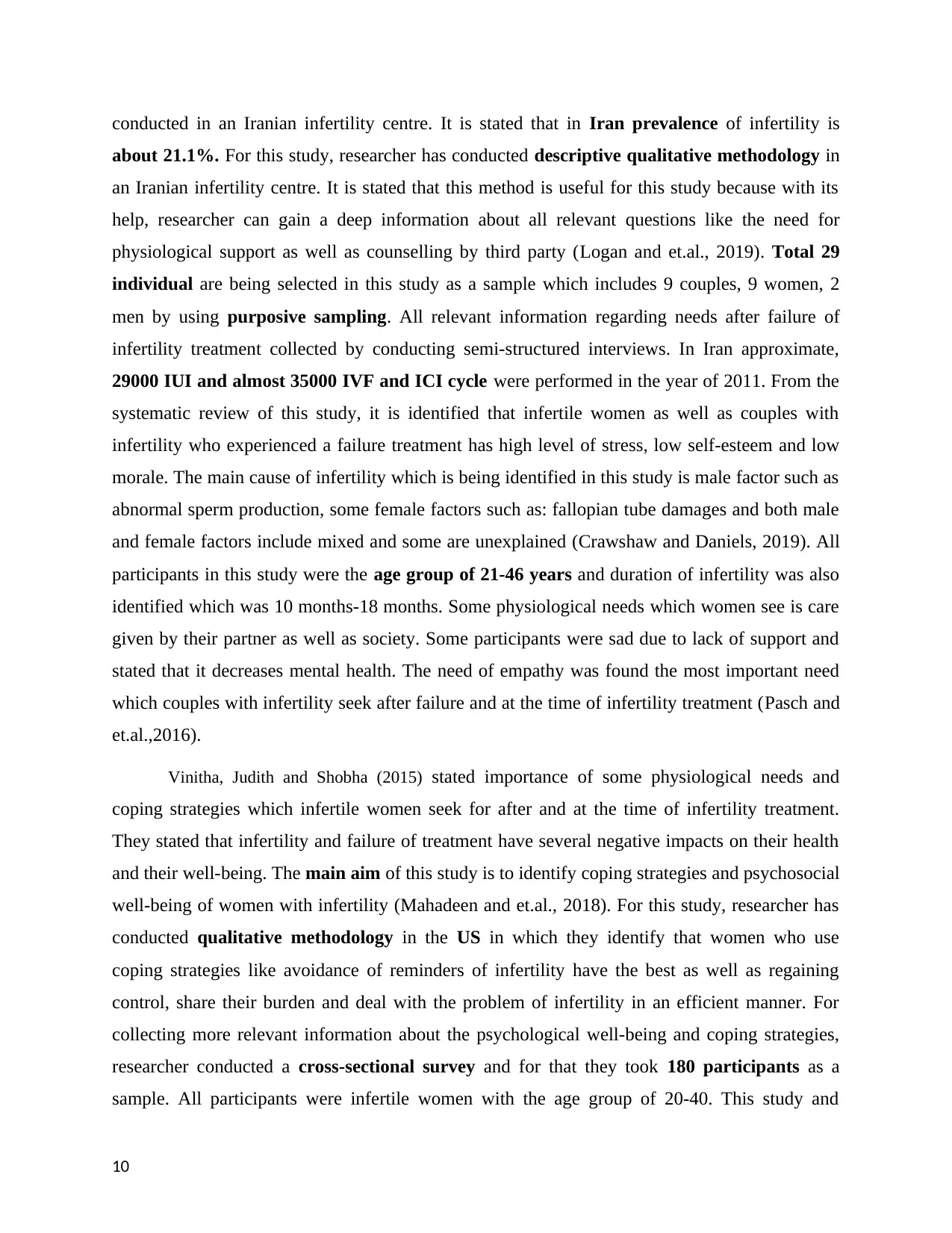
conducted in an Iranian infertility centre. It is stated that in Iran prevalence of infertility is
about 21.1%. For this study, researcher has conducted descriptive qualitative methodology in
an Iranian infertility centre. It is stated that this method is useful for this study because with its
help, researcher can gain a deep information about all relevant questions like the need for
physiological support as well as counselling by third party (Logan and et.al., 2019). Total 29
individual are being selected in this study as a sample which includes 9 couples, 9 women, 2
men by using purposive sampling. All relevant information regarding needs after failure of
infertility treatment collected by conducting semi-structured interviews. In Iran approximate,
29000 IUI and almost 35000 IVF and ICI cycle were performed in the year of 2011. From the
systematic review of this study, it is identified that infertile women as well as couples with
infertility who experienced a failure treatment has high level of stress, low self-esteem and low
morale. The main cause of infertility which is being identified in this study is male factor such as
abnormal sperm production, some female factors such as: fallopian tube damages and both male
and female factors include mixed and some are unexplained (Crawshaw and Daniels, 2019). All
participants in this study were the age group of 21-46 years and duration of infertility was also
identified which was 10 months-18 months. Some physiological needs which women see is care
given by their partner as well as society. Some participants were sad due to lack of support and
stated that it decreases mental health. The need of empathy was found the most important need
which couples with infertility seek after failure and at the time of infertility treatment (Pasch and
et.al.,2016).
Vinitha, Judith and Shobha (2015) stated importance of some physiological needs and
coping strategies which infertile women seek for after and at the time of infertility treatment.
They stated that infertility and failure of treatment have several negative impacts on their health
and their well-being. The main aim of this study is to identify coping strategies and psychosocial
well-being of women with infertility (Mahadeen and et.al., 2018). For this study, researcher has
conducted qualitative methodology in the US in which they identify that women who use
coping strategies like avoidance of reminders of infertility have the best as well as regaining
control, share their burden and deal with the problem of infertility in an efficient manner. For
collecting more relevant information about the psychological well-being and coping strategies,
researcher conducted a cross-sectional survey and for that they took 180 participants as a
sample. All participants were infertile women with the age group of 20-40. This study and
10
about 21.1%. For this study, researcher has conducted descriptive qualitative methodology in
an Iranian infertility centre. It is stated that this method is useful for this study because with its
help, researcher can gain a deep information about all relevant questions like the need for
physiological support as well as counselling by third party (Logan and et.al., 2019). Total 29
individual are being selected in this study as a sample which includes 9 couples, 9 women, 2
men by using purposive sampling. All relevant information regarding needs after failure of
infertility treatment collected by conducting semi-structured interviews. In Iran approximate,
29000 IUI and almost 35000 IVF and ICI cycle were performed in the year of 2011. From the
systematic review of this study, it is identified that infertile women as well as couples with
infertility who experienced a failure treatment has high level of stress, low self-esteem and low
morale. The main cause of infertility which is being identified in this study is male factor such as
abnormal sperm production, some female factors such as: fallopian tube damages and both male
and female factors include mixed and some are unexplained (Crawshaw and Daniels, 2019). All
participants in this study were the age group of 21-46 years and duration of infertility was also
identified which was 10 months-18 months. Some physiological needs which women see is care
given by their partner as well as society. Some participants were sad due to lack of support and
stated that it decreases mental health. The need of empathy was found the most important need
which couples with infertility seek after failure and at the time of infertility treatment (Pasch and
et.al.,2016).
Vinitha, Judith and Shobha (2015) stated importance of some physiological needs and
coping strategies which infertile women seek for after and at the time of infertility treatment.
They stated that infertility and failure of treatment have several negative impacts on their health
and their well-being. The main aim of this study is to identify coping strategies and psychosocial
well-being of women with infertility (Mahadeen and et.al., 2018). For this study, researcher has
conducted qualitative methodology in the US in which they identify that women who use
coping strategies like avoidance of reminders of infertility have the best as well as regaining
control, share their burden and deal with the problem of infertility in an efficient manner. For
collecting more relevant information about the psychological well-being and coping strategies,
researcher conducted a cross-sectional survey and for that they took 180 participants as a
sample. All participants were infertile women with the age group of 20-40. This study and
10
Paraphrase This Document
Need a fresh take? Get an instant paraphrase of this document with our AI Paraphraser
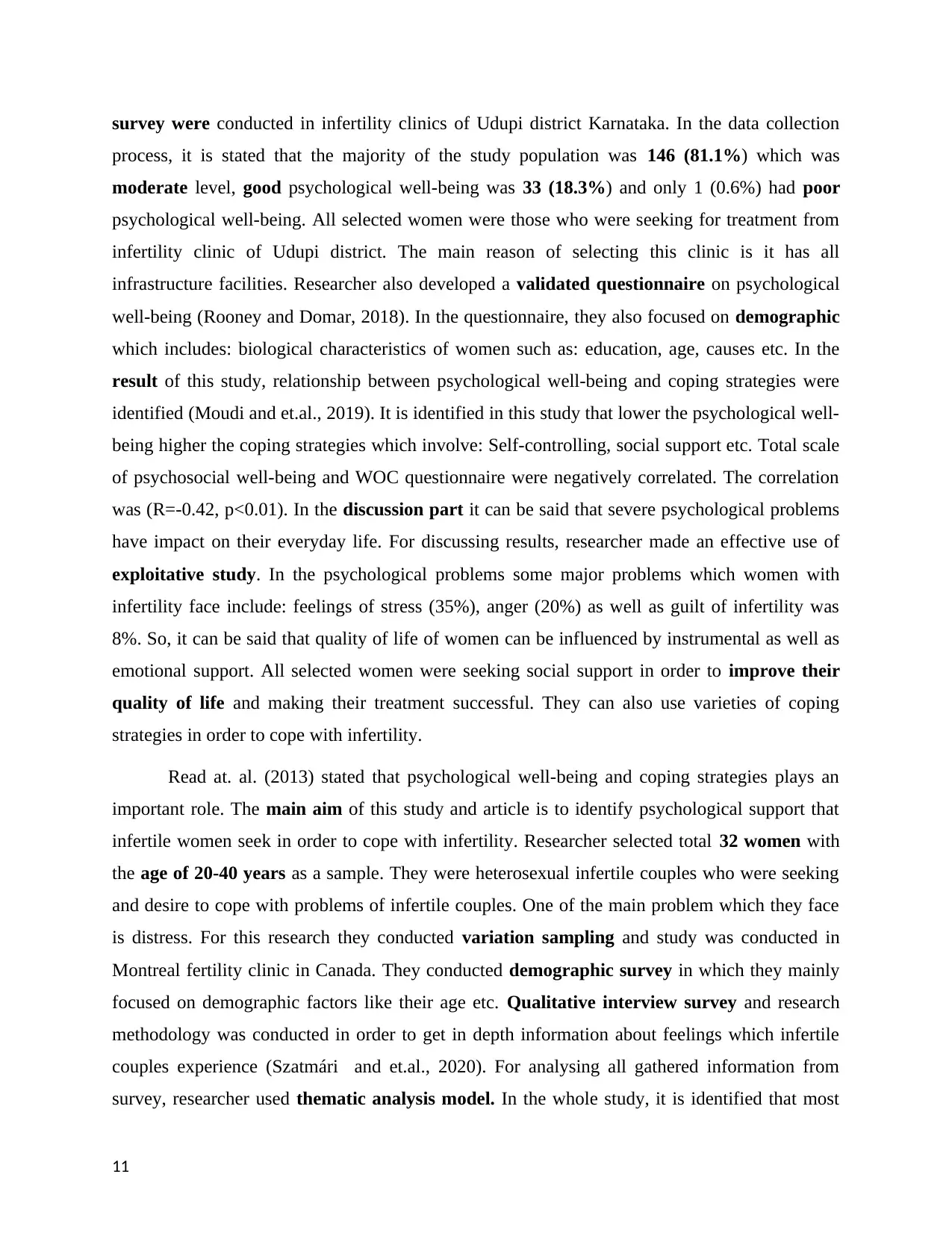
survey were conducted in infertility clinics of Udupi district Karnataka. In the data collection
process, it is stated that the majority of the study population was 146 (81.1%) which was
moderate level, good psychological well-being was 33 (18.3%) and only 1 (0.6%) had poor
psychological well-being. All selected women were those who were seeking for treatment from
infertility clinic of Udupi district. The main reason of selecting this clinic is it has all
infrastructure facilities. Researcher also developed a validated questionnaire on psychological
well-being (Rooney and Domar, 2018). In the questionnaire, they also focused on demographic
which includes: biological characteristics of women such as: education, age, causes etc. In the
result of this study, relationship between psychological well-being and coping strategies were
identified (Moudi and et.al., 2019). It is identified in this study that lower the psychological well-
being higher the coping strategies which involve: Self-controlling, social support etc. Total scale
of psychosocial well-being and WOC questionnaire were negatively correlated. The correlation
was (R=-0.42, p<0.01). In the discussion part it can be said that severe psychological problems
have impact on their everyday life. For discussing results, researcher made an effective use of
exploitative study. In the psychological problems some major problems which women with
infertility face include: feelings of stress (35%), anger (20%) as well as guilt of infertility was
8%. So, it can be said that quality of life of women can be influenced by instrumental as well as
emotional support. All selected women were seeking social support in order to improve their
quality of life and making their treatment successful. They can also use varieties of coping
strategies in order to cope with infertility.
Read at. al. (2013) stated that psychological well-being and coping strategies plays an
important role. The main aim of this study and article is to identify psychological support that
infertile women seek in order to cope with infertility. Researcher selected total 32 women with
the age of 20-40 years as a sample. They were heterosexual infertile couples who were seeking
and desire to cope with problems of infertile couples. One of the main problem which they face
is distress. For this research they conducted variation sampling and study was conducted in
Montreal fertility clinic in Canada. They conducted demographic survey in which they mainly
focused on demographic factors like their age etc. Qualitative interview survey and research
methodology was conducted in order to get in depth information about feelings which infertile
couples experience (Szatmári and et.al., 2020). For analysing all gathered information from
survey, researcher used thematic analysis model. In the whole study, it is identified that most
11
process, it is stated that the majority of the study population was 146 (81.1%) which was
moderate level, good psychological well-being was 33 (18.3%) and only 1 (0.6%) had poor
psychological well-being. All selected women were those who were seeking for treatment from
infertility clinic of Udupi district. The main reason of selecting this clinic is it has all
infrastructure facilities. Researcher also developed a validated questionnaire on psychological
well-being (Rooney and Domar, 2018). In the questionnaire, they also focused on demographic
which includes: biological characteristics of women such as: education, age, causes etc. In the
result of this study, relationship between psychological well-being and coping strategies were
identified (Moudi and et.al., 2019). It is identified in this study that lower the psychological well-
being higher the coping strategies which involve: Self-controlling, social support etc. Total scale
of psychosocial well-being and WOC questionnaire were negatively correlated. The correlation
was (R=-0.42, p<0.01). In the discussion part it can be said that severe psychological problems
have impact on their everyday life. For discussing results, researcher made an effective use of
exploitative study. In the psychological problems some major problems which women with
infertility face include: feelings of stress (35%), anger (20%) as well as guilt of infertility was
8%. So, it can be said that quality of life of women can be influenced by instrumental as well as
emotional support. All selected women were seeking social support in order to improve their
quality of life and making their treatment successful. They can also use varieties of coping
strategies in order to cope with infertility.
Read at. al. (2013) stated that psychological well-being and coping strategies plays an
important role. The main aim of this study and article is to identify psychological support that
infertile women seek in order to cope with infertility. Researcher selected total 32 women with
the age of 20-40 years as a sample. They were heterosexual infertile couples who were seeking
and desire to cope with problems of infertile couples. One of the main problem which they face
is distress. For this research they conducted variation sampling and study was conducted in
Montreal fertility clinic in Canada. They conducted demographic survey in which they mainly
focused on demographic factors like their age etc. Qualitative interview survey and research
methodology was conducted in order to get in depth information about feelings which infertile
couples experience (Szatmári and et.al., 2020). For analysing all gathered information from
survey, researcher used thematic analysis model. In the whole study, it is identified that most
11
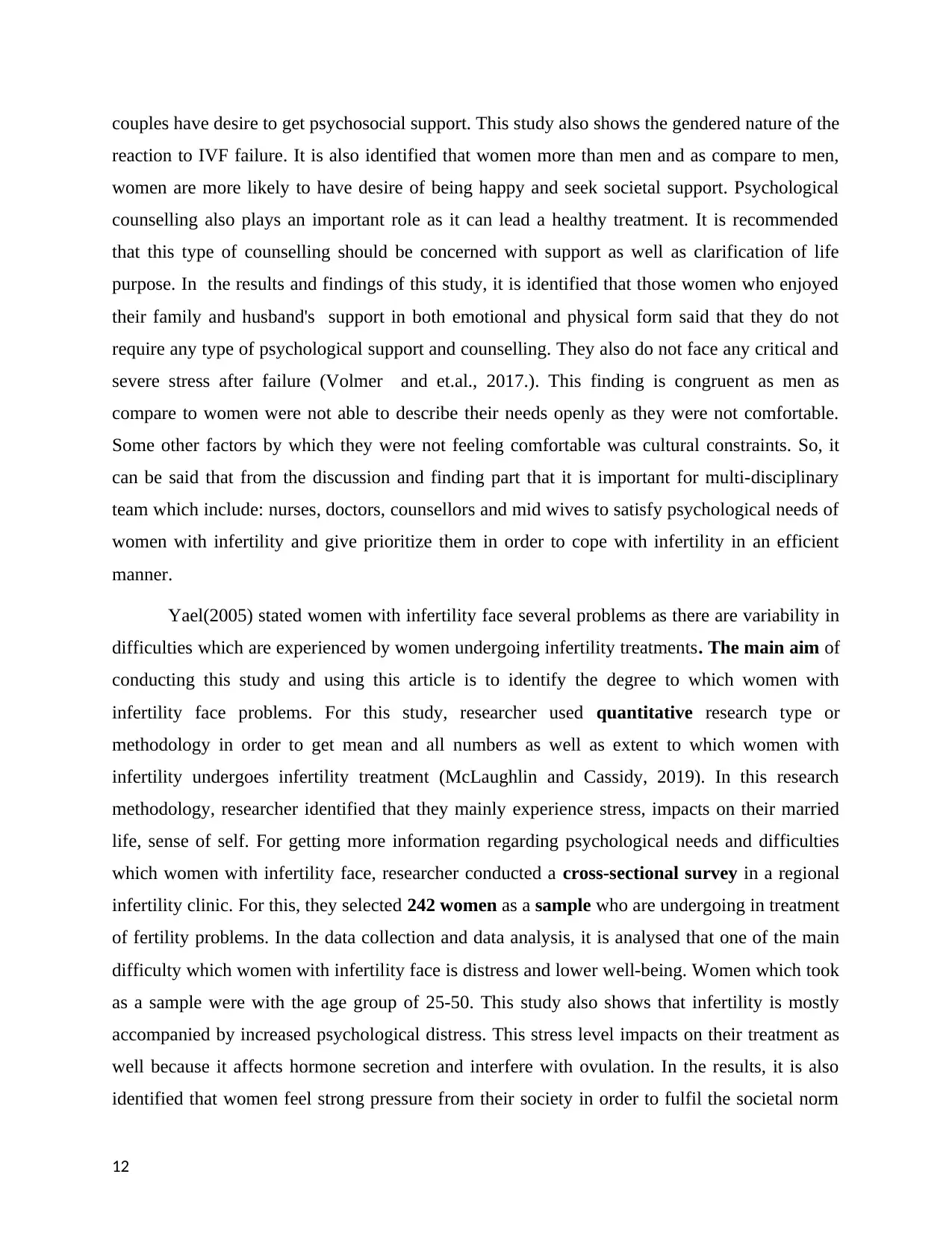
couples have desire to get psychosocial support. This study also shows the gendered nature of the
reaction to IVF failure. It is also identified that women more than men and as compare to men,
women are more likely to have desire of being happy and seek societal support. Psychological
counselling also plays an important role as it can lead a healthy treatment. It is recommended
that this type of counselling should be concerned with support as well as clarification of life
purpose. In the results and findings of this study, it is identified that those women who enjoyed
their family and husband's support in both emotional and physical form said that they do not
require any type of psychological support and counselling. They also do not face any critical and
severe stress after failure (Volmer and et.al., 2017.). This finding is congruent as men as
compare to women were not able to describe their needs openly as they were not comfortable.
Some other factors by which they were not feeling comfortable was cultural constraints. So, it
can be said that from the discussion and finding part that it is important for multi-disciplinary
team which include: nurses, doctors, counsellors and mid wives to satisfy psychological needs of
women with infertility and give prioritize them in order to cope with infertility in an efficient
manner.
Yael(2005) stated women with infertility face several problems as there are variability in
difficulties which are experienced by women undergoing infertility treatments. The main aim of
conducting this study and using this article is to identify the degree to which women with
infertility face problems. For this study, researcher used quantitative research type or
methodology in order to get mean and all numbers as well as extent to which women with
infertility undergoes infertility treatment (McLaughlin and Cassidy, 2019). In this research
methodology, researcher identified that they mainly experience stress, impacts on their married
life, sense of self. For getting more information regarding psychological needs and difficulties
which women with infertility face, researcher conducted a cross-sectional survey in a regional
infertility clinic. For this, they selected 242 women as a sample who are undergoing in treatment
of fertility problems. In the data collection and data analysis, it is analysed that one of the main
difficulty which women with infertility face is distress and lower well-being. Women which took
as a sample were with the age group of 25-50. This study also shows that infertility is mostly
accompanied by increased psychological distress. This stress level impacts on their treatment as
well because it affects hormone secretion and interfere with ovulation. In the results, it is also
identified that women feel strong pressure from their society in order to fulfil the societal norm
12
reaction to IVF failure. It is also identified that women more than men and as compare to men,
women are more likely to have desire of being happy and seek societal support. Psychological
counselling also plays an important role as it can lead a healthy treatment. It is recommended
that this type of counselling should be concerned with support as well as clarification of life
purpose. In the results and findings of this study, it is identified that those women who enjoyed
their family and husband's support in both emotional and physical form said that they do not
require any type of psychological support and counselling. They also do not face any critical and
severe stress after failure (Volmer and et.al., 2017.). This finding is congruent as men as
compare to women were not able to describe their needs openly as they were not comfortable.
Some other factors by which they were not feeling comfortable was cultural constraints. So, it
can be said that from the discussion and finding part that it is important for multi-disciplinary
team which include: nurses, doctors, counsellors and mid wives to satisfy psychological needs of
women with infertility and give prioritize them in order to cope with infertility in an efficient
manner.
Yael(2005) stated women with infertility face several problems as there are variability in
difficulties which are experienced by women undergoing infertility treatments. The main aim of
conducting this study and using this article is to identify the degree to which women with
infertility face problems. For this study, researcher used quantitative research type or
methodology in order to get mean and all numbers as well as extent to which women with
infertility undergoes infertility treatment (McLaughlin and Cassidy, 2019). In this research
methodology, researcher identified that they mainly experience stress, impacts on their married
life, sense of self. For getting more information regarding psychological needs and difficulties
which women with infertility face, researcher conducted a cross-sectional survey in a regional
infertility clinic. For this, they selected 242 women as a sample who are undergoing in treatment
of fertility problems. In the data collection and data analysis, it is analysed that one of the main
difficulty which women with infertility face is distress and lower well-being. Women which took
as a sample were with the age group of 25-50. This study also shows that infertility is mostly
accompanied by increased psychological distress. This stress level impacts on their treatment as
well because it affects hormone secretion and interfere with ovulation. In the results, it is also
identified that women feel strong pressure from their society in order to fulfil the societal norm
12
⊘ This is a preview!⊘
Do you want full access?
Subscribe today to unlock all pages.
Trusted by 1+ million students worldwide

1 out of 32


Related Documents


Your All-in-One AI-Powered Toolkit for Academic Success.
+13062052269
info@desklib.com
Available 24*7 on WhatsApp / Email
![[object Object]](/_next/static/media/star-bottom.7253800d.svg)
Unlock your academic potential
Copyright © 2020–2026 A2Z Services. All Rights Reserved. Developed and managed by ZUCOL.