Risk and Protective Factors for Psychotic Disorders in Young UK Adults
VerifiedAdded on 2023/01/11
|18
|6326
|25
Report
AI Summary
This report delves into the analysis of risk and protective factors for psychotic disorders among young people aged 16-25 in the UK. It begins with an introduction that defines psychotic disorders and highlights their prevalence and impact. The report then explores the aims and objectives, research questions, and rationale for the study. The literature review examines various themes including protective and risk factors, psychotic disorders in individuals aged 16-25, processes to overcome risk factors, and ways to improve health conditions. The methodology section outlines the research type, data collection methods, literature search strategy, research approach, design, reliability, validity, and ethical considerations. The report also includes data analysis, findings, results, conclusions, and recommendations. Finally, it provides a comprehensive list of references used in the research.
What are the Risk and Protective
Factors for Psychotic Disorders Among
Young Me Aged 16-25 in the UK
Factors for Psychotic Disorders Among
Young Me Aged 16-25 in the UK

Paraphrase This Document
Need a fresh take? Get an instant paraphrase of this document with our AI Paraphraser
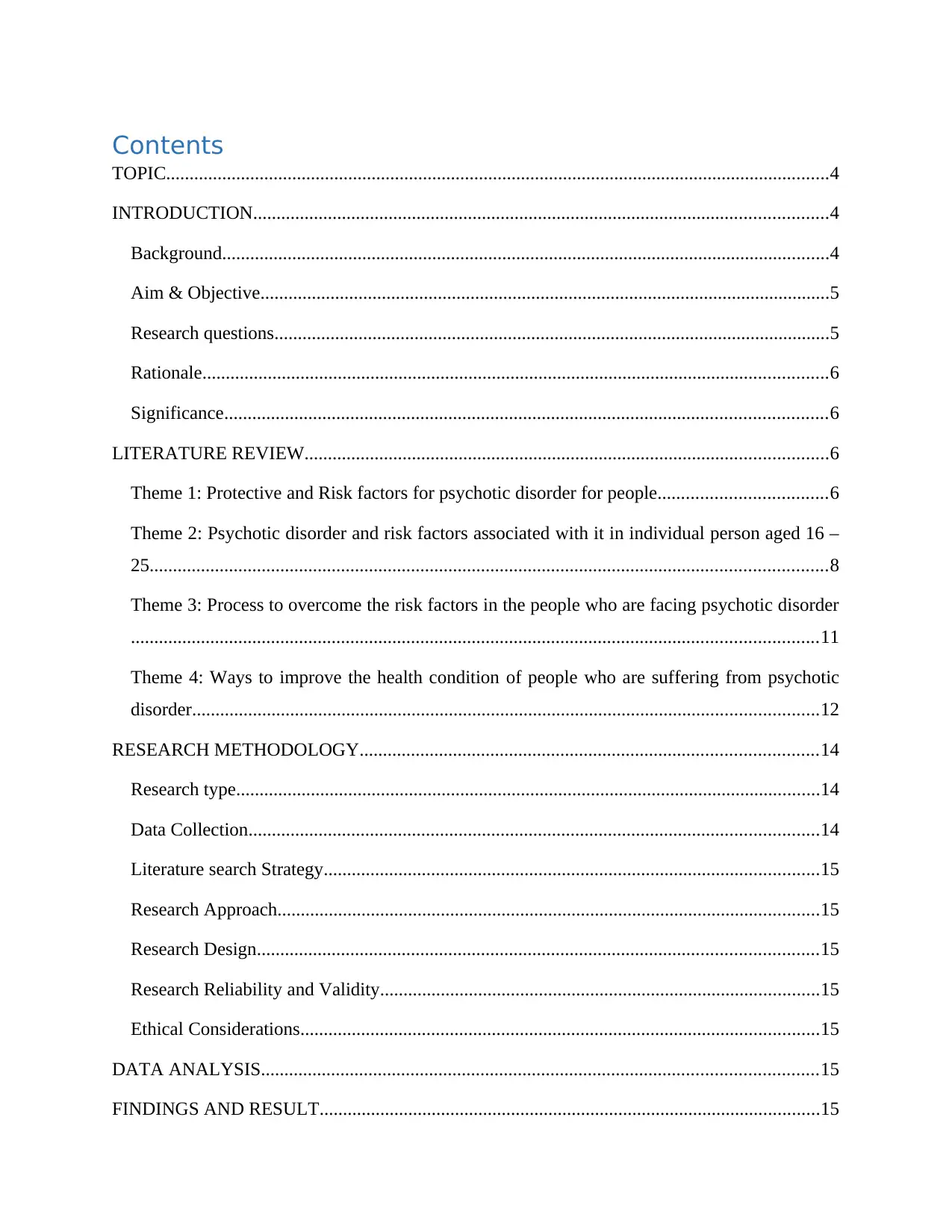
Contents
TOPIC..............................................................................................................................................4
INTRODUCTION...........................................................................................................................4
Background..................................................................................................................................4
Aim & Objective..........................................................................................................................5
Research questions.......................................................................................................................5
Rationale......................................................................................................................................6
Significance.................................................................................................................................6
LITERATURE REVIEW................................................................................................................6
Theme 1: Protective and Risk factors for psychotic disorder for people....................................6
Theme 2: Psychotic disorder and risk factors associated with it in individual person aged 16 –
25.................................................................................................................................................8
Theme 3: Process to overcome the risk factors in the people who are facing psychotic disorder
...................................................................................................................................................11
Theme 4: Ways to improve the health condition of people who are suffering from psychotic
disorder......................................................................................................................................12
RESEARCH METHODOLOGY..................................................................................................14
Research type.............................................................................................................................14
Data Collection..........................................................................................................................14
Literature search Strategy..........................................................................................................15
Research Approach....................................................................................................................15
Research Design........................................................................................................................15
Research Reliability and Validity..............................................................................................15
Ethical Considerations...............................................................................................................15
DATA ANALYSIS.......................................................................................................................15
FINDINGS AND RESULT...........................................................................................................15
TOPIC..............................................................................................................................................4
INTRODUCTION...........................................................................................................................4
Background..................................................................................................................................4
Aim & Objective..........................................................................................................................5
Research questions.......................................................................................................................5
Rationale......................................................................................................................................6
Significance.................................................................................................................................6
LITERATURE REVIEW................................................................................................................6
Theme 1: Protective and Risk factors for psychotic disorder for people....................................6
Theme 2: Psychotic disorder and risk factors associated with it in individual person aged 16 –
25.................................................................................................................................................8
Theme 3: Process to overcome the risk factors in the people who are facing psychotic disorder
...................................................................................................................................................11
Theme 4: Ways to improve the health condition of people who are suffering from psychotic
disorder......................................................................................................................................12
RESEARCH METHODOLOGY..................................................................................................14
Research type.............................................................................................................................14
Data Collection..........................................................................................................................14
Literature search Strategy..........................................................................................................15
Research Approach....................................................................................................................15
Research Design........................................................................................................................15
Research Reliability and Validity..............................................................................................15
Ethical Considerations...............................................................................................................15
DATA ANALYSIS.......................................................................................................................15
FINDINGS AND RESULT...........................................................................................................15

CONCLUSION..............................................................................................................................15
RECOMMENDATIONS...............................................................................................................15
REFERENCES..............................................................................................................................16
RECOMMENDATIONS...............................................................................................................15
REFERENCES..............................................................................................................................16
⊘ This is a preview!⊘
Do you want full access?
Subscribe today to unlock all pages.

Trusted by 1+ million students worldwide
TOPIC
To analyse the risk and protective factors for psychotic disorders among young
me aged 16-25 in the UK.
INTRODUCTION
Background
The psychotic disorders are considered as characteristics by a disconnection from reality.
This can be considered result of psychiatric illness such as schizophrenia. Mental disorder can
affect the health condition of people and lead them to the sever conditions. There are different
symptoms of the psychiatric illness are known as delusion, hallucinations, agitation and talking
incoherently. In this conditions people who are suffering from psychiatric illness are mostly not
aware of their mental and physical health condition. There are different type of therapies can be
provided to the patient in order to provide them better cure for their conditions. Sometimes these
condition are recoverable and sometimes it is quite difficult for the doctors to provide better cure
to the situation of the individual person in order to cure their illness. There are many people in
country are suffering from mental and physical health conditions. The frequency of the mental
illness in United Kingdom is very high. In the each people person is suffering from mental
illness. This is highly challenging for the country to improve the conditions of the people in the
country. There are total 792 million people are affected of mental health issue all over the world.
The cost of mental issues to the country is about 74 to 99 million each year. Due to mental health
issues different people suffer from losing their job. In UK there are about 300000 people have
lost their job due to mental illness. The cost that is estimated in England due to mental illness is
about 105 billion. As per a research most of the mental illness starts from the age of 18 year. For
example dementia is known as one of the most famous mental health issue in world. This is
known as progressive neurological disorder that does not occur before age of 30. Among the
group of people who are suffering from mental illness there are 70 to 75 people diagnosed with
mental illness that receives no treatment at all. Since year 1993 the cases of mental illness are
continuously increasing in United Kingdom. This increment is continuous in span of 1993 to
2014. In the case of women they are more likely to be suffering from mental illness. Women in
UK are more diagnosed with mental illness. The number of women infected in country are more
in each group. But in case of the men, suicidal rate is high in men. Mental problems stats at early
To analyse the risk and protective factors for psychotic disorders among young
me aged 16-25 in the UK.
INTRODUCTION
Background
The psychotic disorders are considered as characteristics by a disconnection from reality.
This can be considered result of psychiatric illness such as schizophrenia. Mental disorder can
affect the health condition of people and lead them to the sever conditions. There are different
symptoms of the psychiatric illness are known as delusion, hallucinations, agitation and talking
incoherently. In this conditions people who are suffering from psychiatric illness are mostly not
aware of their mental and physical health condition. There are different type of therapies can be
provided to the patient in order to provide them better cure for their conditions. Sometimes these
condition are recoverable and sometimes it is quite difficult for the doctors to provide better cure
to the situation of the individual person in order to cure their illness. There are many people in
country are suffering from mental and physical health conditions. The frequency of the mental
illness in United Kingdom is very high. In the each people person is suffering from mental
illness. This is highly challenging for the country to improve the conditions of the people in the
country. There are total 792 million people are affected of mental health issue all over the world.
The cost of mental issues to the country is about 74 to 99 million each year. Due to mental health
issues different people suffer from losing their job. In UK there are about 300000 people have
lost their job due to mental illness. The cost that is estimated in England due to mental illness is
about 105 billion. As per a research most of the mental illness starts from the age of 18 year. For
example dementia is known as one of the most famous mental health issue in world. This is
known as progressive neurological disorder that does not occur before age of 30. Among the
group of people who are suffering from mental illness there are 70 to 75 people diagnosed with
mental illness that receives no treatment at all. Since year 1993 the cases of mental illness are
continuously increasing in United Kingdom. This increment is continuous in span of 1993 to
2014. In the case of women they are more likely to be suffering from mental illness. Women in
UK are more diagnosed with mental illness. The number of women infected in country are more
in each group. But in case of the men, suicidal rate is high in men. Mental problems stats at early
Paraphrase This Document
Need a fresh take? Get an instant paraphrase of this document with our AI Paraphraser
age but with getting older the metal health issues are more frequent and common. In old age
people 3 out of 4 people are suffering with mental illness. In middle aged people each one out of
two person is suffering mental illness. In children conditions of mental illness is less frequent
and in cases of children 1 out of 10 children is suffering from mental illness. The main issue is
related to the funding condition where the health care organization do not have enough financial
resources to provide better care to the people who are suffering from mental illness. This is
important for the government and health care organization to improve the health conditions that
can help the people who are suffering from different health conditions. The attitude of people is
now getting better with the time. People are showing more positive attitude for health conditions.
These is how it is highly challenging for the UK government to improve the health standards in
the country to reduce the number of mentally ill people in United Kingdom.
Aim & Objective
The main aim and objectives of the research project are-
Aim
“To analyse the risk and protective factors for psychotic disorders among young
me aged 16-25 in the UK.”
Objective
To analyse the protective and Risk factors for psychotic disorder for people.
To analyse various risk factors in Psychotic disorder in individual person aged 16 – 25.
To evaluate the process overcome the risk factors in the people who are facing psychotic
disorder.
To evaluate the ways to improve the health condition of people who are suffering from
psychotic disorder.
Research questions
O1: Highlighting the prevalence of psychotic disorders among young people who live in London
O2:Identifying the risk and protective factors involved in the development of psychotic disorders
among the target population
O3:Exploring the long and short-term outcomes of psychotic disorders for young Londoners
people 3 out of 4 people are suffering with mental illness. In middle aged people each one out of
two person is suffering mental illness. In children conditions of mental illness is less frequent
and in cases of children 1 out of 10 children is suffering from mental illness. The main issue is
related to the funding condition where the health care organization do not have enough financial
resources to provide better care to the people who are suffering from mental illness. This is
important for the government and health care organization to improve the health conditions that
can help the people who are suffering from different health conditions. The attitude of people is
now getting better with the time. People are showing more positive attitude for health conditions.
These is how it is highly challenging for the UK government to improve the health standards in
the country to reduce the number of mentally ill people in United Kingdom.
Aim & Objective
The main aim and objectives of the research project are-
Aim
“To analyse the risk and protective factors for psychotic disorders among young
me aged 16-25 in the UK.”
Objective
To analyse the protective and Risk factors for psychotic disorder for people.
To analyse various risk factors in Psychotic disorder in individual person aged 16 – 25.
To evaluate the process overcome the risk factors in the people who are facing psychotic
disorder.
To evaluate the ways to improve the health condition of people who are suffering from
psychotic disorder.
Research questions
O1: Highlighting the prevalence of psychotic disorders among young people who live in London
O2:Identifying the risk and protective factors involved in the development of psychotic disorders
among the target population
O3:Exploring the long and short-term outcomes of psychotic disorders for young Londoners
O4: Analyzing the impact of policy and strategic measures such as early intervention on the
improvement of the long and short-term outcomes of young Londoners suffering from psychotic
disorders.
Rationale
Selecting this topic is most have various reasons that can help the people and health care
organization. The main reason behind selecting this topic is regarding improve the awareness in
people who are can use the knowledge that is provided in report to improve the health care
conditions and social treatment to these people. The knowledge saved in the research can be used
by the health care organization to evaluate the challenges that are faced by the people in order to
improve their situation in society. The changes that can be understood by the health care
organization to development various improvements in the organization to get better solutions for
these people. Some of the major challenges that are faced by the mentally ill people can be
targeted with help of these research report. This report can be utilised by the health care
organizations to develop better services for the people who are suffering from mental illness.
Significance
There are different challenges are faces by the people in in real life when they are facing
such problem as mental illness. This is challenge for both individual patient and their family
members. This is challenging for the people to make survival with mental illness without any
troubles. These report can help the people to develop effective changes in the health care and
social care services to provide better situations to the people who are suffering from major or
minor mental health problems. This research can be used by different people as base of their
research in order to develop new research work. This research work ca be used by the other
researcher to find out the new field of research work. Medical and social care services can use
report to make proper arrangements for the challenges and risks that is faced by mentally ill
people in local areas.
LITERATURE REVIEW
Theme 1: Protective and Risk factors for psychotic disorder for people
Before knowing various protective and risk this is important for the people to analyse
various factors that are related to the protective and risk factors for better analysis of the mentally
ill people. as per the view of protective factors are known as conditions or attributes of individual
improvement of the long and short-term outcomes of young Londoners suffering from psychotic
disorders.
Rationale
Selecting this topic is most have various reasons that can help the people and health care
organization. The main reason behind selecting this topic is regarding improve the awareness in
people who are can use the knowledge that is provided in report to improve the health care
conditions and social treatment to these people. The knowledge saved in the research can be used
by the health care organization to evaluate the challenges that are faced by the people in order to
improve their situation in society. The changes that can be understood by the health care
organization to development various improvements in the organization to get better solutions for
these people. Some of the major challenges that are faced by the mentally ill people can be
targeted with help of these research report. This report can be utilised by the health care
organizations to develop better services for the people who are suffering from mental illness.
Significance
There are different challenges are faces by the people in in real life when they are facing
such problem as mental illness. This is challenge for both individual patient and their family
members. This is challenging for the people to make survival with mental illness without any
troubles. These report can help the people to develop effective changes in the health care and
social care services to provide better situations to the people who are suffering from major or
minor mental health problems. This research can be used by different people as base of their
research in order to develop new research work. This research work ca be used by the other
researcher to find out the new field of research work. Medical and social care services can use
report to make proper arrangements for the challenges and risks that is faced by mentally ill
people in local areas.
LITERATURE REVIEW
Theme 1: Protective and Risk factors for psychotic disorder for people
Before knowing various protective and risk this is important for the people to analyse
various factors that are related to the protective and risk factors for better analysis of the mentally
ill people. as per the view of protective factors are known as conditions or attributes of individual
⊘ This is a preview!⊘
Do you want full access?
Subscribe today to unlock all pages.
Trusted by 1+ million students worldwide
person, families, communities and much larger societies that can help the people to solve various
events and mitigate the risk elements in families and communities (Franzen and Buysse, 2017).
Some of the major factors or attributes that are considered in the protective factors are known as-
skills of people, strengths, resources, supporting elements, and coping strategies. These all
attributes of people can be considered as protective factor.
As per the view of Lebow and Chen, (2016) there are different factors can be included in
the protective factor for the people who are suffering from various type of mental illness. Some
of the major example of these protective factors are- positive attitude of people, positive values
and beliefs of people and society, skills that can help the people to solve various kind of
conflicts, the health attributes also can be considered as positive factors that can be used by the
organization for effective health conditions of the people. for example effective mental, physical,
spiritual and emotional health of the people can be considered as major protective factor that can
help the mentally ill people to get recover fast of gain no harm from society or people who lives
nearby them. Positive self esteem is also one of the most important protective factor for the
people who are suffering from mental health issues. Other protective factors for mentally ill
people are- success on various platforms, good and effective parenting skills, parental
supervision, and strong social support. These all are major factors that can help the patient to get
recover in effective way and make effective survival through the medication and therapy process.
According to the view of Kendler, (2016) all the protective factors which are considered
for the mentally ill people can be considered as aid that can improve the health condition of the
people who are suffering from critical health issues that can affect the recovery process of the
patient or later can make their situation more critical. The role of protective factors can be
considered for the people who needs medical aid along with social need in order to effectively
recover from their mentally ill state. These factors can help the health care officials to provide
better services to the patients in order to improve their recovery rate or help them to stay stable in
critical health conditions. These all factors can be utilised by the medical organization to
motivate the people who are suffering from mental health issue. these factors can be utilised in
various therapies which that can help the patients to improve recovery rate. this is how protective
factors can be utilised by the organization to effectively develop mental and physical health of
the people.
events and mitigate the risk elements in families and communities (Franzen and Buysse, 2017).
Some of the major factors or attributes that are considered in the protective factors are known as-
skills of people, strengths, resources, supporting elements, and coping strategies. These all
attributes of people can be considered as protective factor.
As per the view of Lebow and Chen, (2016) there are different factors can be included in
the protective factor for the people who are suffering from various type of mental illness. Some
of the major example of these protective factors are- positive attitude of people, positive values
and beliefs of people and society, skills that can help the people to solve various kind of
conflicts, the health attributes also can be considered as positive factors that can be used by the
organization for effective health conditions of the people. for example effective mental, physical,
spiritual and emotional health of the people can be considered as major protective factor that can
help the mentally ill people to get recover fast of gain no harm from society or people who lives
nearby them. Positive self esteem is also one of the most important protective factor for the
people who are suffering from mental health issues. Other protective factors for mentally ill
people are- success on various platforms, good and effective parenting skills, parental
supervision, and strong social support. These all are major factors that can help the patient to get
recover in effective way and make effective survival through the medication and therapy process.
According to the view of Kendler, (2016) all the protective factors which are considered
for the mentally ill people can be considered as aid that can improve the health condition of the
people who are suffering from critical health issues that can affect the recovery process of the
patient or later can make their situation more critical. The role of protective factors can be
considered for the people who needs medical aid along with social need in order to effectively
recover from their mentally ill state. These factors can help the health care officials to provide
better services to the patients in order to improve their recovery rate or help them to stay stable in
critical health conditions. These all factors can be utilised by the medical organization to
motivate the people who are suffering from mental health issue. these factors can be utilised in
various therapies which that can help the patients to improve recovery rate. this is how protective
factors can be utilised by the organization to effectively develop mental and physical health of
the people.
Paraphrase This Document
Need a fresh take? Get an instant paraphrase of this document with our AI Paraphraser
As per the view of Sullivan and Geschwind, (2019)there are some risk factors are also
there that can be considered by health care organization and societies in order to help the patients
in the adverse conditions. The factors that can affect the mental health of the people are
considered as risk factors. These factors are more critical for the health care organization to
consider in the medication and therapy sessions in order to improve the recovery rate of the
people. These factors can be considered by the organization to provide better and effective
conditions to the patient to improve their chances getting back to the normal life. As per the
definition of the risk factors, thee are the factors that can negatively influence the life of
individual person or group of people in the society or community. The impact of these factor is
negative for the mental health condition for the patients. This is difficult for the health care and
social care organization to provide better conditions and facilities to the mentally ill people.
Some of the risk factors for the people who are facing mental illness. Some of the major risk
factors that can affect the health of the people in negative way. There are different factors which
are negative for the people who can affect that can affect the people. Major factors that can affect
the health condition of the people are- negative attitude, value of beliefs, low self esteem, drug,
alcohol, solvent abuse, poverty, children of parents in conflict with the law, homelessness,
presence of neighbourhood crime, early and repeated anti-social behaviour, lack of positive role
models, children who witnessed violence, lack of services, unemployment or underemployment,
family distress, racism, mental or physical health, low literacy and family violence.
As per the view of Marín, (2016)these are major factors that can affect the health
conditions of the people. The impact of these factor are more critical for people. These people
can affect the mental health stability of the people. These factors are high negative for the
people. These factors can cause negative impact on the people and their personality and health
conditions. This factors can lead to affect the physical and mental health conditions of the
people.
Theme 2: Psychotic disorder and risk factors associated with it in individual person aged 16 – 25
According to the view of De Vries and Van Busschbach, (2017) Psychotic disorder in
individuals’ persons especially among people of age 16-25 years is quite risky. Psychotic
disorder is also known as Psychosis. It is a kind of disorder in which individual’s loss contact
with reality. It includes seeing or hearing things that are not even there (hallucinating). One of
the most common Psychotic disorder that are most common among youngsters of age 16 - 25
there that can be considered by health care organization and societies in order to help the patients
in the adverse conditions. The factors that can affect the mental health of the people are
considered as risk factors. These factors are more critical for the health care organization to
consider in the medication and therapy sessions in order to improve the recovery rate of the
people. These factors can be considered by the organization to provide better and effective
conditions to the patient to improve their chances getting back to the normal life. As per the
definition of the risk factors, thee are the factors that can negatively influence the life of
individual person or group of people in the society or community. The impact of these factor is
negative for the mental health condition for the patients. This is difficult for the health care and
social care organization to provide better conditions and facilities to the mentally ill people.
Some of the risk factors for the people who are facing mental illness. Some of the major risk
factors that can affect the health of the people in negative way. There are different factors which
are negative for the people who can affect that can affect the people. Major factors that can affect
the health condition of the people are- negative attitude, value of beliefs, low self esteem, drug,
alcohol, solvent abuse, poverty, children of parents in conflict with the law, homelessness,
presence of neighbourhood crime, early and repeated anti-social behaviour, lack of positive role
models, children who witnessed violence, lack of services, unemployment or underemployment,
family distress, racism, mental or physical health, low literacy and family violence.
As per the view of Marín, (2016)these are major factors that can affect the health
conditions of the people. The impact of these factor are more critical for people. These people
can affect the mental health stability of the people. These factors are high negative for the
people. These factors can cause negative impact on the people and their personality and health
conditions. This factors can lead to affect the physical and mental health conditions of the
people.
Theme 2: Psychotic disorder and risk factors associated with it in individual person aged 16 – 25
According to the view of De Vries and Van Busschbach, (2017) Psychotic disorder in
individuals’ persons especially among people of age 16-25 years is quite risky. Psychotic
disorder is also known as Psychosis. It is a kind of disorder in which individual’s loss contact
with reality. It includes seeing or hearing things that are not even there (hallucinating). One of
the most common Psychotic disorder that are most common among youngsters of age 16 - 25
years are schizophrenia, schizotypal personality disorder, delusional disorder, catatonia. Out of
all of these Schizophrenia is one of the most common psychotic disorder which is mostly seen
within individuals who are in their mid- late teenage (approximately 16 years) to late 20’s i.e.
approximately 25 years of age. There are various kinds of reasons because of which these
psychotic disorders occur among such individuals are quite complex. There is no one reason
because of which this disorder occurs. It is quite difficult to understand reasons because of which
this disorder occurs. There are various factors that results in this disorder. It is a result of
complex web of underlying genetic, hereditary, psychological, and environmental factors.
Sometimes due to some medical conditions like brain tumour, brain infection, blood salt
imbalance, metabolic disorders, seizure disorder and many others this disorder occurs. Some of
the most common symptoms of such kind of disorder are: difficulty in concentrating, depressed
moods, sleeping too much, anxiety, hallucination, depression, suicidal thoughts or actions and
many more.
As per the view of de Vries and et. al., (2019) there are various kinds of risk factors
associated with development of psychotic disorder in youngsters of age 16-25 years. Its quite
difficulty to precisely identify who is likely to develop psychotic disorder. However, various
kinds of research have taken place that clearly explains that one of the most prominent factors
due to which psychotic disorder among 16-25 years of age group of individuals can occur is
genetics. Genetics play a vital role in this. People are likely to develop this disorder if they have
a close family member like their siblings or parents who are suffering from psychotic disorder.
This many times because one of the main and prevailing risk factors that can increase chances of
developing psychotic disorder among individuals between age group of 16-25 years. Other than
this there are many other factors because of which risk of psychotic disorder development among
individuals increases such as: children with genetic mutation known as 22q11.2 deletion
syndrome are also one of those individuals who are as risk of developing psychotic disorder
especially schizophrenia.
In reference to research done by Isvoranu and et. al., (2016) explains that there are
various kinds of psychotic disorder and each one of then has their own risk associated with it.
Many times, when a person is extremely stressed or suffers an extreme situation such as death of
a family member, they become vulnerable to or their risk of developing brief psychotic disorder
increases. But this disorder is quite temporary and is the lowest risk factor that can impact 16-25
all of these Schizophrenia is one of the most common psychotic disorder which is mostly seen
within individuals who are in their mid- late teenage (approximately 16 years) to late 20’s i.e.
approximately 25 years of age. There are various kinds of reasons because of which these
psychotic disorders occur among such individuals are quite complex. There is no one reason
because of which this disorder occurs. It is quite difficult to understand reasons because of which
this disorder occurs. There are various factors that results in this disorder. It is a result of
complex web of underlying genetic, hereditary, psychological, and environmental factors.
Sometimes due to some medical conditions like brain tumour, brain infection, blood salt
imbalance, metabolic disorders, seizure disorder and many others this disorder occurs. Some of
the most common symptoms of such kind of disorder are: difficulty in concentrating, depressed
moods, sleeping too much, anxiety, hallucination, depression, suicidal thoughts or actions and
many more.
As per the view of de Vries and et. al., (2019) there are various kinds of risk factors
associated with development of psychotic disorder in youngsters of age 16-25 years. Its quite
difficulty to precisely identify who is likely to develop psychotic disorder. However, various
kinds of research have taken place that clearly explains that one of the most prominent factors
due to which psychotic disorder among 16-25 years of age group of individuals can occur is
genetics. Genetics play a vital role in this. People are likely to develop this disorder if they have
a close family member like their siblings or parents who are suffering from psychotic disorder.
This many times because one of the main and prevailing risk factors that can increase chances of
developing psychotic disorder among individuals between age group of 16-25 years. Other than
this there are many other factors because of which risk of psychotic disorder development among
individuals increases such as: children with genetic mutation known as 22q11.2 deletion
syndrome are also one of those individuals who are as risk of developing psychotic disorder
especially schizophrenia.
In reference to research done by Isvoranu and et. al., (2016) explains that there are
various kinds of psychotic disorder and each one of then has their own risk associated with it.
Many times, when a person is extremely stressed or suffers an extreme situation such as death of
a family member, they become vulnerable to or their risk of developing brief psychotic disorder
increases. But this disorder is quite temporary and is the lowest risk factor that can impact 16-25
⊘ This is a preview!⊘
Do you want full access?
Subscribe today to unlock all pages.
Trusted by 1+ million students worldwide
years individuals as this disorder can be recovered in few days or few weeks. When an individual
is a drug or alcohol addict then in such case risk of developing psychotic disorder increases
whenever they suddenly stop taking those drugs or stop drinking. In such case risk of
development of psychotic disorder increases by 50 percent. Isvoranu and et. al., (2016) further
explains that, head or brain is one of the most sensitive part of a body any kind of serious head
injury or any kind of infection within head can increase risk of developing such kind of disorder.
According to the view of Alderson and et. al., (2017) research investigation shows that
environmental factors have potential to trigger vulnerability of development of psychotic
disorder among individuals of age 16 to 25 years. Some of such kind of risk factors are: Fetal
hypoxia is a kind of risk factor that occurs when oxygen supply to development of fetus is
disrupted. This results in changes within brain that can later impact and result in develop of
schizophrenia. It might because of bleeding during pregnancy or emergency caesarean section.
Another risk factor is when mother and child had suffered any kind of infection during
pregnancy then chances of psychotic disorder increases. When a child suffers any kind of
emotional or mental trauma then in such cases chances of psychotic disorder for that child in
later age increases. If they live a stress full life then their chances of development of
schizophrenia between 16 to 25 years of age increases. So, it clearly explains that most of the
environmental and genetical factors are the one because of risk factors associated with psychotic
disorder increases. If these risk factors are not focused on in a proper manner then it can convert
into some serious situation in which individuals can loss their sense to reality 100 percent, can
develop suicidal tendencies, can hurt themselves or others. So, it is important to diagnose any
kind of psychotic disorder faced by individuals so that a proper process can be adopted though
which risk associated with psychotic disorder faced by individuals can be reduced.
However, according to the view of Chouinard and et. al., (2016) Psychotic disorder
mostly runs within family. Various kinds of reasons have been investigated which clearly
explains reasons because of which chances of family members to suffer from psychotic disorder
increases such as: genetic predisposition, infectious agents, toxins, allergies, and disturbances in
metabolism. In this area, many researchers have contributed their knowledge and findings.
Chouinard and et. al., (2016) have further elaborated that, if an identical twin has a kind of
psychotic disorder or is 50% at risk of developing such kind of disorder, then in such case, 5%-
15% chances increases that other sibling might also develop similar kind of psychotic disorder.
is a drug or alcohol addict then in such case risk of developing psychotic disorder increases
whenever they suddenly stop taking those drugs or stop drinking. In such case risk of
development of psychotic disorder increases by 50 percent. Isvoranu and et. al., (2016) further
explains that, head or brain is one of the most sensitive part of a body any kind of serious head
injury or any kind of infection within head can increase risk of developing such kind of disorder.
According to the view of Alderson and et. al., (2017) research investigation shows that
environmental factors have potential to trigger vulnerability of development of psychotic
disorder among individuals of age 16 to 25 years. Some of such kind of risk factors are: Fetal
hypoxia is a kind of risk factor that occurs when oxygen supply to development of fetus is
disrupted. This results in changes within brain that can later impact and result in develop of
schizophrenia. It might because of bleeding during pregnancy or emergency caesarean section.
Another risk factor is when mother and child had suffered any kind of infection during
pregnancy then chances of psychotic disorder increases. When a child suffers any kind of
emotional or mental trauma then in such cases chances of psychotic disorder for that child in
later age increases. If they live a stress full life then their chances of development of
schizophrenia between 16 to 25 years of age increases. So, it clearly explains that most of the
environmental and genetical factors are the one because of risk factors associated with psychotic
disorder increases. If these risk factors are not focused on in a proper manner then it can convert
into some serious situation in which individuals can loss their sense to reality 100 percent, can
develop suicidal tendencies, can hurt themselves or others. So, it is important to diagnose any
kind of psychotic disorder faced by individuals so that a proper process can be adopted though
which risk associated with psychotic disorder faced by individuals can be reduced.
However, according to the view of Chouinard and et. al., (2016) Psychotic disorder
mostly runs within family. Various kinds of reasons have been investigated which clearly
explains reasons because of which chances of family members to suffer from psychotic disorder
increases such as: genetic predisposition, infectious agents, toxins, allergies, and disturbances in
metabolism. In this area, many researchers have contributed their knowledge and findings.
Chouinard and et. al., (2016) have further elaborated that, if an identical twin has a kind of
psychotic disorder or is 50% at risk of developing such kind of disorder, then in such case, 5%-
15% chances increases that other sibling might also develop similar kind of psychotic disorder.
Paraphrase This Document
Need a fresh take? Get an instant paraphrase of this document with our AI Paraphraser
A child of a parent with psychotic disorder has about 10% chances that they will be developing
similar illness. Other than this toxins like ketamine or marijuana also increases chances of
developing psychotic disorder at a rapid rate. So, from this discussion it can be clearly explained
that major risk factors in development of psychotic disorder are: parental (intrauterine), perinatal
(around the time of birth), and nonspecific stressors that involves creation of deposition or
vulnerability to develop the illness.
Theme 3: Process to overcome the risk factors in the people who are facing psychotic disorder
According to the view of Di Forti and et. al., (2019) there are various ways though which
risk factors associated with people who are facing psychotic disorder reduces. There is no such
proper way or treatment with the help of which psychotic disorder can be cured permanently and
100 percent. However, there are various kinds of medicines and therapies with the help of which
risk factors associated with it can be reduced. One of the most common process though which
risk factors in the people who are facing psychotic disorder can be overcome is medication.
Proper medication helps in reducing risk associated with psychotic disorder and also helps in
controlling their mind in a proper manner. People who hallucinate or are dilution, anti- psychotic
drugs can help in reducing such symptoms and can be brought back to reality. With the help of
proper combination medicines risk factor of cutting from reality within individuals suffering
such kind of disorder can be reduced, in fact, their sense visualizing reality can be restored.
As per the view of Parmigiani and et. al., (2016) Family interventions is another process
though which risk factor in the people who are facing psychotic disorder can be reduced. Family
interventions is one of the main key processes especially for individuals of age group between
16-25 years. Various kinds studies that have took place in this field shows that it is one of the
main process though which protection to such individuals can be provided so that they do not
relapse back to the disorder which they were suffering from. These family focused interventions
include psychoeducation, communication skills training, problem- solving therapy and many
more. Supportive and proactive home environment helps such individuals in learning and putting
more efforts to understand and move towards path of recovery.
According to the view of Hahn and et. al., (2018) one of the best Process to overcome the
risk factors in the people who are facing psychotic disorder is education. Individuals suffering
from such kind of disorder should be provided with proper education about their current
condition they should understand their symptoms and ways in which their disorder is affecting
similar illness. Other than this toxins like ketamine or marijuana also increases chances of
developing psychotic disorder at a rapid rate. So, from this discussion it can be clearly explained
that major risk factors in development of psychotic disorder are: parental (intrauterine), perinatal
(around the time of birth), and nonspecific stressors that involves creation of deposition or
vulnerability to develop the illness.
Theme 3: Process to overcome the risk factors in the people who are facing psychotic disorder
According to the view of Di Forti and et. al., (2019) there are various ways though which
risk factors associated with people who are facing psychotic disorder reduces. There is no such
proper way or treatment with the help of which psychotic disorder can be cured permanently and
100 percent. However, there are various kinds of medicines and therapies with the help of which
risk factors associated with it can be reduced. One of the most common process though which
risk factors in the people who are facing psychotic disorder can be overcome is medication.
Proper medication helps in reducing risk associated with psychotic disorder and also helps in
controlling their mind in a proper manner. People who hallucinate or are dilution, anti- psychotic
drugs can help in reducing such symptoms and can be brought back to reality. With the help of
proper combination medicines risk factor of cutting from reality within individuals suffering
such kind of disorder can be reduced, in fact, their sense visualizing reality can be restored.
As per the view of Parmigiani and et. al., (2016) Family interventions is another process
though which risk factor in the people who are facing psychotic disorder can be reduced. Family
interventions is one of the main key processes especially for individuals of age group between
16-25 years. Various kinds studies that have took place in this field shows that it is one of the
main process though which protection to such individuals can be provided so that they do not
relapse back to the disorder which they were suffering from. These family focused interventions
include psychoeducation, communication skills training, problem- solving therapy and many
more. Supportive and proactive home environment helps such individuals in learning and putting
more efforts to understand and move towards path of recovery.
According to the view of Hahn and et. al., (2018) one of the best Process to overcome the
risk factors in the people who are facing psychotic disorder is education. Individuals suffering
from such kind of disorder should be provided with proper education about their current
condition they should understand their symptoms and ways in which their disorder is affecting
their overall health. This will help them to understand and readily cope up with interventions so
that they can be cured in a proper and effective manner. If education is provided in an effective
manner then such individuals will themselves participate within therapies provided to them. Not
only this, they will themselves put extra efforts so that risk associated with psychotic disorder
will be reduced. They will themselves work on rescuing such risks in an effective and excellent
manner.
According to the view of Naito and et. al., (2019), with different kinds of processes to reduce
risk factors of psychotic disorder it is important to include different kinds of therapy sessions
with it. There are various kinds of therapies that can be provide to such individuals so that risk
associated to their condition can be reduced. Therapies play a vital role in reducing such risk and
increases effectiveness of other interventions as well. These theories also help youngers suffering
from psychotic disorder to tackle with stress in a healthy and effective manner so that they can
overcome all kinds of unique and difficult challenges associated with them. Some of the
therapies are developed in such a manner that these therapies help and motivates the individual
so that they mix up with others and reduce living along. These therapies also help an individual
to get motivated and reduce negativity and negative thoughts that are continuously processed
within them.
Theme 4: Ways to improve the health condition of people who are suffering from psychotic
disorder
According to the view of Dixon, Holoshitz and Nossel, (2016) ways to improve health
condition of psychotic disorder patients completely depends upon the seriousness of the disorder.
These ways of treatment vary from seriousness of the illness or disorder so that proper and
appropriate ways can be identified though which such patients can be treated. In most of the
cases antipsychotic medications or drugs have proven to be one of the most effective and
efficient way though which acute psychotic disorder or psychosis can be treated. Not only this,
such kind of drugs have also proven to be one of the most effective way that helps in reducing
chances of future psychotic disorder episodes. Doses ort amount in such drugs or medicines
should be given to the patients also depends upon the level or seriousness of the disorder. When
such medicines are provided to the patients their whole treatment is divided into three phases
first is initial phase, second is intermediate phase and third is the last or final curing stage.
Medicine doses provided to the patients at initial stage is often high as compared to doses
that they can be cured in a proper and effective manner. If education is provided in an effective
manner then such individuals will themselves participate within therapies provided to them. Not
only this, they will themselves put extra efforts so that risk associated with psychotic disorder
will be reduced. They will themselves work on rescuing such risks in an effective and excellent
manner.
According to the view of Naito and et. al., (2019), with different kinds of processes to reduce
risk factors of psychotic disorder it is important to include different kinds of therapy sessions
with it. There are various kinds of therapies that can be provide to such individuals so that risk
associated to their condition can be reduced. Therapies play a vital role in reducing such risk and
increases effectiveness of other interventions as well. These theories also help youngers suffering
from psychotic disorder to tackle with stress in a healthy and effective manner so that they can
overcome all kinds of unique and difficult challenges associated with them. Some of the
therapies are developed in such a manner that these therapies help and motivates the individual
so that they mix up with others and reduce living along. These therapies also help an individual
to get motivated and reduce negativity and negative thoughts that are continuously processed
within them.
Theme 4: Ways to improve the health condition of people who are suffering from psychotic
disorder
According to the view of Dixon, Holoshitz and Nossel, (2016) ways to improve health
condition of psychotic disorder patients completely depends upon the seriousness of the disorder.
These ways of treatment vary from seriousness of the illness or disorder so that proper and
appropriate ways can be identified though which such patients can be treated. In most of the
cases antipsychotic medications or drugs have proven to be one of the most effective and
efficient way though which acute psychotic disorder or psychosis can be treated. Not only this,
such kind of drugs have also proven to be one of the most effective way that helps in reducing
chances of future psychotic disorder episodes. Doses ort amount in such drugs or medicines
should be given to the patients also depends upon the level or seriousness of the disorder. When
such medicines are provided to the patients their whole treatment is divided into three phases
first is initial phase, second is intermediate phase and third is the last or final curing stage.
Medicine doses provided to the patients at initial stage is often high as compared to doses
⊘ This is a preview!⊘
Do you want full access?
Subscribe today to unlock all pages.
Trusted by 1+ million students worldwide

1 out of 18


Related Documents


Your All-in-One AI-Powered Toolkit for Academic Success.
+13062052269
info@desklib.com
Available 24*7 on WhatsApp / Email
![[object Object]](/_next/static/media/star-bottom.7253800d.svg)
Unlock your academic potential
Copyright © 2020–2026 A2Z Services. All Rights Reserved. Developed and managed by ZUCOL.