PUBH620: Statistics Application in Public Health - Biostatistics Essay

Verified

Added on  2023/03/31

|4
|999
|379
Essay
AI Summary
This essay discusses the crucial role of statistics in public health, particularly in areas such as disease outbreak management, public awareness campaigns, and governmental health policy advising. It highlights the use of biostatistics, which applies statistical methods to biological organisms, emphasizing data collection (primary and secondary), descriptive statistics for understanding data characteristics, and inferential statistics for drawing conclusions about populations. The essay also covers various sampling techniques, such as simple random sampling, stratified random sampling, and non-random sampling, noting the importance of representative samples. Furthermore, it explains the application of descriptive statistics to understand data shape, spread, and distribution, as well as the use of inferential statistics, including parametric and non-parametric methods, for hypothesis testing and decision-making in public health contexts. The document is available on Desklib, a platform offering a wealth of study resources for students.
Document Page
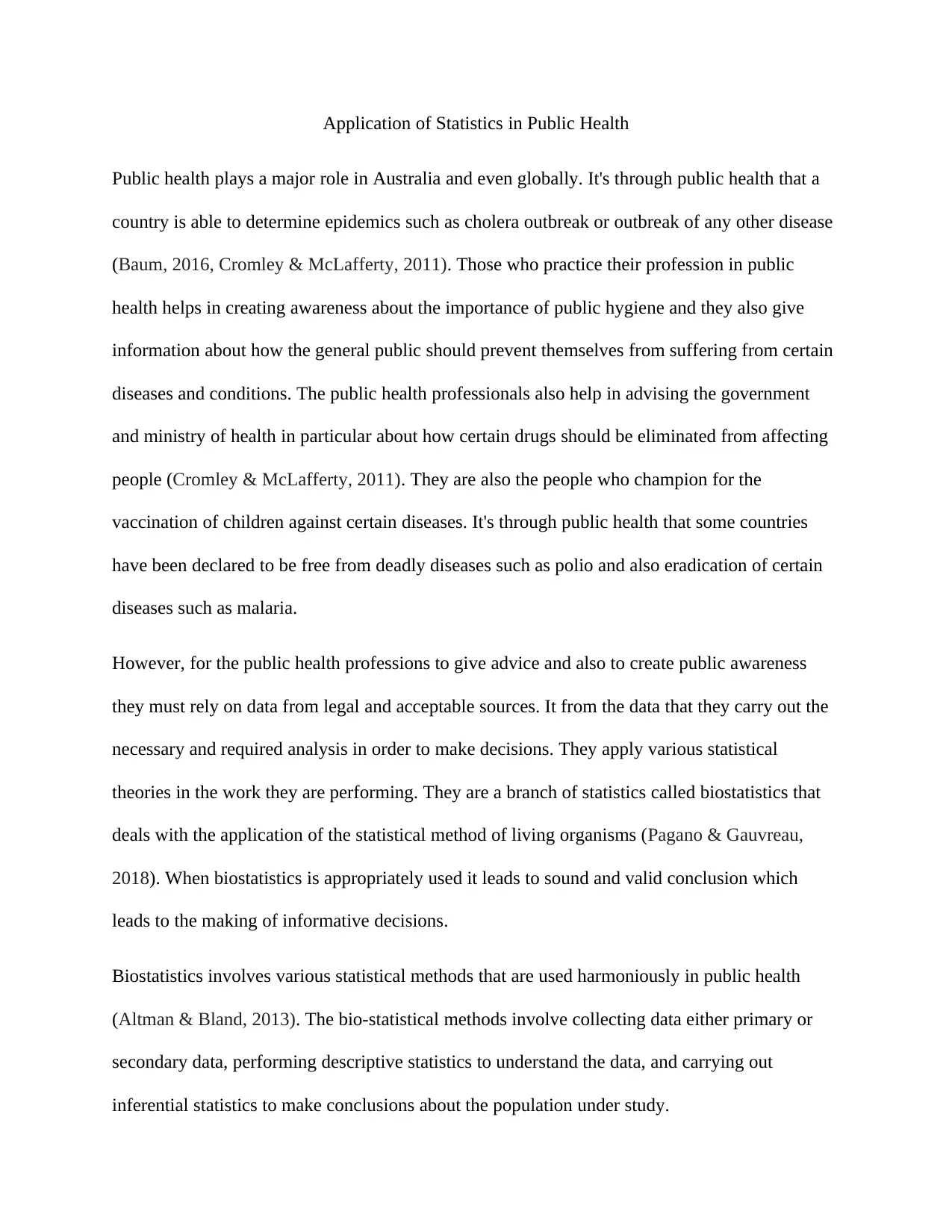
Application of Statistics in Public Health
Public health plays a major role in Australia and even globally. It's through public health that a
country is able to determine epidemics such as cholera outbreak or outbreak of any other disease
(Baum, 2016, Cromley & McLafferty, 2011). Those who practice their profession in public
health helps in creating awareness about the importance of public hygiene and they also give
information about how the general public should prevent themselves from suffering from certain
diseases and conditions. The public health professionals also help in advising the government
and ministry of health in particular about how certain drugs should be eliminated from affecting
people (Cromley & McLafferty, 2011). They are also the people who champion for the
vaccination of children against certain diseases. It's through public health that some countries
have been declared to be free from deadly diseases such as polio and also eradication of certain
diseases such as malaria.
However, for the public health professions to give advice and also to create public awareness
they must rely on data from legal and acceptable sources. It from the data that they carry out the
necessary and required analysis in order to make decisions. They apply various statistical
theories in the work they are performing. They are a branch of statistics called biostatistics that
deals with the application of the statistical method of living organisms (Pagano & Gauvreau,
2018). When biostatistics is appropriately used it leads to sound and valid conclusion which
leads to the making of informative decisions.
Biostatistics involves various statistical methods that are used harmoniously in public health
(Altman & Bland, 2013). The bio-statistical methods involve collecting data either primary or
secondary data, performing descriptive statistics to understand the data, and carrying out
inferential statistics to make conclusions about the population under study.
tabler-icon-diamond-filled.svg

Paraphrase This Document

Need a fresh take? Get an instant paraphrase of this document with our AI Paraphraser
Document Page
Before data is collected, the population under study is identified for instance the population may
be people suffering from tuberculosis. To study the whole population is expensive and time-
consuming, rather a sample is selected from the population of interest (Gofin, 2010). The sample
to be selected must be ensured that it represents the population uniformly. This is achieved by
using various sampling techniques such as simple random sampling, stratified random sampling,
quota sampling and non-random sampling methods like quota sampling and volunteer sampling.
The random sampling techniques are preferred over non-random sampling methods. The random
sampling ensures that each observation in the population has equal chances of being selected and
hence the population is uniformly represented by the sample (Gofin, 2010, Bernard, 2011). The
most commonly used sampling technique is the simple random sampling method because it’s
cost effective and saves time. Data analysis for this technique is also simplest compared with
other sampling methods. Once the sample has been selected the other statistical analysis can be
performed.
To understand the data descriptive statistics is performed. This involves understanding the shape
of the data, the spread of the data, and the distribution of the data. The shape of the data is
understood using the measures of location such as mean, median, and the mode. The spread of
the data is understood by computing the measures of central tendency such as the standard
deviation and range. Finally, the distribution of the data is understood by visualizing it using
histograms and boxplots.
Inferential statistics is very important in any statistical works since it helps in drawing a
conclusion about the population from the sample. Inferential statistics involves investigating the
null hypothesis which is a claim about the population (Köser et al, 2012). They are two types that
aid in investigating the null hypothesis which includes the parametric statistics and the non-
Document Page
parametric methods. The parametric methods make a certain assumption about the distribution of
the variable which usually is that the variables are normally distributed while in non-parametric
methods no assumptions are made about the variables (Ammerman et al, 2014). Every
parametric test has a corresponding non-parametric test. For instance, if its comparison of the
mean of three or more variables analysis of variance (ANOVA) test is used while the
corresponding non-parametric test is the Kruskal-Wallis test. Every statistical test has to be
performed at a specified level of significance (Bernard, 2011). When the null hypothesis is
rejected the alternative hypothesis is accepted and a decision is made. It’s from the decision that
a conclusion is made about the population.
The methods of sampling learned will in future help in selecting an optimal sample that is free
from bias that will ensure that every observation in the sample equally represents the population.
The descriptive statistics will help in understanding about the frequency in which disease occurs
and how to spread it is among the patients (Köser et al, 2012). In conclusion, once the sample is
randomly selected the inferential statistics that is performed in regardless of whether it's
parametric or non-parametric it will help in making conclusions that are free from bias and
decisions that aren’t suspicious at the given level of significance. The inferential statistics also
indicate the areas that need improvement for future studies, for instance, selecting an alternative
sampling technique.
Document Page
References
Altman, D. G., & Bland, J. M. (2013). Parametric v non-parametric methods for data
analysis. Bmj, 338, a3167.
Ammerman, A., Smith, T. W., & Calancie, L. (2014). Practice-based evidence in public health:
improving reach, relevance, and results. Annual review of public health, 35, 47-63.
Baum, F. (2016). The new public health (No. Ed. 4). Oxford University Press.
Bernard Turnock. (2011). Essentials of public health. Jones & Bartlett Publishers.
Cromley, E. K., & McLafferty, S. L. (2011). GIS and public health. Guilford Press.
Gofin, J (2010). Essentials of global community health. Jones & Bartlett Learning.
Köser, C. U., Ellington, M. J., Cartwright, E. J., Gillespie, S. H., Brown, N. M., Farrington,
M., ... & Peacock, S. J. (2012). Routine use of microbial whole genome sequencing in
diagnostic and public health microbiology. PLoS pathogens, 8(8), e1002824.
Pagano, M., & Gauvreau, K. (2018). Principles of biostatistics. Chapman and Hall/CRC.
chevron_up_icon
1 out of 4
circle_padding
hide_on_mobile
zoom_out_icon
[object Object]