Evaluation of Public Finance: Germany Government Budget Allocation
VerifiedAdded on 2023/06/05
|8
|1394
|328
Report
AI Summary
This report provides an evaluation of Germany's government budget allocation over the past three years, focusing on public goods and services. It analyzes the goals and priorities of the local government, which primarily aims for continuous growth in public goods and services, with public investment increasing by an average of 4.5% annually. The report identifies internal and external challenges such as an aging population, funding deficits, housing pressures, and changing customer preferences. Budget stabilization measures, including Budget Stabilization Funds (BSF), are discussed as strategies to mitigate revenue volatility. Recommendations for alternative financing, such as Tax Anticipation Notes (TAN), Bond Anticipation Notes (BAN), and Revenue Anticipation Notes (RAN), are provided to enhance budget stability. The report concludes that while the government focuses on increasing public goods and services, addressing these challenges and implementing recommended financial instruments are crucial for sustainable fiscal management.
Running head: PUBLIC FINANCE 1
Public Finance
Name
Professor
Institution
Date
Introduction
Public Finance
Name
Professor
Institution
Date
Introduction
Paraphrase This Document
Need a fresh take? Get an instant paraphrase of this document with our AI Paraphraser

PUBLIC FINANCE 2
The main purpose of this paper is to make an evaluation of the past three years’
allocation of public goods for the Germany government budget. This paper seeks to develop an
analysis which seeks to evaluate the goals and priorities of the goods and services of the local
government, assess the internal as well as external challenges faced in provision of gods and
services, evaluate stabilization measures of the budget and provide necessary recommendations.
Government budget refers to the systematic accounting for the payments that are received by a
government from sources such as taxes, and its expenditures such as transfer payments and
purchases (Dalton, 2013).
a. Analysis of the Goals and Priorities of the Local Government Goods and Services
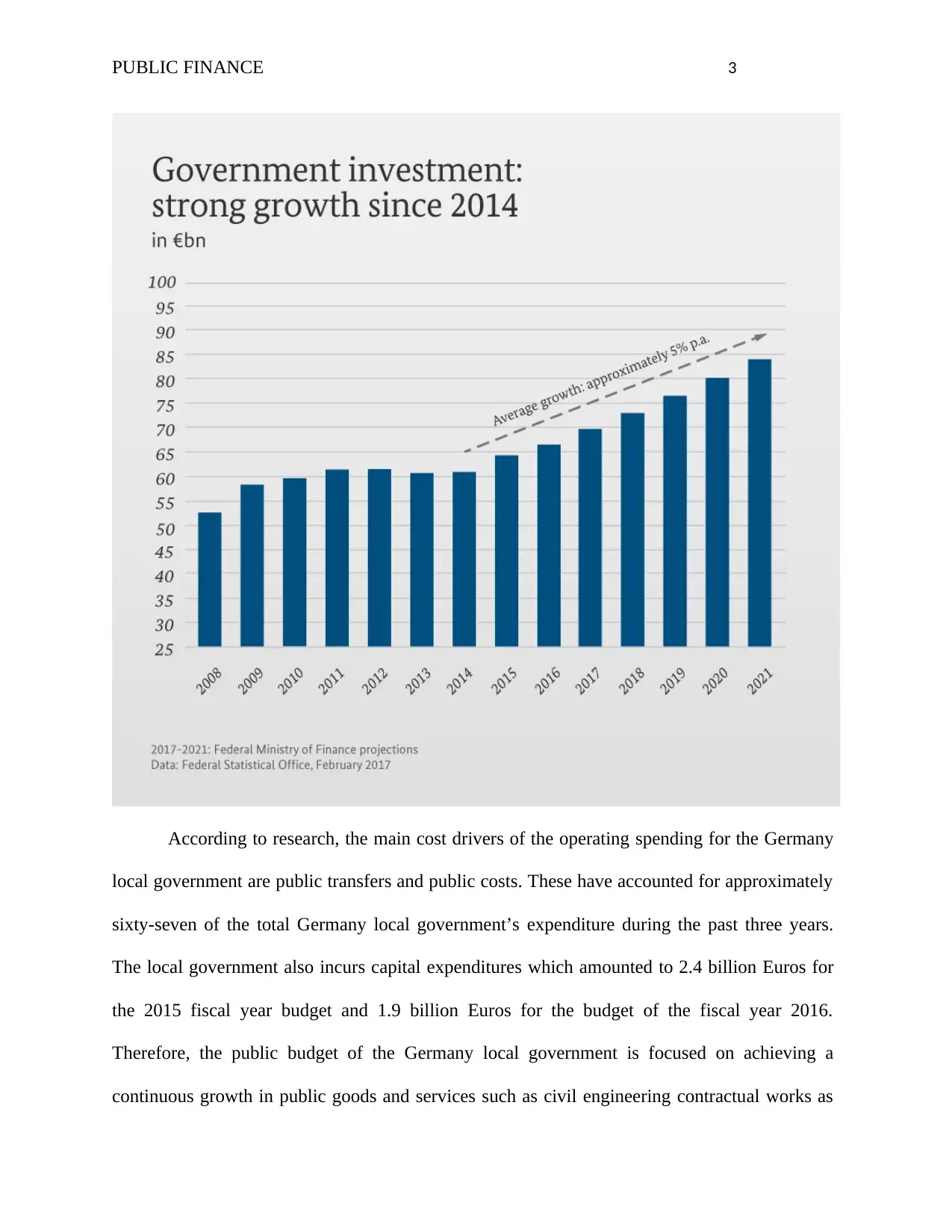
The Germany local government budget focuses mainly on provision of public goods and
services which are expected to increase by an average of around five percent per annum during
the forthcoming fiscal years. Public investment has been increasing by an annual average of 4.5
percent in the fiscal years 2015 and 2016 (Special Report: Local government in the Federal
Republic of Germany, 2013). This rate exceeds that of the rate of spending as well as the Gross
Domestic product (GDP) of the country. The main public expenditures of the local government
in Germany are:
i. Expenditure or spending on military constructions as well as systems of weapons
ii. Expenditure or spending on research that is capitalized as an insignificant or
immaterial asset.
iii. Research allocations
iv. Public infrastructure such as roads and social amenities.
The main purpose of this paper is to make an evaluation of the past three years’
allocation of public goods for the Germany government budget. This paper seeks to develop an
analysis which seeks to evaluate the goals and priorities of the goods and services of the local
government, assess the internal as well as external challenges faced in provision of gods and
services, evaluate stabilization measures of the budget and provide necessary recommendations.
Government budget refers to the systematic accounting for the payments that are received by a
government from sources such as taxes, and its expenditures such as transfer payments and
purchases (Dalton, 2013).
a. Analysis of the Goals and Priorities of the Local Government Goods and Services
The Germany local government budget focuses mainly on provision of public goods and
services which are expected to increase by an average of around five percent per annum during
the forthcoming fiscal years. Public investment has been increasing by an annual average of 4.5
percent in the fiscal years 2015 and 2016 (Special Report: Local government in the Federal
Republic of Germany, 2013). This rate exceeds that of the rate of spending as well as the Gross
Domestic product (GDP) of the country. The main public expenditures of the local government
in Germany are:
i. Expenditure or spending on military constructions as well as systems of weapons
ii. Expenditure or spending on research that is capitalized as an insignificant or
immaterial asset.
iii. Research allocations
iv. Public infrastructure such as roads and social amenities.

PUBLIC FINANCE 3
According to research, the main cost drivers of the operating spending for the Germany
local government are public transfers and public costs. These have accounted for approximately
sixty-seven of the total Germany local government’s expenditure during the past three years.
The local government also incurs capital expenditures which amounted to 2.4 billion Euros for
the 2015 fiscal year budget and 1.9 billion Euros for the budget of the fiscal year 2016.
Therefore, the public budget of the Germany local government is focused on achieving a
continuous growth in public goods and services such as civil engineering contractual works as
According to research, the main cost drivers of the operating spending for the Germany
local government are public transfers and public costs. These have accounted for approximately
sixty-seven of the total Germany local government’s expenditure during the past three years.
The local government also incurs capital expenditures which amounted to 2.4 billion Euros for
the 2015 fiscal year budget and 1.9 billion Euros for the budget of the fiscal year 2016.
Therefore, the public budget of the Germany local government is focused on achieving a
continuous growth in public goods and services such as civil engineering contractual works as
⊘ This is a preview!⊘
Do you want full access?
Subscribe today to unlock all pages.

Trusted by 1+ million students worldwide

PUBLIC FINANCE 4
well as public constructions, which are aimed at improvement of social infrastructures (Special
Report: Local government in the Federal Republic of Germany, 2013).
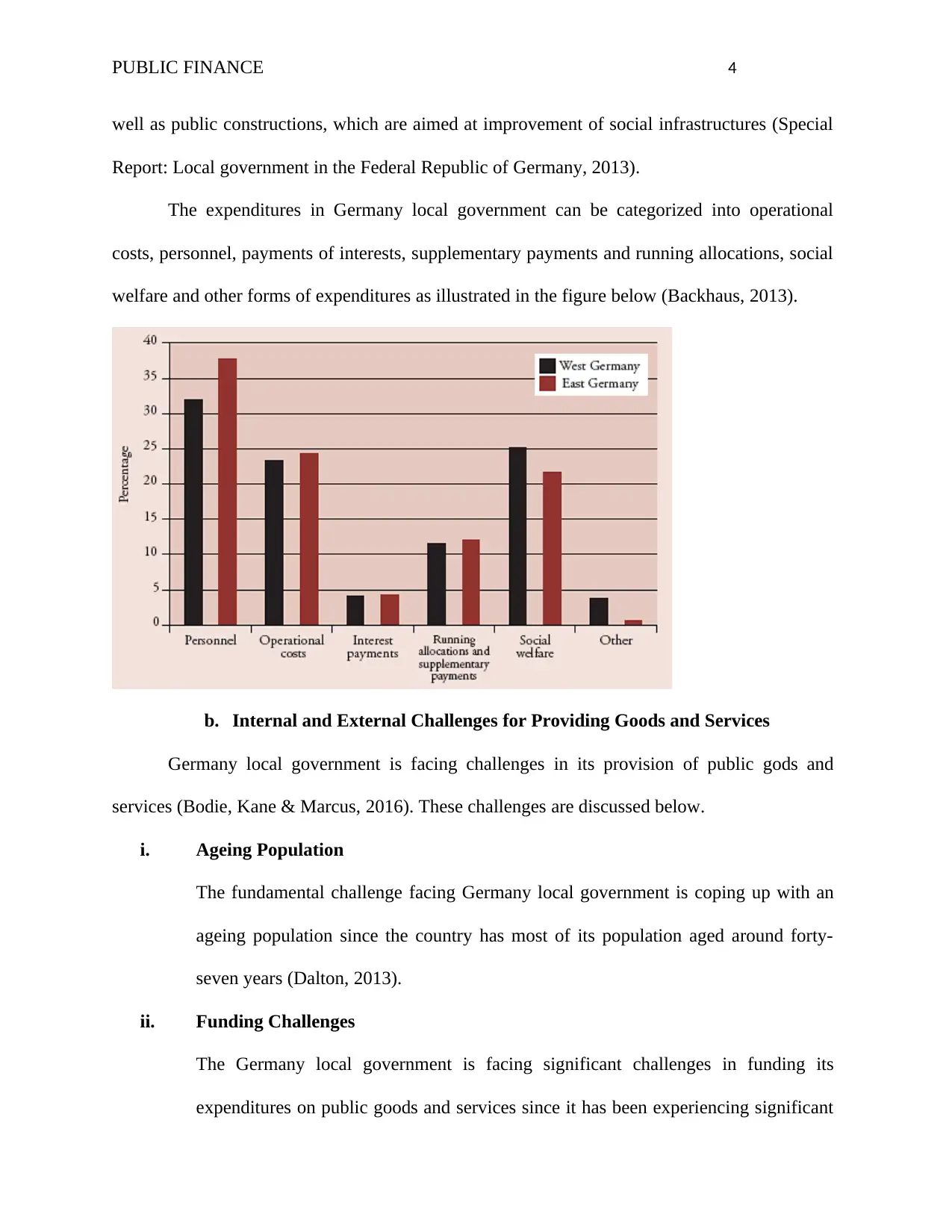
The expenditures in Germany local government can be categorized into operational
costs, personnel, payments of interests, supplementary payments and running allocations, social
welfare and other forms of expenditures as illustrated in the figure below (Backhaus, 2013).
b. Internal and External Challenges for Providing Goods and Services
Germany local government is facing challenges in its provision of public gods and
services (Bodie, Kane & Marcus, 2016). These challenges are discussed below.
i. Ageing Population
The fundamental challenge facing Germany local government is coping up with an
ageing population since the country has most of its population aged around forty-
seven years (Dalton, 2013).
ii. Funding Challenges
The Germany local government is facing significant challenges in funding its
expenditures on public goods and services since it has been experiencing significant
well as public constructions, which are aimed at improvement of social infrastructures (Special
Report: Local government in the Federal Republic of Germany, 2013).
The expenditures in Germany local government can be categorized into operational
costs, personnel, payments of interests, supplementary payments and running allocations, social
welfare and other forms of expenditures as illustrated in the figure below (Backhaus, 2013).
b. Internal and External Challenges for Providing Goods and Services
Germany local government is facing challenges in its provision of public gods and
services (Bodie, Kane & Marcus, 2016). These challenges are discussed below.
i. Ageing Population
The fundamental challenge facing Germany local government is coping up with an
ageing population since the country has most of its population aged around forty-
seven years (Dalton, 2013).
ii. Funding Challenges
The Germany local government is facing significant challenges in funding its
expenditures on public goods and services since it has been experiencing significant
Paraphrase This Document
Need a fresh take? Get an instant paraphrase of this document with our AI Paraphraser

PUBLIC FINANCE 5
budget deficits. The government is therefore compelled with a need to prepare and
develop financial plans for ensuring that it meets its future requirements of funding
(Bodie, Kane & Marcus, 2016).
iii. Housing
The listings of the local authorities in Germany have continued to grow
fundamentally, causing much pressure on the country’s current stock of housing.
There is also a significant change in the landscape for the delivery of social housing.
Due to this, the quality of accommodation has suffered significantly from the historic
under-investments. This causes much strain on the local government’s resources
(Backhaus, 2013).
iv. Changing and Diverse Preferences of Customers
The expectations of the societies in Germany are constantly changing, as citizens
now wish gain an access of the public goods and services outside the hours set aside
for the business (Dalton, 2013).
c. Budget Stabilization Measures
The local government of Germany can stabilize its budget by using measures such as
Budget Stabilization Funds (BSF), which is also referred to as Rainy Day Funds. This measure
is mainly used by governments in mitigating volatility of state revenue by setting aside surplus
revenue for use during times of shortfalls in revenue (Budget Stabilization Funds, 2017). The
following combinations of rules may be used for this purpose:
i. Allowing some or all of the revenue surplus at the end of the year to flow to the BSF
account or rainy day funds.
budget deficits. The government is therefore compelled with a need to prepare and
develop financial plans for ensuring that it meets its future requirements of funding
(Bodie, Kane & Marcus, 2016).
iii. Housing
The listings of the local authorities in Germany have continued to grow
fundamentally, causing much pressure on the country’s current stock of housing.
There is also a significant change in the landscape for the delivery of social housing.
Due to this, the quality of accommodation has suffered significantly from the historic
under-investments. This causes much strain on the local government’s resources
(Backhaus, 2013).
iv. Changing and Diverse Preferences of Customers
The expectations of the societies in Germany are constantly changing, as citizens
now wish gain an access of the public goods and services outside the hours set aside
for the business (Dalton, 2013).
c. Budget Stabilization Measures
The local government of Germany can stabilize its budget by using measures such as
Budget Stabilization Funds (BSF), which is also referred to as Rainy Day Funds. This measure
is mainly used by governments in mitigating volatility of state revenue by setting aside surplus
revenue for use during times of shortfalls in revenue (Budget Stabilization Funds, 2017). The
following combinations of rules may be used for this purpose:
i. Allowing some or all of the revenue surplus at the end of the year to flow to the BSF
account or rainy day funds.

PUBLIC FINANCE 6
ii. Requiring revenue which is set aside for every year till the funds get to its cap, or
else requiring an automatic deposit of revenue (Backhaus, 2013).
iii. Requiring a contribution which is based on revenue as well as economic growth.
iv. Requiring payments and replenishing funds as decreed by the legislation.
Use of rainy day funds or BSF as a measure of stabilizing budgets helps in increasing
savings and reducing volatility by:
i. Mitigating fiscal volatility
ii. Buoying spending of the state government as revenues decline during recessions of
the economy.
iii. Producing a net increase in the savings of both the local and state governments
(Budget Stabilization Funds, 2017).
d. Recommendations
As part of stabilizing its budget, the Germany government should seek other alternatives
for financing its expenditures on public goods and services (Backhaus, 2013). For instance, the
following are the three recommendations provided in this case.
i. Tax Anticipation Note (TAN)
This is a short-term security of a debt that a Stockton municipality can issue for
financing its immediate projects which will be payable in future through future
collections of taxes (Dalton, 2013).
ii. Bond Anticipation Note (BAN)
This is a short term security that bears interest. Stockton Municipality can issue this
type of security prior to issuance of a bigger bond in future. This security can be
ii. Requiring revenue which is set aside for every year till the funds get to its cap, or
else requiring an automatic deposit of revenue (Backhaus, 2013).
iii. Requiring a contribution which is based on revenue as well as economic growth.
iv. Requiring payments and replenishing funds as decreed by the legislation.
Use of rainy day funds or BSF as a measure of stabilizing budgets helps in increasing
savings and reducing volatility by:
i. Mitigating fiscal volatility
ii. Buoying spending of the state government as revenues decline during recessions of
the economy.
iii. Producing a net increase in the savings of both the local and state governments
(Budget Stabilization Funds, 2017).
d. Recommendations
As part of stabilizing its budget, the Germany government should seek other alternatives
for financing its expenditures on public goods and services (Backhaus, 2013). For instance, the
following are the three recommendations provided in this case.
i. Tax Anticipation Note (TAN)
This is a short-term security of a debt that a Stockton municipality can issue for
financing its immediate projects which will be payable in future through future
collections of taxes (Dalton, 2013).
ii. Bond Anticipation Note (BAN)
This is a short term security that bears interest. Stockton Municipality can issue this
type of security prior to issuance of a bigger bond in future. This security can be
⊘ This is a preview!⊘
Do you want full access?
Subscribe today to unlock all pages.

Trusted by 1+ million students worldwide

PUBLIC FINANCE 7
issued for purposes of generating funds for financing forthcoming projects
(Dalton, 2013).
iii. Revenue Anticipation Note (RAN)
This is type of a bond issued by a municipal. In this case, Stockton municipality can
borrow money with a view to financing its projects and then repaying the debt using
the projects’ generated revenue (Backhaus, 2013).
Conclusion
As discussed above, the Germany local government budget focuses mainly on provision
of public goods and services which are expected to increase by an average of around five
percent per annum during the forthcoming fiscal years. Public investment has been increasing
by an annual average of 4.5 percent in the fiscal years 2015 and 2016. The expenditures in
Germany local government can be categorized into operational costs, personnel, payments of
interests, supplementary payments and running allocations as well as social welfare
(Dalton, 2013).
issued for purposes of generating funds for financing forthcoming projects
(Dalton, 2013).
iii. Revenue Anticipation Note (RAN)
This is type of a bond issued by a municipal. In this case, Stockton municipality can
borrow money with a view to financing its projects and then repaying the debt using
the projects’ generated revenue (Backhaus, 2013).
Conclusion
As discussed above, the Germany local government budget focuses mainly on provision
of public goods and services which are expected to increase by an average of around five
percent per annum during the forthcoming fiscal years. Public investment has been increasing
by an annual average of 4.5 percent in the fiscal years 2015 and 2016. The expenditures in
Germany local government can be categorized into operational costs, personnel, payments of
interests, supplementary payments and running allocations as well as social welfare
(Dalton, 2013).
Paraphrase This Document
Need a fresh take? Get an instant paraphrase of this document with our AI Paraphraser

PUBLIC FINANCE 8
References
Backhaus, J. G. (2013). Essentials of fiscal sociology: Conception of an encyclopedia. Frankfurt
am Main: PL Academic Research.
Bodie, Z., Kane, A., & Marcus, A. J. (2016). Essentials of Investments. NY: McGraw-Hill
Higher Education.
Budget Stabilization Funds. (2017). Retrieved from
https://www.urban.org/research/publication/budget-stabilization-funds
Special Report: Local government in the Federal Republic of Germany. (2013). Retrieved from
http://regional.gov.au/local/publications/reports/2003_2004/C7.aspx
Dalton, H. (2013). Principles of Public Finance. Hoboken: Taylor and Francis.
References
Backhaus, J. G. (2013). Essentials of fiscal sociology: Conception of an encyclopedia. Frankfurt
am Main: PL Academic Research.
Bodie, Z., Kane, A., & Marcus, A. J. (2016). Essentials of Investments. NY: McGraw-Hill
Higher Education.
Budget Stabilization Funds. (2017). Retrieved from
https://www.urban.org/research/publication/budget-stabilization-funds
Special Report: Local government in the Federal Republic of Germany. (2013). Retrieved from
http://regional.gov.au/local/publications/reports/2003_2004/C7.aspx
Dalton, H. (2013). Principles of Public Finance. Hoboken: Taylor and Francis.
1 out of 8
Related Documents
Your All-in-One AI-Powered Toolkit for Academic Success.
+13062052269
info@desklib.com
Available 24*7 on WhatsApp / Email
Unlock your academic potential
Copyright © 2020–2025 A2Z Services. All Rights Reserved. Developed and managed by ZUCOL.