Public Finance Report: Economic Policies and Social Impact
VerifiedAdded on 2020/06/05
|16
|3871
|95
Report
AI Summary
This report delves into the realm of public finance, examining critical aspects such as Paretian welfare economics and its impact on efficiency, particularly in scenarios lacking economic equality. It explores the determination of pure public goods and the role of policymakers in addressing their demands. The report also investigates the gap between social and private costs, along with the implications of market failure. A significant portion is dedicated to explaining the tax system, including vertical and horizontal equity, and how organizations manage tax returns. Furthermore, it evaluates poverty and income inequality in terms of social obstacles and analyzes interventions aimed at improving healthcare system efficiency and achieving specific goals. The report uses illustrations to clarify complex concepts, providing a comprehensive overview of public finance principles and their practical applications.

Public Finance

Paraphrase This Document
Need a fresh take? Get an instant paraphrase of this document with our AI Paraphraser
Table of Contents
INTRODUCTION...........................................................................................................................1
1 Critical analysis over the paretian welfare economics affect the efficiency outcomes where
economy does not imply equality...............................................................................................1
2 Determining pure public good and the demands of such articles will be accedes by the
policy makers..............................................................................................................................2
3 Determination of the gap between social and private costs as well as the market failure.......4
4 Explaining the tax system and the organisation make the tax return in terms of vertical and
horizontal equity tax....................................................................................................................8
5 Evaluating the poverty and income inequality in terms of social obstacles............................9
6 Analysing the interventions under which healthcare system will improve the efficiency and
achieve the goals.......................................................................................................................10
CONCLUSION..............................................................................................................................10
REFERENCES..............................................................................................................................12
INTRODUCTION...........................................................................................................................1
1 Critical analysis over the paretian welfare economics affect the efficiency outcomes where
economy does not imply equality...............................................................................................1
2 Determining pure public good and the demands of such articles will be accedes by the
policy makers..............................................................................................................................2
3 Determination of the gap between social and private costs as well as the market failure.......4
4 Explaining the tax system and the organisation make the tax return in terms of vertical and
horizontal equity tax....................................................................................................................8
5 Evaluating the poverty and income inequality in terms of social obstacles............................9
6 Analysing the interventions under which healthcare system will improve the efficiency and
achieve the goals.......................................................................................................................10
CONCLUSION..............................................................................................................................10
REFERENCES..............................................................................................................................12
Illustration Index
Illustration 1: Pure public good example.........................................................................................3
Illustration 2: Negative Externality affects market failure..............................................................6
Illustration 3: Positive Externalities of market................................................................................7
Illustration 4: Horizontal and Vertical equity example....................................................................8
Illustration 1: Pure public good example.........................................................................................3
Illustration 2: Negative Externality affects market failure..............................................................6
Illustration 3: Positive Externalities of market................................................................................7
Illustration 4: Horizontal and Vertical equity example....................................................................8
⊘ This is a preview!⊘
Do you want full access?
Subscribe today to unlock all pages.

Trusted by 1+ million students worldwide
INTRODUCTION
In terms with facilitating the adequate funds and finances for the public organisation
there is need to analyse various policies and procedure of the government a various country.
Thus, the governmental policies are varies at the different locations or levels in terms of taxation,
laws, rules, regulations, acts etc. however, in the present assessment there will be discussion
based on the various economical welfare terms, pure public goods, social and private costs as
well as tax system which are affecting the operations of the public sector. The report will also
highlight various interventions which are affecting the healthcare sector in terms of obtaining the
business aims.
1 Critical analysis over the paretian welfare economics affect the efficiency outcomes where
economy does not imply equality
According to Shoup, (2017), the Parto efficiency theory determines that all the available
resources in the business premises must be allocated and fully utilised by the internal individuals.
There will be need of managing such resources which in turn helps industry in attaining the
adequate amount of profit and brings the adequate changes in the operational activities. Jung,
(2017) stated that, such techniques will be helpful for entity in terms with reducing wastage,
improving the efficiency as well as making the adequate increments in the operational activities.
Thus, it cannot improve the inequality in the society. In accordance with Dutt and Mitra, (2016),
the allocation of the resources must be optimal or not is determined by this concept. Thus, the
main motive is to improve the social well-being. In terms with Fullerton and Ta, (2017), it will
be beneficial in terms of having the proper utilisation of such operational resources and that will
affect reducing costs or expenses over making purchase and manufacturing the products.
Moreover, it will be beneficial for the organisation in terms of having the adequate decision
making as well as determine the goals of business. As per the views of Xu and et.al., (2016), the
concept total focuses over the use of material, men and machinery in terms of manufacturing an
article but it does not determine the benefits to the workforce. Therefore, it does not focus over
removal of stereotyping, appropriate remuneration to the all employees as per the qualifications
of skills owned by them.
However, as per Canova, (2017), this theory would help in better funnelling to the
production units which in turn designs products which are required by the society with
1
In terms with facilitating the adequate funds and finances for the public organisation
there is need to analyse various policies and procedure of the government a various country.
Thus, the governmental policies are varies at the different locations or levels in terms of taxation,
laws, rules, regulations, acts etc. however, in the present assessment there will be discussion
based on the various economical welfare terms, pure public goods, social and private costs as
well as tax system which are affecting the operations of the public sector. The report will also
highlight various interventions which are affecting the healthcare sector in terms of obtaining the
business aims.
1 Critical analysis over the paretian welfare economics affect the efficiency outcomes where
economy does not imply equality
According to Shoup, (2017), the Parto efficiency theory determines that all the available
resources in the business premises must be allocated and fully utilised by the internal individuals.
There will be need of managing such resources which in turn helps industry in attaining the
adequate amount of profit and brings the adequate changes in the operational activities. Jung,
(2017) stated that, such techniques will be helpful for entity in terms with reducing wastage,
improving the efficiency as well as making the adequate increments in the operational activities.
Thus, it cannot improve the inequality in the society. In accordance with Dutt and Mitra, (2016),
the allocation of the resources must be optimal or not is determined by this concept. Thus, the
main motive is to improve the social well-being. In terms with Fullerton and Ta, (2017), it will
be beneficial in terms of having the proper utilisation of such operational resources and that will
affect reducing costs or expenses over making purchase and manufacturing the products.
Moreover, it will be beneficial for the organisation in terms of having the adequate decision
making as well as determine the goals of business. As per the views of Xu and et.al., (2016), the
concept total focuses over the use of material, men and machinery in terms of manufacturing an
article but it does not determine the benefits to the workforce. Therefore, it does not focus over
removal of stereotyping, appropriate remuneration to the all employees as per the qualifications
of skills owned by them.
However, as per Canova, (2017), this theory would help in better funnelling to the
production units which in turn designs products which are required by the society with
1
Paraphrase This Document
Need a fresh take? Get an instant paraphrase of this document with our AI Paraphraser
consideration to entail the appropriate business functions. Therefore, it only focuses over
assumptions to meet the competition in the market environment and attaining the adequate
profitability in the business. However, such techniques will not affect the healthy environment
for the workforce which are making efforts for the achievement of the organisational goals.
There can be reduction in the faith and trust in their mind as they will highly influence by the
business competitions. Bovaird and et.al., (2016) criticised that, professionals in the firm plans
for achieving the fruitful targets as well as belies that they must have the appropriate returns for
whatever they are investing in. there can be need of various operational activities as well as
increment in the efficiency of the entity (Kaiser, Bredenkamp and Iglesias, 2016). Thus, they
ignore the well fare of the employees who are working for them in context with remuneration
policies, work environment, their shifts and the level of operations handled by them (Economic
Efficiency and Pareto Optimality: Marginal Condition and Critical Evaluation, 2017). Due to
such negative impacts there has been reduction in the brand image as it highlights or brings the
inequality in workforce. There will be not favourable communication between employees and
the seniors as well as lack of coordination.
2 Determining pure public good and the demands of such articles will be accedes by the policy
makers
In accordance with the Pure public goods it can be said that the products which are to be
designed by the professional that must meet the consumer requirements as well as satisfy them at
the desirable state. However, there is need to generate the informations by making surveys,
interacting with people and analyse their wants which in turn fruitful for the corporation to
produce such articles (Ihori, 2017). There will be benefits of such techniques is that the
consumer will be helpful in having the products as well as there will be increment in the
organisational goodwill or reputation. It can be said that, such method will be beneficial in
attaining the large umbers of consumers as well as increment in the profitability of entity.
Therefore, in terms of making the adequate assumptions regarding consumer preferences there is
need to evaluate the procedures of public and private corporation to satisfy needs (Bloch and
et.al., 2016).
In terms with the manufacturing concepts of the private and public organisation it can be
said that private firms designs goods as to meet the competition in market. Thus, there have two
2
assumptions to meet the competition in the market environment and attaining the adequate
profitability in the business. However, such techniques will not affect the healthy environment
for the workforce which are making efforts for the achievement of the organisational goals.
There can be reduction in the faith and trust in their mind as they will highly influence by the
business competitions. Bovaird and et.al., (2016) criticised that, professionals in the firm plans
for achieving the fruitful targets as well as belies that they must have the appropriate returns for
whatever they are investing in. there can be need of various operational activities as well as
increment in the efficiency of the entity (Kaiser, Bredenkamp and Iglesias, 2016). Thus, they
ignore the well fare of the employees who are working for them in context with remuneration
policies, work environment, their shifts and the level of operations handled by them (Economic
Efficiency and Pareto Optimality: Marginal Condition and Critical Evaluation, 2017). Due to
such negative impacts there has been reduction in the brand image as it highlights or brings the
inequality in workforce. There will be not favourable communication between employees and
the seniors as well as lack of coordination.
2 Determining pure public good and the demands of such articles will be accedes by the policy
makers
In accordance with the Pure public goods it can be said that the products which are to be
designed by the professional that must meet the consumer requirements as well as satisfy them at
the desirable state. However, there is need to generate the informations by making surveys,
interacting with people and analyse their wants which in turn fruitful for the corporation to
produce such articles (Ihori, 2017). There will be benefits of such techniques is that the
consumer will be helpful in having the products as well as there will be increment in the
organisational goodwill or reputation. It can be said that, such method will be beneficial in
attaining the large umbers of consumers as well as increment in the profitability of entity.
Therefore, in terms of making the adequate assumptions regarding consumer preferences there is
need to evaluate the procedures of public and private corporation to satisfy needs (Bloch and
et.al., 2016).
In terms with the manufacturing concepts of the private and public organisation it can be
said that private firms designs goods as to meet the competition in market. Thus, there have two
2
main motives while producing any unit such as focusing over returns they have from such
investments made in developing the end product. There will be objectives of attaining the large
amount of profits than the other rivalry firms in the market (Jalan, Marjit and Santra, 2016). The
negative side of such techniques is that only few buyers are available for the product those who
cannot afford the products will make a switch to another firm. On the other side, public
corporations designs the products which satisfies the public need and it can easily be affordable
by the large number consumers.
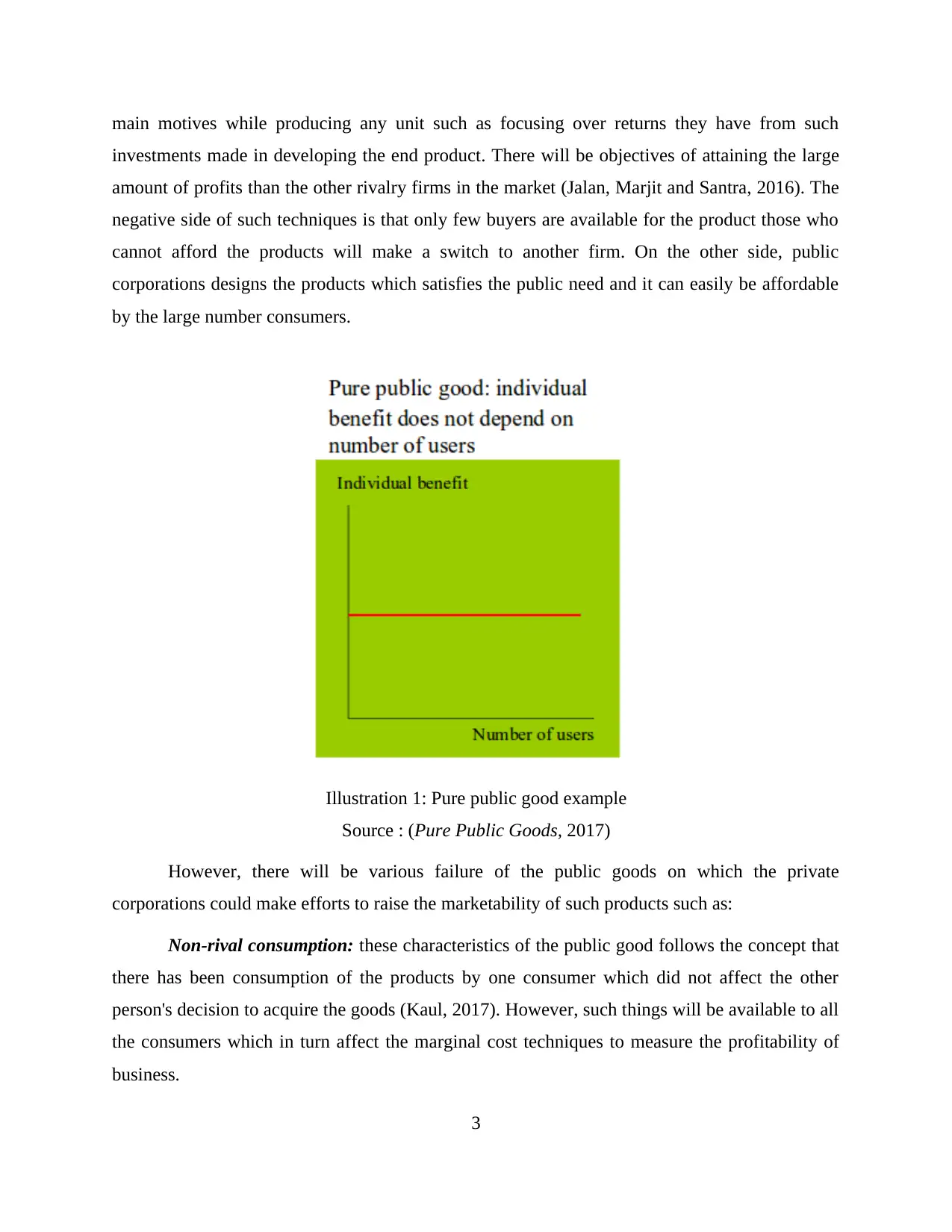
Illustration 1: Pure public good example
Source : (Pure Public Goods, 2017)
However, there will be various failure of the public goods on which the private
corporations could make efforts to raise the marketability of such products such as:
Non-rival consumption: these characteristics of the public good follows the concept that
there has been consumption of the products by one consumer which did not affect the other
person's decision to acquire the goods (Kaul, 2017). However, such things will be available to all
the consumers which in turn affect the marginal cost techniques to measure the profitability of
business.
3
investments made in developing the end product. There will be objectives of attaining the large
amount of profits than the other rivalry firms in the market (Jalan, Marjit and Santra, 2016). The
negative side of such techniques is that only few buyers are available for the product those who
cannot afford the products will make a switch to another firm. On the other side, public
corporations designs the products which satisfies the public need and it can easily be affordable
by the large number consumers.
Illustration 1: Pure public good example
Source : (Pure Public Goods, 2017)
However, there will be various failure of the public goods on which the private
corporations could make efforts to raise the marketability of such products such as:
Non-rival consumption: these characteristics of the public good follows the concept that
there has been consumption of the products by one consumer which did not affect the other
person's decision to acquire the goods (Kaul, 2017). However, such things will be available to all
the consumers which in turn affect the marginal cost techniques to measure the profitability of
business.
3
⊘ This is a preview!⊘
Do you want full access?
Subscribe today to unlock all pages.
Trusted by 1+ million students worldwide
Non- Excludability: in terms with this concept the goods are to be consumed by an
individual who had paid for it but not by the person who is not making any payments (Newbigin,
2017). Thus, such procedure will be denoted as the Free- rider term which in turn affects
profitability of business. However, in the private sector the goods are always facilitated to those
individual who had paid for it.
Non-rejectable: In accordance with this segmentation the goods which are manufactured
and have no restrictions or rejections over it (Public Goods and Market Failure, 2015). Thus,
such products are easily acceptable to all the individual in the society such as Defence projects
like, nuclear weapons, armed, navy and air forces as well as disaster management projects.
3 Determination of the gap between social and private costs as well as the market failure
To have the adequate consumer responses over the products there has been various
factors which in turn affecting the business decision making as well as enhancement of the
quality of goods. However, in terms with the gap between social and private costs which are
highly influenced by the externalities (Shoup, 2017). Therefore, there has been various factors
which are the main reasons behind market failure and there will be suggestions to them in
context with acquiring the adequate decisions to resolve such obstacles.
Private costs: These are the costs which are being payable by the consumer which are
consuming it on the basis of expense incurred by manufacturer on producing such units.
However, these costs did not belong to any external costs which are included in price such as
transportation or holding costs. This only include the elements which are being used while
developing the products such as direct material, labour, equipments and machineries (What is the
difference between private and social costs, and how do they relate to pollution and production?,
2017). Therefore, it can be said that these are the private costs which are levied by organisations
in context with fulfil the requirement of costs or expense incurred in producing such units.
Social costs: these are the costs which includes private and external costs that is affecting
the increment in the productions and consumption of the goods and services by individuals.
Thus, it can be said that such expensiveness are differed from the private costs because there has
been influence of various costs which in turn useful for the environment and for the corporate
social responsibilities of firm (Jung, 2017). For instance, a manufacturing unit install a plant to
reduce the air pollution so the costs incurred in such process will be charged over consumer.
4
individual who had paid for it but not by the person who is not making any payments (Newbigin,
2017). Thus, such procedure will be denoted as the Free- rider term which in turn affects
profitability of business. However, in the private sector the goods are always facilitated to those
individual who had paid for it.
Non-rejectable: In accordance with this segmentation the goods which are manufactured
and have no restrictions or rejections over it (Public Goods and Market Failure, 2015). Thus,
such products are easily acceptable to all the individual in the society such as Defence projects
like, nuclear weapons, armed, navy and air forces as well as disaster management projects.
3 Determination of the gap between social and private costs as well as the market failure
To have the adequate consumer responses over the products there has been various
factors which in turn affecting the business decision making as well as enhancement of the
quality of goods. However, in terms with the gap between social and private costs which are
highly influenced by the externalities (Shoup, 2017). Therefore, there has been various factors
which are the main reasons behind market failure and there will be suggestions to them in
context with acquiring the adequate decisions to resolve such obstacles.
Private costs: These are the costs which are being payable by the consumer which are
consuming it on the basis of expense incurred by manufacturer on producing such units.
However, these costs did not belong to any external costs which are included in price such as
transportation or holding costs. This only include the elements which are being used while
developing the products such as direct material, labour, equipments and machineries (What is the
difference between private and social costs, and how do they relate to pollution and production?,
2017). Therefore, it can be said that these are the private costs which are levied by organisations
in context with fulfil the requirement of costs or expense incurred in producing such units.
Social costs: these are the costs which includes private and external costs that is affecting
the increment in the productions and consumption of the goods and services by individuals.
Thus, it can be said that such expensiveness are differed from the private costs because there has
been influence of various costs which in turn useful for the environment and for the corporate
social responsibilities of firm (Jung, 2017). For instance, a manufacturing unit install a plant to
reduce the air pollution so the costs incurred in such process will be charged over consumer.
4
Paraphrase This Document
Need a fresh take? Get an instant paraphrase of this document with our AI Paraphraser
Thus, if the organisation would not charge such expense in the products than they will stop such
plant which in turn affect the environment. Hence, these are known as the costs which are had to
be made by organisation in context with presenting the social responsibilities.
Market failure which is the reason behind gap between private and social costs:
These are the factors which in turn affect the production and consumption of the products
in the market. Therefore, there can be influence of various factors which in turn affect the big
market failures. However, the private costs such bas material, labour and use of equipments are
the direct costs which are included in the manufacturing of the units (Dutt and Mitra, 2016).
While on the other side the social costs which are indirectly included in consumption or
production process. However, the social costs can be measured by adding the externality cots to
the social costs. However, there can be negative or positive segmentations to these factors which
affect the market failure as:
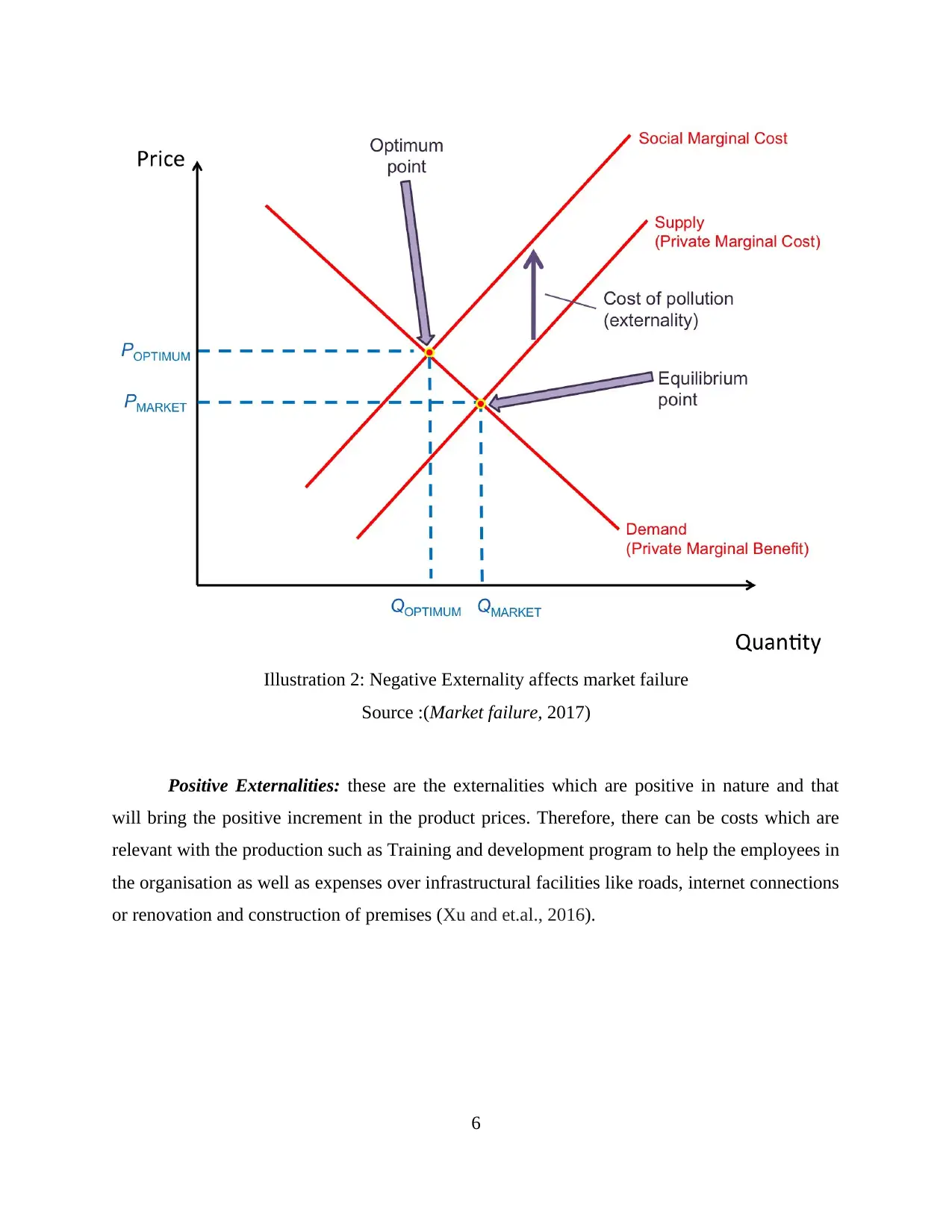
Negative Externalities: These are the costs which are generally incurred when the
marginal costs of social costs exceed the private costs (Fullerton and Ta, 2017). There will be
examples of such costs as air pollution emission plant, water filters over rivers or water bank as
according to discharge for factories or manufacturing units etc.
5
plant which in turn affect the environment. Hence, these are known as the costs which are had to
be made by organisation in context with presenting the social responsibilities.
Market failure which is the reason behind gap between private and social costs:
These are the factors which in turn affect the production and consumption of the products
in the market. Therefore, there can be influence of various factors which in turn affect the big
market failures. However, the private costs such bas material, labour and use of equipments are
the direct costs which are included in the manufacturing of the units (Dutt and Mitra, 2016).
While on the other side the social costs which are indirectly included in consumption or
production process. However, the social costs can be measured by adding the externality cots to
the social costs. However, there can be negative or positive segmentations to these factors which
affect the market failure as:
Negative Externalities: These are the costs which are generally incurred when the
marginal costs of social costs exceed the private costs (Fullerton and Ta, 2017). There will be
examples of such costs as air pollution emission plant, water filters over rivers or water bank as
according to discharge for factories or manufacturing units etc.
5
Positive Externalities: these are the externalities which are positive in nature and that
will bring the positive increment in the product prices. Therefore, there can be costs which are
relevant with the production such as Training and development program to help the employees in
the organisation as well as expenses over infrastructural facilities like roads, internet connections
or renovation and construction of premises (Xu and et.al., 2016).
6
Illustration 2: Negative Externality affects market failure
Source :(Market failure, 2017)
will bring the positive increment in the product prices. Therefore, there can be costs which are
relevant with the production such as Training and development program to help the employees in
the organisation as well as expenses over infrastructural facilities like roads, internet connections
or renovation and construction of premises (Xu and et.al., 2016).
6
Illustration 2: Negative Externality affects market failure
Source :(Market failure, 2017)
⊘ This is a preview!⊘
Do you want full access?
Subscribe today to unlock all pages.
Trusted by 1+ million students worldwide
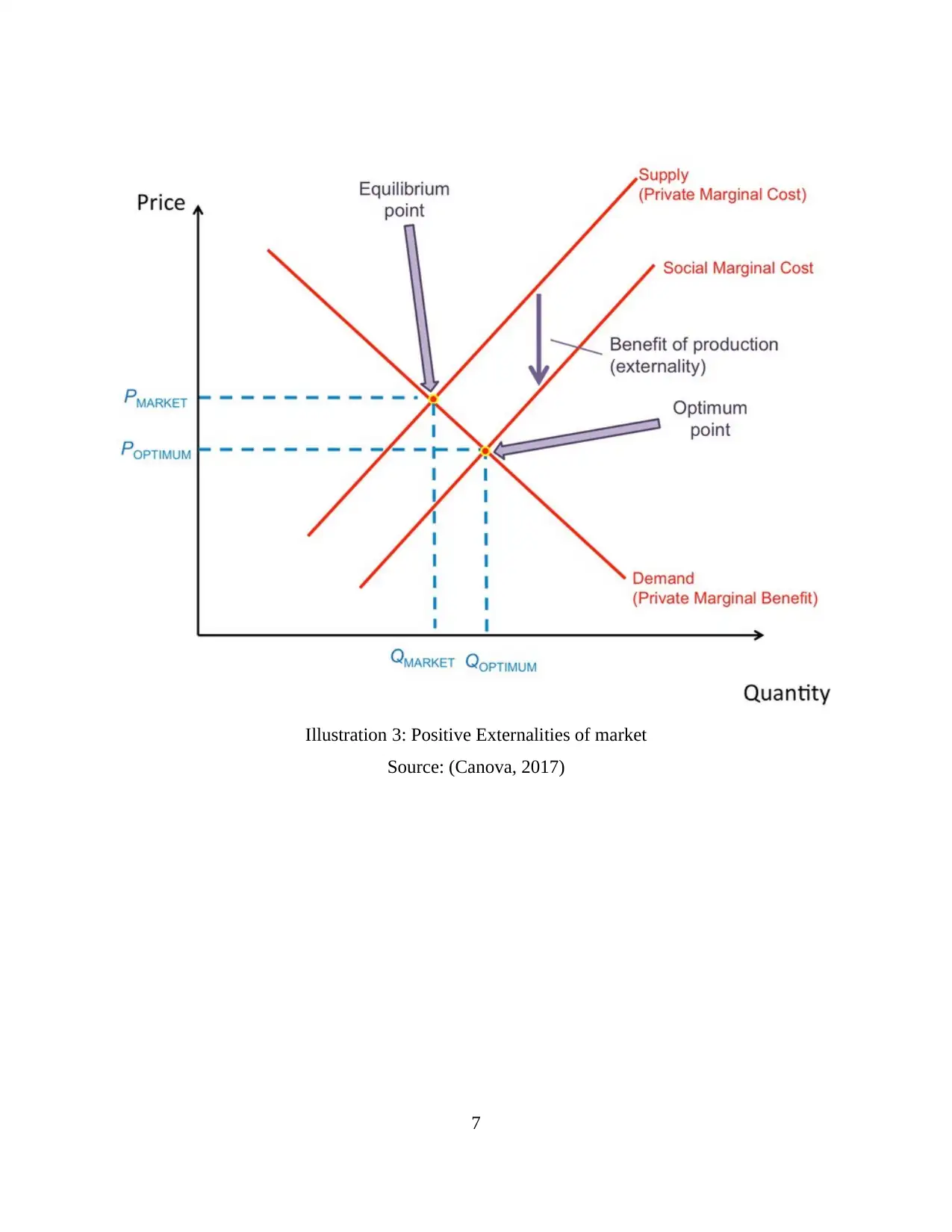
Illustration 3: Positive Externalities of market
Source: (Canova, 2017)
7
Source: (Canova, 2017)
7
Paraphrase This Document
Need a fresh take? Get an instant paraphrase of this document with our AI Paraphraser
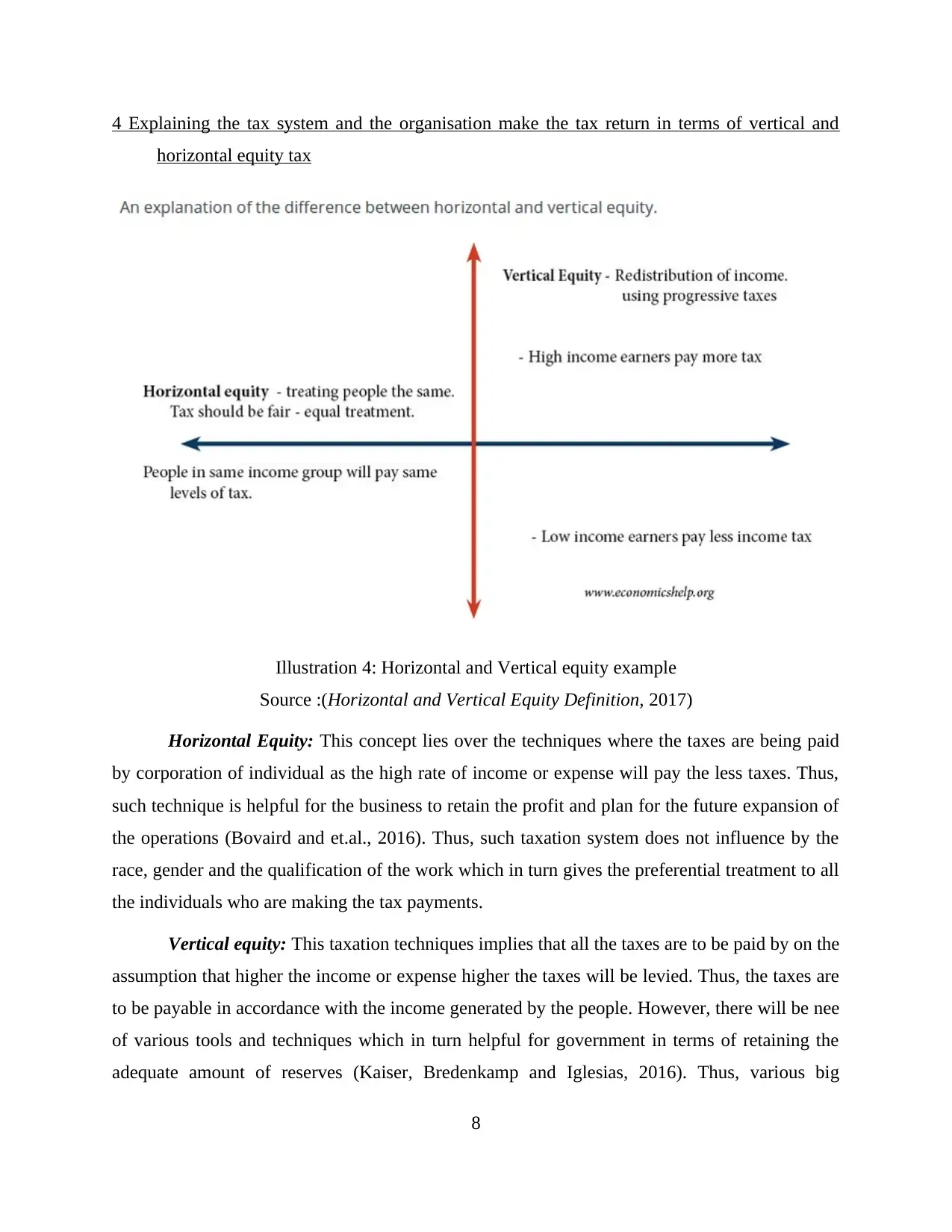
4 Explaining the tax system and the organisation make the tax return in terms of vertical and
horizontal equity tax
Illustration 4: Horizontal and Vertical equity example
Source :(Horizontal and Vertical Equity Definition, 2017)
Horizontal Equity: This concept lies over the techniques where the taxes are being paid
by corporation of individual as the high rate of income or expense will pay the less taxes. Thus,
such technique is helpful for the business to retain the profit and plan for the future expansion of
the operations (Bovaird and et.al., 2016). Thus, such taxation system does not influence by the
race, gender and the qualification of the work which in turn gives the preferential treatment to all
the individuals who are making the tax payments.
Vertical equity: This taxation techniques implies that all the taxes are to be paid by on the
assumption that higher the income or expense higher the taxes will be levied. Thus, the taxes are
to be payable in accordance with the income generated by the people. However, there will be nee
of various tools and techniques which in turn helpful for government in terms of retaining the
adequate amount of reserves (Kaiser, Bredenkamp and Iglesias, 2016). Thus, various big
8
horizontal equity tax
Illustration 4: Horizontal and Vertical equity example
Source :(Horizontal and Vertical Equity Definition, 2017)
Horizontal Equity: This concept lies over the techniques where the taxes are being paid
by corporation of individual as the high rate of income or expense will pay the less taxes. Thus,
such technique is helpful for the business to retain the profit and plan for the future expansion of
the operations (Bovaird and et.al., 2016). Thus, such taxation system does not influence by the
race, gender and the qualification of the work which in turn gives the preferential treatment to all
the individuals who are making the tax payments.
Vertical equity: This taxation techniques implies that all the taxes are to be paid by on the
assumption that higher the income or expense higher the taxes will be levied. Thus, the taxes are
to be payable in accordance with the income generated by the people. However, there will be nee
of various tools and techniques which in turn helpful for government in terms of retaining the
adequate amount of reserves (Kaiser, Bredenkamp and Iglesias, 2016). Thus, various big
8
corporations which have the favourable turnover ratios will be able to make the adequate tax
payment in the society welfare.
Fair and unfair taxation payments for various firm in the environment:
In context with UK taxation system the taxes are being levied over the income and gains
by Corporates and individual were collected by the HMRC and under various acts. However,
there has been the taxes are levied over business is mainly the corporate taxes, import and export
taxes as well as various tariff or duties which in turn helpful for the government to have the
adequate gains or reserves (Ihori, 2017). Thus, such reserves are being utilised by legal
authorities in UK to improve the education, medical facilities, infrastructural facilities as well as
economical advancement.
On the other side the tax slabs which are being implicated by the government in context
with facilitating the adequate tax payments which are affecting firms in having the fair trade
practices. Thus, there has been increment in the duties payable by corporation over the import
and export of the products and services (Bloch and et.al., 2016). Thus, such technique is
unfavourable as it affects the small size industry and the revenue retention of such firms.
5 Evaluating the poverty and income inequality in terms of social obstacles
There has been various obstacle in the economic environment on which the major issues
are influencing the internal operations of the country. However, there has been two serious
problems which are need to be evaluated such as:
Income inequality and Poverty: the economic ability of individual or corporations in
terms with meeting the liabilities and debts of the firm. Thus, such gap and difference has been
found in various big economies in the world. It usually influenced the purchasing power of the
individuals such as the higher the rate over product and services the lower the consumers or
buyer for such goods (Jalan, Marjit and Santra, 2016). Thus, such factors may help the
organisation in making the favourable profitability but it is somehow affected the reduction in
the demands. While on the other side various public industries who are operating the country as
to design the products and service which are fruitful for the consumers and easily affordable by
everyone in the society (Kaul, 2017). Thus, such kinds of segmentations do not affect the profit
gathering or the revenue requisition of the individuals. Therefore, the demands for such products
9
payment in the society welfare.
Fair and unfair taxation payments for various firm in the environment:
In context with UK taxation system the taxes are being levied over the income and gains
by Corporates and individual were collected by the HMRC and under various acts. However,
there has been the taxes are levied over business is mainly the corporate taxes, import and export
taxes as well as various tariff or duties which in turn helpful for the government to have the
adequate gains or reserves (Ihori, 2017). Thus, such reserves are being utilised by legal
authorities in UK to improve the education, medical facilities, infrastructural facilities as well as
economical advancement.
On the other side the tax slabs which are being implicated by the government in context
with facilitating the adequate tax payments which are affecting firms in having the fair trade
practices. Thus, there has been increment in the duties payable by corporation over the import
and export of the products and services (Bloch and et.al., 2016). Thus, such technique is
unfavourable as it affects the small size industry and the revenue retention of such firms.
5 Evaluating the poverty and income inequality in terms of social obstacles
There has been various obstacle in the economic environment on which the major issues
are influencing the internal operations of the country. However, there has been two serious
problems which are need to be evaluated such as:
Income inequality and Poverty: the economic ability of individual or corporations in
terms with meeting the liabilities and debts of the firm. Thus, such gap and difference has been
found in various big economies in the world. It usually influenced the purchasing power of the
individuals such as the higher the rate over product and services the lower the consumers or
buyer for such goods (Jalan, Marjit and Santra, 2016). Thus, such factors may help the
organisation in making the favourable profitability but it is somehow affected the reduction in
the demands. While on the other side various public industries who are operating the country as
to design the products and service which are fruitful for the consumers and easily affordable by
everyone in the society (Kaul, 2017). Thus, such kinds of segmentations do not affect the profit
gathering or the revenue requisition of the individuals. Therefore, the demands for such products
9
⊘ This is a preview!⊘
Do you want full access?
Subscribe today to unlock all pages.
Trusted by 1+ million students worldwide

1 out of 16


Related Documents


Your All-in-One AI-Powered Toolkit for Academic Success.
+13062052269
info@desklib.com
Available 24*7 on WhatsApp / Email
![[object Object]](/_next/static/media/star-bottom.7253800d.svg)
Unlock your academic potential
Copyright © 2020–2026 A2Z Services. All Rights Reserved. Developed and managed by ZUCOL.