Evaluating Public Health Agencies' Roles in the UK
VerifiedAdded on 2020/02/05
|11
|2860
|92
Essay
AI Summary
This essay provides an in-depth analysis of the roles and responsibilities of various public health agencies, including the World Health Organization (WHO), the National Health Service (NHS), and Clinical Commissioning Groups (CGC), at global, national, and local levels within the United Kingdom. It examines how these agencies collaborate to promote public health, control diseases, and address the needs of the population. The essay also investigates the prevalence of both infectious and non-infectious diseases in the UK, highlighting the strategies and approaches used to manage and control these health issues. Furthermore, it discusses the principles and policies followed in health and social care settings, including the importance of patient rights, transparency, and complaint mechanisms. The essay also touches upon mental health services, emphasizing the role of staff and the effectiveness of these services in supporting individuals. Overall, the essay offers a comprehensive overview of the UK's public health system and the key agencies involved in maintaining a healthy society.

The Role of Public Health
1
1

Paraphrase This Document
Need a fresh take? Get an instant paraphrase of this document with our AI Paraphraser
Introduction
This essay explains the significant role played by global, national and local
agencies.Furthermore it evaluates such responsible agencies in
maintaining public health and investigates the prevalent infectious and
non-infectious diseases in UK.
1.1
Public health system for attaining healthy population comprises of various
agencies acting together in collaboration at local, state and national level.
To promote health and control disease in communities, it is essential to
find the current level of disease and health, and these agencies are
playing significant role in identifying the same.
The agencies like World health organisation (WHO), Department of
health, National health services (NHS), Clinical Commissioning Groups
(CGC), have specific roles in terms of their aims, objectives and targets
but broadly they all work towards attaining a healthy society (Naidoo and
Willis, 2009).
WHO is the primary public health organization acting at international level
that does not directly act but supports, guides and provide expertise
assistance to countries. It works in collaboration with other private and
public agencies in shaping the research agenda required for identifying
disease level in community (Buse, et al., 2012). It is regarded as apex
institution in the whole world that cares about all individuals in improving
their existing health conditions. The subsidies are granted by this
institution in order create awareness among all the peoples in the whole
world regarding the complexities of the diseases. The primary role played
2
This essay explains the significant role played by global, national and local
agencies.Furthermore it evaluates such responsible agencies in
maintaining public health and investigates the prevalent infectious and
non-infectious diseases in UK.
1.1
Public health system for attaining healthy population comprises of various
agencies acting together in collaboration at local, state and national level.
To promote health and control disease in communities, it is essential to
find the current level of disease and health, and these agencies are
playing significant role in identifying the same.
The agencies like World health organisation (WHO), Department of
health, National health services (NHS), Clinical Commissioning Groups
(CGC), have specific roles in terms of their aims, objectives and targets
but broadly they all work towards attaining a healthy society (Naidoo and
Willis, 2009).
WHO is the primary public health organization acting at international level
that does not directly act but supports, guides and provide expertise
assistance to countries. It works in collaboration with other private and
public agencies in shaping the research agenda required for identifying
disease level in community (Buse, et al., 2012). It is regarded as apex
institution in the whole world that cares about all individuals in improving
their existing health conditions. The subsidies are granted by this
institution in order create awareness among all the peoples in the whole
world regarding the complexities of the diseases. The primary role played
2
by this organisation is to cater the healthy needs of all individuals by
devising various health related programs.
The National Health Service is the organization working in UK for the
health and social care. They are the authority’s bodies which are working
for the regulations of health and social care matters. They are controlling
and monitoring the operations of the other health and social care units.
The national health organisation is that institute which is highly devoted
to the health of individuals. The cost of dangerous diseases is calculated
by this institute which helps in awaking various individuals in order to
predict the future costs of various diseases. The compensation relief given
by this institution in order to provide additional support to individuals. The
self medication protocols are devised by this institution in order to provide
additional support to all individuals in order to improve their existing
health conditions. Training and supporting activities are executed by the
business enterprise in order to gain competitive advantage over variety of
customers. The curriculum schedules are prepared by this institute by
coordinating with various pharmacists. The coordination will be
maintained by appointing mediator who contacts the suppliers and the
doctors in selling all the medicines to its end consumers that is all the
patients. The professional performance will be monitored by this
organisation that held responsible for catering the medical objectives
framed by the business enterprise.
Clinical Commissioning Group (CGC) is the group working on the surveys
and data provided to the health and social care units. They are studying
and evaluating the root causes of the major cases in a stream or the
3
devising various health related programs.
The National Health Service is the organization working in UK for the
health and social care. They are the authority’s bodies which are working
for the regulations of health and social care matters. They are controlling
and monitoring the operations of the other health and social care units.
The national health organisation is that institute which is highly devoted
to the health of individuals. The cost of dangerous diseases is calculated
by this institute which helps in awaking various individuals in order to
predict the future costs of various diseases. The compensation relief given
by this institution in order to provide additional support to individuals. The
self medication protocols are devised by this institution in order to provide
additional support to all individuals in order to improve their existing
health conditions. Training and supporting activities are executed by the
business enterprise in order to gain competitive advantage over variety of
customers. The curriculum schedules are prepared by this institute by
coordinating with various pharmacists. The coordination will be
maintained by appointing mediator who contacts the suppliers and the
doctors in selling all the medicines to its end consumers that is all the
patients. The professional performance will be monitored by this
organisation that held responsible for catering the medical objectives
framed by the business enterprise.
Clinical Commissioning Group (CGC) is the group working on the surveys
and data provided to the health and social care units. They are studying
and evaluating the root causes of the major cases in a stream or the
3
⊘ This is a preview!⊘
Do you want full access?
Subscribe today to unlock all pages.

Trusted by 1+ million students worldwide
causes for the failure or non-performance. They are also monitoring and
reviewing the process of other units keeping a tough eye on their
operations and wrong doing. This organisation comes into existence with
the inauguration of health and social care act established in the year
2012. The major role played by this entity is to provide clinical support to
all individuals in order to meet the healthy needs o all individuals. The
health related services are offered by this institute by accomplishing the
local area needs of the United Kingdom. The social needs of every
individual will get accomplished by offering services to improve their
health.
3.2
There are various principles that have been suggested for procedures
followed in a health and social care setting. For a health care organisation
to provide efficient and effective services to service users, it is essential to
consider and implement these policies and principles. These principles
guide in providing better services to the needy (Karsh et al. 2005).
Better Home Organization is a service providing special organisation in
London that takes care of vulnerable people. This particular legislation
comes into existence in the United kingdom that helps in improving the
current income situations of all individuals. This unique theme imposed by
the legal environment of the United Kingdom. The poverty has eradicated
by implementing this policy which provides equal opportunity to all
individuals living in the UK to provide new home to all of them. This
service centre a wide group of needy people are taken care of and
therefore, it is crucial for the organisation to have good support principles
4
reviewing the process of other units keeping a tough eye on their
operations and wrong doing. This organisation comes into existence with
the inauguration of health and social care act established in the year
2012. The major role played by this entity is to provide clinical support to
all individuals in order to meet the healthy needs o all individuals. The
health related services are offered by this institute by accomplishing the
local area needs of the United Kingdom. The social needs of every
individual will get accomplished by offering services to improve their
health.
3.2
There are various principles that have been suggested for procedures
followed in a health and social care setting. For a health care organisation
to provide efficient and effective services to service users, it is essential to
consider and implement these policies and principles. These principles
guide in providing better services to the needy (Karsh et al. 2005).
Better Home Organization is a service providing special organisation in
London that takes care of vulnerable people. This particular legislation
comes into existence in the United kingdom that helps in improving the
current income situations of all individuals. This unique theme imposed by
the legal environment of the United Kingdom. The poverty has eradicated
by implementing this policy which provides equal opportunity to all
individuals living in the UK to provide new home to all of them. This
service centre a wide group of needy people are taken care of and
therefore, it is crucial for the organisation to have good support principles
4
Paraphrase This Document
Need a fresh take? Get an instant paraphrase of this document with our AI Paraphraser
so as to provide beneficial services to all the users. The code of conduct
and values will be followed while providing help and care services to the
users. For instance, if there is a user with certain learning disability then
he must be specially supported while explaining basic things as well
(Gulliksen et al. 2003). The housing facility is the basic need of an
individual which gets fulfilled by providing homes in the affordable rates
to meet their disability.
According to Health and Social Care Act 2012, every patient has a right to
manage his or her health care and must be free to express his views,
feedback as well as concerns. Thus, in the organisation, the act is strictly
followed and every patient is received with a professional and accountable
approach. Service providers give proper time to each individual, record
their proper history and listen to their chief complain patiently. Thereafter,
diagnosis and treatment planning is done based upon individual needs
and same is explained to as well as consent is taken from the patient or
family. Hence, it is made sure that everyone is treated with equality and
given proper rights despite of having differences.
It has been reported that this act leads to increase in care accessibility
and efficiency of the services given to the clients (Glasby, 2012). Thus,
steps are taken to apply other policies of NHS as well, as that would assist
in setting practice standards beneficial for common vulnerable people.
There are several complaints policies in regarding with the mental health
services.
Transparency and privacy policies: The service users are feeling that ant
breach has happened with their confidentiality or private information’s
5
and values will be followed while providing help and care services to the
users. For instance, if there is a user with certain learning disability then
he must be specially supported while explaining basic things as well
(Gulliksen et al. 2003). The housing facility is the basic need of an
individual which gets fulfilled by providing homes in the affordable rates
to meet their disability.
According to Health and Social Care Act 2012, every patient has a right to
manage his or her health care and must be free to express his views,
feedback as well as concerns. Thus, in the organisation, the act is strictly
followed and every patient is received with a professional and accountable
approach. Service providers give proper time to each individual, record
their proper history and listen to their chief complain patiently. Thereafter,
diagnosis and treatment planning is done based upon individual needs
and same is explained to as well as consent is taken from the patient or
family. Hence, it is made sure that everyone is treated with equality and
given proper rights despite of having differences.
It has been reported that this act leads to increase in care accessibility
and efficiency of the services given to the clients (Glasby, 2012). Thus,
steps are taken to apply other policies of NHS as well, as that would assist
in setting practice standards beneficial for common vulnerable people.
There are several complaints policies in regarding with the mental health
services.
Transparency and privacy policies: The service users are feeling that ant
breach has happened with their confidentiality or private information’s
5
they can go for complaint matrix. The policies implemented in the nation
further needs to be evaluated by taking prior consent of all individuals by
executing sample of the legislations.
Staff or process complaints: Complaints are related with the staff,
services or process than the management can be contacted for which
they can resolve the matter as per their credentials or responsibility. But
in case if service users are still not satisfied they can pursue the complaint
matrix. The personnel are regarded as major aspects of the current
legislations which will be revised in order to enhance the existing
conditions of the business enterprise. The complain redressal system will
be reframed by an individual which helps in gathering the needs and the
expectations of several number of customers.
Management complaints: If there are complaints related with the
management or payment related queries, service users can contact board
members for settlement. But in case if service users are still not satisfied
they can pursue the complaint matrix. The existence of the complain
management system will be reviewed once a while by appointing new
individual. Technology can be used by an enterprise in monitoring and
tracking the system in order to know existence of the current
management system.
Escalations: There is one more option of complaints settling, which is
directly putting an escalation mail to the support or helpdesk or by online
medium on website. The email management is used that helps in catering
6
further needs to be evaluated by taking prior consent of all individuals by
executing sample of the legislations.
Staff or process complaints: Complaints are related with the staff,
services or process than the management can be contacted for which
they can resolve the matter as per their credentials or responsibility. But
in case if service users are still not satisfied they can pursue the complaint
matrix. The personnel are regarded as major aspects of the current
legislations which will be revised in order to enhance the existing
conditions of the business enterprise. The complain redressal system will
be reframed by an individual which helps in gathering the needs and the
expectations of several number of customers.
Management complaints: If there are complaints related with the
management or payment related queries, service users can contact board
members for settlement. But in case if service users are still not satisfied
they can pursue the complaint matrix. The existence of the complain
management system will be reviewed once a while by appointing new
individual. Technology can be used by an enterprise in monitoring and
tracking the system in order to know existence of the current
management system.
Escalations: There is one more option of complaints settling, which is
directly putting an escalation mail to the support or helpdesk or by online
medium on website. The email management is used that helps in catering
6
⊘ This is a preview!⊘
Do you want full access?
Subscribe today to unlock all pages.
Trusted by 1+ million students worldwide
variety of patient’s feedbacks whether good or bad after taken into
considerations all the complaints.
3.4
Patients in the mental health hospitals need to be fragmented into
different categories that help in improving the existing working conditions
of the business enterprise. The top management has allotted various
activities in order to develop various objectives in order to achieve all
kinds of goals and the objectives framed by an entity. The critical and
sensitive patients with highly severe disease need to be taken into
consideration by developing care units to treat all that kinds of patients.
Mental health services programme is one of the top priority programmes
in health and social care services of UK. In certain programmes and social
groups there is a higher prevalence of mental disorders and problems
owing to various external factors like work stress, family stress, lack of
means, discrimination, inability to get a better job and life style choice. It
is important that the causative reason behind a stressful situation should
be addressed (McFarlane, Kaplan & Lawrence, 2011 p.98).
The role of staff is essential in the heath care homes that represent the
whole hospital in meeting different needs of all kinds of individual in the
hospital. A mental health nurse can play a very vital role here as she
would understand their social, political and economic situation and she
can offer them help by providing guidance to resolve these issues while at
the same time she can create a positive atmosphere with in family and
help them come out of their depressive state.
7
considerations all the complaints.
3.4
Patients in the mental health hospitals need to be fragmented into
different categories that help in improving the existing working conditions
of the business enterprise. The top management has allotted various
activities in order to develop various objectives in order to achieve all
kinds of goals and the objectives framed by an entity. The critical and
sensitive patients with highly severe disease need to be taken into
consideration by developing care units to treat all that kinds of patients.
Mental health services programme is one of the top priority programmes
in health and social care services of UK. In certain programmes and social
groups there is a higher prevalence of mental disorders and problems
owing to various external factors like work stress, family stress, lack of
means, discrimination, inability to get a better job and life style choice. It
is important that the causative reason behind a stressful situation should
be addressed (McFarlane, Kaplan & Lawrence, 2011 p.98).
The role of staff is essential in the heath care homes that represent the
whole hospital in meeting different needs of all kinds of individual in the
hospital. A mental health nurse can play a very vital role here as she
would understand their social, political and economic situation and she
can offer them help by providing guidance to resolve these issues while at
the same time she can create a positive atmosphere with in family and
help them come out of their depressive state.
7
Paraphrase This Document
Need a fresh take? Get an instant paraphrase of this document with our AI Paraphraser
Mental Health Services are coherently effective for the service users as
they provide an environment feasible for their living. They provide that
stability and self-dependency to the service users for which they
considered to be independent living. These mental health services not
only provide mental services bit provide an esteem care as well as loved
feelings providing an attachment to the service users and treating them
emotionally. These are effective to a great extent as services users are
releasing their mental stress out and are curing for their better living.
Globally, various public health agencies like World Health Organisation
(WHO), United Nations (UN), The United Nation Children's Fund (UNICEF)
work towards attaining a healthy population and these agencies support
and coordinate with each other to achieve their targets. Infectious
diseases like HIV and non-infectious diseases like breast cancer is
affecting large number of people in country and various strategies and
approaches are followed to control these cases. Government and non-
government agencies are working in collaboration to identify the needs
and requirements of people, identifying major risk factors of these
diseases and thus, working to control the rising number of these diseases
in society. Awareness programmes are organised to educate people in
order to avoid risk factor and improve lifestyle.
8
they provide an environment feasible for their living. They provide that
stability and self-dependency to the service users for which they
considered to be independent living. These mental health services not
only provide mental services bit provide an esteem care as well as loved
feelings providing an attachment to the service users and treating them
emotionally. These are effective to a great extent as services users are
releasing their mental stress out and are curing for their better living.
Globally, various public health agencies like World Health Organisation
(WHO), United Nations (UN), The United Nation Children's Fund (UNICEF)
work towards attaining a healthy population and these agencies support
and coordinate with each other to achieve their targets. Infectious
diseases like HIV and non-infectious diseases like breast cancer is
affecting large number of people in country and various strategies and
approaches are followed to control these cases. Government and non-
government agencies are working in collaboration to identify the needs
and requirements of people, identifying major risk factors of these
diseases and thus, working to control the rising number of these diseases
in society. Awareness programmes are organised to educate people in
order to avoid risk factor and improve lifestyle.
8
References
Nelson, M.E., Rejeski, W.J., Blair, S.N., et al. (2007) Physical activity
and health in older adults: Recommendations from the ACSM and
AHA. Circulation, 116, 1094–1105.
Balsa A.I., Homer J.F., Fleming M., and French M.T. (2008) Alcohol
consumption and health among elders. The Gerontologist, 48, 622–
636.
Adams, K.F., Schatzkin, A., Harris, T.B., Kipnis, V., Mouw, T., Ballard-
Barbash, R., Hollennecck, A., and Leitzmann, M.F. (2006)
Overweight, obesity, and mortality in a large prospective cohort of
persons 50 to 71 years old. New England Journal of Medicine,
355(8):763–778.
Public health England (2015). HIV in the UK 2015: situation report
(online) accessed on 15 May 2016
Harris RJ, Ramsay M, Hope VD, Brant L, Hickman M, Foster GR, et al.
(2012). Hepatitis C prevalence in England remains low and varies by
ethnicity: an updated evidence synthesis. European Journal of Public
Health. 22(2):187-92. 2.
Department of Health,Social Services and Public Safety. (2007)
Action Plan for the Prevention, Management and Control of
Hepatitis C in Northern Ireland
National cancer control programmes, policies, and managerial
guidelines (2002), 2nd ed. Geneva, World Health Organization,
Buse, K., Mayes, N. and Wait, G. (2012). Making public health,
Maidenhead, Berkshire, Open University.
Bury, M. (1997). Health and illness in changing society. London:
Routledge.
Costello, J. Haggart, M. Eds. (2003) Public Health and Society.
Basingstoke: Palgrave Macmillan.
Heller, T., Muston, R., Sidell, M., and Lloyd, C. (2000). Working for
health. London: Sage.
Naidoo, J. and Willis, J. (2009). Foundations for health promotion.
Balliere Tindall.
Wellings, K., Mitchell, K., and Collumbien, M. eds. (2012). Sexual
health. A public health perspective. Maidenhead, Berkshire: Open
University Press. ISBN 13 978 0 33 524481
9
Nelson, M.E., Rejeski, W.J., Blair, S.N., et al. (2007) Physical activity
and health in older adults: Recommendations from the ACSM and
AHA. Circulation, 116, 1094–1105.
Balsa A.I., Homer J.F., Fleming M., and French M.T. (2008) Alcohol
consumption and health among elders. The Gerontologist, 48, 622–
636.
Adams, K.F., Schatzkin, A., Harris, T.B., Kipnis, V., Mouw, T., Ballard-
Barbash, R., Hollennecck, A., and Leitzmann, M.F. (2006)
Overweight, obesity, and mortality in a large prospective cohort of
persons 50 to 71 years old. New England Journal of Medicine,
355(8):763–778.
Public health England (2015). HIV in the UK 2015: situation report
(online) accessed on 15 May 2016
Harris RJ, Ramsay M, Hope VD, Brant L, Hickman M, Foster GR, et al.
(2012). Hepatitis C prevalence in England remains low and varies by
ethnicity: an updated evidence synthesis. European Journal of Public
Health. 22(2):187-92. 2.
Department of Health,Social Services and Public Safety. (2007)
Action Plan for the Prevention, Management and Control of
Hepatitis C in Northern Ireland
National cancer control programmes, policies, and managerial
guidelines (2002), 2nd ed. Geneva, World Health Organization,
Buse, K., Mayes, N. and Wait, G. (2012). Making public health,
Maidenhead, Berkshire, Open University.
Bury, M. (1997). Health and illness in changing society. London:
Routledge.
Costello, J. Haggart, M. Eds. (2003) Public Health and Society.
Basingstoke: Palgrave Macmillan.
Heller, T., Muston, R., Sidell, M., and Lloyd, C. (2000). Working for
health. London: Sage.
Naidoo, J. and Willis, J. (2009). Foundations for health promotion.
Balliere Tindall.
Wellings, K., Mitchell, K., and Collumbien, M. eds. (2012). Sexual
health. A public health perspective. Maidenhead, Berkshire: Open
University Press. ISBN 13 978 0 33 524481
9
⊘ This is a preview!⊘
Do you want full access?
Subscribe today to unlock all pages.
Trusted by 1+ million students worldwide
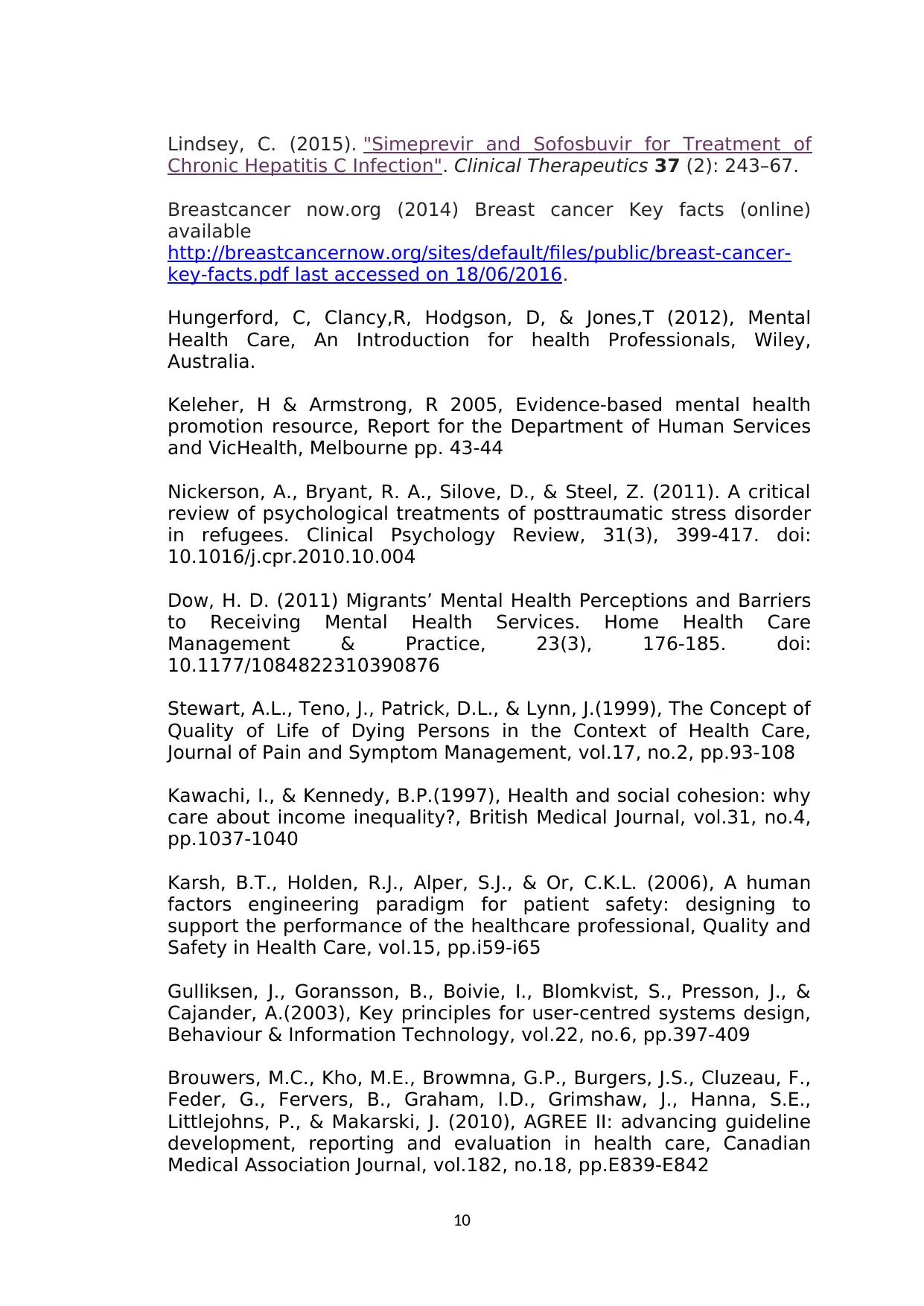
Lindsey, C. (2015). "Simeprevir and Sofosbuvir for Treatment of
Chronic Hepatitis C Infection". Clinical Therapeutics 37 (2): 243–67.
Breastcancer now.org (2014) Breast cancer Key facts (online)
available
http://breastcancernow.org/sites/default/files/public/breast-cancer-
key-facts.pdf last accessed on 18/06/2016.
Hungerford, C, Clancy,R, Hodgson, D, & Jones,T (2012), Mental
Health Care, An Introduction for health Professionals, Wiley,
Australia.
Keleher, H & Armstrong, R 2005, Evidence-based mental health
promotion resource, Report for the Department of Human Services
and VicHealth, Melbourne pp. 43-44
Nickerson, A., Bryant, R. A., Silove, D., & Steel, Z. (2011). A critical
review of psychological treatments of posttraumatic stress disorder
in refugees. Clinical Psychology Review, 31(3), 399-417. doi:
10.1016/j.cpr.2010.10.004
Dow, H. D. (2011) Migrants’ Mental Health Perceptions and Barriers
to Receiving Mental Health Services. Home Health Care
Management & Practice, 23(3), 176-185. doi:
10.1177/1084822310390876
Stewart, A.L., Teno, J., Patrick, D.L., & Lynn, J.(1999), The Concept of
Quality of Life of Dying Persons in the Context of Health Care,
Journal of Pain and Symptom Management, vol.17, no.2, pp.93-108
Kawachi, I., & Kennedy, B.P.(1997), Health and social cohesion: why
care about income inequality?, British Medical Journal, vol.31, no.4,
pp.1037-1040
Karsh, B.T., Holden, R.J., Alper, S.J., & Or, C.K.L. (2006), A human
factors engineering paradigm for patient safety: designing to
support the performance of the healthcare professional, Quality and
Safety in Health Care, vol.15, pp.i59-i65
Gulliksen, J., Goransson, B., Boivie, I., Blomkvist, S., Presson, J., &
Cajander, A.(2003), Key principles for user-centred systems design,
Behaviour & Information Technology, vol.22, no.6, pp.397-409
Brouwers, M.C., Kho, M.E., Browmna, G.P., Burgers, J.S., Cluzeau, F.,
Feder, G., Fervers, B., Graham, I.D., Grimshaw, J., Hanna, S.E.,
Littlejohns, P., & Makarski, J. (2010), AGREE II: advancing guideline
development, reporting and evaluation in health care, Canadian
Medical Association Journal, vol.182, no.18, pp.E839-E842
10
Chronic Hepatitis C Infection". Clinical Therapeutics 37 (2): 243–67.
Breastcancer now.org (2014) Breast cancer Key facts (online)
available
http://breastcancernow.org/sites/default/files/public/breast-cancer-
key-facts.pdf last accessed on 18/06/2016.
Hungerford, C, Clancy,R, Hodgson, D, & Jones,T (2012), Mental
Health Care, An Introduction for health Professionals, Wiley,
Australia.
Keleher, H & Armstrong, R 2005, Evidence-based mental health
promotion resource, Report for the Department of Human Services
and VicHealth, Melbourne pp. 43-44
Nickerson, A., Bryant, R. A., Silove, D., & Steel, Z. (2011). A critical
review of psychological treatments of posttraumatic stress disorder
in refugees. Clinical Psychology Review, 31(3), 399-417. doi:
10.1016/j.cpr.2010.10.004
Dow, H. D. (2011) Migrants’ Mental Health Perceptions and Barriers
to Receiving Mental Health Services. Home Health Care
Management & Practice, 23(3), 176-185. doi:
10.1177/1084822310390876
Stewart, A.L., Teno, J., Patrick, D.L., & Lynn, J.(1999), The Concept of
Quality of Life of Dying Persons in the Context of Health Care,
Journal of Pain and Symptom Management, vol.17, no.2, pp.93-108
Kawachi, I., & Kennedy, B.P.(1997), Health and social cohesion: why
care about income inequality?, British Medical Journal, vol.31, no.4,
pp.1037-1040
Karsh, B.T., Holden, R.J., Alper, S.J., & Or, C.K.L. (2006), A human
factors engineering paradigm for patient safety: designing to
support the performance of the healthcare professional, Quality and
Safety in Health Care, vol.15, pp.i59-i65
Gulliksen, J., Goransson, B., Boivie, I., Blomkvist, S., Presson, J., &
Cajander, A.(2003), Key principles for user-centred systems design,
Behaviour & Information Technology, vol.22, no.6, pp.397-409
Brouwers, M.C., Kho, M.E., Browmna, G.P., Burgers, J.S., Cluzeau, F.,
Feder, G., Fervers, B., Graham, I.D., Grimshaw, J., Hanna, S.E.,
Littlejohns, P., & Makarski, J. (2010), AGREE II: advancing guideline
development, reporting and evaluation in health care, Canadian
Medical Association Journal, vol.182, no.18, pp.E839-E842
10
Paraphrase This Document
Need a fresh take? Get an instant paraphrase of this document with our AI Paraphraser

Glasby, J.(2012), Understanding Health and Social Care, The Policy
press
Baxter, S.K., Brumfitt, S.M.(2008), Professional differences in
interprofessional working, Journal of Interprofessional Care, vol.22,
no.3, pp.239-251
Jones, M. and Atwal, A (2009). Preparing for Professional Practice in
Health & Social Care. Chichester: Wiley-Blackwell.
11
press
Baxter, S.K., Brumfitt, S.M.(2008), Professional differences in
interprofessional working, Journal of Interprofessional Care, vol.22,
no.3, pp.239-251
Jones, M. and Atwal, A (2009). Preparing for Professional Practice in
Health & Social Care. Chichester: Wiley-Blackwell.
11

1 out of 11


Related Documents


Your All-in-One AI-Powered Toolkit for Academic Success.
+13062052269
info@desklib.com
Available 24*7 on WhatsApp / Email
![[object Object]](/_next/static/media/star-bottom.7253800d.svg)
Unlock your academic potential
Copyright © 2020–2026 A2Z Services. All Rights Reserved. Developed and managed by ZUCOL.