Community-Based Participatory Research in Public Health Analysis

Verified

Added on  2022/11/18

|4
|726
|190
Homework Assignment
AI Summary
This assignment analyzes a community-based participatory research (CBPR) study focused on addressing cardiovascular disease and cancer risk within an African American church community. The study implemented interventions such as dietary modifications, increased physical activity, and health monitoring, including blood pressure checks. The research aligns with CBPR principles by involving community members, researchers, and organizational representatives in decision-making. The interventions, which included training church members to incorporate healthy habits, aimed to reduce health disparities. The theoretical background supporting the study's focus on the African American church members' susceptibility to health disparities, like cardiovascular disease, is also discussed. The study highlights the importance of considering socioeconomic factors and access to healthy resources in addressing these health issues. The analysis references relevant studies and the design of the Faith, Activity, and Nutrition (FAN) program.
Document Page
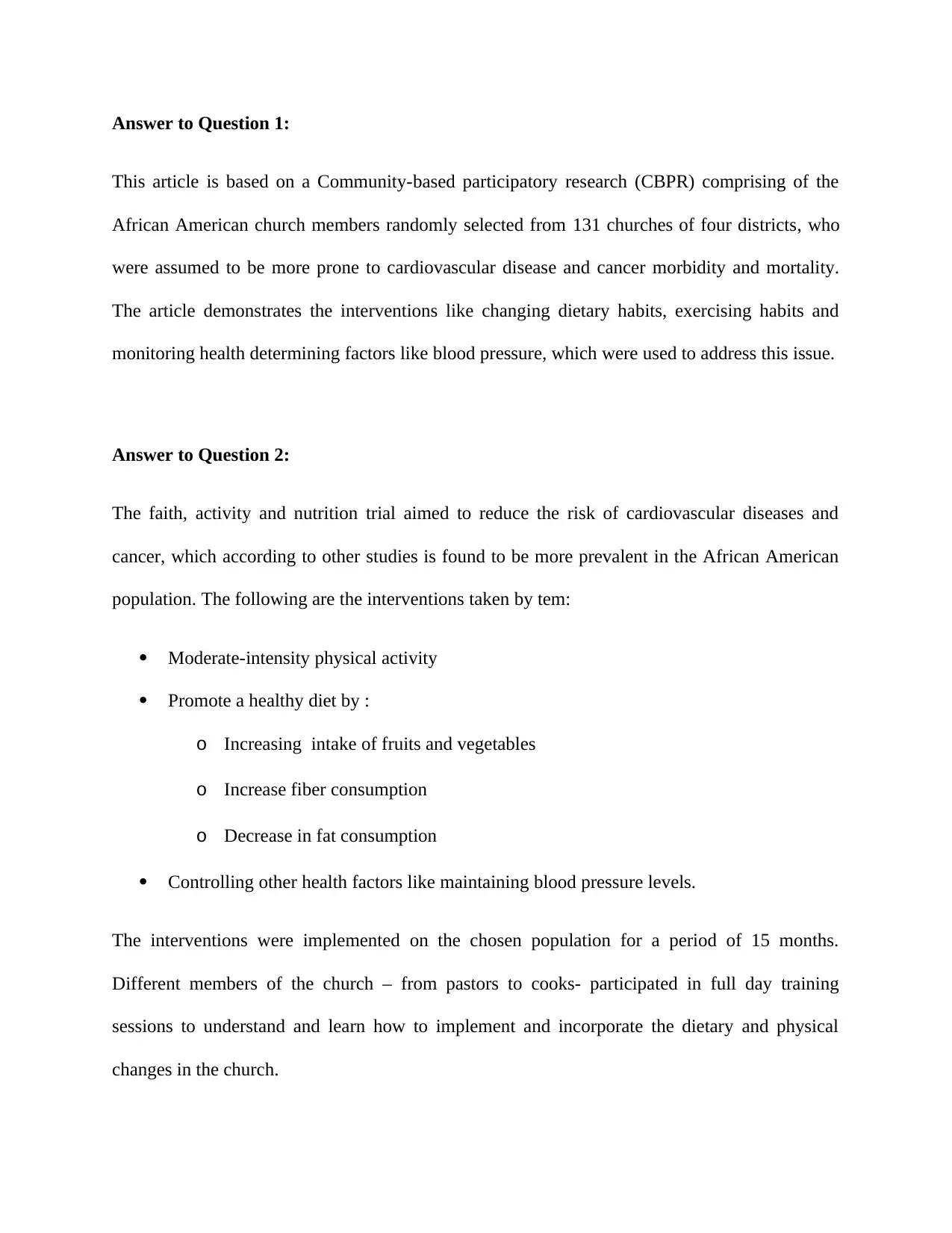
Answer to Question 1:
This article is based on a Community-based participatory research (CBPR) comprising of the
African American church members randomly selected from 131 churches of four districts, who
were assumed to be more prone to cardiovascular disease and cancer morbidity and mortality.
The article demonstrates the interventions like changing dietary habits, exercising habits and
monitoring health determining factors like blood pressure, which were used to address this issue.
Answer to Question 2:
The faith, activity and nutrition trial aimed to reduce the risk of cardiovascular diseases and
cancer, which according to other studies is found to be more prevalent in the African American
population. The following are the interventions taken by tem:
Moderate-intensity physical activity
Promote a healthy diet by :
o Increasing intake of fruits and vegetables
o Increase fiber consumption
o Decrease in fat consumption
Controlling other health factors like maintaining blood pressure levels.
The interventions were implemented on the chosen population for a period of 15 months.
Different members of the church – from pastors to cooks- participated in full day training
sessions to understand and learn how to implement and incorporate the dietary and physical
changes in the church.
tabler-icon-diamond-filled.svg

Paraphrase This Document

Need a fresh take? Get an instant paraphrase of this document with our AI Paraphraser
Document Page
Answer to Question 3:
a. The CBPR is an approach which can be used to study that involves different
community members, researchers, and organizational representatives in sharing
information and expertise in the decision making process which would affect them
all. They aim to increase the knowledge with the help of interventions in order to
benefit the members (Bermúdez Parsai et al., 2010).
b. Thus, the article perfectly corresponds with the principles of CBPR, by implementing
different interventions on the African American church members to help them not
develop heart diseases and other fatal diseases like cancer (Ralston, Young-Clark and
Coccia, 2017).
c. The principles of CBPR already clearly states the actions required to conduct an
experiment to help the community. Thus, it would be easier for the researcher to
follow the rules and conduct the research smoothly.
d. The partnerships between universities and faith communities successfully promote
good health by enforcing the church members to follow the different interventions in
order to eliminate disparities of their health.
Answer to Question 4:
The theoretical background to study the health behavior of the target population was a good fit.
The African American church members proved to be an appropriate theoretical background, as
they are seen to be prone to health disparities like cardiovascular diseases, and cancer. Their low
socio-economic status, limited access to healthy foods , unhealthy diets, and lack of physical
Document Page
exercise, contribute to the disease risk among the African Americans, and thus make them a
good fit for the study (Der Ananian et al., 2018).
Document Page
References
Bermúdez Parsai, M., Castro, F., Marsiglia, F., Harthun, M. and Valdez, H. (2010). Using
Community Based Participatory Research to Create a Culturally Grounded Intervention
for Parents and Youth to Prevent Risky Behaviors. Prevention Science, 12(1), pp.34-47.
Der Ananian, C., Winham, D., Thompson, S. and Tisue, M. (2018). Perceptions of Heart-Healthy
Behaviors among African American Adults: A Mixed Methods Study. International
Journal of Environmental Research and Public Health, 15(11), p.2433.
Ralston, P., Young-Clark, I. and Coccia, C. (2017). The Development of Health for Hearts
United: A Longitudinal Church-based Intervention to Reduce Cardiovascular Risk in
Mid-life and Older African Americans. Ethnicity & Disease, 27(1), p.21.
Wilcox, S., Laken, M., Parrott, A., Condrasky, M., Saunders, R., Addy, C., Evans, R., Baruth, M.
and Samuel, M. (2010). The Faith, Activity, and Nutrition (FAN) Program: Design of a
participatory research intervention to increase physical activity and improve dietary
habits in African American churches. Contemporary Clinical Trials, 31(4), pp.323-335.
chevron_up_icon
1 out of 4
circle_padding
hide_on_mobile
zoom_out_icon
[object Object]