Dengue Outbreak in Australia: Public Health Protection
VerifiedAdded on 2021/01/02
|13
|3727
|418
Report
AI Summary
This report provides a comprehensive overview of the public health challenges posed by dengue fever in Australia. It begins with an introduction to health protection and the specific context of dengue, highlighting the increasing prevalence and impact of the disease on the Australian population. The report then explores various prevention and control strategies, including the assessment of current methods and the use of integrated vector management (IVM). The report delves into the application of Wolbachia in paratransgenesis as a biological control method, discussing its implementation and challenges. It also offers future recommendations, such as the use of vaccination programs and contact management strategies to mitigate the effects of dengue. The report emphasizes the importance of community engagement and the need for continuous research and development to combat this public health issue effectively. The report highlights the need for coordinated efforts between governmental bodies, healthcare professionals, and the public to reduce dengue mortality and improve public health outcomes.
PUBLIC HEALTH
PROTECTION
PROTECTION

Paraphrase This Document
Need a fresh take? Get an instant paraphrase of this document with our AI Paraphraser
TABLE OF CONTENTS
INTRODUCTION...........................................................................................................................1
Overview...............................................................................................................................1
Assessment of the prevention and control strategies...........................................................2
Use of integrated vector management.................................................................................2
Use of Wolbachia in the Paratransgenesis Process............................................................4
Future recommendations......................................................................................................7
CONCLUSION...............................................................................................................................8
REFERENCES..............................................................................................................................9
INTRODUCTION...........................................................................................................................1
Overview...............................................................................................................................1
Assessment of the prevention and control strategies...........................................................2
Use of integrated vector management.................................................................................2
Use of Wolbachia in the Paratransgenesis Process............................................................4
Future recommendations......................................................................................................7
CONCLUSION...............................................................................................................................8
REFERENCES..............................................................................................................................9
Prevalence and Development of overall impact of health issue of dengue in Australian
Population
Introduction
Health Protection is defined as prevention from diseases by maintaining the quality and
safety of the basic needs of human's life. This assignment is based on the health issue of
dengue in Australia. It will shed light on the Public Health Protection management in a well-
defined manner. This will cover a set of activities to identify the issues and challenges such as
late exhibition of symptoms, lack of antiviral treatment, rise of complexities when not treated
with effective medication etc. Such identification will help in better management of mitigating the
effects. This report will be going to include about the dengue prevention and control strategies
such as vaccination, tests etc. It will highlight the critical assessment of such strategies in order
to strengthen them. Here these preventive measures that are currently applicable will be useful
to generate awareness to overcome challenges in near future.
Overview
Recently, there is an increased cases of Dengue-infected areas in Australia that has
shown negative impact on the entire population. This dengue outbreak has threatened the
socio-economic, political and medical sectors (Nguyen et.al., 2015). There are many causes
such as faster rate of urbanization, lack of awareness at public platforms in mitigating
measures, insufficiency in execution of programs for recovery etc., which added to increase this
public health issue at such rapid rate. However, with growing dengue cases, people have
become vigilant in context to any symptoms shown such as rashes, drowsiness and muscle
joint, etc. Along with, there are few solutions that have been suggested by the professionals of
healthcare sector to prevent this disease like applying mosquito repellent like DEET, wearing
fully covered clothing and using net (Ernst et.al., 2015). Studies and latest researches have
described the need of dengue control and preventive measures at large scale to overcome this
challenging issue.
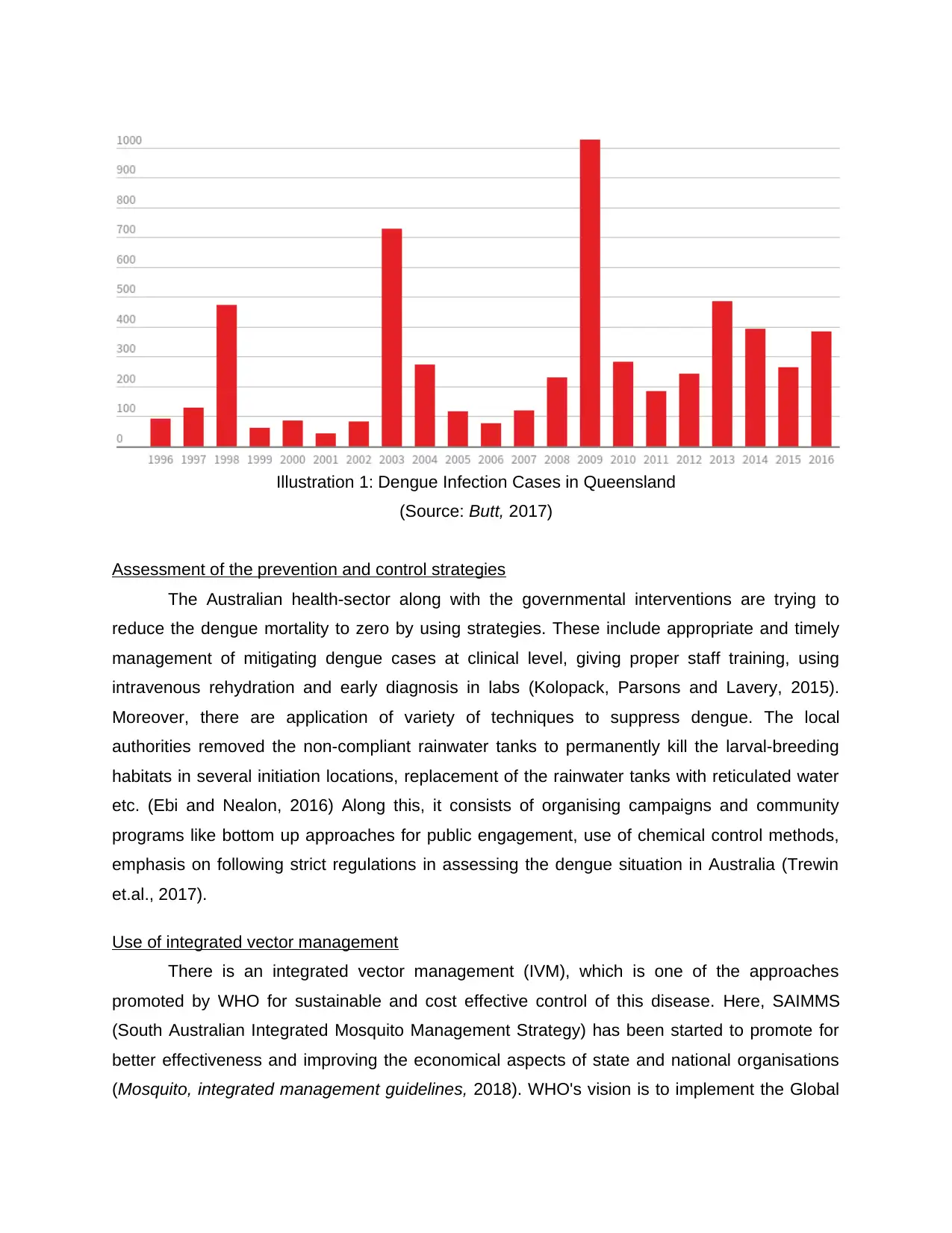
It has been clearly demonstrated that the Australian population especially in few parts of
Queensland, Victoria, New South Wales and Western Australia are severely affected from
Aedes mosquitoes, which is the main causative agent. There was the highest number of dengue
cases in the year 2016 when many citizens travelled to tropical areas; Western Australia saw
the most cases of 553 approximately (Butt, 2017).
Population
Introduction
Health Protection is defined as prevention from diseases by maintaining the quality and
safety of the basic needs of human's life. This assignment is based on the health issue of
dengue in Australia. It will shed light on the Public Health Protection management in a well-
defined manner. This will cover a set of activities to identify the issues and challenges such as
late exhibition of symptoms, lack of antiviral treatment, rise of complexities when not treated
with effective medication etc. Such identification will help in better management of mitigating the
effects. This report will be going to include about the dengue prevention and control strategies
such as vaccination, tests etc. It will highlight the critical assessment of such strategies in order
to strengthen them. Here these preventive measures that are currently applicable will be useful
to generate awareness to overcome challenges in near future.
Overview
Recently, there is an increased cases of Dengue-infected areas in Australia that has
shown negative impact on the entire population. This dengue outbreak has threatened the
socio-economic, political and medical sectors (Nguyen et.al., 2015). There are many causes
such as faster rate of urbanization, lack of awareness at public platforms in mitigating
measures, insufficiency in execution of programs for recovery etc., which added to increase this
public health issue at such rapid rate. However, with growing dengue cases, people have
become vigilant in context to any symptoms shown such as rashes, drowsiness and muscle
joint, etc. Along with, there are few solutions that have been suggested by the professionals of
healthcare sector to prevent this disease like applying mosquito repellent like DEET, wearing
fully covered clothing and using net (Ernst et.al., 2015). Studies and latest researches have
described the need of dengue control and preventive measures at large scale to overcome this
challenging issue.
It has been clearly demonstrated that the Australian population especially in few parts of
Queensland, Victoria, New South Wales and Western Australia are severely affected from
Aedes mosquitoes, which is the main causative agent. There was the highest number of dengue
cases in the year 2016 when many citizens travelled to tropical areas; Western Australia saw
the most cases of 553 approximately (Butt, 2017).
⊘ This is a preview!⊘
Do you want full access?
Subscribe today to unlock all pages.

Trusted by 1+ million students worldwide
Assessment of the prevention and control strategies
The Australian health-sector along with the governmental interventions are trying to
reduce the dengue mortality to zero by using strategies. These include appropriate and timely
management of mitigating dengue cases at clinical level, giving proper staff training, using
intravenous rehydration and early diagnosis in labs (Kolopack, Parsons and Lavery, 2015).
Moreover, there are application of variety of techniques to suppress dengue. The local
authorities removed the non-compliant rainwater tanks to permanently kill the larval-breeding
habitats in several initiation locations, replacement of the rainwater tanks with reticulated water
etc. (Ebi and Nealon, 2016) Along this, it consists of organising campaigns and community
programs like bottom up approaches for public engagement, use of chemical control methods,
emphasis on following strict regulations in assessing the dengue situation in Australia (Trewin
et.al., 2017).
Use of integrated vector management
There is an integrated vector management (IVM), which is one of the approaches
promoted by WHO for sustainable and cost effective control of this disease. Here, SAIMMS
(South Australian Integrated Mosquito Management Strategy) has been started to promote for
better effectiveness and improving the economical aspects of state and national organisations
(Mosquito, integrated management guidelines, 2018). WHO's vision is to implement the Global
Illustration 1: Dengue Infection Cases in Queensland
(Source: Butt, 2017)
The Australian health-sector along with the governmental interventions are trying to
reduce the dengue mortality to zero by using strategies. These include appropriate and timely
management of mitigating dengue cases at clinical level, giving proper staff training, using
intravenous rehydration and early diagnosis in labs (Kolopack, Parsons and Lavery, 2015).
Moreover, there are application of variety of techniques to suppress dengue. The local
authorities removed the non-compliant rainwater tanks to permanently kill the larval-breeding
habitats in several initiation locations, replacement of the rainwater tanks with reticulated water
etc. (Ebi and Nealon, 2016) Along this, it consists of organising campaigns and community
programs like bottom up approaches for public engagement, use of chemical control methods,
emphasis on following strict regulations in assessing the dengue situation in Australia (Trewin
et.al., 2017).
Use of integrated vector management
There is an integrated vector management (IVM), which is one of the approaches
promoted by WHO for sustainable and cost effective control of this disease. Here, SAIMMS
(South Australian Integrated Mosquito Management Strategy) has been started to promote for
better effectiveness and improving the economical aspects of state and national organisations
(Mosquito, integrated management guidelines, 2018). WHO's vision is to implement the Global
Illustration 1: Dengue Infection Cases in Queensland
(Source: Butt, 2017)
Paraphrase This Document
Need a fresh take? Get an instant paraphrase of this document with our AI Paraphraser
Vector Control Response from 2017-2030 to generate awareness worldwide with better co-
ordination and surveillance (Integrated Vector Management, 2018). This program is currently a
state wide approach. It is implemented in a step by step methodology that involves responsible
behaviour under a legal framework from all the key-players. These key-players are state and
local government, research institutions, community centres, public, etc. Firstly, a surveillance is
conducted for better monitoring of the growth and related fluctuations. This surveillance consists
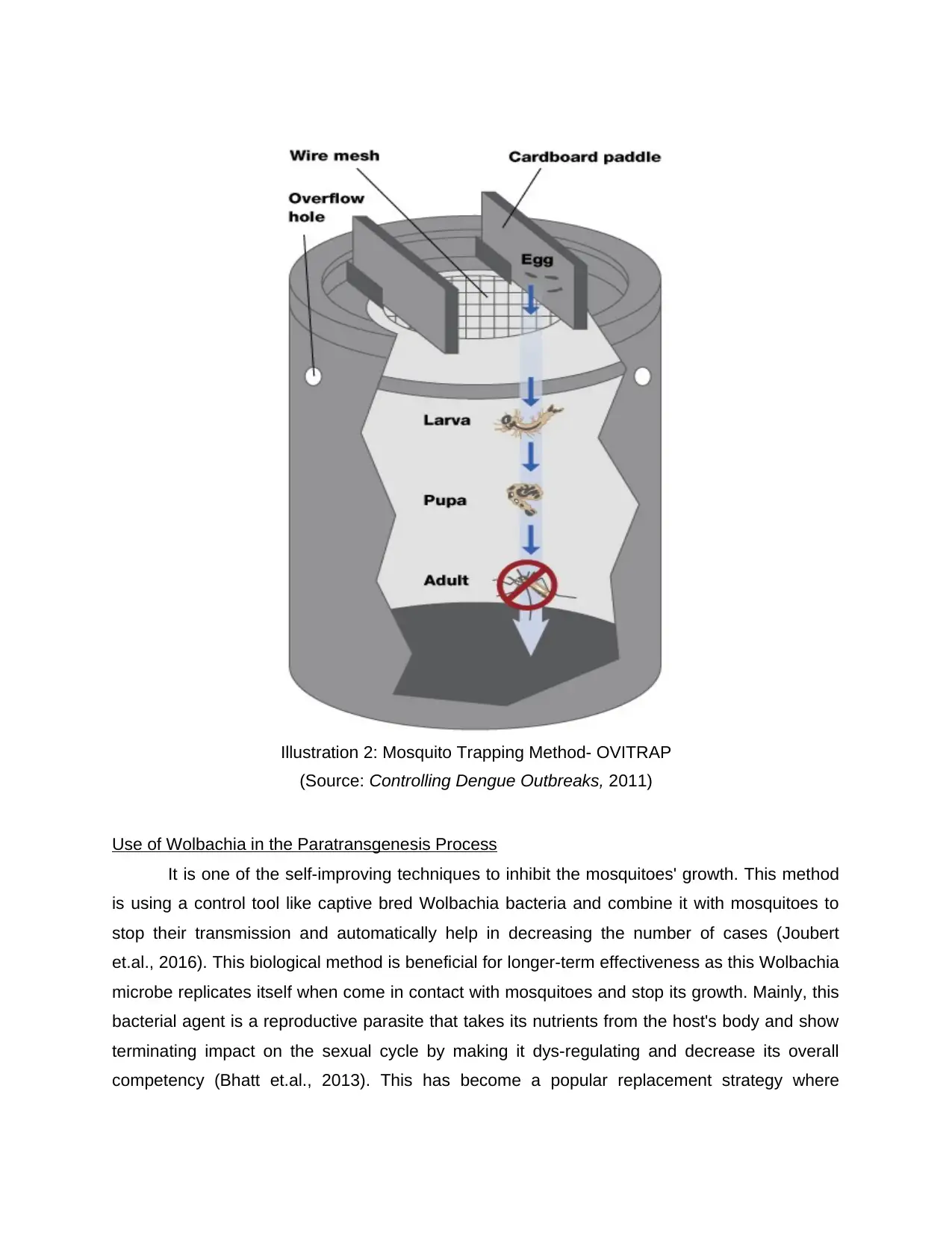
of mosquito trapping, sampling of larval, exploration of morphological traits to recognise existing
species and lastly, data recording is done (Mustafa et.al., 2015). Furthermore, this would help
in monitoring the control measures in better manner. It contains physical control techniques like
supervision of proper drainage systems and management of water through ditching, runneling
etc., applying microbial control methods by using israeliensis and using chemical control tools
like spraying s-methoprene, larvicides etc (Boyce et.al., 2013).
Furthermore, this vector program has helped in controlling and monitoring of dengue
growth in affected regions of Australia. It has been done on the basis of their available local
resources and action-plan so that it suit the citizens in more effective manner (Murray, Jansen
and De Barro, 2016). On the other hand, this IVM methodology proved inadequate because it
was based on evidence. Also this technique needed quick decision making to improve capacity
building (Rafikov, Rafikova and Yang, 2015). It required proper cooperation from all the
regulatory bodies to strategize and implement. However, it was unsuccessful in it.
Nevertheless, there was also lack of participation from people for controlling this risk. This used
environmental management for this(Gyawali, Bradbury and Taylor-Robinson, 2016). They were
not held accountable for this. In fact people were passive in understanding the implications of
such vector-borne diseases. Thus, they were confused in adopting any strategic planning,
hence never contributed towards minimising the overall effects through collaboration. However,
now they are vigilant and started participating by using the Elisa kits. They are also trying to
make the surroundings clean and hygienic (Pal et.al., 2014).
ordination and surveillance (Integrated Vector Management, 2018). This program is currently a
state wide approach. It is implemented in a step by step methodology that involves responsible
behaviour under a legal framework from all the key-players. These key-players are state and
local government, research institutions, community centres, public, etc. Firstly, a surveillance is
conducted for better monitoring of the growth and related fluctuations. This surveillance consists
of mosquito trapping, sampling of larval, exploration of morphological traits to recognise existing
species and lastly, data recording is done (Mustafa et.al., 2015). Furthermore, this would help
in monitoring the control measures in better manner. It contains physical control techniques like
supervision of proper drainage systems and management of water through ditching, runneling
etc., applying microbial control methods by using israeliensis and using chemical control tools
like spraying s-methoprene, larvicides etc (Boyce et.al., 2013).
Furthermore, this vector program has helped in controlling and monitoring of dengue
growth in affected regions of Australia. It has been done on the basis of their available local
resources and action-plan so that it suit the citizens in more effective manner (Murray, Jansen
and De Barro, 2016). On the other hand, this IVM methodology proved inadequate because it
was based on evidence. Also this technique needed quick decision making to improve capacity
building (Rafikov, Rafikova and Yang, 2015). It required proper cooperation from all the
regulatory bodies to strategize and implement. However, it was unsuccessful in it.
Nevertheless, there was also lack of participation from people for controlling this risk. This used
environmental management for this(Gyawali, Bradbury and Taylor-Robinson, 2016). They were
not held accountable for this. In fact people were passive in understanding the implications of
such vector-borne diseases. Thus, they were confused in adopting any strategic planning,
hence never contributed towards minimising the overall effects through collaboration. However,
now they are vigilant and started participating by using the Elisa kits. They are also trying to
make the surroundings clean and hygienic (Pal et.al., 2014).
Use of Wolbachia in the Paratransgenesis Process
It is one of the self-improving techniques to inhibit the mosquitoes' growth. This method
is using a control tool like captive bred Wolbachia bacteria and combine it with mosquitoes to
stop their transmission and automatically help in decreasing the number of cases (Joubert
et.al., 2016). This biological method is beneficial for longer-term effectiveness as this Wolbachia
microbe replicates itself when come in contact with mosquitoes and stop its growth. Mainly, this
bacterial agent is a reproductive parasite that takes its nutrients from the host's body and show
terminating impact on the sexual cycle by making it dys-regulating and decrease its overall
competency (Bhatt et.al., 2013). This has become a popular replacement strategy where
Illustration 2: Mosquito Trapping Method- OVITRAP
(Source: Controlling Dengue Outbreaks, 2011)
It is one of the self-improving techniques to inhibit the mosquitoes' growth. This method
is using a control tool like captive bred Wolbachia bacteria and combine it with mosquitoes to
stop their transmission and automatically help in decreasing the number of cases (Joubert
et.al., 2016). This biological method is beneficial for longer-term effectiveness as this Wolbachia
microbe replicates itself when come in contact with mosquitoes and stop its growth. Mainly, this
bacterial agent is a reproductive parasite that takes its nutrients from the host's body and show
terminating impact on the sexual cycle by making it dys-regulating and decrease its overall
competency (Bhatt et.al., 2013). This has become a popular replacement strategy where
Illustration 2: Mosquito Trapping Method- OVITRAP
(Source: Controlling Dengue Outbreaks, 2011)
⊘ This is a preview!⊘
Do you want full access?
Subscribe today to unlock all pages.
Trusted by 1+ million students worldwide
modifications in the genetic engineering are made. It helps in the development of symbiotic
relationship of host-guest (Wilke and Marrelli, 2015).
Additionally, this control strategy has been successfully implemented in few parts of
Australia as it is still in under developing, and covered the targeted zones with suitable planning
(Iturbe‐Ormaetxe, Walker and O'Neill, 2011). Here, there are few criteria that needed to be look
into. At first, these bacteria need to be developed in the laboratory by maintaining the cell
culture in compact order. Then these are excreted into the host's cytoplasm in order to reach
the hemolymph and inhibit their growth (Baldini et.al., 2014). This directly stops the indicators
that lead to the haemorrhagic fever and other symptoms in humans.
However, the biggest challenge is to use it on a universal level due to emphasis on
sustainability parameter. With cooperation from regulatory bodies and governments like World
Mosquito Program, Tropical Public Health Service (TPHS) and the Northern Peninsula Area
Regional Council, “Dengue-Out Program” has been promoted. With constant research and
tests, this program led to make the approaches environmental-friendly (World Mosquito
Program, 2018). For instance, Townsville Hospital and Health Service, Situated in Queensland
has started preparing containers for host eggs which will carry the Wolbachia that will affect
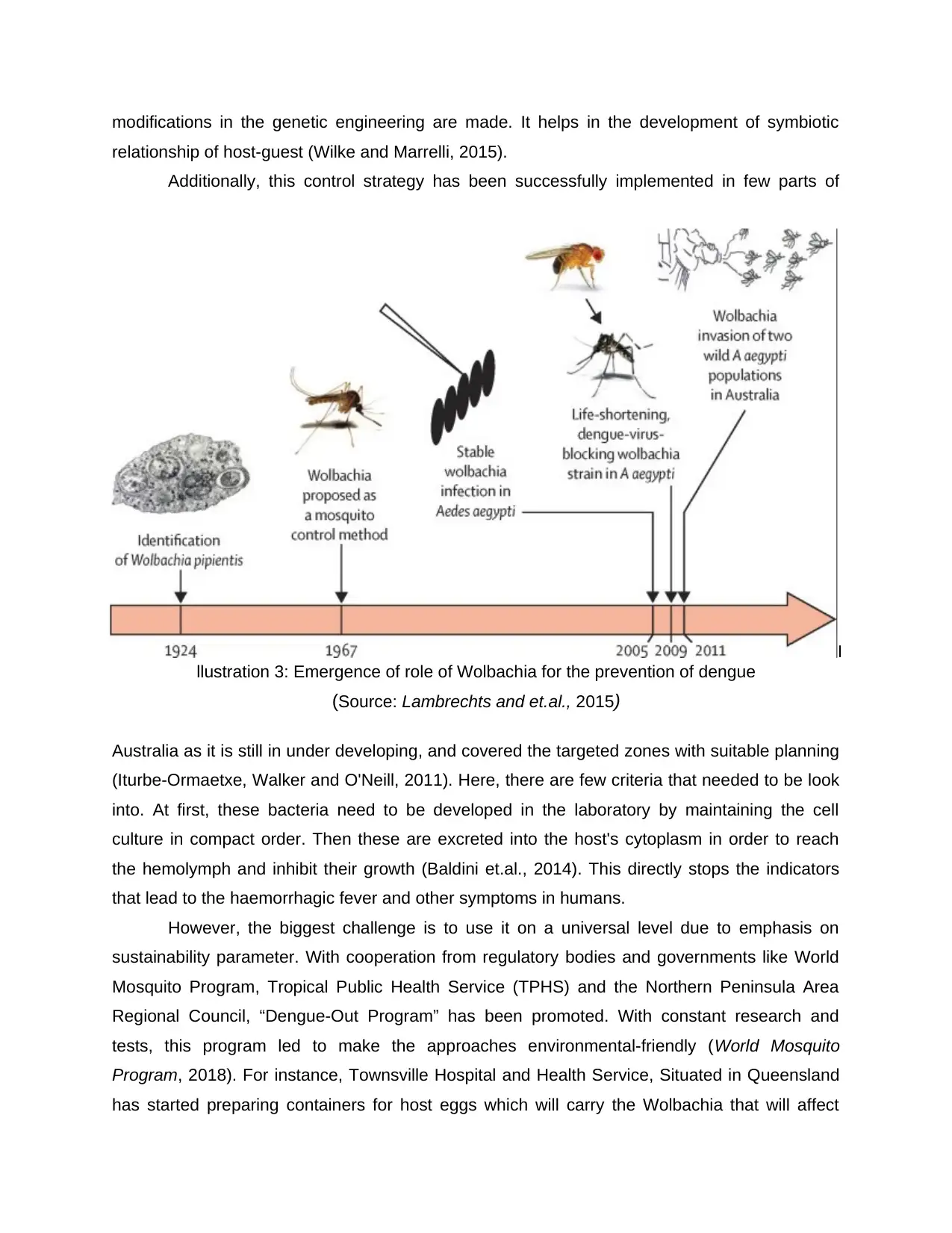
I
llustration 3: Emergence of role of Wolbachia for the prevention of dengue
(Source: Lambrechts and et.al., 2015)
relationship of host-guest (Wilke and Marrelli, 2015).
Additionally, this control strategy has been successfully implemented in few parts of
Australia as it is still in under developing, and covered the targeted zones with suitable planning
(Iturbe‐Ormaetxe, Walker and O'Neill, 2011). Here, there are few criteria that needed to be look
into. At first, these bacteria need to be developed in the laboratory by maintaining the cell
culture in compact order. Then these are excreted into the host's cytoplasm in order to reach
the hemolymph and inhibit their growth (Baldini et.al., 2014). This directly stops the indicators
that lead to the haemorrhagic fever and other symptoms in humans.
However, the biggest challenge is to use it on a universal level due to emphasis on
sustainability parameter. With cooperation from regulatory bodies and governments like World
Mosquito Program, Tropical Public Health Service (TPHS) and the Northern Peninsula Area
Regional Council, “Dengue-Out Program” has been promoted. With constant research and
tests, this program led to make the approaches environmental-friendly (World Mosquito
Program, 2018). For instance, Townsville Hospital and Health Service, Situated in Queensland
has started preparing containers for host eggs which will carry the Wolbachia that will affect
I
llustration 3: Emergence of role of Wolbachia for the prevention of dengue
(Source: Lambrechts and et.al., 2015)
Paraphrase This Document
Need a fresh take? Get an instant paraphrase of this document with our AI Paraphraser
mosquitoes. Additionally, it has also started recruiting volunteers to generate awareness about
this program to control dengue (Dengue Safe Project Ingham, 2018). Additionally, this is useful
in integrating the practices for efficient environmental frameworks. It supported in promoting the
social mobilization under a suitable legal framework by encouraging collaboration in between
the health sector and public (Australia helps Sri Lanka to control dengue fever, 2017).
Another physical control method can be applied is GIS mapping of dengue foci. It has
been helpful in locating the dengue concentrations and their affected locations of Australia. This
would effectively implement the preventive strategies (Racloz and et.al., 2012). This control
method has also helped in the surveillance process. Along with, this promotes the community
based programs for overcoming this dengue crisis. Hereby, interior residual spraying (IRS)
program which started in Cairns, Australia had used data from previous dengue outbreaks. The
effectiveness of IRS is dependent on several parameters as it includes the use of chemicals
(Vazquez-Prokopec et.al., 2010).
However, there was a cost analysis attached with this control procedure which involved
a combination of timely surveillance and response mechanisms. The response systems can use
this GIS mapping for appropriate measurements and evaluations. This would help to know
about any early warning systems to implement the vector control measures in proper manner
(McGraw and O'neill, 2013). Furthermore, this laid the basis for active participation from people
in generating acceptance towards such spraying methodologies for ensuring a longer-term
sustainability in dengue prevention and control. Their authorities used a mixture of s-
methosprene or lambda-cyhalothrin with the source reduction to integrate and form the
appropriate dengue control (Ritchie et.al., 2013). This affected the diseases on the basis of age
adjusted dengue incidence and emphasised on specific measures (Community effectiveness of
indoor spraying as a dengue vector control method, 2017). Lastly, the ratio were to mitigate the
overall impact of the secondary dengue infection on the human population.
this program to control dengue (Dengue Safe Project Ingham, 2018). Additionally, this is useful
in integrating the practices for efficient environmental frameworks. It supported in promoting the
social mobilization under a suitable legal framework by encouraging collaboration in between
the health sector and public (Australia helps Sri Lanka to control dengue fever, 2017).
Another physical control method can be applied is GIS mapping of dengue foci. It has
been helpful in locating the dengue concentrations and their affected locations of Australia. This
would effectively implement the preventive strategies (Racloz and et.al., 2012). This control
method has also helped in the surveillance process. Along with, this promotes the community
based programs for overcoming this dengue crisis. Hereby, interior residual spraying (IRS)
program which started in Cairns, Australia had used data from previous dengue outbreaks. The
effectiveness of IRS is dependent on several parameters as it includes the use of chemicals
(Vazquez-Prokopec et.al., 2010).
However, there was a cost analysis attached with this control procedure which involved
a combination of timely surveillance and response mechanisms. The response systems can use
this GIS mapping for appropriate measurements and evaluations. This would help to know
about any early warning systems to implement the vector control measures in proper manner
(McGraw and O'neill, 2013). Furthermore, this laid the basis for active participation from people
in generating acceptance towards such spraying methodologies for ensuring a longer-term
sustainability in dengue prevention and control. Their authorities used a mixture of s-
methosprene or lambda-cyhalothrin with the source reduction to integrate and form the
appropriate dengue control (Ritchie et.al., 2013). This affected the diseases on the basis of age
adjusted dengue incidence and emphasised on specific measures (Community effectiveness of
indoor spraying as a dengue vector control method, 2017). Lastly, the ratio were to mitigate the
overall impact of the secondary dengue infection on the human population.
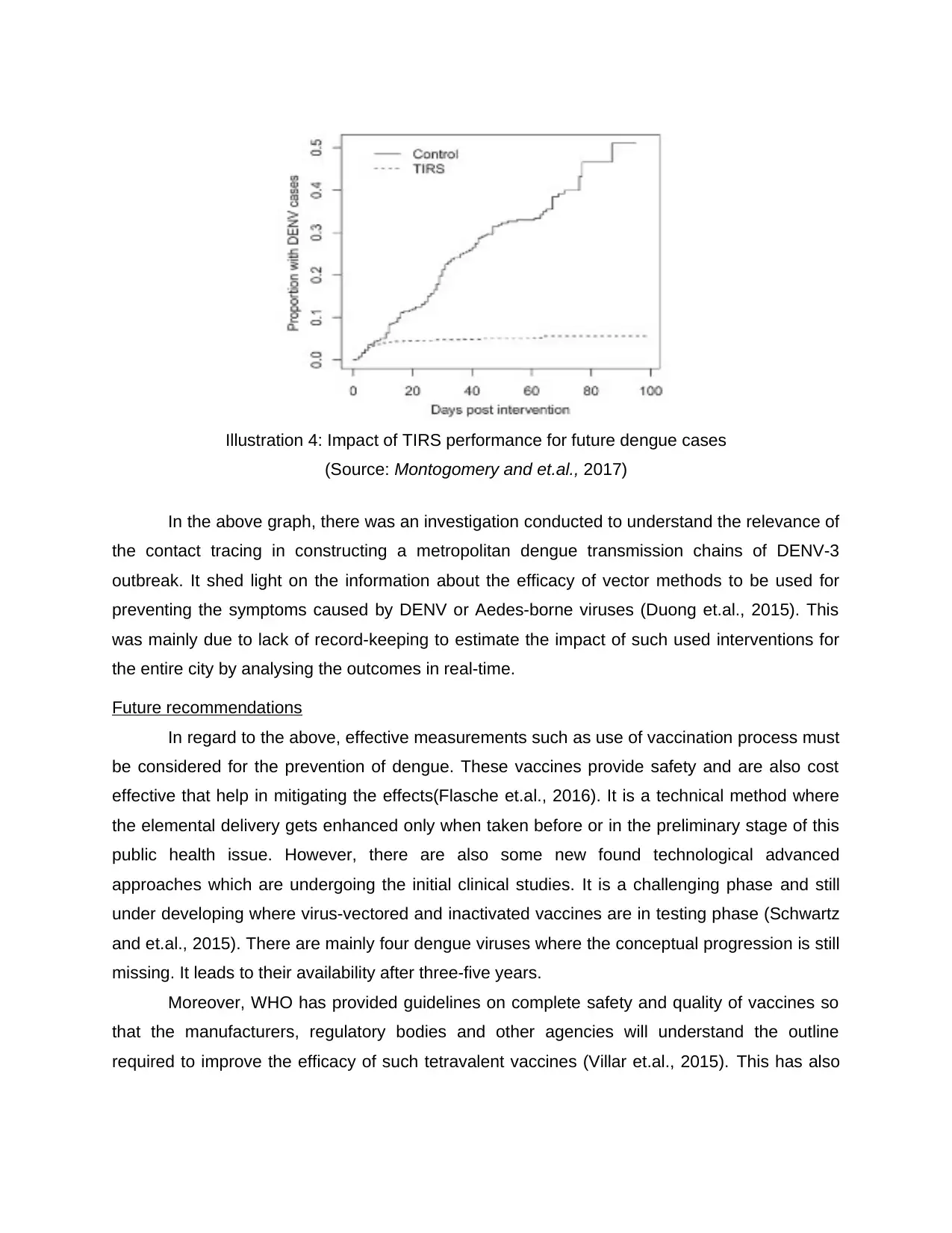
In the above graph, there was an investigation conducted to understand the relevance of
the contact tracing in constructing a metropolitan dengue transmission chains of DENV-3
outbreak. It shed light on the information about the efficacy of vector methods to be used for
preventing the symptoms caused by DENV or Aedes-borne viruses (Duong et.al., 2015). This
was mainly due to lack of record-keeping to estimate the impact of such used interventions for
the entire city by analysing the outcomes in real-time.
Future recommendations
In regard to the above, effective measurements such as use of vaccination process must
be considered for the prevention of dengue. These vaccines provide safety and are also cost
effective that help in mitigating the effects(Flasche et.al., 2016). It is a technical method where
the elemental delivery gets enhanced only when taken before or in the preliminary stage of this
public health issue. However, there are also some new found technological advanced
approaches which are undergoing the initial clinical studies. It is a challenging phase and still
under developing where virus-vectored and inactivated vaccines are in testing phase (Schwartz
and et.al., 2015). There are mainly four dengue viruses where the conceptual progression is still
missing. It leads to their availability after three-five years.
Moreover, WHO has provided guidelines on complete safety and quality of vaccines so
that the manufacturers, regulatory bodies and other agencies will understand the outline
required to improve the efficacy of such tetravalent vaccines (Villar et.al., 2015). This has also
Illustration 4: Impact of TIRS performance for future dengue cases
(Source: Montogomery and et.al., 2017)
the contact tracing in constructing a metropolitan dengue transmission chains of DENV-3
outbreak. It shed light on the information about the efficacy of vector methods to be used for
preventing the symptoms caused by DENV or Aedes-borne viruses (Duong et.al., 2015). This
was mainly due to lack of record-keeping to estimate the impact of such used interventions for
the entire city by analysing the outcomes in real-time.
Future recommendations
In regard to the above, effective measurements such as use of vaccination process must
be considered for the prevention of dengue. These vaccines provide safety and are also cost
effective that help in mitigating the effects(Flasche et.al., 2016). It is a technical method where
the elemental delivery gets enhanced only when taken before or in the preliminary stage of this
public health issue. However, there are also some new found technological advanced
approaches which are undergoing the initial clinical studies. It is a challenging phase and still
under developing where virus-vectored and inactivated vaccines are in testing phase (Schwartz
and et.al., 2015). There are mainly four dengue viruses where the conceptual progression is still
missing. It leads to their availability after three-five years.
Moreover, WHO has provided guidelines on complete safety and quality of vaccines so
that the manufacturers, regulatory bodies and other agencies will understand the outline
required to improve the efficacy of such tetravalent vaccines (Villar et.al., 2015). This has also
Illustration 4: Impact of TIRS performance for future dengue cases
(Source: Montogomery and et.al., 2017)
⊘ This is a preview!⊘
Do you want full access?
Subscribe today to unlock all pages.
Trusted by 1+ million students worldwide
led to introduction of contact management in all public units of Australia so that availability of
professionals is sorted (Dengue control guideline, 2017).
As per CDNA (Communicable Diseases Network Australia) by following the national
guidelines' series by the AHPCC (Australian Health Protection Principal Committee), such
contact is necessary for sending the help immediately in the receptive areas for effectively
following the guidelines they have framed to combat this crisis (Dengue: CDNA National
Guidelines for Public Health Units, 2015). Whereas, this is only beneficial when implemented in
a proper manner by incorporating the support from local hospitals and health care professionals.
They must also conduct seminars and induction programs to give clear instructions on how to
address the contact management and other services of ARCBS, etc. to overcome
environmental risk management when travellers visit from other countries or local citizens come
back after spending vacations in some other parts of the world (Alex et.al., 2016).
CONCLUSION
To sum up, it can be inferred that dengue preventive and control measures have been
mitigated in Australia, only when cooperation from the community as a whole has been shown
under a legislative framework. This has been supported by using the integrated vector program
for generating awareness in the public and use of Wolbachia has also been enforced for
implementing the anti-mosquito regulations successfully. Along with that, few recommendations
for future have been mentioned and has already initiated it by putting consistent efforts in
dengue-prevention for Australian population by their government.
professionals is sorted (Dengue control guideline, 2017).
As per CDNA (Communicable Diseases Network Australia) by following the national
guidelines' series by the AHPCC (Australian Health Protection Principal Committee), such
contact is necessary for sending the help immediately in the receptive areas for effectively
following the guidelines they have framed to combat this crisis (Dengue: CDNA National
Guidelines for Public Health Units, 2015). Whereas, this is only beneficial when implemented in
a proper manner by incorporating the support from local hospitals and health care professionals.
They must also conduct seminars and induction programs to give clear instructions on how to
address the contact management and other services of ARCBS, etc. to overcome
environmental risk management when travellers visit from other countries or local citizens come
back after spending vacations in some other parts of the world (Alex et.al., 2016).
CONCLUSION
To sum up, it can be inferred that dengue preventive and control measures have been
mitigated in Australia, only when cooperation from the community as a whole has been shown
under a legislative framework. This has been supported by using the integrated vector program
for generating awareness in the public and use of Wolbachia has also been enforced for
implementing the anti-mosquito regulations successfully. Along with that, few recommendations
for future have been mentioned and has already initiated it by putting consistent efforts in
dengue-prevention for Australian population by their government.
Paraphrase This Document
Need a fresh take? Get an instant paraphrase of this document with our AI Paraphraser
REFERENCES
Books and Journals
Baldini, F. et.al. (2014). Evidence of natural Wolbachia infections in field populations of
Anopheles gambiae. Nature communications.5. p.3985.
Bhatt, S. et.al. (2013). The global distribution and burden of dengue. Nature.496(7446). p.504.
Boyce, R. et.al. (2013). Bacillus thuringiensis israelensis (B ti) for the control of dengue vectors:
systematic literature review. Tropical Medicine & International Health. 18(5). pp.564-577.
Duong, V. et.al. (2015). Asymptomatic humans transmit dengue virus to mosquitoes.
Proceedings of the National Academy of Sciences. 112(47).pp.14688-14693.
Ebi, K.L. and Nealon, J. (2016). Dengue in a changing climate. Environmental research.151.
pp.115-123.
Ernst, T. et.al. (2015). Emergence of a new lineage of dengue virus type 2 identified in travelers
entering Western Australia from Indonesia, 2010-2012. PLoS neglected tropical
diseases. 9(1). p.e0003442.
Flasche, S. et.al. (2016). The long-term safety, public health impact, and cost-effectiveness of
routine vaccination with a recombinant, live-attenuated dengue vaccine (Dengvaxia): a
model comparison study. PLoS medicine. 13(11). p.e1002181.
Gyawali, N., Bradbury, R.S. and Taylor-Robinson, A.W. (2016). Knowledge, attitude and
recommendations for practice regarding dengue among the resident population of
Queensland, Australia. Asian Pacific Journal of Tropical Biomedicine. 6(4). pp.360-366.
Iturbe‐Ormaetxe, I., Walker, T. and O'Neill, S.L. (2011). Wolbachia and the biological control of
mosquito‐borne disease. EMBO reports. 12(6). pp.508-518.
Joubert, D.A. et.al. (2016). Establishment of a Wolbachia superinfection in Aedes aegypti
mosquitoes as a potential approach for future resistance management. PLoS pathogens.
12(2). p.e1005434.
Kolopack, P.A., Parsons, J.A. and Lavery, J.V. (2015). What makes community engagement
effective?: lessons from eliminate dengue program in Queensland Australia. PLoS
neglected tropical diseases. 9(4). p.e0003713.
McGraw, E.A. and O'neill, S.L., (2013). Beyond insecticides: new thinking on an ancient
problem. Nature Reviews Microbiology. 11(3). p.181.
Mustafa, M.S. et.al. (2015). Discovery of fifth serotype of dengue virus (DENV-5): A new public
health dilemma in dengue control.Medical Journal Armed Forces India. 71(1). pp.67-70.
Murray, J.V., Jansen, C.C. and De Barro, P. (2016). Risk associated with the release of
Wolbachia-infected Aedes aegypti mosquitoes into the environment in an effort to control
dengue. Frontiers in public health.4. p.43.
9
Books and Journals
Baldini, F. et.al. (2014). Evidence of natural Wolbachia infections in field populations of
Anopheles gambiae. Nature communications.5. p.3985.
Bhatt, S. et.al. (2013). The global distribution and burden of dengue. Nature.496(7446). p.504.
Boyce, R. et.al. (2013). Bacillus thuringiensis israelensis (B ti) for the control of dengue vectors:
systematic literature review. Tropical Medicine & International Health. 18(5). pp.564-577.
Duong, V. et.al. (2015). Asymptomatic humans transmit dengue virus to mosquitoes.
Proceedings of the National Academy of Sciences. 112(47).pp.14688-14693.
Ebi, K.L. and Nealon, J. (2016). Dengue in a changing climate. Environmental research.151.
pp.115-123.
Ernst, T. et.al. (2015). Emergence of a new lineage of dengue virus type 2 identified in travelers
entering Western Australia from Indonesia, 2010-2012. PLoS neglected tropical
diseases. 9(1). p.e0003442.
Flasche, S. et.al. (2016). The long-term safety, public health impact, and cost-effectiveness of
routine vaccination with a recombinant, live-attenuated dengue vaccine (Dengvaxia): a
model comparison study. PLoS medicine. 13(11). p.e1002181.
Gyawali, N., Bradbury, R.S. and Taylor-Robinson, A.W. (2016). Knowledge, attitude and
recommendations for practice regarding dengue among the resident population of
Queensland, Australia. Asian Pacific Journal of Tropical Biomedicine. 6(4). pp.360-366.
Iturbe‐Ormaetxe, I., Walker, T. and O'Neill, S.L. (2011). Wolbachia and the biological control of
mosquito‐borne disease. EMBO reports. 12(6). pp.508-518.
Joubert, D.A. et.al. (2016). Establishment of a Wolbachia superinfection in Aedes aegypti
mosquitoes as a potential approach for future resistance management. PLoS pathogens.
12(2). p.e1005434.
Kolopack, P.A., Parsons, J.A. and Lavery, J.V. (2015). What makes community engagement
effective?: lessons from eliminate dengue program in Queensland Australia. PLoS
neglected tropical diseases. 9(4). p.e0003713.
McGraw, E.A. and O'neill, S.L., (2013). Beyond insecticides: new thinking on an ancient
problem. Nature Reviews Microbiology. 11(3). p.181.
Mustafa, M.S. et.al. (2015). Discovery of fifth serotype of dengue virus (DENV-5): A new public
health dilemma in dengue control.Medical Journal Armed Forces India. 71(1). pp.67-70.
Murray, J.V., Jansen, C.C. and De Barro, P. (2016). Risk associated with the release of
Wolbachia-infected Aedes aegypti mosquitoes into the environment in an effort to control
dengue. Frontiers in public health.4. p.43.
9
Nguyen, T.H. et.al. (2015). Field evaluation of the establishment potential of w MelPop
Wolbachia in Australia and Vietnam for dengue control. Parasites & vectors. 8(1). p.563.
Pal, S. et.al. (2014). Evaluation of dengue NS1 antigen rapid tests and ELISA kits using clinical
samples. PloS one. 9(11). p.e113411.
Racloz, V. et.al. (2012). Surveillance of dengue fever virus: a review of epidemiological models
and early warning systems. PLoS neglected tropical diseases. 6(5). p.e1648.
Rafikov, M., Rafikova, E. and Yang, H.M. (2015). Optimization of the Aedes aegypti control
strategies for integrated vector management. Journal of Applied Mathematics. 2015.
Ritchie, S.A. et.al. (2013). An explosive epidemic of DENV-3 in Cairns, Australia. PLoS One.
8(7). p.e68137.
Schwartz, L.M. et.al. (2015). The dengue vaccine pipeline: Implications for the future of dengue
control. Vaccine. 33(29). pp.3293-3298.
Trewin, B.J. et.al. (2017). The elimination of the dengue vector, Aedes aegypti, from Brisbane,
Australia: The role of surveillance, larval habitat removal and policy. PLoS neglected
tropical diseases. 11(8). p.e0005848.
Vazquez-Prokopec et.al. (2010). Quantifying the spatial dimension of dengue virus epidemic
spread within a tropical urban environment. PLoS Negl Trop Dis. 4. e920.
Villar, L. et.al. (2015). Efficacy of a tetravalent dengue vaccine in children in Latin America. New
England Journal of Medicine. 372(2). pp.113-123.
Online
Alex YC. T. and et.al., 2016. Management of dengue in Australian travellers: a retrospective
multicentre analysis. [Pdf]. Available through:
<https://www.mja.com.au/system/files/issues/206_07/10%205694mja16%2001056.pdf>.
Dengue: CDNA National Guidelines for Public Health Units 2015. [Pdf]. Available through:
<http://www.health.gov.au/internet/main/publishing.nsf/content/FE1CB334E23F9DD4CA
257BF0001C11FC/$File/DENGUE-SONG.pdf>.
Australia helps Sri Lanka to control dengue fever. 2017. [Online]. Available through:
<https://www.reuters.com/article/us-sri-lanka-dengue-australia-idUSKBN1A4287>.
Butt, C., 2017. Dengue fever cases hit 20-year high in Australia. [Online]. Available through:
<https://www.smh.com.au/healthcare/dengue-fever-cases-hit-20year-high-in-australia-
20170113-gtqq5b.html>.
Community effectiveness of indoor spraying as a dengue vector control method. 2017. [Online].
Available through: <https://www.ncbi.nlm.nih.gov/pmc/articles/PMC5578493/>.
Controlling Dengue Outbreaks. 2011. [Online]. Available through:
<https://www.nature.com/scitable/topicpage/controlling-dengue-outbreaks-22403714>.
10
Wolbachia in Australia and Vietnam for dengue control. Parasites & vectors. 8(1). p.563.
Pal, S. et.al. (2014). Evaluation of dengue NS1 antigen rapid tests and ELISA kits using clinical
samples. PloS one. 9(11). p.e113411.
Racloz, V. et.al. (2012). Surveillance of dengue fever virus: a review of epidemiological models
and early warning systems. PLoS neglected tropical diseases. 6(5). p.e1648.
Rafikov, M., Rafikova, E. and Yang, H.M. (2015). Optimization of the Aedes aegypti control
strategies for integrated vector management. Journal of Applied Mathematics. 2015.
Ritchie, S.A. et.al. (2013). An explosive epidemic of DENV-3 in Cairns, Australia. PLoS One.
8(7). p.e68137.
Schwartz, L.M. et.al. (2015). The dengue vaccine pipeline: Implications for the future of dengue
control. Vaccine. 33(29). pp.3293-3298.
Trewin, B.J. et.al. (2017). The elimination of the dengue vector, Aedes aegypti, from Brisbane,
Australia: The role of surveillance, larval habitat removal and policy. PLoS neglected
tropical diseases. 11(8). p.e0005848.
Vazquez-Prokopec et.al. (2010). Quantifying the spatial dimension of dengue virus epidemic
spread within a tropical urban environment. PLoS Negl Trop Dis. 4. e920.
Villar, L. et.al. (2015). Efficacy of a tetravalent dengue vaccine in children in Latin America. New
England Journal of Medicine. 372(2). pp.113-123.
Online
Alex YC. T. and et.al., 2016. Management of dengue in Australian travellers: a retrospective
multicentre analysis. [Pdf]. Available through:
<https://www.mja.com.au/system/files/issues/206_07/10%205694mja16%2001056.pdf>.
Dengue: CDNA National Guidelines for Public Health Units 2015. [Pdf]. Available through:
<http://www.health.gov.au/internet/main/publishing.nsf/content/FE1CB334E23F9DD4CA
257BF0001C11FC/$File/DENGUE-SONG.pdf>.
Australia helps Sri Lanka to control dengue fever. 2017. [Online]. Available through:
<https://www.reuters.com/article/us-sri-lanka-dengue-australia-idUSKBN1A4287>.
Butt, C., 2017. Dengue fever cases hit 20-year high in Australia. [Online]. Available through:
<https://www.smh.com.au/healthcare/dengue-fever-cases-hit-20year-high-in-australia-
20170113-gtqq5b.html>.
Community effectiveness of indoor spraying as a dengue vector control method. 2017. [Online].
Available through: <https://www.ncbi.nlm.nih.gov/pmc/articles/PMC5578493/>.
Controlling Dengue Outbreaks. 2011. [Online]. Available through:
<https://www.nature.com/scitable/topicpage/controlling-dengue-outbreaks-22403714>.
10
⊘ This is a preview!⊘
Do you want full access?
Subscribe today to unlock all pages.
Trusted by 1+ million students worldwide

1 out of 13


Related Documents


Your All-in-One AI-Powered Toolkit for Academic Success.
+13062052269
info@desklib.com
Available 24*7 on WhatsApp / Email
![[object Object]](/_next/static/media/star-bottom.7253800d.svg)
Unlock your academic potential
Copyright © 2020–2026 A2Z Services. All Rights Reserved. Developed and managed by ZUCOL.