Stakeholders in Health Policy: Obesity, Nutrition, and Public Health

Verified

Added on  2023/05/31

|4
|594
|67
Report
AI Summary
This report focuses on identifying the key stakeholders involved in the development of health policies, particularly those related to obesity. The report emphasizes the importance of involving stakeholders for successful policy implementation. It discusses the roles of various stakeholders, including public health experts, nutritionists, food industries, the ministry of health, and the general public. The report highlights the significance of these stakeholders in shaping policies related to diet, nutrition, and public health. It stresses the need for a collaborative approach to address obesity and related chronic diseases, ensuring that all relevant parties are involved in the policy-making process to promote effective health outcomes. The report references several sources to support the arguments made.
Document Page
Running head: HEALTH POLICY AND PLANNING
Health Policy and Planning
Student’s Name
Institutional Affiliation
tabler-icon-diamond-filled.svg

Paraphrase This Document

Need a fresh take? Get an instant paraphrase of this document with our AI Paraphraser
Document Page
HEALTH POLICY AND PLANNING 2
Health Policy and Planning
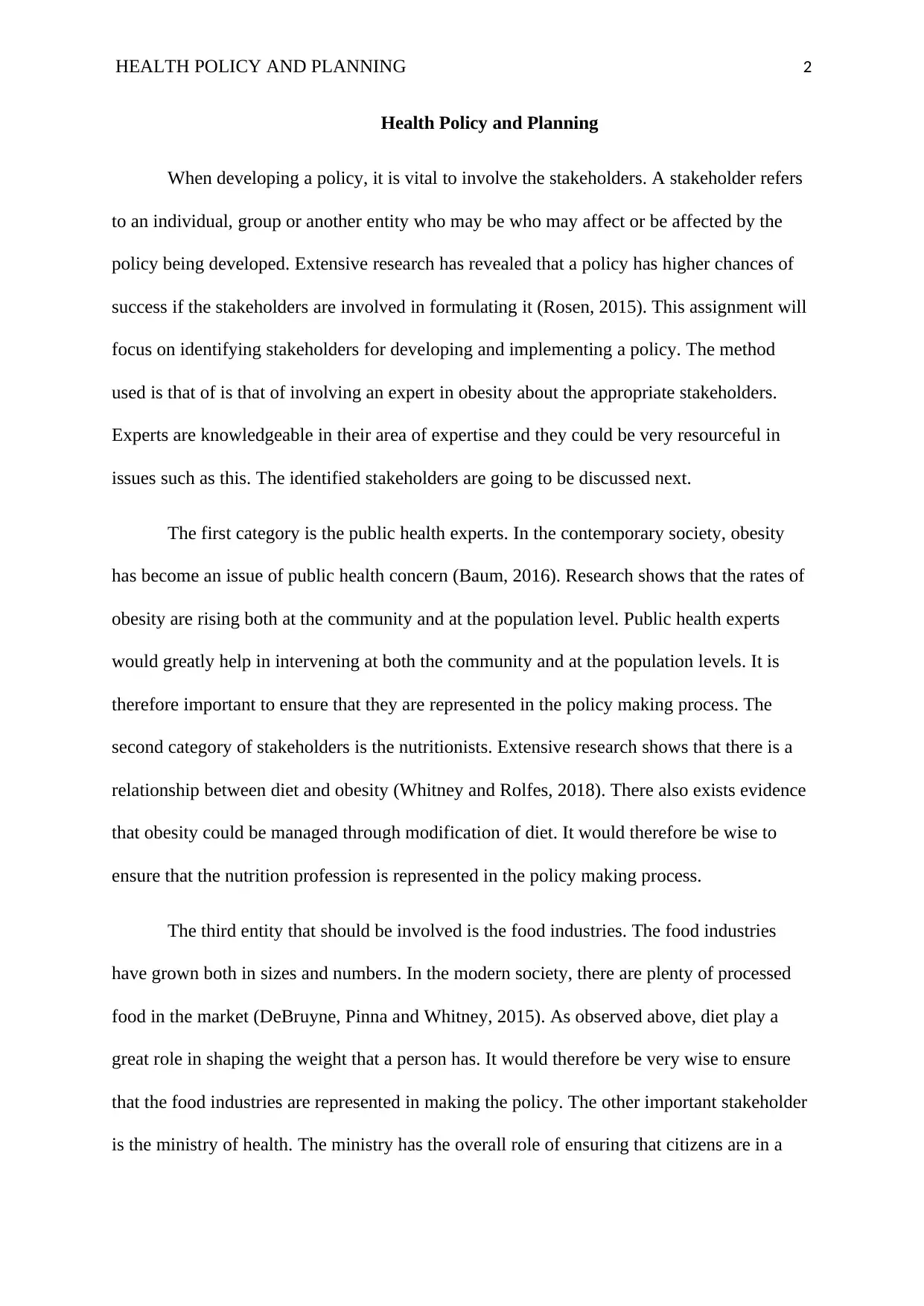
When developing a policy, it is vital to involve the stakeholders. A stakeholder refers
to an individual, group or another entity who may be who may affect or be affected by the
policy being developed. Extensive research has revealed that a policy has higher chances of
success if the stakeholders are involved in formulating it (Rosen, 2015). This assignment will
focus on identifying stakeholders for developing and implementing a policy. The method
used is that of is that of involving an expert in obesity about the appropriate stakeholders.
Experts are knowledgeable in their area of expertise and they could be very resourceful in
issues such as this. The identified stakeholders are going to be discussed next.
The first category is the public health experts. In the contemporary society, obesity
has become an issue of public health concern (Baum, 2016). Research shows that the rates of
obesity are rising both at the community and at the population level. Public health experts
would greatly help in intervening at both the community and at the population levels. It is
therefore important to ensure that they are represented in the policy making process. The
second category of stakeholders is the nutritionists. Extensive research shows that there is a
relationship between diet and obesity (Whitney and Rolfes, 2018). There also exists evidence
that obesity could be managed through modification of diet. It would therefore be wise to
ensure that the nutrition profession is represented in the policy making process.
The third entity that should be involved is the food industries. The food industries
have grown both in sizes and numbers. In the modern society, there are plenty of processed
food in the market (DeBruyne, Pinna and Whitney, 2015). As observed above, diet play a
great role in shaping the weight that a person has. It would therefore be very wise to ensure
that the food industries are represented in making the policy. The other important stakeholder
is the ministry of health. The ministry has the overall role of ensuring that citizens are in a
Document Page
HEALTH POLICY AND PLANNING 3
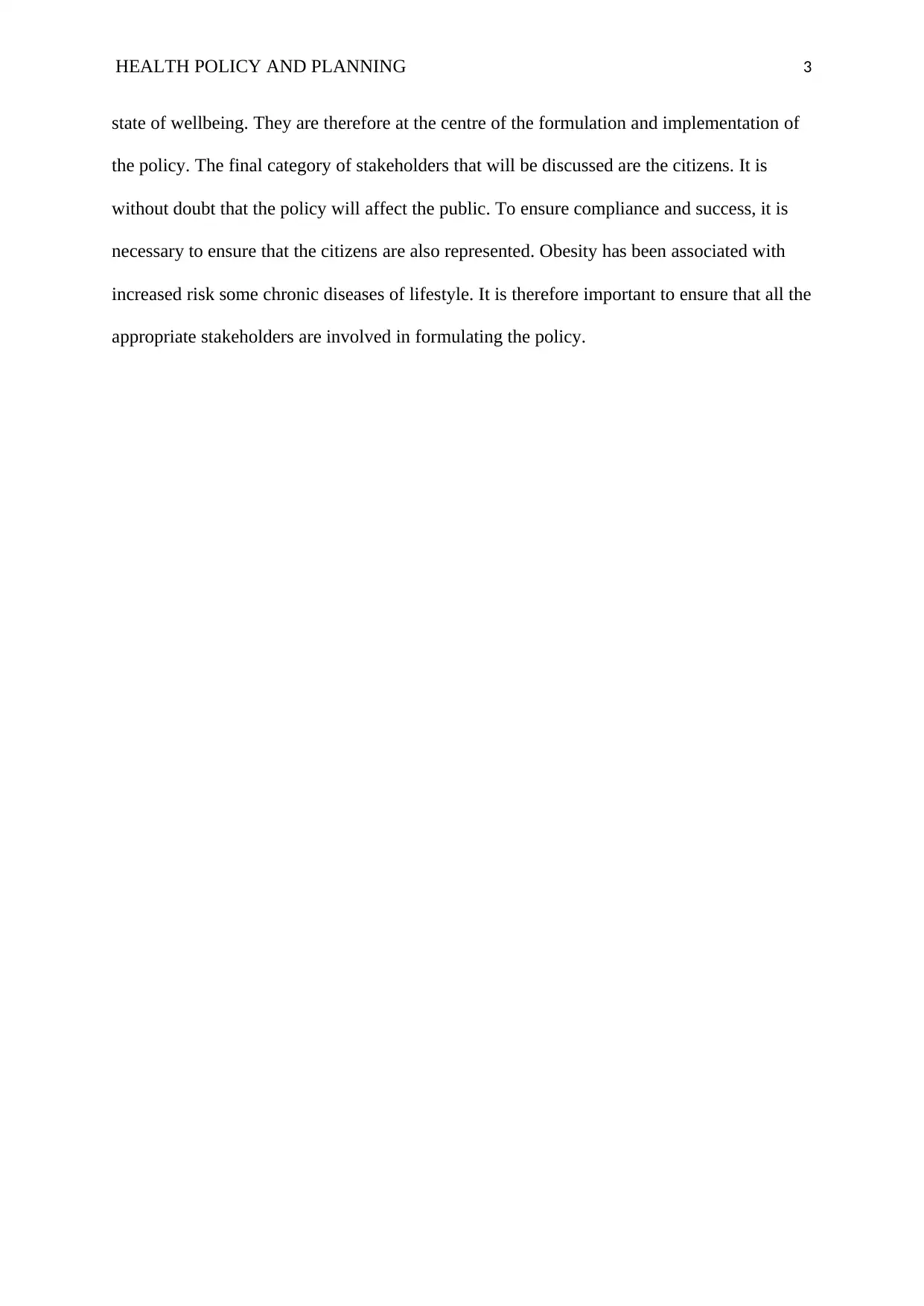
state of wellbeing. They are therefore at the centre of the formulation and implementation of
the policy. The final category of stakeholders that will be discussed are the citizens. It is
without doubt that the policy will affect the public. To ensure compliance and success, it is
necessary to ensure that the citizens are also represented. Obesity has been associated with
increased risk some chronic diseases of lifestyle. It is therefore important to ensure that all the
appropriate stakeholders are involved in formulating the policy.
Document Page
HEALTH POLICY AND PLANNING 4
References
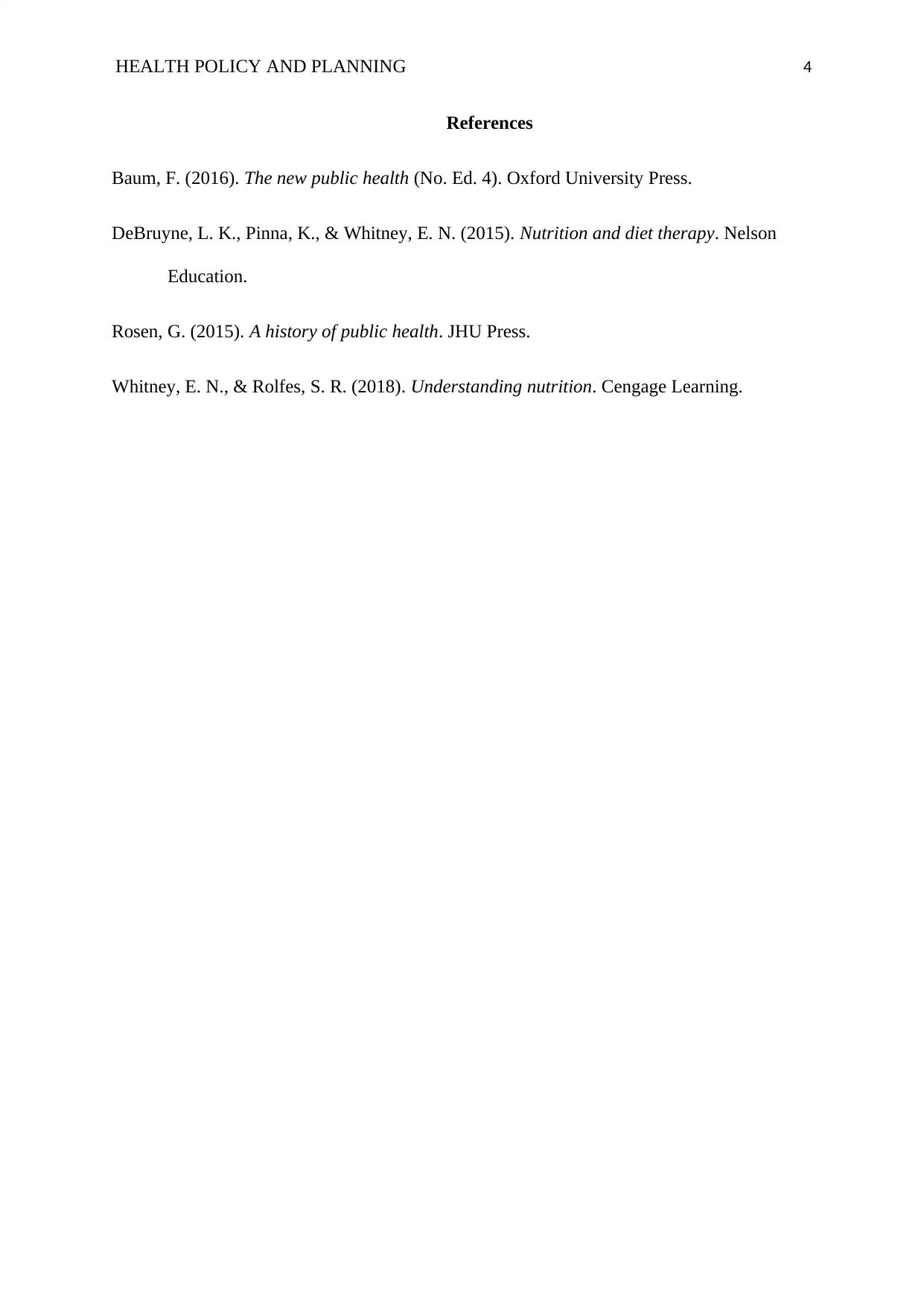
Baum, F. (2016). The new public health (No. Ed. 4). Oxford University Press.
DeBruyne, L. K., Pinna, K., & Whitney, E. N. (2015). Nutrition and diet therapy. Nelson
Education.
Rosen, G. (2015). A history of public health. JHU Press.
Whitney, E. N., & Rolfes, S. R. (2018). Understanding nutrition. Cengage Learning.
chevron_up_icon
1 out of 4
circle_padding
hide_on_mobile
zoom_out_icon
[object Object]