Capstone A: Applied Research Project - Schizophrenia Research Proposal
VerifiedAdded on 2022/08/30
|14
|3662
|43
Report
AI Summary
This research proposal investigates the risk factors associated with certain drugs, such as LSD and cannabis, that may trigger schizophrenia in susceptible individuals. It includes a comprehensive literature review examining the background of schizophrenia and its potential triggers. The research aims to identify vulnerable age groups and specific drugs involved, along with potential recommendations. The study employs a qualitative research design using content analysis to analyze data from online and offline sources, including databases like PubMed and Google Scholar. Ethical considerations are addressed to maintain participant anonymity. The proposal outlines the research questions, justification, methodology, data analysis, and ethical considerations, providing a detailed plan for a public health research project. It also includes Gantt charts for both Capstone A and Capstone B, outlining the project timeline and activities.

Running Head: RESEARCH PROPOSAL
APPLIED RESEARCH PROJECT IN PUBLIC HEALTH
Name of the student
Name of the university
Author note
APPLIED RESEARCH PROJECT IN PUBLIC HEALTH
Name of the student
Name of the university
Author note

Paraphrase This Document
Need a fresh take? Get an instant paraphrase of this document with our AI Paraphraser
1RESEARCH PROPOSAL
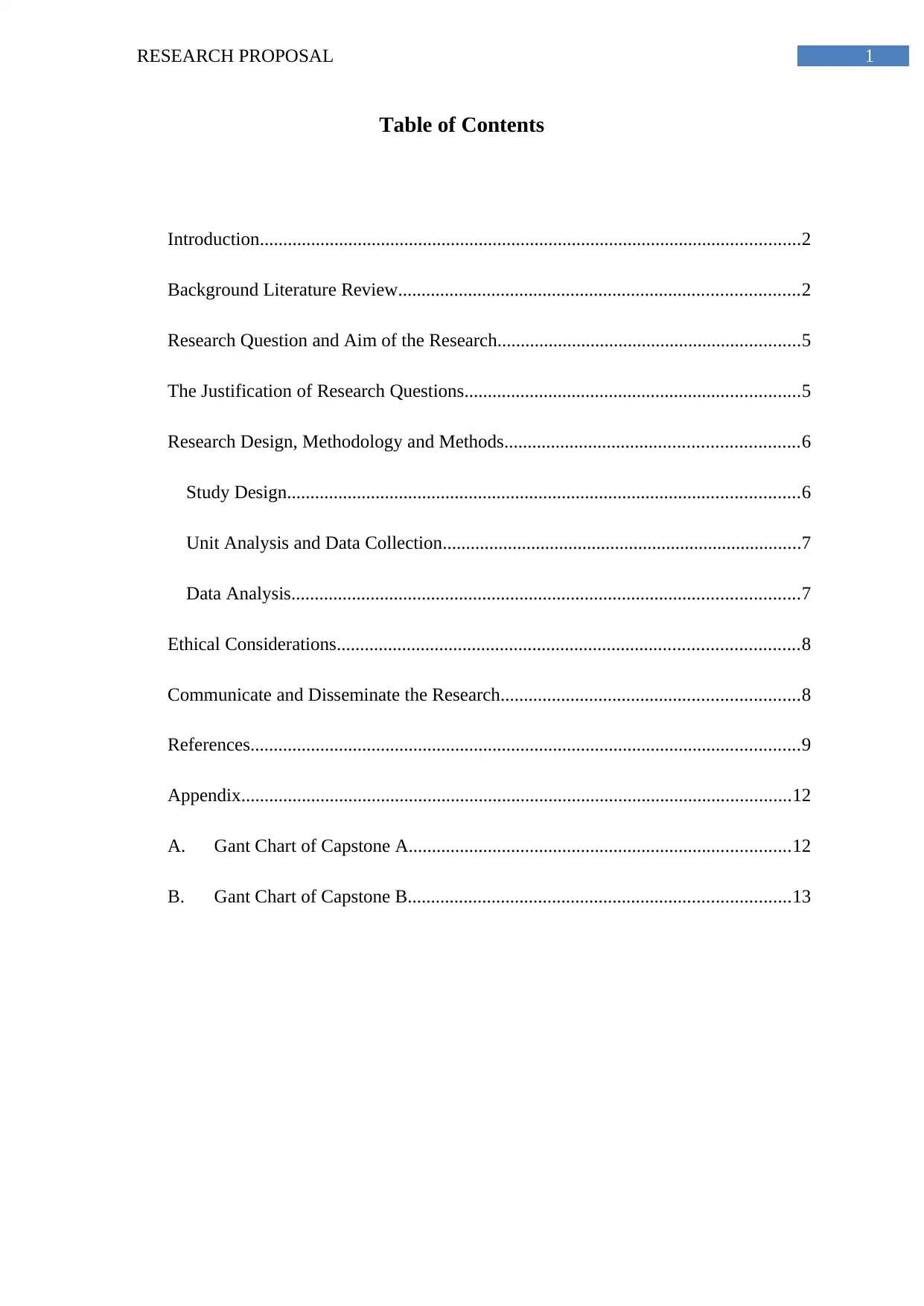
Table of Contents
Introduction....................................................................................................................2
Background Literature Review......................................................................................2
Research Question and Aim of the Research.................................................................5
The Justification of Research Questions........................................................................5
Research Design, Methodology and Methods...............................................................6
Study Design..............................................................................................................6
Unit Analysis and Data Collection.............................................................................7
Data Analysis.............................................................................................................7
Ethical Considerations...................................................................................................8
Communicate and Disseminate the Research................................................................8
References......................................................................................................................9
Appendix......................................................................................................................12
A. Gant Chart of Capstone A..................................................................................12
B. Gant Chart of Capstone B..................................................................................13
Table of Contents
Introduction....................................................................................................................2
Background Literature Review......................................................................................2
Research Question and Aim of the Research.................................................................5
The Justification of Research Questions........................................................................5
Research Design, Methodology and Methods...............................................................6
Study Design..............................................................................................................6
Unit Analysis and Data Collection.............................................................................7
Data Analysis.............................................................................................................7
Ethical Considerations...................................................................................................8
Communicate and Disseminate the Research................................................................8
References......................................................................................................................9
Appendix......................................................................................................................12
A. Gant Chart of Capstone A..................................................................................12
B. Gant Chart of Capstone B..................................................................................13
2RESEARCH PROPOSAL
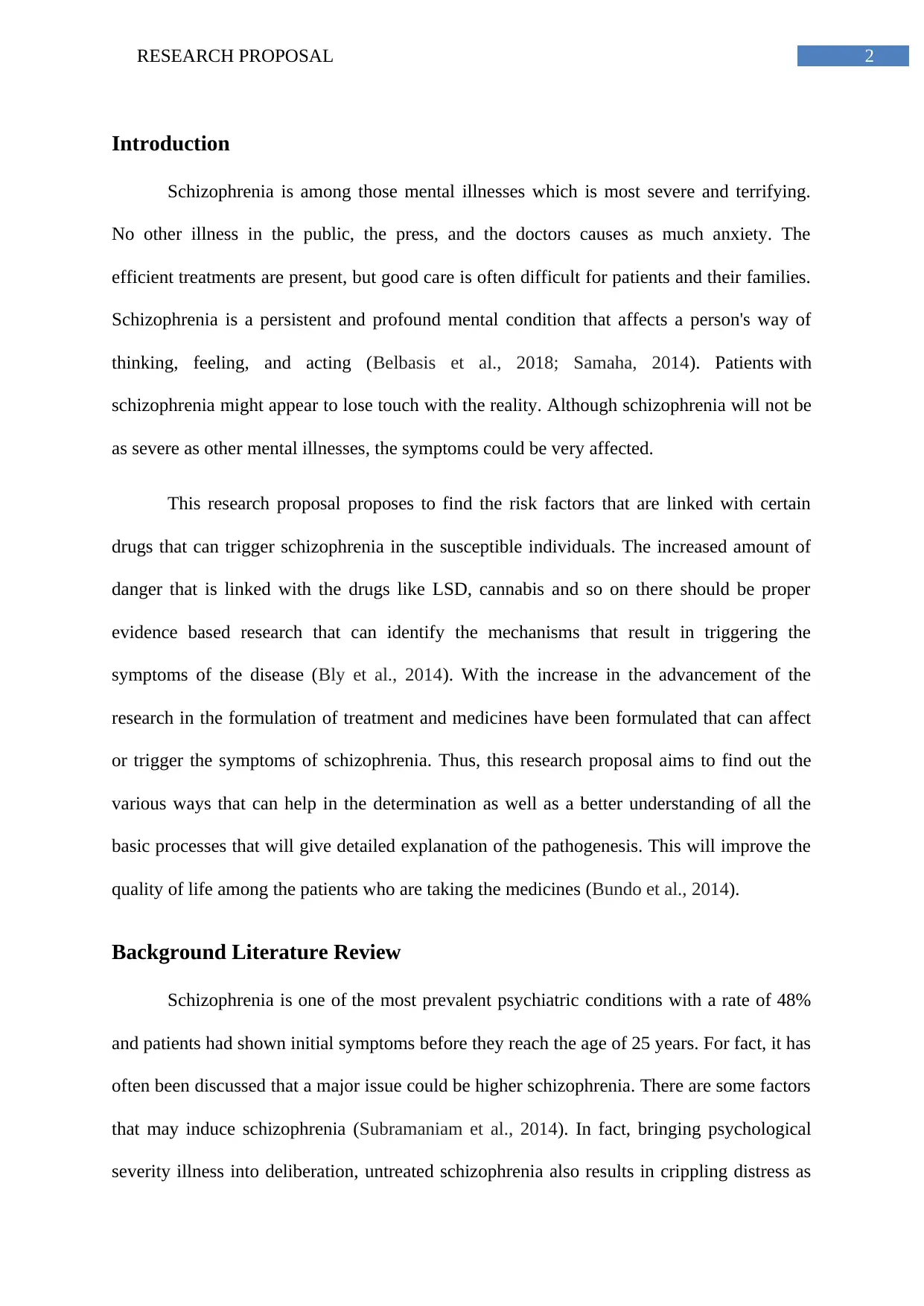
Introduction
Schizophrenia is among those mental illnesses which is most severe and terrifying.
No other illness in the public, the press, and the doctors causes as much anxiety. The
efficient treatments are present, but good care is often difficult for patients and their families.
Schizophrenia is a persistent and profound mental condition that affects a person's way of
thinking, feeling, and acting (Belbasis et al., 2018; Samaha, 2014). Patients with
schizophrenia might appear to lose touch with the reality. Although schizophrenia will not be
as severe as other mental illnesses, the symptoms could be very affected.
This research proposal proposes to find the risk factors that are linked with certain
drugs that can trigger schizophrenia in the susceptible individuals. The increased amount of
danger that is linked with the drugs like LSD, cannabis and so on there should be proper
evidence based research that can identify the mechanisms that result in triggering the
symptoms of the disease (Bly et al., 2014). With the increase in the advancement of the
research in the formulation of treatment and medicines have been formulated that can affect
or trigger the symptoms of schizophrenia. Thus, this research proposal aims to find out the
various ways that can help in the determination as well as a better understanding of all the
basic processes that will give detailed explanation of the pathogenesis. This will improve the
quality of life among the patients who are taking the medicines (Bundo et al., 2014).
Background Literature Review
Schizophrenia is one of the most prevalent psychiatric conditions with a rate of 48%
and patients had shown initial symptoms before they reach the age of 25 years. For fact, it has
often been discussed that a major issue could be higher schizophrenia. There are some factors
that may induce schizophrenia (Subramaniam et al., 2014). In fact, bringing psychological
severity illness into deliberation, untreated schizophrenia also results in crippling distress as
Introduction
Schizophrenia is among those mental illnesses which is most severe and terrifying.
No other illness in the public, the press, and the doctors causes as much anxiety. The
efficient treatments are present, but good care is often difficult for patients and their families.
Schizophrenia is a persistent and profound mental condition that affects a person's way of
thinking, feeling, and acting (Belbasis et al., 2018; Samaha, 2014). Patients with
schizophrenia might appear to lose touch with the reality. Although schizophrenia will not be
as severe as other mental illnesses, the symptoms could be very affected.
This research proposal proposes to find the risk factors that are linked with certain
drugs that can trigger schizophrenia in the susceptible individuals. The increased amount of
danger that is linked with the drugs like LSD, cannabis and so on there should be proper
evidence based research that can identify the mechanisms that result in triggering the
symptoms of the disease (Bly et al., 2014). With the increase in the advancement of the
research in the formulation of treatment and medicines have been formulated that can affect
or trigger the symptoms of schizophrenia. Thus, this research proposal aims to find out the
various ways that can help in the determination as well as a better understanding of all the
basic processes that will give detailed explanation of the pathogenesis. This will improve the
quality of life among the patients who are taking the medicines (Bundo et al., 2014).
Background Literature Review
Schizophrenia is one of the most prevalent psychiatric conditions with a rate of 48%
and patients had shown initial symptoms before they reach the age of 25 years. For fact, it has
often been discussed that a major issue could be higher schizophrenia. There are some factors
that may induce schizophrenia (Subramaniam et al., 2014). In fact, bringing psychological
severity illness into deliberation, untreated schizophrenia also results in crippling distress as
⊘ This is a preview!⊘
Do you want full access?
Subscribe today to unlock all pages.

Trusted by 1+ million students worldwide
3RESEARCH PROPOSAL
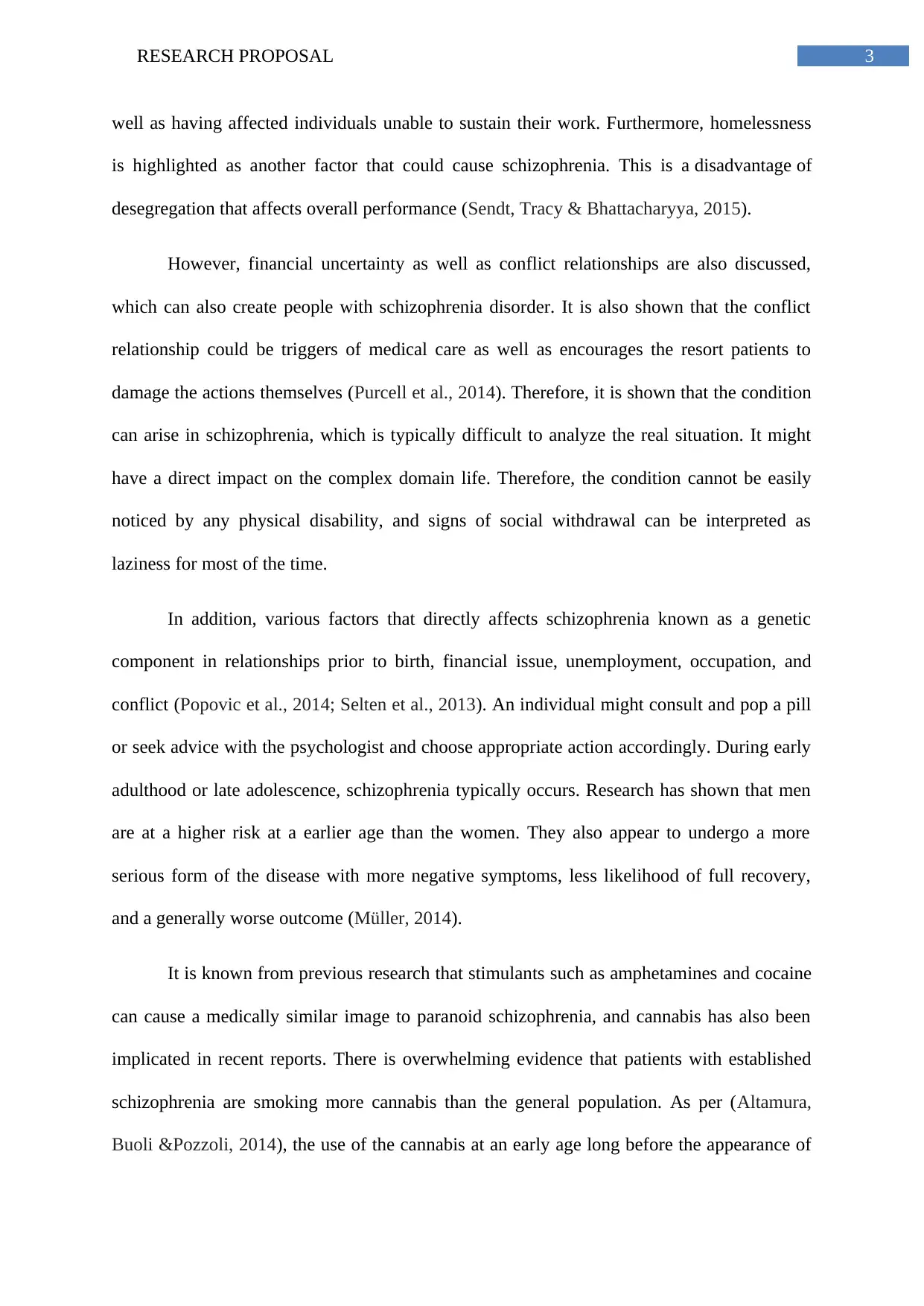
well as having affected individuals unable to sustain their work. Furthermore, homelessness
is highlighted as another factor that could cause schizophrenia. This is a disadvantage of
desegregation that affects overall performance (Sendt, Tracy & Bhattacharyya, 2015).
However, financial uncertainty as well as conflict relationships are also discussed,
which can also create people with schizophrenia disorder. It is also shown that the conflict
relationship could be triggers of medical care as well as encourages the resort patients to
damage the actions themselves (Purcell et al., 2014). Therefore, it is shown that the condition
can arise in schizophrenia, which is typically difficult to analyze the real situation. It might
have a direct impact on the complex domain life. Therefore, the condition cannot be easily
noticed by any physical disability, and signs of social withdrawal can be interpreted as
laziness for most of the time.
In addition, various factors that directly affects schizophrenia known as a genetic
component in relationships prior to birth, financial issue, unemployment, occupation, and
conflict (Popovic et al., 2014; Selten et al., 2013). An individual might consult and pop a pill
or seek advice with the psychologist and choose appropriate action accordingly. During early
adulthood or late adolescence, schizophrenia typically occurs. Research has shown that men
are at a higher risk at a earlier age than the women. They also appear to undergo a more
serious form of the disease with more negative symptoms, less likelihood of full recovery,
and a generally worse outcome (Müller, 2014).
It is known from previous research that stimulants such as amphetamines and cocaine
can cause a medically similar image to paranoid schizophrenia, and cannabis has also been
implicated in recent reports. There is overwhelming evidence that patients with established
schizophrenia are smoking more cannabis than the general population. As per (Altamura,
Buoli &Pozzoli, 2014), the use of the cannabis at an early age long before the appearance of
well as having affected individuals unable to sustain their work. Furthermore, homelessness
is highlighted as another factor that could cause schizophrenia. This is a disadvantage of
desegregation that affects overall performance (Sendt, Tracy & Bhattacharyya, 2015).
However, financial uncertainty as well as conflict relationships are also discussed,
which can also create people with schizophrenia disorder. It is also shown that the conflict
relationship could be triggers of medical care as well as encourages the resort patients to
damage the actions themselves (Purcell et al., 2014). Therefore, it is shown that the condition
can arise in schizophrenia, which is typically difficult to analyze the real situation. It might
have a direct impact on the complex domain life. Therefore, the condition cannot be easily
noticed by any physical disability, and signs of social withdrawal can be interpreted as
laziness for most of the time.
In addition, various factors that directly affects schizophrenia known as a genetic
component in relationships prior to birth, financial issue, unemployment, occupation, and
conflict (Popovic et al., 2014; Selten et al., 2013). An individual might consult and pop a pill
or seek advice with the psychologist and choose appropriate action accordingly. During early
adulthood or late adolescence, schizophrenia typically occurs. Research has shown that men
are at a higher risk at a earlier age than the women. They also appear to undergo a more
serious form of the disease with more negative symptoms, less likelihood of full recovery,
and a generally worse outcome (Müller, 2014).
It is known from previous research that stimulants such as amphetamines and cocaine
can cause a medically similar image to paranoid schizophrenia, and cannabis has also been
implicated in recent reports. There is overwhelming evidence that patients with established
schizophrenia are smoking more cannabis than the general population. As per (Altamura,
Buoli &Pozzoli, 2014), the use of the cannabis at an early age long before the appearance of
Paraphrase This Document
Need a fresh take? Get an instant paraphrase of this document with our AI Paraphraser
4RESEARCH PROPOSAL
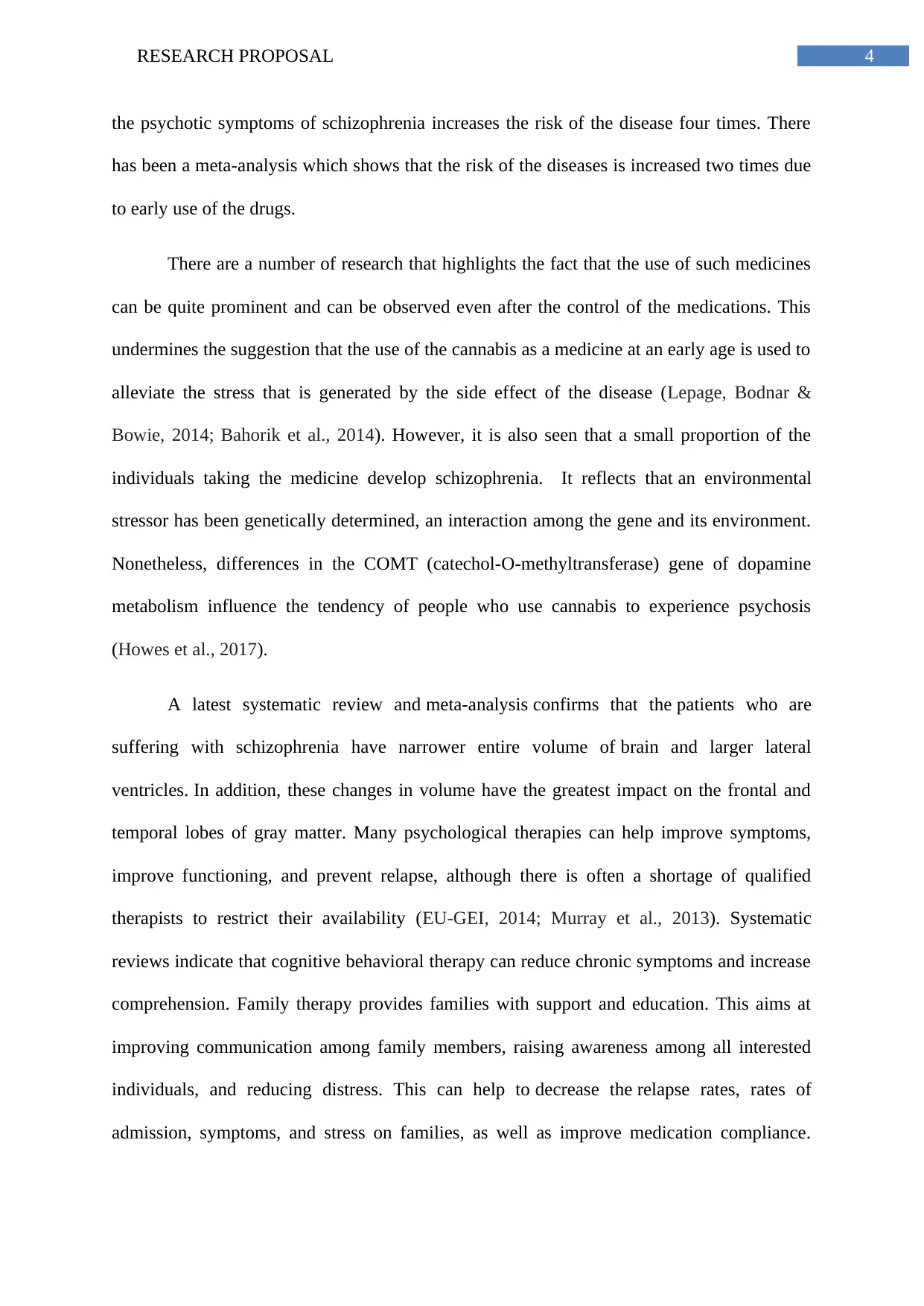
the psychotic symptoms of schizophrenia increases the risk of the disease four times. There
has been a meta-analysis which shows that the risk of the diseases is increased two times due
to early use of the drugs.
There are a number of research that highlights the fact that the use of such medicines
can be quite prominent and can be observed even after the control of the medications. This
undermines the suggestion that the use of the cannabis as a medicine at an early age is used to
alleviate the stress that is generated by the side effect of the disease (Lepage, Bodnar &
Bowie, 2014; Bahorik et al., 2014). However, it is also seen that a small proportion of the
individuals taking the medicine develop schizophrenia. It reflects that an environmental
stressor has been genetically determined, an interaction among the gene and its environment.
Nonetheless, differences in the COMT (catechol-O-methyltransferase) gene of dopamine
metabolism influence the tendency of people who use cannabis to experience psychosis
(Howes et al., 2017).
A latest systematic review and meta-analysis confirms that the patients who are
suffering with schizophrenia have narrower entire volume of brain and larger lateral
ventricles. In addition, these changes in volume have the greatest impact on the frontal and
temporal lobes of gray matter. Many psychological therapies can help improve symptoms,
improve functioning, and prevent relapse, although there is often a shortage of qualified
therapists to restrict their availability (EU-GEI, 2014; Murray et al., 2013). Systematic
reviews indicate that cognitive behavioral therapy can reduce chronic symptoms and increase
comprehension. Family therapy provides families with support and education. This aims at
improving communication among family members, raising awareness among all interested
individuals, and reducing distress. This can help to decrease the relapse rates, rates of
admission, symptoms, and stress on families, as well as improve medication compliance.
the psychotic symptoms of schizophrenia increases the risk of the disease four times. There
has been a meta-analysis which shows that the risk of the diseases is increased two times due
to early use of the drugs.
There are a number of research that highlights the fact that the use of such medicines
can be quite prominent and can be observed even after the control of the medications. This
undermines the suggestion that the use of the cannabis as a medicine at an early age is used to
alleviate the stress that is generated by the side effect of the disease (Lepage, Bodnar &
Bowie, 2014; Bahorik et al., 2014). However, it is also seen that a small proportion of the
individuals taking the medicine develop schizophrenia. It reflects that an environmental
stressor has been genetically determined, an interaction among the gene and its environment.
Nonetheless, differences in the COMT (catechol-O-methyltransferase) gene of dopamine
metabolism influence the tendency of people who use cannabis to experience psychosis
(Howes et al., 2017).
A latest systematic review and meta-analysis confirms that the patients who are
suffering with schizophrenia have narrower entire volume of brain and larger lateral
ventricles. In addition, these changes in volume have the greatest impact on the frontal and
temporal lobes of gray matter. Many psychological therapies can help improve symptoms,
improve functioning, and prevent relapse, although there is often a shortage of qualified
therapists to restrict their availability (EU-GEI, 2014; Murray et al., 2013). Systematic
reviews indicate that cognitive behavioral therapy can reduce chronic symptoms and increase
comprehension. Family therapy provides families with support and education. This aims at
improving communication among family members, raising awareness among all interested
individuals, and reducing distress. This can help to decrease the relapse rates, rates of
admission, symptoms, and stress on families, as well as improve medication compliance.
5RESEARCH PROPOSAL
Systematic reviews have shown that psychoeducation can reduce the rate of relapse and
readmission, and can be cost-effective (Carliner et al., 2014; Frank et al., 2015).
Research Question and Aim of the Research
The main aim of the research is to analyse the details of the drugs that can trigger
schizophrenia among the individuals or the patients who are already suffering from the
disease. The research proposal thus tries to find out the risk factors that are associated with
the certain drugs like LSD or cannabis that have the potential to trigger schizophrenia among
the susceptible individuals.
The research questions are mentioned below:
1. Which age group is vulnerable to the trigger of schizophrenia by the use of drugs?
2. What are the drugs that is especially involved in this and why they do so?
3. What are the probable recommendations for either using or not using the drugs?
The Justification of Research Questions
It is important to carry out the research as it will help in the identification of the risk
factors that are linked to the medications prescribed to the individuals susceptible to
schizophrenia. As it is one of the most serious diseases and no such treatment is available it is
observed that the prescribed medicines can sometimes trigger the disease in some of the
individuals (Tang et al., 2017; Palm et al., 2013). Thus, this research identifies the gap that is
present in the previous literature that highlights that certain drugs can trigger the symptoms of
the disease but do not explain the proper mechanism behind it.
This research proposal also tries to identify that whether a particular age group is only
susceptible to such symptoms or can happen to any individual. All these factors are important
Systematic reviews have shown that psychoeducation can reduce the rate of relapse and
readmission, and can be cost-effective (Carliner et al., 2014; Frank et al., 2015).
Research Question and Aim of the Research
The main aim of the research is to analyse the details of the drugs that can trigger
schizophrenia among the individuals or the patients who are already suffering from the
disease. The research proposal thus tries to find out the risk factors that are associated with
the certain drugs like LSD or cannabis that have the potential to trigger schizophrenia among
the susceptible individuals.
The research questions are mentioned below:
1. Which age group is vulnerable to the trigger of schizophrenia by the use of drugs?
2. What are the drugs that is especially involved in this and why they do so?
3. What are the probable recommendations for either using or not using the drugs?
The Justification of Research Questions
It is important to carry out the research as it will help in the identification of the risk
factors that are linked to the medications prescribed to the individuals susceptible to
schizophrenia. As it is one of the most serious diseases and no such treatment is available it is
observed that the prescribed medicines can sometimes trigger the disease in some of the
individuals (Tang et al., 2017; Palm et al., 2013). Thus, this research identifies the gap that is
present in the previous literature that highlights that certain drugs can trigger the symptoms of
the disease but do not explain the proper mechanism behind it.
This research proposal also tries to identify that whether a particular age group is only
susceptible to such symptoms or can happen to any individual. All these factors are important
⊘ This is a preview!⊘
Do you want full access?
Subscribe today to unlock all pages.
Trusted by 1+ million students worldwide
6RESEARCH PROPOSAL
and should be highlighted and thus there was a need to conduct this kind of research. It is also
seen that schizophrenia patients can have either negative or positive thoughts that is helps in
the classification of the type of the disease (Wimberley et al., 2016). Thus, the research will
help in the investigation of the impact of the drugs that can be studied that increases the
necessity of this research. Apart from this, it helps in studying the effect of schizophrenia
from a quantitative point rather than a qualitative deviation like hypertension and diabetes
(Selten et al., 2013; Malchow et al., 2013).
Research Design, Methodology and Methods
Study Design
The study design that will be used for the research study is qualitative. Qualitative
research is characterized as a method of market research focusing on data acquisition via
open-ended and communicative interaction. Qualitative research designs are intended to help
expose the action of a specific audience and interpretation in respect to a specific topic. The
findings of qualitative approaches are more concise and the inferences from the data obtained
can be made very quickly. The psychological and behavioral sciences emerged in qualitative
research approaches.
In particular, the research will use content analysis as a specific qualitative tool for
designing the study. Content analysis is a research technique for analyzing documents and
objects of communication that could be texts in different formats, images, audio or video.
Social scientists use content analysis to replicatively and systematically analyze
communication patterns. This design has been used in order to quantify the terms, themes or
even the concepts in order to analyse the factors related to schizophrenia. Here, the research
investigator is the main source for gathering the data as well as for their analysis.
and should be highlighted and thus there was a need to conduct this kind of research. It is also
seen that schizophrenia patients can have either negative or positive thoughts that is helps in
the classification of the type of the disease (Wimberley et al., 2016). Thus, the research will
help in the investigation of the impact of the drugs that can be studied that increases the
necessity of this research. Apart from this, it helps in studying the effect of schizophrenia
from a quantitative point rather than a qualitative deviation like hypertension and diabetes
(Selten et al., 2013; Malchow et al., 2013).
Research Design, Methodology and Methods
Study Design
The study design that will be used for the research study is qualitative. Qualitative
research is characterized as a method of market research focusing on data acquisition via
open-ended and communicative interaction. Qualitative research designs are intended to help
expose the action of a specific audience and interpretation in respect to a specific topic. The
findings of qualitative approaches are more concise and the inferences from the data obtained
can be made very quickly. The psychological and behavioral sciences emerged in qualitative
research approaches.
In particular, the research will use content analysis as a specific qualitative tool for
designing the study. Content analysis is a research technique for analyzing documents and
objects of communication that could be texts in different formats, images, audio or video.
Social scientists use content analysis to replicatively and systematically analyze
communication patterns. This design has been used in order to quantify the terms, themes or
even the concepts in order to analyse the factors related to schizophrenia. Here, the research
investigator is the main source for gathering the data as well as for their analysis.
Paraphrase This Document
Need a fresh take? Get an instant paraphrase of this document with our AI Paraphraser
7RESEARCH PROPOSAL
Unit Analysis and Data Collection
The unit analysis in this research proposal is related to the medicines that are legally
available and are approved by the FDA in order to be used for the treatment of the disease.
There are a number of other drugs that are also used by individuals that trigger the symptoms
of schizophrenia. The collection of data is being carried out by the help of the web based sites
and also in the offline mode by the library. The online platforms for searching the articles
involve Embase, Web of Science, PubMed, or Google scholar. The search of the articles also
included certain inclusion and exclusion criteria that involved the limitation to the English
language and the use of the articles that are published after 2013.
The search strategy also used certain keywords that helped in obtaining results more
easily and quickly. The keywords that are used for the search of the articles are mentioned
below:
Amphetamine AND cannabis OR kappa opioid,
Ketamine OR LSD AND psilocybin OR psychosis
salvia divinorum AND schizophrenia, THC
stress AND psychological AND child development
prenatal development AND risk factors
Data Analysis
The process of data analysis for the research proposal will include the reviewing of all
the content that is being obtained from the secondary data. This can be done in a step-by-step
manner by the investigator. This will also need the help of certain codes that will help in
identifying the meaning of the units involved in the research content. It will also need to
validate the research articles used. The researcher will give detailed analysis of the content in
Unit Analysis and Data Collection
The unit analysis in this research proposal is related to the medicines that are legally
available and are approved by the FDA in order to be used for the treatment of the disease.
There are a number of other drugs that are also used by individuals that trigger the symptoms
of schizophrenia. The collection of data is being carried out by the help of the web based sites
and also in the offline mode by the library. The online platforms for searching the articles
involve Embase, Web of Science, PubMed, or Google scholar. The search of the articles also
included certain inclusion and exclusion criteria that involved the limitation to the English
language and the use of the articles that are published after 2013.
The search strategy also used certain keywords that helped in obtaining results more
easily and quickly. The keywords that are used for the search of the articles are mentioned
below:
Amphetamine AND cannabis OR kappa opioid,
Ketamine OR LSD AND psilocybin OR psychosis
salvia divinorum AND schizophrenia, THC
stress AND psychological AND child development
prenatal development AND risk factors
Data Analysis
The process of data analysis for the research proposal will include the reviewing of all
the content that is being obtained from the secondary data. This can be done in a step-by-step
manner by the investigator. This will also need the help of certain codes that will help in
identifying the meaning of the units involved in the research content. It will also need to
validate the research articles used. The researcher will give detailed analysis of the content in
8RESEARCH PROPOSAL
order to check whether the content is relatable to the aim of the research project. Then after
that there will be identification of the themes or concepts that are being predicted in the
research along with the outcomes of the articles used in the analysis. At last, the major
outcomes of the paper will be compiled at the final stage.
Ethical Considerations
This study will extract the data that is available publicly or the secondary data. Thus,
in order to maintain the ethics of the research, the researcher has kept the anonymity of the
participants who were mentioned in the research articles from which the data has been
collected. The author has also tried to acknowledge the source of information and the issues
related to the content in the secondary data. Apart from this the author has tried to protect the
data obtained from the secondary data analysis.
Communicate and Disseminate the Research
The research strategy will be communicated with the other researchers and
academicians and as well as the healthcare staff as it is necessary and important to address the
issue about schizophrenia. This can be disseminated by conducting various seminars and
conferences where the researchers and investigators will be able to communicate with the rest
of world about the triggering of schizophrenia by the extensive use of drugs.
Apart from this, the findings will be published in scientific journals that can be
accessed by the students locally as well as globally. In this way there will be easy
dissemination and communication of the research outcomes.
order to check whether the content is relatable to the aim of the research project. Then after
that there will be identification of the themes or concepts that are being predicted in the
research along with the outcomes of the articles used in the analysis. At last, the major
outcomes of the paper will be compiled at the final stage.
Ethical Considerations
This study will extract the data that is available publicly or the secondary data. Thus,
in order to maintain the ethics of the research, the researcher has kept the anonymity of the
participants who were mentioned in the research articles from which the data has been
collected. The author has also tried to acknowledge the source of information and the issues
related to the content in the secondary data. Apart from this the author has tried to protect the
data obtained from the secondary data analysis.
Communicate and Disseminate the Research
The research strategy will be communicated with the other researchers and
academicians and as well as the healthcare staff as it is necessary and important to address the
issue about schizophrenia. This can be disseminated by conducting various seminars and
conferences where the researchers and investigators will be able to communicate with the rest
of world about the triggering of schizophrenia by the extensive use of drugs.
Apart from this, the findings will be published in scientific journals that can be
accessed by the students locally as well as globally. In this way there will be easy
dissemination and communication of the research outcomes.
⊘ This is a preview!⊘
Do you want full access?
Subscribe today to unlock all pages.
Trusted by 1+ million students worldwide
9RESEARCH PROPOSAL
References
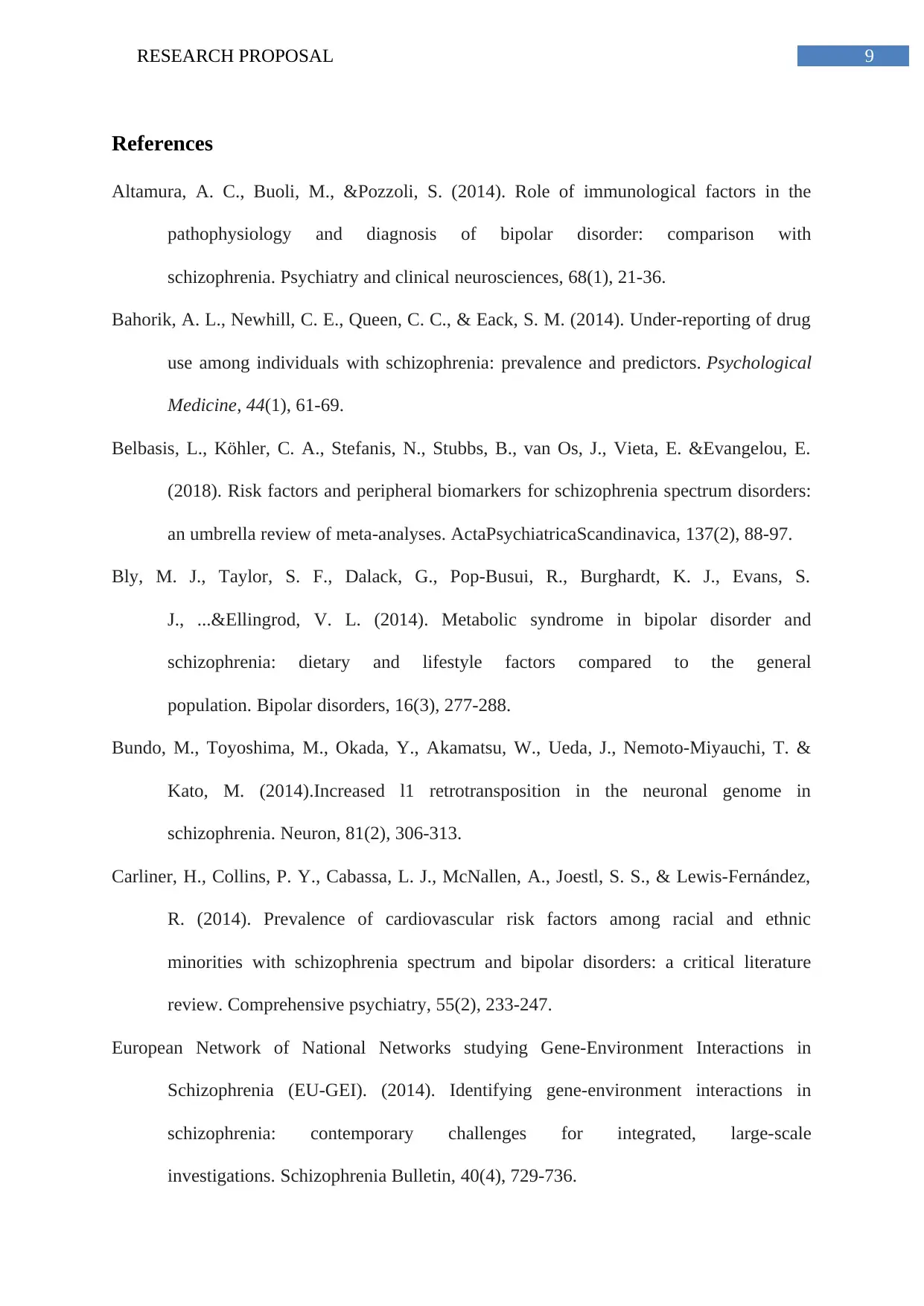
Altamura, A. C., Buoli, M., &Pozzoli, S. (2014). Role of immunological factors in the
pathophysiology and diagnosis of bipolar disorder: comparison with
schizophrenia. Psychiatry and clinical neurosciences, 68(1), 21-36.
Bahorik, A. L., Newhill, C. E., Queen, C. C., & Eack, S. M. (2014). Under-reporting of drug
use among individuals with schizophrenia: prevalence and predictors. Psychological
Medicine, 44(1), 61-69.
Belbasis, L., Köhler, C. A., Stefanis, N., Stubbs, B., van Os, J., Vieta, E. &Evangelou, E.
(2018). Risk factors and peripheral biomarkers for schizophrenia spectrum disorders:
an umbrella review of meta‐analyses. ActaPsychiatricaScandinavica, 137(2), 88-97.
Bly, M. J., Taylor, S. F., Dalack, G., Pop‐Busui, R., Burghardt, K. J., Evans, S.
J., ...&Ellingrod, V. L. (2014). Metabolic syndrome in bipolar disorder and
schizophrenia: dietary and lifestyle factors compared to the general
population. Bipolar disorders, 16(3), 277-288.
Bundo, M., Toyoshima, M., Okada, Y., Akamatsu, W., Ueda, J., Nemoto-Miyauchi, T. &
Kato, M. (2014).Increased l1 retrotransposition in the neuronal genome in
schizophrenia. Neuron, 81(2), 306-313.
Carliner, H., Collins, P. Y., Cabassa, L. J., McNallen, A., Joestl, S. S., & Lewis-Fernández,
R. (2014). Prevalence of cardiovascular risk factors among racial and ethnic
minorities with schizophrenia spectrum and bipolar disorders: a critical literature
review. Comprehensive psychiatry, 55(2), 233-247.
European Network of National Networks studying Gene-Environment Interactions in
Schizophrenia (EU-GEI). (2014). Identifying gene-environment interactions in
schizophrenia: contemporary challenges for integrated, large-scale
investigations. Schizophrenia Bulletin, 40(4), 729-736.
References
Altamura, A. C., Buoli, M., &Pozzoli, S. (2014). Role of immunological factors in the
pathophysiology and diagnosis of bipolar disorder: comparison with
schizophrenia. Psychiatry and clinical neurosciences, 68(1), 21-36.
Bahorik, A. L., Newhill, C. E., Queen, C. C., & Eack, S. M. (2014). Under-reporting of drug
use among individuals with schizophrenia: prevalence and predictors. Psychological
Medicine, 44(1), 61-69.
Belbasis, L., Köhler, C. A., Stefanis, N., Stubbs, B., van Os, J., Vieta, E. &Evangelou, E.
(2018). Risk factors and peripheral biomarkers for schizophrenia spectrum disorders:
an umbrella review of meta‐analyses. ActaPsychiatricaScandinavica, 137(2), 88-97.
Bly, M. J., Taylor, S. F., Dalack, G., Pop‐Busui, R., Burghardt, K. J., Evans, S.
J., ...&Ellingrod, V. L. (2014). Metabolic syndrome in bipolar disorder and
schizophrenia: dietary and lifestyle factors compared to the general
population. Bipolar disorders, 16(3), 277-288.
Bundo, M., Toyoshima, M., Okada, Y., Akamatsu, W., Ueda, J., Nemoto-Miyauchi, T. &
Kato, M. (2014).Increased l1 retrotransposition in the neuronal genome in
schizophrenia. Neuron, 81(2), 306-313.
Carliner, H., Collins, P. Y., Cabassa, L. J., McNallen, A., Joestl, S. S., & Lewis-Fernández,
R. (2014). Prevalence of cardiovascular risk factors among racial and ethnic
minorities with schizophrenia spectrum and bipolar disorders: a critical literature
review. Comprehensive psychiatry, 55(2), 233-247.
European Network of National Networks studying Gene-Environment Interactions in
Schizophrenia (EU-GEI). (2014). Identifying gene-environment interactions in
schizophrenia: contemporary challenges for integrated, large-scale
investigations. Schizophrenia Bulletin, 40(4), 729-736.
Paraphrase This Document
Need a fresh take? Get an instant paraphrase of this document with our AI Paraphraser
10RESEARCH PROPOSAL
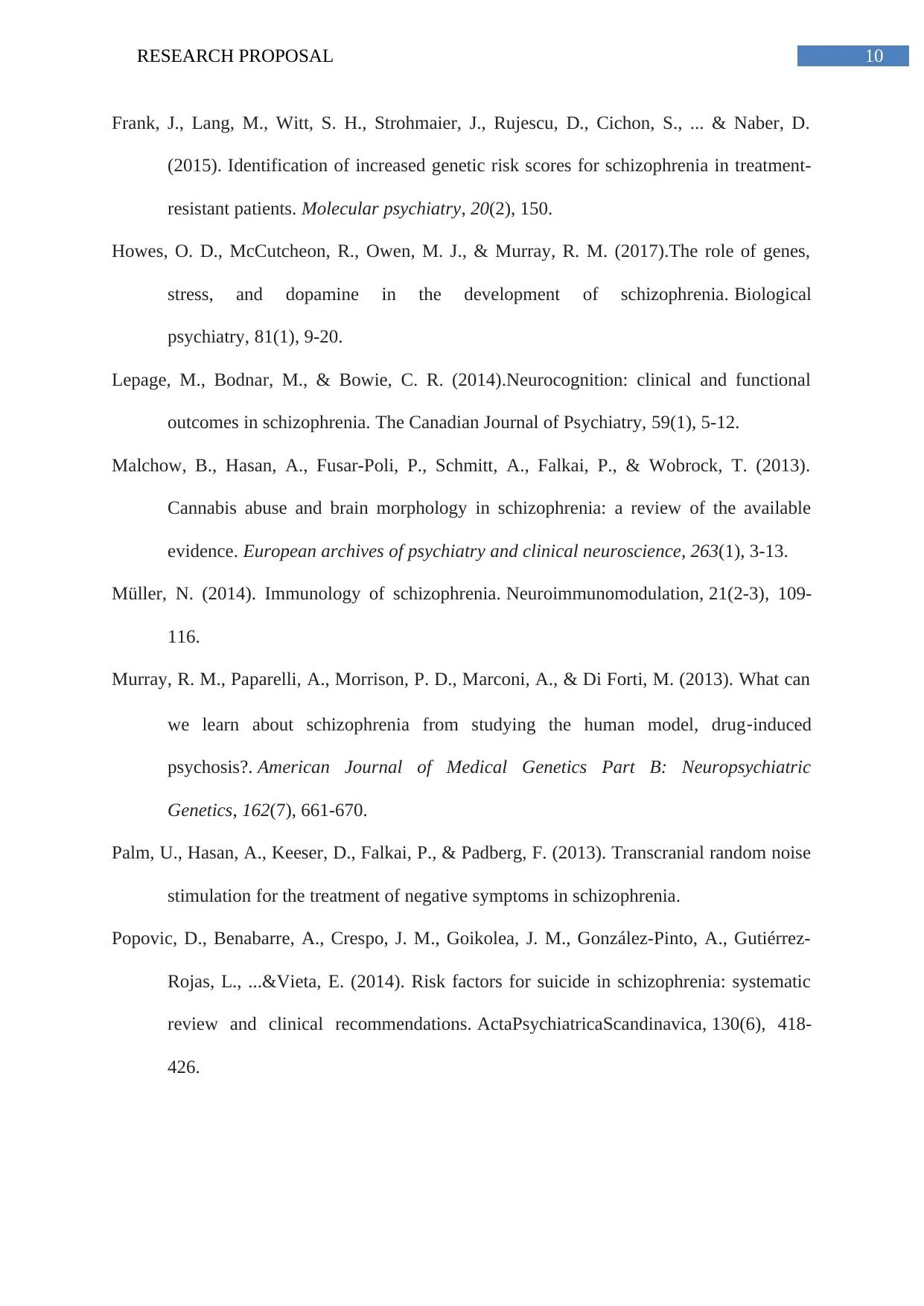
Frank, J., Lang, M., Witt, S. H., Strohmaier, J., Rujescu, D., Cichon, S., ... & Naber, D.
(2015). Identification of increased genetic risk scores for schizophrenia in treatment-
resistant patients. Molecular psychiatry, 20(2), 150.
Howes, O. D., McCutcheon, R., Owen, M. J., & Murray, R. M. (2017).The role of genes,
stress, and dopamine in the development of schizophrenia. Biological
psychiatry, 81(1), 9-20.
Lepage, M., Bodnar, M., & Bowie, C. R. (2014).Neurocognition: clinical and functional
outcomes in schizophrenia. The Canadian Journal of Psychiatry, 59(1), 5-12.
Malchow, B., Hasan, A., Fusar-Poli, P., Schmitt, A., Falkai, P., & Wobrock, T. (2013).
Cannabis abuse and brain morphology in schizophrenia: a review of the available
evidence. European archives of psychiatry and clinical neuroscience, 263(1), 3-13.
Müller, N. (2014). Immunology of schizophrenia. Neuroimmunomodulation, 21(2-3), 109-
116.
Murray, R. M., Paparelli, A., Morrison, P. D., Marconi, A., & Di Forti, M. (2013). What can
we learn about schizophrenia from studying the human model, drug‐induced
psychosis?. American Journal of Medical Genetics Part B: Neuropsychiatric
Genetics, 162(7), 661-670.
Palm, U., Hasan, A., Keeser, D., Falkai, P., & Padberg, F. (2013). Transcranial random noise
stimulation for the treatment of negative symptoms in schizophrenia.
Popovic, D., Benabarre, A., Crespo, J. M., Goikolea, J. M., González‐Pinto, A., Gutiérrez‐
Rojas, L., ...&Vieta, E. (2014). Risk factors for suicide in schizophrenia: systematic
review and clinical recommendations. ActaPsychiatricaScandinavica, 130(6), 418-
426.
Frank, J., Lang, M., Witt, S. H., Strohmaier, J., Rujescu, D., Cichon, S., ... & Naber, D.
(2015). Identification of increased genetic risk scores for schizophrenia in treatment-
resistant patients. Molecular psychiatry, 20(2), 150.
Howes, O. D., McCutcheon, R., Owen, M. J., & Murray, R. M. (2017).The role of genes,
stress, and dopamine in the development of schizophrenia. Biological
psychiatry, 81(1), 9-20.
Lepage, M., Bodnar, M., & Bowie, C. R. (2014).Neurocognition: clinical and functional
outcomes in schizophrenia. The Canadian Journal of Psychiatry, 59(1), 5-12.
Malchow, B., Hasan, A., Fusar-Poli, P., Schmitt, A., Falkai, P., & Wobrock, T. (2013).
Cannabis abuse and brain morphology in schizophrenia: a review of the available
evidence. European archives of psychiatry and clinical neuroscience, 263(1), 3-13.
Müller, N. (2014). Immunology of schizophrenia. Neuroimmunomodulation, 21(2-3), 109-
116.
Murray, R. M., Paparelli, A., Morrison, P. D., Marconi, A., & Di Forti, M. (2013). What can
we learn about schizophrenia from studying the human model, drug‐induced
psychosis?. American Journal of Medical Genetics Part B: Neuropsychiatric
Genetics, 162(7), 661-670.
Palm, U., Hasan, A., Keeser, D., Falkai, P., & Padberg, F. (2013). Transcranial random noise
stimulation for the treatment of negative symptoms in schizophrenia.
Popovic, D., Benabarre, A., Crespo, J. M., Goikolea, J. M., González‐Pinto, A., Gutiérrez‐
Rojas, L., ...&Vieta, E. (2014). Risk factors for suicide in schizophrenia: systematic
review and clinical recommendations. ActaPsychiatricaScandinavica, 130(6), 418-
426.
11RESEARCH PROPOSAL
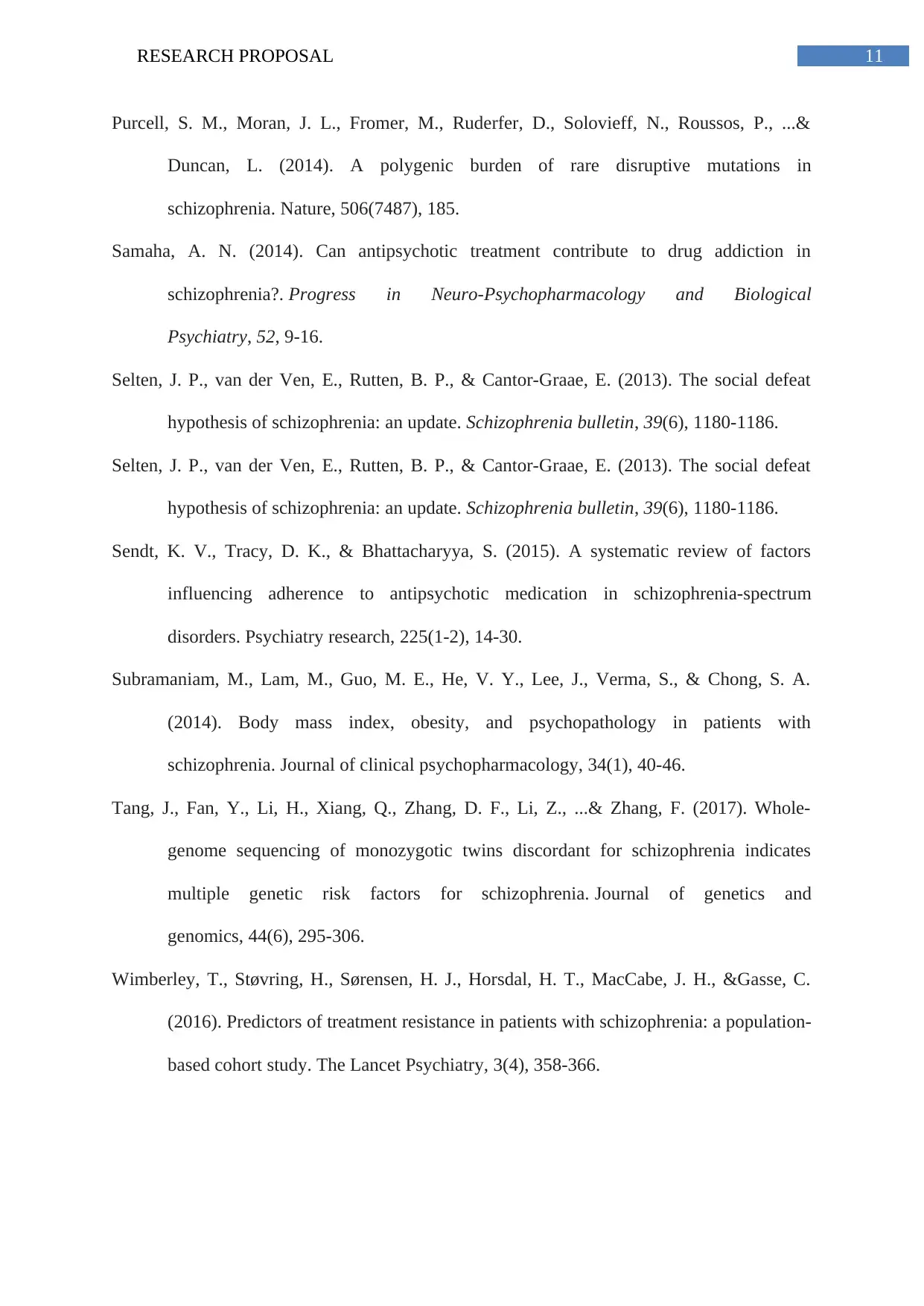
Purcell, S. M., Moran, J. L., Fromer, M., Ruderfer, D., Solovieff, N., Roussos, P., ...&
Duncan, L. (2014). A polygenic burden of rare disruptive mutations in
schizophrenia. Nature, 506(7487), 185.
Samaha, A. N. (2014). Can antipsychotic treatment contribute to drug addiction in
schizophrenia?. Progress in Neuro-Psychopharmacology and Biological
Psychiatry, 52, 9-16.
Selten, J. P., van der Ven, E., Rutten, B. P., & Cantor-Graae, E. (2013). The social defeat
hypothesis of schizophrenia: an update. Schizophrenia bulletin, 39(6), 1180-1186.
Selten, J. P., van der Ven, E., Rutten, B. P., & Cantor-Graae, E. (2013). The social defeat
hypothesis of schizophrenia: an update. Schizophrenia bulletin, 39(6), 1180-1186.
Sendt, K. V., Tracy, D. K., & Bhattacharyya, S. (2015). A systematic review of factors
influencing adherence to antipsychotic medication in schizophrenia-spectrum
disorders. Psychiatry research, 225(1-2), 14-30.
Subramaniam, M., Lam, M., Guo, M. E., He, V. Y., Lee, J., Verma, S., & Chong, S. A.
(2014). Body mass index, obesity, and psychopathology in patients with
schizophrenia. Journal of clinical psychopharmacology, 34(1), 40-46.
Tang, J., Fan, Y., Li, H., Xiang, Q., Zhang, D. F., Li, Z., ...& Zhang, F. (2017). Whole-
genome sequencing of monozygotic twins discordant for schizophrenia indicates
multiple genetic risk factors for schizophrenia. Journal of genetics and
genomics, 44(6), 295-306.
Wimberley, T., Støvring, H., Sørensen, H. J., Horsdal, H. T., MacCabe, J. H., &Gasse, C.
(2016). Predictors of treatment resistance in patients with schizophrenia: a population-
based cohort study. The Lancet Psychiatry, 3(4), 358-366.
Purcell, S. M., Moran, J. L., Fromer, M., Ruderfer, D., Solovieff, N., Roussos, P., ...&
Duncan, L. (2014). A polygenic burden of rare disruptive mutations in
schizophrenia. Nature, 506(7487), 185.
Samaha, A. N. (2014). Can antipsychotic treatment contribute to drug addiction in
schizophrenia?. Progress in Neuro-Psychopharmacology and Biological
Psychiatry, 52, 9-16.
Selten, J. P., van der Ven, E., Rutten, B. P., & Cantor-Graae, E. (2013). The social defeat
hypothesis of schizophrenia: an update. Schizophrenia bulletin, 39(6), 1180-1186.
Selten, J. P., van der Ven, E., Rutten, B. P., & Cantor-Graae, E. (2013). The social defeat
hypothesis of schizophrenia: an update. Schizophrenia bulletin, 39(6), 1180-1186.
Sendt, K. V., Tracy, D. K., & Bhattacharyya, S. (2015). A systematic review of factors
influencing adherence to antipsychotic medication in schizophrenia-spectrum
disorders. Psychiatry research, 225(1-2), 14-30.
Subramaniam, M., Lam, M., Guo, M. E., He, V. Y., Lee, J., Verma, S., & Chong, S. A.
(2014). Body mass index, obesity, and psychopathology in patients with
schizophrenia. Journal of clinical psychopharmacology, 34(1), 40-46.
Tang, J., Fan, Y., Li, H., Xiang, Q., Zhang, D. F., Li, Z., ...& Zhang, F. (2017). Whole-
genome sequencing of monozygotic twins discordant for schizophrenia indicates
multiple genetic risk factors for schizophrenia. Journal of genetics and
genomics, 44(6), 295-306.
Wimberley, T., Støvring, H., Sørensen, H. J., Horsdal, H. T., MacCabe, J. H., &Gasse, C.
(2016). Predictors of treatment resistance in patients with schizophrenia: a population-
based cohort study. The Lancet Psychiatry, 3(4), 358-366.
⊘ This is a preview!⊘
Do you want full access?
Subscribe today to unlock all pages.
Trusted by 1+ million students worldwide

1 out of 14


Related Documents


Your All-in-One AI-Powered Toolkit for Academic Success.
+13062052269
info@desklib.com
Available 24*7 on WhatsApp / Email
![[object Object]](/_next/static/media/star-bottom.7253800d.svg)
Unlock your academic potential
Copyright © 2020–2026 A2Z Services. All Rights Reserved. Developed and managed by ZUCOL.