Public Health: Identifying and Contacting Community Healthcare Users
VerifiedAdded on 2022/10/02
|7
|1015
|29
Report
AI Summary
This report examines the utilization of community health services, focusing on methods to identify and contact both users and non-users of these services. It highlights the use of observation, medical records, administrative data, and interviews for data collection, comparing the strengths and weaknesses of each approach. The chosen sampling method is quota sampling, which involves classifying the population by characteristics like gender and then selecting units for each quota. The report also discusses recruitment strategies, including long-term interaction with participants, understanding their behaviors, and using online advertising. It acknowledges limitations such as excluding individuals without social media access and the time-consuming nature of participant interaction. Ultimately, the report emphasizes the importance of high-quality research in producing information applicable beyond the immediate research area. Desklib provides access to a wealth of similar reports and solved assignments for students.
1
Running head: PUBLIC HEALTH
Public Health
Student’s Name
Institutional affiliation
Running head: PUBLIC HEALTH
Public Health
Student’s Name
Institutional affiliation
Paraphrase This Document
Need a fresh take? Get an instant paraphrase of this document with our AI Paraphraser

2
PUBLIC HEALTH
Part 1
Community health service is a facility that provides patient care within the settings of a
community. Although a community health service is designed to help a community, there are
members of the community who do no use the facilities. There are a number of ways to
determine those who use publicly funded healthcare, those who do not and the reasons behind
each community member’s preference. One of the ways is to find out the demographic
characteristics through a telephone survey. This model is a type of survey method which gathers
data from a certain population generally or from a targeted population. Anyone from the
population can participate in the data collection once they agree to be respondents. This paper
will focus on the contact of two groups, those who use the community healthcare service and
those who do not and the methods used to identify and contact them.
How to Identify and Contact these Two Groups
These two groups can be identified through observation which involves taking note of
what is happening. Being a participant observer by using the local community health service can
be helpful in giving a deeper understanding of how the facility functions. After observing, these
two groups can be contacted through phone calls. The information used to select these
participants can be obtained from medical records used in the public-funded health facility
(Sutton and Austin, 2015). Additionally, administrative and billing data can be used to give
information about each of the patients that have been treated in public healthcare and the services
they received. Participants can also be selected through interviews which a common data
collection method in research.
PUBLIC HEALTH
Part 1
Community health service is a facility that provides patient care within the settings of a
community. Although a community health service is designed to help a community, there are
members of the community who do no use the facilities. There are a number of ways to
determine those who use publicly funded healthcare, those who do not and the reasons behind
each community member’s preference. One of the ways is to find out the demographic
characteristics through a telephone survey. This model is a type of survey method which gathers
data from a certain population generally or from a targeted population. Anyone from the
population can participate in the data collection once they agree to be respondents. This paper
will focus on the contact of two groups, those who use the community healthcare service and
those who do not and the methods used to identify and contact them.
How to Identify and Contact these Two Groups
These two groups can be identified through observation which involves taking note of
what is happening. Being a participant observer by using the local community health service can
be helpful in giving a deeper understanding of how the facility functions. After observing, these
two groups can be contacted through phone calls. The information used to select these
participants can be obtained from medical records used in the public-funded health facility
(Sutton and Austin, 2015). Additionally, administrative and billing data can be used to give
information about each of the patients that have been treated in public healthcare and the services
they received. Participants can also be selected through interviews which a common data
collection method in research.

3
PUBLIC HEALTH
Compared to other methods, observation is the simplest method of data collection as it
requires little or no technical skills. It also has a higher degree of accuracy compared to other
methods like interviews that rely on data from the participant. However, data may be inaccurate
since people may change or act differently when they notice they are being observed. This gives
data that lacks reliability. Medical records give complete information on patient care. On the
other hand, the structure of the medical records does not ensure that all relevant information of
the patient is recorded thus some important information might be missing. The data in the
administrative record is complete and comprehensive. However, administrative data lacks the
detail of the medical record. Interviews are a convenient method since those that cannot read and
write can take part. However, interviews are considered costly and time-consuming.
Description of the sampling method
The sampling method which will be used is quota sampling. This method involves the
classification of the population by characteristics, for instance, gender. Several units are
subsequently selected for completion of each quota (Taherdoost, 2016). In recruiting
participants, a number of steps will be used. First, there will be long term interaction with the
participants and the area prior to recruitment which increases the success of the recruitment.
Also, there would be an understanding of the behaviors and differences of prospective
participants. This will be useful in understanding the view of the participants about the cost and
benefit of participation in research. Moreover, there would be the use of online advertising
through sites such as Facebook ads and hanging notices in public places targeting potential
participants (Gelinas, Pierce, Winkler, Cohen, Lynch and Bierer, 2017). Using this approach can
have limitations for people without access to social media. Again, interaction with future
participants can be time-consuming.
PUBLIC HEALTH
Compared to other methods, observation is the simplest method of data collection as it
requires little or no technical skills. It also has a higher degree of accuracy compared to other
methods like interviews that rely on data from the participant. However, data may be inaccurate
since people may change or act differently when they notice they are being observed. This gives
data that lacks reliability. Medical records give complete information on patient care. On the
other hand, the structure of the medical records does not ensure that all relevant information of
the patient is recorded thus some important information might be missing. The data in the
administrative record is complete and comprehensive. However, administrative data lacks the
detail of the medical record. Interviews are a convenient method since those that cannot read and
write can take part. However, interviews are considered costly and time-consuming.
Description of the sampling method
The sampling method which will be used is quota sampling. This method involves the
classification of the population by characteristics, for instance, gender. Several units are
subsequently selected for completion of each quota (Taherdoost, 2016). In recruiting
participants, a number of steps will be used. First, there will be long term interaction with the
participants and the area prior to recruitment which increases the success of the recruitment.
Also, there would be an understanding of the behaviors and differences of prospective
participants. This will be useful in understanding the view of the participants about the cost and
benefit of participation in research. Moreover, there would be the use of online advertising
through sites such as Facebook ads and hanging notices in public places targeting potential
participants (Gelinas, Pierce, Winkler, Cohen, Lynch and Bierer, 2017). Using this approach can
have limitations for people without access to social media. Again, interaction with future
participants can be time-consuming.
⊘ This is a preview!⊘
Do you want full access?
Subscribe today to unlock all pages.

Trusted by 1+ million students worldwide

4
PUBLIC HEALTH
Research is an important aspect of society. Not only does research generate knowledge
and ideas but also revise existing information and replace it with the current one. Identification
of the participants and contacting them is an important process of research and useful in
determining how successful research can be. High-quality research is important in producing
information which can be used outside of the area the research was conducted.
PUBLIC HEALTH
Research is an important aspect of society. Not only does research generate knowledge
and ideas but also revise existing information and replace it with the current one. Identification
of the participants and contacting them is an important process of research and useful in
determining how successful research can be. High-quality research is important in producing
information which can be used outside of the area the research was conducted.
Paraphrase This Document
Need a fresh take? Get an instant paraphrase of this document with our AI Paraphraser

5
PUBLIC HEALTH
References
Gelinas, L., Pierce, R., Winkler, S., Cohen, I. G., Lynch, H. F., & Bierer, B. E. (2017). Using
social media as a research recruitment tool: Ethical issues and recommendations. The
American Journal of Bioethics, 17(3), 3-14.
Sutton, J., & Austin, Z. (2015). Qualitative research: Data collection, analysis, and
management. The Canadian journal of hospital pharmacy, 68(3), 226.
Taherdoost, H. (2016). Sampling methods in research methodology; How to choose a sampling
technique for research.
PUBLIC HEALTH
References
Gelinas, L., Pierce, R., Winkler, S., Cohen, I. G., Lynch, H. F., & Bierer, B. E. (2017). Using
social media as a research recruitment tool: Ethical issues and recommendations. The
American Journal of Bioethics, 17(3), 3-14.
Sutton, J., & Austin, Z. (2015). Qualitative research: Data collection, analysis, and
management. The Canadian journal of hospital pharmacy, 68(3), 226.
Taherdoost, H. (2016). Sampling methods in research methodology; How to choose a sampling
technique for research.

6
PUBLIC HEALTH
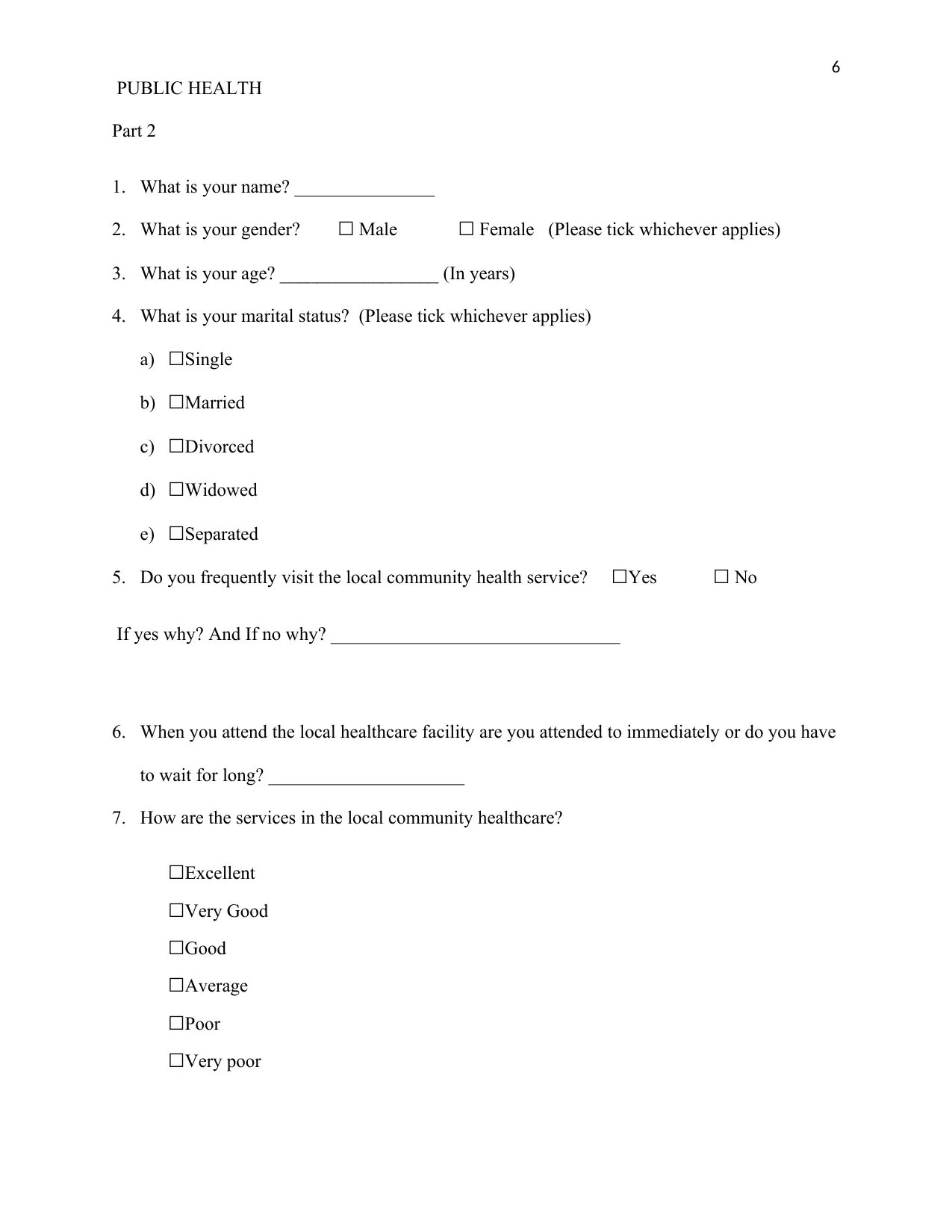
Part 2
1. What is your name? _______________
2. What is your gender? ☐ Male ☐ Female (Please tick whichever applies)
3. What is your age? _________________ (In years)
4. What is your marital status? (Please tick whichever applies)
a) ☐Single
b) ☐Married
c) ☐Divorced
d) ☐Widowed
e) ☐Separated
5. Do you frequently visit the local community health service? ☐Yes ☐ No
If yes why? And If no why? _______________________________
6. When you attend the local healthcare facility are you attended to immediately or do you have
to wait for long? _____________________
7. How are the services in the local community healthcare?
☐Excellent
☐Very Good
☐Good
☐Average
☐Poor
☐Very poor
PUBLIC HEALTH
Part 2
1. What is your name? _______________
2. What is your gender? ☐ Male ☐ Female (Please tick whichever applies)
3. What is your age? _________________ (In years)
4. What is your marital status? (Please tick whichever applies)
a) ☐Single
b) ☐Married
c) ☐Divorced
d) ☐Widowed
e) ☐Separated
5. Do you frequently visit the local community health service? ☐Yes ☐ No
If yes why? And If no why? _______________________________
6. When you attend the local healthcare facility are you attended to immediately or do you have
to wait for long? _____________________
7. How are the services in the local community healthcare?
☐Excellent
☐Very Good
☐Good
☐Average
☐Poor
☐Very poor
⊘ This is a preview!⊘
Do you want full access?
Subscribe today to unlock all pages.

Trusted by 1+ million students worldwide

7
PUBLIC HEALTH
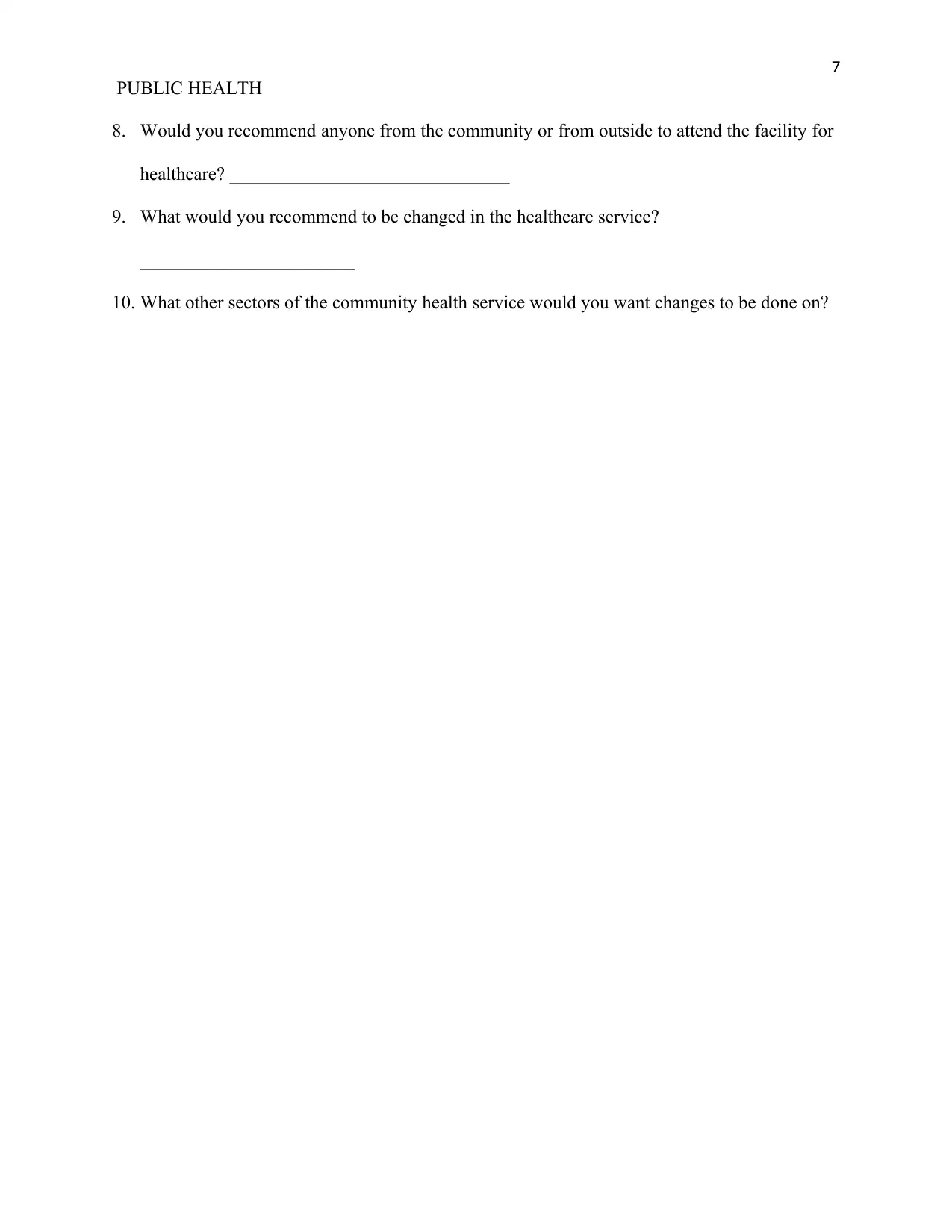
8. Would you recommend anyone from the community or from outside to attend the facility for
healthcare? ______________________________
9. What would you recommend to be changed in the healthcare service?
_______________________
10. What other sectors of the community health service would you want changes to be done on?
PUBLIC HEALTH
8. Would you recommend anyone from the community or from outside to attend the facility for
healthcare? ______________________________
9. What would you recommend to be changed in the healthcare service?
_______________________
10. What other sectors of the community health service would you want changes to be done on?
1 out of 7
Related Documents
Your All-in-One AI-Powered Toolkit for Academic Success.
+13062052269
info@desklib.com
Available 24*7 on WhatsApp / Email
Unlock your academic potential
Copyright © 2020–2026 A2Z Services. All Rights Reserved. Developed and managed by ZUCOL.