Public Health and Social Care: Roles, Diseases, Services, and Policies
VerifiedAdded on 2019/12/28
|19
|7153
|170
Report
AI Summary
This report delves into the multifaceted roles of public health and social care, examining the responsibilities of various agencies at local, national, and international levels. It explores the epidemiology of both infectious and non-infectious diseases, such as HIV and diabetes, and evaluates the effectiveness of different approaches to control disease incidents. The report further analyzes current approaches and priorities of services to communities, the relationship between disease prevalence and service requirements, and the impact of lifestyle choices on future needs. It also discusses priorities for health and well-being, the effectiveness of strategies and policies, and potential improvements. The report concludes with an examination of activities implemented to encourage behavioral changes within the context of public health and social care.
ROLE OF PUBLIC
HEALTH AND SOCIAL
CARE
HEALTH AND SOCIAL
CARE

Paraphrase This Document
Need a fresh take? Get an instant paraphrase of this document with our AI Paraphraser
Table of Contents
INTRODUCTION...........................................................................................................................3
TASK1.............................................................................................................................................3
1.1) Roles of different agencies..............................................................................................3
1.2)The epidemiology of infectious and non- infectious diseases.........................................5
1.3)Effectiveness of different approaches to control disease incidents..................................7
TASK2...........................................................................................................................................10
2.1) Current approaches and priorities of the services to communities...............................10
2.2)Relationship between prevalence of diseases and requirement of the services.............11
2.3) The impact of the current lifestyle choices for the future needs...................................12
TASK 3..........................................................................................................................................14
3.1) Priorities of health and well being................................................................................14
3.2) Effectiveness of the strategies and policies in the health and social care.....................15
3.3) Changes that could be made for more improvement....................................................15
3.4)The activity that has been implemented to encourage the behavioural changes............15
CONCLUSION .............................................................................................................................16
REFERENCES..............................................................................................................................17
INTRODUCTION...........................................................................................................................3
TASK1.............................................................................................................................................3
1.1) Roles of different agencies..............................................................................................3
1.2)The epidemiology of infectious and non- infectious diseases.........................................5
1.3)Effectiveness of different approaches to control disease incidents..................................7
TASK2...........................................................................................................................................10
2.1) Current approaches and priorities of the services to communities...............................10
2.2)Relationship between prevalence of diseases and requirement of the services.............11
2.3) The impact of the current lifestyle choices for the future needs...................................12
TASK 3..........................................................................................................................................14
3.1) Priorities of health and well being................................................................................14
3.2) Effectiveness of the strategies and policies in the health and social care.....................15
3.3) Changes that could be made for more improvement....................................................15
3.4)The activity that has been implemented to encourage the behavioural changes............15
CONCLUSION .............................................................................................................................16
REFERENCES..............................................................................................................................17
INTRODUCTION
The public health means the safety and protection of the health of population of nation
rather than the health of an individual person. The government of the nation has also a major role
in the development and improvement of the health of the people of society (Atrash and
Carpentier, 2012). There are many factors that can cause health related issues to the people of the
nation. Hence it is very necessary to understand these factors and safety and protection policies
and procedures are to be made as to safeguard the health of the population. The policies can not
be made by any single entity it is very must to create links and connection with the different
nation's government and private sectors so that the effective procedures of health safety can be
executed.
TASK1
1.1) Roles of different agencies.
The health of the public very important as it has to be safeguard by adapting the various
policies that are related to the disease, safety of the health campaigns has to be promoted by the
government and several agencies who are involved in the identifying the diseases and the reasons
behind it. The health care sectors has to very carefully tackle the patients facing the health
related problems and they have to be treated very effective manner. And the root cause of the
issue has to be find out by the researchers so that the problems can be reduced earlier (Basile and
Smith, 2011). The local, national and international levels are the stages where the agencies are
performing their duties and they are making many plans and strategies that can help in resolving
the health related issues. The world health organisation, national health organisation and national
institution of health and clinical excellence are different agencies which are involved in health
and safety of public who are affected by various diseases.
Local agency
Local Care Force - The Nursing, Social & Healthcare Agency, it is an agency in
country which is working for public's health at local level. The local public health department
has the basic and difficult role in the the sector of health and social care. As they act as the front
line staffs who delivers the services to the public of the various communities of nation. They are
liable for the availing the facilities to the people of community in different countries. The local
The public health means the safety and protection of the health of population of nation
rather than the health of an individual person. The government of the nation has also a major role
in the development and improvement of the health of the people of society (Atrash and
Carpentier, 2012). There are many factors that can cause health related issues to the people of the
nation. Hence it is very necessary to understand these factors and safety and protection policies
and procedures are to be made as to safeguard the health of the population. The policies can not
be made by any single entity it is very must to create links and connection with the different
nation's government and private sectors so that the effective procedures of health safety can be
executed.
TASK1
1.1) Roles of different agencies.
The health of the public very important as it has to be safeguard by adapting the various
policies that are related to the disease, safety of the health campaigns has to be promoted by the
government and several agencies who are involved in the identifying the diseases and the reasons
behind it. The health care sectors has to very carefully tackle the patients facing the health
related problems and they have to be treated very effective manner. And the root cause of the
issue has to be find out by the researchers so that the problems can be reduced earlier (Basile and
Smith, 2011). The local, national and international levels are the stages where the agencies are
performing their duties and they are making many plans and strategies that can help in resolving
the health related issues. The world health organisation, national health organisation and national
institution of health and clinical excellence are different agencies which are involved in health
and safety of public who are affected by various diseases.
Local agency
Local Care Force - The Nursing, Social & Healthcare Agency, it is an agency in
country which is working for public's health at local level. The local public health department
has the basic and difficult role in the the sector of health and social care. As they act as the front
line staffs who delivers the services to the public of the various communities of nation. They are
liable for the availing the facilities to the people of community in different countries. The local
⊘ This is a preview!⊘
Do you want full access?
Subscribe today to unlock all pages.

Trusted by 1+ million students worldwide
outbreaks of the diseases are responded by these agencies. The social services at local level are
to be considered effectively and also the welfare acts are to be done like accommodation related
to the residential to those people who are not able to get any kind of care due to several reasons
(Beckman And et.al, 2010).
Role of local agency
Welfare of people of the society.
To educate public about several diseases that are spreading and causing many problems
in their healths. They create awareness to all so that prevention can be taken at primary
stage itself. This agency do immunization activities for both adult and kids.
Regional agency
PHE is a regional agency which has been introduced in 2013, its main motive is to
protect and enhance the health condition of people in a particular nation and also to maintain
equality among all the people. It is working into several division, they are-
Health protection
Health improvement
Research and improving the people who are affected with various diseases.
Contagious disease surveillance and its control
Its main role is to provide integrated services to people so that they can be able to avail
better services that can be very helpful for them in getting prevented by various health related
problems. It also plays a very important role in developing the new strategies and tactics which
are very useful for the society as they could be prevented from the threats of the diseases.
National agency
At national level the National Health Services are operating in England and it is named as
the Health and Social Care Act 2012, where the nation's people health are protected and
improved and they try to reduce the issue of health inequalities of the country. This act is been
established on 1st April 2013 it got its existence due to the unhealthy condition of the people in
the nation was increasing rapidly, death rates are increasing which has disturbed the country's
standard of living very badly (Bennett, 2010). Role of NICE( National institution of health and
care excellence) is to enhance results for individuals utilizing the NHS and other general well
being and social care administrations. Delivering proofs based direction and guidance for general
to be considered effectively and also the welfare acts are to be done like accommodation related
to the residential to those people who are not able to get any kind of care due to several reasons
(Beckman And et.al, 2010).
Role of local agency
Welfare of people of the society.
To educate public about several diseases that are spreading and causing many problems
in their healths. They create awareness to all so that prevention can be taken at primary
stage itself. This agency do immunization activities for both adult and kids.
Regional agency
PHE is a regional agency which has been introduced in 2013, its main motive is to
protect and enhance the health condition of people in a particular nation and also to maintain
equality among all the people. It is working into several division, they are-
Health protection
Health improvement
Research and improving the people who are affected with various diseases.
Contagious disease surveillance and its control
Its main role is to provide integrated services to people so that they can be able to avail
better services that can be very helpful for them in getting prevented by various health related
problems. It also plays a very important role in developing the new strategies and tactics which
are very useful for the society as they could be prevented from the threats of the diseases.
National agency
At national level the National Health Services are operating in England and it is named as
the Health and Social Care Act 2012, where the nation's people health are protected and
improved and they try to reduce the issue of health inequalities of the country. This act is been
established on 1st April 2013 it got its existence due to the unhealthy condition of the people in
the nation was increasing rapidly, death rates are increasing which has disturbed the country's
standard of living very badly (Bennett, 2010). Role of NICE( National institution of health and
care excellence) is to enhance results for individuals utilizing the NHS and other general well
being and social care administrations. Delivering proofs based direction and guidance for general
Paraphrase This Document
Need a fresh take? Get an instant paraphrase of this document with our AI Paraphraser
well-being and social care specialists. It is very much concern about health related issues that are
faced by general public in the society
Role of National agency
This section is very much responsible for introducing new health care centres so that
patient can be benefited from it. It conveys information regarding many diseases at national level
so that entire nation will be able to take safety measures and can be able to prevent from
dangerous and hazardous infections and viruses. NICE is a community which is dealing in
treating customers and providing those service in improved manner that has not been delivered
by NHS. At national level they are very practically performing their part as they want to
eradicate the issues that are faced by people.
International agency
In international level the World Health Organisation is carrying out its duty to safeguard
the life and the health of the nation's people. The WHO is providing many financial aids to the
different countries so that the governments of the nation can be able to invest those funds in the
health and the safety policies and health cares for better services to the public. The research
agenda for every country are planned and shaped by it, the knowledge and the informations are
communicated worldwide to create the awareness related to health aspects. It issues policies and
rules regarding articulating ethical and evidence based elements. It also helps in providing the
technical support system and evaluate and monitor the situations of health and also assess the
trends.
Role of Internation agency
To make policy regarding health and social care that must be followed by every nation.
To provide aid to several agencies that are performing activities related to social and
health care.
It use to set agenda for research for all countries.
Situations of every nation is get evaluated by it so public can be able to get better health
care services.
Red cross
It is an organisation that is providing customers the effective and emergency services and
are offering people at times of disaster and other circumstances. This basically avails the services
as first aid, help for those who are on wheel chairs, refugee supports, armed people are protected
faced by general public in the society
Role of National agency
This section is very much responsible for introducing new health care centres so that
patient can be benefited from it. It conveys information regarding many diseases at national level
so that entire nation will be able to take safety measures and can be able to prevent from
dangerous and hazardous infections and viruses. NICE is a community which is dealing in
treating customers and providing those service in improved manner that has not been delivered
by NHS. At national level they are very practically performing their part as they want to
eradicate the issues that are faced by people.
International agency
In international level the World Health Organisation is carrying out its duty to safeguard
the life and the health of the nation's people. The WHO is providing many financial aids to the
different countries so that the governments of the nation can be able to invest those funds in the
health and the safety policies and health cares for better services to the public. The research
agenda for every country are planned and shaped by it, the knowledge and the informations are
communicated worldwide to create the awareness related to health aspects. It issues policies and
rules regarding articulating ethical and evidence based elements. It also helps in providing the
technical support system and evaluate and monitor the situations of health and also assess the
trends.
Role of Internation agency
To make policy regarding health and social care that must be followed by every nation.
To provide aid to several agencies that are performing activities related to social and
health care.
It use to set agenda for research for all countries.
Situations of every nation is get evaluated by it so public can be able to get better health
care services.
Red cross
It is an organisation that is providing customers the effective and emergency services and
are offering people at times of disaster and other circumstances. This basically avails the services
as first aid, help for those who are on wheel chairs, refugee supports, armed people are protected
and also teaching resources are provided on free of cost. The major motive of them is not to
refuse people who are facing several issues regarding their health.
1.2)The epidemiology of infectious and non- infectious diseases.
Epidemiology is the study of medicines which deals with the incidents possible situation
of controlling the diseases and the study of all the related aspects of the health. It helps in the
collection of data of the population, monitoring them and they take corrective and protective
actions against them. It do the identification of all the problems related to health and several
programmes and policies are created by them (Blas and Kurup, 2010).
Infectious disease
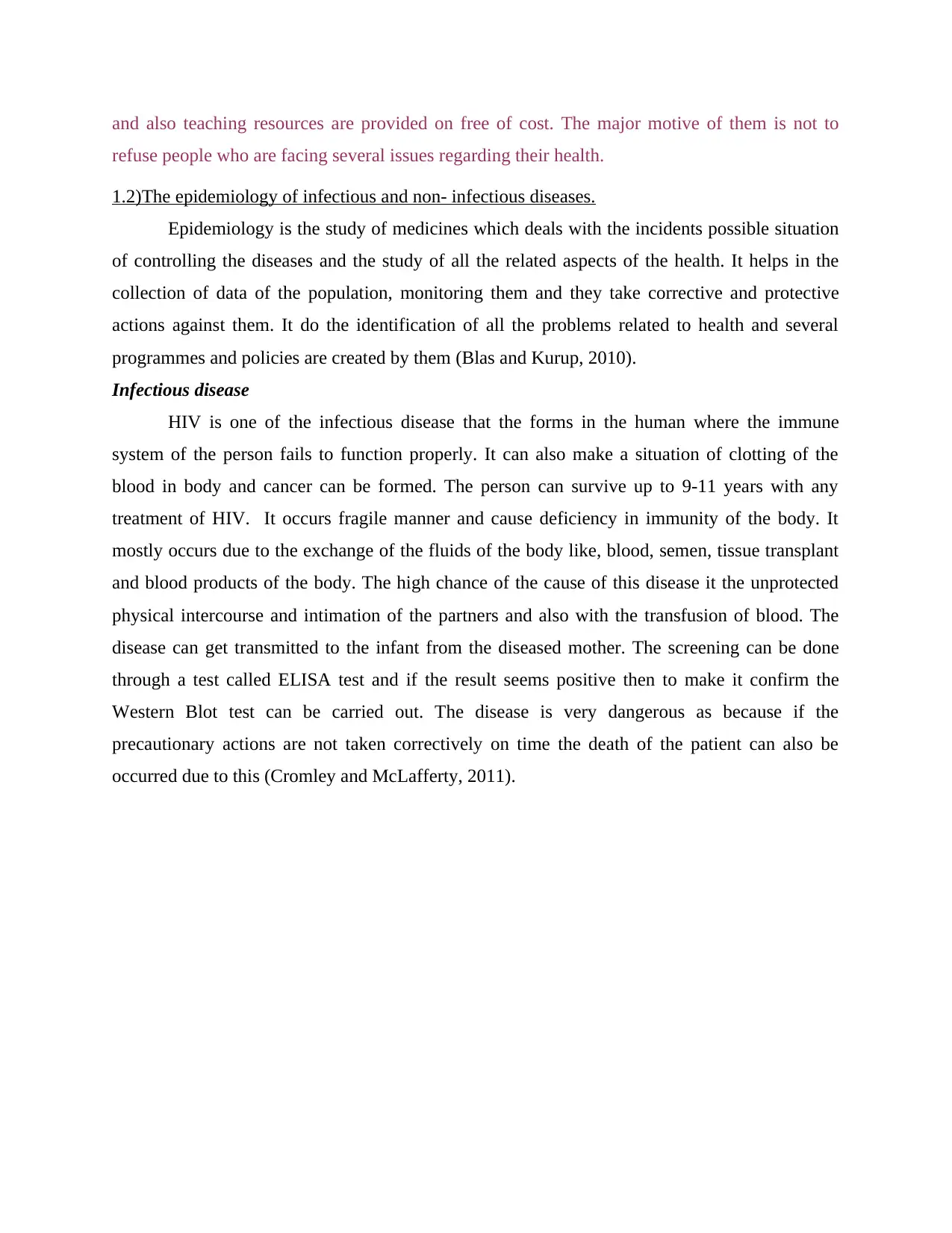
HIV is one of the infectious disease that the forms in the human where the immune
system of the person fails to function properly. It can also make a situation of clotting of the
blood in body and cancer can be formed. The person can survive up to 9-11 years with any
treatment of HIV. It occurs fragile manner and cause deficiency in immunity of the body. It
mostly occurs due to the exchange of the fluids of the body like, blood, semen, tissue transplant
and blood products of the body. The high chance of the cause of this disease it the unprotected
physical intercourse and intimation of the partners and also with the transfusion of blood. The
disease can get transmitted to the infant from the diseased mother. The screening can be done
through a test called ELISA test and if the result seems positive then to make it confirm the
Western Blot test can be carried out. The disease is very dangerous as because if the
precautionary actions are not taken correctively on time the death of the patient can also be
occurred due to this (Cromley and McLafferty, 2011).
refuse people who are facing several issues regarding their health.
1.2)The epidemiology of infectious and non- infectious diseases.
Epidemiology is the study of medicines which deals with the incidents possible situation
of controlling the diseases and the study of all the related aspects of the health. It helps in the
collection of data of the population, monitoring them and they take corrective and protective
actions against them. It do the identification of all the problems related to health and several
programmes and policies are created by them (Blas and Kurup, 2010).
Infectious disease
HIV is one of the infectious disease that the forms in the human where the immune
system of the person fails to function properly. It can also make a situation of clotting of the
blood in body and cancer can be formed. The person can survive up to 9-11 years with any
treatment of HIV. It occurs fragile manner and cause deficiency in immunity of the body. It
mostly occurs due to the exchange of the fluids of the body like, blood, semen, tissue transplant
and blood products of the body. The high chance of the cause of this disease it the unprotected
physical intercourse and intimation of the partners and also with the transfusion of blood. The
disease can get transmitted to the infant from the diseased mother. The screening can be done
through a test called ELISA test and if the result seems positive then to make it confirm the
Western Blot test can be carried out. The disease is very dangerous as because if the
precautionary actions are not taken correctively on time the death of the patient can also be
occurred due to this (Cromley and McLafferty, 2011).
⊘ This is a preview!⊘
Do you want full access?
Subscribe today to unlock all pages.
Trusted by 1+ million students worldwide
Non- infectious disease
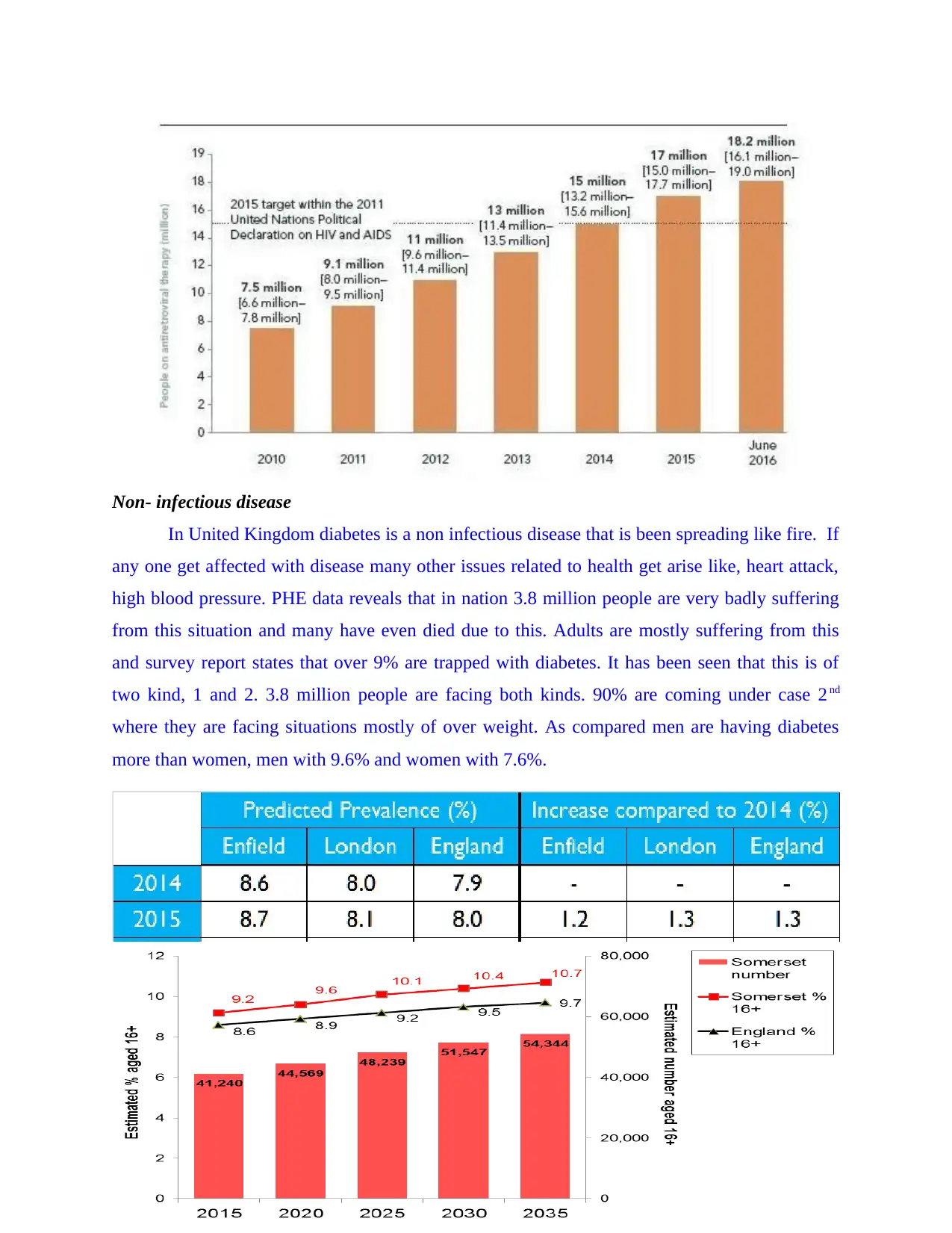
In United Kingdom diabetes is a non infectious disease that is been spreading like fire. If
any one get affected with disease many other issues related to health get arise like, heart attack,
high blood pressure. PHE data reveals that in nation 3.8 million people are very badly suffering
from this situation and many have even died due to this. Adults are mostly suffering from this
and survey report states that over 9% are trapped with diabetes. It has been seen that this is of
two kind, 1 and 2. 3.8 million people are facing both kinds. 90% are coming under case 2 nd
where they are facing situations mostly of over weight. As compared men are having diabetes
more than women, men with 9.6% and women with 7.6%.
In United Kingdom diabetes is a non infectious disease that is been spreading like fire. If
any one get affected with disease many other issues related to health get arise like, heart attack,
high blood pressure. PHE data reveals that in nation 3.8 million people are very badly suffering
from this situation and many have even died due to this. Adults are mostly suffering from this
and survey report states that over 9% are trapped with diabetes. It has been seen that this is of
two kind, 1 and 2. 3.8 million people are facing both kinds. 90% are coming under case 2 nd
where they are facing situations mostly of over weight. As compared men are having diabetes
more than women, men with 9.6% and women with 7.6%.
Paraphrase This Document
Need a fresh take? Get an instant paraphrase of this document with our AI Paraphraser
1.3)Effectiveness of different approaches to control disease incidents.
The health research agencies and organisation has planned for the development of the
policies and procedures that has to be implemented in the laws so that the health related issues
that the people of the society is facing can be resolved or can be reduced as because there are
many such diseases which do not have any treatment. They can be medicated but not eliminate
from the root. There are several strategies that are made to control the incidents of the diseases.
The solutions that can be understood and implement in the aspect of controlling of the HIV
disease in the nation. The World Health Organisation has to few objectives of the programmes
and the strategies related to the STI control system, they are as below-
To protect the people by the development of the disease and its complications.
To control the infection to be get transmitted.
And to interrupt the STI transmission.
The campaigns are been introduced by the government and the different agencies to promote the
safety of the health related to HIV diseases (Fairchild And et.al, 2010). The health education and
awareness programmes are organising where the unprotected sex related aspects are informed
and also the safety precautions are communicated. The use of condoms while intimating if any of
the partner is already suffering from the disease. Also the physical relation of a person with
many people can be a cause of the formation of this virus, hence the awareness are created by
these agencies to the public.
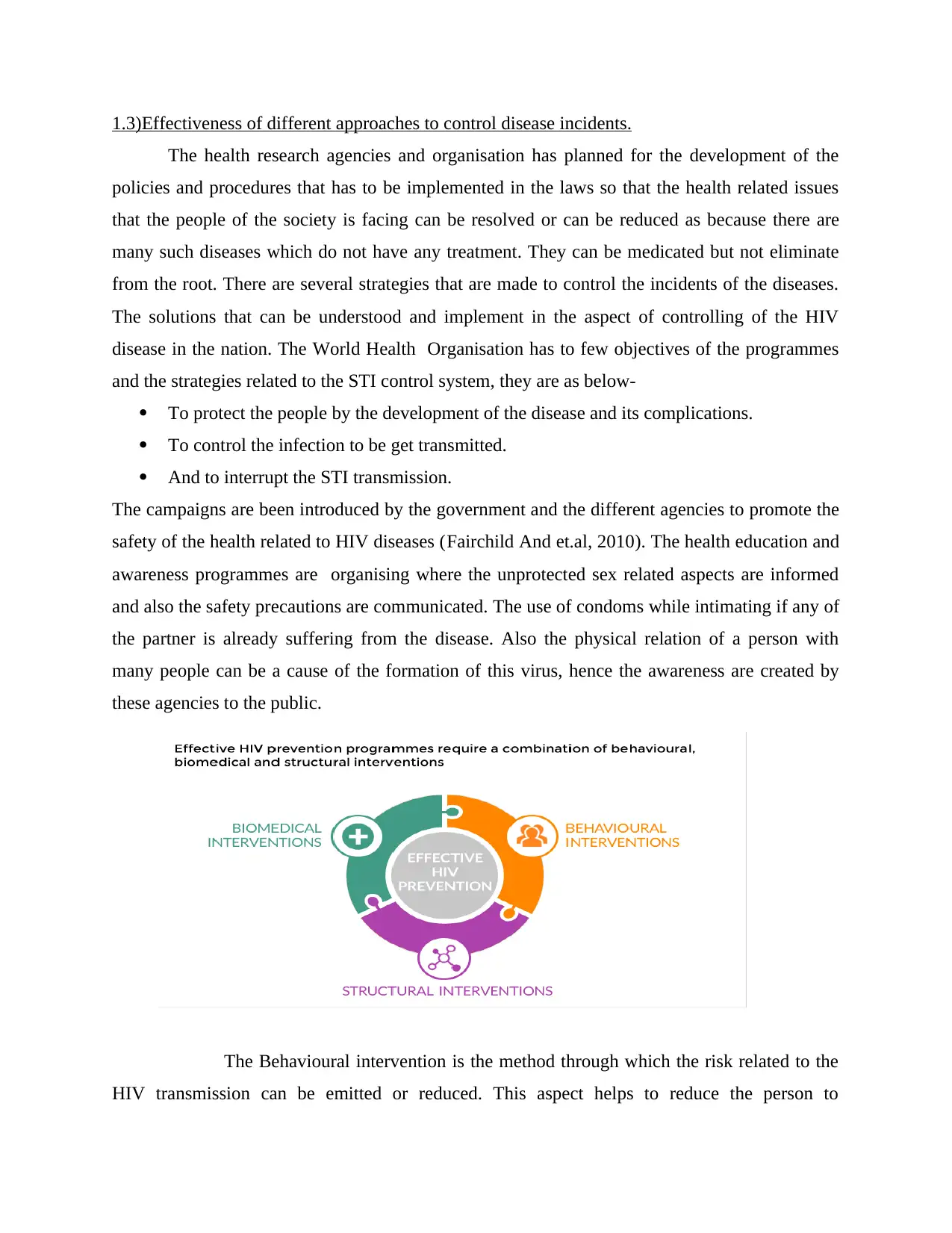
The Behavioural intervention is the method through which the risk related to the
HIV transmission can be emitted or reduced. This aspect helps to reduce the person to
The health research agencies and organisation has planned for the development of the
policies and procedures that has to be implemented in the laws so that the health related issues
that the people of the society is facing can be resolved or can be reduced as because there are
many such diseases which do not have any treatment. They can be medicated but not eliminate
from the root. There are several strategies that are made to control the incidents of the diseases.
The solutions that can be understood and implement in the aspect of controlling of the HIV
disease in the nation. The World Health Organisation has to few objectives of the programmes
and the strategies related to the STI control system, they are as below-
To protect the people by the development of the disease and its complications.
To control the infection to be get transmitted.
And to interrupt the STI transmission.
The campaigns are been introduced by the government and the different agencies to promote the
safety of the health related to HIV diseases (Fairchild And et.al, 2010). The health education and
awareness programmes are organising where the unprotected sex related aspects are informed
and also the safety precautions are communicated. The use of condoms while intimating if any of
the partner is already suffering from the disease. Also the physical relation of a person with
many people can be a cause of the formation of this virus, hence the awareness are created by
these agencies to the public.
The Behavioural intervention is the method through which the risk related to the
HIV transmission can be emitted or reduced. This aspect helps to reduce the person to
understand the need of avoiding number of sexual partners that an individual person have
(Frieden, 2010). The use of the clean and new needles for those who uses drug injections and
also the increase of the use of condoms by people.
Biomedical intervention is the strategy through which the transmission of the HIV can be
reduced up to 60% when the unprotected heterosexual sex is been performed. The examples
related to this approach is the condoms of male and females both, Tests and counselling, needle
and the syringe programmes and screening of the blood.
Structural intervention is the method by which the HIV disease can be prevented, but it is
very difficult to implement as because it deals with the core socio-economical issues of the
nation. The cases here occurs between the lesbians and gays, hence the implementation of the
programmes become quite difficult with them.
There are three stages which are used to prevent the disease, below are the step-
1. Primary- At this prevention stage Health safety and promotional acts are understood so
that, one can be able to know current state of him/her. This is a stage where several
preventive actions are performed so that possibility of occurrence of diseases can be
reduced. This is a stage of prepathogenesism where chances of a person to get affected
with several diseases takes place. This level shows a life style of a person which is
effective enough to live a healthy living.
2. Secondary- It is a phase where recognition of diseases takes place and safety measures
get starts here. Early diagnosis and treatments are performed
3. Tertiary- It is a last stage where a proper treatment has to be performed so as to protect
one from its severe consequences. It is a late pathogenesis stage.
For prevention of HIV disease following aspect can be adapted at three stages-
Primary stage- This is the first and the basic stage where the person or the one who are in
risk of the disease has to be immunized. There are different vaccines which are available
in the market which is help a person's body to get resistance against the HIV disease.
Zoster, Varicella and many more vaccines are available which is very essentially injected
so as to avoid the infection of disease.
Secondary stage- This is the stage where several precautionary actions and tools can be
used by person to get prevented by the disease as people can use condoms that both male
and female can use at the time of intercourse.
(Frieden, 2010). The use of the clean and new needles for those who uses drug injections and
also the increase of the use of condoms by people.
Biomedical intervention is the strategy through which the transmission of the HIV can be
reduced up to 60% when the unprotected heterosexual sex is been performed. The examples
related to this approach is the condoms of male and females both, Tests and counselling, needle
and the syringe programmes and screening of the blood.
Structural intervention is the method by which the HIV disease can be prevented, but it is
very difficult to implement as because it deals with the core socio-economical issues of the
nation. The cases here occurs between the lesbians and gays, hence the implementation of the
programmes become quite difficult with them.
There are three stages which are used to prevent the disease, below are the step-
1. Primary- At this prevention stage Health safety and promotional acts are understood so
that, one can be able to know current state of him/her. This is a stage where several
preventive actions are performed so that possibility of occurrence of diseases can be
reduced. This is a stage of prepathogenesism where chances of a person to get affected
with several diseases takes place. This level shows a life style of a person which is
effective enough to live a healthy living.
2. Secondary- It is a phase where recognition of diseases takes place and safety measures
get starts here. Early diagnosis and treatments are performed
3. Tertiary- It is a last stage where a proper treatment has to be performed so as to protect
one from its severe consequences. It is a late pathogenesis stage.
For prevention of HIV disease following aspect can be adapted at three stages-
Primary stage- This is the first and the basic stage where the person or the one who are in
risk of the disease has to be immunized. There are different vaccines which are available
in the market which is help a person's body to get resistance against the HIV disease.
Zoster, Varicella and many more vaccines are available which is very essentially injected
so as to avoid the infection of disease.
Secondary stage- This is the stage where several precautionary actions and tools can be
used by person to get prevented by the disease as people can use condoms that both male
and female can use at the time of intercourse.
⊘ This is a preview!⊘
Do you want full access?
Subscribe today to unlock all pages.
Trusted by 1+ million students worldwide
Tertiary stage- At this stage the patients are treated with different therapies which is very
essential as because it will help in preventing form the HIV diseases. Antiretroviral
therapy can be used as a treatment to prevent from sexual transmission diseases like
HIV/AIDS.
Surveillance is a system which is a way or method that helps in gathering and evaluating
data and information for interpretation that are related to health problems suffered by people of
the society. It is very helpful in making several strategies and plans that are needed by different
agencies of nation to implement effective and appropriate system for the betterment of health of
the public. It is very necessary to carry out as because this will help and assist in maintaining a
good health and make to live a happy life.
Screening are those tests and method of identification of the disease before a symptom
get arise. With the help of this methodology one can be able to to know about a disease at an
early stage. This is very helpful as because through this a person could be able to realize about
several consequences that could take place in future hence an early stage treatment can be
performed. This is very beneficial to perform as because, this will support in keeping a healthy
and safe life with resistance to several dangerous diseases.
Immunization is the method through which one will get immunity against numerous
infections and diseases. This is system which helps in providing a precautionary safety to an
individual. This is mostly carried out with vaccination. There are number of vaccines available
that can be used by people for their health as this will help in preventing them from diseases. It
act as a resistance part for the body. At different level of life span from childhood till old age this
is used as it will help in protecting by facing numerous infectious diseases.
TASK2
2.1) Current approaches and priorities of the services to communities.
The diseases are impacting the nation's whole scenario, not only the country but the
world is facing the problem of health related issues. There are some approaches and priorities
that are considered as to provide the services to the communities. They are as follows-
1. Disease prevention- It is the method through which the attention are drawn upon the
services that are to be availed to the public of the nation (Glanz and Bishop, 2010). With
the help of cooperation with different entities and groups the medication approach to
essential as because it will help in preventing form the HIV diseases. Antiretroviral
therapy can be used as a treatment to prevent from sexual transmission diseases like
HIV/AIDS.
Surveillance is a system which is a way or method that helps in gathering and evaluating
data and information for interpretation that are related to health problems suffered by people of
the society. It is very helpful in making several strategies and plans that are needed by different
agencies of nation to implement effective and appropriate system for the betterment of health of
the public. It is very necessary to carry out as because this will help and assist in maintaining a
good health and make to live a happy life.
Screening are those tests and method of identification of the disease before a symptom
get arise. With the help of this methodology one can be able to to know about a disease at an
early stage. This is very helpful as because through this a person could be able to realize about
several consequences that could take place in future hence an early stage treatment can be
performed. This is very beneficial to perform as because, this will support in keeping a healthy
and safe life with resistance to several dangerous diseases.
Immunization is the method through which one will get immunity against numerous
infections and diseases. This is system which helps in providing a precautionary safety to an
individual. This is mostly carried out with vaccination. There are number of vaccines available
that can be used by people for their health as this will help in preventing them from diseases. It
act as a resistance part for the body. At different level of life span from childhood till old age this
is used as it will help in protecting by facing numerous infectious diseases.
TASK2
2.1) Current approaches and priorities of the services to communities.
The diseases are impacting the nation's whole scenario, not only the country but the
world is facing the problem of health related issues. There are some approaches and priorities
that are considered as to provide the services to the communities. They are as follows-
1. Disease prevention- It is the method through which the attention are drawn upon the
services that are to be availed to the public of the nation (Glanz and Bishop, 2010). With
the help of cooperation with different entities and groups the medication approach to
Paraphrase This Document
Need a fresh take? Get an instant paraphrase of this document with our AI Paraphraser
prevent the diseases are carried out. Basically the aspect focuses upon the safety and
protection of the people of the nation and its communities. This concentrate on the
strategies that are made to reduce the risk of the chronic disease and the morbidities. The
division of the medication and the science are included in this and to learn the racial
practices that can spread the diseases among the people.
2. Treatment- It is the way through which the several diseases and the cause and the
outcomes of them are deal out. The aspects of the medicines and the use of the various
equipments so that the disease can be identified and can be treated effectively this way
the diseases can be eliminated or can be reduced from the person and their life can be
saved and the number of death can also be decreased.
3. Palliative care- It is the approach through which the patients are treated and the aid are
provided to them apart from the care of the hospitals. The grief that the patient has are
released with this and proper attention and care are given to them. The main
concentration is in the part of the patients safety as because this is availed to those people
who are not having the chance to live any more, at any moment they can take their last
breath (Goh And et.al, 2011). Therefore special attention beside the medicines of the
hospitals are also to be availed to them.
4. Palliative medicines- These are the medicines that are provided to those who are in
palliative care, their life is going only on the basis of these medicines. This is only
suitable for the patients who is suffering from every aspects he does not have any chance
to live further, the case is very worst of the patient.
5. Remedial care- This is a non residential care centre for those young and grown up people
who are not capable enough to carry out their own work, the disabled or the incapable
people are held here are care is done for them. They are well treated and all the facilities
that they requires are fulfilled by remedial care centres.
2.2)Relationship between prevalence of diseases and requirement of the services.
The prevalence is the quantity of the situations of different incidents related to the event
of the health issues that has been occurred in specific time period. It is the division of the
circumstances of the issues related to the health problems according to the time gap of the
population of the happened indicators. As to provide the social care and services to the public the
prevalence are required as it is very important (Goldstein, Kriesky and Pavliakova, 2012). It
protection of the people of the nation and its communities. This concentrate on the
strategies that are made to reduce the risk of the chronic disease and the morbidities. The
division of the medication and the science are included in this and to learn the racial
practices that can spread the diseases among the people.
2. Treatment- It is the way through which the several diseases and the cause and the
outcomes of them are deal out. The aspects of the medicines and the use of the various
equipments so that the disease can be identified and can be treated effectively this way
the diseases can be eliminated or can be reduced from the person and their life can be
saved and the number of death can also be decreased.
3. Palliative care- It is the approach through which the patients are treated and the aid are
provided to them apart from the care of the hospitals. The grief that the patient has are
released with this and proper attention and care are given to them. The main
concentration is in the part of the patients safety as because this is availed to those people
who are not having the chance to live any more, at any moment they can take their last
breath (Goh And et.al, 2011). Therefore special attention beside the medicines of the
hospitals are also to be availed to them.
4. Palliative medicines- These are the medicines that are provided to those who are in
palliative care, their life is going only on the basis of these medicines. This is only
suitable for the patients who is suffering from every aspects he does not have any chance
to live further, the case is very worst of the patient.
5. Remedial care- This is a non residential care centre for those young and grown up people
who are not capable enough to carry out their own work, the disabled or the incapable
people are held here are care is done for them. They are well treated and all the facilities
that they requires are fulfilled by remedial care centres.
2.2)Relationship between prevalence of diseases and requirement of the services.
The prevalence is the quantity of the situations of different incidents related to the event
of the health issues that has been occurred in specific time period. It is the division of the
circumstances of the issues related to the health problems according to the time gap of the
population of the happened indicators. As to provide the social care and services to the public the
prevalence are required as it is very important (Goldstein, Kriesky and Pavliakova, 2012). It
helps in making appropriate plans to avail the best health services to the clients and the patients
suffering from various diseases.
Considering the prevalence of the HIV disease the basic need is to plan the strategies and
to implement these activities in the protection and prevention of the health threatened diseases.
The understanding and knowing the exact issue related to the disease will help in targetting the
issues, and will also help in implementing the strategies in effective manner that has been
planned by the varies agencies and government for the prevention of the diseases.
The public of the society are not even aware of the several diseases and its outcome
hence it become very essential to create the awareness about the diseases and their impact in the
life of the people. The education and all the information has to be conveyed and to make them
understand the need of the precautions and safety measures to tackle the different circumstances.
The planning has to be made to identify the services that has to be availed to the patients. The
incidents that occurs is not in proper therefore the the prevalence is required as to measure the
requirement of the services that must be provided to the patients who are suffering various health
related problems which are both infectious and non infectious. With the help of the gathered
information it can be understood that what all areas has to be practised and where the expert
attentions can be executed (Hills, Dengel and Lubans, 2015). Hence the relation between the
prevalence and the services are very directly connected and they are to be implemented in the
best effective manner so that the patients can be treated and their life can be protected and
prevented from the several diseases.
A proper planning is been done so that each and every aspect that are related to the health
and care section can be managed in an appropriate manner. This will help in availing services
that are needed at different health care centre as they are serving the customers. For that they
need many support planning is one of the factor through which all the operations and functions
can be able to perform in most effective manner.
Training is very essential to train people for their own safety and precaution also to those
who are providing service to patients in health care centres. Well trained people will be able to
serve in more effective and better manner so that they clients can get better and aided to recover
from their health problems.
Availing funds is very necessary, this has to be done by government of nation and they
have to keep an eye upon them so that properly services can be provided to patients in health
suffering from various diseases.
Considering the prevalence of the HIV disease the basic need is to plan the strategies and
to implement these activities in the protection and prevention of the health threatened diseases.
The understanding and knowing the exact issue related to the disease will help in targetting the
issues, and will also help in implementing the strategies in effective manner that has been
planned by the varies agencies and government for the prevention of the diseases.
The public of the society are not even aware of the several diseases and its outcome
hence it become very essential to create the awareness about the diseases and their impact in the
life of the people. The education and all the information has to be conveyed and to make them
understand the need of the precautions and safety measures to tackle the different circumstances.
The planning has to be made to identify the services that has to be availed to the patients. The
incidents that occurs is not in proper therefore the the prevalence is required as to measure the
requirement of the services that must be provided to the patients who are suffering various health
related problems which are both infectious and non infectious. With the help of the gathered
information it can be understood that what all areas has to be practised and where the expert
attentions can be executed (Hills, Dengel and Lubans, 2015). Hence the relation between the
prevalence and the services are very directly connected and they are to be implemented in the
best effective manner so that the patients can be treated and their life can be protected and
prevented from the several diseases.
A proper planning is been done so that each and every aspect that are related to the health
and care section can be managed in an appropriate manner. This will help in availing services
that are needed at different health care centre as they are serving the customers. For that they
need many support planning is one of the factor through which all the operations and functions
can be able to perform in most effective manner.
Training is very essential to train people for their own safety and precaution also to those
who are providing service to patients in health care centres. Well trained people will be able to
serve in more effective and better manner so that they clients can get better and aided to recover
from their health problems.
Availing funds is very necessary, this has to be done by government of nation and they
have to keep an eye upon them so that properly services can be provided to patients in health
⊘ This is a preview!⊘
Do you want full access?
Subscribe today to unlock all pages.
Trusted by 1+ million students worldwide

1 out of 19


Related Documents


Your All-in-One AI-Powered Toolkit for Academic Success.
+13062052269
info@desklib.com
Available 24*7 on WhatsApp / Email
![[object Object]](/_next/static/media/star-bottom.7253800d.svg)
Unlock your academic potential
Copyright © 2020–2026 A2Z Services. All Rights Reserved. Developed and managed by ZUCOL.