BMLW4004 Public Law Assignment: Defamation and Environment
VerifiedAdded on 2022/12/27
|10
|2380
|50
Report
AI Summary
This report provides a comprehensive overview of key aspects of public law, focusing on defamation and environmental law. The first section examines the extent to which the law of defamation protects an individual's reputation while allowing freedom of expression by the press, referencing the Defamation Act 2013 and the Contempt of Court Act 1981, including the Reynolds v Times Newspapers Ltd case. The second section analyzes the potential for Norton Solutions plc and NRT to make claims for judicial review concerning decisions affecting them, referencing the Environmental Protection Act 1990 and the duty of care in waste management. The report explores legal principles, relevant case law, and statutory provisions to provide a detailed analysis of the topics covered.
Public law

Paraphrase This Document
Need a fresh take? Get an instant paraphrase of this document with our AI Paraphraser
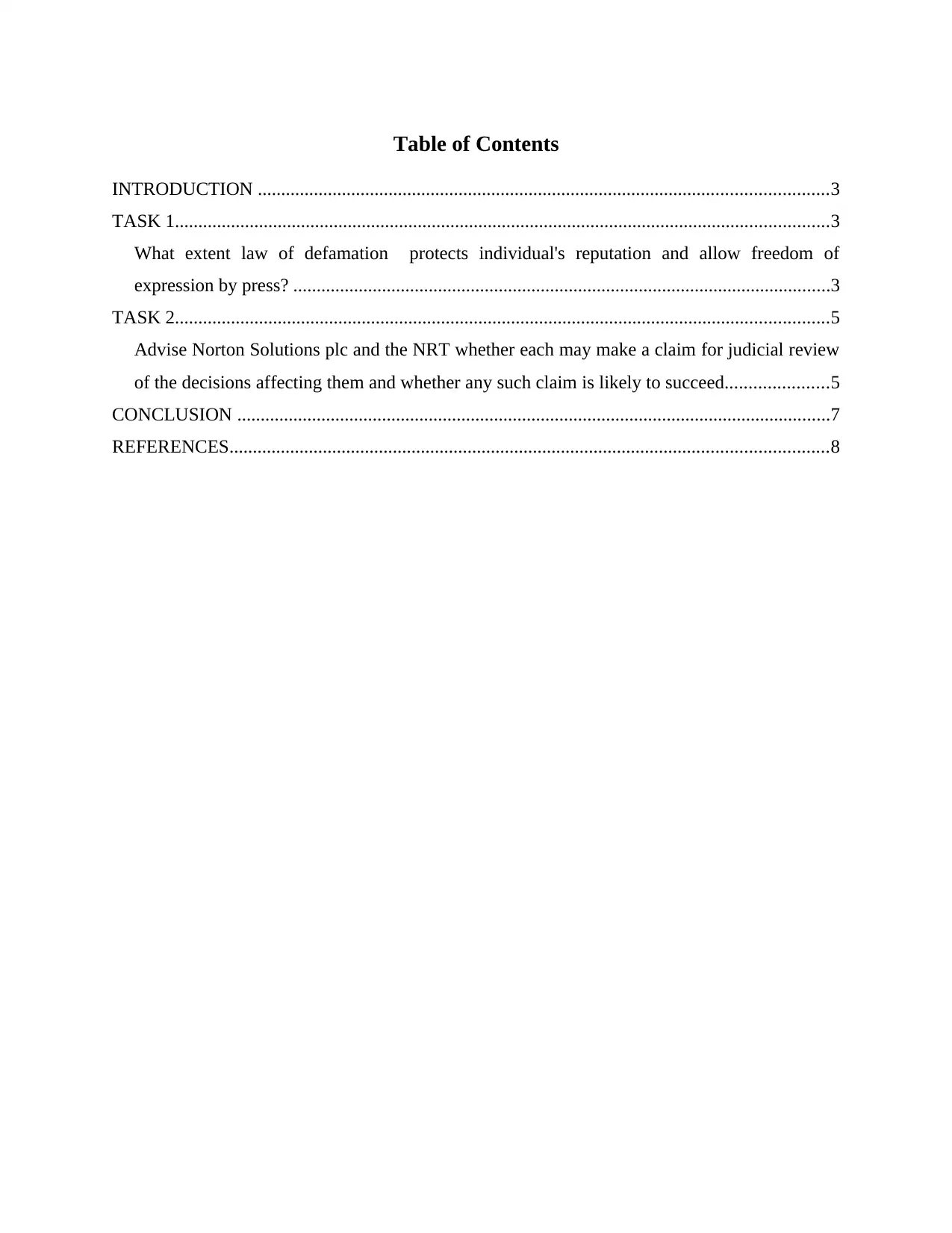
Table of Contents
INTRODUCTION ..........................................................................................................................3
TASK 1............................................................................................................................................3
What extent law of defamation protects individual's reputation and allow freedom of
expression by press? ...................................................................................................................3
TASK 2............................................................................................................................................5
Advise Norton Solutions plc and the NRT whether each may make a claim for judicial review
of the decisions affecting them and whether any such claim is likely to succeed......................5
CONCLUSION ...............................................................................................................................7
REFERENCES................................................................................................................................8
INTRODUCTION ..........................................................................................................................3
TASK 1............................................................................................................................................3
What extent law of defamation protects individual's reputation and allow freedom of
expression by press? ...................................................................................................................3
TASK 2............................................................................................................................................5
Advise Norton Solutions plc and the NRT whether each may make a claim for judicial review
of the decisions affecting them and whether any such claim is likely to succeed......................5
CONCLUSION ...............................................................................................................................7
REFERENCES................................................................................................................................8
INTRODUCTION
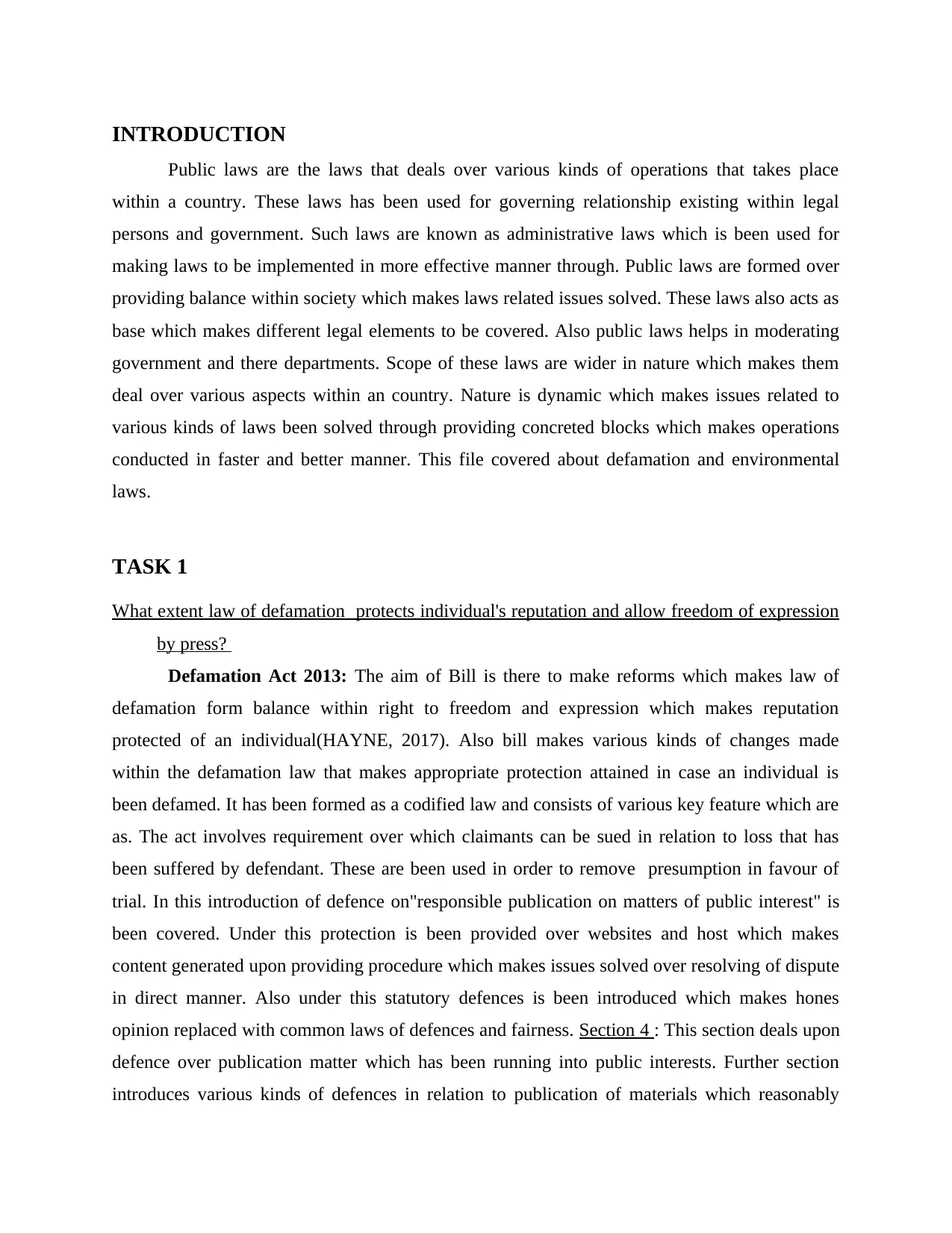
Public laws are the laws that deals over various kinds of operations that takes place
within a country. These laws has been used for governing relationship existing within legal
persons and government. Such laws are known as administrative laws which is been used for
making laws to be implemented in more effective manner through. Public laws are formed over
providing balance within society which makes laws related issues solved. These laws also acts as
base which makes different legal elements to be covered. Also public laws helps in moderating
government and there departments. Scope of these laws are wider in nature which makes them
deal over various aspects within an country. Nature is dynamic which makes issues related to
various kinds of laws been solved through providing concreted blocks which makes operations
conducted in faster and better manner. This file covered about defamation and environmental
laws.
TASK 1
What extent law of defamation protects individual's reputation and allow freedom of expression
by press?
Defamation Act 2013: The aim of Bill is there to make reforms which makes law of
defamation form balance within right to freedom and expression which makes reputation
protected of an individual(HAYNE, 2017). Also bill makes various kinds of changes made
within the defamation law that makes appropriate protection attained in case an individual is
been defamed. It has been formed as a codified law and consists of various key feature which are
as. The act involves requirement over which claimants can be sued in relation to loss that has
been suffered by defendant. These are been used in order to remove presumption in favour of
trial. In this introduction of defence on"responsible publication on matters of public interest" is
been covered. Under this protection is been provided over websites and host which makes
content generated upon providing procedure which makes issues solved over resolving of dispute
in direct manner. Also under this statutory defences is been introduced which makes hones
opinion replaced with common laws of defences and fairness. Section 4 : This section deals upon
defence over publication matter which has been running into public interests. Further section
introduces various kinds of defences in relation to publication of materials which reasonably
Public laws are the laws that deals over various kinds of operations that takes place
within a country. These laws has been used for governing relationship existing within legal
persons and government. Such laws are known as administrative laws which is been used for
making laws to be implemented in more effective manner through. Public laws are formed over
providing balance within society which makes laws related issues solved. These laws also acts as
base which makes different legal elements to be covered. Also public laws helps in moderating
government and there departments. Scope of these laws are wider in nature which makes them
deal over various aspects within an country. Nature is dynamic which makes issues related to
various kinds of laws been solved through providing concreted blocks which makes operations
conducted in faster and better manner. This file covered about defamation and environmental
laws.
TASK 1
What extent law of defamation protects individual's reputation and allow freedom of expression
by press?
Defamation Act 2013: The aim of Bill is there to make reforms which makes law of
defamation form balance within right to freedom and expression which makes reputation
protected of an individual(HAYNE, 2017). Also bill makes various kinds of changes made
within the defamation law that makes appropriate protection attained in case an individual is
been defamed. It has been formed as a codified law and consists of various key feature which are
as. The act involves requirement over which claimants can be sued in relation to loss that has
been suffered by defendant. These are been used in order to remove presumption in favour of
trial. In this introduction of defence on"responsible publication on matters of public interest" is
been covered. Under this protection is been provided over websites and host which makes
content generated upon providing procedure which makes issues solved over resolving of dispute
in direct manner. Also under this statutory defences is been introduced which makes hones
opinion replaced with common laws of defences and fairness. Section 4 : This section deals upon
defence over publication matter which has been running into public interests. Further section
introduces various kinds of defences in relation to publication of materials which reasonably
⊘ This is a preview!⊘
Do you want full access?
Subscribe today to unlock all pages.

Trusted by 1+ million students worldwide
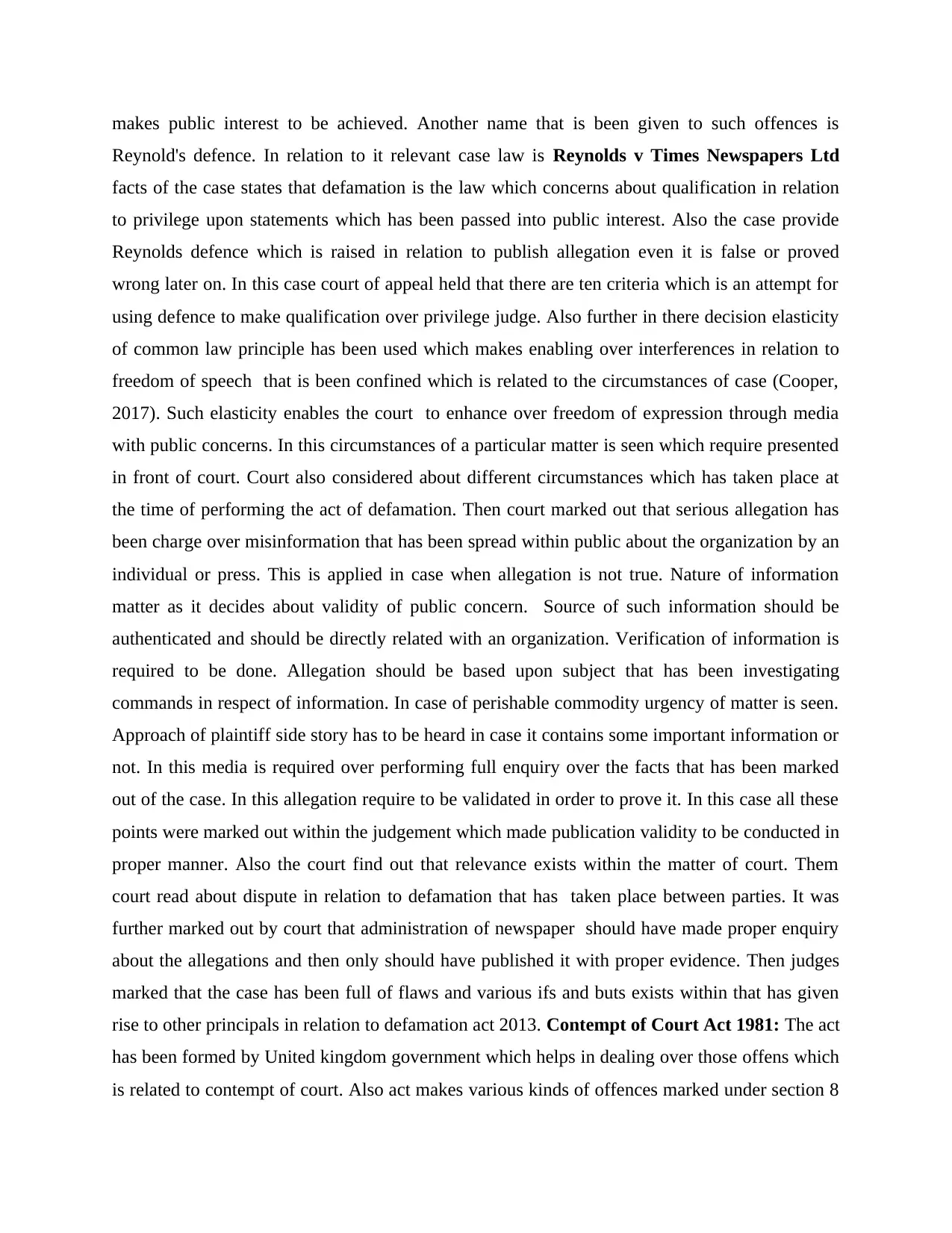
makes public interest to be achieved. Another name that is been given to such offences is
Reynold's defence. In relation to it relevant case law is Reynolds v Times Newspapers Ltd
facts of the case states that defamation is the law which concerns about qualification in relation
to privilege upon statements which has been passed into public interest. Also the case provide
Reynolds defence which is raised in relation to publish allegation even it is false or proved
wrong later on. In this case court of appeal held that there are ten criteria which is an attempt for
using defence to make qualification over privilege judge. Also further in there decision elasticity
of common law principle has been used which makes enabling over interferences in relation to
freedom of speech that is been confined which is related to the circumstances of case (Cooper,
2017). Such elasticity enables the court to enhance over freedom of expression through media
with public concerns. In this circumstances of a particular matter is seen which require presented
in front of court. Court also considered about different circumstances which has taken place at
the time of performing the act of defamation. Then court marked out that serious allegation has
been charge over misinformation that has been spread within public about the organization by an
individual or press. This is applied in case when allegation is not true. Nature of information
matter as it decides about validity of public concern. Source of such information should be
authenticated and should be directly related with an organization. Verification of information is
required to be done. Allegation should be based upon subject that has been investigating
commands in respect of information. In case of perishable commodity urgency of matter is seen.
Approach of plaintiff side story has to be heard in case it contains some important information or
not. In this media is required over performing full enquiry over the facts that has been marked
out of the case. In this allegation require to be validated in order to prove it. In this case all these
points were marked out within the judgement which made publication validity to be conducted in
proper manner. Also the court find out that relevance exists within the matter of court. Them
court read about dispute in relation to defamation that has taken place between parties. It was
further marked out by court that administration of newspaper should have made proper enquiry
about the allegations and then only should have published it with proper evidence. Then judges
marked that the case has been full of flaws and various ifs and buts exists within that has given
rise to other principals in relation to defamation act 2013. Contempt of Court Act 1981: The act
has been formed by United kingdom government which helps in dealing over those offens which
is related to contempt of court. Also act makes various kinds of offences marked under section 8
Reynold's defence. In relation to it relevant case law is Reynolds v Times Newspapers Ltd
facts of the case states that defamation is the law which concerns about qualification in relation
to privilege upon statements which has been passed into public interest. Also the case provide
Reynolds defence which is raised in relation to publish allegation even it is false or proved
wrong later on. In this case court of appeal held that there are ten criteria which is an attempt for
using defence to make qualification over privilege judge. Also further in there decision elasticity
of common law principle has been used which makes enabling over interferences in relation to
freedom of speech that is been confined which is related to the circumstances of case (Cooper,
2017). Such elasticity enables the court to enhance over freedom of expression through media
with public concerns. In this circumstances of a particular matter is seen which require presented
in front of court. Court also considered about different circumstances which has taken place at
the time of performing the act of defamation. Then court marked out that serious allegation has
been charge over misinformation that has been spread within public about the organization by an
individual or press. This is applied in case when allegation is not true. Nature of information
matter as it decides about validity of public concern. Source of such information should be
authenticated and should be directly related with an organization. Verification of information is
required to be done. Allegation should be based upon subject that has been investigating
commands in respect of information. In case of perishable commodity urgency of matter is seen.
Approach of plaintiff side story has to be heard in case it contains some important information or
not. In this media is required over performing full enquiry over the facts that has been marked
out of the case. In this allegation require to be validated in order to prove it. In this case all these
points were marked out within the judgement which made publication validity to be conducted in
proper manner. Also the court find out that relevance exists within the matter of court. Them
court read about dispute in relation to defamation that has taken place between parties. It was
further marked out by court that administration of newspaper should have made proper enquiry
about the allegations and then only should have published it with proper evidence. Then judges
marked that the case has been full of flaws and various ifs and buts exists within that has given
rise to other principals in relation to defamation act 2013. Contempt of Court Act 1981: The act
has been formed by United kingdom government which helps in dealing over those offens which
is related to contempt of court. Also act makes various kinds of offences marked under section 8
Paraphrase This Document
Need a fresh take? Get an instant paraphrase of this document with our AI Paraphraser
of the act. Further the act deals with disturbing of order and balance within court room. In this
common law is been used which makes court authority over forming rules and regulation in
relation to any kind of contempt that has taken place within environment of court (Blumm and
Jamin, 2018). These are divided into tow parts that is civil contempt and criminal contempt. In
civil contempt that involves case related to injuries, damages that has been caused by an
individual within the court. In criminal contempt judgement has not been followed which has
been passed by judges, breach of undertakings within courts and also documentation of case is
also seen which is covered within contempt of court. Section 10 of the act says that no person is
required to disclose about the guilt of contempt that has been done by them. Also in this
disclosing of information regarding such conduct is not required but main points should be
highlighted for making interest of justice saved.
TASK 2
Advise Norton Solutions plc and the NRT whether each may make a claim for judicial review of
the decisions affecting them and whether any such claim is likely to succeed.
Environmental protection Act 1990 the act has been formed within the parliament of
UK in the years 2008. It covers England Wales and Scotland. This has been mainly formed on
the basis of controlling of waste that has been formed over lot of factors and also focuses upon
protecting of environment. The act is also known as Umbrella act as it is related over the
framework which makes central government coordinate with the state government by making
central authority which helpless in protecting environment by managing of waste. In the act both
centre and state government makes an authority which makes pollution and various other factors
impact growth of environment is been protected. This has attained authorization for protecting
within improving environment condition's. Act is mainly focused over quality and pollution
control through putting restriction by creating awareness in relation to environment. In this act
section 34 relates over duty of care in relation to disposing and controlling of waste management
through proper methods applied for it. In this various regulation deals upon different aspects
related those factors that may create adverse impact over environment. This act promotes more
processes which makes environment safety uplifted. There are certain basic principles that has
been marked and they are, To make sure that clean air, land and water is been given to people
living in that country. Reduction of environmental risk that is related over various projects which
common law is been used which makes court authority over forming rules and regulation in
relation to any kind of contempt that has taken place within environment of court (Blumm and
Jamin, 2018). These are divided into tow parts that is civil contempt and criminal contempt. In
civil contempt that involves case related to injuries, damages that has been caused by an
individual within the court. In criminal contempt judgement has not been followed which has
been passed by judges, breach of undertakings within courts and also documentation of case is
also seen which is covered within contempt of court. Section 10 of the act says that no person is
required to disclose about the guilt of contempt that has been done by them. Also in this
disclosing of information regarding such conduct is not required but main points should be
highlighted for making interest of justice saved.
TASK 2
Advise Norton Solutions plc and the NRT whether each may make a claim for judicial review of
the decisions affecting them and whether any such claim is likely to succeed.
Environmental protection Act 1990 the act has been formed within the parliament of
UK in the years 2008. It covers England Wales and Scotland. This has been mainly formed on
the basis of controlling of waste that has been formed over lot of factors and also focuses upon
protecting of environment. The act is also known as Umbrella act as it is related over the
framework which makes central government coordinate with the state government by making
central authority which helpless in protecting environment by managing of waste. In the act both
centre and state government makes an authority which makes pollution and various other factors
impact growth of environment is been protected. This has attained authorization for protecting
within improving environment condition's. Act is mainly focused over quality and pollution
control through putting restriction by creating awareness in relation to environment. In this act
section 34 relates over duty of care in relation to disposing and controlling of waste management
through proper methods applied for it. In this various regulation deals upon different aspects
related those factors that may create adverse impact over environment. This act promotes more
processes which makes environment safety uplifted. There are certain basic principles that has
been marked and they are, To make sure that clean air, land and water is been given to people
living in that country. Reduction of environmental risk that is related over various projects which

is been performed by an organization (Alvarez, 2016). Safety measure to be taken in relation to
developing strategies which promote environmental effectiveness within individual living in UK.
This is done through making laws in relation to this. Management of various activities through
making rules for both government and corporate factories which control there chemical waste
and carbon emission. Environmental protectionist integral part of United Kingdom policies
which is in relation to natural resources, human health, economic growth, energy, transportation,
agriculture, industry, and international trade. This makes environmental stability to be attained
within country like UK. In this act all parts of society communities, individuals, businesses, and
state, local and tribal governments have access to accurate information sufficient to effectively
participate in managing human health and environmental risks. Duty of care in respect of waste
Section 34(1): This imposes duty over a person who is responsible for imports, produces,
carries, keeps, treats or disposes of controlled waste. Also various kinds of measure is been taken
as per the circumstances that occur which are, For preventing and controlling of dispute which
has happened between person. Preventing and controlling of certain measures within which
provisions over controlling pollution has been formed. For managing of waste and disposing it
properly. This makes transferring of waste possible in more effective manner. Licence is been
issued to person authorized for transportation purpose . That there is transferred such a written
description of the waste as will enable other persons to avoid a contravention section 33 or the
Pollution Prevention and Control Regulations. In section 34(2) deals with domestic party which
is made in respect of household waste that has been produced upon property. This makes
reasonable steps taken through making secure transfer of waste to an authority authorised over
disposing it. It has been covered under duties related over environmental protection (Alvarez,
2016). Authorised persons means that authority which holds responsibility over collecting waste
and has been licences to do so. This makes transportation to be done in more secured manner
which makes framework formed. Section 34(5) allows Secretary of State to make regulations as
to retention of documents and the Environmental Protection (Duty of Care) Regulations 1991 its
says that developing mechanism for making transfer of waste possible in more efficient manner.
Copies which is related to license and documentation should be kept for one year. These should
be available to proper authority having authorized permission to do it. In the case it can be
observed that license in relation to recycling plant has been published in newspaper but there is
no authentication upon the license. So, there can be a claim for judicial review under section 34
developing strategies which promote environmental effectiveness within individual living in UK.
This is done through making laws in relation to this. Management of various activities through
making rules for both government and corporate factories which control there chemical waste
and carbon emission. Environmental protectionist integral part of United Kingdom policies
which is in relation to natural resources, human health, economic growth, energy, transportation,
agriculture, industry, and international trade. This makes environmental stability to be attained
within country like UK. In this act all parts of society communities, individuals, businesses, and
state, local and tribal governments have access to accurate information sufficient to effectively
participate in managing human health and environmental risks. Duty of care in respect of waste
Section 34(1): This imposes duty over a person who is responsible for imports, produces,
carries, keeps, treats or disposes of controlled waste. Also various kinds of measure is been taken
as per the circumstances that occur which are, For preventing and controlling of dispute which
has happened between person. Preventing and controlling of certain measures within which
provisions over controlling pollution has been formed. For managing of waste and disposing it
properly. This makes transferring of waste possible in more effective manner. Licence is been
issued to person authorized for transportation purpose . That there is transferred such a written
description of the waste as will enable other persons to avoid a contravention section 33 or the
Pollution Prevention and Control Regulations. In section 34(2) deals with domestic party which
is made in respect of household waste that has been produced upon property. This makes
reasonable steps taken through making secure transfer of waste to an authority authorised over
disposing it. It has been covered under duties related over environmental protection (Alvarez,
2016). Authorised persons means that authority which holds responsibility over collecting waste
and has been licences to do so. This makes transportation to be done in more secured manner
which makes framework formed. Section 34(5) allows Secretary of State to make regulations as
to retention of documents and the Environmental Protection (Duty of Care) Regulations 1991 its
says that developing mechanism for making transfer of waste possible in more efficient manner.
Copies which is related to license and documentation should be kept for one year. These should
be available to proper authority having authorized permission to do it. In the case it can be
observed that license in relation to recycling plant has been published in newspaper but there is
no authentication upon the license. So, there can be a claim for judicial review under section 34
⊘ This is a preview!⊘
Do you want full access?
Subscribe today to unlock all pages.
Trusted by 1+ million students worldwide
of the act. As this sections makes authority issuing licence follow certain rules and principles
before issuing the license.
CONCLUSION
From the above discussion it is clear that public laws are the laws that has been formed to
deal with administrative activities of a country. These laws has been formed for controlling laws
from harming public or exploiting them. Further in this file law of defamation is covered which
deals over reputation of an individual. In then end Environmental act is covered which deals with
controlling of pollution and managing of waste with efficiency.
before issuing the license.
CONCLUSION
From the above discussion it is clear that public laws are the laws that has been formed to
deal with administrative activities of a country. These laws has been formed for controlling laws
from harming public or exploiting them. Further in this file law of defamation is covered which
deals over reputation of an individual. In then end Environmental act is covered which deals with
controlling of pollution and managing of waste with efficiency.
Paraphrase This Document
Need a fresh take? Get an instant paraphrase of this document with our AI Paraphraser
REFERENCES
Books and Journals
Alvarez, J.E., 2016. ‘Beware: Boundary Crossings’–A Critical Appraisal of Public Law
Approaches to International Investment Law. The Journal of World Investment &
Trade. 17(2). pp.171-228.
Alvarez, J.E., 2016. ‘Beware: Boundary Crossings’–A Critical Appraisal of Public Law
Approaches to International Investment Law. The Journal of World Investment &
Trade, 17(2), pp.171-228.
Blumm, M.C. and Jamin, O., 2018. The Trump Public Lands Revolution: Redefining The Public
in Public Land Law. Envtl. L.. 48. p.311.
Cooper, P.J., 2017. “Without Which Nothing”: Public Law As the Sine Qua Non of Public
Administration. Administration & Society. 49(5). pp.634-657.
HAYNE, K.M., 2017. Government contracts and public law. Melbourne University Law
Review. 41(1). pp.155-181.
Kysar, D.A., 2018. The public life of private law: Tort law as a risk regulation mechanism. Eur.
J. Risk Reg.. 9. p.48.
McDonagh, M. and Paterson, M., 2017. FOI in the balance: the function and role of the public
interest test. Public Law. (1). pp.81-98.
Roach, K., 2016. Polycentricity and queue jumping in public law remedies: A two-track
response. University of Toronto Law Journal. 66(1). pp.3-52.
Teremtsova, N., 2019. The problem of differentiation between private and public law. Transition
Studies Review. 26(2). pp.15-22.
Theil, S., 2019. Germany: Federal Constitutional Court qualifies the distinction between
fundamental rights obligations of the state and private actors. Public Law. (4). pp.790-
792.
Books and Journals
Alvarez, J.E., 2016. ‘Beware: Boundary Crossings’–A Critical Appraisal of Public Law
Approaches to International Investment Law. The Journal of World Investment &
Trade. 17(2). pp.171-228.
Alvarez, J.E., 2016. ‘Beware: Boundary Crossings’–A Critical Appraisal of Public Law
Approaches to International Investment Law. The Journal of World Investment &
Trade, 17(2), pp.171-228.
Blumm, M.C. and Jamin, O., 2018. The Trump Public Lands Revolution: Redefining The Public
in Public Land Law. Envtl. L.. 48. p.311.
Cooper, P.J., 2017. “Without Which Nothing”: Public Law As the Sine Qua Non of Public
Administration. Administration & Society. 49(5). pp.634-657.
HAYNE, K.M., 2017. Government contracts and public law. Melbourne University Law
Review. 41(1). pp.155-181.
Kysar, D.A., 2018. The public life of private law: Tort law as a risk regulation mechanism. Eur.
J. Risk Reg.. 9. p.48.
McDonagh, M. and Paterson, M., 2017. FOI in the balance: the function and role of the public
interest test. Public Law. (1). pp.81-98.
Roach, K., 2016. Polycentricity and queue jumping in public law remedies: A two-track
response. University of Toronto Law Journal. 66(1). pp.3-52.
Teremtsova, N., 2019. The problem of differentiation between private and public law. Transition
Studies Review. 26(2). pp.15-22.
Theil, S., 2019. Germany: Federal Constitutional Court qualifies the distinction between
fundamental rights obligations of the state and private actors. Public Law. (4). pp.790-
792.

⊘ This is a preview!⊘
Do you want full access?
Subscribe today to unlock all pages.
Trusted by 1+ million students worldwide


1 out of 10


Related Documents


Your All-in-One AI-Powered Toolkit for Academic Success.
+13062052269
info@desklib.com
Available 24*7 on WhatsApp / Email
![[object Object]](/_next/static/media/star-bottom.7253800d.svg)
Unlock your academic potential
Copyright © 2020–2026 A2Z Services. All Rights Reserved. Developed and managed by ZUCOL.