Analyzing Public Order Policing: Powers, Strategies & the 1986 Act
VerifiedAdded on 2023/06/09
|15
|5271
|333
Essay
AI Summary
This essay provides a comprehensive overview of public order policing in the UK, focusing on police powers and strategies, particularly in the context of managing protests, rallies, and public gatherings. It discusses the core principles of public order policing, including policing style, communication, the use of the national decision model, command structure, proportionate response, and capacity. The essay also examines the legal framework governing police use of force, referencing key legislations such as the Criminal Law Act 1967, the Police and Criminal Evidence Act 1984, and the European Convention on Human Rights. Further, it explains the command structure of public order policing (Gold, Silver, Bronze) and the disorder model, highlighting the importance of communication and community engagement. The essay also addresses the concept of mobs, the Public Order Act 1986, and police strategies for managing public disorder, including the use of Police Support Units and crowd control tactics. It concludes by emphasizing the significance of maintaining public confidence in police services through effective communication and adherence to legal standards.
Policing and police powers

Paraphrase This Document
Need a fresh take? Get an instant paraphrase of this document with our AI Paraphraser
TABLE OF CONTENTS
QUESTION 4..................................................................................................................................3
a) Discussing concept of public order policing...........................................................................3
b) Explaining concept of Mob link to public order policing & Public Order Act 1886..............6
c) Work of police in partnership with other agencies..................................................................9
REFERENCES..............................................................................................................................14
QUESTION 4..................................................................................................................................3
a) Discussing concept of public order policing...........................................................................3
b) Explaining concept of Mob link to public order policing & Public Order Act 1886..............6
c) Work of police in partnership with other agencies..................................................................9
REFERENCES..............................................................................................................................14
QUESTION 4
a) Discussing concept of public order policing
Article 4 of the Public Order (Northern Ireland) Order 1987 permits police for imposing
directions on persons who are organizing or taking part in any public meeting which is taking
place in open-air as to place where meeting is conducted or time duration in order to avoid
disorder, damage or disruption to public property. The organization of or participation in any of
the public meeting that has been prohibited or any action taking place that are violating the terms
& conditions of the even, will be considered as a criminal offence & event is rendered unlawful.
Crowd management is the focal point of policing in large scale events on national and
regional level. Public order policing is policing of planned and sudden events like any protest,
rally or football matches, etc. Public order authorized professional practice (APP) has been
framed in order to plan and command operations. They develop complete framework by
planning operations and managing resources at national or local level.
There are six core principles which apply to public order policing which are as follows:
Policing style & tone: All the commanders should set style and tone in advance of the
operation and remain aware about any of the impact on public perception (Gargiulo,
2022). Police commanders need to be impartial, approachable & legally compliant,
further, they should clearly identifiable.
Communication: Police should make use of engagements and dialogues when and where
possible by maintaining links with communities, groups & organizers. The message that
is to be delivered must be clear, unambiguous and coordinated. All policing teams in
neighborhood must have an established network of local information which can be used
at time of community tensions.
Using the national decision model (NDM) and joint decision model (JDM): NDM is
used while framing operational decisions and JDM is used while dealing with multi-
agency response to events. They should use audit trails in order to record decisions and
maintain rationale.
Command: All commanders of public order must be trained and competent while
operating and should consider specialist’s advice. The structure of command should be in
appropriate manner which meets the requirements of operation.
a) Discussing concept of public order policing
Article 4 of the Public Order (Northern Ireland) Order 1987 permits police for imposing
directions on persons who are organizing or taking part in any public meeting which is taking
place in open-air as to place where meeting is conducted or time duration in order to avoid
disorder, damage or disruption to public property. The organization of or participation in any of
the public meeting that has been prohibited or any action taking place that are violating the terms
& conditions of the even, will be considered as a criminal offence & event is rendered unlawful.
Crowd management is the focal point of policing in large scale events on national and
regional level. Public order policing is policing of planned and sudden events like any protest,
rally or football matches, etc. Public order authorized professional practice (APP) has been
framed in order to plan and command operations. They develop complete framework by
planning operations and managing resources at national or local level.
There are six core principles which apply to public order policing which are as follows:
Policing style & tone: All the commanders should set style and tone in advance of the
operation and remain aware about any of the impact on public perception (Gargiulo,
2022). Police commanders need to be impartial, approachable & legally compliant,
further, they should clearly identifiable.
Communication: Police should make use of engagements and dialogues when and where
possible by maintaining links with communities, groups & organizers. The message that
is to be delivered must be clear, unambiguous and coordinated. All policing teams in
neighborhood must have an established network of local information which can be used
at time of community tensions.
Using the national decision model (NDM) and joint decision model (JDM): NDM is
used while framing operational decisions and JDM is used while dealing with multi-
agency response to events. They should use audit trails in order to record decisions and
maintain rationale.
Command: All commanders of public order must be trained and competent while
operating and should consider specialist’s advice. The structure of command should be in
appropriate manner which meets the requirements of operation.
⊘ This is a preview!⊘
Do you want full access?
Subscribe today to unlock all pages.

Trusted by 1+ million students worldwide
Proportionate response: Powers rested with public order police must be used in
appropriate and proportionate manner (Boon-Kuo and et.al., 2021). Police officers should
make rational judgements which is based on complete information.
Capacity and capability: Public commanders get full training according to national
standards and are given equipment & vehicle in accordance with national requirement.
There is development of plans to mobile Police support unit (PSU) which are subject to
continuous testing.
Offences which are considered as international harassment, alarm or distress are as follows:
provocative conduct
threatening, abusive or insulting behavior
hindering participants in a public procession
Any individual taking part in peaceful protest will come under purview of the above offences
if he conducts the moves which are provocative or threatening or any other harful behavior.
Police Use Of Force
This law recognizes that police may be required to use force when situation arises, further,
primary responsibility is with individual police officers to whom they are answerable for using
force. The Criminal Law Act 1967, the Police and Criminal Evidence Act 1984, Common Law
and the Criminal Justice and Immigration Act 2008 and the European Convention on Human
Rights (ECHR) govern the police use of force. Any kind of torture of unfair & degrading
treatment or punishing public without any offence are completely prohibited under ECHR
(Comparato and Topping, 2021). Non-violent means should be used, if possible, to sole any
incident or violent protests before making use of force.
Furthermore, any usage of force by police officers requires that force must be ‘reasonable’.
Reasonable in such circumstance mean that force is necessary for the purpose and the amount of
force must be proportionate. Otherwise, it will be considered that force was used excessively and
in unlawful manner.
Command structure of Public Order
appropriate and proportionate manner (Boon-Kuo and et.al., 2021). Police officers should
make rational judgements which is based on complete information.
Capacity and capability: Public commanders get full training according to national
standards and are given equipment & vehicle in accordance with national requirement.
There is development of plans to mobile Police support unit (PSU) which are subject to
continuous testing.
Offences which are considered as international harassment, alarm or distress are as follows:
provocative conduct
threatening, abusive or insulting behavior
hindering participants in a public procession
Any individual taking part in peaceful protest will come under purview of the above offences
if he conducts the moves which are provocative or threatening or any other harful behavior.
Police Use Of Force
This law recognizes that police may be required to use force when situation arises, further,
primary responsibility is with individual police officers to whom they are answerable for using
force. The Criminal Law Act 1967, the Police and Criminal Evidence Act 1984, Common Law
and the Criminal Justice and Immigration Act 2008 and the European Convention on Human
Rights (ECHR) govern the police use of force. Any kind of torture of unfair & degrading
treatment or punishing public without any offence are completely prohibited under ECHR
(Comparato and Topping, 2021). Non-violent means should be used, if possible, to sole any
incident or violent protests before making use of force.
Furthermore, any usage of force by police officers requires that force must be ‘reasonable’.
Reasonable in such circumstance mean that force is necessary for the purpose and the amount of
force must be proportionate. Otherwise, it will be considered that force was used excessively and
in unlawful manner.
Command structure of Public Order
Paraphrase This Document
Need a fresh take? Get an instant paraphrase of this document with our AI Paraphraser
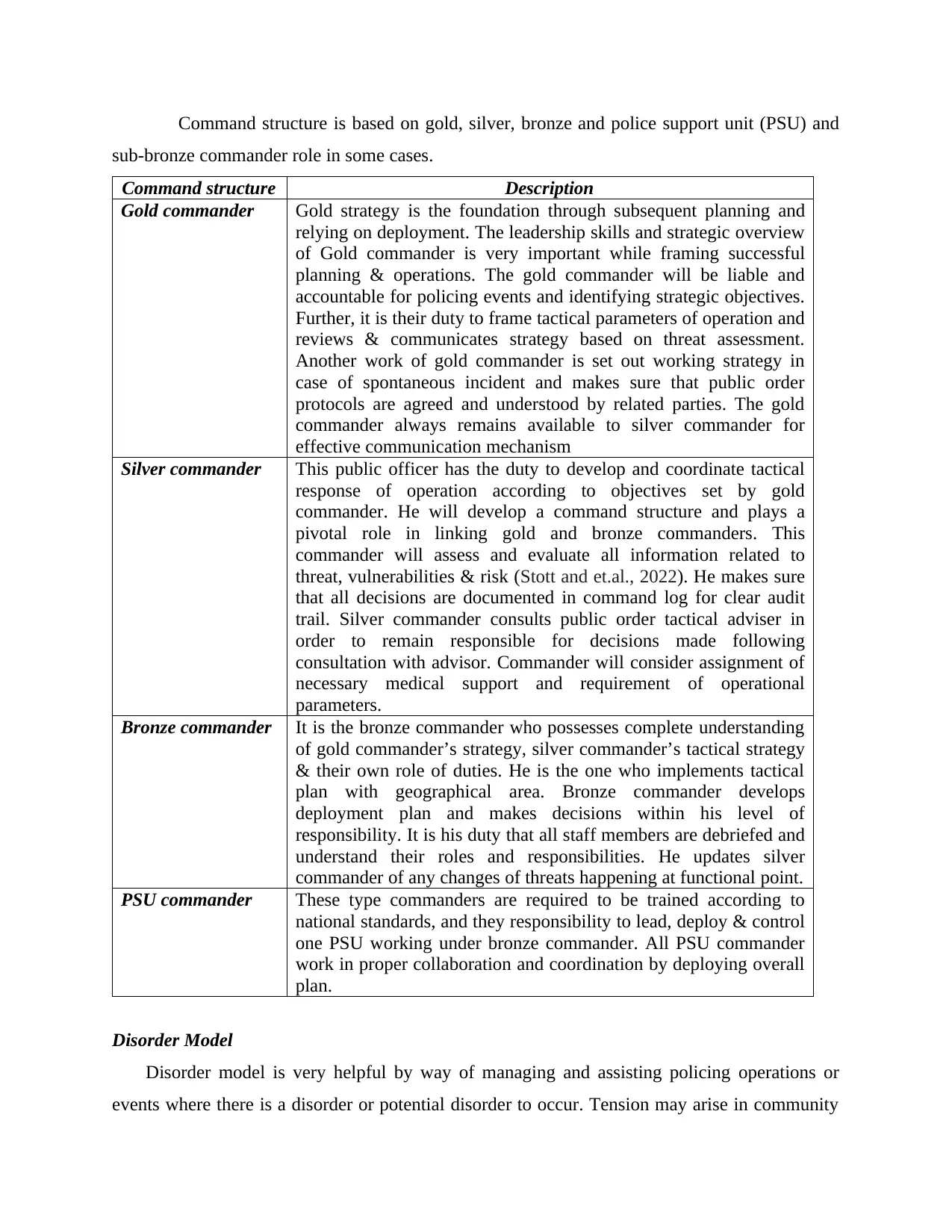
Command structure is based on gold, silver, bronze and police support unit (PSU) and
sub-bronze commander role in some cases.
Command structure Description
Gold commander Gold strategy is the foundation through subsequent planning and
relying on deployment. The leadership skills and strategic overview
of Gold commander is very important while framing successful
planning & operations. The gold commander will be liable and
accountable for policing events and identifying strategic objectives.
Further, it is their duty to frame tactical parameters of operation and
reviews & communicates strategy based on threat assessment.
Another work of gold commander is set out working strategy in
case of spontaneous incident and makes sure that public order
protocols are agreed and understood by related parties. The gold
commander always remains available to silver commander for
effective communication mechanism
Silver commander This public officer has the duty to develop and coordinate tactical
response of operation according to objectives set by gold
commander. He will develop a command structure and plays a
pivotal role in linking gold and bronze commanders. This
commander will assess and evaluate all information related to
threat, vulnerabilities & risk (Stott and et.al., 2022). He makes sure
that all decisions are documented in command log for clear audit
trail. Silver commander consults public order tactical adviser in
order to remain responsible for decisions made following
consultation with advisor. Commander will consider assignment of
necessary medical support and requirement of operational
parameters.
Bronze commander It is the bronze commander who possesses complete understanding
of gold commander’s strategy, silver commander’s tactical strategy
& their own role of duties. He is the one who implements tactical
plan with geographical area. Bronze commander develops
deployment plan and makes decisions within his level of
responsibility. It is his duty that all staff members are debriefed and
understand their roles and responsibilities. He updates silver
commander of any changes of threats happening at functional point.
PSU commander These type commanders are required to be trained according to
national standards, and they responsibility to lead, deploy & control
one PSU working under bronze commander. All PSU commander
work in proper collaboration and coordination by deploying overall
plan.
Disorder Model
Disorder model is very helpful by way of managing and assisting policing operations or
events where there is a disorder or potential disorder to occur. Tension may arise in community
sub-bronze commander role in some cases.
Command structure Description
Gold commander Gold strategy is the foundation through subsequent planning and
relying on deployment. The leadership skills and strategic overview
of Gold commander is very important while framing successful
planning & operations. The gold commander will be liable and
accountable for policing events and identifying strategic objectives.
Further, it is their duty to frame tactical parameters of operation and
reviews & communicates strategy based on threat assessment.
Another work of gold commander is set out working strategy in
case of spontaneous incident and makes sure that public order
protocols are agreed and understood by related parties. The gold
commander always remains available to silver commander for
effective communication mechanism
Silver commander This public officer has the duty to develop and coordinate tactical
response of operation according to objectives set by gold
commander. He will develop a command structure and plays a
pivotal role in linking gold and bronze commanders. This
commander will assess and evaluate all information related to
threat, vulnerabilities & risk (Stott and et.al., 2022). He makes sure
that all decisions are documented in command log for clear audit
trail. Silver commander consults public order tactical adviser in
order to remain responsible for decisions made following
consultation with advisor. Commander will consider assignment of
necessary medical support and requirement of operational
parameters.
Bronze commander It is the bronze commander who possesses complete understanding
of gold commander’s strategy, silver commander’s tactical strategy
& their own role of duties. He is the one who implements tactical
plan with geographical area. Bronze commander develops
deployment plan and makes decisions within his level of
responsibility. It is his duty that all staff members are debriefed and
understand their roles and responsibilities. He updates silver
commander of any changes of threats happening at functional point.
PSU commander These type commanders are required to be trained according to
national standards, and they responsibility to lead, deploy & control
one PSU working under bronze commander. All PSU commander
work in proper collaboration and coordination by deploying overall
plan.
Disorder Model
Disorder model is very helpful by way of managing and assisting policing operations or
events where there is a disorder or potential disorder to occur. Tension may arise in community
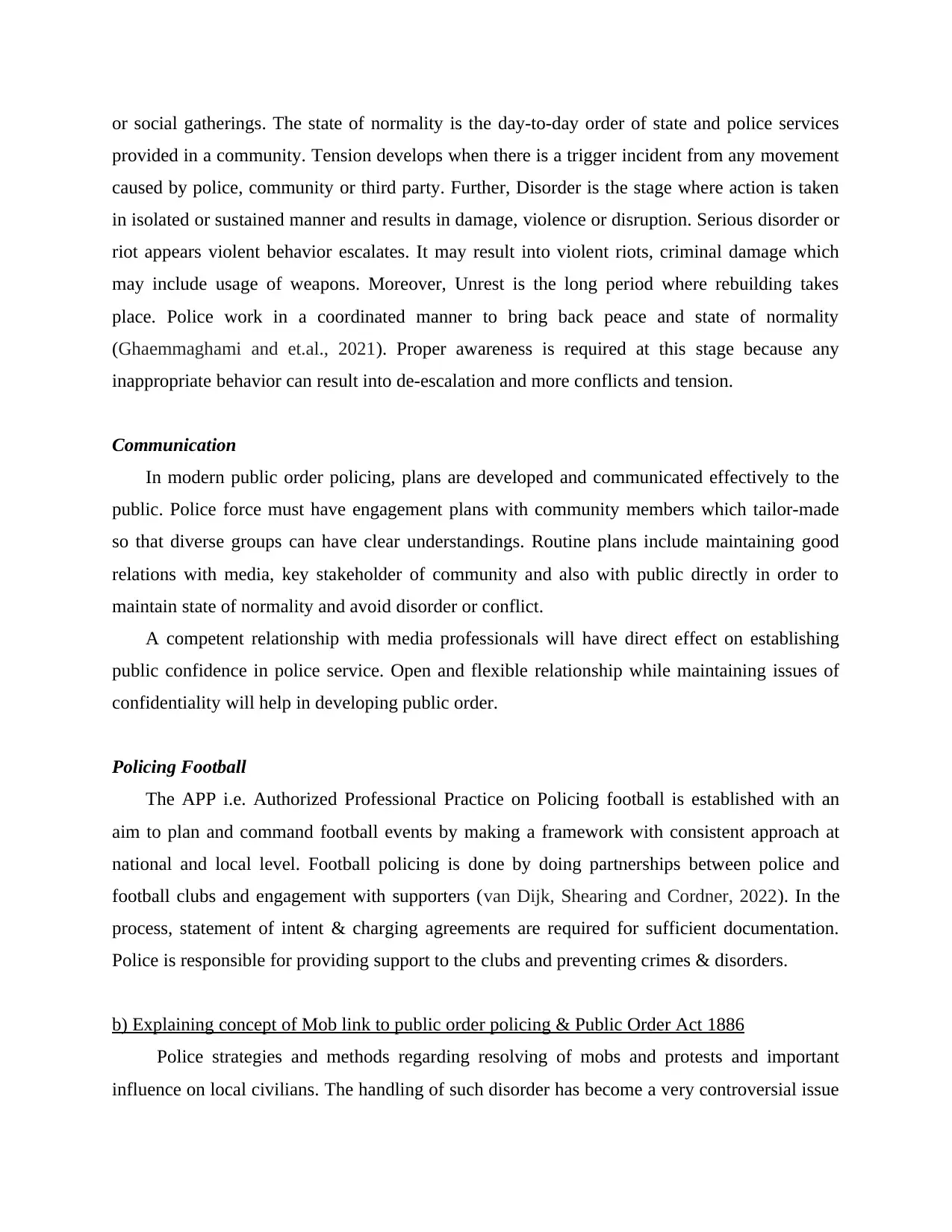
or social gatherings. The state of normality is the day-to-day order of state and police services
provided in a community. Tension develops when there is a trigger incident from any movement
caused by police, community or third party. Further, Disorder is the stage where action is taken
in isolated or sustained manner and results in damage, violence or disruption. Serious disorder or
riot appears violent behavior escalates. It may result into violent riots, criminal damage which
may include usage of weapons. Moreover, Unrest is the long period where rebuilding takes
place. Police work in a coordinated manner to bring back peace and state of normality
(Ghaemmaghami and et.al., 2021). Proper awareness is required at this stage because any
inappropriate behavior can result into de-escalation and more conflicts and tension.
Communication
In modern public order policing, plans are developed and communicated effectively to the
public. Police force must have engagement plans with community members which tailor-made
so that diverse groups can have clear understandings. Routine plans include maintaining good
relations with media, key stakeholder of community and also with public directly in order to
maintain state of normality and avoid disorder or conflict.
A competent relationship with media professionals will have direct effect on establishing
public confidence in police service. Open and flexible relationship while maintaining issues of
confidentiality will help in developing public order.
Policing Football
The APP i.e. Authorized Professional Practice on Policing football is established with an
aim to plan and command football events by making a framework with consistent approach at
national and local level. Football policing is done by doing partnerships between police and
football clubs and engagement with supporters (van Dijk, Shearing and Cordner, 2022). In the
process, statement of intent & charging agreements are required for sufficient documentation.
Police is responsible for providing support to the clubs and preventing crimes & disorders.
b) Explaining concept of Mob link to public order policing & Public Order Act 1886
Police strategies and methods regarding resolving of mobs and protests and important
influence on local civilians. The handling of such disorder has become a very controversial issue
provided in a community. Tension develops when there is a trigger incident from any movement
caused by police, community or third party. Further, Disorder is the stage where action is taken
in isolated or sustained manner and results in damage, violence or disruption. Serious disorder or
riot appears violent behavior escalates. It may result into violent riots, criminal damage which
may include usage of weapons. Moreover, Unrest is the long period where rebuilding takes
place. Police work in a coordinated manner to bring back peace and state of normality
(Ghaemmaghami and et.al., 2021). Proper awareness is required at this stage because any
inappropriate behavior can result into de-escalation and more conflicts and tension.
Communication
In modern public order policing, plans are developed and communicated effectively to the
public. Police force must have engagement plans with community members which tailor-made
so that diverse groups can have clear understandings. Routine plans include maintaining good
relations with media, key stakeholder of community and also with public directly in order to
maintain state of normality and avoid disorder or conflict.
A competent relationship with media professionals will have direct effect on establishing
public confidence in police service. Open and flexible relationship while maintaining issues of
confidentiality will help in developing public order.
Policing Football
The APP i.e. Authorized Professional Practice on Policing football is established with an
aim to plan and command football events by making a framework with consistent approach at
national and local level. Football policing is done by doing partnerships between police and
football clubs and engagement with supporters (van Dijk, Shearing and Cordner, 2022). In the
process, statement of intent & charging agreements are required for sufficient documentation.
Police is responsible for providing support to the clubs and preventing crimes & disorders.
b) Explaining concept of Mob link to public order policing & Public Order Act 1886
Police strategies and methods regarding resolving of mobs and protests and important
influence on local civilians. The handling of such disorder has become a very controversial issue
⊘ This is a preview!⊘
Do you want full access?
Subscribe today to unlock all pages.
Trusted by 1+ million students worldwide
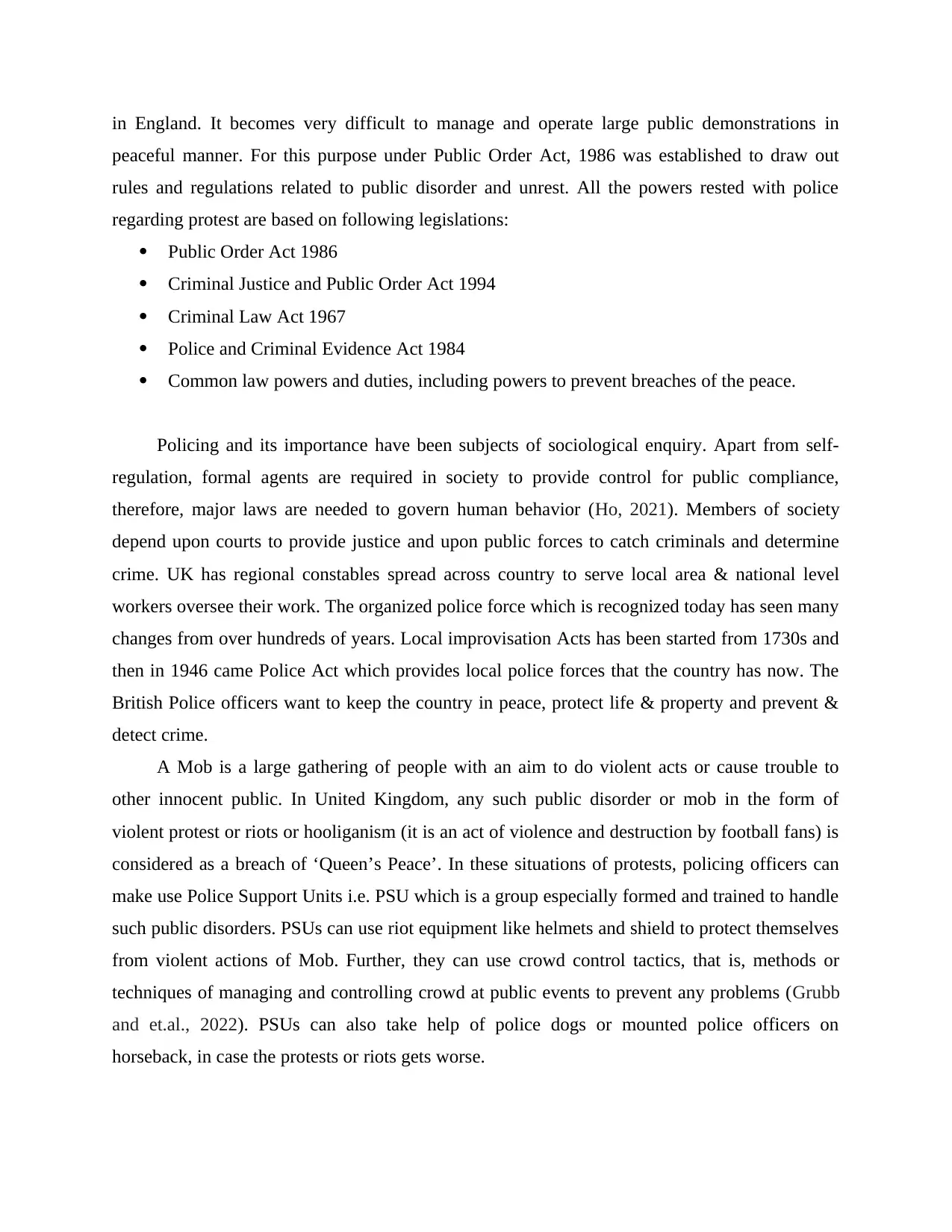
in England. It becomes very difficult to manage and operate large public demonstrations in
peaceful manner. For this purpose under Public Order Act, 1986 was established to draw out
rules and regulations related to public disorder and unrest. All the powers rested with police
regarding protest are based on following legislations:
Public Order Act 1986
Criminal Justice and Public Order Act 1994
Criminal Law Act 1967
Police and Criminal Evidence Act 1984
Common law powers and duties, including powers to prevent breaches of the peace.
Policing and its importance have been subjects of sociological enquiry. Apart from self-
regulation, formal agents are required in society to provide control for public compliance,
therefore, major laws are needed to govern human behavior (Ho, 2021). Members of society
depend upon courts to provide justice and upon public forces to catch criminals and determine
crime. UK has regional constables spread across country to serve local area & national level
workers oversee their work. The organized police force which is recognized today has seen many
changes from over hundreds of years. Local improvisation Acts has been started from 1730s and
then in 1946 came Police Act which provides local police forces that the country has now. The
British Police officers want to keep the country in peace, protect life & property and prevent &
detect crime.
A Mob is a large gathering of people with an aim to do violent acts or cause trouble to
other innocent public. In United Kingdom, any such public disorder or mob in the form of
violent protest or riots or hooliganism (it is an act of violence and destruction by football fans) is
considered as a breach of ‘Queen’s Peace’. In these situations of protests, policing officers can
make use Police Support Units i.e. PSU which is a group especially formed and trained to handle
such public disorders. PSUs can use riot equipment like helmets and shield to protect themselves
from violent actions of Mob. Further, they can use crowd control tactics, that is, methods or
techniques of managing and controlling crowd at public events to prevent any problems (Grubb
and et.al., 2022). PSUs can also take help of police dogs or mounted police officers on
horseback, in case the protests or riots gets worse.
peaceful manner. For this purpose under Public Order Act, 1986 was established to draw out
rules and regulations related to public disorder and unrest. All the powers rested with police
regarding protest are based on following legislations:
Public Order Act 1986
Criminal Justice and Public Order Act 1994
Criminal Law Act 1967
Police and Criminal Evidence Act 1984
Common law powers and duties, including powers to prevent breaches of the peace.
Policing and its importance have been subjects of sociological enquiry. Apart from self-
regulation, formal agents are required in society to provide control for public compliance,
therefore, major laws are needed to govern human behavior (Ho, 2021). Members of society
depend upon courts to provide justice and upon public forces to catch criminals and determine
crime. UK has regional constables spread across country to serve local area & national level
workers oversee their work. The organized police force which is recognized today has seen many
changes from over hundreds of years. Local improvisation Acts has been started from 1730s and
then in 1946 came Police Act which provides local police forces that the country has now. The
British Police officers want to keep the country in peace, protect life & property and prevent &
detect crime.
A Mob is a large gathering of people with an aim to do violent acts or cause trouble to
other innocent public. In United Kingdom, any such public disorder or mob in the form of
violent protest or riots or hooliganism (it is an act of violence and destruction by football fans) is
considered as a breach of ‘Queen’s Peace’. In these situations of protests, policing officers can
make use Police Support Units i.e. PSU which is a group especially formed and trained to handle
such public disorders. PSUs can use riot equipment like helmets and shield to protect themselves
from violent actions of Mob. Further, they can use crowd control tactics, that is, methods or
techniques of managing and controlling crowd at public events to prevent any problems (Grubb
and et.al., 2022). PSUs can also take help of police dogs or mounted police officers on
horseback, in case the protests or riots gets worse.
Paraphrase This Document
Need a fresh take? Get an instant paraphrase of this document with our AI Paraphraser
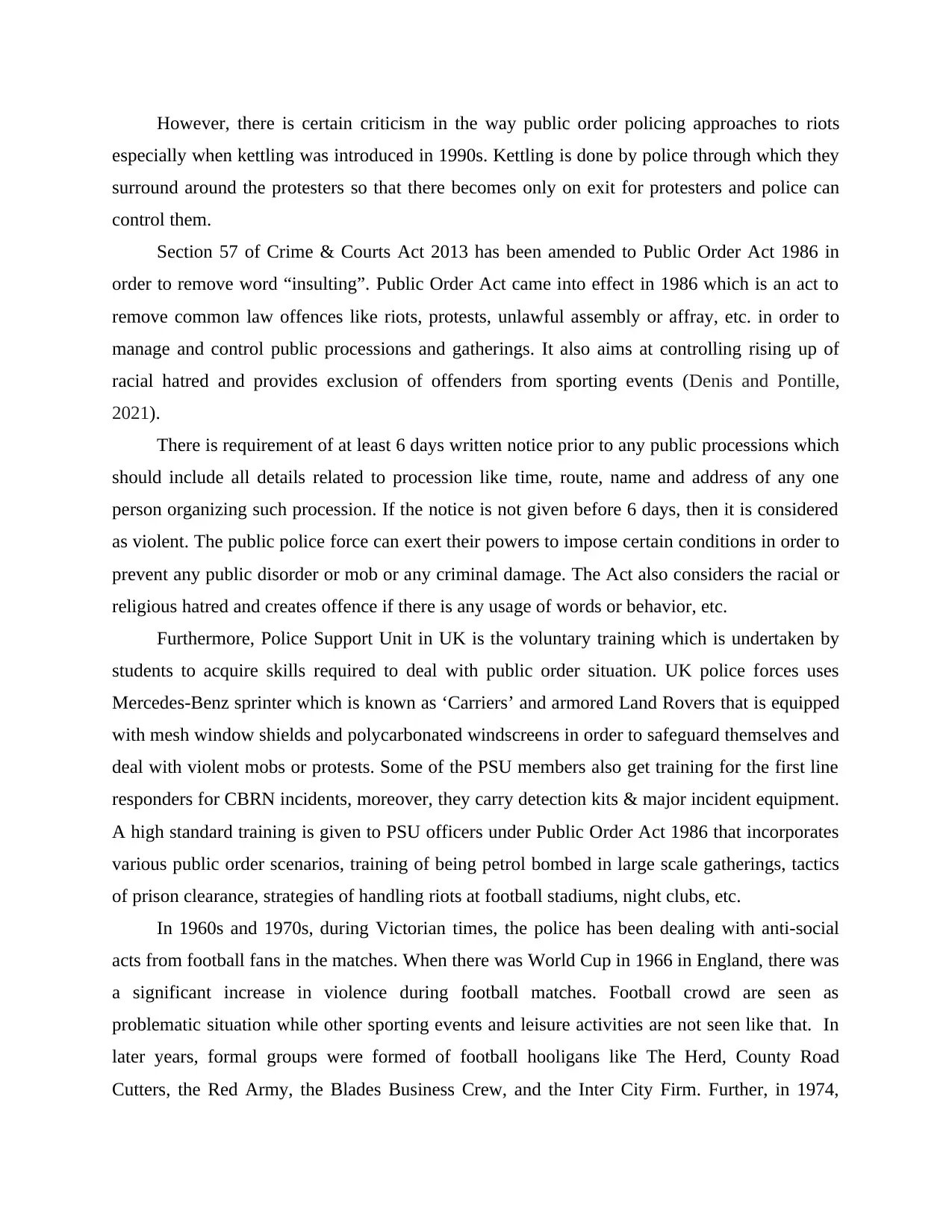
However, there is certain criticism in the way public order policing approaches to riots
especially when kettling was introduced in 1990s. Kettling is done by police through which they
surround around the protesters so that there becomes only on exit for protesters and police can
control them.
Section 57 of Crime & Courts Act 2013 has been amended to Public Order Act 1986 in
order to remove word “insulting”. Public Order Act came into effect in 1986 which is an act to
remove common law offences like riots, protests, unlawful assembly or affray, etc. in order to
manage and control public processions and gatherings. It also aims at controlling rising up of
racial hatred and provides exclusion of offenders from sporting events (Denis and Pontille,
2021).
There is requirement of at least 6 days written notice prior to any public processions which
should include all details related to procession like time, route, name and address of any one
person organizing such procession. If the notice is not given before 6 days, then it is considered
as violent. The public police force can exert their powers to impose certain conditions in order to
prevent any public disorder or mob or any criminal damage. The Act also considers the racial or
religious hatred and creates offence if there is any usage of words or behavior, etc.
Furthermore, Police Support Unit in UK is the voluntary training which is undertaken by
students to acquire skills required to deal with public order situation. UK police forces uses
Mercedes-Benz sprinter which is known as ‘Carriers’ and armored Land Rovers that is equipped
with mesh window shields and polycarbonated windscreens in order to safeguard themselves and
deal with violent mobs or protests. Some of the PSU members also get training for the first line
responders for CBRN incidents, moreover, they carry detection kits & major incident equipment.
A high standard training is given to PSU officers under Public Order Act 1986 that incorporates
various public order scenarios, training of being petrol bombed in large scale gatherings, tactics
of prison clearance, strategies of handling riots at football stadiums, night clubs, etc.
In 1960s and 1970s, during Victorian times, the police has been dealing with anti-social
acts from football fans in the matches. When there was World Cup in 1966 in England, there was
a significant increase in violence during football matches. Football crowd are seen as
problematic situation while other sporting events and leisure activities are not seen like that. In
later years, formal groups were formed of football hooligans like The Herd, County Road
Cutters, the Red Army, the Blades Business Crew, and the Inter City Firm. Further, in 1974,
especially when kettling was introduced in 1990s. Kettling is done by police through which they
surround around the protesters so that there becomes only on exit for protesters and police can
control them.
Section 57 of Crime & Courts Act 2013 has been amended to Public Order Act 1986 in
order to remove word “insulting”. Public Order Act came into effect in 1986 which is an act to
remove common law offences like riots, protests, unlawful assembly or affray, etc. in order to
manage and control public processions and gatherings. It also aims at controlling rising up of
racial hatred and provides exclusion of offenders from sporting events (Denis and Pontille,
2021).
There is requirement of at least 6 days written notice prior to any public processions which
should include all details related to procession like time, route, name and address of any one
person organizing such procession. If the notice is not given before 6 days, then it is considered
as violent. The public police force can exert their powers to impose certain conditions in order to
prevent any public disorder or mob or any criminal damage. The Act also considers the racial or
religious hatred and creates offence if there is any usage of words or behavior, etc.
Furthermore, Police Support Unit in UK is the voluntary training which is undertaken by
students to acquire skills required to deal with public order situation. UK police forces uses
Mercedes-Benz sprinter which is known as ‘Carriers’ and armored Land Rovers that is equipped
with mesh window shields and polycarbonated windscreens in order to safeguard themselves and
deal with violent mobs or protests. Some of the PSU members also get training for the first line
responders for CBRN incidents, moreover, they carry detection kits & major incident equipment.
A high standard training is given to PSU officers under Public Order Act 1986 that incorporates
various public order scenarios, training of being petrol bombed in large scale gatherings, tactics
of prison clearance, strategies of handling riots at football stadiums, night clubs, etc.
In 1960s and 1970s, during Victorian times, the police has been dealing with anti-social
acts from football fans in the matches. When there was World Cup in 1966 in England, there was
a significant increase in violence during football matches. Football crowd are seen as
problematic situation while other sporting events and leisure activities are not seen like that. In
later years, formal groups were formed of football hooligans like The Herd, County Road
Cutters, the Red Army, the Blades Business Crew, and the Inter City Firm. Further, in 1974,
there was much violence of Manchester United and stabbing the fan of Blackpool during home
match led to separation of home and away supporters in different areas of ground and putting up
fences to stop any such violence (Gunatilleke, 2021). Finally, the Popplewell Committee gave
suggestions regarding changes in organization of football matches. Various schemes were
proposed to curb hooliganism which also includes harsh prison sentences. The supporters of
football sometimes tolerate and normalizes the situation but sometime turn into aggressive as
part of ‘match day experience’. The use of same policing strategies against such political
demonstrations can result into legal challenge (Public order, 2022). There can be situation where
protesters are politically inclined to challenge such authorities than those just resembling for
socio cultural reasons. An analysis says that political protest case and practice of policing
football crowds by reference to ethnography, sociologically, etc. affects fans behavior and
policing of fans.
During current times of Covid-19, there has been many protests ranging from celebrations,
vigils, environmental activism, anti-lockdown protests and riots, movements like Black Lives
Matter demonstrations, etc. are dangerous acts of violence and protests. All these crowd
emotions can result into multiple threats of unrest and convert into public disorder. For this, the
public order police holds the power to exert pressure and organize all resources and weapons to
intervene and take legal actions to control such protests (Devarhubli and Patel, 2022). When
protesting situation is out of control, then at that time, police force can make use of more
personnel force, dogs, shields and even batons. In such situation, people who are innocent and
have not done anything also comes under the confrontation and find themselves treated as they
have done something wrong.
Now, UK citizens have complete rights to carry out processions and demonstrations which
is linked with free speech. However, it has to be balanced with disruption & stress caused to
general public (The psychology of crowd control – and why the UK may see violence escalate
before lockdown ends, 2021). On the other hand, UK does not have paramilitary police force like
Sweden’s RRTF, rather standard officers are given training to function at times required.
c) Work of police in partnership with other agencies
Public order was policed prior to the introduction of the Public Order Act, 1986 on the
basis of the Public Order Act, 1936 and other relevant common law offences. Now, the
match led to separation of home and away supporters in different areas of ground and putting up
fences to stop any such violence (Gunatilleke, 2021). Finally, the Popplewell Committee gave
suggestions regarding changes in organization of football matches. Various schemes were
proposed to curb hooliganism which also includes harsh prison sentences. The supporters of
football sometimes tolerate and normalizes the situation but sometime turn into aggressive as
part of ‘match day experience’. The use of same policing strategies against such political
demonstrations can result into legal challenge (Public order, 2022). There can be situation where
protesters are politically inclined to challenge such authorities than those just resembling for
socio cultural reasons. An analysis says that political protest case and practice of policing
football crowds by reference to ethnography, sociologically, etc. affects fans behavior and
policing of fans.
During current times of Covid-19, there has been many protests ranging from celebrations,
vigils, environmental activism, anti-lockdown protests and riots, movements like Black Lives
Matter demonstrations, etc. are dangerous acts of violence and protests. All these crowd
emotions can result into multiple threats of unrest and convert into public disorder. For this, the
public order police holds the power to exert pressure and organize all resources and weapons to
intervene and take legal actions to control such protests (Devarhubli and Patel, 2022). When
protesting situation is out of control, then at that time, police force can make use of more
personnel force, dogs, shields and even batons. In such situation, people who are innocent and
have not done anything also comes under the confrontation and find themselves treated as they
have done something wrong.
Now, UK citizens have complete rights to carry out processions and demonstrations which
is linked with free speech. However, it has to be balanced with disruption & stress caused to
general public (The psychology of crowd control – and why the UK may see violence escalate
before lockdown ends, 2021). On the other hand, UK does not have paramilitary police force like
Sweden’s RRTF, rather standard officers are given training to function at times required.
c) Work of police in partnership with other agencies
Public order was policed prior to the introduction of the Public Order Act, 1986 on the
basis of the Public Order Act, 1936 and other relevant common law offences. Now, the
⊘ This is a preview!⊘
Do you want full access?
Subscribe today to unlock all pages.
Trusted by 1+ million students worldwide
introduction of the Public Order Act, 1986 was based on various events like Southall riot in
1979, Brixton riot in 1981, national miner’s strike between 1984 to 1985, Battle of Orgreave in
June, 1984, Battle of the Beanfield in June 1985, Law Commission report in 1983, etc. The
purpose of the law was the extension of the codes of the law in England and Wales and removal
of common law offences namely – unlawful assembly, riot, rout and affray (Chetty and Alathur,
2018). The law said that the changes will make the legislation of the public order much more
practical to implement and use and the law will become more understandable and relatable to the
juries and the courts.
The Public Order Act, 1986 intended abolishment of common law offences of unlawful
assembly of people, riots, routs and affrays and other statutory public order offences with the
intention of creating new offences for order of the public, to handle and tackle the public
assemblies and processions, to keep in check the spread of racial hatred, to exclude specified
offenders from participating in the sporting events, to prevent offence relating to contaminating
or interfering with the goods, to keep the power to keep the specified trespassers away from a
privately owned land, devise amendments relating to the section 7 of the Conspiracy and
Protection of Property Act, 1875, amendments relating to the section 1 of the Prevention of
Crime Act, 1953, amendments relating to the part V of the Criminal Justice (Scotland) Act, 1980
and amendments relating to the Sporting Events (Control of Alcohol etc.) Act, 1985 with the
intentions of repealing particular unnecessary and obsolete provisions and for the other related
provisions.
The Public Order Act, 1986 equips the police with the power to restrict the forming
assemblies by declaring the number of participants in the assembly, the location or the venue of
the assembly and the duration for which it can be held with the intention of preventing serious
public disorder, serious criminal damage and most importantly, disruption of the community life
and many more powers to the police through various sections of the act to avoid happening of
unlawful assembly, riot, rout or affray.
As per the theory of partnership working according to the government of UK, it is
explained that it is not possible to efficiently deal with the complicated safety and crime
problems of the community for a single agency therefore, partnership approach is followed
(Pickard, 2018). Thus, agencies whether statutory like police or non – statutory like a NGO will
work toward the common goal to handle the crime issues both at the local level as well as the
1979, Brixton riot in 1981, national miner’s strike between 1984 to 1985, Battle of Orgreave in
June, 1984, Battle of the Beanfield in June 1985, Law Commission report in 1983, etc. The
purpose of the law was the extension of the codes of the law in England and Wales and removal
of common law offences namely – unlawful assembly, riot, rout and affray (Chetty and Alathur,
2018). The law said that the changes will make the legislation of the public order much more
practical to implement and use and the law will become more understandable and relatable to the
juries and the courts.
The Public Order Act, 1986 intended abolishment of common law offences of unlawful
assembly of people, riots, routs and affrays and other statutory public order offences with the
intention of creating new offences for order of the public, to handle and tackle the public
assemblies and processions, to keep in check the spread of racial hatred, to exclude specified
offenders from participating in the sporting events, to prevent offence relating to contaminating
or interfering with the goods, to keep the power to keep the specified trespassers away from a
privately owned land, devise amendments relating to the section 7 of the Conspiracy and
Protection of Property Act, 1875, amendments relating to the section 1 of the Prevention of
Crime Act, 1953, amendments relating to the part V of the Criminal Justice (Scotland) Act, 1980
and amendments relating to the Sporting Events (Control of Alcohol etc.) Act, 1985 with the
intentions of repealing particular unnecessary and obsolete provisions and for the other related
provisions.
The Public Order Act, 1986 equips the police with the power to restrict the forming
assemblies by declaring the number of participants in the assembly, the location or the venue of
the assembly and the duration for which it can be held with the intention of preventing serious
public disorder, serious criminal damage and most importantly, disruption of the community life
and many more powers to the police through various sections of the act to avoid happening of
unlawful assembly, riot, rout or affray.
As per the theory of partnership working according to the government of UK, it is
explained that it is not possible to efficiently deal with the complicated safety and crime
problems of the community for a single agency therefore, partnership approach is followed
(Pickard, 2018). Thus, agencies whether statutory like police or non – statutory like a NGO will
work toward the common goal to handle the crime issues both at the local level as well as the
Paraphrase This Document
Need a fresh take? Get an instant paraphrase of this document with our AI Paraphraser
regional level (Amankwaa, 2018). Working in partnership will also have various benefits like
innovative and detailed solutions to the complex crime and drug problems, working in
partnership will allow better identification and definition of the problems concerning community,
partnership will allow better development of approaches toward various interventions to be
planned, intervention by more than one agency will always be effective than single intervention,
partnerships will allow access to more resources and newer ideas for the solution of an issue in
hand, multiple intervention will naturally enhance the impact on the targeted party and new facts
and information may be accessed by the means of multiple intervention.
Working in partnerships for the reduction of crime in the UK was promoted and
developed by Home Office Circulars since 1960s but it shall be noted that the most important
chapter of such working in partnership was when the Morgan Report was published on Safer
Communities: The local Delivery of Crime Prevention through the Partnership Approach, 1991
(Philips, 2021). In England and Wales, the Morgan report was the one that was of utmost
importance to work for the safety and future development of the community. It emphasised on
the grouping of various stakeholders of the community of safety and crime prevention like
connecting of various local agencies and police to tackle the crimes. The Crime & Disorder Act,
1998 brought total transformation to the partnership approach of tackling with the community
crimes when it made it a statutory requirement for police, local authorities and other health
authorities to work together (Partnership working and multi-agency responses/mechanisms.
2022). The Delivering Community Safety: A guide to effective partnership working, 2007 was
published by the Home Office which enlisted six hallmarks namely, community engagement,
delivery structure which is both responsive as well as effective, processes of business which are
intelligence – led, effective as well as empowered leadership, accountability which is both
visible and constructive and application of specific knowledge and skills. Community Safety
Partnerships (CSPs) are at play at this level.
Now there are various instances and form of crimes where the police are working in the
partnership with various agencies to tackle a crime case. One such very concerning and serious
crime is Domestic Violence or Domestic Abuse. Here, it important to prevent domestic abuse
from happening at the early stage and even preventing it from happening in the first place and
very necessarily, reducing the cases that slip through such system of safeguarding thus having
the objectives of early identifying of the risks, effective sharing of the information and data, joint
innovative and detailed solutions to the complex crime and drug problems, working in
partnership will allow better identification and definition of the problems concerning community,
partnership will allow better development of approaches toward various interventions to be
planned, intervention by more than one agency will always be effective than single intervention,
partnerships will allow access to more resources and newer ideas for the solution of an issue in
hand, multiple intervention will naturally enhance the impact on the targeted party and new facts
and information may be accessed by the means of multiple intervention.
Working in partnerships for the reduction of crime in the UK was promoted and
developed by Home Office Circulars since 1960s but it shall be noted that the most important
chapter of such working in partnership was when the Morgan Report was published on Safer
Communities: The local Delivery of Crime Prevention through the Partnership Approach, 1991
(Philips, 2021). In England and Wales, the Morgan report was the one that was of utmost
importance to work for the safety and future development of the community. It emphasised on
the grouping of various stakeholders of the community of safety and crime prevention like
connecting of various local agencies and police to tackle the crimes. The Crime & Disorder Act,
1998 brought total transformation to the partnership approach of tackling with the community
crimes when it made it a statutory requirement for police, local authorities and other health
authorities to work together (Partnership working and multi-agency responses/mechanisms.
2022). The Delivering Community Safety: A guide to effective partnership working, 2007 was
published by the Home Office which enlisted six hallmarks namely, community engagement,
delivery structure which is both responsive as well as effective, processes of business which are
intelligence – led, effective as well as empowered leadership, accountability which is both
visible and constructive and application of specific knowledge and skills. Community Safety
Partnerships (CSPs) are at play at this level.
Now there are various instances and form of crimes where the police are working in the
partnership with various agencies to tackle a crime case. One such very concerning and serious
crime is Domestic Violence or Domestic Abuse. Here, it important to prevent domestic abuse
from happening at the early stage and even preventing it from happening in the first place and
very necessarily, reducing the cases that slip through such system of safeguarding thus having
the objectives of early identifying of the risks, effective sharing of the information and data, joint
decision making and actions to be in coordination for management, assessment and reduction of
the said risk (Sohal and et.al., 2020). There shall be well laid out Information Sharing
Agreements (ISAs) between the senior officers and the other agencies which shall be regularly
updated and reviewed specially when there is involvement of highly sensitive and personal
details of any victim. It is the responsibility of the police officers to inform the victims that the
records of the incident will include 999 call recordings, interviews, photographs, forensic
medical reports, etc. as an evidence of such domestic abuse. The Crown Prosecution Service will
also be involved for sharing of such information which will allow planning of the safety
processes for the victims and also allow fair judgements. For such an action protocols regarding
information sharing is to maintained with the Children and Family Court Advisory and Support
Services (CAFCASS).
A strong multi-agency links is required in case with the assistance of such agencies
namely – abuse forums, Specialist domestic Violence Courts (SDVCs), Multi-agency Risk
Assessment Conferences (MARACs) and development of Service Level Agreements (SLAs) for
monitoring of services. As said earlier, the Crime and Disorder Act 1998 requires statutory duties
of various authorities in partnership to reduce the risk public disorder which includes the police,
local authorities, fire & rescue authorities, probation services and health or clinical
commissioning groups of England or local health boards of Wales.
Gang crimes is also a serious issue which needs intervention of police and other agencies
to prevent the offences committed by such gangs of children and young people like dealing in
drugs, theft and stealing and having illegal access to drugs and weapons. This is serious because
such children and young members are at the risk of violence and might not even know what they
are part of and this will result into their exploitation (Campana and Varese, 2022). To tackle such
crimes, the police with other agencies are devising various programs like Ending Gang and
Youth Violence Programme in which most risk prone areas were chosen that had the highest rate
of violence, hospital admissions due to sharp objects assault and local gang issues. Under this
programme, Detective Chief Superintendent heads the team from the Metropolitan Police
Service. Ending Gang and Youth Violence (EGYV) team is also involved.
Rape and sexual offending is one of the most serious offences and will require the most
effective support and response from the police officers and other agencies which includes first
responders, secondary investigators, supervisors and managers & leadership. The government
the said risk (Sohal and et.al., 2020). There shall be well laid out Information Sharing
Agreements (ISAs) between the senior officers and the other agencies which shall be regularly
updated and reviewed specially when there is involvement of highly sensitive and personal
details of any victim. It is the responsibility of the police officers to inform the victims that the
records of the incident will include 999 call recordings, interviews, photographs, forensic
medical reports, etc. as an evidence of such domestic abuse. The Crown Prosecution Service will
also be involved for sharing of such information which will allow planning of the safety
processes for the victims and also allow fair judgements. For such an action protocols regarding
information sharing is to maintained with the Children and Family Court Advisory and Support
Services (CAFCASS).
A strong multi-agency links is required in case with the assistance of such agencies
namely – abuse forums, Specialist domestic Violence Courts (SDVCs), Multi-agency Risk
Assessment Conferences (MARACs) and development of Service Level Agreements (SLAs) for
monitoring of services. As said earlier, the Crime and Disorder Act 1998 requires statutory duties
of various authorities in partnership to reduce the risk public disorder which includes the police,
local authorities, fire & rescue authorities, probation services and health or clinical
commissioning groups of England or local health boards of Wales.
Gang crimes is also a serious issue which needs intervention of police and other agencies
to prevent the offences committed by such gangs of children and young people like dealing in
drugs, theft and stealing and having illegal access to drugs and weapons. This is serious because
such children and young members are at the risk of violence and might not even know what they
are part of and this will result into their exploitation (Campana and Varese, 2022). To tackle such
crimes, the police with other agencies are devising various programs like Ending Gang and
Youth Violence Programme in which most risk prone areas were chosen that had the highest rate
of violence, hospital admissions due to sharp objects assault and local gang issues. Under this
programme, Detective Chief Superintendent heads the team from the Metropolitan Police
Service. Ending Gang and Youth Violence (EGYV) team is also involved.
Rape and sexual offending is one of the most serious offences and will require the most
effective support and response from the police officers and other agencies which includes first
responders, secondary investigators, supervisors and managers & leadership. The government
⊘ This is a preview!⊘
Do you want full access?
Subscribe today to unlock all pages.
Trusted by 1+ million students worldwide

1 out of 15


Related Documents


Your All-in-One AI-Powered Toolkit for Academic Success.
+13062052269
info@desklib.com
Available 24*7 on WhatsApp / Email
![[object Object]](/_next/static/media/star-bottom.7253800d.svg)
Unlock your academic potential
Copyright © 2020–2026 A2Z Services. All Rights Reserved. Developed and managed by ZUCOL.