Report on the Public, Private, and Voluntary Sports Sectors in the UK

Verified

Added on  2022/12/27

|6
|1166
|86
Report
AI Summary
This report provides a detailed analysis of the sports industry, focusing on its various sectors: public, private, and voluntary. The public sector, often the largest provider, is examined in terms of government investment, funding sources (taxes, lotteries), and the facilities and opportunities it offers, such as those provided by organizations like Basketball England. The private sector's role, driven by investment returns, is also explored, highlighting its responsiveness to trends and examples like football clubs and private educational institutions providing sports facilities. The report then delves into the voluntary sector, which is characterized by non-profit organizations run by amateur sportsmen and women. It covers their funding models (subscriptions, sponsorships, grants) and examples like the British Basketball League. The conclusion emphasizes the roles of each sector in fostering sports activities and their contribution to the industry's growth and innovation.

Document Page
Different sectors of
Sports
tabler-icon-diamond-filled.svg

Paraphrase This Document

Need a fresh take? Get an instant paraphrase of this document with our AI Paraphraser
Document Page
Table of Contents
INTRODUCTION ..........................................................................................................................3
MAIN BODY...................................................................................................................................3
Public sector................................................................................................................................3
Private sector...............................................................................................................................3
Voluntary sector..........................................................................................................................4
CONCLUSION ...............................................................................................................................5
REFERENCES................................................................................................................................6
Document Page
INTRODUCTION
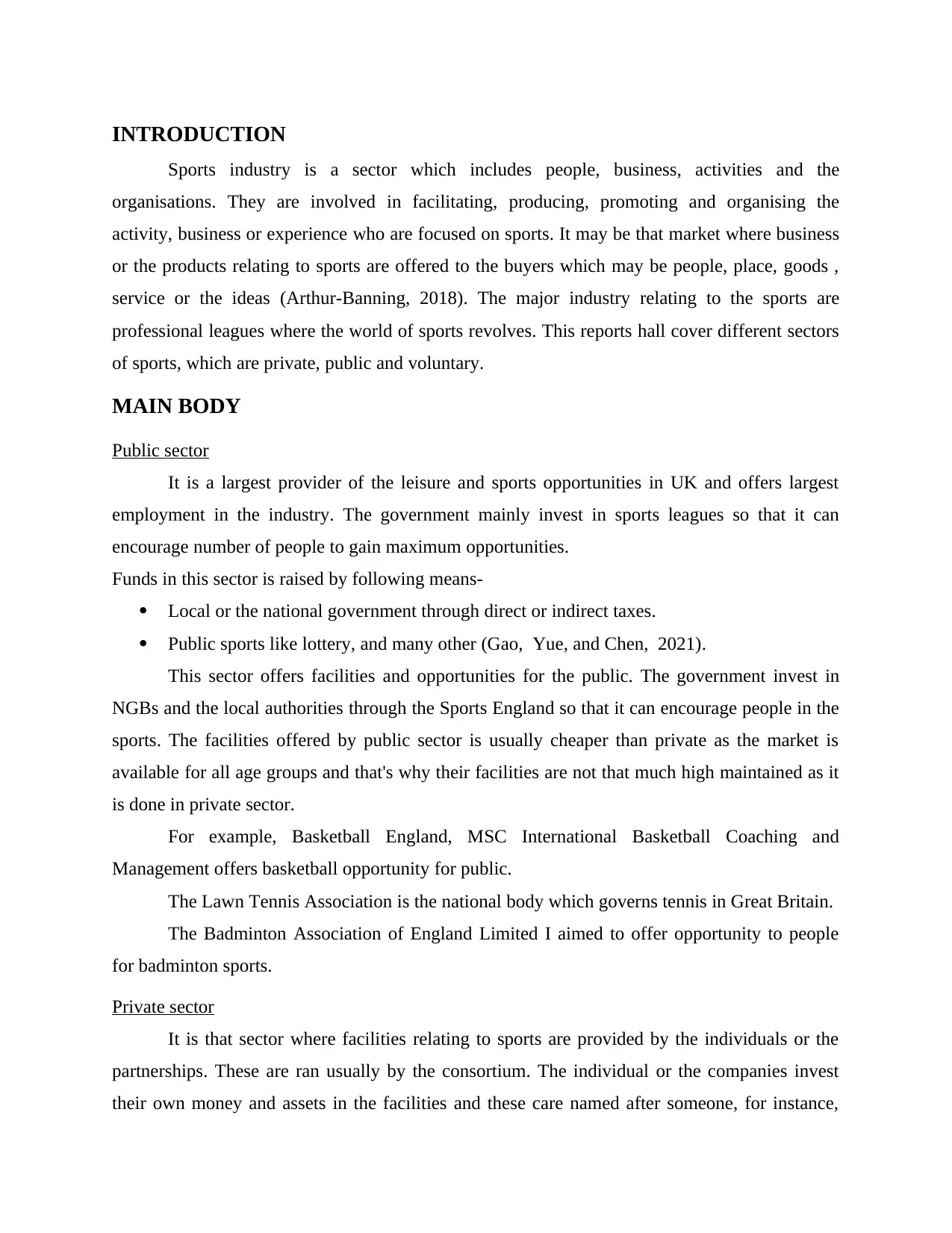
Sports industry is a sector which includes people, business, activities and the
organisations. They are involved in facilitating, producing, promoting and organising the
activity, business or experience who are focused on sports. It may be that market where business
or the products relating to sports are offered to the buyers which may be people, place, goods ,
service or the ideas (Arthur-Banning, 2018). The major industry relating to the sports are
professional leagues where the world of sports revolves. This reports hall cover different sectors
of sports, which are private, public and voluntary.
MAIN BODY
Public sector
It is a largest provider of the leisure and sports opportunities in UK and offers largest
employment in the industry. The government mainly invest in sports leagues so that it can
encourage number of people to gain maximum opportunities.
Funds in this sector is raised by following means-
Local or the national government through direct or indirect taxes.
Public sports like lottery, and many other (Gao, Yue, and Chen, 2021).
This sector offers facilities and opportunities for the public. The government invest in
NGBs and the local authorities through the Sports England so that it can encourage people in the
sports. The facilities offered by public sector is usually cheaper than private as the market is
available for all age groups and that's why their facilities are not that much high maintained as it
is done in private sector.
For example, Basketball England, MSC International Basketball Coaching and
Management offers basketball opportunity for public.
The Lawn Tennis Association is the national body which governs tennis in Great Britain.
The Badminton Association of England Limited I aimed to offer opportunity to people
for badminton sports.
Private sector
It is that sector where facilities relating to sports are provided by the individuals or the
partnerships. These are ran usually by the consortium. The individual or the companies invest
their own money and assets in the facilities and these care named after someone, for instance,
Document Page
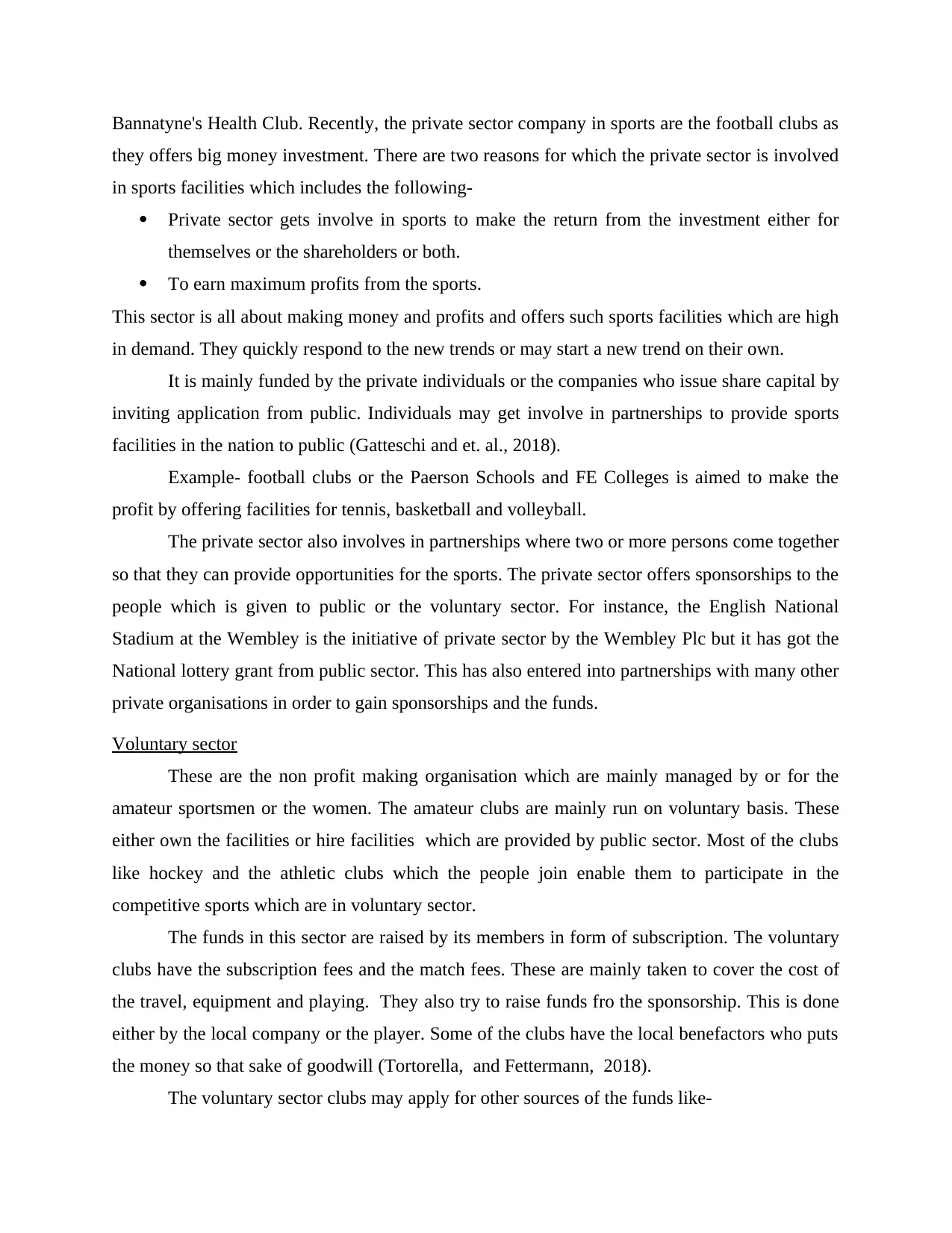
Bannatyne's Health Club. Recently, the private sector company in sports are the football clubs as
they offers big money investment. There are two reasons for which the private sector is involved
in sports facilities which includes the following-
Private sector gets involve in sports to make the return from the investment either for
themselves or the shareholders or both.
To earn maximum profits from the sports.
This sector is all about making money and profits and offers such sports facilities which are high
in demand. They quickly respond to the new trends or may start a new trend on their own.
It is mainly funded by the private individuals or the companies who issue share capital by
inviting application from public. Individuals may get involve in partnerships to provide sports
facilities in the nation to public (Gatteschi and et. al., 2018).
Example- football clubs or the Paerson Schools and FE Colleges is aimed to make the
profit by offering facilities for tennis, basketball and volleyball.
The private sector also involves in partnerships where two or more persons come together
so that they can provide opportunities for the sports. The private sector offers sponsorships to the
people which is given to public or the voluntary sector. For instance, the English National
Stadium at the Wembley is the initiative of private sector by the Wembley Plc but it has got the
National lottery grant from public sector. This has also entered into partnerships with many other
private organisations in order to gain sponsorships and the funds.
Voluntary sector
These are the non profit making organisation which are mainly managed by or for the
amateur sportsmen or the women. The amateur clubs are mainly run on voluntary basis. These
either own the facilities or hire facilities which are provided by public sector. Most of the clubs
like hockey and the athletic clubs which the people join enable them to participate in the
competitive sports which are in voluntary sector.
The funds in this sector are raised by its members in form of subscription. The voluntary
clubs have the subscription fees and the match fees. These are mainly taken to cover the cost of
the travel, equipment and playing. They also try to raise funds fro the sponsorship. This is done
either by the local company or the player. Some of the clubs have the local benefactors who puts
the money so that sake of goodwill (Tortorella, and Fettermann, 2018).
The voluntary sector clubs may apply for other sources of the funds like-
tabler-icon-diamond-filled.svg

Paraphrase This Document

Need a fresh take? Get an instant paraphrase of this document with our AI Paraphraser
Document Page
grants from the national governing bodies
grants from local authorities.
Grants from the government
National lottery grants.
For example, British Basketball League is a voluntary association for basketball
management. NGB offers badminton sports facility to public.
CONCLUSION
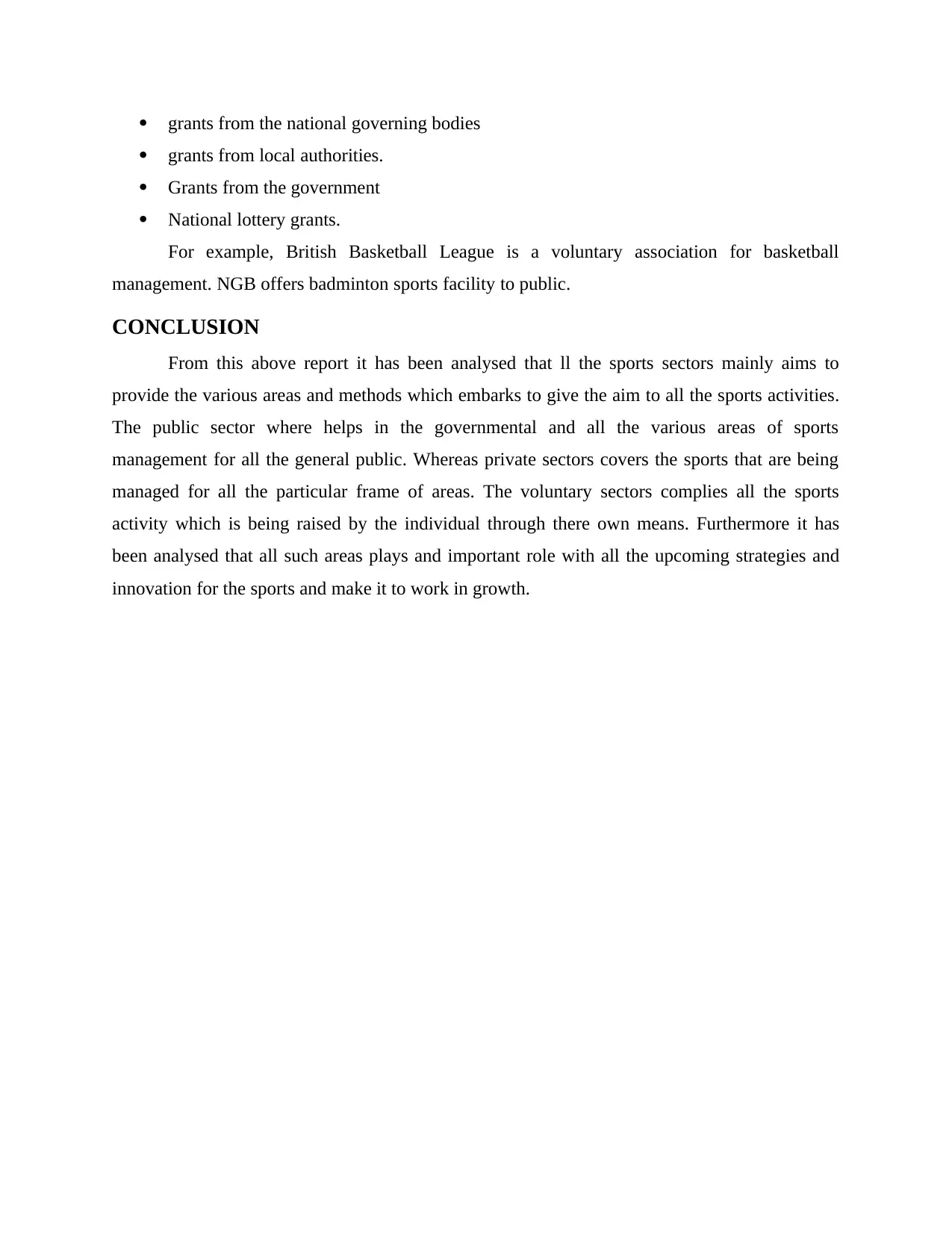
From this above report it has been analysed that ll the sports sectors mainly aims to
provide the various areas and methods which embarks to give the aim to all the sports activities.
The public sector where helps in the governmental and all the various areas of sports
management for all the general public. Whereas private sectors covers the sports that are being
managed for all the particular frame of areas. The voluntary sectors complies all the sports
activity which is being raised by the individual through there own means. Furthermore it has
been analysed that all such areas plays and important role with all the upcoming strategies and
innovation for the sports and make it to work in growth.
Document Page
REFERENCES
Books and Journals
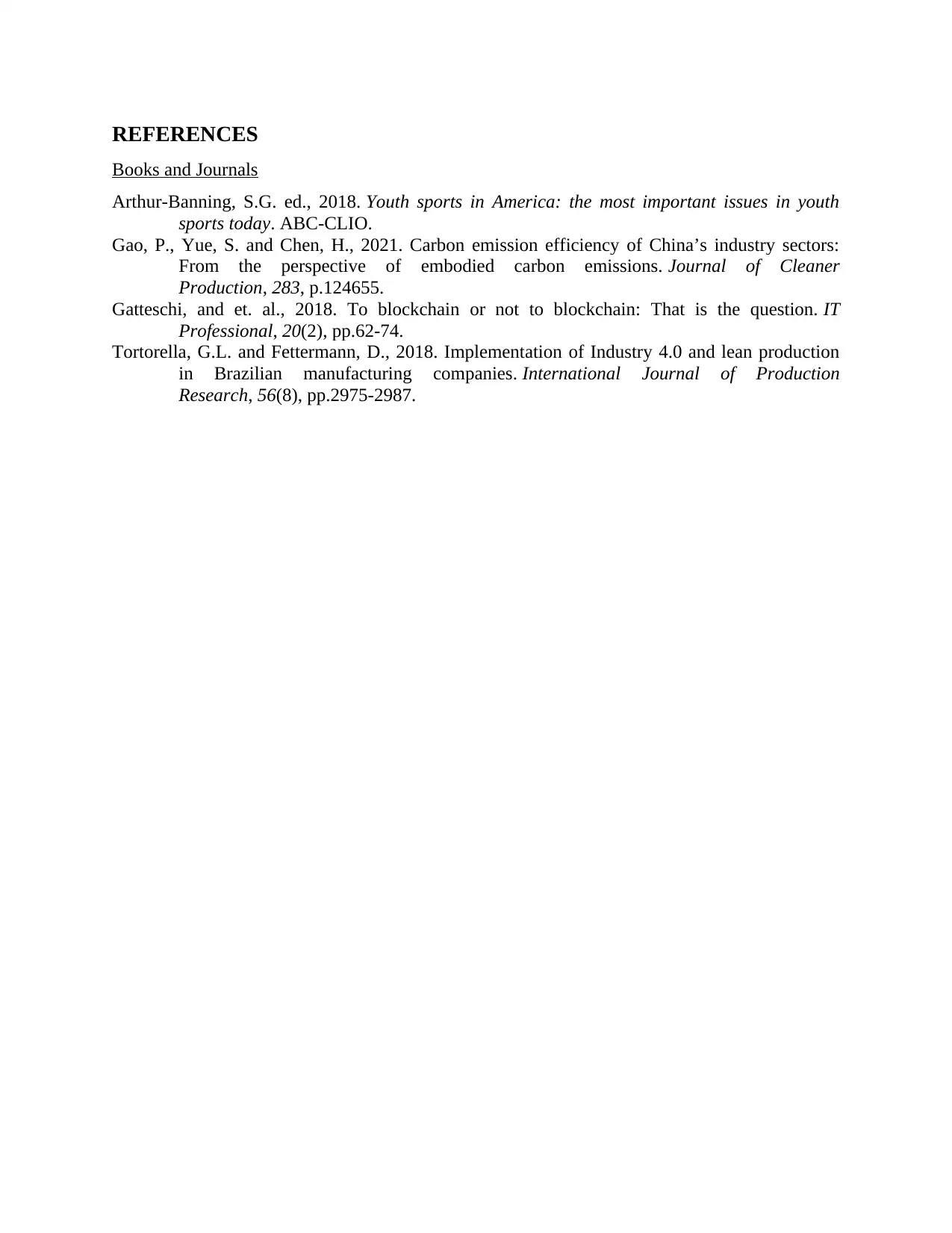
Arthur-Banning, S.G. ed., 2018. Youth sports in America: the most important issues in youth
sports today. ABC-CLIO.
Gao, P., Yue, S. and Chen, H., 2021. Carbon emission efficiency of China’s industry sectors:
From the perspective of embodied carbon emissions. Journal of Cleaner
Production, 283, p.124655.
Gatteschi, and et. al., 2018. To blockchain or not to blockchain: That is the question. IT
Professional, 20(2), pp.62-74.
Tortorella, G.L. and Fettermann, D., 2018. Implementation of Industry 4.0 and lean production
in Brazilian manufacturing companies. International Journal of Production
Research, 56(8), pp.2975-2987.
chevron_up_icon
1 out of 6
circle_padding
hide_on_mobile
zoom_out_icon
[object Object]