Public Sector SCM: Procurement Policies at Humber College, Canada
VerifiedAdded on 2022/10/04
|13
|2786
|36
Report
AI Summary
This report provides a comparative analysis of procurement practices in the public and private sectors, focusing on a case study of Humber College in Ontario, Canada. The research report investigates Humber College's procurement policies, budget, and compliance with legislation, highlighting its responsibility in providing post-secondary education. The comparison report contrasts public and private sector procurement based on regulation, funding, supplier management, interests, value, and management style. It concludes that differing focuses and factors influence procurement activities, with public sectors prioritizing social value and private sectors emphasizing revenue generation. The report recommends that public sectors streamline regulatory research to avoid project delays, while private sectors should focus on adding value to the supply chain.
Running Head: Public Sector SCM
PUBLIC SECTOR SCM
PUBLIC SECTOR SCM

Paraphrase This Document
Need a fresh take? Get an instant paraphrase of this document with our AI Paraphraser
2
Public Sector SCM
Executive summary
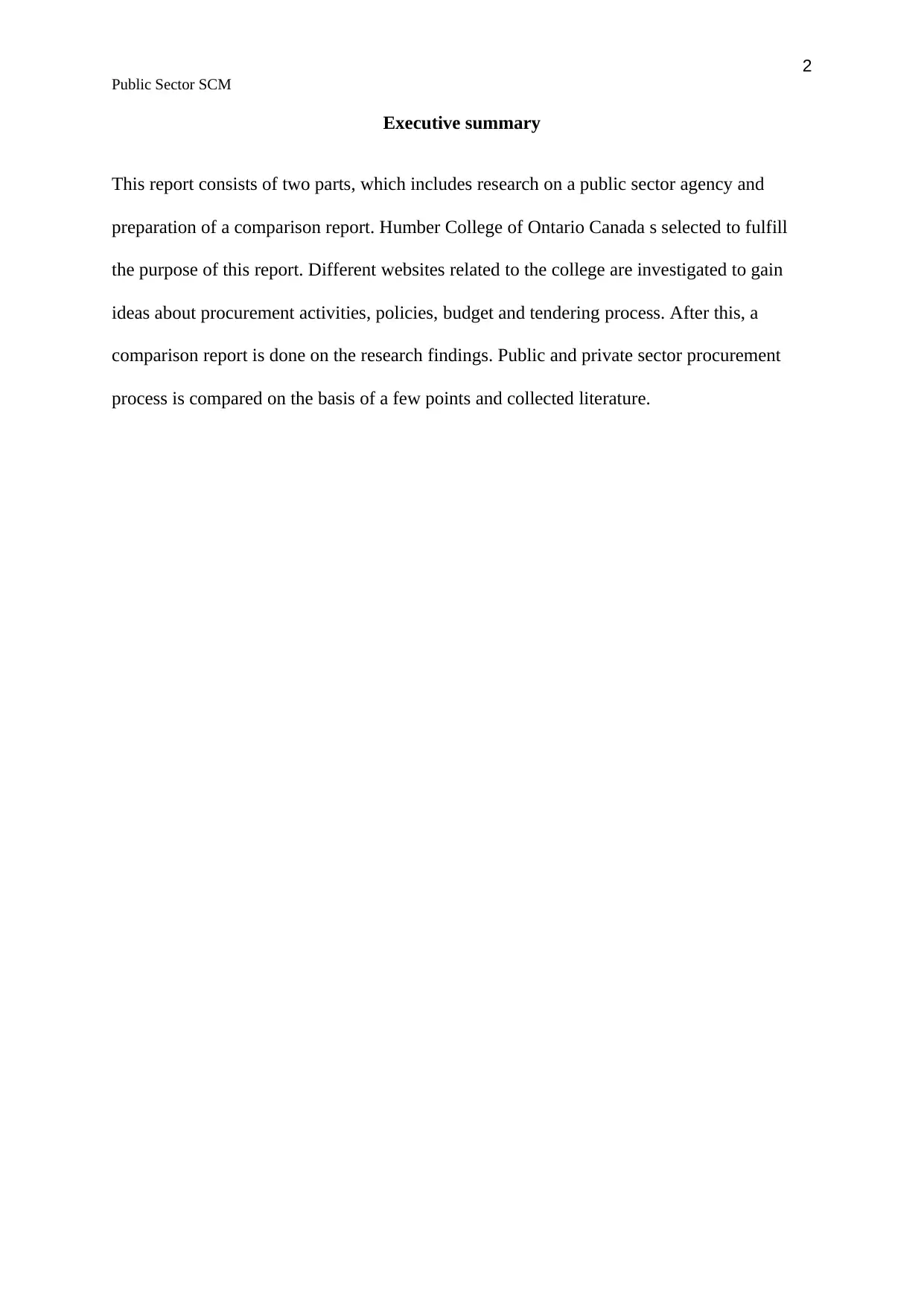
This report consists of two parts, which includes research on a public sector agency and
preparation of a comparison report. Humber College of Ontario Canada s selected to fulfill
the purpose of this report. Different websites related to the college are investigated to gain
ideas about procurement activities, policies, budget and tendering process. After this, a
comparison report is done on the research findings. Public and private sector procurement
process is compared on the basis of a few points and collected literature.
Public Sector SCM
Executive summary
This report consists of two parts, which includes research on a public sector agency and
preparation of a comparison report. Humber College of Ontario Canada s selected to fulfill
the purpose of this report. Different websites related to the college are investigated to gain
ideas about procurement activities, policies, budget and tendering process. After this, a
comparison report is done on the research findings. Public and private sector procurement
process is compared on the basis of a few points and collected literature.
3
Public Sector SCM
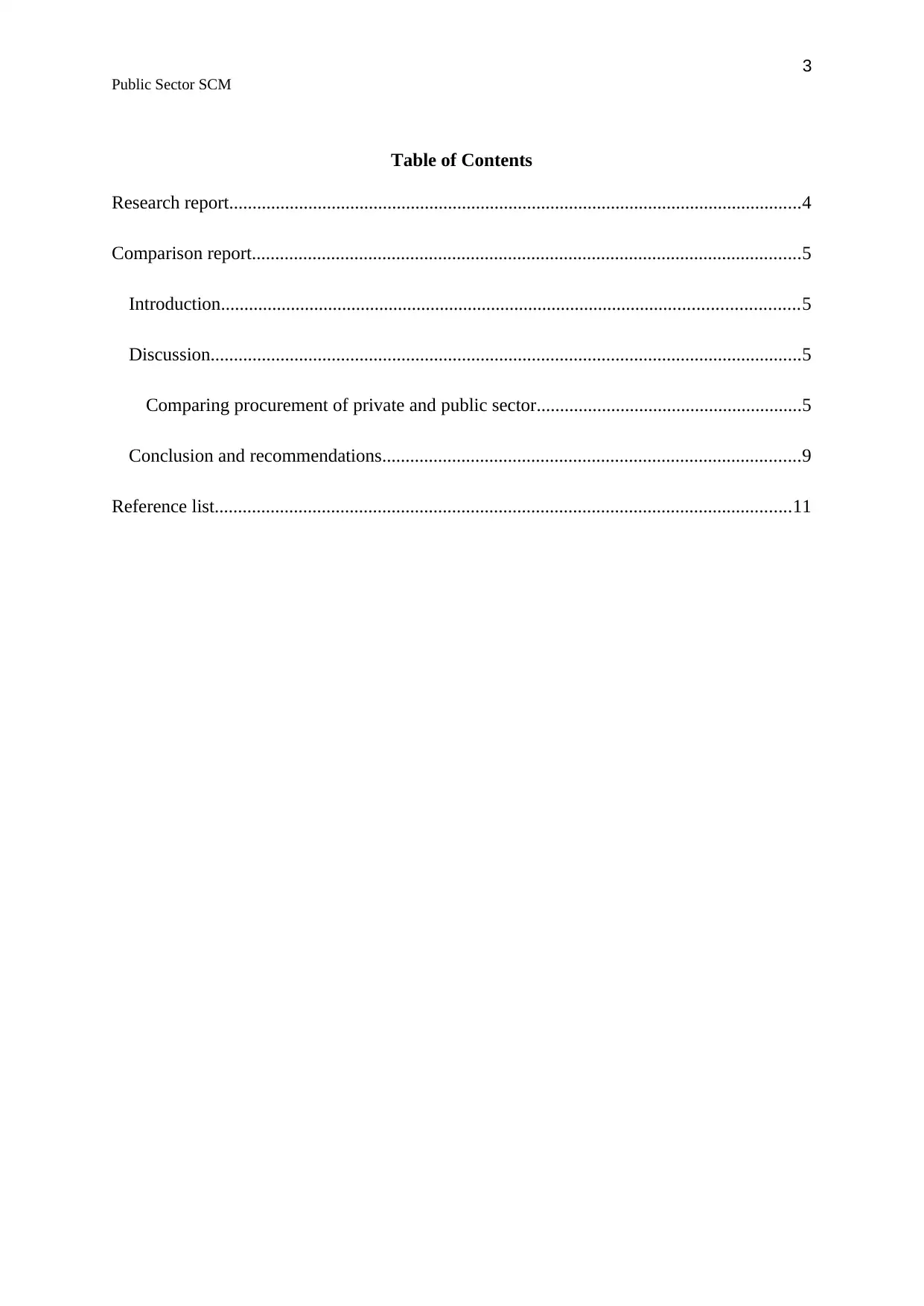
Table of Contents
Research report...........................................................................................................................4
Comparison report......................................................................................................................5
Introduction............................................................................................................................5
Discussion...............................................................................................................................5
Comparing procurement of private and public sector.........................................................5
Conclusion and recommendations..........................................................................................9
Reference list............................................................................................................................11
Public Sector SCM
Table of Contents
Research report...........................................................................................................................4
Comparison report......................................................................................................................5
Introduction............................................................................................................................5
Discussion...............................................................................................................................5
Comparing procurement of private and public sector.........................................................5
Conclusion and recommendations..........................................................................................9
Reference list............................................................................................................................11
⊘ This is a preview!⊘
Do you want full access?
Subscribe today to unlock all pages.

Trusted by 1+ million students worldwide
4
Public Sector SCM
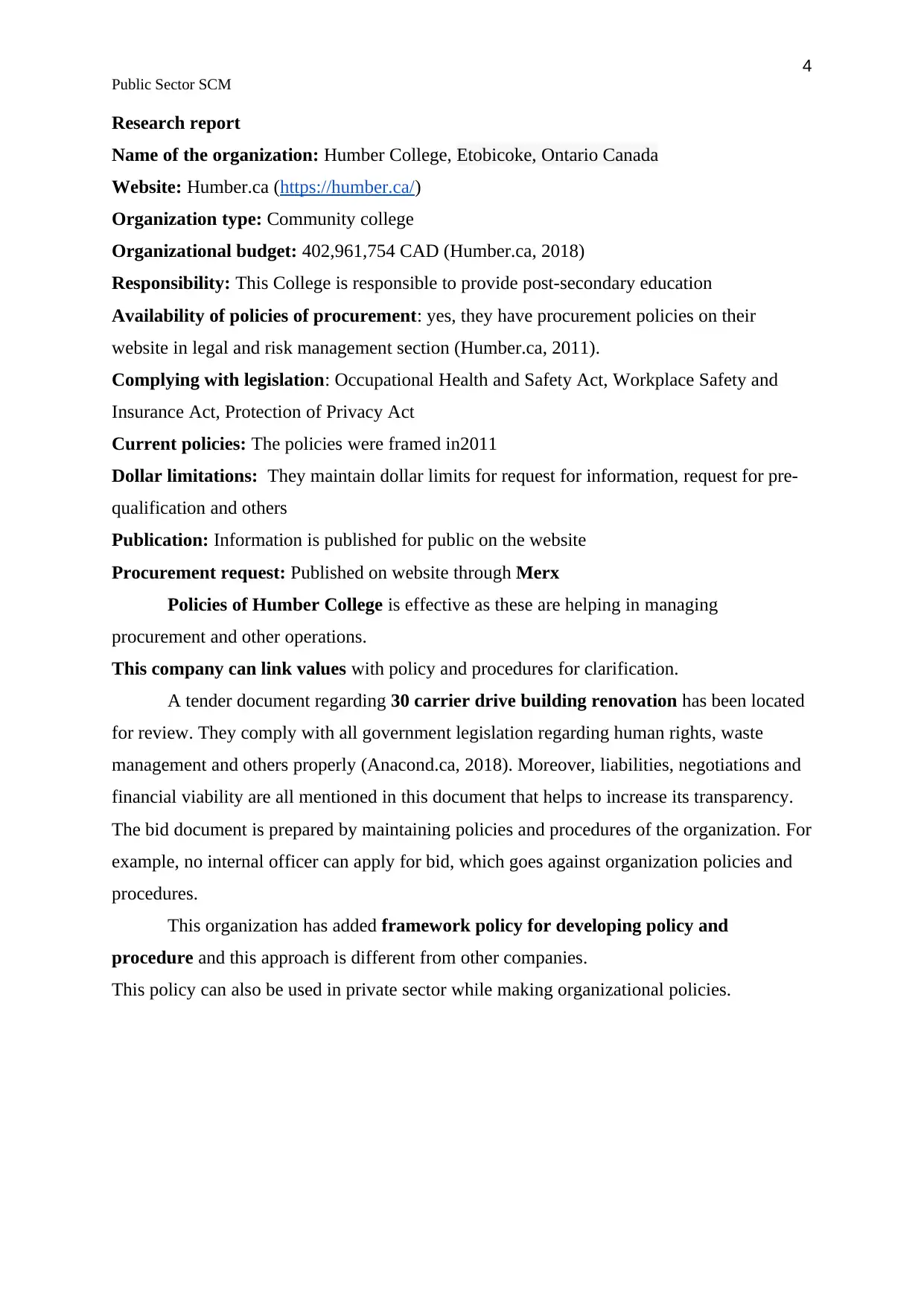
Research report
Name of the organization: Humber College, Etobicoke, Ontario Canada
Website: Humber.ca (https://humber.ca/)
Organization type: Community college
Organizational budget: 402,961,754 CAD (Humber.ca, 2018)
Responsibility: This College is responsible to provide post-secondary education
Availability of policies of procurement: yes, they have procurement policies on their
website in legal and risk management section (Humber.ca, 2011).
Complying with legislation: Occupational Health and Safety Act, Workplace Safety and
Insurance Act, Protection of Privacy Act
Current policies: The policies were framed in2011
Dollar limitations: They maintain dollar limits for request for information, request for pre-
qualification and others
Publication: Information is published for public on the website
Procurement request: Published on website through Merx
Policies of Humber College is effective as these are helping in managing
procurement and other operations.
This company can link values with policy and procedures for clarification.
A tender document regarding 30 carrier drive building renovation has been located
for review. They comply with all government legislation regarding human rights, waste
management and others properly (Anacond.ca, 2018). Moreover, liabilities, negotiations and
financial viability are all mentioned in this document that helps to increase its transparency.
The bid document is prepared by maintaining policies and procedures of the organization. For
example, no internal officer can apply for bid, which goes against organization policies and
procedures.
This organization has added framework policy for developing policy and
procedure and this approach is different from other companies.
This policy can also be used in private sector while making organizational policies.
Public Sector SCM
Research report
Name of the organization: Humber College, Etobicoke, Ontario Canada
Website: Humber.ca (https://humber.ca/)
Organization type: Community college
Organizational budget: 402,961,754 CAD (Humber.ca, 2018)
Responsibility: This College is responsible to provide post-secondary education
Availability of policies of procurement: yes, they have procurement policies on their
website in legal and risk management section (Humber.ca, 2011).
Complying with legislation: Occupational Health and Safety Act, Workplace Safety and
Insurance Act, Protection of Privacy Act
Current policies: The policies were framed in2011
Dollar limitations: They maintain dollar limits for request for information, request for pre-
qualification and others
Publication: Information is published for public on the website
Procurement request: Published on website through Merx
Policies of Humber College is effective as these are helping in managing
procurement and other operations.
This company can link values with policy and procedures for clarification.
A tender document regarding 30 carrier drive building renovation has been located
for review. They comply with all government legislation regarding human rights, waste
management and others properly (Anacond.ca, 2018). Moreover, liabilities, negotiations and
financial viability are all mentioned in this document that helps to increase its transparency.
The bid document is prepared by maintaining policies and procedures of the organization. For
example, no internal officer can apply for bid, which goes against organization policies and
procedures.
This organization has added framework policy for developing policy and
procedure and this approach is different from other companies.
This policy can also be used in private sector while making organizational policies.
Paraphrase This Document
Need a fresh take? Get an instant paraphrase of this document with our AI Paraphraser
5
Public Sector SCM
Comparison report
Introduction
Procurement is an essential part of business and different sectors deal with this part in
different manners. Procurement practices allow organizations to obtain required materials by
agreeing to legal terms and conditions. Procurement practices of private and public sectors
differ in some points. Aim of this report is to compare and contrast procurement of public and
private sector. Basic differences between these kinds of procurement are due to different
ownership. As business goals of public and private sectors are different, they are bound to
maintain different procurement practices. Findings of the research report are required for
comparing these two different kinds of procurement practices.
Discussion
Comparing procurement of private and public sector
Regulation and legislation
Public procurement is bound by regulations and public sector is limited to incorporate
creativity in the procurement due to legislative constraints. For example, The World Trade
Organization plays an important role in case of public procurement. Public organizations like
Humber College, Canada comply with the regulations of The World Trade Organization for
managing their procurement legally. As stated by Johnson, Leenders & McCue (2017),
private sectors have more freedom in managing procurement than the public sector. They are
bound to follow legislation for monitoring bribery and equality. Public organizations are
bound by laws to answer to the government body scrutiny as they get aid from the
government. It can be stated that decision making for procurement of public organizations is
dependent on government bodies. On the contrary, Hueskes, Verhoest & Block (2017) have
mentioned that this duty is not applicable for private sectors. Procurement practices are
determined and discussed within shareholders, board members and owners of private sector
companies. This approach helps this sector to make decisions for procurement independently.
Public Sector SCM
Comparison report
Introduction
Procurement is an essential part of business and different sectors deal with this part in
different manners. Procurement practices allow organizations to obtain required materials by
agreeing to legal terms and conditions. Procurement practices of private and public sectors
differ in some points. Aim of this report is to compare and contrast procurement of public and
private sector. Basic differences between these kinds of procurement are due to different
ownership. As business goals of public and private sectors are different, they are bound to
maintain different procurement practices. Findings of the research report are required for
comparing these two different kinds of procurement practices.
Discussion
Comparing procurement of private and public sector
Regulation and legislation
Public procurement is bound by regulations and public sector is limited to incorporate
creativity in the procurement due to legislative constraints. For example, The World Trade
Organization plays an important role in case of public procurement. Public organizations like
Humber College, Canada comply with the regulations of The World Trade Organization for
managing their procurement legally. As stated by Johnson, Leenders & McCue (2017),
private sectors have more freedom in managing procurement than the public sector. They are
bound to follow legislation for monitoring bribery and equality. Public organizations are
bound by laws to answer to the government body scrutiny as they get aid from the
government. It can be stated that decision making for procurement of public organizations is
dependent on government bodies. On the contrary, Hueskes, Verhoest & Block (2017) have
mentioned that this duty is not applicable for private sectors. Procurement practices are
determined and discussed within shareholders, board members and owners of private sector
companies. This approach helps this sector to make decisions for procurement independently.
6
Public Sector SCM
Public organizations take a lot of time in following regulations and research on
vendors, which causes delay of a certain project. For example, Humber College spent time
and money in researching regulations and due to this reason; they complete projects within a
long period (Humber.ca, 2019). However, Nurmandi & Kim (2015) have mentioned that
private entities invest less amount of time in doing research. They conduct a thorough job of
understanding the vendors before signing any form of procurement contract. This sector does
not need to get approval from government entities while entering into a contract with a
vendor. On the other hand, without having approval of concerned government entities, public
sector companies cannot deal with a vendor of their own. As these sectors are liable to follow
different sets of regulations, procurement processes of these sectors are different.
Funding
Funding is an essential point of comparison between private and public organizations.
Both public and private organizations need to have enough funds for conducting procurement
activities. Public organizations like Humber College depend on government for funding to
procure, which can even cause delay of a certain project. On the other hand, Stiglitz &
Rosengard (2015) contradicted that private organization does fund collection through the help
of revenue from sales, investment in other business areas. This gives them an opportunity to
conduct procurement freely and they are less dependent as compared to public organizations.
However, for both public and private organizations collection of fund before procurement is
essential. As opined by Reijonen, Tammi & Saastamoinen (2016), public organizations
generally depend on federal, state or local governments for funds, which mean that they have
little or no control over the cycle of procurement. Management of public organization need to
wait until the funding department of government disburses funds after collection of tax. This
may also lead to delay in providing payments to suppliers, which can impact on business
Public Sector SCM
Public organizations take a lot of time in following regulations and research on
vendors, which causes delay of a certain project. For example, Humber College spent time
and money in researching regulations and due to this reason; they complete projects within a
long period (Humber.ca, 2019). However, Nurmandi & Kim (2015) have mentioned that
private entities invest less amount of time in doing research. They conduct a thorough job of
understanding the vendors before signing any form of procurement contract. This sector does
not need to get approval from government entities while entering into a contract with a
vendor. On the other hand, without having approval of concerned government entities, public
sector companies cannot deal with a vendor of their own. As these sectors are liable to follow
different sets of regulations, procurement processes of these sectors are different.
Funding
Funding is an essential point of comparison between private and public organizations.
Both public and private organizations need to have enough funds for conducting procurement
activities. Public organizations like Humber College depend on government for funding to
procure, which can even cause delay of a certain project. On the other hand, Stiglitz &
Rosengard (2015) contradicted that private organization does fund collection through the help
of revenue from sales, investment in other business areas. This gives them an opportunity to
conduct procurement freely and they are less dependent as compared to public organizations.
However, for both public and private organizations collection of fund before procurement is
essential. As opined by Reijonen, Tammi & Saastamoinen (2016), public organizations
generally depend on federal, state or local governments for funds, which mean that they have
little or no control over the cycle of procurement. Management of public organization need to
wait until the funding department of government disburses funds after collection of tax. This
may also lead to delay in providing payments to suppliers, which can impact on business
⊘ This is a preview!⊘
Do you want full access?
Subscribe today to unlock all pages.
Trusted by 1+ million students worldwide
7
Public Sector SCM
relationships. However, private organizations invest collected revenue for procurement,
which gives them an upper hand to maintain an effective business relationship.
Funding in public sector organization is a complex process. This involves collection
of approval from concerned government authorities. In the procurement policies of Humber
College, it is mentioned that procurement process is totally subjected to the approval
authority and will follow government directives (Humber.ca, 2019). After only approval of
procurement request, funding is sanctioned. This takes a lot of time as compared to private
companies. In the private sector, procurement decisions are generally taken on general
meetings and funds are sanctioned at a faster rate. However, in private sector government
directives are also maintained while funding to avoid any legal complications.
Identifying and managing suppliers
Private sector organizations generally operate under the policies set by the institution,
which are set for achieving different business goals. Hence, these organizations are able to
source suppliers easily at their own will and offer direct contracts. Hence, communication
process can be done directly and properly. For example, if a private college wants to renovate
a building, then direct contracts can be offered directly to suppliers or bid can be invited upon
favorable terms and conditions. However, in public organizations, identifying suppliers is a
complex process (Lundberg, Marklund & Strömbäck, 2016). This involves checking both
public guidelines and internal guidelines, investigating certification of suppliers and other
regulations. This makes the process complex and creates many challenges for procuring
organization. Humber College has to abide with general principles set by local, federal and
provincial governments for procurement. Moreover, they abide Purchasing Management
Association of Canada (PMAC) code of ethics and guiding principles (Humber.ca, 2011).
Interests and motivations
Public Sector SCM
relationships. However, private organizations invest collected revenue for procurement,
which gives them an upper hand to maintain an effective business relationship.
Funding in public sector organization is a complex process. This involves collection
of approval from concerned government authorities. In the procurement policies of Humber
College, it is mentioned that procurement process is totally subjected to the approval
authority and will follow government directives (Humber.ca, 2019). After only approval of
procurement request, funding is sanctioned. This takes a lot of time as compared to private
companies. In the private sector, procurement decisions are generally taken on general
meetings and funds are sanctioned at a faster rate. However, in private sector government
directives are also maintained while funding to avoid any legal complications.
Identifying and managing suppliers
Private sector organizations generally operate under the policies set by the institution,
which are set for achieving different business goals. Hence, these organizations are able to
source suppliers easily at their own will and offer direct contracts. Hence, communication
process can be done directly and properly. For example, if a private college wants to renovate
a building, then direct contracts can be offered directly to suppliers or bid can be invited upon
favorable terms and conditions. However, in public organizations, identifying suppliers is a
complex process (Lundberg, Marklund & Strömbäck, 2016). This involves checking both
public guidelines and internal guidelines, investigating certification of suppliers and other
regulations. This makes the process complex and creates many challenges for procuring
organization. Humber College has to abide with general principles set by local, federal and
provincial governments for procurement. Moreover, they abide Purchasing Management
Association of Canada (PMAC) code of ethics and guiding principles (Humber.ca, 2011).
Interests and motivations
Paraphrase This Document
Need a fresh take? Get an instant paraphrase of this document with our AI Paraphraser
8
Public Sector SCM
Interest of private and public sectors are different. Private sector companies focus on
the return of investment for ensuring benefit for shareholders. On the other hand, Patrucco et
al. (2017) have mentioned that the main focus of public sector is to add values to the supply
chain and they are not worried about driving revenue. For example, Humber College of
Canada is focusing on providing the best quality services and values with public funds.
Mission of this organization is to help global citizens to obtain knowledge and develop skills
for leading and innovating (Humber.ca, 2019). They are not concerned about competitors and
generating maximum revenue. Rather they have designed their procurement practices for
delivering the best service to the society. Due to this difference, procurement practices of
these two sectors differ from each other. As private sector organizations are competitive by
nature, they do not reveal information regarding their procurement activities. However, Buso,
Marty & Tran (2017) have mentioned that procurement activities of public organizations are
published on the web and it is available for all. Complex objectives and motivations are parts
of public organization and it reflects on their procurement. Relatively simpler motivations
and objectives are found in private sectors.
Getting value
It is an essential point of comparison between procurement activities of public and
private organizations. Both private and public organizations have a similar goal of achieving
value for money upon all procurement activities they conduct. Main focus of both types of
organizations in procurement is to achieve good quality materials at a low cost. For achieving
this, both organizations conduct cost reduction negotiations. Moreover, Jensen &
Dowlatabadi (2018) argued that both public and private organizations serve communities but
in a different way. Public entities aim in selling services at low cost, while private
organizations aim to gain maximum profit by selling products or services. This is because
private organizations generally face great market competition.
Public Sector SCM
Interest of private and public sectors are different. Private sector companies focus on
the return of investment for ensuring benefit for shareholders. On the other hand, Patrucco et
al. (2017) have mentioned that the main focus of public sector is to add values to the supply
chain and they are not worried about driving revenue. For example, Humber College of
Canada is focusing on providing the best quality services and values with public funds.
Mission of this organization is to help global citizens to obtain knowledge and develop skills
for leading and innovating (Humber.ca, 2019). They are not concerned about competitors and
generating maximum revenue. Rather they have designed their procurement practices for
delivering the best service to the society. Due to this difference, procurement practices of
these two sectors differ from each other. As private sector organizations are competitive by
nature, they do not reveal information regarding their procurement activities. However, Buso,
Marty & Tran (2017) have mentioned that procurement activities of public organizations are
published on the web and it is available for all. Complex objectives and motivations are parts
of public organization and it reflects on their procurement. Relatively simpler motivations
and objectives are found in private sectors.
Getting value
It is an essential point of comparison between procurement activities of public and
private organizations. Both private and public organizations have a similar goal of achieving
value for money upon all procurement activities they conduct. Main focus of both types of
organizations in procurement is to achieve good quality materials at a low cost. For achieving
this, both organizations conduct cost reduction negotiations. Moreover, Jensen &
Dowlatabadi (2018) argued that both public and private organizations serve communities but
in a different way. Public entities aim in selling services at low cost, while private
organizations aim to gain maximum profit by selling products or services. This is because
private organizations generally face great market competition.
9
Public Sector SCM
Management style
The supply chain of procurement differs after filtering through a different style of
management. In the public sector, management is generally heavy, which involves lots of
procedure and follows bureaucracy (Thai, 2017). Hence, the process of procurement is
complex and less efficient as compared with private entities. Management of Humber
College consists of board of governors, executive team and government executives, which
makes the management heavy and complex. On the other hand, private entities have lighter
management and generally, a procurement manager reports to the CEO directly. Hence,
procurement decisions are taken properly without any confusion. However, the final decision
is taken by the board of directors and CEO. The legislative bodies and executive team in
public organizations make the procurement process time-bound (Schapper, Malta & Gilbert,
2017). However, less transparency is maintained in private sectors as compared to public
organizations. Reviewing of procurement process by different management boards in public
organizations helps to increase alignment of procurement with legal regulations.
Conclusion and recommendations
From the entire discussion of this comparison report, it can be concluded that different
focus of private and public sector have caused different procurement activities. Procurement
practices of public sectors are designed for adding social value to supply chain. On the other
hand, private sectors drive revenue generation with the help of their effective procurement
activities. Other factors including management style, motivations, interest, and liability to
regulations are different in these sectors and this fact reflects on their procurement practices.
However, it has been found that both of these sectors manage procurement with efficiency
based not a business requirement.
It is recommended that public sectors must reduce their investment of time and budget
on researching regulatory guidelines and it can help them to avoid delays in completing
Public Sector SCM
Management style
The supply chain of procurement differs after filtering through a different style of
management. In the public sector, management is generally heavy, which involves lots of
procedure and follows bureaucracy (Thai, 2017). Hence, the process of procurement is
complex and less efficient as compared with private entities. Management of Humber
College consists of board of governors, executive team and government executives, which
makes the management heavy and complex. On the other hand, private entities have lighter
management and generally, a procurement manager reports to the CEO directly. Hence,
procurement decisions are taken properly without any confusion. However, the final decision
is taken by the board of directors and CEO. The legislative bodies and executive team in
public organizations make the procurement process time-bound (Schapper, Malta & Gilbert,
2017). However, less transparency is maintained in private sectors as compared to public
organizations. Reviewing of procurement process by different management boards in public
organizations helps to increase alignment of procurement with legal regulations.
Conclusion and recommendations
From the entire discussion of this comparison report, it can be concluded that different
focus of private and public sector have caused different procurement activities. Procurement
practices of public sectors are designed for adding social value to supply chain. On the other
hand, private sectors drive revenue generation with the help of their effective procurement
activities. Other factors including management style, motivations, interest, and liability to
regulations are different in these sectors and this fact reflects on their procurement practices.
However, it has been found that both of these sectors manage procurement with efficiency
based not a business requirement.
It is recommended that public sectors must reduce their investment of time and budget
on researching regulatory guidelines and it can help them to avoid delays in completing
⊘ This is a preview!⊘
Do you want full access?
Subscribe today to unlock all pages.
Trusted by 1+ million students worldwide
10
Public Sector SCM
projects. For private sectors, it is recommended to focus on adding value to the supply chain
through improved procurement activities.
Public Sector SCM
projects. For private sectors, it is recommended to focus on adding value to the supply chain
through improved procurement activities.
Paraphrase This Document
Need a fresh take? Get an instant paraphrase of this document with our AI Paraphraser
11
Public Sector SCM
Reference list
Anacond.ca (2018), 30 carrier drive building renovation. Retrieved on 30th September
2019http://www.anacond.ca/wp-content/uploads/2018/10/2018-312P-Final-
RFPPDF.pdf
Buso, M., Marty, F., & Tran, P. T. (2017). Public-private partnerships from budget
constraints: Looking for debt hiding?. International Journal of Industrial
Organization, 51, 56-84. Retrieved from:https://halshs.archives-ouvertes.fr/halshs-
01091725/document
Hueskes, M., Verhoest, K., & Block, T. (2017). Governing public–private partnerships for
sustainability: An analysis of procurement and governance practices of PPP
infrastructure projects. International journal of project management, 35(6), 1184-
1195. Retrieved
from:https://www.sciencedirect.com/science/article/pii/S0263786317302557
Humber.ca (2011), Policies and procedures, Retrieved on 30th September 2019
from:https://humber.ca/legal-and-risk-management/policies/general-administration/
purchasing-policy.html
Humber.ca. (2019). 2017-2018 Annual report. Retrieved on 28th September 2019,
from:https://humber.ca/about-humber/corporate-info/publications/files/humber-
annual-report-17-18.pdf
Humber.ca. (2019). Doing business with Humber. Retrieved on 28th September 2019,
from:http://humber.ca/purchasing/doingbusiness.php
Humber.ca. (2019). Home. Retrieved on 28th September 2019, from:https://humber.ca/
Jensen, T., & Dowlatabadi, H. (2018). Challenges in financing public sector low-carbon
initiatives: lessons from private finance for a school district in British Columbia,
Canada. Climate policy, 18(7), 878-888. Retrieved
from:https://www.tandfonline.com/doi/abs/10.1080/14693062.2017.1387512
Public Sector SCM
Reference list
Anacond.ca (2018), 30 carrier drive building renovation. Retrieved on 30th September
2019http://www.anacond.ca/wp-content/uploads/2018/10/2018-312P-Final-
RFPPDF.pdf
Buso, M., Marty, F., & Tran, P. T. (2017). Public-private partnerships from budget
constraints: Looking for debt hiding?. International Journal of Industrial
Organization, 51, 56-84. Retrieved from:https://halshs.archives-ouvertes.fr/halshs-
01091725/document
Hueskes, M., Verhoest, K., & Block, T. (2017). Governing public–private partnerships for
sustainability: An analysis of procurement and governance practices of PPP
infrastructure projects. International journal of project management, 35(6), 1184-
1195. Retrieved
from:https://www.sciencedirect.com/science/article/pii/S0263786317302557
Humber.ca (2011), Policies and procedures, Retrieved on 30th September 2019
from:https://humber.ca/legal-and-risk-management/policies/general-administration/
purchasing-policy.html
Humber.ca. (2019). 2017-2018 Annual report. Retrieved on 28th September 2019,
from:https://humber.ca/about-humber/corporate-info/publications/files/humber-
annual-report-17-18.pdf
Humber.ca. (2019). Doing business with Humber. Retrieved on 28th September 2019,
from:http://humber.ca/purchasing/doingbusiness.php
Humber.ca. (2019). Home. Retrieved on 28th September 2019, from:https://humber.ca/
Jensen, T., & Dowlatabadi, H. (2018). Challenges in financing public sector low-carbon
initiatives: lessons from private finance for a school district in British Columbia,
Canada. Climate policy, 18(7), 878-888. Retrieved
from:https://www.tandfonline.com/doi/abs/10.1080/14693062.2017.1387512
12
Public Sector SCM
Johnson, P. F., Leenders, M. R., & McCue, C. (2017). A comparison of purchasing’s
organizational roles and responsibilities in the public and private sector. Journal of
Public Procurement, 3(1), 57-74. Retrieved
from:https://www.researchgate.net/profile/Clifford_Mccue/publication/
265108836_A_Comparison_of_Purchasing's_Organizational_Roles_and_Responsibili
ties_in_the_Public_and_Private_Sector/links/5540b6fb0cf2718618da8d54.pdf
Lundberg, S., Marklund, P. O., & Strömbäck, E. (2016). Is environmental policy by public
procurement effective?. Public Finance Review, 44(4), 478-499. Retrieved
from:http://www.diva-portal.org/smash/record.jsf?pid=diva2:817783
Nurmandi, A., & Kim, S. (2015). Making e-procurement work in a decentralized procurement
system: A comparison of three Indonesian cities. International Journal of Public
Sector Management, 28(3), 198-220. Retrieved
from:https://www.emeraldinsight.com/doi/pdfplus/10.1108/IJPSM-03-2015-0035
Patrucco, A. S., Luzzini, D., Ronchi, S., Essig, M., Amann, M., & Glas, A. H. (2017).
Designing a public procurement strategy: lessons from local governments. Public
Money & Management, 37(4), 269-276. Retrieved
from:https://www.researchgate.net/profile/Andrea_Stefano_Patrucco/publication/
315768346_Designing_a_public_procurement_strategy_lessons_from_local_governm
ents/links/59ef5519458515ec0c7b5d79/Designing-a-public-procurement-strategy-
lessons-from-local-governments.pdf
Reijonen, H., Tammi, T., & Saastamoinen, J. (2016). SMEs and public sector procurement:
Does entrepreneurial orientation make a difference?. International Small Business
Journal, 34(4), 468-486. Retrieved
from:https://journals.sagepub.com/doi/abs/10.1177/0266242614556661
Public Sector SCM
Johnson, P. F., Leenders, M. R., & McCue, C. (2017). A comparison of purchasing’s
organizational roles and responsibilities in the public and private sector. Journal of
Public Procurement, 3(1), 57-74. Retrieved
from:https://www.researchgate.net/profile/Clifford_Mccue/publication/
265108836_A_Comparison_of_Purchasing's_Organizational_Roles_and_Responsibili
ties_in_the_Public_and_Private_Sector/links/5540b6fb0cf2718618da8d54.pdf
Lundberg, S., Marklund, P. O., & Strömbäck, E. (2016). Is environmental policy by public
procurement effective?. Public Finance Review, 44(4), 478-499. Retrieved
from:http://www.diva-portal.org/smash/record.jsf?pid=diva2:817783
Nurmandi, A., & Kim, S. (2015). Making e-procurement work in a decentralized procurement
system: A comparison of three Indonesian cities. International Journal of Public
Sector Management, 28(3), 198-220. Retrieved
from:https://www.emeraldinsight.com/doi/pdfplus/10.1108/IJPSM-03-2015-0035
Patrucco, A. S., Luzzini, D., Ronchi, S., Essig, M., Amann, M., & Glas, A. H. (2017).
Designing a public procurement strategy: lessons from local governments. Public
Money & Management, 37(4), 269-276. Retrieved
from:https://www.researchgate.net/profile/Andrea_Stefano_Patrucco/publication/
315768346_Designing_a_public_procurement_strategy_lessons_from_local_governm
ents/links/59ef5519458515ec0c7b5d79/Designing-a-public-procurement-strategy-
lessons-from-local-governments.pdf
Reijonen, H., Tammi, T., & Saastamoinen, J. (2016). SMEs and public sector procurement:
Does entrepreneurial orientation make a difference?. International Small Business
Journal, 34(4), 468-486. Retrieved
from:https://journals.sagepub.com/doi/abs/10.1177/0266242614556661
⊘ This is a preview!⊘
Do you want full access?
Subscribe today to unlock all pages.
Trusted by 1+ million students worldwide

1 out of 13


Your All-in-One AI-Powered Toolkit for Academic Success.
+13062052269
info@desklib.com
Available 24*7 on WhatsApp / Email
![[object Object]](/_next/static/media/star-bottom.7253800d.svg)
Unlock your academic potential
Copyright © 2020–2026 A2Z Services. All Rights Reserved. Developed and managed by ZUCOL.