Pupil Referral Units and Student Success: A Research Report Analysis

Verified

Added on  2020/06/06

|1
|2136
|159
Report
AI Summary
This report presents a research proposal and analysis focusing on Pupil Referral Units (PRUs) as alternative education settings. It examines the theoretical underpinnings, including motivational theories and change management models, and outlines a detailed research methodology involving semi-structured interviews with students aged 12-16. The report reviews existing literature, highlighting concerns about the quality of alternative provision and the need to understand student perspectives on enablers and barriers to positive outcomes. It proposes research questions to assess the appropriateness of PRUs, provisional outcomes, and potential barriers to future success, aiming to explore whether alternative educational provision puts pupils on the path to success in adulthood. The research timeline spans 17 weeks, including literature review, data collection, analysis, and report writing, with the ultimate goal of understanding the impact of PRUs and informing improvements in educational practices. The report also references several key studies that discuss the impact of pupil exclusion and alternative education.
Document Page
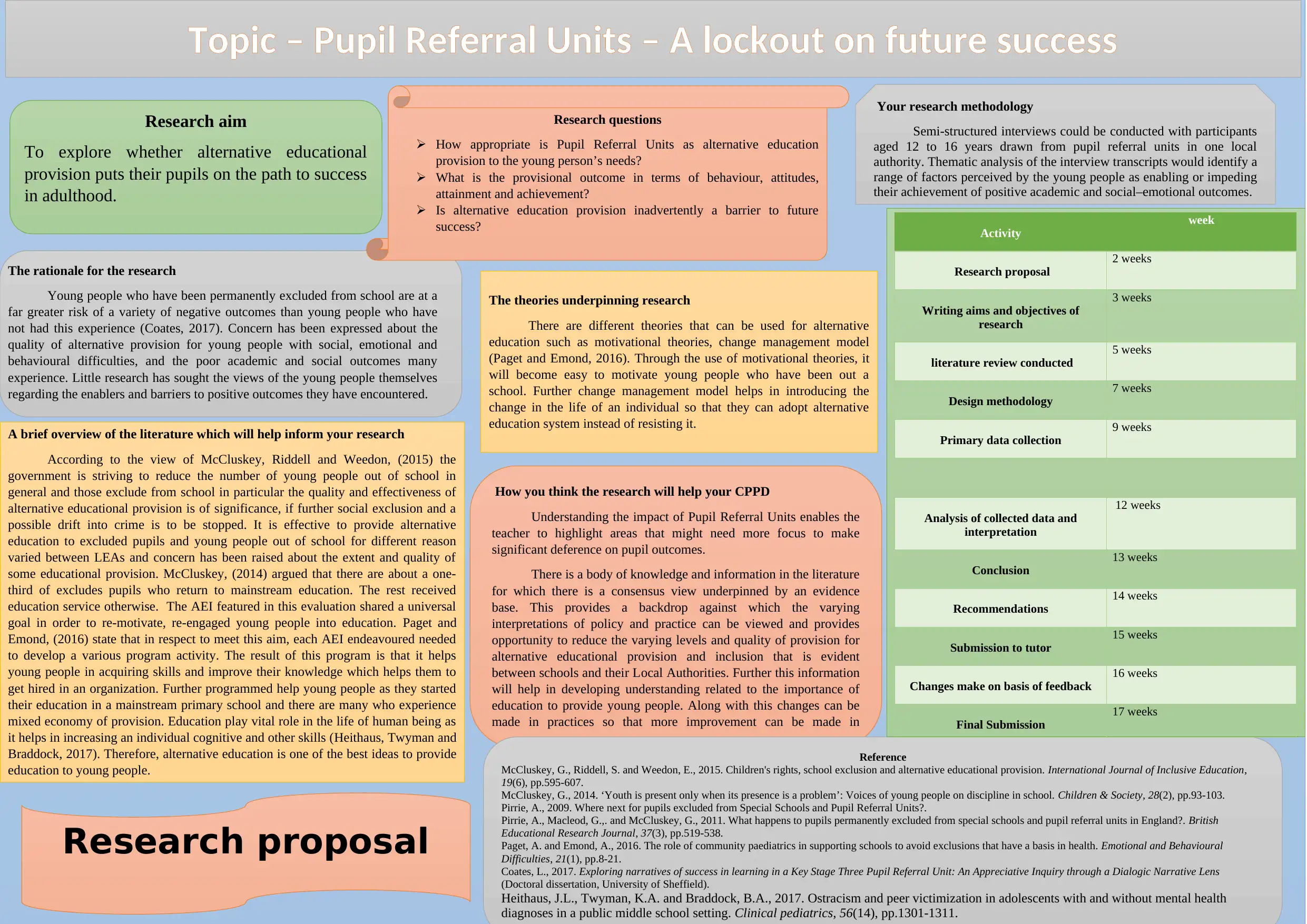
Topic – Pupil Referral Units – A lockout on future success
Research aim
To explore whether alternative educational
provision puts their pupils on the path to success
in adulthood.
The rationale for the research
Young people who have been permanently excluded from school are at a
far greater risk of a variety of negative outcomes than young people who have
not had this experience (Coates, 2017). Concern has been expressed about the
quality of alternative provision for young people with social, emotional and
behavioural difficulties, and the poor academic and social outcomes many
experience. Little research has sought the views of the young people themselves
regarding the enablers and barriers to positive outcomes they have encountered.
Research questions
How appropriate is Pupil Referral Units as alternative education
provision to the young person’s needs?
What is the provisional outcome in terms of behaviour, attitudes,
attainment and achievement?
Is alternative education provision inadvertently a barrier to future
success?
The theories underpinning research
There are different theories that can be used for alternative
education such as motivational theories, change management model
(Paget and Emond, 2016). Through the use of motivational theories, it
will become easy to motivate young people who have been out a
school. Further change management model helps in introducing the
change in the life of an individual so that they can adopt alternative
education system instead of resisting it.
Your research methodology
Semi-structured interviews could be conducted with participants
aged 12 to 16 years drawn from pupil referral units in one local
authority. Thematic analysis of the interview transcripts would identify a
range of factors perceived by the young people as enabling or impeding
their achievement of positive academic and social–emotional outcomes.
How you think the research will help your CPPD
Understanding the impact of Pupil Referral Units enables the
teacher to highlight areas that might need more focus to make
significant deference on pupil outcomes.
There is a body of knowledge and information in the literature
for which there is a consensus view underpinned by an evidence
base. This provides a backdrop against which the varying
interpretations of policy and practice can be viewed and provides
opportunity to reduce the varying levels and quality of provision for
alternative educational provision and inclusion that is evident
between schools and their Local Authorities. Further this information
will help in developing understanding related to the importance of
education to provide young people. Along with this changes can be
made in practices so that more improvement can be made in
alternative educational services
Reference
McCluskey, G., Riddell, S. and Weedon, E., 2015. Children's rights, school exclusion and alternative educational provision. International Journal of Inclusive Education,
19(6), pp.595-607.
McCluskey, G., 2014. ‘Youth is present only when its presence is a problem’: Voices of young people on discipline in school. Children & Society, 28(2), pp.93-103.
Pirrie, A., 2009. Where next for pupils excluded from Special Schools and Pupil Referral Units?.
Pirrie, A., Macleod, G.,. and McCluskey, G., 2011. What happens to pupils permanently excluded from special schools and pupil referral units in England?. British
Educational Research Journal, 37(3), pp.519-538.
Paget, A. and Emond, A., 2016. The role of community paediatrics in supporting schools to avoid exclusions that have a basis in health. Emotional and Behavioural
Difficulties, 21(1), pp.8-21.
Coates, L., 2017. Exploring narratives of success in learning in a Key Stage Three Pupil Referral Unit: An Appreciative Inquiry through a Dialogic Narrative Lens
(Doctoral dissertation, University of Sheffield).
Heithaus, J.L., Twyman, K.A. and Braddock, B.A., 2017. Ostracism and peer victimization in adolescents with and without mental health
diagnoses in a public middle school setting. Clinical pediatrics, 56(14), pp.1301-1311.
A brief overview of the literature which will help inform your research
According to the view of McCluskey, Riddell and Weedon, (2015) the
government is striving to reduce the number of young people out of school in
general and those exclude from school in particular the quality and effectiveness of
alternative educational provision is of significance, if further social exclusion and a
possible drift into crime is to be stopped. It is effective to provide alternative
education to excluded pupils and young people out of school for different reason
varied between LEAs and concern has been raised about the extent and quality of
some educational provision. McCluskey, (2014) argued that there are about a one-
third of excludes pupils who return to mainstream education. The rest received
education service otherwise. The AEI featured in this evaluation shared a universal
goal in order to re-motivate, re-engaged young people into education. Paget and
Emond, (2016) state that in respect to meet this aim, each AEI endeavoured needed
to develop a various program activity. The result of this program is that it helps
young people in acquiring skills and improve their knowledge which helps them to
get hired in an organization. Further programmed help young people as they started
their education in a mainstream primary school and there are many who experience
mixed economy of provision. Education play vital role in the life of human being as
it helps in increasing an individual cognitive and other skills (Heithaus, Twyman and
Braddock, 2017). Therefore, alternative education is one of the best ideas to provide
education to young people.
Activity
week
Research proposal
2 weeks
Writing aims and objectives of
research
3 weeks
literature review conducted
5 weeks
Design methodology
7 weeks
Primary data collection
9 weeks
Analysis of collected data and
interpretation
12 weeks
Conclusion
13 weeks
Recommendations
14 weeks
Submission to tutor
15 weeks
Changes make on basis of feedback
16 weeks
Final Submission
17 weeks
Research proposal
tabler-icon-diamond-filled.svg

Paraphrase This Document

Need a fresh take? Get an instant paraphrase of this document with our AI Paraphraser
[object Object]