Analysis of Purchasing Management at Starbucks: A Comprehensive Review
VerifiedAdded on 2022/11/22
|11
|2774
|223
Report
AI Summary
This report provides a comprehensive analysis of Starbucks' purchasing management practices, focusing on supplier selection criteria, cost analysis, and the integration of Information and Communication Technology (ICT) in its operations. The analysis begins with an introduction to purchasing management and its importance in business organizations, followed by an overview of Starbucks' background and its position in the coffee industry. The report delves into Starbucks' supplier selection process, highlighting its criteria for choosing coffee bean suppliers, including the importance of premier Arabica beans, climate considerations, and research and development programs. It also examines the company's C.A.F.E. Practices program, which sets environmental, social, and economic guidelines for suppliers. The report further discusses the role of ICT in improving purchasing operations, including streamlining processes, increasing information access, and facilitating internal and external communication. The analysis then shifts to a detailed examination of Starbucks' purchasing cost analysis, including the rise in costs, cost drivers, and the strategies the company has implemented to reduce costs, such as supply chain reorganization, outsourcing, and focus on key performance indicators. The report concludes by summarizing the key findings and emphasizing the importance of effective purchasing management for Starbucks' success.

Running head: PURCHASING MANAGEMENT ANALYSIS
PURCHASING MANAGEMENT ANALYSIS
Name of the Student
Name of the University
Author Note
PURCHASING MANAGEMENT ANALYSIS
Name of the Student
Name of the University
Author Note

Paraphrase This Document
Need a fresh take? Get an instant paraphrase of this document with our AI Paraphraser
1PURCHASING MANAGEMENT ANALYSIS
Introduction
As discussed by Dabhilkar, Bengtsson and Lakemond (2016), purchasing
management is considered to be a vital component for the operations of business
organizations. The companies are able to recognise high levels of cost savings that mainly
takes place due to effective decisions related to purchasing. The poor purchasing based
decisions can also lead to disasters that have an impact on the operations of various
organizations. The costs related to development of products can be controlled effectively with
the support of proper cost control techniques. The managers tend to analyse the suppliers who
are selling various inputs that are considered to be important for proper manufacture of the
products (Gadde & Wynstra, 2018).
The essay will be based on the ways by which an organization is able to select the
suppliers and develop the purchasing goals as well. The use of ICT in the purchasing
operations will be able discussed in the essay in detail with respect to the information related
to operations of the firm. The organization that has been selected for analysis of purchasing
management activities is Starbucks. The purchasing management based activities that are
performed by Starbucks will also be discussed in the essay (González-Benito et al., 2016).
Starbucks Corporation is a coffee based company of American origin that was
established in Seattle, Washington in the year 1971. Starbucks has developed its position as a
major representative as “second wave coffee” that is a movement which has popularized
coffee in different parts of the world. The purchasing management process that is used by
Starbucks will be mainly discussed in the essay in detail (Starbucks.com. 2019). The use of
ICT in the purchasing management process of Starbucks is also an important part of the
analysis that will be made in the essay.
Supplier selection criteria and issues
Introduction
As discussed by Dabhilkar, Bengtsson and Lakemond (2016), purchasing
management is considered to be a vital component for the operations of business
organizations. The companies are able to recognise high levels of cost savings that mainly
takes place due to effective decisions related to purchasing. The poor purchasing based
decisions can also lead to disasters that have an impact on the operations of various
organizations. The costs related to development of products can be controlled effectively with
the support of proper cost control techniques. The managers tend to analyse the suppliers who
are selling various inputs that are considered to be important for proper manufacture of the
products (Gadde & Wynstra, 2018).
The essay will be based on the ways by which an organization is able to select the
suppliers and develop the purchasing goals as well. The use of ICT in the purchasing
operations will be able discussed in the essay in detail with respect to the information related
to operations of the firm. The organization that has been selected for analysis of purchasing
management activities is Starbucks. The purchasing management based activities that are
performed by Starbucks will also be discussed in the essay (González-Benito et al., 2016).
Starbucks Corporation is a coffee based company of American origin that was
established in Seattle, Washington in the year 1971. Starbucks has developed its position as a
major representative as “second wave coffee” that is a movement which has popularized
coffee in different parts of the world. The purchasing management process that is used by
Starbucks will be mainly discussed in the essay in detail (Starbucks.com. 2019). The use of
ICT in the purchasing management process of Starbucks is also an important part of the
analysis that will be made in the essay.
Supplier selection criteria and issues

2PURCHASING MANAGEMENT ANALYSIS
The CEO of Starbucks Mr. Howard Schultz has always stated that the company is not
interested in the vertical integration of the supply chain. Currently Starbucks purchases coffee
from more than 300,000 growers in different parts of the world. Starbucks has also developed
plans with respect to the changes that can be made in manufacturing strategy implemented by
the firm. The suppliers of Starbucks are mainly selected by the organization with respect to
the premier Arabica beans that are used for improving the taste of coffee (Starbucks.com.
2019).
The coffee beans that are used for making the coffee of Starbucks mainly thrive in the
high elevation based climate. The organization has selected the suppliers with respect to the
fertility of the land and temperature levels of the areas as well. The research and development
based programs that have been owned by Starbucks are helpful for generating the coffee
seeds which have the ability to resist the current diseases and pests that can inflict the crops.
Starbucks is thereby able to experiment with various types of coffee beans as the organization
owns the farms (Jääskeläinen, 2018).
The suppliers of Starbucks are considered to be the direct recipients of payments that
are provided for the coffee beans and the organization currently sources the coffee from more
than 300000 growers in different parts of the world. The selection process of Starbucks has
been established as an internal program that has been named as Coffee and Farmers Equity or
C.A.F.E Practices. This is also considered to be a selection of the environmental, social and
economic coffee based guidelines that are able to support the farmers and the coffee buyers
as well (Jääskeläinen & Heikkilä, 2019).
The high quality coffee that are provided to Starbucks by the suppliers are able to
promote the long term based equitable relationships. The organization has also used verifiers
who are third party approved and are able to assess the coffee based supply chains against
The CEO of Starbucks Mr. Howard Schultz has always stated that the company is not
interested in the vertical integration of the supply chain. Currently Starbucks purchases coffee
from more than 300,000 growers in different parts of the world. Starbucks has also developed
plans with respect to the changes that can be made in manufacturing strategy implemented by
the firm. The suppliers of Starbucks are mainly selected by the organization with respect to
the premier Arabica beans that are used for improving the taste of coffee (Starbucks.com.
2019).
The coffee beans that are used for making the coffee of Starbucks mainly thrive in the
high elevation based climate. The organization has selected the suppliers with respect to the
fertility of the land and temperature levels of the areas as well. The research and development
based programs that have been owned by Starbucks are helpful for generating the coffee
seeds which have the ability to resist the current diseases and pests that can inflict the crops.
Starbucks is thereby able to experiment with various types of coffee beans as the organization
owns the farms (Jääskeläinen, 2018).
The suppliers of Starbucks are considered to be the direct recipients of payments that
are provided for the coffee beans and the organization currently sources the coffee from more
than 300000 growers in different parts of the world. The selection process of Starbucks has
been established as an internal program that has been named as Coffee and Farmers Equity or
C.A.F.E Practices. This is also considered to be a selection of the environmental, social and
economic coffee based guidelines that are able to support the farmers and the coffee buyers
as well (Jääskeläinen & Heikkilä, 2019).
The high quality coffee that are provided to Starbucks by the suppliers are able to
promote the long term based equitable relationships. The organization has also used verifiers
who are third party approved and are able to assess the coffee based supply chains against
⊘ This is a preview!⊘
Do you want full access?
Subscribe today to unlock all pages.

Trusted by 1+ million students worldwide
3PURCHASING MANAGEMENT ANALYSIS
internal C.A.F.E. based practices and evaluation guidelines. The social responsibility of
suppliers is considered to be highly important by Starbucks in order to maintain the
operations (Starbucks.com. 2019). The critical issues that are considered by Starbucks with
respect to the social responsibility of the firm are,
Transparency of the suppliers of the operations, processes, company records
and the policies.
Suppliers need to provide a healthy and safe working environment for the
employees.
The rights of workers and treatment provided to them needs to be set out in a
clear way (Starbucks.com. 2019).
The compensation and worker hours have to be made clear to the employees.
The suppliers of Starbucks have to comply with the local environmental laws
totally and conduct the operations in such a manner that is helpful in
conserving the resources (Starbucks.com. 2019).
The supplier guidelines that have been developed by Starbucks do not require high
levels of improvement as the company is mainly known for the comprehensive nature of the
guidelines that are offered to the employees (Johnsen, Howard & Miemczyk, 2018).
ICT for Purchasing Operations
Goals and Progress of Starbucks – Coffee Purchasing
The success gained by Starbucks is mainly related to the levels of growth of the
farmers who grow the coffee beans. Major goal that has been set by Starbucks is mainly
based on the long term based supply of the high-quality coffee with the help of responsible
coffee purchasing based practices. The company has made investments in the communities
internal C.A.F.E. based practices and evaluation guidelines. The social responsibility of
suppliers is considered to be highly important by Starbucks in order to maintain the
operations (Starbucks.com. 2019). The critical issues that are considered by Starbucks with
respect to the social responsibility of the firm are,
Transparency of the suppliers of the operations, processes, company records
and the policies.
Suppliers need to provide a healthy and safe working environment for the
employees.
The rights of workers and treatment provided to them needs to be set out in a
clear way (Starbucks.com. 2019).
The compensation and worker hours have to be made clear to the employees.
The suppliers of Starbucks have to comply with the local environmental laws
totally and conduct the operations in such a manner that is helpful in
conserving the resources (Starbucks.com. 2019).
The supplier guidelines that have been developed by Starbucks do not require high
levels of improvement as the company is mainly known for the comprehensive nature of the
guidelines that are offered to the employees (Johnsen, Howard & Miemczyk, 2018).
ICT for Purchasing Operations
Goals and Progress of Starbucks – Coffee Purchasing
The success gained by Starbucks is mainly related to the levels of growth of the
farmers who grow the coffee beans. Major goal that has been set by Starbucks is mainly
based on the long term based supply of the high-quality coffee with the help of responsible
coffee purchasing based practices. The company has made investments in the communities
Paraphrase This Document
Need a fresh take? Get an instant paraphrase of this document with our AI Paraphraser
4PURCHASING MANAGEMENT ANALYSIS
and the farmers in order to source the best levels of raw materials. The fluctuations that have
been depicted in the commodity prices in the year 2011 had made the purchasing of coffee
highly challenging in nature (Starbucks.com. 2019).
The coffee beans are sourced by Starbucks in an ethical manner and the growth
process is considered to be responsible in nature. The cornerstone of the approach of
Starbucks related to the proper development of goals is related to C.A.F.E. or Coffee and
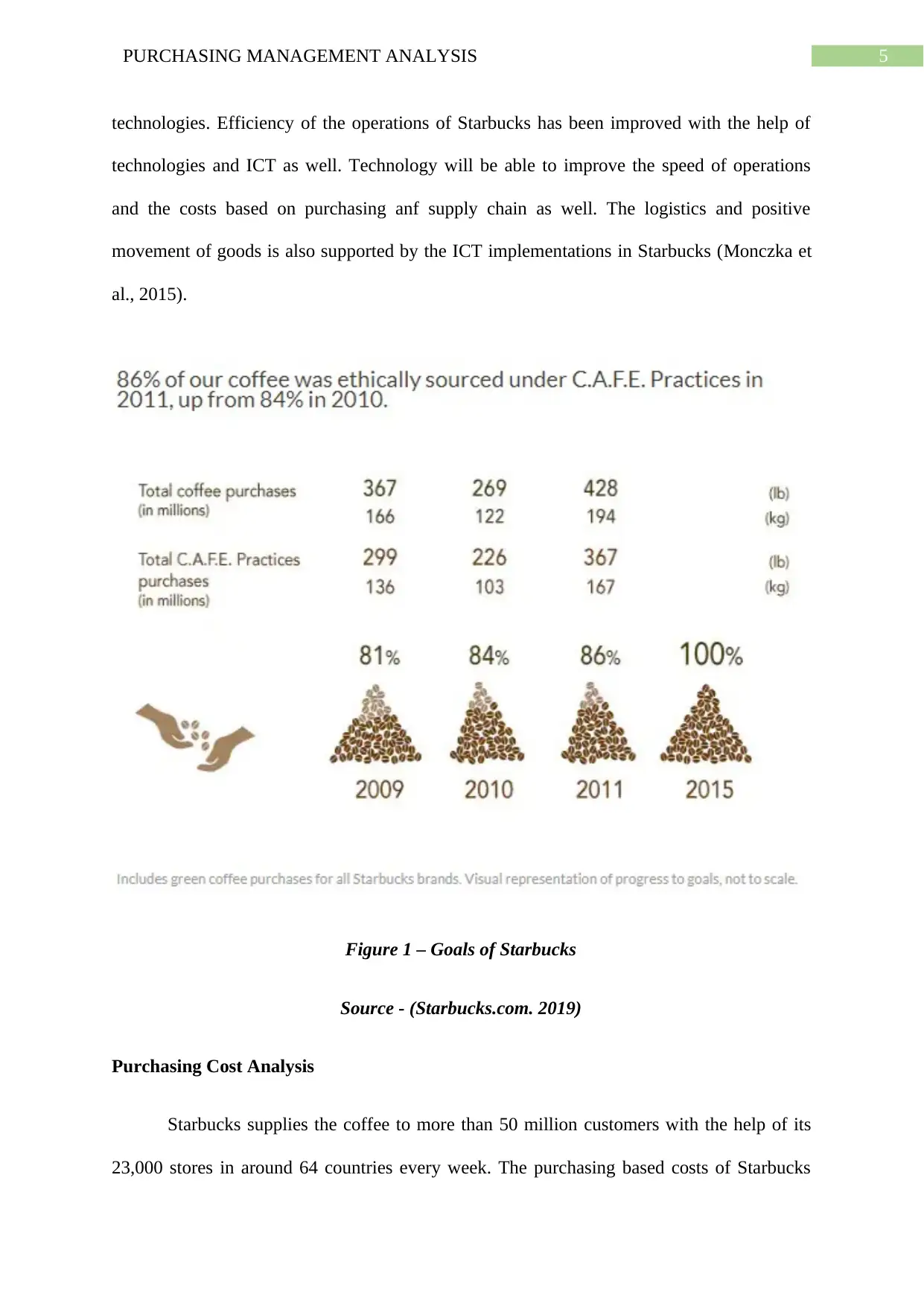
Farmer Equity Practices. By the year 2015 the major goal that has been set by the
organization was that 100% of the coffee will be sourced ethically (Starbucks.com. 2019).
Purchasing the third party certified coffee or verified coffee is helpful for the organization to
meet needs of the customers and the protecting the environment as well. The model of green
coffee pricing aims at paying prices for the premium quality coffee demands (Luzzini et al.,
2015).
Use of ICT in purchasing operations
The use of ICT or technologies in order to improve the supply based operations is
considered to be a major trend in the current business environment. IT is able to provide
support in streamlining the processes, increasing information and obtaining access to the
necessary data as well. The systems are able to help proper streamlining of the purchasing
process and also facilitating the communication on an internal and external basis. The
relationship that has been developed between IT and purchasing has also started changing
quickly as technology is helpful in proper sourcing of the services and products (Mariadoss et
al., 2016).
Starbucks can also implement ICT in order to improve the purchasing operations and
supply chain based activities as well. The organization will be able to reduce the costs related
to supply chain activities and purchasing operations with the proper application of
and the farmers in order to source the best levels of raw materials. The fluctuations that have
been depicted in the commodity prices in the year 2011 had made the purchasing of coffee
highly challenging in nature (Starbucks.com. 2019).
The coffee beans are sourced by Starbucks in an ethical manner and the growth
process is considered to be responsible in nature. The cornerstone of the approach of
Starbucks related to the proper development of goals is related to C.A.F.E. or Coffee and
Farmer Equity Practices. By the year 2015 the major goal that has been set by the
organization was that 100% of the coffee will be sourced ethically (Starbucks.com. 2019).
Purchasing the third party certified coffee or verified coffee is helpful for the organization to
meet needs of the customers and the protecting the environment as well. The model of green
coffee pricing aims at paying prices for the premium quality coffee demands (Luzzini et al.,
2015).
Use of ICT in purchasing operations
The use of ICT or technologies in order to improve the supply based operations is
considered to be a major trend in the current business environment. IT is able to provide
support in streamlining the processes, increasing information and obtaining access to the
necessary data as well. The systems are able to help proper streamlining of the purchasing
process and also facilitating the communication on an internal and external basis. The
relationship that has been developed between IT and purchasing has also started changing
quickly as technology is helpful in proper sourcing of the services and products (Mariadoss et
al., 2016).
Starbucks can also implement ICT in order to improve the purchasing operations and
supply chain based activities as well. The organization will be able to reduce the costs related
to supply chain activities and purchasing operations with the proper application of
5PURCHASING MANAGEMENT ANALYSIS
technologies. Efficiency of the operations of Starbucks has been improved with the help of
technologies and ICT as well. Technology will be able to improve the speed of operations
and the costs based on purchasing anf supply chain as well. The logistics and positive
movement of goods is also supported by the ICT implementations in Starbucks (Monczka et
al., 2015).
Figure 1 – Goals of Starbucks
Source - (Starbucks.com. 2019)
Purchasing Cost Analysis
Starbucks supplies the coffee to more than 50 million customers with the help of its
23,000 stores in around 64 countries every week. The purchasing based costs of Starbucks
technologies. Efficiency of the operations of Starbucks has been improved with the help of
technologies and ICT as well. Technology will be able to improve the speed of operations
and the costs based on purchasing anf supply chain as well. The logistics and positive
movement of goods is also supported by the ICT implementations in Starbucks (Monczka et
al., 2015).
Figure 1 – Goals of Starbucks
Source - (Starbucks.com. 2019)
Purchasing Cost Analysis
Starbucks supplies the coffee to more than 50 million customers with the help of its
23,000 stores in around 64 countries every week. The purchasing based costs of Starbucks
⊘ This is a preview!⊘
Do you want full access?
Subscribe today to unlock all pages.
Trusted by 1+ million students worldwide
6PURCHASING MANAGEMENT ANALYSIS
have however shown a major rise in the last few years that has been able to affect the profits
of the organization. The rapid increase in global stores of the organization and the
enhancement of costs based on supply chain in the United States increased from 750 Million
US Dollars to 835 Million US Dollars. The sales of the stores in United States had also
dropped by around 10% within the same period (O'brien, 2019). The fast growth of Starbucks
has not been able to provide chances to the company to improve the fundamentals and the
costs as well. The cost imbalance that has been faced by Starbucks can be improved with the
help of focus that is offered to the three major areas that include reorganization of the supply
chain of the firm, reduction of costs to improve the execution and serving the stores and
laying the foundation for capability of supply chain in the future (Russel, 2017).
Starbucks had to analyse the areas in which costs are high and had increased the
prices as well. The outsourcing agreements had been able to play a major role in reduction of
the costs related to production. Around 70% of the total supply chain based expenses of
Starbucks had been outsourced in the process. The effective reorganization of the operations
of Starbucks had been able to simplify various supply chain based functions into four
different groups that include, planning, sourcing, making and delivering (Schiele, 2019).
Planning – The staffs will be involved in the process of replenishment planning,
production planning and launches of new products as well.
Sourcing – The suppliers are divided into the Coffee and “Non-coffee” based
procurement groups. Starbucks is currently spending more than 600 Million US Dollars on
the purchase of coffee and 2.5 Billion Dollars on various other items that include baked
goods, dairy products, paper goods and the store furniture as well (Starbucks.com. 2019).
Manufacturing – Contracting the manufacturers and developing in-house processes.
have however shown a major rise in the last few years that has been able to affect the profits
of the organization. The rapid increase in global stores of the organization and the
enhancement of costs based on supply chain in the United States increased from 750 Million
US Dollars to 835 Million US Dollars. The sales of the stores in United States had also
dropped by around 10% within the same period (O'brien, 2019). The fast growth of Starbucks
has not been able to provide chances to the company to improve the fundamentals and the
costs as well. The cost imbalance that has been faced by Starbucks can be improved with the
help of focus that is offered to the three major areas that include reorganization of the supply
chain of the firm, reduction of costs to improve the execution and serving the stores and
laying the foundation for capability of supply chain in the future (Russel, 2017).
Starbucks had to analyse the areas in which costs are high and had increased the
prices as well. The outsourcing agreements had been able to play a major role in reduction of
the costs related to production. Around 70% of the total supply chain based expenses of
Starbucks had been outsourced in the process. The effective reorganization of the operations
of Starbucks had been able to simplify various supply chain based functions into four
different groups that include, planning, sourcing, making and delivering (Schiele, 2019).
Planning – The staffs will be involved in the process of replenishment planning,
production planning and launches of new products as well.
Sourcing – The suppliers are divided into the Coffee and “Non-coffee” based
procurement groups. Starbucks is currently spending more than 600 Million US Dollars on
the purchase of coffee and 2.5 Billion Dollars on various other items that include baked
goods, dairy products, paper goods and the store furniture as well (Starbucks.com. 2019).
Manufacturing – Contracting the manufacturers and developing in-house processes.
Paraphrase This Document
Need a fresh take? Get an instant paraphrase of this document with our AI Paraphraser
7PURCHASING MANAGEMENT ANALYSIS
Delivering – All the personnel who are a part of different processes like
transportation, distribution and the customer services help in the delivery of products. Each of
the groups have been reorganized and tasks have been assigned in order to reduce the costs
and improving efficiencies (Uhl et al., 2017).
The cost drivers in Starbucks have been identified with the help of the sourcing
groups and this is also able to reduce the purchasing costs. The contracts that are developed
with the suppliers and the prices related to payment for the goods are a major part of the
purchasing cost analysis based process (Starbucks.com. 2019). The manufacturing group on
the other hand had reorganized the processing plants that are internally located within the
operations of Starbucks. The transportation based costs and the lead times have been reduced
due to changes that are implemented by Starbucks (Spina et al., 2016).
The costs related to delivery and execution are related to each other and the global
map of the transportation based expenditures of Starbucks has been developed in order to
develop a single system of global logistics. The organization has turned its focus on the four
major areas that include Safety in the operations, services that are measured with respect to
the on time based delivery and the order fill rates as well, total end to end supply chain based
costs and the enterprise savings (Starbucks.com. 2019). The company has implemented
various methods with the aim of reducing the costs based on operations. Starbucks has also
developed a foundation based on the future capabilities of the supply chain in order to
support the growth of coffee empire (Singh & Trivedi, 2016).
Conclusion
The report can be concluded by stating that Starbucks has been able to implement
many different steps with respect to proper reduction of manufacture and purchase based
costs as well. The organization continues to purchase coffee from the independent growers in
Delivering – All the personnel who are a part of different processes like
transportation, distribution and the customer services help in the delivery of products. Each of
the groups have been reorganized and tasks have been assigned in order to reduce the costs
and improving efficiencies (Uhl et al., 2017).
The cost drivers in Starbucks have been identified with the help of the sourcing
groups and this is also able to reduce the purchasing costs. The contracts that are developed
with the suppliers and the prices related to payment for the goods are a major part of the
purchasing cost analysis based process (Starbucks.com. 2019). The manufacturing group on
the other hand had reorganized the processing plants that are internally located within the
operations of Starbucks. The transportation based costs and the lead times have been reduced
due to changes that are implemented by Starbucks (Spina et al., 2016).
The costs related to delivery and execution are related to each other and the global
map of the transportation based expenditures of Starbucks has been developed in order to
develop a single system of global logistics. The organization has turned its focus on the four
major areas that include Safety in the operations, services that are measured with respect to
the on time based delivery and the order fill rates as well, total end to end supply chain based
costs and the enterprise savings (Starbucks.com. 2019). The company has implemented
various methods with the aim of reducing the costs based on operations. Starbucks has also
developed a foundation based on the future capabilities of the supply chain in order to
support the growth of coffee empire (Singh & Trivedi, 2016).
Conclusion
The report can be concluded by stating that Starbucks has been able to implement
many different steps with respect to proper reduction of manufacture and purchase based
costs as well. The organization continues to purchase coffee from the independent growers in
8PURCHASING MANAGEMENT ANALYSIS
order to develop and supply the various products. The research and development facilities of
the firm have also been able to play a major role in influencing the production and
manufacture based costs. The purchasing cost analysis of the firm has been able to depict that
Starbucks has broken down the entire supply chain of the firm into smaller components in
order to maintain the cost based benefits.
order to develop and supply the various products. The research and development facilities of
the firm have also been able to play a major role in influencing the production and
manufacture based costs. The purchasing cost analysis of the firm has been able to depict that
Starbucks has broken down the entire supply chain of the firm into smaller components in
order to maintain the cost based benefits.
⊘ This is a preview!⊘
Do you want full access?
Subscribe today to unlock all pages.
Trusted by 1+ million students worldwide
9PURCHASING MANAGEMENT ANALYSIS
References
Dabhilkar, M., Bengtsson, L., & Lakemond, N. (2016). Sustainable supply management as a
purchasing capability: A power and dependence perspective. International Journal of
Operations & Production Management, 36(1), 2-22.
Gadde, L. E., & Wynstra, F. (2018). Purchasing management and the role of
uncertainty. IMP Journal, 12(1), 127-147.
González-Benito, J., Lannelongue, G., Ferreira, L. M., & Gonzalez-Zapatero, C. (2016). The
effect of green purchasing on purchasing performance: the moderating role played by
long-term relationships and strategic integration. Journal of Business & Industrial
Marketing, 31(2), 312-324.
Jääskeläinen, A. (2018). Comparison of performance measurement in different purchasing
and supply management practices. International Journal of Productivity and
Performance Management, 67(8), 1290-1309.
Jääskeläinen, A., & Heikkilä, J. (2019). Purchasing and supply management practices in
customer value creation. Supply Chain Management: An International Journal, 24(3),
317-333.
Johnsen, T. E., Howard, M., & Miemczyk, J. (2018). Purchasing and supply chain
management: A sustainability perspective. Routledge.
Luzzini, D., Amann, M., Caniato, F., Essig, M., & Ronchi, S. (2015). The path of innovation:
purchasing and supplier involvement into new product development. Industrial
Marketing Management, 47, 109-120.
References
Dabhilkar, M., Bengtsson, L., & Lakemond, N. (2016). Sustainable supply management as a
purchasing capability: A power and dependence perspective. International Journal of
Operations & Production Management, 36(1), 2-22.
Gadde, L. E., & Wynstra, F. (2018). Purchasing management and the role of
uncertainty. IMP Journal, 12(1), 127-147.
González-Benito, J., Lannelongue, G., Ferreira, L. M., & Gonzalez-Zapatero, C. (2016). The
effect of green purchasing on purchasing performance: the moderating role played by
long-term relationships and strategic integration. Journal of Business & Industrial
Marketing, 31(2), 312-324.
Jääskeläinen, A. (2018). Comparison of performance measurement in different purchasing
and supply management practices. International Journal of Productivity and
Performance Management, 67(8), 1290-1309.
Jääskeläinen, A., & Heikkilä, J. (2019). Purchasing and supply management practices in
customer value creation. Supply Chain Management: An International Journal, 24(3),
317-333.
Johnsen, T. E., Howard, M., & Miemczyk, J. (2018). Purchasing and supply chain
management: A sustainability perspective. Routledge.
Luzzini, D., Amann, M., Caniato, F., Essig, M., & Ronchi, S. (2015). The path of innovation:
purchasing and supplier involvement into new product development. Industrial
Marketing Management, 47, 109-120.
Paraphrase This Document
Need a fresh take? Get an instant paraphrase of this document with our AI Paraphraser
10PURCHASING MANAGEMENT ANALYSIS
Mariadoss, B. J., Chi, T., Tansuhaj, P., & Pomirleanu, N. (2016). Influences of firm
orientations on sustainable supply chain management. Journal of Business
Research, 69(9), 3406-3414.
Monczka, R. M., Handfield, R. B., Giunipero, L. C., & Patterson, J. L. (2015). Purchasing
and supply chain management. Cengage Learning.
O'brien, J. (2019). Category management in purchasing: a strategic approach to maximize
business profitability. Kogan Page Publishers.
Russel, T. (2017). Greener purchasing: Opportunities and innovations. Routledge.
Schiele, H. (2019). Purchasing and Supply Management. In Operations, Logistics and Supply
Chain Management (pp. 45-73). Springer, Cham.
Singh, A., & Trivedi, A. (2016). Sustainable green supply chain management: trends and
current practices. Competitiveness Review, 26(3), 265-288.
Spina, G., Caniato, F., Luzzini, D., & Ronchi, S. (2016). Assessing the use of external grand
theories in purchasing and supply management research. Journal of Purchasing and
Supply Management, 22(1), 18-30.
Starbucks.com. (2019). Coffee Purchasing. Retrieved 13 September 2019, from
https://www.starbucks.com/responsibility/global-report/ethical-sourcing/coffee-
purchasing
Uhl, C., Nabhani, F., Kauf, F., Shokri, A., & Hughes, D. (2017). Purchasing management: the
optimisation of product variance. Procedia Manufacturing, 11, 1366-1374.
Mariadoss, B. J., Chi, T., Tansuhaj, P., & Pomirleanu, N. (2016). Influences of firm
orientations on sustainable supply chain management. Journal of Business
Research, 69(9), 3406-3414.
Monczka, R. M., Handfield, R. B., Giunipero, L. C., & Patterson, J. L. (2015). Purchasing
and supply chain management. Cengage Learning.
O'brien, J. (2019). Category management in purchasing: a strategic approach to maximize
business profitability. Kogan Page Publishers.
Russel, T. (2017). Greener purchasing: Opportunities and innovations. Routledge.
Schiele, H. (2019). Purchasing and Supply Management. In Operations, Logistics and Supply
Chain Management (pp. 45-73). Springer, Cham.
Singh, A., & Trivedi, A. (2016). Sustainable green supply chain management: trends and
current practices. Competitiveness Review, 26(3), 265-288.
Spina, G., Caniato, F., Luzzini, D., & Ronchi, S. (2016). Assessing the use of external grand
theories in purchasing and supply management research. Journal of Purchasing and
Supply Management, 22(1), 18-30.
Starbucks.com. (2019). Coffee Purchasing. Retrieved 13 September 2019, from
https://www.starbucks.com/responsibility/global-report/ethical-sourcing/coffee-
purchasing
Uhl, C., Nabhani, F., Kauf, F., Shokri, A., & Hughes, D. (2017). Purchasing management: the
optimisation of product variance. Procedia Manufacturing, 11, 1366-1374.

1 out of 11


Related Documents


Your All-in-One AI-Powered Toolkit for Academic Success.
+13062052269
info@desklib.com
Available 24*7 on WhatsApp / Email
![[object Object]](/_next/static/media/star-bottom.7253800d.svg)
Unlock your academic potential
Copyright © 2020–2026 A2Z Services. All Rights Reserved. Developed and managed by ZUCOL.