Purchasing Power Parity: Big Mac Price Analysis in Different Countries
VerifiedAdded on 2020/05/08
|15
|3321
|34
Report
AI Summary
This report delves into the concept of Purchasing Power Parity (PPP) by examining the price of McDonald's Big Mac across ten countries: United States, Brazil, Denmark, China, Australia, Malaysia, Egypt, Russia, Hong Kong, and South Korea. The report aims to determine the extent to which each country's currency is overvalued or undervalued relative to the US dollar. It explores the factors influencing PPP, such as commodity prices, employment, wages, currency fluctuations, and credit availability, while also addressing the limitations of this economic model. Through calculations and comparisons of Big Mac prices, the report evaluates whether the PPP method is appropriate for the Big Mac and concludes by highlighting the advantages of PPP over market exchange rates. The analysis considers transportation costs, demand variations, and tax implications, providing a comprehensive understanding of how these elements influence the purchasing power of consumers across different nations.
Running head: PURCHASING POWER PARITY
Purchasing Power Parity
Name of the Student
Name of the University
Author Note
Purchasing Power Parity
Name of the Student
Name of the University
Author Note

Paraphrase This Document
Need a fresh take? Get an instant paraphrase of this document with our AI Paraphraser
1PURCHASING POWER PARITY
Executive Summary
The report aims to look into the factors affecting the Purchasing Power Parity for individuals
across different countries. This is a concept in Economics, which says that the exchange rate
of two countries is directly proportional to the ratio of the purchasing power of those
respective currencies. Purchasing Power Parity concept helps in analyzing what the rate of
exchange between two countries must be, so that the exchange maintains parity with the
purchasing power of the currencies of two countries. PPP helps in determining the costs
though profits get excluded. Hence, this is an efficient method when compared to the market
exchange rates. The problems and the factors influencing Purchasing Power Parity would be
taken into consideration. The product considered for preparing the report is McDonald’s Big
Mac, where an analysis would be carried with discussions on the price of Big Mac in local
currency against US Dollars in 10 selected countries. The selected countries for the
assignment are United States, Brazil, Denmark, China, Australia, Malaysia, Egypt, Russia,
Hong Kong and South Korea. The prices will be compared to determine to what extent a
country’s currency is overvalued or undervalued with the required calculations and thereafter
justifications would be provided whether or not, Purchasing Power Parity method is
appropriate for Big Mac. The report would conclude by stating the relative advantages of
Purchasing Power Parity method over the market exchange rates.
Executive Summary
The report aims to look into the factors affecting the Purchasing Power Parity for individuals
across different countries. This is a concept in Economics, which says that the exchange rate
of two countries is directly proportional to the ratio of the purchasing power of those
respective currencies. Purchasing Power Parity concept helps in analyzing what the rate of
exchange between two countries must be, so that the exchange maintains parity with the
purchasing power of the currencies of two countries. PPP helps in determining the costs
though profits get excluded. Hence, this is an efficient method when compared to the market
exchange rates. The problems and the factors influencing Purchasing Power Parity would be
taken into consideration. The product considered for preparing the report is McDonald’s Big
Mac, where an analysis would be carried with discussions on the price of Big Mac in local
currency against US Dollars in 10 selected countries. The selected countries for the
assignment are United States, Brazil, Denmark, China, Australia, Malaysia, Egypt, Russia,
Hong Kong and South Korea. The prices will be compared to determine to what extent a
country’s currency is overvalued or undervalued with the required calculations and thereafter
justifications would be provided whether or not, Purchasing Power Parity method is
appropriate for Big Mac. The report would conclude by stating the relative advantages of
Purchasing Power Parity method over the market exchange rates.
2PURCHASING POWER PARITY
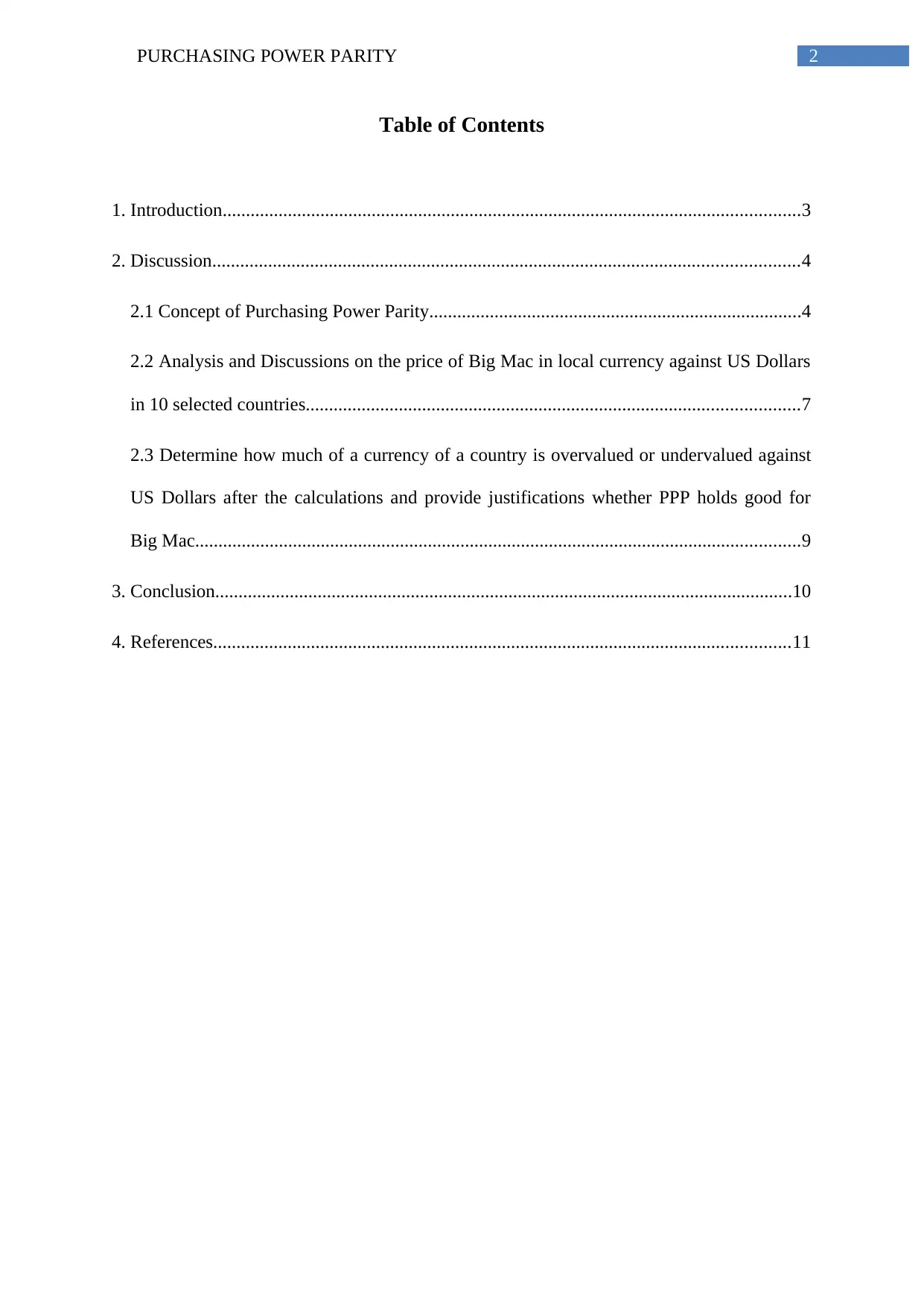
Table of Contents
1. Introduction............................................................................................................................3
2. Discussion..............................................................................................................................4
2.1 Concept of Purchasing Power Parity................................................................................4
2.2 Analysis and Discussions on the price of Big Mac in local currency against US Dollars
in 10 selected countries..........................................................................................................7
2.3 Determine how much of a currency of a country is overvalued or undervalued against
US Dollars after the calculations and provide justifications whether PPP holds good for
Big Mac..................................................................................................................................9
3. Conclusion............................................................................................................................10
4. References............................................................................................................................11
Table of Contents
1. Introduction............................................................................................................................3
2. Discussion..............................................................................................................................4
2.1 Concept of Purchasing Power Parity................................................................................4
2.2 Analysis and Discussions on the price of Big Mac in local currency against US Dollars
in 10 selected countries..........................................................................................................7
2.3 Determine how much of a currency of a country is overvalued or undervalued against
US Dollars after the calculations and provide justifications whether PPP holds good for
Big Mac..................................................................................................................................9
3. Conclusion............................................................................................................................10
4. References............................................................................................................................11
⊘ This is a preview!⊘
Do you want full access?
Subscribe today to unlock all pages.

Trusted by 1+ million students worldwide
3PURCHASING POWER PARITY
1. Introduction
The report is aimed to look into the concept of Purchasing Power Parity, by taking the
Big Mac product of McDonald’s and comparing the prices in US Dollars with the currencies
of other countries 1.
This concept in Economics says that the rate of exchange between two countries is
equal when the purchasing power in both the countries is similar. This is a relative measure to
analyze the changes in prices of products, affecting the purchasing power over a period of
time.
McDonald’s Big Mac is considered for preparing the report, whereby 10 countries are
considered to compare their local currency with the US Dollars and determine the price
fluctuations in them. The countries considered for comparison are United States, Brazil,
Denmark, China, Australia, Malaysia, Egypt, Russia, Hong Kong and South Korea.
There are certain factors which affect the purchasing power parity. The factors include, prices
of the commodities, kind of employment and wages provided to the consumers, currency and
credit availability 2.
. All these factors impact the purchasing of customers across nations. There are also
certain problems, which arise due to the application of this method. These include, the
method is based on statistics, related to the way parity computation is done. Only a sample of
a commodity is considered, where the real price indices are calculated from that sample,
rather than considering all the commodities present in an economy. Another problem is that
1 Engel, C., 2013. Exchange rates and interest parity (No. w19336). National Bureau of Economic Research.
2 Giovannetti, G., 2013. A survey of recent empirical tests of the purchasing power parity hypothesis. PSL
Quarterly Review, 45(180)
1. Introduction
The report is aimed to look into the concept of Purchasing Power Parity, by taking the
Big Mac product of McDonald’s and comparing the prices in US Dollars with the currencies
of other countries 1.
This concept in Economics says that the rate of exchange between two countries is
equal when the purchasing power in both the countries is similar. This is a relative measure to
analyze the changes in prices of products, affecting the purchasing power over a period of
time.
McDonald’s Big Mac is considered for preparing the report, whereby 10 countries are
considered to compare their local currency with the US Dollars and determine the price
fluctuations in them. The countries considered for comparison are United States, Brazil,
Denmark, China, Australia, Malaysia, Egypt, Russia, Hong Kong and South Korea.
There are certain factors which affect the purchasing power parity. The factors include, prices
of the commodities, kind of employment and wages provided to the consumers, currency and
credit availability 2.
. All these factors impact the purchasing of customers across nations. There are also
certain problems, which arise due to the application of this method. These include, the
method is based on statistics, related to the way parity computation is done. Only a sample of
a commodity is considered, where the real price indices are calculated from that sample,
rather than considering all the commodities present in an economy. Another problem is that
1 Engel, C., 2013. Exchange rates and interest parity (No. w19336). National Bureau of Economic Research.
2 Giovannetti, G., 2013. A survey of recent empirical tests of the purchasing power parity hypothesis. PSL
Quarterly Review, 45(180)
Paraphrase This Document
Need a fresh take? Get an instant paraphrase of this document with our AI Paraphraser
4PURCHASING POWER PARITY
the theory puts emphasis only on the exchange rate, rather than the income levels of people
staying in particular countries.
2. Discussion
2.1 Concept of Purchasing Power Parity
Purchasing Power Parity, a theory in economics, talks about the fact that when the
purchasing power for two countries is same, the rates of exchange between those countries
are equal. This theory puts stress on the fact of maintaining one price for products across
different regions3. Economists believe that once the difference in exchange rates is taken into
consideration, then every commodity would cost the same amount. In this report, Big Mac of
McDonald’s is considered with the price comparisons of the product done for 10 countries,
taking US Dollars as the base4.
The problems involved in applying this concept are as follows:
i) Cost of transportation – When goods get transported by the manufacturer to
reach the marketplace, that cost incurred in transportation gets added by the retailer to the
final cost of the goods. The farther the goods need to travel from the manufacturer to the
market, higher is price charged for those goods from the customers in that region. Hence the
purchasing power for customers living in close vicinity is far less as compared to the ones
staying far away from the market. Thus the rule of thumb for Purchasing Power Parity,
3 MacDonald, R. and Stein, J.L. eds., 2012. Equilibrium exchange rates (Vol. 69). Springer Science & Business
Media
4 He, H. and Chang, T., 2013. Purchasing power parity in transition countries: Sequential panel selection
method. Economic Modelling, 35, pp.604-609.
the theory puts emphasis only on the exchange rate, rather than the income levels of people
staying in particular countries.
2. Discussion
2.1 Concept of Purchasing Power Parity
Purchasing Power Parity, a theory in economics, talks about the fact that when the
purchasing power for two countries is same, the rates of exchange between those countries
are equal. This theory puts stress on the fact of maintaining one price for products across
different regions3. Economists believe that once the difference in exchange rates is taken into
consideration, then every commodity would cost the same amount. In this report, Big Mac of
McDonald’s is considered with the price comparisons of the product done for 10 countries,
taking US Dollars as the base4.
The problems involved in applying this concept are as follows:
i) Cost of transportation – When goods get transported by the manufacturer to
reach the marketplace, that cost incurred in transportation gets added by the retailer to the
final cost of the goods. The farther the goods need to travel from the manufacturer to the
market, higher is price charged for those goods from the customers in that region. Hence the
purchasing power for customers living in close vicinity is far less as compared to the ones
staying far away from the market. Thus the rule of thumb for Purchasing Power Parity,
3 MacDonald, R. and Stein, J.L. eds., 2012. Equilibrium exchange rates (Vol. 69). Springer Science & Business
Media
4 He, H. and Chang, T., 2013. Purchasing power parity in transition countries: Sequential panel selection
method. Economic Modelling, 35, pp.604-609.
5PURCHASING POWER PARITY
having one price for all, does not hold as price in different markets for the same good is not
constant.
ii) Demand – Prices of commodities are set by the manufacturers and they get
adjusted according to the demand in specific marketplaces. High demand for the products
leads to hike in prices and subsequently when demand falls, prices also come down. In this
situation, the law applied for Purchasing Power Parity does not hold as customers staying in
high-demand areas would have low purchasing power due to the high prices charged for the
commodities 5.
. Similarly people who live in areas with demand on the lower side, possess higher
purchasing power because prices for the same products are less expensive.
iii) Taxes – Taxes influence the pricing of goods to a great extent, which leads to the
price variations for same product in different market areas. There are areas where sales tax
applied, is higher6. In those regions, the purchasing power of consumers is less as the final
price required to be paid for consuming the commodity is on the higher side. Similarly, the
areas where the applicable sales tax is low, the consumers can have a higher purchasing
power as the price they are required to pay is low. This differentiation is caused in prices due
to the application of sales taxes on them, so the one price law in case of Purchasing Power
Parity is no longer applicable.
There are certain factors which affect the purchasing power parity. The details are as
under:
5 Giovannetti, G., 2013. A survey of recent empirical tests of the purchasing power parity hypothesis. PSL
Quarterly Review, 45(180).
6 Jolliffe, D. and Prydz, E.B., 2015. Global poverty goals and prices: how purchasing power parity matters
having one price for all, does not hold as price in different markets for the same good is not
constant.
ii) Demand – Prices of commodities are set by the manufacturers and they get
adjusted according to the demand in specific marketplaces. High demand for the products
leads to hike in prices and subsequently when demand falls, prices also come down. In this
situation, the law applied for Purchasing Power Parity does not hold as customers staying in
high-demand areas would have low purchasing power due to the high prices charged for the
commodities 5.
. Similarly people who live in areas with demand on the lower side, possess higher
purchasing power because prices for the same products are less expensive.
iii) Taxes – Taxes influence the pricing of goods to a great extent, which leads to the
price variations for same product in different market areas. There are areas where sales tax
applied, is higher6. In those regions, the purchasing power of consumers is less as the final
price required to be paid for consuming the commodity is on the higher side. Similarly, the
areas where the applicable sales tax is low, the consumers can have a higher purchasing
power as the price they are required to pay is low. This differentiation is caused in prices due
to the application of sales taxes on them, so the one price law in case of Purchasing Power
Parity is no longer applicable.
There are certain factors which affect the purchasing power parity. The details are as
under:
5 Giovannetti, G., 2013. A survey of recent empirical tests of the purchasing power parity hypothesis. PSL
Quarterly Review, 45(180).
6 Jolliffe, D. and Prydz, E.B., 2015. Global poverty goals and prices: how purchasing power parity matters
⊘ This is a preview!⊘
Do you want full access?
Subscribe today to unlock all pages.
Trusted by 1+ million students worldwide
6PURCHASING POWER PARITY
a) Prices – The purchasing power of individuals gets directly impacted by inflation.
This is the rate through which the general level of prices for goods and other services rise on
a continuous basis, resulting in a fall in the purchasing power of currencies7. People are not
inclined towards buying products by paying high prices, thus giving rise to a fall in demand.
This problem can be tackled through increasing the wages, rate of interest and other related
factors.
b) Employment and Wages – Level of employment and average salaries of the
consumers in general have a great effect on the purchasing power. The logic behind this
comes from the fact that more employment for people will bring more money into the hands
of people, which would in turn lead to an increase in purchasing power 8. Employment does
not allow any nation’s currency to get stronger but has an effect on people’s purchasing
power by bringing more money into the hands of customers.
c) Considerations in Currency – Fluctuations in exchange rates affect purchasing power
to a great extent. Considering the case of McDonald’s Big Mac, when there is a devaluation
of currency against another, goods in the second country would cost higher in first country’s
currency. Suppose, the price of Big Mac in Russia is 41 Ruble but in US dollars, the price is
1.32, then the implied PPP of dollar would be very high, around $15.1.
d) Credit Availability – The willingness of financial institutions like banks to lend
money to businesses and consumers affect total purchasing power, just like higher salaries
and level of employment do. When credit is available, companies and consumers tend to
7 Jedrzejczyk, M., 2012. Labor productivity parity vs trend of exchange rate. Modern Economy, 3(06), p.780.
8 Jolliffe, Dean, and Espen Beer Prydz. "Global poverty goals and prices: how purchasing power parity matters."
(2015)
a) Prices – The purchasing power of individuals gets directly impacted by inflation.
This is the rate through which the general level of prices for goods and other services rise on
a continuous basis, resulting in a fall in the purchasing power of currencies7. People are not
inclined towards buying products by paying high prices, thus giving rise to a fall in demand.
This problem can be tackled through increasing the wages, rate of interest and other related
factors.
b) Employment and Wages – Level of employment and average salaries of the
consumers in general have a great effect on the purchasing power. The logic behind this
comes from the fact that more employment for people will bring more money into the hands
of people, which would in turn lead to an increase in purchasing power 8. Employment does
not allow any nation’s currency to get stronger but has an effect on people’s purchasing
power by bringing more money into the hands of customers.
c) Considerations in Currency – Fluctuations in exchange rates affect purchasing power
to a great extent. Considering the case of McDonald’s Big Mac, when there is a devaluation
of currency against another, goods in the second country would cost higher in first country’s
currency. Suppose, the price of Big Mac in Russia is 41 Ruble but in US dollars, the price is
1.32, then the implied PPP of dollar would be very high, around $15.1.
d) Credit Availability – The willingness of financial institutions like banks to lend
money to businesses and consumers affect total purchasing power, just like higher salaries
and level of employment do. When credit is available, companies and consumers tend to
7 Jedrzejczyk, M., 2012. Labor productivity parity vs trend of exchange rate. Modern Economy, 3(06), p.780.
8 Jolliffe, Dean, and Espen Beer Prydz. "Global poverty goals and prices: how purchasing power parity matters."
(2015)
Paraphrase This Document
Need a fresh take? Get an instant paraphrase of this document with our AI Paraphraser
7PURCHASING POWER PARITY
spend more than the amount they actually possess, thus they get a boost on their purchasing
power. This gives rise to more number of products getting bought even in high prices.
2.2 Analysis and Discussions on the price of Big Mac in local currency against US
Dollars in 10 selected countries
The analysis and discussions on the price of Big Mac in local currencies of those
regions against US dollars in 10 selected countries are given below, taking the base price in
US Dollars, charged for the product in US as $5.04
New Zealand – In New Zealand Dollar, the Big Mac costs NZD $6.94 (market value),
whereas the same product, if bought by someone staying in New Zealand after converting to
US Dollars, he would have paid USD 6.03, which is far less as compared the amount he is
paying in his own currency, which implies that Purchasing Power Parity is 5.80 (implied
value). In this case Big Mac should sell for less in New Zealand. 9.
Argentina – In Argentine Peso, a Big Mac would cost ARS $85.52. Whereas, when
the Argentines are looking to buy the same product in US Dollars, they would have to pay far
lesser amount of only USD 6.47. So, in this case if Peso is considered, the currency is
overvalued, as for the same product, they are paying more. In this case, the implied PPP of
the dollar is $66.57. Even in this case Big Mac should less in Argentina
Japan – In the currency of Japan, a Big Mac would cost JPY569.82. The Japanese
people aiming to buy the product in US Dollars, would have paid only $7.95. The implied
Purchasing Power Parity of US Dollar is 361.36. The product should sell for less in New
Zealand than in the US.
9 McKinnon, R.I. and Ohno, K., 2016. 7 Purchasing power parity as a monetary. The Future of the International
Monetary System: Change, Coordination of Instability?: Change, Coordination of Instability?, p.42.
spend more than the amount they actually possess, thus they get a boost on their purchasing
power. This gives rise to more number of products getting bought even in high prices.
2.2 Analysis and Discussions on the price of Big Mac in local currency against US
Dollars in 10 selected countries
The analysis and discussions on the price of Big Mac in local currencies of those
regions against US dollars in 10 selected countries are given below, taking the base price in
US Dollars, charged for the product in US as $5.04
New Zealand – In New Zealand Dollar, the Big Mac costs NZD $6.94 (market value),
whereas the same product, if bought by someone staying in New Zealand after converting to
US Dollars, he would have paid USD 6.03, which is far less as compared the amount he is
paying in his own currency, which implies that Purchasing Power Parity is 5.80 (implied
value). In this case Big Mac should sell for less in New Zealand. 9.
Argentina – In Argentine Peso, a Big Mac would cost ARS $85.52. Whereas, when
the Argentines are looking to buy the same product in US Dollars, they would have to pay far
lesser amount of only USD 6.47. So, in this case if Peso is considered, the currency is
overvalued, as for the same product, they are paying more. In this case, the implied PPP of
the dollar is $66.57. Even in this case Big Mac should less in Argentina
Japan – In the currency of Japan, a Big Mac would cost JPY569.82. The Japanese
people aiming to buy the product in US Dollars, would have paid only $7.95. The implied
Purchasing Power Parity of US Dollar is 361.36. The product should sell for less in New
Zealand than in the US.
9 McKinnon, R.I. and Ohno, K., 2016. 7 Purchasing power parity as a monetary. The Future of the International
Monetary System: Change, Coordination of Instability?: Change, Coordination of Instability?, p.42.
8PURCHASING POWER PARITY
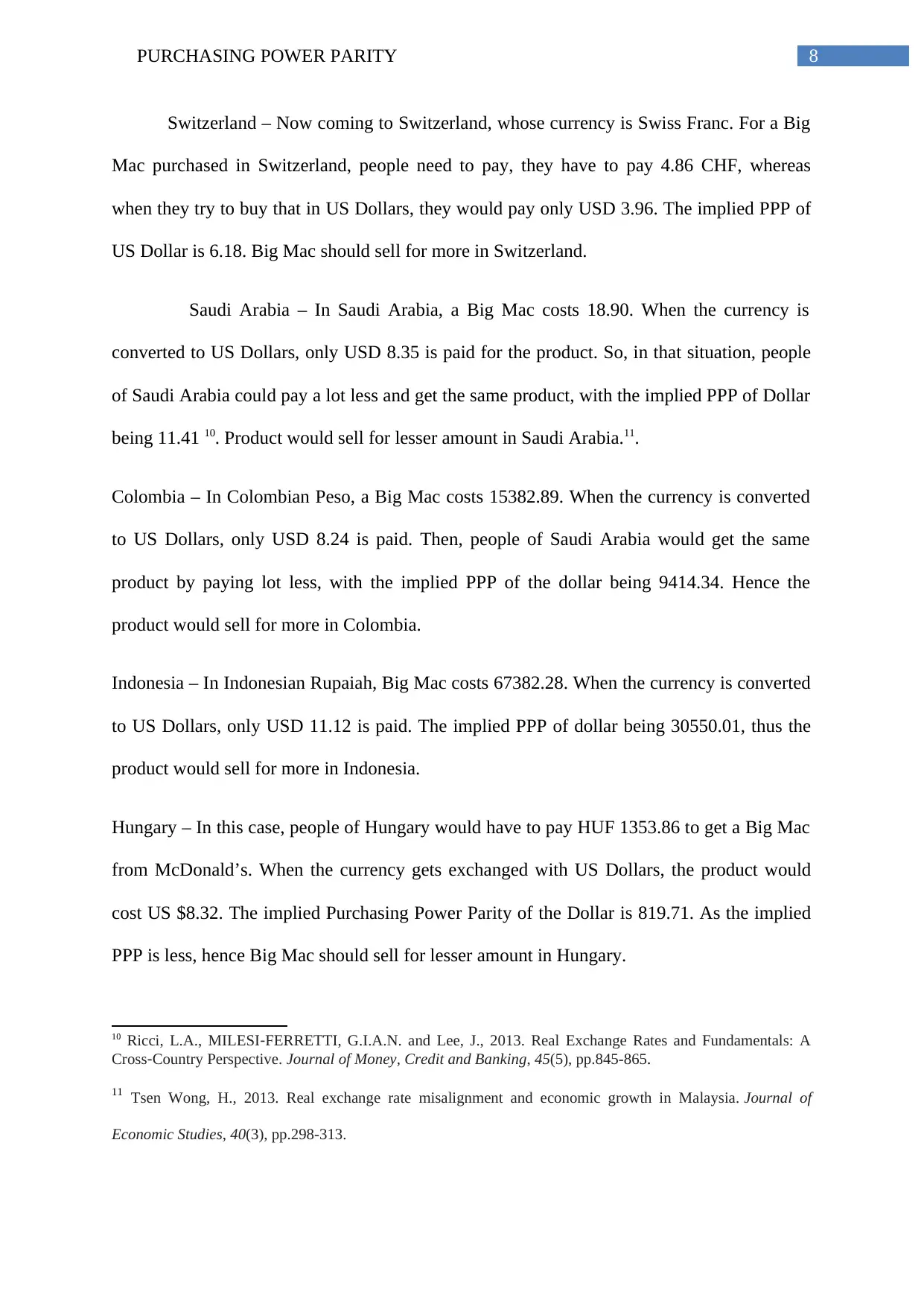
Switzerland – Now coming to Switzerland, whose currency is Swiss Franc. For a Big
Mac purchased in Switzerland, people need to pay, they have to pay 4.86 CHF, whereas
when they try to buy that in US Dollars, they would pay only USD 3.96. The implied PPP of
US Dollar is 6.18. Big Mac should sell for more in Switzerland.
Saudi Arabia – In Saudi Arabia, a Big Mac costs 18.90. When the currency is
converted to US Dollars, only USD 8.35 is paid for the product. So, in that situation, people
of Saudi Arabia could pay a lot less and get the same product, with the implied PPP of Dollar
being 11.41 10. Product would sell for lesser amount in Saudi Arabia.11.
Colombia – In Colombian Peso, a Big Mac costs 15382.89. When the currency is converted
to US Dollars, only USD 8.24 is paid. Then, people of Saudi Arabia would get the same
product by paying lot less, with the implied PPP of the dollar being 9414.34. Hence the
product would sell for more in Colombia.
Indonesia – In Indonesian Rupaiah, Big Mac costs 67382.28. When the currency is converted
to US Dollars, only USD 11.12 is paid. The implied PPP of dollar being 30550.01, thus the
product would sell for more in Indonesia.
Hungary – In this case, people of Hungary would have to pay HUF 1353.86 to get a Big Mac
from McDonald’s. When the currency gets exchanged with US Dollars, the product would
cost US $8.32. The implied Purchasing Power Parity of the Dollar is 819.71. As the implied
PPP is less, hence Big Mac should sell for lesser amount in Hungary.
10 Ricci, L.A., MILESI‐FERRETTI, G.I.A.N. and Lee, J., 2013. Real Exchange Rates and Fundamentals: A
Cross‐Country Perspective. Journal of Money, Credit and Banking, 45(5), pp.845-865.
11 Tsen Wong, H., 2013. Real exchange rate misalignment and economic growth in Malaysia. Journal of
Economic Studies, 40(3), pp.298-313.
Switzerland – Now coming to Switzerland, whose currency is Swiss Franc. For a Big
Mac purchased in Switzerland, people need to pay, they have to pay 4.86 CHF, whereas
when they try to buy that in US Dollars, they would pay only USD 3.96. The implied PPP of
US Dollar is 6.18. Big Mac should sell for more in Switzerland.
Saudi Arabia – In Saudi Arabia, a Big Mac costs 18.90. When the currency is
converted to US Dollars, only USD 8.35 is paid for the product. So, in that situation, people
of Saudi Arabia could pay a lot less and get the same product, with the implied PPP of Dollar
being 11.41 10. Product would sell for lesser amount in Saudi Arabia.11.
Colombia – In Colombian Peso, a Big Mac costs 15382.89. When the currency is converted
to US Dollars, only USD 8.24 is paid. Then, people of Saudi Arabia would get the same
product by paying lot less, with the implied PPP of the dollar being 9414.34. Hence the
product would sell for more in Colombia.
Indonesia – In Indonesian Rupaiah, Big Mac costs 67382.28. When the currency is converted
to US Dollars, only USD 11.12 is paid. The implied PPP of dollar being 30550.01, thus the
product would sell for more in Indonesia.
Hungary – In this case, people of Hungary would have to pay HUF 1353.86 to get a Big Mac
from McDonald’s. When the currency gets exchanged with US Dollars, the product would
cost US $8.32. The implied Purchasing Power Parity of the Dollar is 819.71. As the implied
PPP is less, hence Big Mac should sell for lesser amount in Hungary.
10 Ricci, L.A., MILESI‐FERRETTI, G.I.A.N. and Lee, J., 2013. Real Exchange Rates and Fundamentals: A
Cross‐Country Perspective. Journal of Money, Credit and Banking, 45(5), pp.845-865.
11 Tsen Wong, H., 2013. Real exchange rate misalignment and economic growth in Malaysia. Journal of
Economic Studies, 40(3), pp.298-313.
⊘ This is a preview!⊘
Do you want full access?
Subscribe today to unlock all pages.
Trusted by 1+ million students worldwide
9PURCHASING POWER PARITY
Fiji – Here, people of Fiji would be paying 4.65 Fijian Dollar to get one 1 Big Mac from
McDonalds. On the other hand, when the currency gets exchanged with US Dollars, then they
would be paying US $0.578. The implied Purchasing Power Parity of dollar is 0.667. As the
implied PPC is less, so Big Mac would sell for lesser amount in Fiji.
Cyprus – People of Cyprus would be paying CYP 5.29 to acquire a Big Mac. In US Dollars,
they would need to pay only $1.98. Now the implied Purchasing Power Parity is 1.04. In this
case, the implied Purchasing Power Parity is less, hence Big Mac would sell for less in
Cuprus. This would not be feasible for McDonald’s.
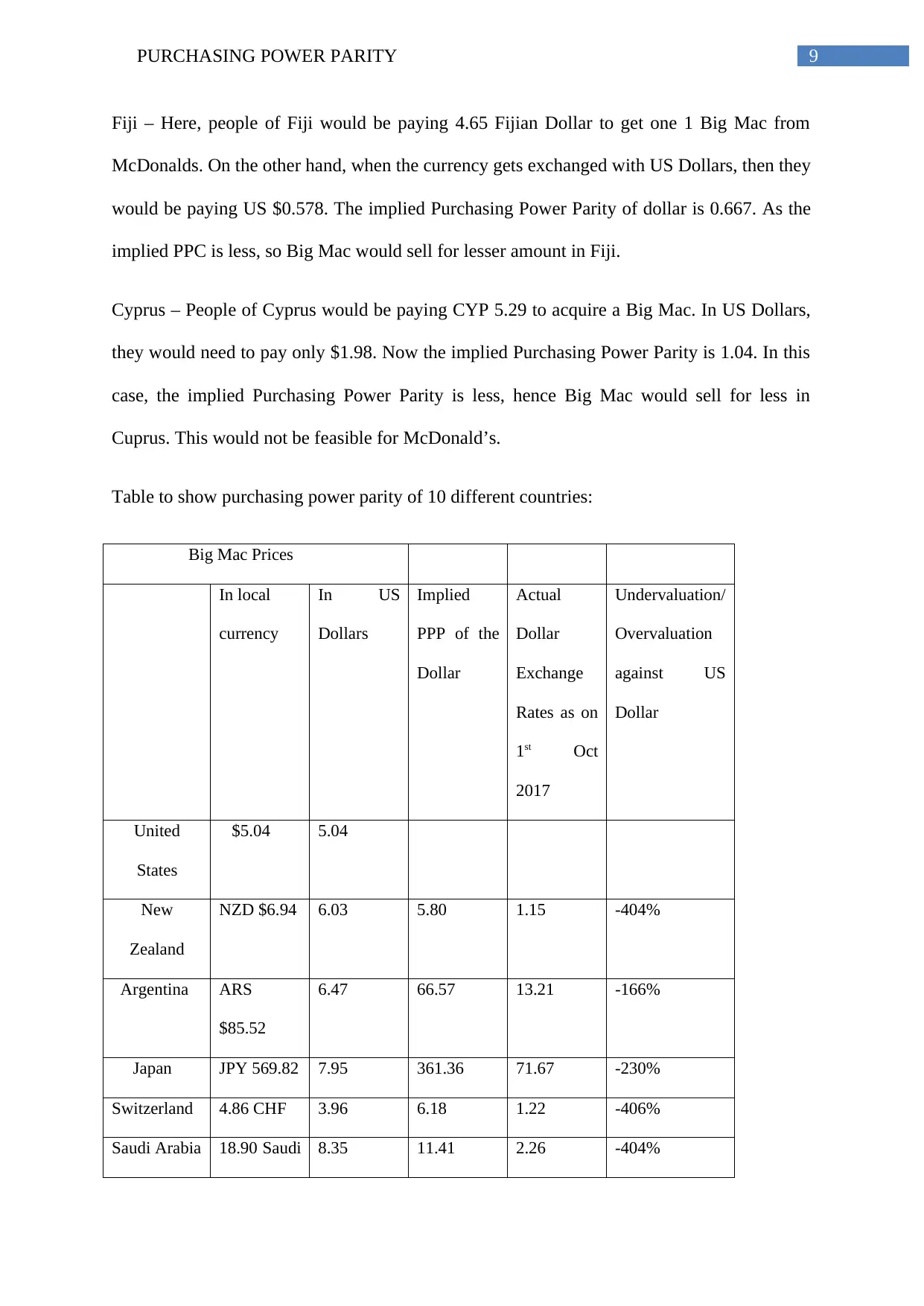
Table to show purchasing power parity of 10 different countries:
Big Mac Prices
In local
currency
In US
Dollars
Implied
PPP of the
Dollar
Actual
Dollar
Exchange
Rates as on
1st Oct
2017
Undervaluation/
Overvaluation
against US
Dollar
United
States
$5.04 5.04
New
Zealand
NZD $6.94 6.03 5.80 1.15 -404%
Argentina ARS
$85.52
6.47 66.57 13.21 -166%
Japan JPY 569.82 7.95 361.36 71.67 -230%
Switzerland 4.86 CHF 3.96 6.18 1.22 -406%
Saudi Arabia 18.90 Saudi 8.35 11.41 2.26 -404%
Fiji – Here, people of Fiji would be paying 4.65 Fijian Dollar to get one 1 Big Mac from
McDonalds. On the other hand, when the currency gets exchanged with US Dollars, then they
would be paying US $0.578. The implied Purchasing Power Parity of dollar is 0.667. As the
implied PPC is less, so Big Mac would sell for lesser amount in Fiji.
Cyprus – People of Cyprus would be paying CYP 5.29 to acquire a Big Mac. In US Dollars,
they would need to pay only $1.98. Now the implied Purchasing Power Parity is 1.04. In this
case, the implied Purchasing Power Parity is less, hence Big Mac would sell for less in
Cuprus. This would not be feasible for McDonald’s.
Table to show purchasing power parity of 10 different countries:
Big Mac Prices
In local
currency
In US
Dollars
Implied
PPP of the
Dollar
Actual
Dollar
Exchange
Rates as on
1st Oct
2017
Undervaluation/
Overvaluation
against US
Dollar
United
States
$5.04 5.04
New
Zealand
NZD $6.94 6.03 5.80 1.15 -404%
Argentina ARS
$85.52
6.47 66.57 13.21 -166%
Japan JPY 569.82 7.95 361.36 71.67 -230%
Switzerland 4.86 CHF 3.96 6.18 1.22 -406%
Saudi Arabia 18.90 Saudi 8.35 11.41 2.26 -404%
Paraphrase This Document
Need a fresh take? Get an instant paraphrase of this document with our AI Paraphraser
10PURCHASING POWER PARITY
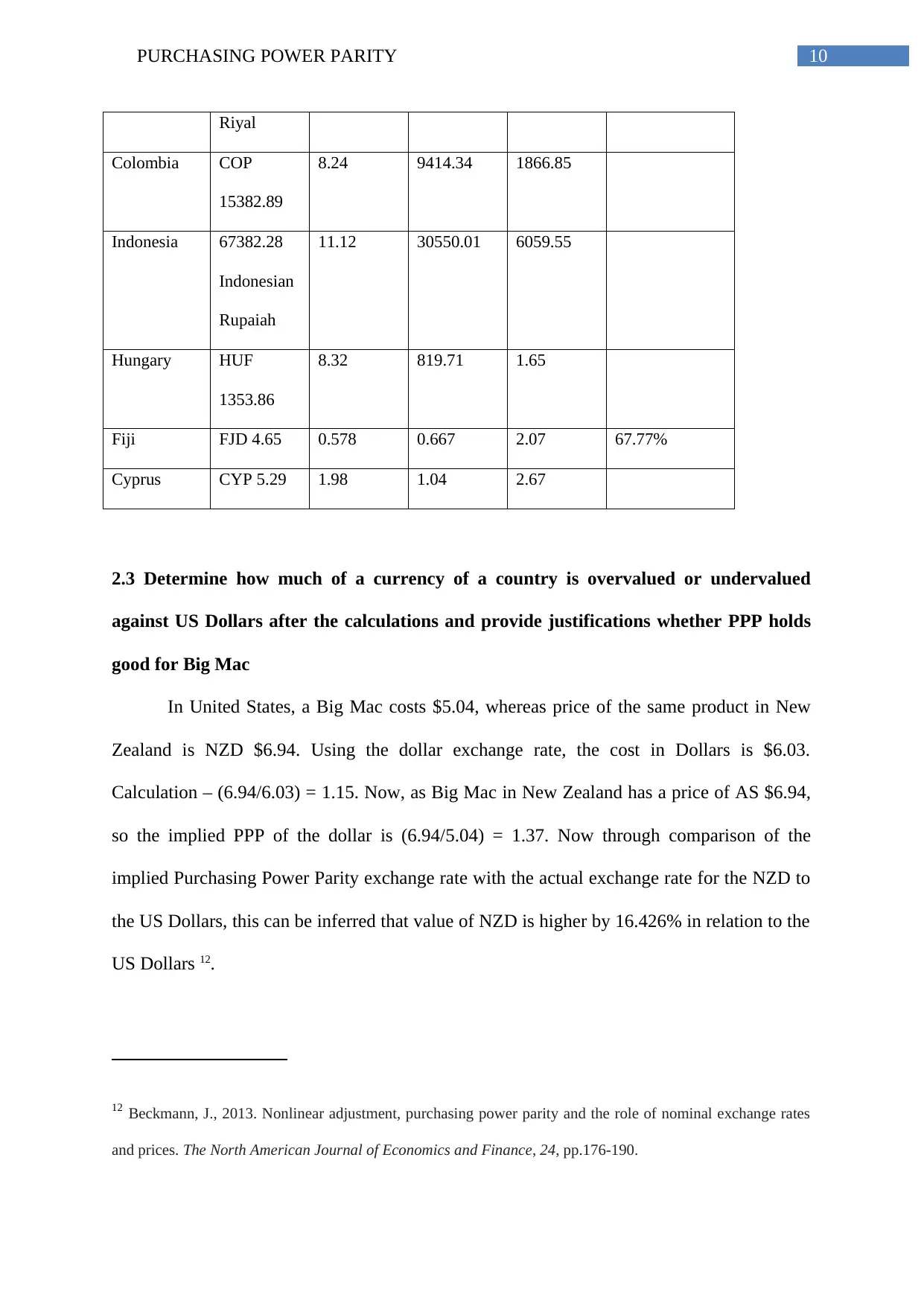
Riyal
Colombia COP
15382.89
8.24 9414.34 1866.85
Indonesia 67382.28
Indonesian
Rupaiah
11.12 30550.01 6059.55
Hungary HUF
1353.86
8.32 819.71 1.65
Fiji FJD 4.65 0.578 0.667 2.07 67.77%
Cyprus CYP 5.29 1.98 1.04 2.67
2.3 Determine how much of a currency of a country is overvalued or undervalued
against US Dollars after the calculations and provide justifications whether PPP holds
good for Big Mac
In United States, a Big Mac costs $5.04, whereas price of the same product in New
Zealand is NZD $6.94. Using the dollar exchange rate, the cost in Dollars is $6.03.
Calculation – (6.94/6.03) = 1.15. Now, as Big Mac in New Zealand has a price of AS $6.94,
so the implied PPP of the dollar is (6.94/5.04) = 1.37. Now through comparison of the
implied Purchasing Power Parity exchange rate with the actual exchange rate for the NZD to
the US Dollars, this can be inferred that value of NZD is higher by 16.426% in relation to the
US Dollars 12.
12 Beckmann, J., 2013. Nonlinear adjustment, purchasing power parity and the role of nominal exchange rates
and prices. The North American Journal of Economics and Finance, 24, pp.176-190.
Riyal
Colombia COP
15382.89
8.24 9414.34 1866.85
Indonesia 67382.28
Indonesian
Rupaiah
11.12 30550.01 6059.55
Hungary HUF
1353.86
8.32 819.71 1.65
Fiji FJD 4.65 0.578 0.667 2.07 67.77%
Cyprus CYP 5.29 1.98 1.04 2.67
2.3 Determine how much of a currency of a country is overvalued or undervalued
against US Dollars after the calculations and provide justifications whether PPP holds
good for Big Mac
In United States, a Big Mac costs $5.04, whereas price of the same product in New
Zealand is NZD $6.94. Using the dollar exchange rate, the cost in Dollars is $6.03.
Calculation – (6.94/6.03) = 1.15. Now, as Big Mac in New Zealand has a price of AS $6.94,
so the implied PPP of the dollar is (6.94/5.04) = 1.37. Now through comparison of the
implied Purchasing Power Parity exchange rate with the actual exchange rate for the NZD to
the US Dollars, this can be inferred that value of NZD is higher by 16.426% in relation to the
US Dollars 12.
12 Beckmann, J., 2013. Nonlinear adjustment, purchasing power parity and the role of nominal exchange rates
and prices. The North American Journal of Economics and Finance, 24, pp.176-190.
11PURCHASING POWER PARITY
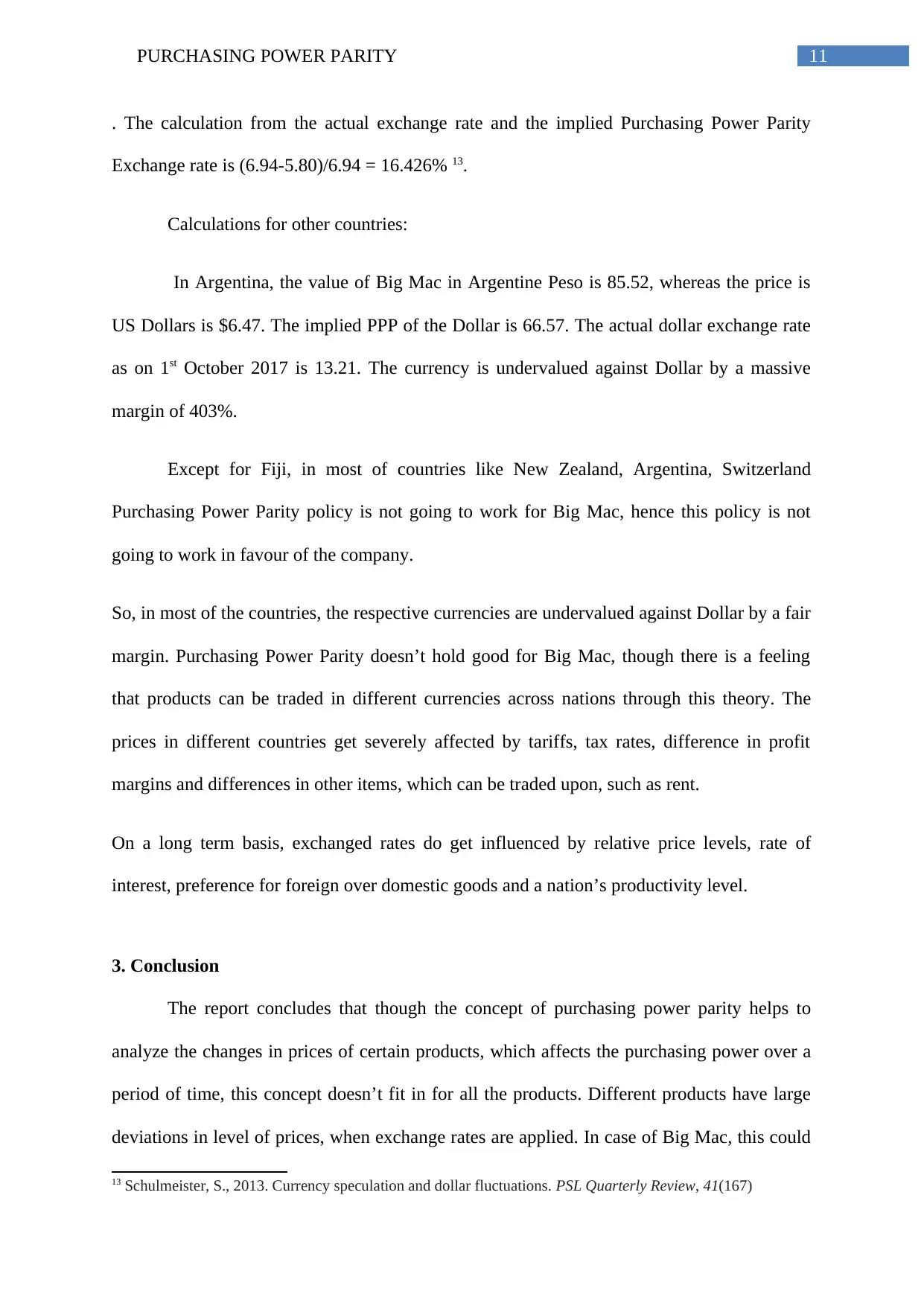
. The calculation from the actual exchange rate and the implied Purchasing Power Parity
Exchange rate is (6.94-5.80)/6.94 = 16.426% 13.
Calculations for other countries:
In Argentina, the value of Big Mac in Argentine Peso is 85.52, whereas the price is
US Dollars is $6.47. The implied PPP of the Dollar is 66.57. The actual dollar exchange rate
as on 1st October 2017 is 13.21. The currency is undervalued against Dollar by a massive
margin of 403%.
Except for Fiji, in most of countries like New Zealand, Argentina, Switzerland
Purchasing Power Parity policy is not going to work for Big Mac, hence this policy is not
going to work in favour of the company.
So, in most of the countries, the respective currencies are undervalued against Dollar by a fair
margin. Purchasing Power Parity doesn’t hold good for Big Mac, though there is a feeling
that products can be traded in different currencies across nations through this theory. The
prices in different countries get severely affected by tariffs, tax rates, difference in profit
margins and differences in other items, which can be traded upon, such as rent.
On a long term basis, exchanged rates do get influenced by relative price levels, rate of
interest, preference for foreign over domestic goods and a nation’s productivity level.
3. Conclusion
The report concludes that though the concept of purchasing power parity helps to
analyze the changes in prices of certain products, which affects the purchasing power over a
period of time, this concept doesn’t fit in for all the products. Different products have large
deviations in level of prices, when exchange rates are applied. In case of Big Mac, this could
13 Schulmeister, S., 2013. Currency speculation and dollar fluctuations. PSL Quarterly Review, 41(167)
. The calculation from the actual exchange rate and the implied Purchasing Power Parity
Exchange rate is (6.94-5.80)/6.94 = 16.426% 13.
Calculations for other countries:
In Argentina, the value of Big Mac in Argentine Peso is 85.52, whereas the price is
US Dollars is $6.47. The implied PPP of the Dollar is 66.57. The actual dollar exchange rate
as on 1st October 2017 is 13.21. The currency is undervalued against Dollar by a massive
margin of 403%.
Except for Fiji, in most of countries like New Zealand, Argentina, Switzerland
Purchasing Power Parity policy is not going to work for Big Mac, hence this policy is not
going to work in favour of the company.
So, in most of the countries, the respective currencies are undervalued against Dollar by a fair
margin. Purchasing Power Parity doesn’t hold good for Big Mac, though there is a feeling
that products can be traded in different currencies across nations through this theory. The
prices in different countries get severely affected by tariffs, tax rates, difference in profit
margins and differences in other items, which can be traded upon, such as rent.
On a long term basis, exchanged rates do get influenced by relative price levels, rate of
interest, preference for foreign over domestic goods and a nation’s productivity level.
3. Conclusion
The report concludes that though the concept of purchasing power parity helps to
analyze the changes in prices of certain products, which affects the purchasing power over a
period of time, this concept doesn’t fit in for all the products. Different products have large
deviations in level of prices, when exchange rates are applied. In case of Big Mac, this could
13 Schulmeister, S., 2013. Currency speculation and dollar fluctuations. PSL Quarterly Review, 41(167)
⊘ This is a preview!⊘
Do you want full access?
Subscribe today to unlock all pages.
Trusted by 1+ million students worldwide

1 out of 15


Related Documents


Your All-in-One AI-Powered Toolkit for Academic Success.
+13062052269
info@desklib.com
Available 24*7 on WhatsApp / Email
![[object Object]](/_next/static/media/star-bottom.7253800d.svg)
Unlock your academic potential
Copyright © 2020–2026 A2Z Services. All Rights Reserved. Developed and managed by ZUCOL.