University Business Valuation and Analysis: Qantas Financial Report
VerifiedAdded on  2020/05/16
|16
|2733
|93
Report
AI Summary
This report provides a comprehensive financial analysis of Qantas, examining its performance from 2013 to 2017. It begins with an executive summary and then delves into various aspects of the company, including Porter's Five Forces, SWOT analysis, and its core competitive strategy. The report identifies key accounting principles relevant to the airline industry, such as revenue recognition and property plant and equipment valuation, and assesses their impact on Qantas' financial reporting. A comparative analysis of the company's financial reports from 2013 and 2017 reveals significant improvements in net income, earnings ratios, and shareholder returns. The analysis highlights the company's strengths, weaknesses, opportunities, and threats, offering insights into its strategic changes and competitive landscape. The report concludes with investment recommendations for shareholders, considering the company's financial performance and debt-equity ratio.
2017
Business
Valutaion and
Analysis
Business
Valutaion and
Analysis
Paraphrase This Document
Need a fresh take? Get an instant paraphrase of this document with our AI Paraphraser

1
By student name
Professor
University
Date: Januray 26 , 2018.
1 | P a g e
By student name
Professor
University
Date: Januray 26 , 2018.
1 | P a g e

2
Executive Summary
In this assignment, financial analysis of the Qantas company is done with respect to the annual
reports of 2013 and 2017. The company is an airline company and different aspects of the airline
company is discussed. The important accounting policies and methods are discussed and
analyses of the same with respect to the company is done.
2 | P a g e
Executive Summary
In this assignment, financial analysis of the Qantas company is done with respect to the annual
reports of 2013 and 2017. The company is an airline company and different aspects of the airline
company is discussed. The important accounting policies and methods are discussed and
analyses of the same with respect to the company is done.
2 | P a g e
⊘ This is a preview!⊘
Do you want full access?
Subscribe today to unlock all pages.

Trusted by 1+ million students worldwide

3
Contents
Question a…………………………………………………………………....4
Question b…………………………………………………………………....5
Question c…………………………………………………………………....5
Question d…………………………………………………………………....6
Question e…………………………………………………………………....7
Question f…………………………………………………………………....8
Question g…………………………………………………………………....9
Refrences.....……………………………………………………………....11
3 | P a g e
Contents
Question a…………………………………………………………………....4
Question b…………………………………………………………………....5
Question c…………………………………………………………………....5
Question d…………………………………………………………………....6
Question e…………………………………………………………………....7
Question f…………………………………………………………………....8
Question g…………………………………………………………………....9
Refrences.....……………………………………………………………....11
3 | P a g e
Paraphrase This Document
Need a fresh take? Get an instant paraphrase of this document with our AI Paraphraser

4
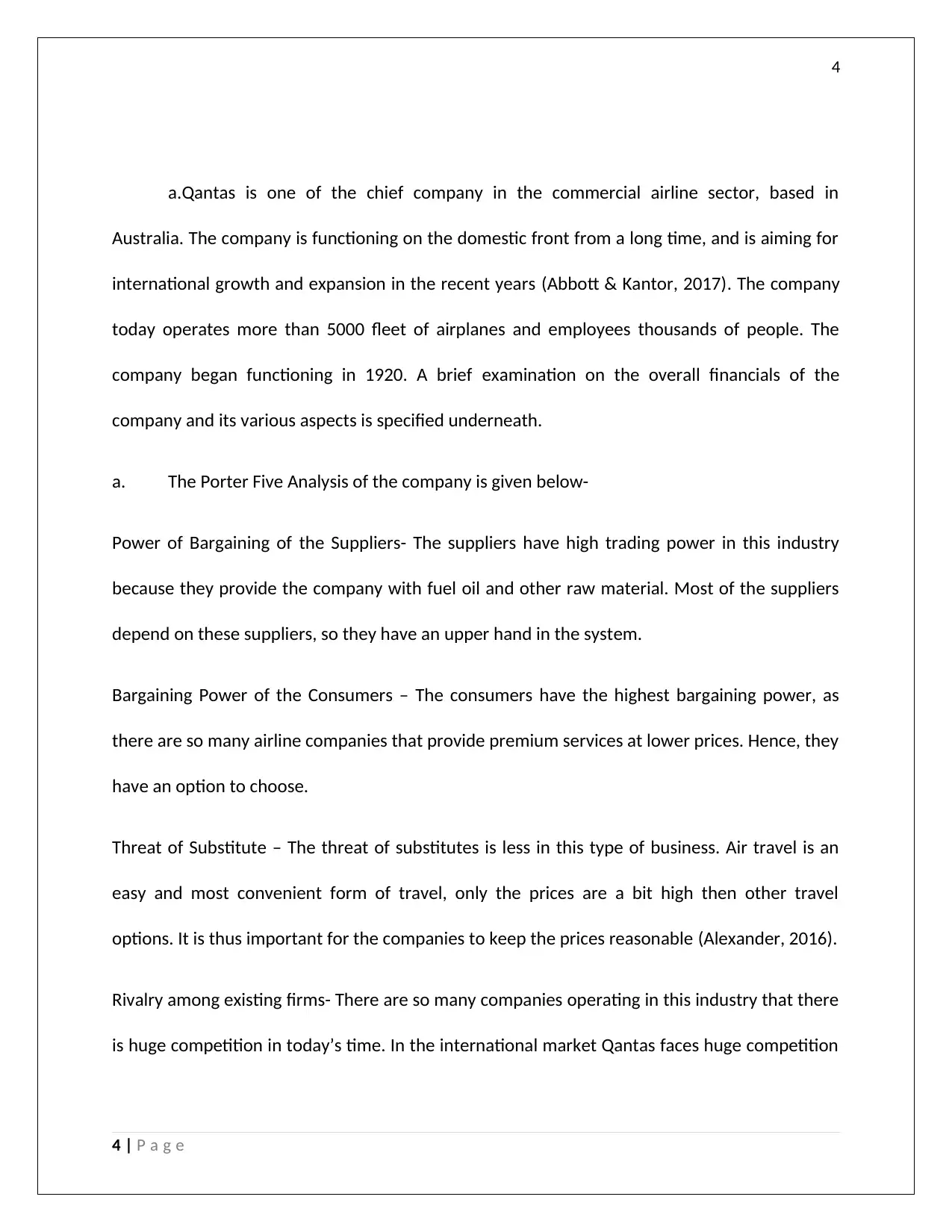
a.Qantas is one of the chief company in the commercial airline sector, based in
Australia. The company is functioning on the domestic front from a long time, and is aiming for
international growth and expansion in the recent years (Abbott & Kantor, 2017). The company
today operates more than 5000 fleet of airplanes and employees thousands of people. The
company began functioning in 1920. A brief examination on the overall financials of the
company and its various aspects is specified underneath.
a. The Porter Five Analysis of the company is given below-
Power of Bargaining of the Suppliers- The suppliers have high trading power in this industry
because they provide the company with fuel oil and other raw material. Most of the suppliers
depend on these suppliers, so they have an upper hand in the system.
Bargaining Power of the Consumers – The consumers have the highest bargaining power, as
there are so many airline companies that provide premium services at lower prices. Hence, they
have an option to choose.
Threat of Substitute – The threat of substitutes is less in this type of business. Air travel is an
easy and most convenient form of travel, only the prices are a bit high then other travel
options. It is thus important for the companies to keep the prices reasonable (Alexander, 2016).
Rivalry among existing firms- There are so many companies operating in this industry that there
is huge competition in today’s time. In the international market Qantas faces huge competition
4 | P a g e
a.Qantas is one of the chief company in the commercial airline sector, based in
Australia. The company is functioning on the domestic front from a long time, and is aiming for
international growth and expansion in the recent years (Abbott & Kantor, 2017). The company
today operates more than 5000 fleet of airplanes and employees thousands of people. The
company began functioning in 1920. A brief examination on the overall financials of the
company and its various aspects is specified underneath.
a. The Porter Five Analysis of the company is given below-
Power of Bargaining of the Suppliers- The suppliers have high trading power in this industry
because they provide the company with fuel oil and other raw material. Most of the suppliers
depend on these suppliers, so they have an upper hand in the system.
Bargaining Power of the Consumers – The consumers have the highest bargaining power, as
there are so many airline companies that provide premium services at lower prices. Hence, they
have an option to choose.
Threat of Substitute – The threat of substitutes is less in this type of business. Air travel is an
easy and most convenient form of travel, only the prices are a bit high then other travel
options. It is thus important for the companies to keep the prices reasonable (Alexander, 2016).
Rivalry among existing firms- There are so many companies operating in this industry that there
is huge competition in today’s time. In the international market Qantas faces huge competition
4 | P a g e

5
from Emirates, Virgin Australia and Air Asia. In the domestic front also, the company is facing
huge competition.
Threat of new entrants – There is very less threat of new entrant in this industry, there is huge
initial investment involved so very few companies enter this sector. Thus, there are high
barriers existing in this sector. The companies need to be financially strong to start operation in
an airline industry.
b. SWOT ANALYSIS
Strengths – The major strengths include –
• It is present in the global and domestic sector, and is expanding to many new areas.
• It is one of the largest and is functioning from a long time in Australia.
• It has also emerged as one of the best brand over its promotion and funding.
• It also bids assortment of facilities like low cost flying opportunities, lounge activities
etc.
Weakness – The main weakness comprises occurrences like price fixing and sabotage and
that has hampered the overall brand image. Even on the international front the company is not
developed so much and is limited. Therefore, the company needs to improve its services to
make better delivery on the international front (Birt, et al., 2017).
Opportunities – The company can widen its scale of operation on the international front by
acquiring many small airlines. The company can also indulge in international tie ups that will
5 | P a g e
from Emirates, Virgin Australia and Air Asia. In the domestic front also, the company is facing
huge competition.
Threat of new entrants – There is very less threat of new entrant in this industry, there is huge
initial investment involved so very few companies enter this sector. Thus, there are high
barriers existing in this sector. The companies need to be financially strong to start operation in
an airline industry.
b. SWOT ANALYSIS
Strengths – The major strengths include –
• It is present in the global and domestic sector, and is expanding to many new areas.
• It is one of the largest and is functioning from a long time in Australia.
• It has also emerged as one of the best brand over its promotion and funding.
• It also bids assortment of facilities like low cost flying opportunities, lounge activities
etc.
Weakness – The main weakness comprises occurrences like price fixing and sabotage and
that has hampered the overall brand image. Even on the international front the company is not
developed so much and is limited. Therefore, the company needs to improve its services to
make better delivery on the international front (Birt, et al., 2017).
Opportunities – The company can widen its scale of operation on the international front by
acquiring many small airlines. The company can also indulge in international tie ups that will
5 | P a g e
⊘ This is a preview!⊘
Do you want full access?
Subscribe today to unlock all pages.

Trusted by 1+ million students worldwide

6
provide the company with better resources and better opportunities. It will give the company
an upper hand in facing competition with other airlines in domestic as well international sector.
Threats – There is a lot of competition in this field, and therefore companies face threat of
losing consumers and that affects their profitability. The presence of new airlines has affected
the growth of the company, because there are so many new airlines that are entering the
market with better resources and advanced services (Chariri, 2017). The company needs to
provide better services to the consumer and get quality services from the suppliers so that
effective cost cutting can be done.
c. The core competitive strategy of Qantas since 1920, has changed a lot and the company
has grown a lot since that time. The main strategy of the company in that period was to grow in
the domestic sector along with wide scale expansion in the international front. In 1992, the
company merged with Australian Airlines to improve its operation and bring down its overall
economics of scale. The company also aimed at improving its position in the airline sector by
acquiring smaller units and expand its operations in remote areas. The company also aimed at
improving its brand image by making effective advertising and promotion and presenting the
brand as one for the masses (Chiapello, 2017). It aimed at providing quality services at lowest
cost possible and improve its overall supplier position by indulging in cost cutting model. The
company aimed at getting better raw material at lower prices and making sure that it was a
position higher to its competitors.
6 | P a g e
provide the company with better resources and better opportunities. It will give the company
an upper hand in facing competition with other airlines in domestic as well international sector.
Threats – There is a lot of competition in this field, and therefore companies face threat of
losing consumers and that affects their profitability. The presence of new airlines has affected
the growth of the company, because there are so many new airlines that are entering the
market with better resources and advanced services (Chariri, 2017). The company needs to
provide better services to the consumer and get quality services from the suppliers so that
effective cost cutting can be done.
c. The core competitive strategy of Qantas since 1920, has changed a lot and the company
has grown a lot since that time. The main strategy of the company in that period was to grow in
the domestic sector along with wide scale expansion in the international front. In 1992, the
company merged with Australian Airlines to improve its operation and bring down its overall
economics of scale. The company also aimed at improving its position in the airline sector by
acquiring smaller units and expand its operations in remote areas. The company also aimed at
improving its brand image by making effective advertising and promotion and presenting the
brand as one for the masses (Chiapello, 2017). It aimed at providing quality services at lowest
cost possible and improve its overall supplier position by indulging in cost cutting model. The
company aimed at getting better raw material at lower prices and making sure that it was a
position higher to its competitors.
6 | P a g e
Paraphrase This Document
Need a fresh take? Get an instant paraphrase of this document with our AI Paraphraser

7
Since that time till today, there have been several changes in the policies of the company.
Today it is a brand that people associate it, and the company aims at providing quality services
even if it must charge higher prices. Along with basic airline services, the company aims to
provide various ancillary services. It is very famous in the domestic market and in the
international market the company is trying to grow and make a name for itself (Crosby &
Henneberry, 2016). It is a bad position for the company, because the overall financial position
of the company is hampered very badly. It can be said that the competitive strategy of the
company is not successful but marginally effective because when it comes to the international
market the company has no hold. The company needs to initiate certain changes so that it
grows internationally too and is overall successful. The company is progressing in that direction
sustainably and hopefully will be able to get competitive advantage in the long run.
d. Two of the most important accounting principles that relates to the airline company are-
• Revenue Recognition
One of the most important policy for the airline company is revenue recognition. The airline
company must record the revenue for the frequent passengers to the core passengers. The
companies follow a policy of revenue recognition is that when the revenue is received it is
overdue and it is classified as a liability. It is important to check when the revenue is recognized
if tickets are not used by the customers. Recognizing revenue can have huge outcome on the
profit of the company. It is thus significant to analyze it closely (Dichev, 2017).
7 | P a g e
Since that time till today, there have been several changes in the policies of the company.
Today it is a brand that people associate it, and the company aims at providing quality services
even if it must charge higher prices. Along with basic airline services, the company aims to
provide various ancillary services. It is very famous in the domestic market and in the
international market the company is trying to grow and make a name for itself (Crosby &
Henneberry, 2016). It is a bad position for the company, because the overall financial position
of the company is hampered very badly. It can be said that the competitive strategy of the
company is not successful but marginally effective because when it comes to the international
market the company has no hold. The company needs to initiate certain changes so that it
grows internationally too and is overall successful. The company is progressing in that direction
sustainably and hopefully will be able to get competitive advantage in the long run.
d. Two of the most important accounting principles that relates to the airline company are-
• Revenue Recognition
One of the most important policy for the airline company is revenue recognition. The airline
company must record the revenue for the frequent passengers to the core passengers. The
companies follow a policy of revenue recognition is that when the revenue is received it is
overdue and it is classified as a liability. It is important to check when the revenue is recognized
if tickets are not used by the customers. Recognizing revenue can have huge outcome on the
profit of the company. It is thus significant to analyze it closely (Dichev, 2017).
7 | P a g e

8
• Property Plant and Equipment
Another important accounting policy that the companies needs to track is the valuation
of property plant and equipment. The airline companies take maximum of their airplanes on
leases and hence estimation of the same becomes hard. As per the latest Ind AS with respect to
leases, the companies are not required to show their operating lease on the balance sheet and
provide a note in respect of the same. It is very important that all assets must be accessed
properly and all leases must be valued and properly reflected on the balance sheet of the
company. The impairment loss and depreciation with relation to the same effects the income
statement of the company and hence should be accessed correctly (Dichev, 2017). The main
reason why these policies are considered significant is that it has huge impact on the financial
reports of the company, the overall profit is also affected. It is important from the perspective
of the shareholders as they depend on the financials of the company to take important
decisions with regards to investing their money in the company (Guragai, et al., 2017). It plays
an significant role in the total profitability and helps the investors in having a view point on the
overall company and its profile.
8 | P a g e
• Property Plant and Equipment
Another important accounting policy that the companies needs to track is the valuation
of property plant and equipment. The airline companies take maximum of their airplanes on
leases and hence estimation of the same becomes hard. As per the latest Ind AS with respect to
leases, the companies are not required to show their operating lease on the balance sheet and
provide a note in respect of the same. It is very important that all assets must be accessed
properly and all leases must be valued and properly reflected on the balance sheet of the
company. The impairment loss and depreciation with relation to the same effects the income
statement of the company and hence should be accessed correctly (Dichev, 2017). The main
reason why these policies are considered significant is that it has huge impact on the financial
reports of the company, the overall profit is also affected. It is important from the perspective
of the shareholders as they depend on the financials of the company to take important
decisions with regards to investing their money in the company (Guragai, et al., 2017). It plays
an significant role in the total profitability and helps the investors in having a view point on the
overall company and its profile.
8 | P a g e
⊘ This is a preview!⊘
Do you want full access?
Subscribe today to unlock all pages.

Trusted by 1+ million students worldwide

9
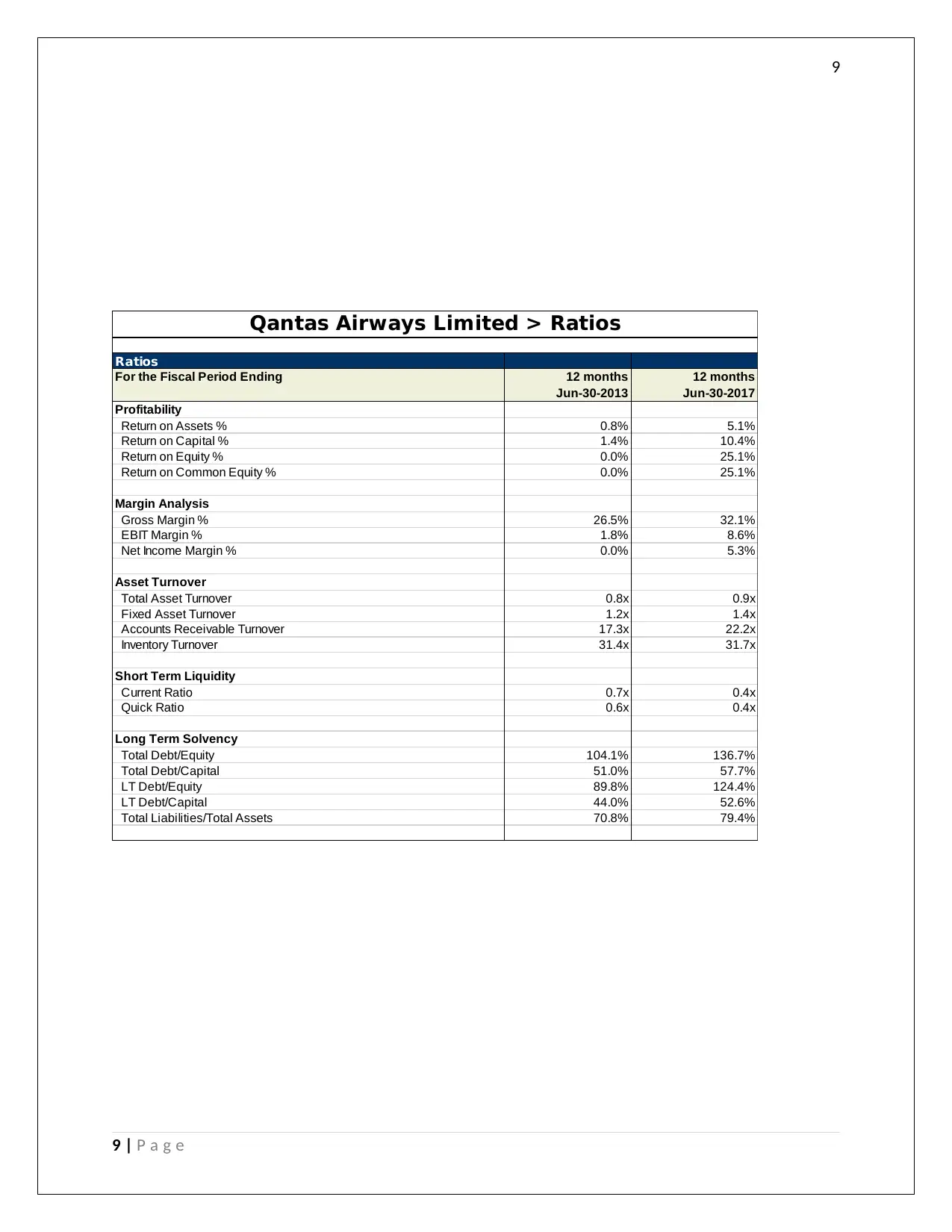
Ratios
For the Fiscal Period Ending 12 months
Jun-30-2013
12 months
Jun-30-2017
Profitability
Return on Assets % 0.8% 5.1%
Return on Capital % 1.4% 10.4%
Return on Equity % 0.0% 25.1%
Return on Common Equity % 0.0% 25.1%
Margin Analysis
Gross Margin % 26.5% 32.1%
EBIT Margin % 1.8% 8.6%
Net Income Margin % 0.0% 5.3%
Asset Turnover
Total Asset Turnover 0.8x 0.9x
Fixed Asset Turnover 1.2x 1.4x
Accounts Receivable Turnover 17.3x 22.2x
Inventory Turnover 31.4x 31.7x
Short Term Liquidity
Current Ratio 0.7x 0.4x
Quick Ratio 0.6x 0.4x
Long Term Solvency
Total Debt/Equity 104.1% 136.7%
Total Debt/Capital 51.0% 57.7%
LT Debt/Equity 89.8% 124.4%
LT Debt/Capital 44.0% 52.6%
Total Liabilities/Total Assets 70.8% 79.4%
Qantas Airways Limited > Ratios
9 | P a g e
Ratios
For the Fiscal Period Ending 12 months
Jun-30-2013
12 months
Jun-30-2017
Profitability
Return on Assets % 0.8% 5.1%
Return on Capital % 1.4% 10.4%
Return on Equity % 0.0% 25.1%
Return on Common Equity % 0.0% 25.1%
Margin Analysis
Gross Margin % 26.5% 32.1%
EBIT Margin % 1.8% 8.6%
Net Income Margin % 0.0% 5.3%
Asset Turnover
Total Asset Turnover 0.8x 0.9x
Fixed Asset Turnover 1.2x 1.4x
Accounts Receivable Turnover 17.3x 22.2x
Inventory Turnover 31.4x 31.7x
Short Term Liquidity
Current Ratio 0.7x 0.4x
Quick Ratio 0.6x 0.4x
Long Term Solvency
Total Debt/Equity 104.1% 136.7%
Total Debt/Capital 51.0% 57.7%
LT Debt/Equity 89.8% 124.4%
LT Debt/Capital 44.0% 52.6%
Total Liabilities/Total Assets 70.8% 79.4%
Qantas Airways Limited > Ratios
9 | P a g e
Paraphrase This Document
Need a fresh take? Get an instant paraphrase of this document with our AI Paraphraser

10
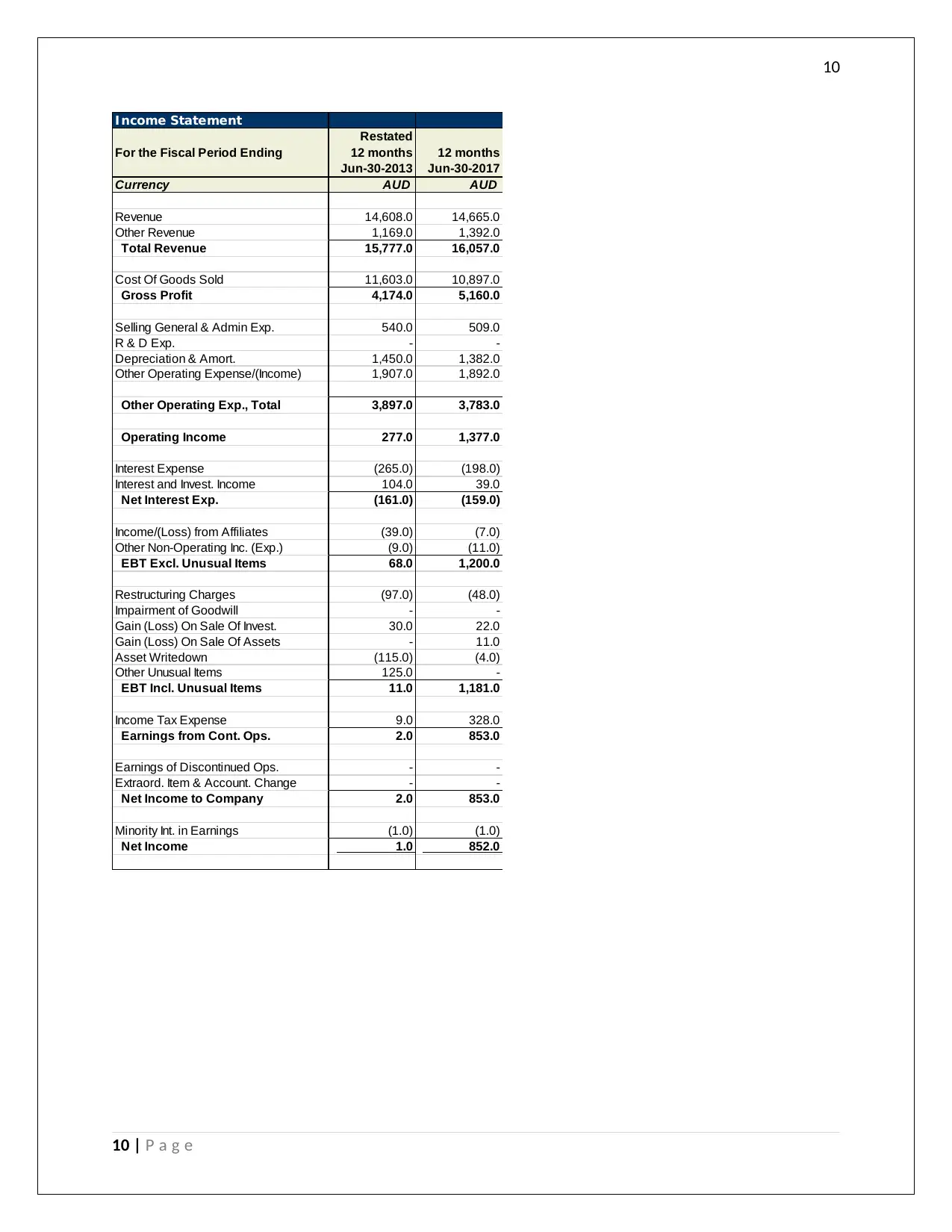
I ncome Statement
For the Fiscal Period Ending
Restated
12 months
Jun-30-2013
12 months
Jun-30-2017
Currency AUD AUD
Revenue 14,608.0 14,665.0
Other Revenue 1,169.0 1,392.0
Total Revenue 15,777.0 16,057.0
Cost Of Goods Sold 11,603.0 10,897.0
Gross Profit 4,174.0 5,160.0
Selling General & Admin Exp. 540.0 509.0
R & D Exp. - -
Depreciation & Amort. 1,450.0 1,382.0
Other Operating Expense/(Income) 1,907.0 1,892.0
Other Operating Exp., Total 3,897.0 3,783.0
Operating Income 277.0 1,377.0
Interest Expense (265.0) (198.0)
Interest and Invest. Income 104.0 39.0
Net Interest Exp. (161.0) (159.0)
Income/(Loss) from Affiliates (39.0) (7.0)
Other Non-Operating Inc. (Exp.) (9.0) (11.0)
EBT Excl. Unusual Items 68.0 1,200.0
Restructuring Charges (97.0) (48.0)
Impairment of Goodwill - -
Gain (Loss) On Sale Of Invest. 30.0 22.0
Gain (Loss) On Sale Of Assets - 11.0
Asset Writedown (115.0) (4.0)
Other Unusual Items 125.0 -
EBT Incl. Unusual Items 11.0 1,181.0
Income Tax Expense 9.0 328.0
Earnings from Cont. Ops. 2.0 853.0
Earnings of Discontinued Ops. - -
Extraord. Item & Account. Change - -
Net Income to Company 2.0 853.0
Minority Int. in Earnings (1.0) (1.0)
Net Income 1.0 852.0
10 | P a g e
I ncome Statement
For the Fiscal Period Ending
Restated
12 months
Jun-30-2013
12 months
Jun-30-2017
Currency AUD AUD
Revenue 14,608.0 14,665.0
Other Revenue 1,169.0 1,392.0
Total Revenue 15,777.0 16,057.0
Cost Of Goods Sold 11,603.0 10,897.0
Gross Profit 4,174.0 5,160.0
Selling General & Admin Exp. 540.0 509.0
R & D Exp. - -
Depreciation & Amort. 1,450.0 1,382.0
Other Operating Expense/(Income) 1,907.0 1,892.0
Other Operating Exp., Total 3,897.0 3,783.0
Operating Income 277.0 1,377.0
Interest Expense (265.0) (198.0)
Interest and Invest. Income 104.0 39.0
Net Interest Exp. (161.0) (159.0)
Income/(Loss) from Affiliates (39.0) (7.0)
Other Non-Operating Inc. (Exp.) (9.0) (11.0)
EBT Excl. Unusual Items 68.0 1,200.0
Restructuring Charges (97.0) (48.0)
Impairment of Goodwill - -
Gain (Loss) On Sale Of Invest. 30.0 22.0
Gain (Loss) On Sale Of Assets - 11.0
Asset Writedown (115.0) (4.0)
Other Unusual Items 125.0 -
EBT Incl. Unusual Items 11.0 1,181.0
Income Tax Expense 9.0 328.0
Earnings from Cont. Ops. 2.0 853.0
Earnings of Discontinued Ops. - -
Extraord. Item & Account. Change - -
Net Income to Company 2.0 853.0
Minority Int. in Earnings (1.0) (1.0)
Net Income 1.0 852.0
10 | P a g e

11
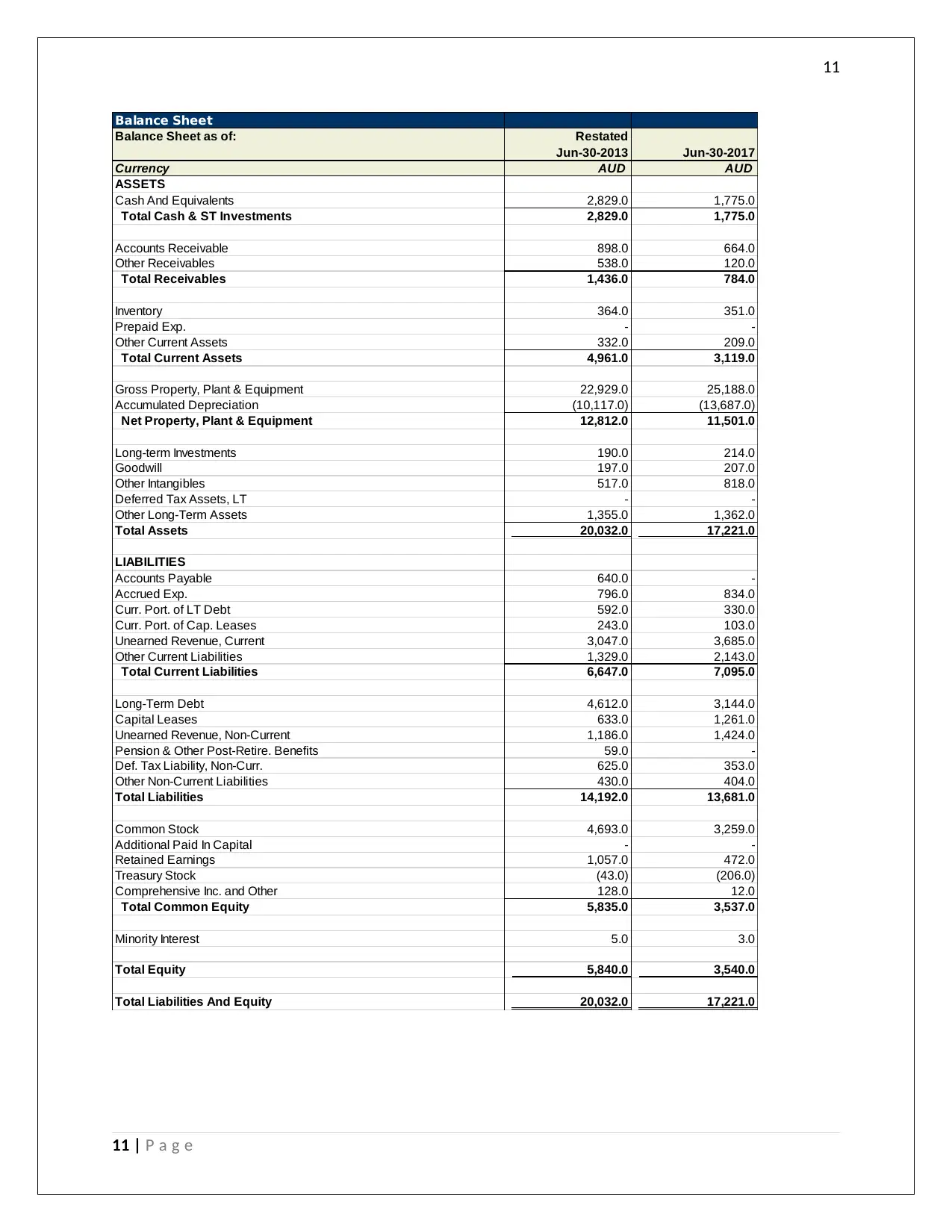
Balance Sheet
Balance Sheet as of: Restated
Jun-30-2013 Jun-30-2017
Currency AUD AUD
ASSETS
Cash And Equivalents 2,829.0 1,775.0
Total Cash & ST Investments 2,829.0 1,775.0
Accounts Receivable 898.0 664.0
Other Receivables 538.0 120.0
Total Receivables 1,436.0 784.0
Inventory 364.0 351.0
Prepaid Exp. - -
Other Current Assets 332.0 209.0
Total Current Assets 4,961.0 3,119.0
Gross Property, Plant & Equipment 22,929.0 25,188.0
Accumulated Depreciation (10,117.0) (13,687.0)
Net Property, Plant & Equipment 12,812.0 11,501.0
Long-term Investments 190.0 214.0
Goodwill 197.0 207.0
Other Intangibles 517.0 818.0
Deferred Tax Assets, LT - -
Other Long-Term Assets 1,355.0 1,362.0
Total Assets 20,032.0 17,221.0
LIABILITIES
Accounts Payable 640.0 -
Accrued Exp. 796.0 834.0
Curr. Port. of LT Debt 592.0 330.0
Curr. Port. of Cap. Leases 243.0 103.0
Unearned Revenue, Current 3,047.0 3,685.0
Other Current Liabilities 1,329.0 2,143.0
Total Current Liabilities 6,647.0 7,095.0
Long-Term Debt 4,612.0 3,144.0
Capital Leases 633.0 1,261.0
Unearned Revenue, Non-Current 1,186.0 1,424.0
Pension & Other Post-Retire. Benefits 59.0 -
Def. Tax Liability, Non-Curr. 625.0 353.0
Other Non-Current Liabilities 430.0 404.0
Total Liabilities 14,192.0 13,681.0
Common Stock 4,693.0 3,259.0
Additional Paid In Capital - -
Retained Earnings 1,057.0 472.0
Treasury Stock (43.0) (206.0)
Comprehensive Inc. and Other 128.0 12.0
Total Common Equity 5,835.0 3,537.0
Minority Interest 5.0 3.0
Total Equity 5,840.0 3,540.0
Total Liabilities And Equity 20,032.0 17,221.0
11 | P a g e
Balance Sheet
Balance Sheet as of: Restated
Jun-30-2013 Jun-30-2017
Currency AUD AUD
ASSETS
Cash And Equivalents 2,829.0 1,775.0
Total Cash & ST Investments 2,829.0 1,775.0
Accounts Receivable 898.0 664.0
Other Receivables 538.0 120.0
Total Receivables 1,436.0 784.0
Inventory 364.0 351.0
Prepaid Exp. - -
Other Current Assets 332.0 209.0
Total Current Assets 4,961.0 3,119.0
Gross Property, Plant & Equipment 22,929.0 25,188.0
Accumulated Depreciation (10,117.0) (13,687.0)
Net Property, Plant & Equipment 12,812.0 11,501.0
Long-term Investments 190.0 214.0
Goodwill 197.0 207.0
Other Intangibles 517.0 818.0
Deferred Tax Assets, LT - -
Other Long-Term Assets 1,355.0 1,362.0
Total Assets 20,032.0 17,221.0
LIABILITIES
Accounts Payable 640.0 -
Accrued Exp. 796.0 834.0
Curr. Port. of LT Debt 592.0 330.0
Curr. Port. of Cap. Leases 243.0 103.0
Unearned Revenue, Current 3,047.0 3,685.0
Other Current Liabilities 1,329.0 2,143.0
Total Current Liabilities 6,647.0 7,095.0
Long-Term Debt 4,612.0 3,144.0
Capital Leases 633.0 1,261.0
Unearned Revenue, Non-Current 1,186.0 1,424.0
Pension & Other Post-Retire. Benefits 59.0 -
Def. Tax Liability, Non-Curr. 625.0 353.0
Other Non-Current Liabilities 430.0 404.0
Total Liabilities 14,192.0 13,681.0
Common Stock 4,693.0 3,259.0
Additional Paid In Capital - -
Retained Earnings 1,057.0 472.0
Treasury Stock (43.0) (206.0)
Comprehensive Inc. and Other 128.0 12.0
Total Common Equity 5,835.0 3,537.0
Minority Interest 5.0 3.0
Total Equity 5,840.0 3,540.0
Total Liabilities And Equity 20,032.0 17,221.0
11 | P a g e
⊘ This is a preview!⊘
Do you want full access?
Subscribe today to unlock all pages.

Trusted by 1+ million students worldwide
1 out of 16
Related Documents
Your All-in-One AI-Powered Toolkit for Academic Success.
 +13062052269
info@desklib.com
Available 24*7 on WhatsApp / Email
Unlock your academic potential
Copyright © 2020–2025 A2Z Services. All Rights Reserved. Developed and managed by ZUCOL.