Qantas Airlines: Business Case Analysis of Gold Coast Ferry Project
VerifiedAdded on  2022/08/18
|8
|1409
|31
Report
AI Summary
This memorandum, prepared for Qantas Airlines, presents a comprehensive business case analysis of a proposed ferry project on the Gold Coast. The analysis evaluates the project's financial viability using investment appraisal techniques such as Net Present Value (NPV), Internal Rate of Return (IRR), Profitability Index (PI), Payback Period, and Discounted Payback Period. The report includes detailed calculations of cash flows, feasibility results, and a sensitivity analysis to assess the impact of varying revenue assumptions. The analysis concludes that the project is financially feasible and recommends investment based on the positive NPV and IRR, while also acknowledging the risks associated with assumptions about variable costs, fixed costs, and expected revenue. Furthermore, the report suggests the project's potential to increase social welfare and reduce pollution by promoting an environmentally friendly transport option. The report is supported by a bibliography and includes appendices with detailed calculations and analysis results.
QUANTAS MEMORANDUM
TO: Olivia Worth, Executive of Government and Corporate Affairs, Qantas Airlines
FROM: Michael Smith, Communications Strategist
DATE: May 5, 2017
SUBJECT: Business Case Analysis
The Goal Coast City Council has addressed that there is a need of transport in the future
and for this they have created a strategy named The Gold Coast City Transport Strategy. This
strategy is concerned with reducing the traffic congestion as well as looking out for travelling
alternatives which are environmental friendly.
The traffic congestion has been increased in the Gold Coast due to continuous increase of
the population and the main objective of this strategy is to promote the use of public transport
and introduce other environmental friendly ways of transportation like walking and cycling.
Initially there no mention of the water transport and therefore, for this purpose the proposal has
been extended to introduce the system of ferry which will operate simultaneously with the land
transport.
This part of the memorandum discusses about the financial aspects of the project along
with the investment needs. The discussion has been done with the help of the investment
appraisal techniques. These techniques are discussed below-
NPV- The difference between the present value of the cash inflow and the present value of the
cash outflow has been termed as the net present value. The use of NPV is found in capital
budgeting as well as investment planning as it helps in the analysis of the profitability of an
TO: Olivia Worth, Executive of Government and Corporate Affairs, Qantas Airlines
FROM: Michael Smith, Communications Strategist
DATE: May 5, 2017
SUBJECT: Business Case Analysis
The Goal Coast City Council has addressed that there is a need of transport in the future
and for this they have created a strategy named The Gold Coast City Transport Strategy. This
strategy is concerned with reducing the traffic congestion as well as looking out for travelling
alternatives which are environmental friendly.
The traffic congestion has been increased in the Gold Coast due to continuous increase of
the population and the main objective of this strategy is to promote the use of public transport
and introduce other environmental friendly ways of transportation like walking and cycling.
Initially there no mention of the water transport and therefore, for this purpose the proposal has
been extended to introduce the system of ferry which will operate simultaneously with the land
transport.
This part of the memorandum discusses about the financial aspects of the project along
with the investment needs. The discussion has been done with the help of the investment
appraisal techniques. These techniques are discussed below-
NPV- The difference between the present value of the cash inflow and the present value of the
cash outflow has been termed as the net present value. The use of NPV is found in capital
budgeting as well as investment planning as it helps in the analysis of the profitability of an
Paraphrase This Document
Need a fresh take? Get an instant paraphrase of this document with our AI Paraphraser

investment or a project. A positive net present value shows that the earnings of the project
exceeds the anticipated costs.
IRR- The rate of interest at which the NPV of any investment or project becomes zero has been
termed as the internal rate of return. It helps in the evaluation of the attractiveness of the project
or the investment. Ideally, the IRR should be less than the required rate of return.
PI- The profitability index is the value or profit investment ratio which helps to describe the
relationship between the costs and the benefits of the suggested project with the help of the ratio
of present value of future cash flows: initial investment. It works as an index for quantifying the
value of each unit of investment.
Payback period- The payback period is the period of time which an investment requires to reach
to the breakeven point. The payback period evaluates the desirability of a project or investment.
Discounted payback period- The discounted payback period helps in the determination of the
profitability of the project. It is a procedure of capital budgeting which helps in the evaluation of
the feasibility and profitability of a project.
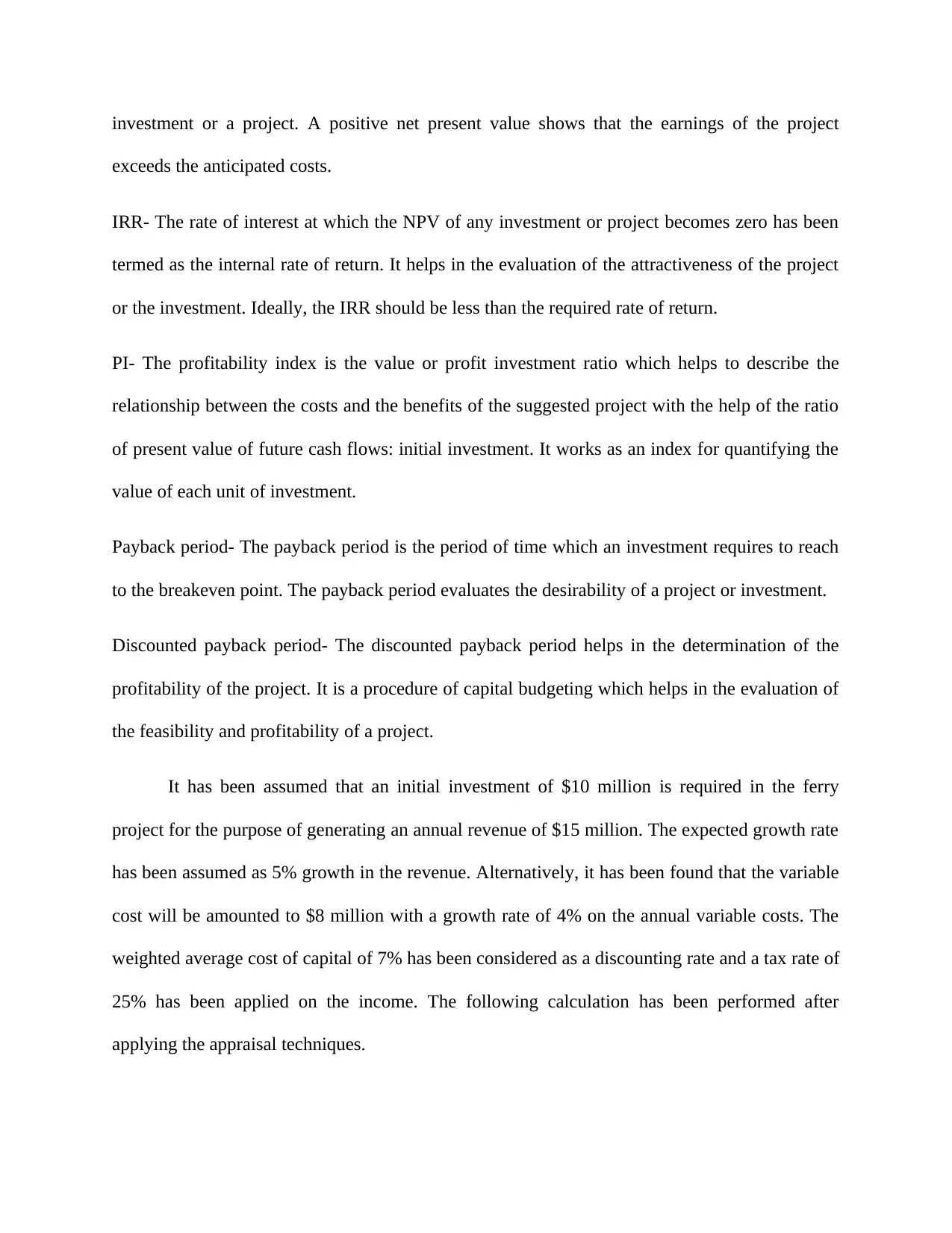
It has been assumed that an initial investment of $10 million is required in the ferry
project for the purpose of generating an annual revenue of $15 million. The expected growth rate
has been assumed as 5% growth in the revenue. Alternatively, it has been found that the variable
cost will be amounted to $8 million with a growth rate of 4% on the annual variable costs. The
weighted average cost of capital of 7% has been considered as a discounting rate and a tax rate of
25% has been applied on the income. The following calculation has been performed after
applying the appraisal techniques.
exceeds the anticipated costs.
IRR- The rate of interest at which the NPV of any investment or project becomes zero has been
termed as the internal rate of return. It helps in the evaluation of the attractiveness of the project
or the investment. Ideally, the IRR should be less than the required rate of return.
PI- The profitability index is the value or profit investment ratio which helps to describe the
relationship between the costs and the benefits of the suggested project with the help of the ratio
of present value of future cash flows: initial investment. It works as an index for quantifying the
value of each unit of investment.
Payback period- The payback period is the period of time which an investment requires to reach
to the breakeven point. The payback period evaluates the desirability of a project or investment.
Discounted payback period- The discounted payback period helps in the determination of the
profitability of the project. It is a procedure of capital budgeting which helps in the evaluation of
the feasibility and profitability of a project.
It has been assumed that an initial investment of $10 million is required in the ferry
project for the purpose of generating an annual revenue of $15 million. The expected growth rate
has been assumed as 5% growth in the revenue. Alternatively, it has been found that the variable
cost will be amounted to $8 million with a growth rate of 4% on the annual variable costs. The
weighted average cost of capital of 7% has been considered as a discounting rate and a tax rate of
25% has been applied on the income. The following calculation has been performed after
applying the appraisal techniques.

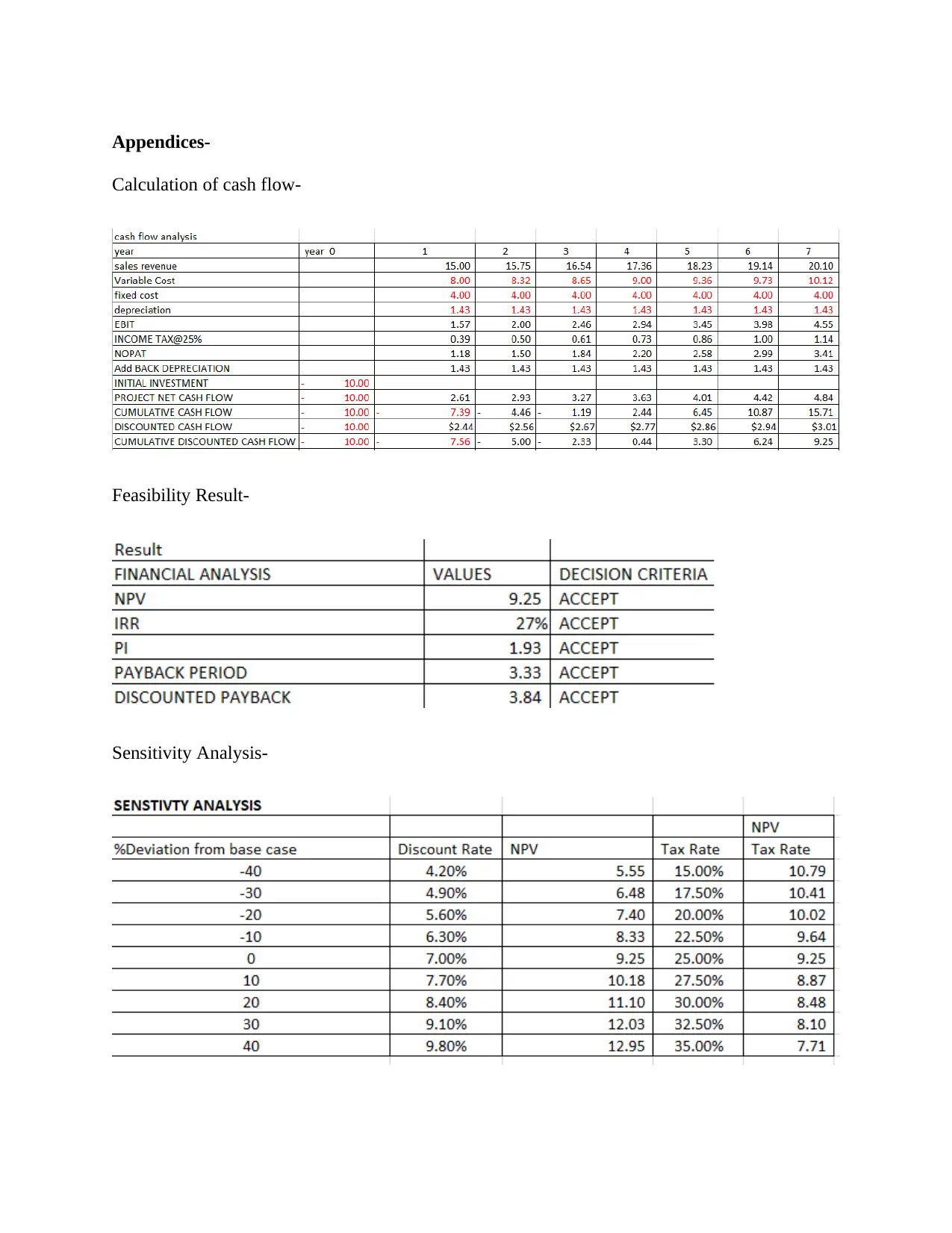
From the above calculation it has been observed that the project will be generating a
positive cash flow over the total life cycle of the project which is 7 years. However, it can be
assumed that if the free cash flows which have been generated by the project have been
discounted with the discounted factor of 7% then the free cash flow is capable of recovering the
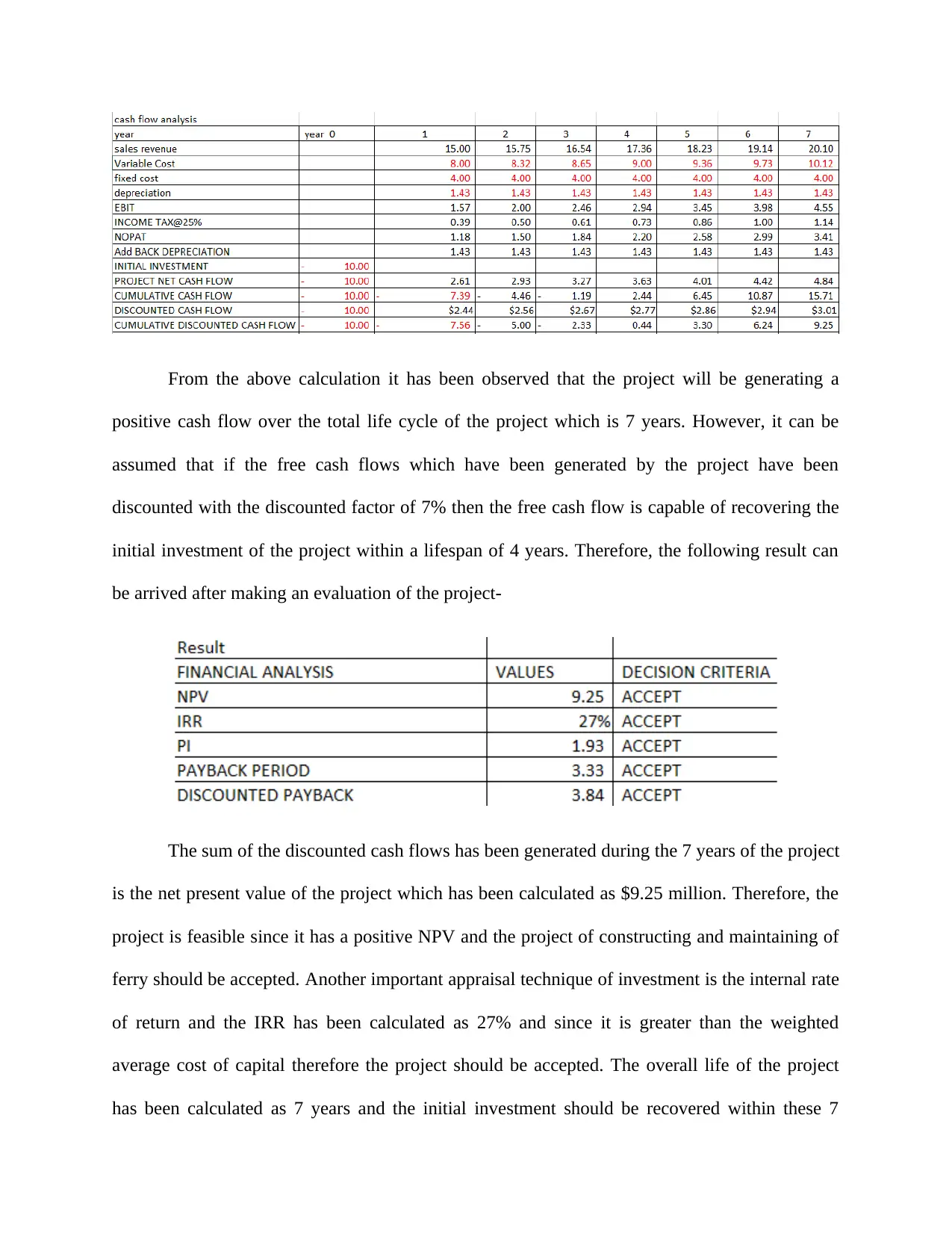
initial investment of the project within a lifespan of 4 years. Therefore, the following result can
be arrived after making an evaluation of the project-
The sum of the discounted cash flows has been generated during the 7 years of the project
is the net present value of the project which has been calculated as $9.25 million. Therefore, the
project is feasible since it has a positive NPV and the project of constructing and maintaining of
ferry should be accepted. Another important appraisal technique of investment is the internal rate
of return and the IRR has been calculated as 27% and since it is greater than the weighted
average cost of capital therefore the project should be accepted. The overall life of the project
has been calculated as 7 years and the initial investment should be recovered within these 7
positive cash flow over the total life cycle of the project which is 7 years. However, it can be
assumed that if the free cash flows which have been generated by the project have been
discounted with the discounted factor of 7% then the free cash flow is capable of recovering the
initial investment of the project within a lifespan of 4 years. Therefore, the following result can
be arrived after making an evaluation of the project-
The sum of the discounted cash flows has been generated during the 7 years of the project
is the net present value of the project which has been calculated as $9.25 million. Therefore, the
project is feasible since it has a positive NPV and the project of constructing and maintaining of
ferry should be accepted. Another important appraisal technique of investment is the internal rate
of return and the IRR has been calculated as 27% and since it is greater than the weighted
average cost of capital therefore the project should be accepted. The overall life of the project
has been calculated as 7 years and the initial investment should be recovered within these 7
⊘ This is a preview!⊘
Do you want full access?
Subscribe today to unlock all pages.

Trusted by 1+ million students worldwide

years. According to the calculation, the payback period has been calculated as 3 years and the
discounted payback period has been calculated as 4 years. Thus, the project is feasible and based
on the above calculations and investment in this project can be made.
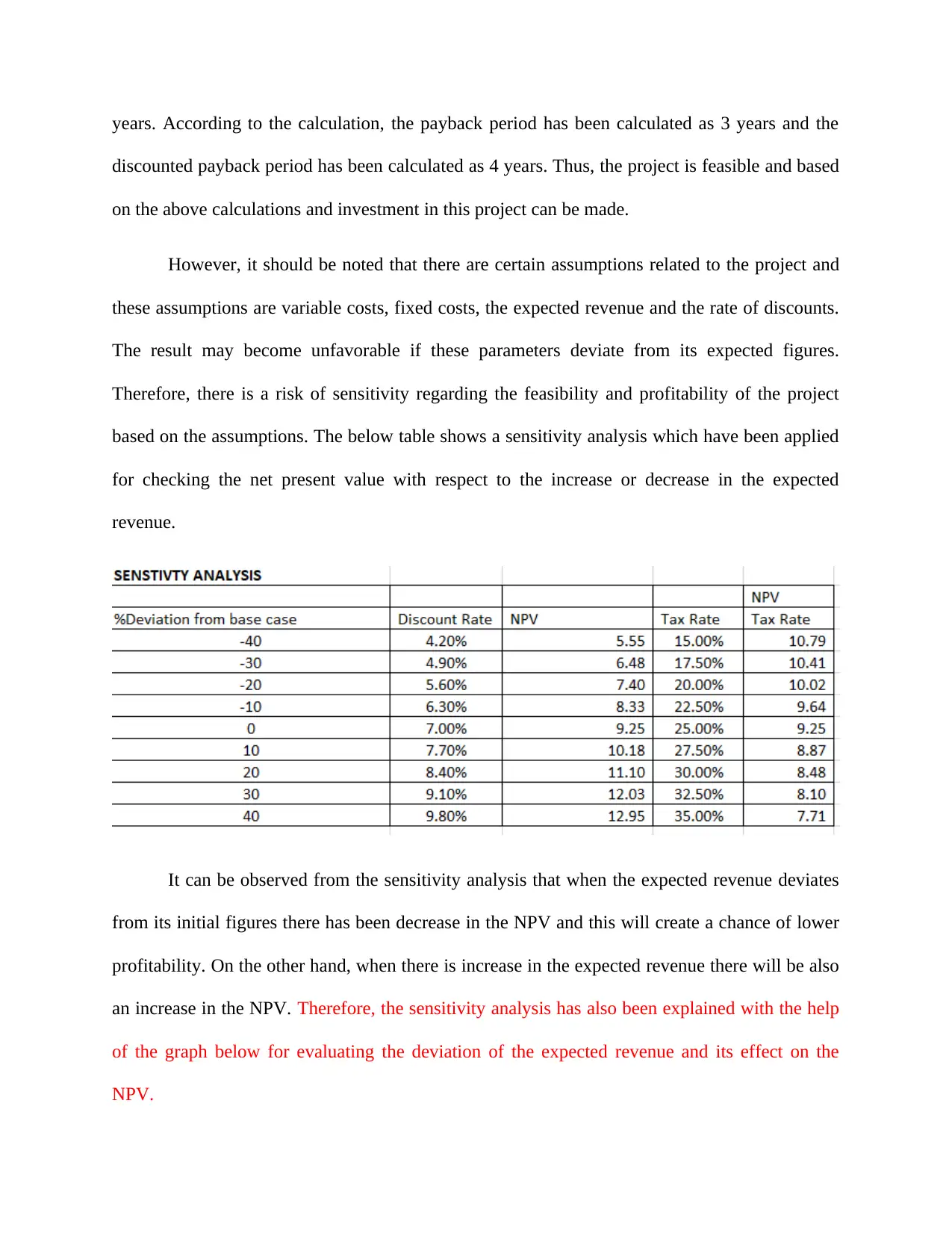
However, it should be noted that there are certain assumptions related to the project and
these assumptions are variable costs, fixed costs, the expected revenue and the rate of discounts.
The result may become unfavorable if these parameters deviate from its expected figures.
Therefore, there is a risk of sensitivity regarding the feasibility and profitability of the project
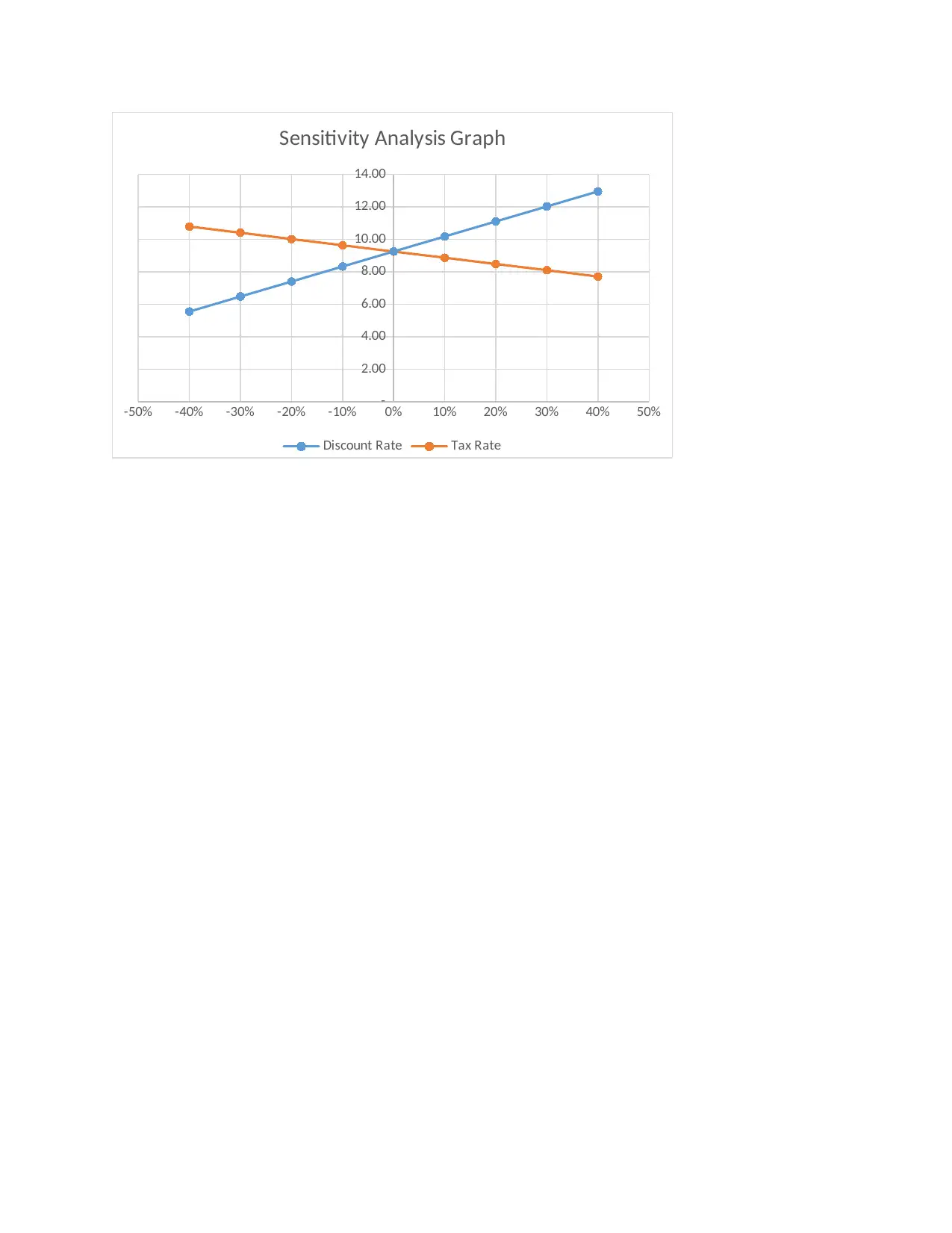
based on the assumptions. The below table shows a sensitivity analysis which have been applied
for checking the net present value with respect to the increase or decrease in the expected
revenue.
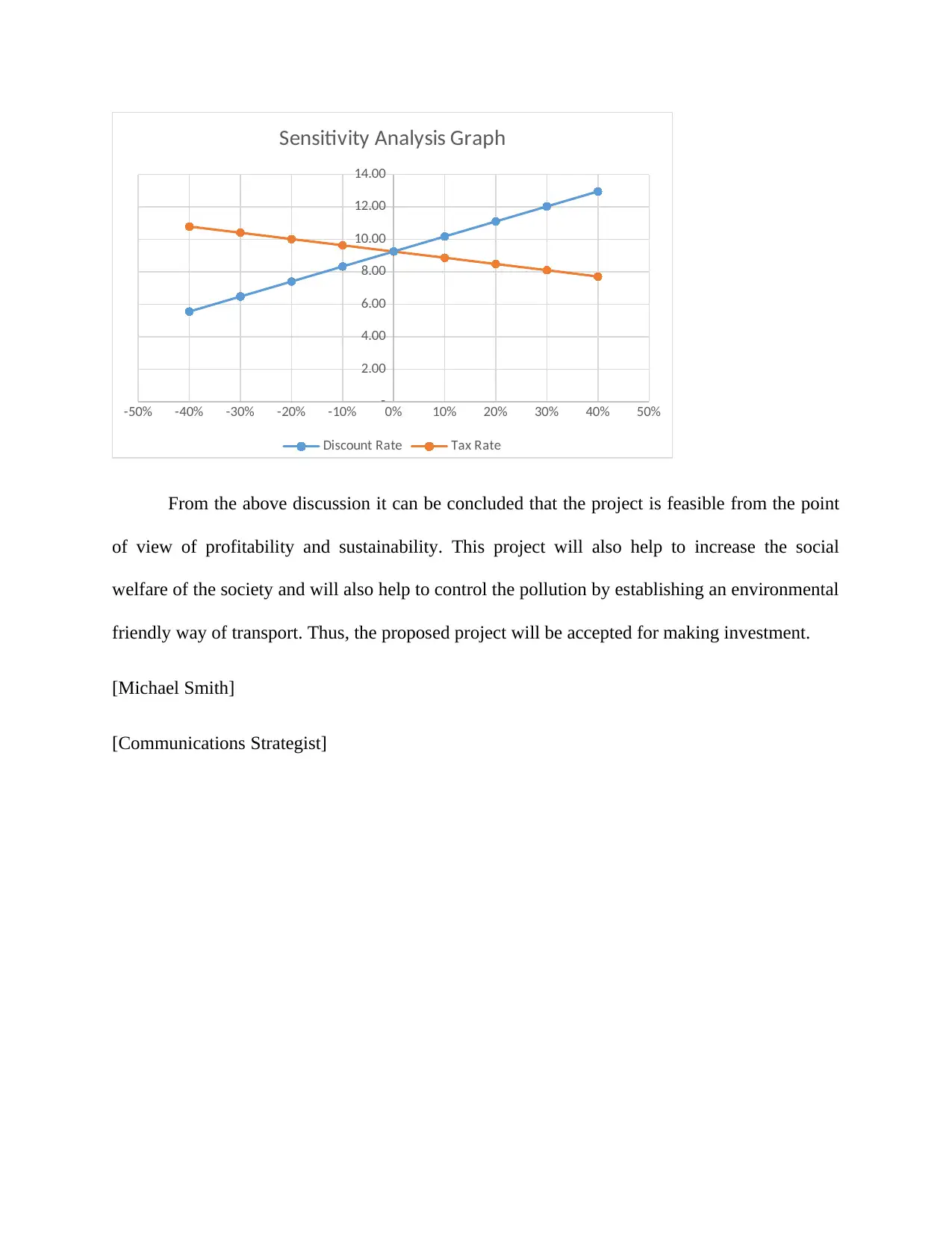
It can be observed from the sensitivity analysis that when the expected revenue deviates
from its initial figures there has been decrease in the NPV and this will create a chance of lower
profitability. On the other hand, when there is increase in the expected revenue there will be also
an increase in the NPV. Therefore, the sensitivity analysis has also been explained with the help
of the graph below for evaluating the deviation of the expected revenue and its effect on the
NPV.
discounted payback period has been calculated as 4 years. Thus, the project is feasible and based
on the above calculations and investment in this project can be made.
However, it should be noted that there are certain assumptions related to the project and
these assumptions are variable costs, fixed costs, the expected revenue and the rate of discounts.
The result may become unfavorable if these parameters deviate from its expected figures.
Therefore, there is a risk of sensitivity regarding the feasibility and profitability of the project
based on the assumptions. The below table shows a sensitivity analysis which have been applied
for checking the net present value with respect to the increase or decrease in the expected
revenue.
It can be observed from the sensitivity analysis that when the expected revenue deviates
from its initial figures there has been decrease in the NPV and this will create a chance of lower
profitability. On the other hand, when there is increase in the expected revenue there will be also
an increase in the NPV. Therefore, the sensitivity analysis has also been explained with the help
of the graph below for evaluating the deviation of the expected revenue and its effect on the
NPV.
Paraphrase This Document
Need a fresh take? Get an instant paraphrase of this document with our AI Paraphraser

-50% -40% -30% -20% -10% 0% 10% 20% 30% 40% 50%
-
2.00
4.00
6.00
8.00
10.00
12.00
14.00
Sensitivity Analysis Graph
Discount Rate Tax Rate
From the above discussion it can be concluded that the project is feasible from the point
of view of profitability and sustainability. This project will also help to increase the social
welfare of the society and will also help to control the pollution by establishing an environmental
friendly way of transport. Thus, the proposed project will be accepted for making investment.
[Michael Smith]
[Communications Strategist]
-
2.00
4.00
6.00
8.00
10.00
12.00
14.00
Sensitivity Analysis Graph
Discount Rate Tax Rate
From the above discussion it can be concluded that the project is feasible from the point
of view of profitability and sustainability. This project will also help to increase the social
welfare of the society and will also help to control the pollution by establishing an environmental
friendly way of transport. Thus, the proposed project will be accepted for making investment.
[Michael Smith]
[Communications Strategist]

Bibliography
Andor, G., Mohanty, S.K. and Toth, T., 2015. Capital budgeting practices: A survey of Central
and Eastern European firms. Emerging Markets Review, 23, pp.148-172.
Batra, R. and Verma, S., 2017. Capital budgeting practices in Indian companies. IIMB
Management Review, 29(1), pp.29-44.
Eldridge, S.M., Lancaster, G.A., Campbell, M.J., Thabane, L., Hopewell, S., Coleman, C.L. and
Bond, C.M., 2016. Defining feasibility and pilot studies in preparation for randomised controlled
trials: development of a conceptual framework. PloS one, 11(3).
Kolodenkova, A.E., Khalikova, E.A., Korobkin, V.V. and Gubanov, N.G., 2016. A method of
project feasibility assessment on creation of information-control systems for complex technical
objects on the basis of fuzzy cognitive modeling. International Journal of Control Theory and
Applications, 9(30), pp.73-82.
Lunkes, R.J., Ripoll-Feliu, V., Giner-Fillol, A. and da Rosa, F.S., 2015. Capital budgeting
practices: A comparative study between a port company in Brazil and in Spain. Journal of
Public Administration and Policy Research, 7(3), p.39.
Malenko, A., 2019. Optimal dynamic capital budgeting. The Review of Economic Studies, 86(4),
pp.1747-1778.
Mukherjee, M. and Roy, S., 2017. Feasibility studies and important aspect of project
management. International Journal of Advanced Engineering and Management, 2(4), pp.98-100.
Andor, G., Mohanty, S.K. and Toth, T., 2015. Capital budgeting practices: A survey of Central
and Eastern European firms. Emerging Markets Review, 23, pp.148-172.
Batra, R. and Verma, S., 2017. Capital budgeting practices in Indian companies. IIMB
Management Review, 29(1), pp.29-44.
Eldridge, S.M., Lancaster, G.A., Campbell, M.J., Thabane, L., Hopewell, S., Coleman, C.L. and
Bond, C.M., 2016. Defining feasibility and pilot studies in preparation for randomised controlled
trials: development of a conceptual framework. PloS one, 11(3).
Kolodenkova, A.E., Khalikova, E.A., Korobkin, V.V. and Gubanov, N.G., 2016. A method of
project feasibility assessment on creation of information-control systems for complex technical
objects on the basis of fuzzy cognitive modeling. International Journal of Control Theory and
Applications, 9(30), pp.73-82.
Lunkes, R.J., Ripoll-Feliu, V., Giner-Fillol, A. and da Rosa, F.S., 2015. Capital budgeting
practices: A comparative study between a port company in Brazil and in Spain. Journal of
Public Administration and Policy Research, 7(3), p.39.
Malenko, A., 2019. Optimal dynamic capital budgeting. The Review of Economic Studies, 86(4),
pp.1747-1778.
Mukherjee, M. and Roy, S., 2017. Feasibility studies and important aspect of project
management. International Journal of Advanced Engineering and Management, 2(4), pp.98-100.
⊘ This is a preview!⊘
Do you want full access?
Subscribe today to unlock all pages.

Trusted by 1+ million students worldwide

Appendices-
Calculation of cash flow-
Feasibility Result-
Sensitivity Analysis-
Calculation of cash flow-
Feasibility Result-
Sensitivity Analysis-
Paraphrase This Document
Need a fresh take? Get an instant paraphrase of this document with our AI Paraphraser

-50% -40% -30% -20% -10% 0% 10% 20% 30% 40% 50%
-
2.00
4.00
6.00
8.00
10.00
12.00
14.00
Sensitivity Analysis Graph
Discount Rate Tax Rate
-
2.00
4.00
6.00
8.00
10.00
12.00
14.00
Sensitivity Analysis Graph
Discount Rate Tax Rate
1 out of 8
Related Documents
Your All-in-One AI-Powered Toolkit for Academic Success.
 +13062052269
info@desklib.com
Available 24*7 on WhatsApp / Email
Unlock your academic potential
Copyright © 2020–2025 A2Z Services. All Rights Reserved. Developed and managed by ZUCOL.