Quality Function Deployment and Axiomatic Design: A Detailed Report
VerifiedAdded on 2023/06/11
|13
|2351
|155
Report
AI Summary
This report provides a detailed comparison between Quality Function Deployment (QFD) and Axiomatic Design (AD) methodologies, both aimed at understanding and implementing customer needs in product development. QFD, developed by Yoji Akao, uses the House of Quality to translate customer feedback into product requirements across various development phases. Axiomatic Design, developed by N.P. Suh, focuses on mapping customer needs through functional, physical, and process domains using specific axioms and equations. The report highlights the differences in their approaches, noting QFD's lengthy process versus Axiomatic Design's simpler, equation-based methodology. It also discusses the concept of 'conman' data and presents a case study on apartment design to illustrate the integration of Axiomatic Design to enhance QFD, ultimately improving product quality and customer satisfaction. The report concludes that understanding and correctly applying these tools is crucial for product development and maintaining strong customer relationships.
Table of contents:
1.0 Quality function deployment VS Axiomatic design
1.1 Quality function Deployment
1.2 Axiomatic Design
2.0 Conman
3.0 Differences
3.1 Case Study
4.0 Conclusion
1.0 Quality function deployment VS Axiomatic design
1.1 Quality function Deployment
1.2 Axiomatic Design
2.0 Conman
3.0 Differences
3.1 Case Study
4.0 Conclusion

Paraphrase This Document
Need a fresh take? Get an instant paraphrase of this document with our AI Paraphraser
1.0 QFD Quality function deployment VS Axiomatic design
1.1 Quality function Deployment
The tool used for the process of understanding customer needs, prioritizing the
needs and then implementing the needs into the product development is Quality Function
Deployment (QFD). The QFD is developed by a Japanese named YojiAkao in 1966. Quality
function deployment is a method of acquiring and analyzing the customer voice and then
transforming it into the product requirements which also acts as a quality assurance measure
throughout the design, building, testing, and commercializing.(Chan, L. K., & Wu, M. L., 2002)
The House Of Quality is the process in that the plan looks like a house, based on the
customer feedback we can find what are customer need, how can it be provided, what are
relationship between that, and the importance that customer gives to each of their needs.
Objectives of QFD:
The objectives of QFD are,
To identify the true voice of the customer and to use that knowledge in product
development which will satisfy the customer
To help in the organization and analysis of all the relevant information associated
with the project.
Capturing voice of customer:
The initial process of QFD is capturing the voice of the customer and what is the exact
requirement of the product.
The various methods of capturing the customer voice are,
Direct discussions
Customer survey
Market survey
Trade trials
Focus groups
Customer Visit
Consultants
Observation
Warranty data
Customer audits
Customer complaints
Field reports
1.1 Quality function Deployment
The tool used for the process of understanding customer needs, prioritizing the
needs and then implementing the needs into the product development is Quality Function
Deployment (QFD). The QFD is developed by a Japanese named YojiAkao in 1966. Quality
function deployment is a method of acquiring and analyzing the customer voice and then
transforming it into the product requirements which also acts as a quality assurance measure
throughout the design, building, testing, and commercializing.(Chan, L. K., & Wu, M. L., 2002)
The House Of Quality is the process in that the plan looks like a house, based on the
customer feedback we can find what are customer need, how can it be provided, what are
relationship between that, and the importance that customer gives to each of their needs.
Objectives of QFD:
The objectives of QFD are,
To identify the true voice of the customer and to use that knowledge in product
development which will satisfy the customer
To help in the organization and analysis of all the relevant information associated
with the project.
Capturing voice of customer:
The initial process of QFD is capturing the voice of the customer and what is the exact
requirement of the product.
The various methods of capturing the customer voice are,
Direct discussions
Customer survey
Market survey
Trade trials
Focus groups
Customer Visit
Consultants
Observation
Warranty data
Customer audits
Customer complaints
Field reports
Standards
Government regulations
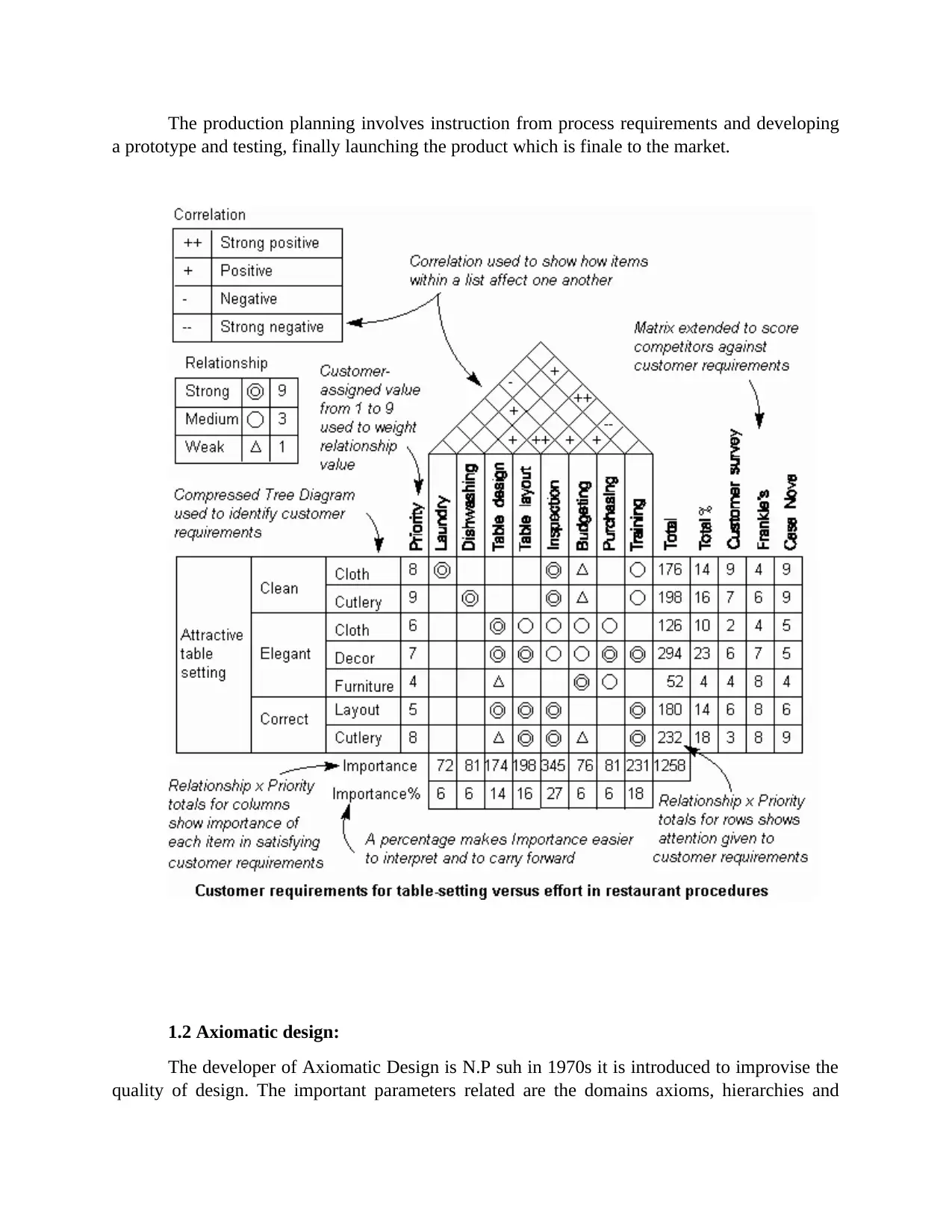
The primary planning tool used in QFD is the house of quality
The house of quality converts the voice of customer into product design characteristics. The
QFD uses a series of Matrix diagrams also called quality tables that resemble connected houses.
(Matzler, K., &Hinterhuber, H. H., 1998).
Basic Structure of House of Quality
The HOQ has six sections,
Section I: Customer relationship
The exterior wall of the house are the customer requirements. On the left hand side, the
voice of the customer is located.
Section II: Prioritized Customer requirements
On the right hand side the prioritized customer requirements are listed it is also called as
planning matrix are listed. Factors such as customer benchmarking, importance rating by the
customer, target value, scale up factor and the point of sales.
Section III: Technical Descriptors
The second floor or the ceiling of the house contains the technical descriptors. The
product design characteristic, expressed in engineering terms are located in this ceiling.
Section IV: Relationship matrix
Customer requirements and technical descriptors makes up the interior wall of the house.
This relationship matrix relates customer requirements with product features.
Section V: Trade off matrix
The top roof of the quality house is the relationship among technical descriptors and the
tradeoff between the similar technical descriptors.
Government regulations
The primary planning tool used in QFD is the house of quality
The house of quality converts the voice of customer into product design characteristics. The
QFD uses a series of Matrix diagrams also called quality tables that resemble connected houses.
(Matzler, K., &Hinterhuber, H. H., 1998).
Basic Structure of House of Quality
The HOQ has six sections,
Section I: Customer relationship
The exterior wall of the house are the customer requirements. On the left hand side, the
voice of the customer is located.
Section II: Prioritized Customer requirements
On the right hand side the prioritized customer requirements are listed it is also called as
planning matrix are listed. Factors such as customer benchmarking, importance rating by the
customer, target value, scale up factor and the point of sales.
Section III: Technical Descriptors
The second floor or the ceiling of the house contains the technical descriptors. The
product design characteristic, expressed in engineering terms are located in this ceiling.
Section IV: Relationship matrix
Customer requirements and technical descriptors makes up the interior wall of the house.
This relationship matrix relates customer requirements with product features.
Section V: Trade off matrix
The top roof of the quality house is the relationship among technical descriptors and the
tradeoff between the similar technical descriptors.
⊘ This is a preview!⊘
Do you want full access?
Subscribe today to unlock all pages.

Trusted by 1+ million students worldwide
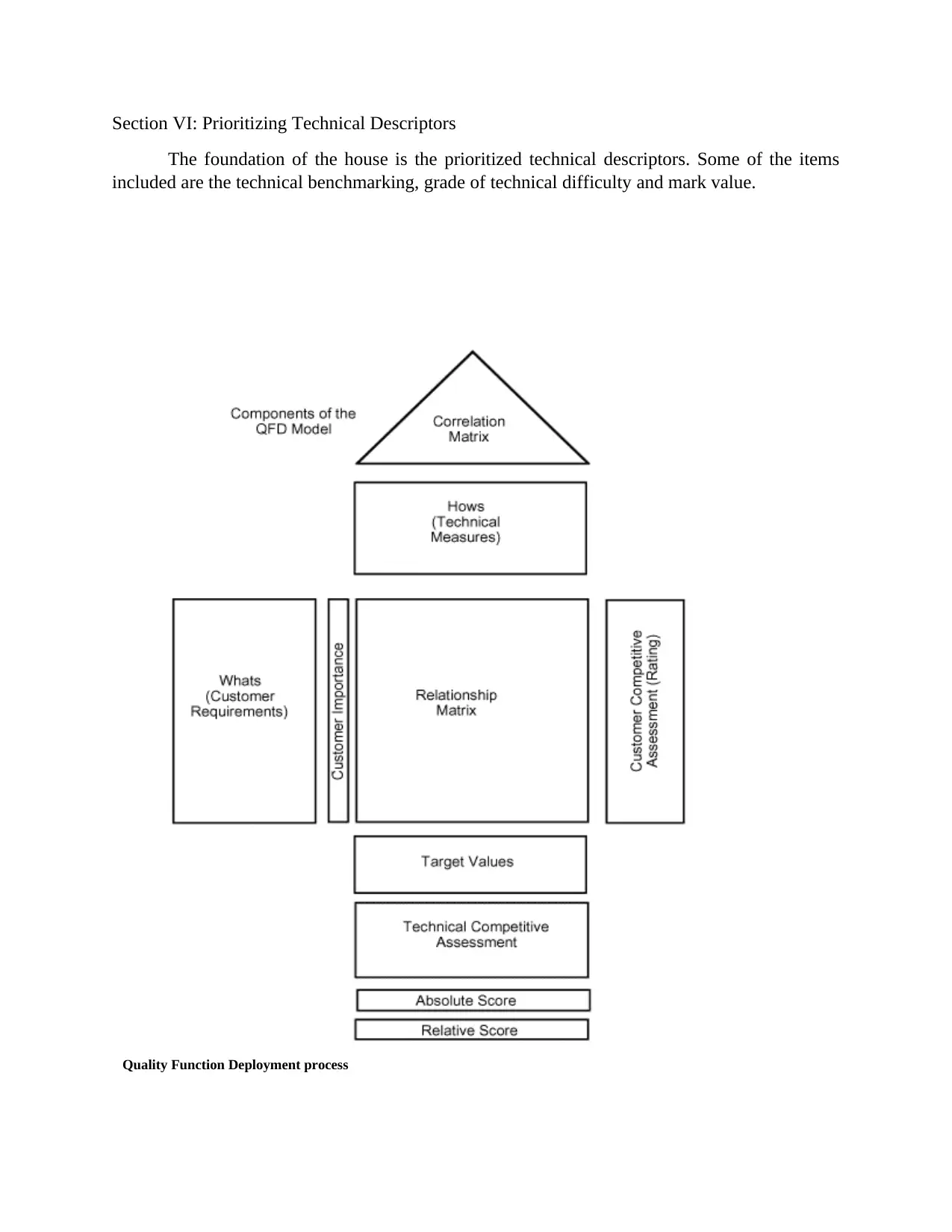
Section VI: Prioritizing Technical Descriptors
The foundation of the house is the prioritized technical descriptors. Some of the items
included are the technical benchmarking, grade of technical difficulty and mark value.
Quality Function Deployment process
The foundation of the house is the prioritized technical descriptors. Some of the items
included are the technical benchmarking, grade of technical difficulty and mark value.
Quality Function Deployment process
Paraphrase This Document
Need a fresh take? Get an instant paraphrase of this document with our AI Paraphraser
Steps involved in constructing the house of quality
Step 1. List customer requirements (whats)
Understand the customer completely. Define what he likes and dislikes. Measure the
priorities of these wants and dislikes by weighing scores. Summarize the customer need into a
small number of major needs, supported by a number of secondary and tertiary needs.
Step 2.List the technical Descriptors (hows)
Translate the identified customer wants into corresponding hows or design
characteristics. Express them in terms of quantifiable technical parameters of product
specifications.
Step 3. Develop a relationship matrix between whats and hows
Develop a relationship between the customer expectations and the technical descriptorsif
a relationship exists, categorize it as strong, medium or weak (or by assigning scores).
Steps 4. Develop an interrelationship Matrix between hows
Identify any interrelationships between each of the technical descriptors. These
relationships are marked in correlation matrix by either positive or negative. Here a positive
correlation represents a strong relationship and a negative correlation represents a weak
relationship.
Step 5. Competitive Assessments
Compare the performance of the product with the competitive products. Evaluate the
product and make note of strength and weakness of the product against the competitive product.
This assessment table consists of two categories customer assessments and technical
assessments.
Step 6. Develop prioritized customer requirements
Develop the prioritized customer requirements corresponding to each customer
requirements in the house of quality on the right side of the customer competitive assessment.
These customer requirements which are prioritized contains columns for importance to
customers, target values, scale up factor, and absolute weight.
Step 7. Develop prioritized technical descriptors
Step 1. List customer requirements (whats)
Understand the customer completely. Define what he likes and dislikes. Measure the
priorities of these wants and dislikes by weighing scores. Summarize the customer need into a
small number of major needs, supported by a number of secondary and tertiary needs.
Step 2.List the technical Descriptors (hows)
Translate the identified customer wants into corresponding hows or design
characteristics. Express them in terms of quantifiable technical parameters of product
specifications.
Step 3. Develop a relationship matrix between whats and hows
Develop a relationship between the customer expectations and the technical descriptorsif
a relationship exists, categorize it as strong, medium or weak (or by assigning scores).
Steps 4. Develop an interrelationship Matrix between hows
Identify any interrelationships between each of the technical descriptors. These
relationships are marked in correlation matrix by either positive or negative. Here a positive
correlation represents a strong relationship and a negative correlation represents a weak
relationship.
Step 5. Competitive Assessments
Compare the performance of the product with the competitive products. Evaluate the
product and make note of strength and weakness of the product against the competitive product.
This assessment table consists of two categories customer assessments and technical
assessments.
Step 6. Develop prioritized customer requirements
Develop the prioritized customer requirements corresponding to each customer
requirements in the house of quality on the right side of the customer competitive assessment.
These customer requirements which are prioritized contains columns for importance to
customers, target values, scale up factor, and absolute weight.
Step 7. Develop prioritized technical descriptors
Develop prioritized technical descriptors corresponding to each technical descriptors in
the house of quality below the technical competitive assessments. These technical descriptors
which are prioritized includes degree of technical difficulty, target value, and absolute and
relative weights.
At the end of the analysis of house of quality, the completed matrix contains all the information
about what are the customer requirements, among them which is more important, how the
competitive products score against our products and all other information regarding the customer
satisfaction. (Powell, T. C., 1995)
QFD process
In quality function development there are four phases in product development, they are:
I. Product planning
II. Part development
III. Process planning
IV. Production planning
Phase I
The House of quality matrix defines the product completely, it has information about
complete product development. The success of the product depends on good product definition
with the help of house of quality which leads toa better design. Thus the HOQ marks the
completion of phase I of the QFD process which is explained in the previous session.
Phase II: Part development
Following the seven steps from the house of quality the next step is deploying the QFD
process to the sub components level both in terms of requirements and characteristics. Then
deploying the component deployment chart and relating the critical sub-component control
characteristics.
Phase III: Processes planning
This phase includes developing the relationship between the critical characteristics and
process used to create the characteristics and developing the control plan related to controlling of
the critical processes.
Phase IV: Production planning
the house of quality below the technical competitive assessments. These technical descriptors
which are prioritized includes degree of technical difficulty, target value, and absolute and
relative weights.
At the end of the analysis of house of quality, the completed matrix contains all the information
about what are the customer requirements, among them which is more important, how the
competitive products score against our products and all other information regarding the customer
satisfaction. (Powell, T. C., 1995)
QFD process
In quality function development there are four phases in product development, they are:
I. Product planning
II. Part development
III. Process planning
IV. Production planning
Phase I
The House of quality matrix defines the product completely, it has information about
complete product development. The success of the product depends on good product definition
with the help of house of quality which leads toa better design. Thus the HOQ marks the
completion of phase I of the QFD process which is explained in the previous session.
Phase II: Part development
Following the seven steps from the house of quality the next step is deploying the QFD
process to the sub components level both in terms of requirements and characteristics. Then
deploying the component deployment chart and relating the critical sub-component control
characteristics.
Phase III: Processes planning
This phase includes developing the relationship between the critical characteristics and
process used to create the characteristics and developing the control plan related to controlling of
the critical processes.
Phase IV: Production planning
⊘ This is a preview!⊘
Do you want full access?
Subscribe today to unlock all pages.
Trusted by 1+ million students worldwide
The production planning involves instruction from process requirements and developing
a prototype and testing, finally launching the product which is finale to the market.
1.2 Axiomatic design:
The developer of Axiomatic Design is N.P suh in 1970s it is introduced to improvise the
quality of design. The important parameters related are the domains axioms, hierarchies and
a prototype and testing, finally launching the product which is finale to the market.
1.2 Axiomatic design:
The developer of Axiomatic Design is N.P suh in 1970s it is introduced to improvise the
quality of design. The important parameters related are the domains axioms, hierarchies and
Paraphrase This Document
Need a fresh take? Get an instant paraphrase of this document with our AI Paraphraser
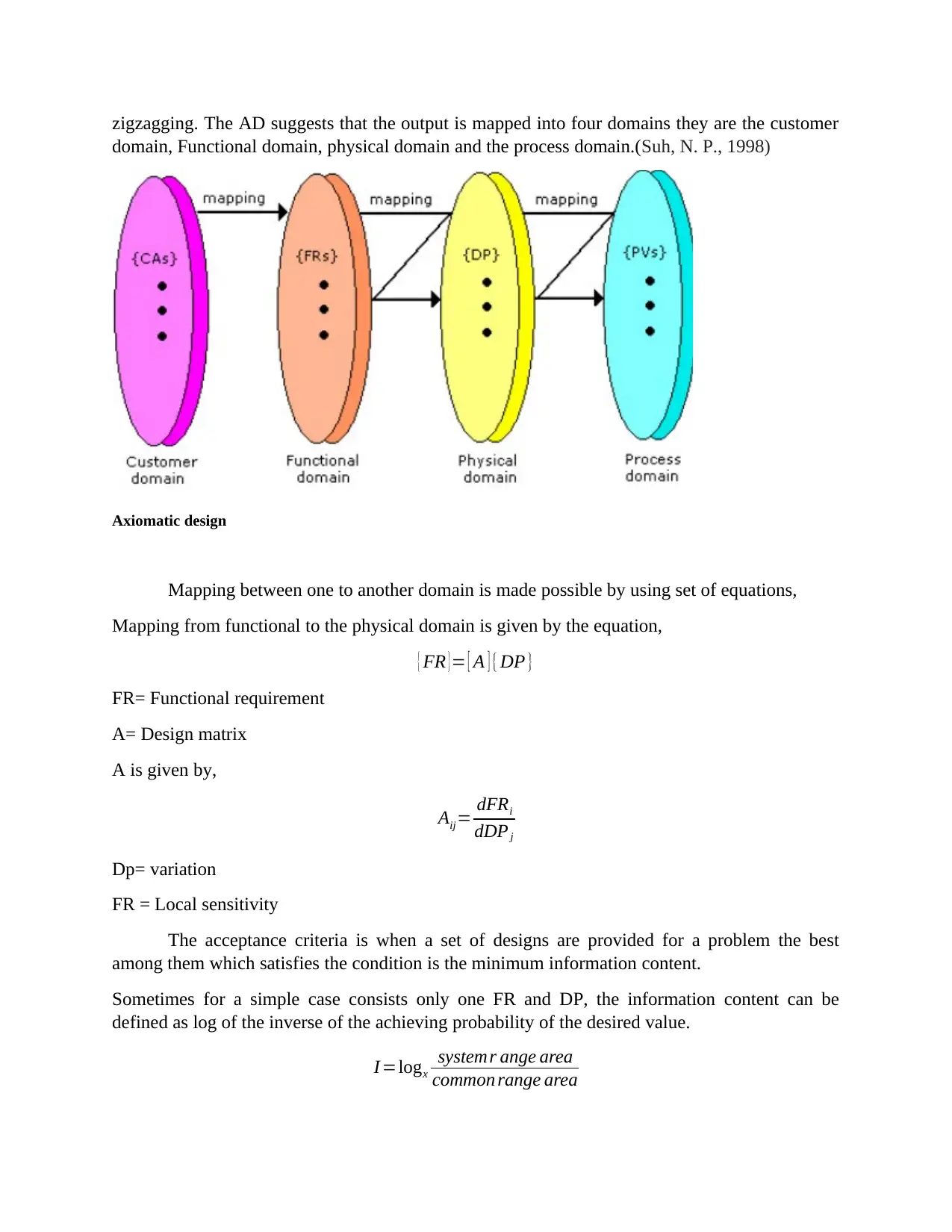
zigzagging. The AD suggests that the output is mapped into four domains they are the customer
domain, Functional domain, physical domain and the process domain.(Suh, N. P., 1998)
Axiomatic design
Mapping between one to another domain is made possible by using set of equations,
Mapping from functional to the physical domain is given by the equation,
{ FR } = [ A ] {DP }
FR= Functional requirement
A= Design matrix
A is given by,
Aij= dFRi
dDP j
Dp= variation
FR = Local sensitivity
The acceptance criteria is when a set of designs are provided for a problem the best
among them which satisfies the condition is the minimum information content.
Sometimes for a simple case consists only one FR and DP, the information content can be
defined as log of the inverse of the achieving probability of the desired value.
I =logx
systemr ange area
common range area
domain, Functional domain, physical domain and the process domain.(Suh, N. P., 1998)
Axiomatic design
Mapping between one to another domain is made possible by using set of equations,
Mapping from functional to the physical domain is given by the equation,
{ FR } = [ A ] {DP }
FR= Functional requirement
A= Design matrix
A is given by,
Aij= dFRi
dDP j
Dp= variation
FR = Local sensitivity
The acceptance criteria is when a set of designs are provided for a problem the best
among them which satisfies the condition is the minimum information content.
Sometimes for a simple case consists only one FR and DP, the information content can be
defined as log of the inverse of the achieving probability of the desired value.
I =logx
systemr ange area
common range area
2.0 Conman:
The axiomatic and the Quality function deployment both are developed in order to find
the requirement of the customer and improvising the quality of the product with the data or the
information obtained from the observations or collected data. The data which is collectively
achieved from the customer but the implementation of which did not make any impact on the
product sales on the market is known as the conman, or it may be declared as a fake data which
should have been excluded during the design.
3.0 Differences:
Quality Function Deployment and the Axiomatic Design are both developed to meet the
customer needs and to understand deeply the requirements of the customers for the development
of a product rather if it’s new or existing in the market. However, both the approaches have their
own pros and cons. The QFD consists of four phases within them there are 14 long steps to be
carried out. In the axiomatic design the steps are not as long as the quality function deployment
methodology rather they are simple and they have set of equations to be used in order to design a
model of our requirements. The axiomatic can be purely used to improve the house of quality
which is being used in the QFD method. The reason for improving house of quality is that the
parameters which are included in the construction of the quality house are highly dependent on
each other, these dependency makes the process of building quality house difficult, thus using
the axiomatic design in construction of quality house will be very useful as the axiomatic design
paves a way for quality and simple design also it make the quality house more clearly correlation
between the reaction function, demand and the design parameters.(Pullman, M. E., Moore, W.
L., &Wardell, D. G., 2002)
3.1 case study: Design of an Apartment
This case study is to illustrate the application of the combined QFD and AD methodology to
design an apartment house for selling. An apartment is a colony of houses that are built by a
house builder in order to sell. The main goal of this project is the customer satisfaction of the
house design.
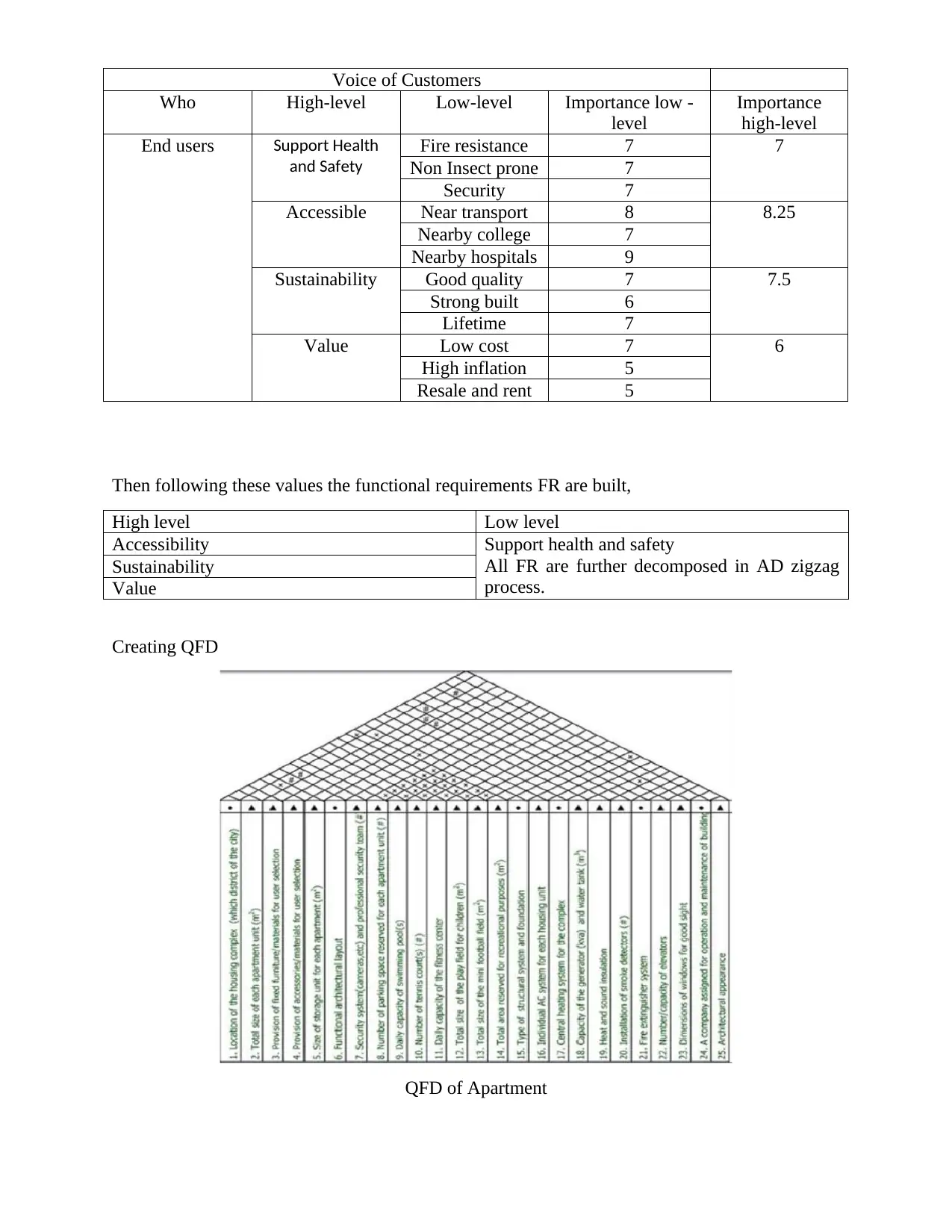
First stage is collecting the Voice of Customers,
The voice of customers is the customer need they are collected around the feedback by
the customers by various methods and tabulated as,
The axiomatic and the Quality function deployment both are developed in order to find
the requirement of the customer and improvising the quality of the product with the data or the
information obtained from the observations or collected data. The data which is collectively
achieved from the customer but the implementation of which did not make any impact on the
product sales on the market is known as the conman, or it may be declared as a fake data which
should have been excluded during the design.
3.0 Differences:
Quality Function Deployment and the Axiomatic Design are both developed to meet the
customer needs and to understand deeply the requirements of the customers for the development
of a product rather if it’s new or existing in the market. However, both the approaches have their
own pros and cons. The QFD consists of four phases within them there are 14 long steps to be
carried out. In the axiomatic design the steps are not as long as the quality function deployment
methodology rather they are simple and they have set of equations to be used in order to design a
model of our requirements. The axiomatic can be purely used to improve the house of quality
which is being used in the QFD method. The reason for improving house of quality is that the
parameters which are included in the construction of the quality house are highly dependent on
each other, these dependency makes the process of building quality house difficult, thus using
the axiomatic design in construction of quality house will be very useful as the axiomatic design
paves a way for quality and simple design also it make the quality house more clearly correlation
between the reaction function, demand and the design parameters.(Pullman, M. E., Moore, W.
L., &Wardell, D. G., 2002)
3.1 case study: Design of an Apartment
This case study is to illustrate the application of the combined QFD and AD methodology to
design an apartment house for selling. An apartment is a colony of houses that are built by a
house builder in order to sell. The main goal of this project is the customer satisfaction of the
house design.
First stage is collecting the Voice of Customers,
The voice of customers is the customer need they are collected around the feedback by
the customers by various methods and tabulated as,
⊘ This is a preview!⊘
Do you want full access?
Subscribe today to unlock all pages.
Trusted by 1+ million students worldwide
Then following these values the functional requirements FR are built,
High level Low level
Accessibility Support health and safety
All FR are further decomposed in AD zigzag
process.
Sustainability
Value
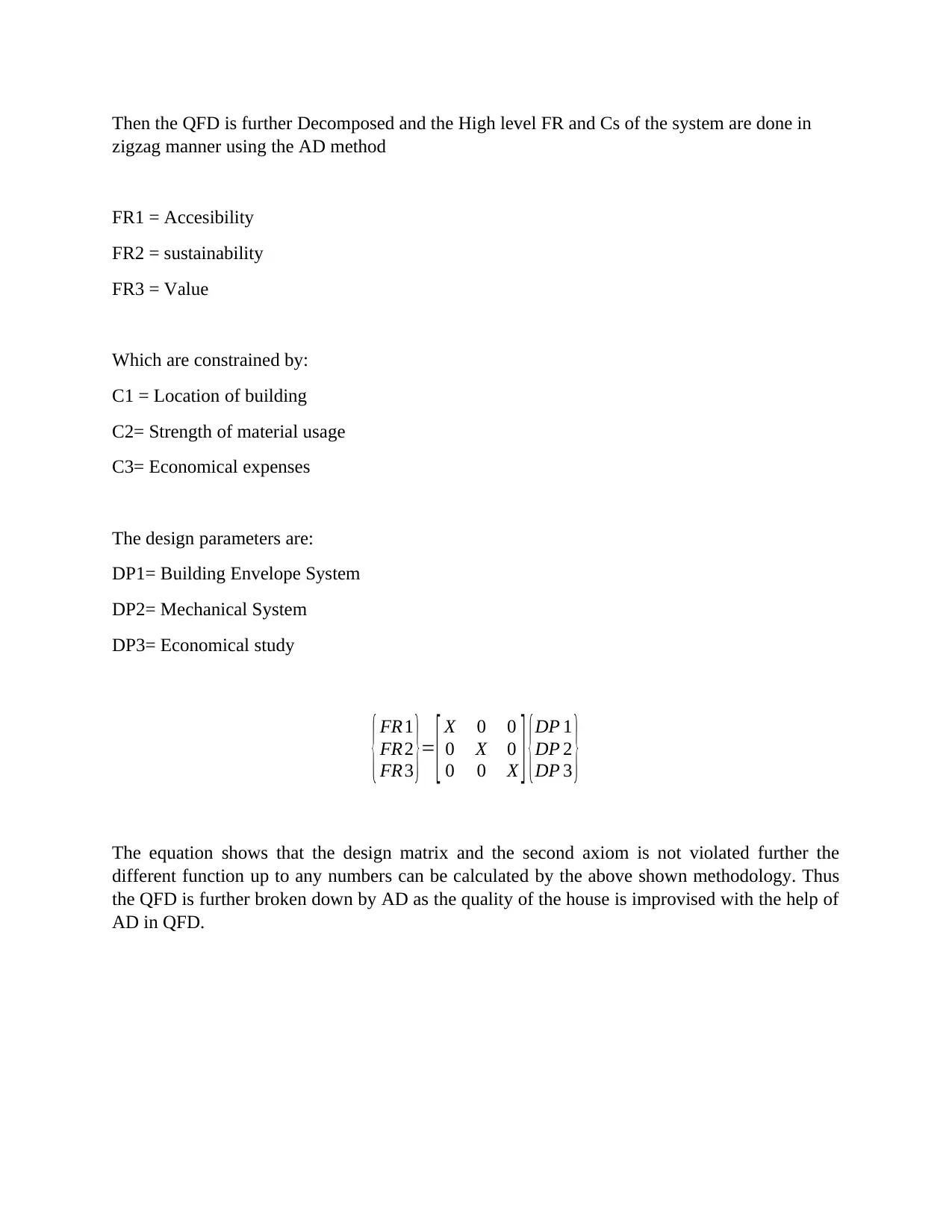
Creating QFD
QFD of Apartment
Voice of Customers
Who High-level Low-level Importance low -
level
Importance
high-level
End users Support Health
and Safety
Fire resistance 7 7
Non Insect prone 7
Security 7
Accessible Near transport 8 8.25
Nearby college 7
Nearby hospitals 9
Sustainability Good quality 7 7.5
Strong built 6
Lifetime 7
Value Low cost 7 6
High inflation 5
Resale and rent 5
High level Low level
Accessibility Support health and safety
All FR are further decomposed in AD zigzag
process.
Sustainability
Value
Creating QFD
QFD of Apartment
Voice of Customers
Who High-level Low-level Importance low -
level
Importance
high-level
End users Support Health
and Safety
Fire resistance 7 7
Non Insect prone 7
Security 7
Accessible Near transport 8 8.25
Nearby college 7
Nearby hospitals 9
Sustainability Good quality 7 7.5
Strong built 6
Lifetime 7
Value Low cost 7 6
High inflation 5
Resale and rent 5
Paraphrase This Document
Need a fresh take? Get an instant paraphrase of this document with our AI Paraphraser
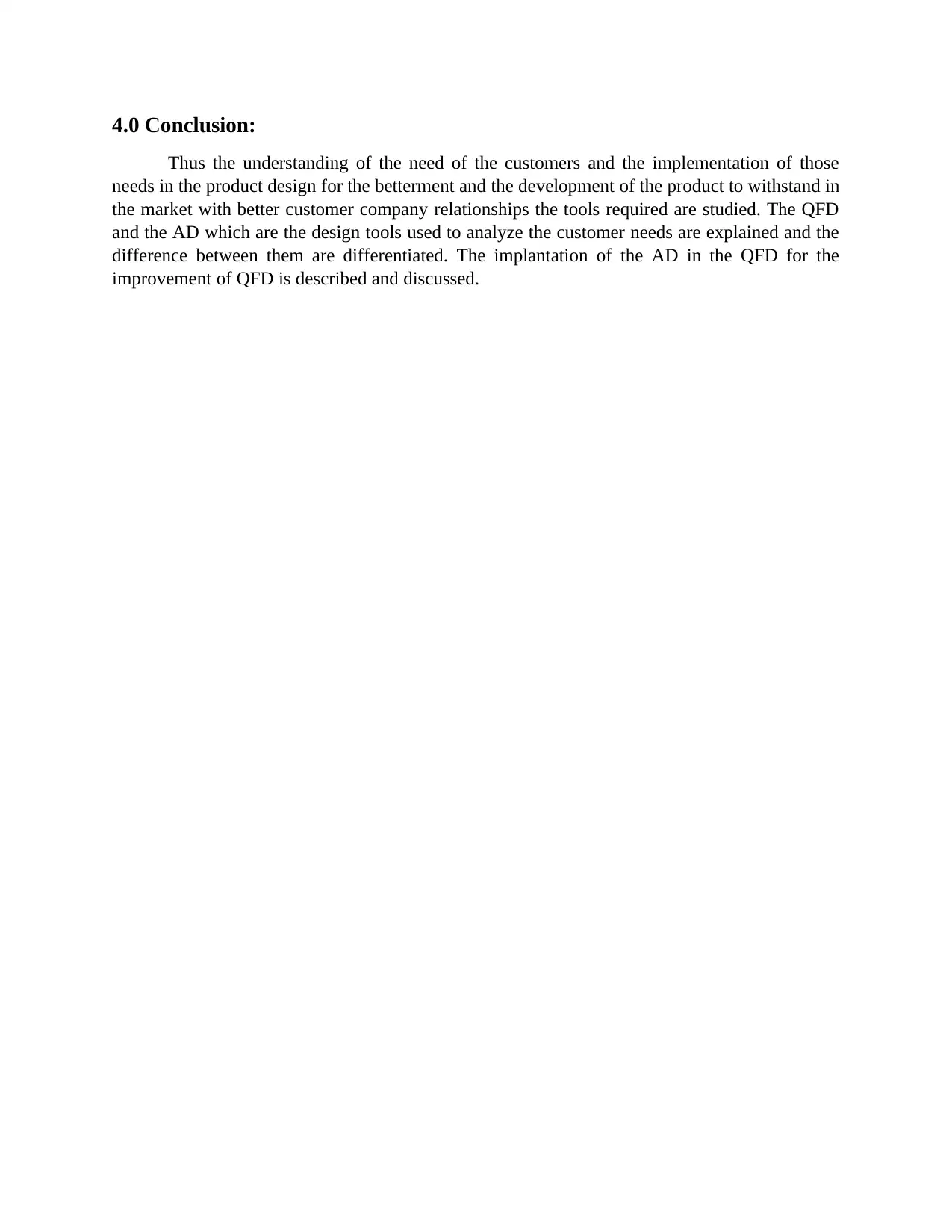
Then the QFD is further Decomposed and the High level FR and Cs of the system are done in
zigzag manner using the AD method
FR1 = Accesibility
FR2 = sustainability
FR3 = Value
Which are constrained by:
C1 = Location of building
C2= Strength of material usage
C3= Economical expenses
The design parameters are:
DP1= Building Envelope System
DP2= Mechanical System
DP3= Economical study
{FR1
FR2
FR3 }= [ X 0 0
0 X 0
0 0 X ] {DP 1
DP 2
DP 3 }
The equation shows that the design matrix and the second axiom is not violated further the
different function up to any numbers can be calculated by the above shown methodology. Thus
the QFD is further broken down by AD as the quality of the house is improvised with the help of
AD in QFD.
zigzag manner using the AD method
FR1 = Accesibility
FR2 = sustainability
FR3 = Value
Which are constrained by:
C1 = Location of building
C2= Strength of material usage
C3= Economical expenses
The design parameters are:
DP1= Building Envelope System
DP2= Mechanical System
DP3= Economical study
{FR1
FR2
FR3 }= [ X 0 0
0 X 0
0 0 X ] {DP 1
DP 2
DP 3 }
The equation shows that the design matrix and the second axiom is not violated further the
different function up to any numbers can be calculated by the above shown methodology. Thus
the QFD is further broken down by AD as the quality of the house is improvised with the help of
AD in QFD.
4.0 Conclusion:
Thus the understanding of the need of the customers and the implementation of those
needs in the product design for the betterment and the development of the product to withstand in
the market with better customer company relationships the tools required are studied. The QFD
and the AD which are the design tools used to analyze the customer needs are explained and the
difference between them are differentiated. The implantation of the AD in the QFD for the
improvement of QFD is described and discussed.
Thus the understanding of the need of the customers and the implementation of those
needs in the product design for the betterment and the development of the product to withstand in
the market with better customer company relationships the tools required are studied. The QFD
and the AD which are the design tools used to analyze the customer needs are explained and the
difference between them are differentiated. The implantation of the AD in the QFD for the
improvement of QFD is described and discussed.
⊘ This is a preview!⊘
Do you want full access?
Subscribe today to unlock all pages.
Trusted by 1+ million students worldwide

1 out of 13


Your All-in-One AI-Powered Toolkit for Academic Success.
+13062052269
info@desklib.com
Available 24*7 on WhatsApp / Email
![[object Object]](/_next/static/media/star-bottom.7253800d.svg)
Unlock your academic potential
Copyright © 2020–2026 A2Z Services. All Rights Reserved. Developed and managed by ZUCOL.