Technology Failure: QR Codes, Analysis and Strategies

Verified

Added on  2022/12/19

|4
|1106
|60
Case Study
AI Summary
This case study examines the failure of QR code technology, analyzing whether the failure stemmed from system issues or technology management. It explores reasons such as worthless content, cumbersome scanning processes, lack of consumer awareness, aesthetic issues, and misinterpretation of codes. The study suggests strategies for organizations to manage technology delivery more successfully, including planning QR codes within campaign strategies, understanding target audiences, setting clear objectives, delivering valuable incentives, developing quality codes, linking codes to mobile-optimized sites, and tracking scans with code management systems. Ultimately, it emphasizes the importance of providing favorable user experiences and utilizing QR codes effectively for specific use cases to improve user engagement and value.
Document Page
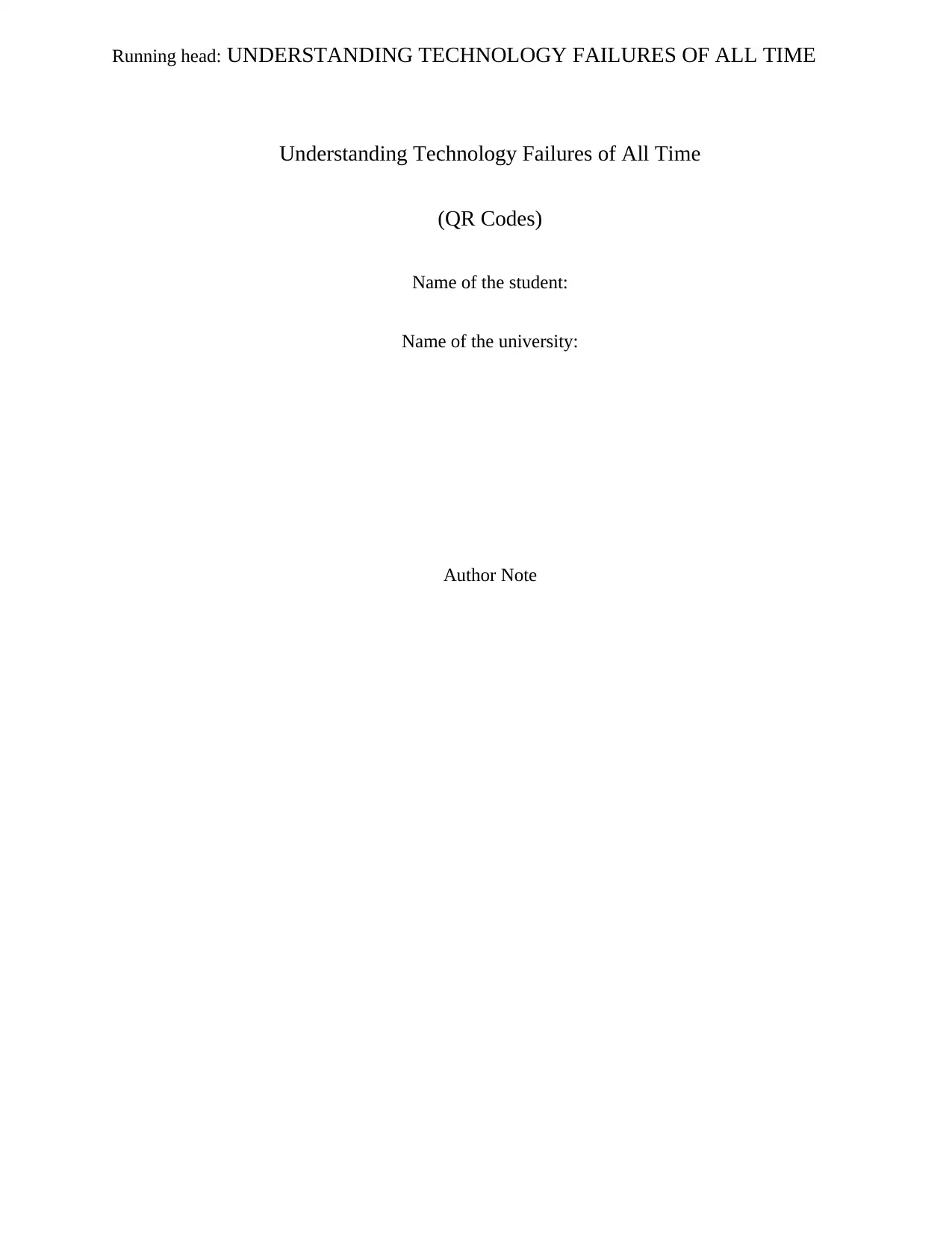
Running head: UNDERSTANDING TECHNOLOGY FAILURES OF ALL TIME
Understanding Technology Failures of All Time
(QR Codes)
Name of the student:
Name of the university:
Author Note
tabler-icon-diamond-filled.svg

Paraphrase This Document

Need a fresh take? Get an instant paraphrase of this document with our AI Paraphraser
Document Page
1UNDERSTANDING TECHNOLOGY FAILURES OF ALL TIME
Task A: QR Codes as the most successful technology failures of all time
The QR codes are barcode like symbols scanned by smartphone users. This is intended for
information regarding few real-world objects. This can be museum exhibit and movie poster. This
has been simple to scan the code instead of typing unwieldy and long URL to the browser of mobile
Internet. Regardless of the fact it has been popular throughout the world, the technology never
caught at US. This is due to the reason that QR codes has been tending to be jarring and ugly (Pérez-
Sanagustín et al., 2016). Nevertheless, the concept of objects of scanning real world with the
smartphones has consists of many events. For instance, the Pinterest has currently introduced Lens in
the market. This app evaluates the physical items for finding same type of products to be sold online.
There are many reasons for failure of QR codes. There are worthless contents. From the
consumer side the scanning of the entire code has been found to be cumbersome. This has been
costing the different consumer with the effective efforts and time. Further, its value is unknown.
Next, there is consumer awareness. Here, the greatest issue that the QR codes that is seen s that that
the consumers are found to have demonstrated that there is devoid of any clue. Next, they have the
value as medium (Okazaki et al., 2017). Additional considerations are commonly ignored with the
intrinsic type of value of existing code. This has been as the part of the data. Further, the location is
other vital consideration. Here, the QR codes are there at all places and at every elements. Regarding
aesthetics the QR codes are ugly. Apart from this, the code present on the product is capable of
getting misinterpreted. The cause is that the tracking barcode art from the outlet of marketing.
Here, the failure has been has been related to technology failure. Besides, technology
management failures has also been there. The reason is that QR codes has been providing glimmer
of the future. This is the method to bring the physical interactions towards much more trackable and
Document Page
2UNDERSTANDING TECHNOLOGY FAILURES OF ALL TIME
malleable digital space (Chow et al., 2016). Nonetheless, despite the overwhelming push from the
side of arts in asking QR code over anything to be eating, marketing and publishing, there is a rise in
skepticism in the usage of the real-world.
There are some strategies that organizations can use for managing the delivery of technology
at the marketplace in successful manner. For this, the business must plan their QR codes in the
strategy of the campaign. For creating successful campaign of QR codes, it is vital to now the target
audience (Focardi, Luccio & Wahsheh, 2018). They should have clear objectives and then deliver
valuable and useful incentives for providing favorable experience for users. Then one must develop
the quality codes and then test them. There are many 2D code formats. Here, the most commonly
utilized throughout the world are the Microsoft tags and QR codes. Then, they must link the codes
with the mobile-optimized and mobile friendly sites. Further, the organizations must track the scans
with systems of code management (Ramalho et al., 2018). Presently, the MS and QR tags are able to
track the primary data. For example this can involve the amount of scans. Nonetheless, as one use
the QR-code management systems, the business is able to collect richer information. Moreover, they
must provide the favorable and valuable user experiences. Here, the most relevant aspect is that
marketers can provides the value of codes. It must be reminded that they are mere tools. The way it
can be send indicates the value that is derived from that (Lin & Chen, 2017).
Lastly, it can be said that QR codes are able serve particular use. It is a leading tool of
generations. As one utilize what is been working and making that better, easier and attractive with
QR codes, one is possibly at the proper track.
Document Page
3UNDERSTANDING TECHNOLOGY FAILURES OF ALL TIME
References:
Chow, Y. W., Susilo, W., Yang, G., Phillips, J. G., Pranata, I., & Barmawi, A. M. (2016, July).
Exploiting the error correction mechanism in QR codes for secret sharing. In Australasian
Conference on Information Security and Privacy (pp. 409-425). Springer, Cham.
Focardi, R., Luccio, F. L., & Wahsheh, H. A. (2018, February). Usable cryptographic QR codes. In
2018 IEEE International Conference on Industrial Technology (ICIT) (pp. 1664-1669).
IEEE.
Lin, P. Y., & Chen, Y. H. (2017). High payload secret hiding technology for QR codes. EURASIP
Journal on Image and Video Processing, 2017(1), 14.
Okazaki, S., Navarro, A., Mukherji, P., & Plangger, K. (2017). The curious versus the overwhelmed:
Factors influencing QR codes scan intention. Journal of Business Research.
Pérez-Sanagustín, M., Parra, D., Verdugo, R., García-Galleguillos, G., & Nussbaum, M. (2016).
Using QR codes to increase user engagement in museum-like spaces. Computers in Human
Behavior, 60, 73-85.
Ramalho, J. F., António, L. C. F., Correia, S. F. H., Fu, L. S., Pinho, A. S., Brites, C. D. S., ... &
Ferreira, R. A. S. (2018). Luminescent QR codes for smart labelling and sensing. Optics &
Laser Technology, 101, 304-311.
chevron_up_icon
1 out of 4
circle_padding
hide_on_mobile
zoom_out_icon
[object Object]