Qualitative Data Analysis Discussion: Student Responses Analysis
VerifiedAdded on 2023/01/16
|6
|895
|65
Discussion Board Post
AI Summary
This assignment presents a discussion forum post analyzing three student responses on qualitative data analysis. The responses critically discuss the purposes and key issues in conducting qualitative data analysis, exploring data quality issues related to validity, reliability, and generalizability. They propose ways to overcome these issues and highlight potential ethical issues and feasibility constraints. The analysis covers time, cost, and accuracy concerns; the impact of data sources on research outcomes; methods to improve data quality through visualization, time management, and software; and ethical considerations such as plagiarism and data manipulation. The assignment brief requires a response to each student's work, providing 166 words for each response with two references, focusing on the different qualitative data analysis techniques, recognizing potential weaknesses, and addressing validity and reliability concerns.

[Date]
MANAGEMENT
Student id:
Dell
[company name]
MANAGEMENT
Student id:
Dell
[company name]
Paraphrase This Document
Need a fresh take? Get an instant paraphrase of this document with our AI Paraphraser

Table of Contents
Student A...............................................................................................................................................2
Student B...............................................................................................................................................2
Student C...............................................................................................................................................3
References.............................................................................................................................................5
Student A...............................................................................................................................................2
Student B...............................................................................................................................................2
Student C...............................................................................................................................................3
References.............................................................................................................................................5

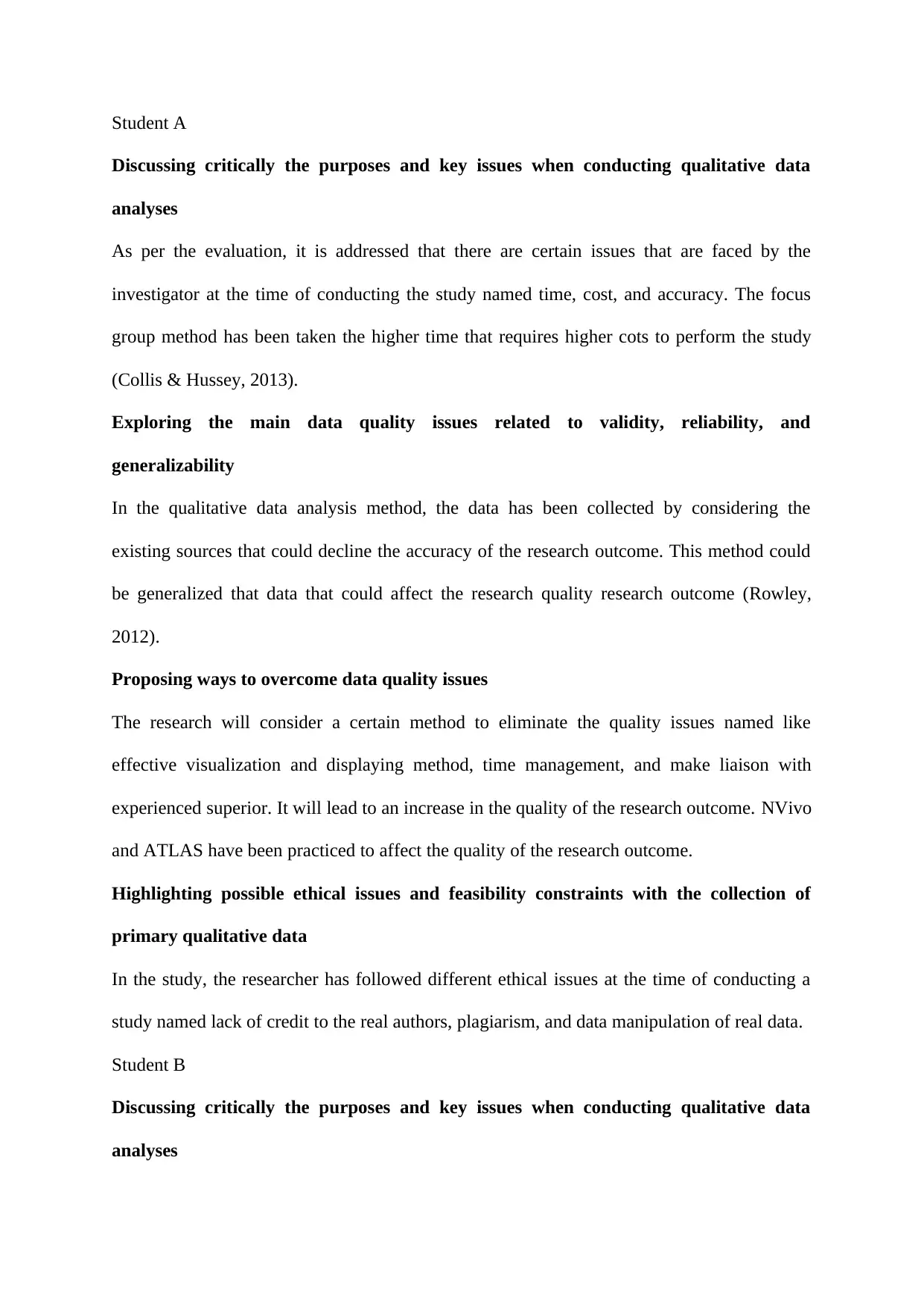
Student A
Discussing critically the purposes and key issues when conducting qualitative data
analyses
As per the evaluation, it is addressed that there are certain issues that are faced by the
investigator at the time of conducting the study named time, cost, and accuracy. The focus
group method has been taken the higher time that requires higher cots to perform the study
(Collis & Hussey, 2013).
Exploring the main data quality issues related to validity, reliability, and
generalizability
In the qualitative data analysis method, the data has been collected by considering the
existing sources that could decline the accuracy of the research outcome. This method could
be generalized that data that could affect the research quality research outcome (Rowley,
2012).
Proposing ways to overcome data quality issues
The research will consider a certain method to eliminate the quality issues named like
effective visualization and displaying method, time management, and make liaison with
experienced superior. It will lead to an increase in the quality of the research outcome. NVivo
and ATLAS have been practiced to affect the quality of the research outcome.
Highlighting possible ethical issues and feasibility constraints with the collection of
primary qualitative data
In the study, the researcher has followed different ethical issues at the time of conducting a
study named lack of credit to the real authors, plagiarism, and data manipulation of real data.
Student B
Discussing critically the purposes and key issues when conducting qualitative data
analyses
Discussing critically the purposes and key issues when conducting qualitative data
analyses
As per the evaluation, it is addressed that there are certain issues that are faced by the
investigator at the time of conducting the study named time, cost, and accuracy. The focus
group method has been taken the higher time that requires higher cots to perform the study
(Collis & Hussey, 2013).
Exploring the main data quality issues related to validity, reliability, and
generalizability
In the qualitative data analysis method, the data has been collected by considering the
existing sources that could decline the accuracy of the research outcome. This method could
be generalized that data that could affect the research quality research outcome (Rowley,
2012).
Proposing ways to overcome data quality issues
The research will consider a certain method to eliminate the quality issues named like
effective visualization and displaying method, time management, and make liaison with
experienced superior. It will lead to an increase in the quality of the research outcome. NVivo
and ATLAS have been practiced to affect the quality of the research outcome.
Highlighting possible ethical issues and feasibility constraints with the collection of
primary qualitative data
In the study, the researcher has followed different ethical issues at the time of conducting a
study named lack of credit to the real authors, plagiarism, and data manipulation of real data.
Student B
Discussing critically the purposes and key issues when conducting qualitative data
analyses
⊘ This is a preview!⊘
Do you want full access?
Subscribe today to unlock all pages.

Trusted by 1+ million students worldwide

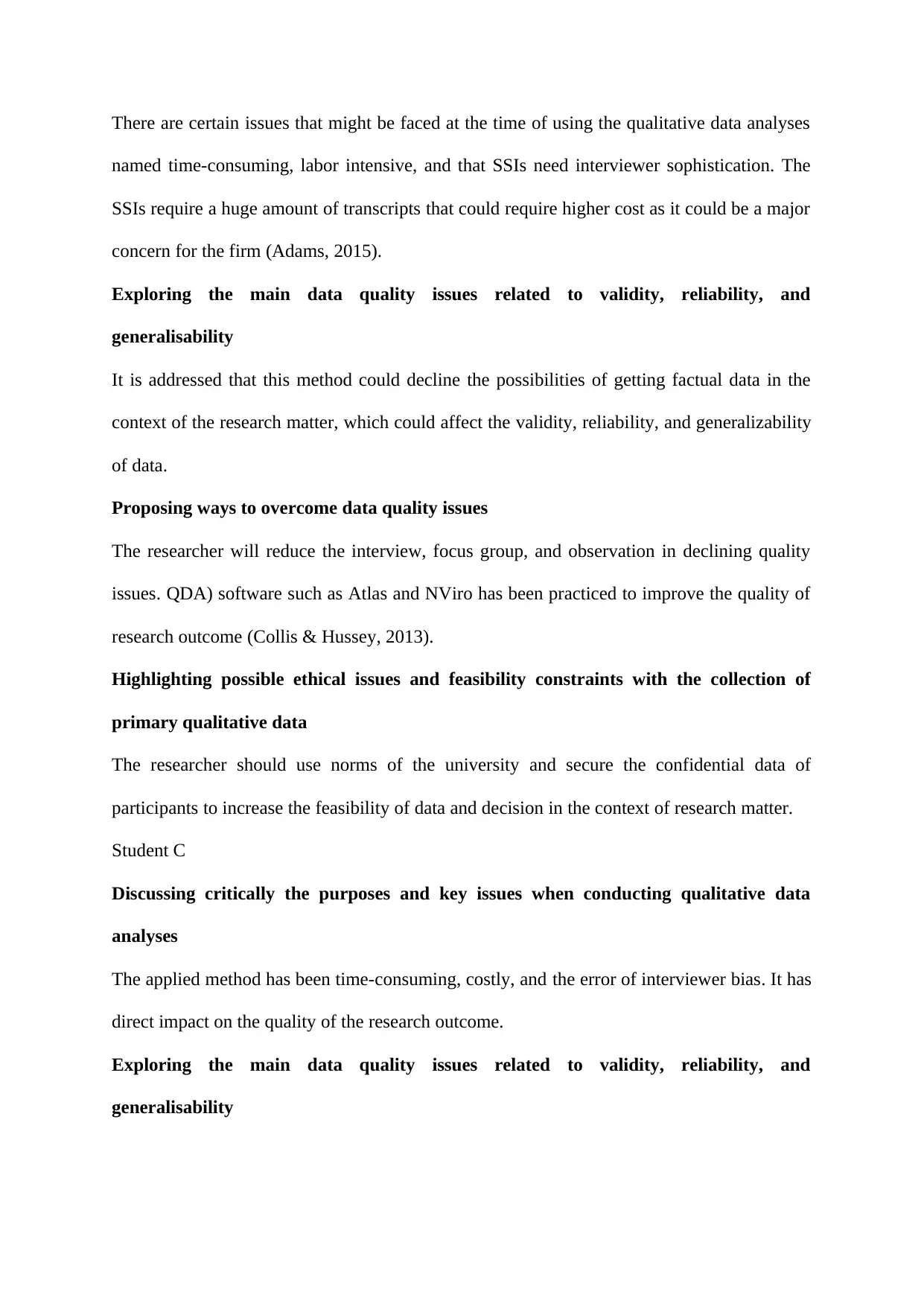
There are certain issues that might be faced at the time of using the qualitative data analyses
named time-consuming, labor intensive, and that SSIs need interviewer sophistication. The
SSIs require a huge amount of transcripts that could require higher cost as it could be a major
concern for the firm (Adams, 2015).
Exploring the main data quality issues related to validity, reliability, and
generalisability
It is addressed that this method could decline the possibilities of getting factual data in the
context of the research matter, which could affect the validity, reliability, and generalizability
of data.
Proposing ways to overcome data quality issues
The researcher will reduce the interview, focus group, and observation in declining quality
issues. QDA) software such as Atlas and NViro has been practiced to improve the quality of
research outcome (Collis & Hussey, 2013).
Highlighting possible ethical issues and feasibility constraints with the collection of
primary qualitative data
The researcher should use norms of the university and secure the confidential data of
participants to increase the feasibility of data and decision in the context of research matter.
Student C
Discussing critically the purposes and key issues when conducting qualitative data
analyses
The applied method has been time-consuming, costly, and the error of interviewer bias. It has
direct impact on the quality of the research outcome.
Exploring the main data quality issues related to validity, reliability, and
generalisability
named time-consuming, labor intensive, and that SSIs need interviewer sophistication. The
SSIs require a huge amount of transcripts that could require higher cost as it could be a major
concern for the firm (Adams, 2015).
Exploring the main data quality issues related to validity, reliability, and
generalisability
It is addressed that this method could decline the possibilities of getting factual data in the
context of the research matter, which could affect the validity, reliability, and generalizability
of data.
Proposing ways to overcome data quality issues
The researcher will reduce the interview, focus group, and observation in declining quality
issues. QDA) software such as Atlas and NViro has been practiced to improve the quality of
research outcome (Collis & Hussey, 2013).
Highlighting possible ethical issues and feasibility constraints with the collection of
primary qualitative data
The researcher should use norms of the university and secure the confidential data of
participants to increase the feasibility of data and decision in the context of research matter.
Student C
Discussing critically the purposes and key issues when conducting qualitative data
analyses
The applied method has been time-consuming, costly, and the error of interviewer bias. It has
direct impact on the quality of the research outcome.
Exploring the main data quality issues related to validity, reliability, and
generalisability
Paraphrase This Document
Need a fresh take? Get an instant paraphrase of this document with our AI Paraphraser

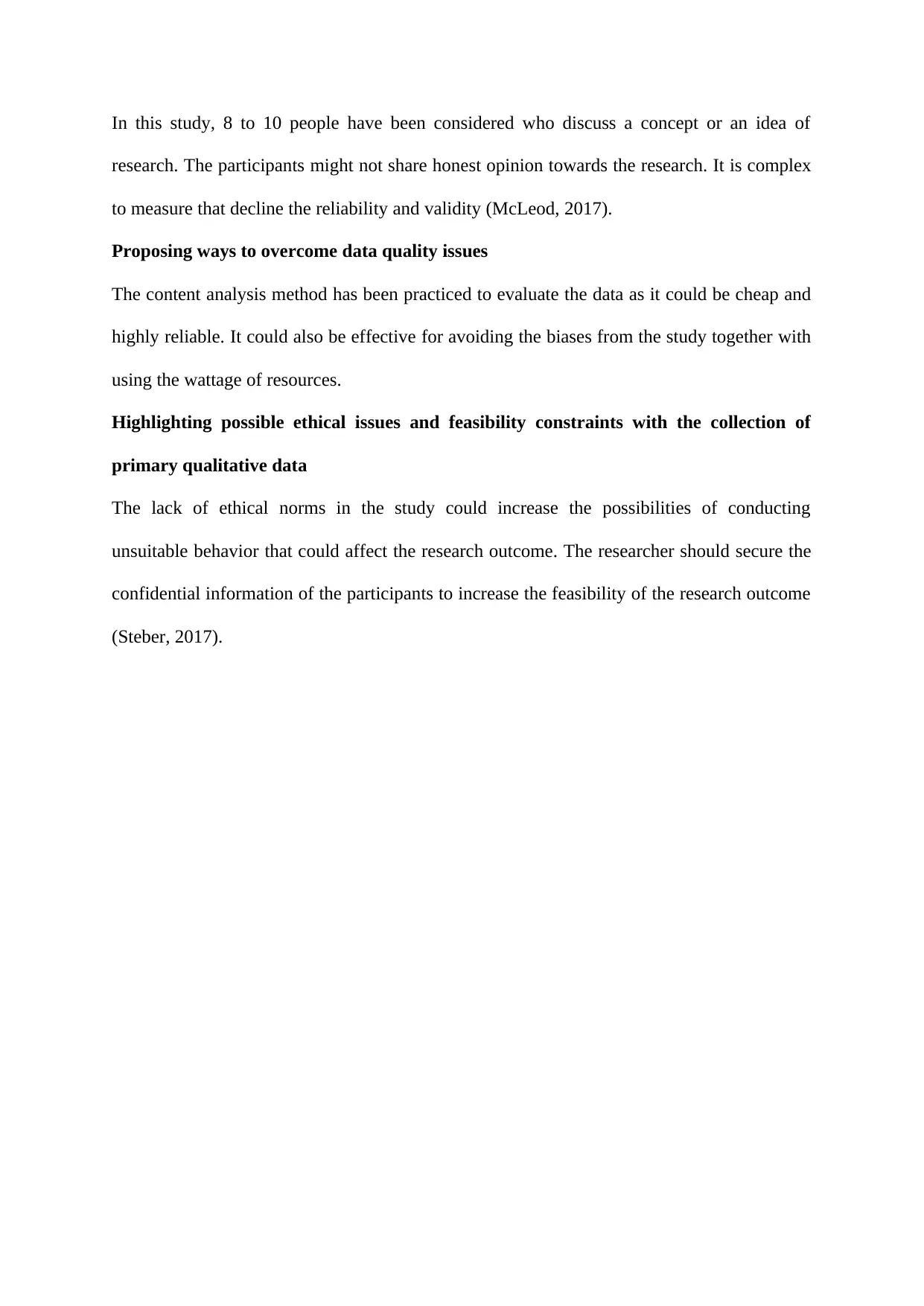
In this study, 8 to 10 people have been considered who discuss a concept or an idea of
research. The participants might not share honest opinion towards the research. It is complex
to measure that decline the reliability and validity (McLeod, 2017).
Proposing ways to overcome data quality issues
The content analysis method has been practiced to evaluate the data as it could be cheap and
highly reliable. It could also be effective for avoiding the biases from the study together with
using the wattage of resources.
Highlighting possible ethical issues and feasibility constraints with the collection of
primary qualitative data
The lack of ethical norms in the study could increase the possibilities of conducting
unsuitable behavior that could affect the research outcome. The researcher should secure the
confidential information of the participants to increase the feasibility of the research outcome
(Steber, 2017).
research. The participants might not share honest opinion towards the research. It is complex
to measure that decline the reliability and validity (McLeod, 2017).
Proposing ways to overcome data quality issues
The content analysis method has been practiced to evaluate the data as it could be cheap and
highly reliable. It could also be effective for avoiding the biases from the study together with
using the wattage of resources.
Highlighting possible ethical issues and feasibility constraints with the collection of
primary qualitative data
The lack of ethical norms in the study could increase the possibilities of conducting
unsuitable behavior that could affect the research outcome. The researcher should secure the
confidential information of the participants to increase the feasibility of the research outcome
(Steber, 2017).

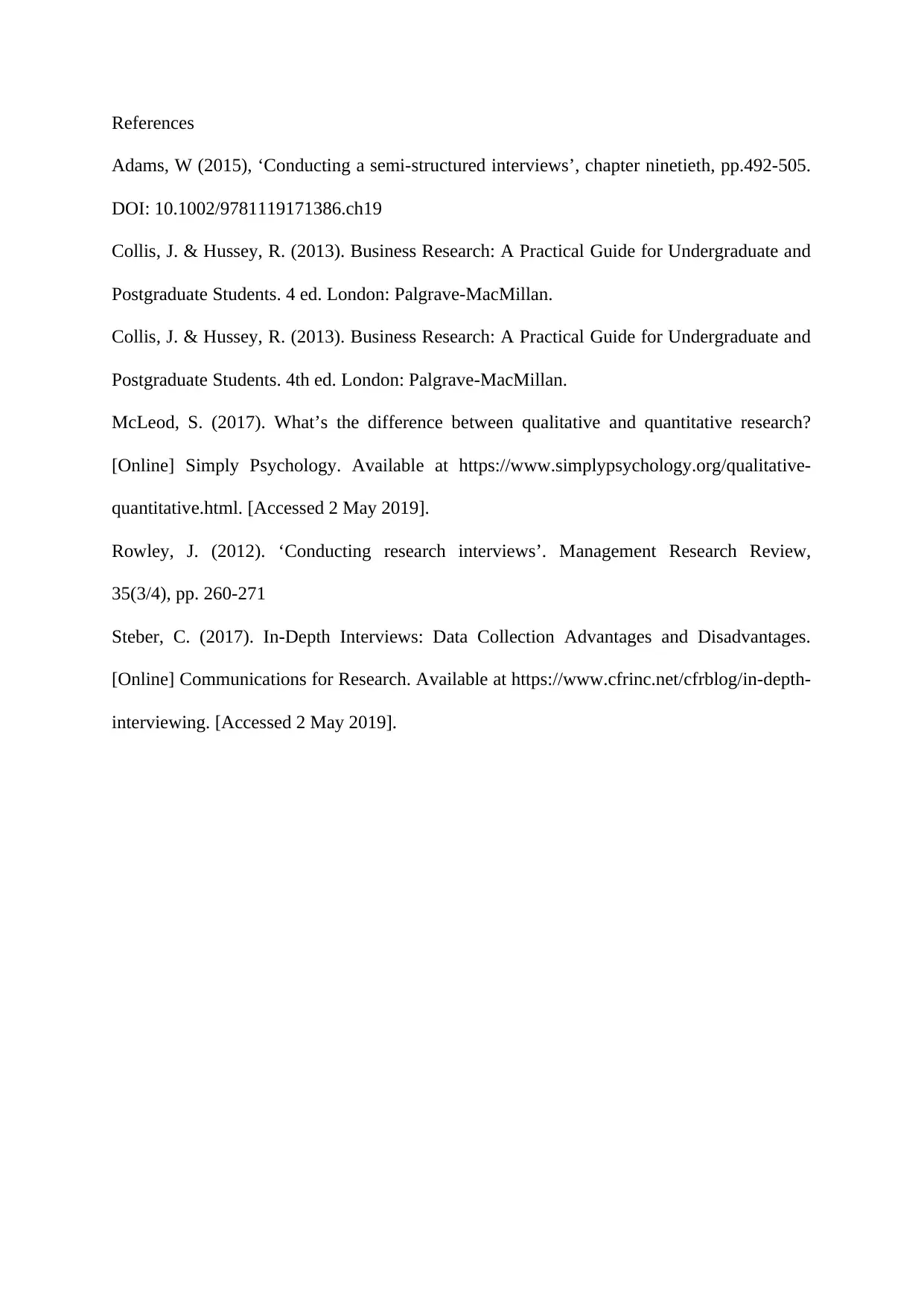
References
Adams, W (2015), ‘Conducting a semi-structured interviews’, chapter ninetieth, pp.492-505.
DOI: 10.1002/9781119171386.ch19
Collis, J. & Hussey, R. (2013). Business Research: A Practical Guide for Undergraduate and
Postgraduate Students. 4 ed. London: Palgrave-MacMillan.
Collis, J. & Hussey, R. (2013). Business Research: A Practical Guide for Undergraduate and
Postgraduate Students. 4th ed. London: Palgrave-MacMillan.
McLeod, S. (2017). What’s the difference between qualitative and quantitative research?
[Online] Simply Psychology. Available at https://www.simplypsychology.org/qualitative-
quantitative.html. [Accessed 2 May 2019].
Rowley, J. (2012). ‘Conducting research interviews’. Management Research Review,
35(3/4), pp. 260-271
Steber, C. (2017). In-Depth Interviews: Data Collection Advantages and Disadvantages.
[Online] Communications for Research. Available at https://www.cfrinc.net/cfrblog/in-depth-
interviewing. [Accessed 2 May 2019].
Adams, W (2015), ‘Conducting a semi-structured interviews’, chapter ninetieth, pp.492-505.
DOI: 10.1002/9781119171386.ch19
Collis, J. & Hussey, R. (2013). Business Research: A Practical Guide for Undergraduate and
Postgraduate Students. 4 ed. London: Palgrave-MacMillan.
Collis, J. & Hussey, R. (2013). Business Research: A Practical Guide for Undergraduate and
Postgraduate Students. 4th ed. London: Palgrave-MacMillan.
McLeod, S. (2017). What’s the difference between qualitative and quantitative research?
[Online] Simply Psychology. Available at https://www.simplypsychology.org/qualitative-
quantitative.html. [Accessed 2 May 2019].
Rowley, J. (2012). ‘Conducting research interviews’. Management Research Review,
35(3/4), pp. 260-271
Steber, C. (2017). In-Depth Interviews: Data Collection Advantages and Disadvantages.
[Online] Communications for Research. Available at https://www.cfrinc.net/cfrblog/in-depth-
interviewing. [Accessed 2 May 2019].
⊘ This is a preview!⊘
Do you want full access?
Subscribe today to unlock all pages.

Trusted by 1+ million students worldwide
1 out of 6
Related Documents
Your All-in-One AI-Powered Toolkit for Academic Success.
+13062052269
info@desklib.com
Available 24*7 on WhatsApp / Email
Unlock your academic potential
Copyright © 2020–2026 A2Z Services. All Rights Reserved. Developed and managed by ZUCOL.