Qualitative Research Critique: Healthcare Research Paper
VerifiedAdded on 2022/09/06
|10
|2085
|21
Homework Assignment
AI Summary
This assignment presents a comprehensive critique of a qualitative research article titled "Above and beyond: an exploratory study of breast cancer patient accounts of healthcare provider information-giving practices and informational support." The critique, conducted by a student, meticulously examines the study's methodology, including the use of a constructivist grounded theory approach and in-depth interviews. It assesses the congruity between the philosophical perspective, research question, methods, and analysis, while also evaluating the ethical considerations and rigor of the research. The critique delves into the sample selection, data collection and analysis techniques, and the reporting of results, including the identification of two key themes: extensive time spent providing cancer-related information and careful explanation of complex information. The assignment also addresses the limitations of the study, the relevance of the findings to public health practice, and the overall trustworthiness of the research, offering a detailed analysis of the strengths and weaknesses of the study's design and execution.
Running Head: QUALITATIVE RESEARCH CRITIQUE
QUALITATIVE RESEARCH CRITIQUE
Name of the student
Name of the University
Author Note
QUALITATIVE RESEARCH CRITIQUE
Name of the student
Name of the University
Author Note
Paraphrase This Document
Need a fresh take? Get an instant paraphrase of this document with our AI Paraphraser

1
QUALITATIVE RESEARCH CRITIQUE
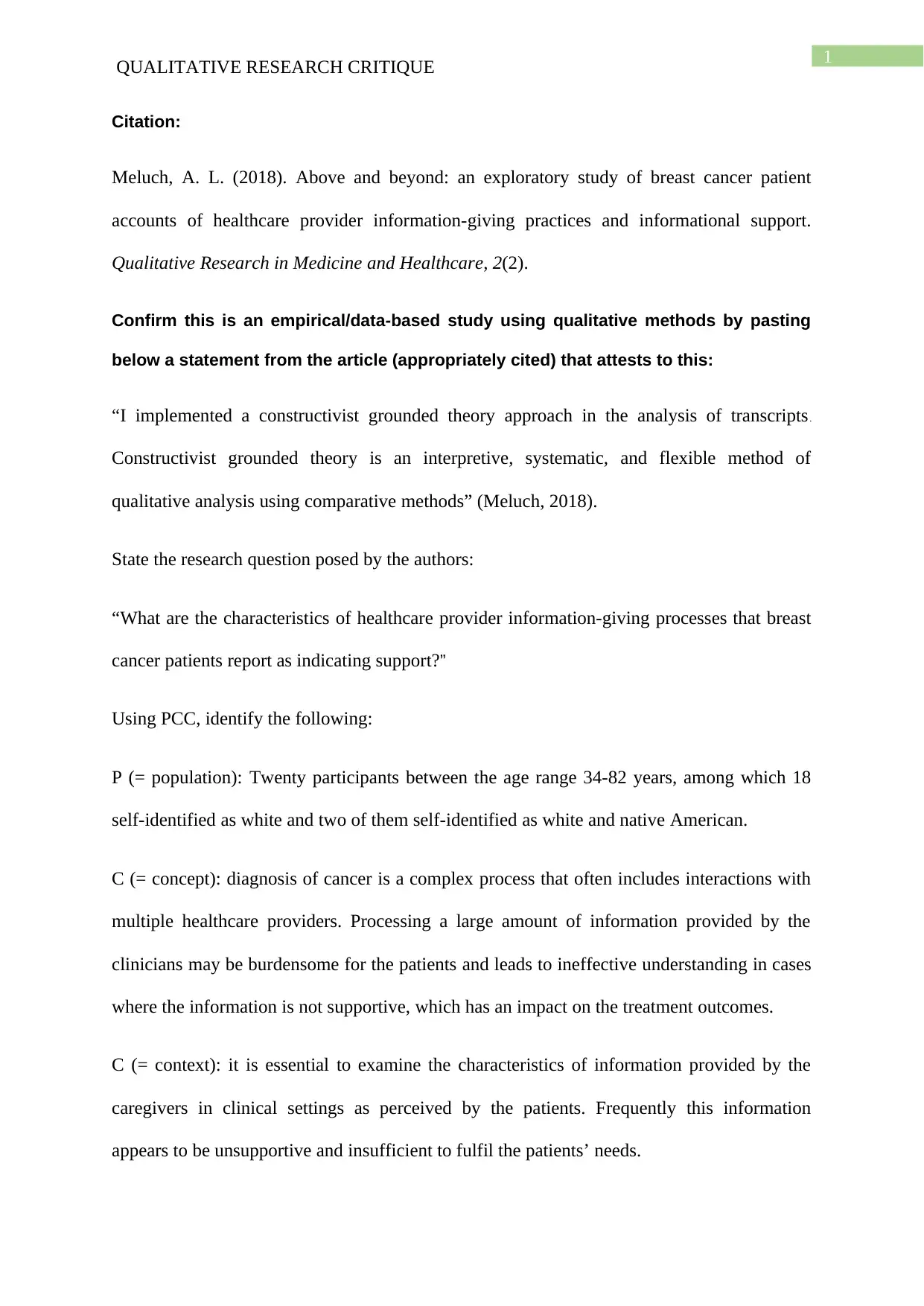
Citation:
Meluch, A. L. (2018). Above and beyond: an exploratory study of breast cancer patient
accounts of healthcare provider information-giving practices and informational support.
Qualitative Research in Medicine and Healthcare, 2(2).
Confirm this is an empirical/data-based study using qualitative methods by pasting
below a statement from the article (appropriately cited) that attests to this:
“I implemented a constructivist grounded theory approach in the analysis of transcripts.
Constructivist grounded theory is an interpretive, systematic, and flexible method of
qualitative analysis using comparative methods” (Meluch, 2018).
State the research question posed by the authors:
“What are the characteristics of healthcare provider information-giving processes that breast
cancer patients report as indicating support?”
Using PCC, identify the following:
P (= population): Twenty participants between the age range 34-82 years, among which 18
self-identified as white and two of them self-identified as white and native American.
C (= concept): diagnosis of cancer is a complex process that often includes interactions with
multiple healthcare providers. Processing a large amount of information provided by the
clinicians may be burdensome for the patients and leads to ineffective understanding in cases
where the information is not supportive, which has an impact on the treatment outcomes.
C (= context): it is essential to examine the characteristics of information provided by the
caregivers in clinical settings as perceived by the patients. Frequently this information
appears to be unsupportive and insufficient to fulfil the patients’ needs.
QUALITATIVE RESEARCH CRITIQUE
Citation:
Meluch, A. L. (2018). Above and beyond: an exploratory study of breast cancer patient
accounts of healthcare provider information-giving practices and informational support.
Qualitative Research in Medicine and Healthcare, 2(2).
Confirm this is an empirical/data-based study using qualitative methods by pasting
below a statement from the article (appropriately cited) that attests to this:
“I implemented a constructivist grounded theory approach in the analysis of transcripts.
Constructivist grounded theory is an interpretive, systematic, and flexible method of
qualitative analysis using comparative methods” (Meluch, 2018).
State the research question posed by the authors:
“What are the characteristics of healthcare provider information-giving processes that breast
cancer patients report as indicating support?”
Using PCC, identify the following:
P (= population): Twenty participants between the age range 34-82 years, among which 18
self-identified as white and two of them self-identified as white and native American.
C (= concept): diagnosis of cancer is a complex process that often includes interactions with
multiple healthcare providers. Processing a large amount of information provided by the
clinicians may be burdensome for the patients and leads to ineffective understanding in cases
where the information is not supportive, which has an impact on the treatment outcomes.
C (= context): it is essential to examine the characteristics of information provided by the
caregivers in clinical settings as perceived by the patients. Frequently this information
appears to be unsupportive and insufficient to fulfil the patients’ needs.

2
QUALITATIVE RESEARCH CRITIQUE
______________________________________________________________________
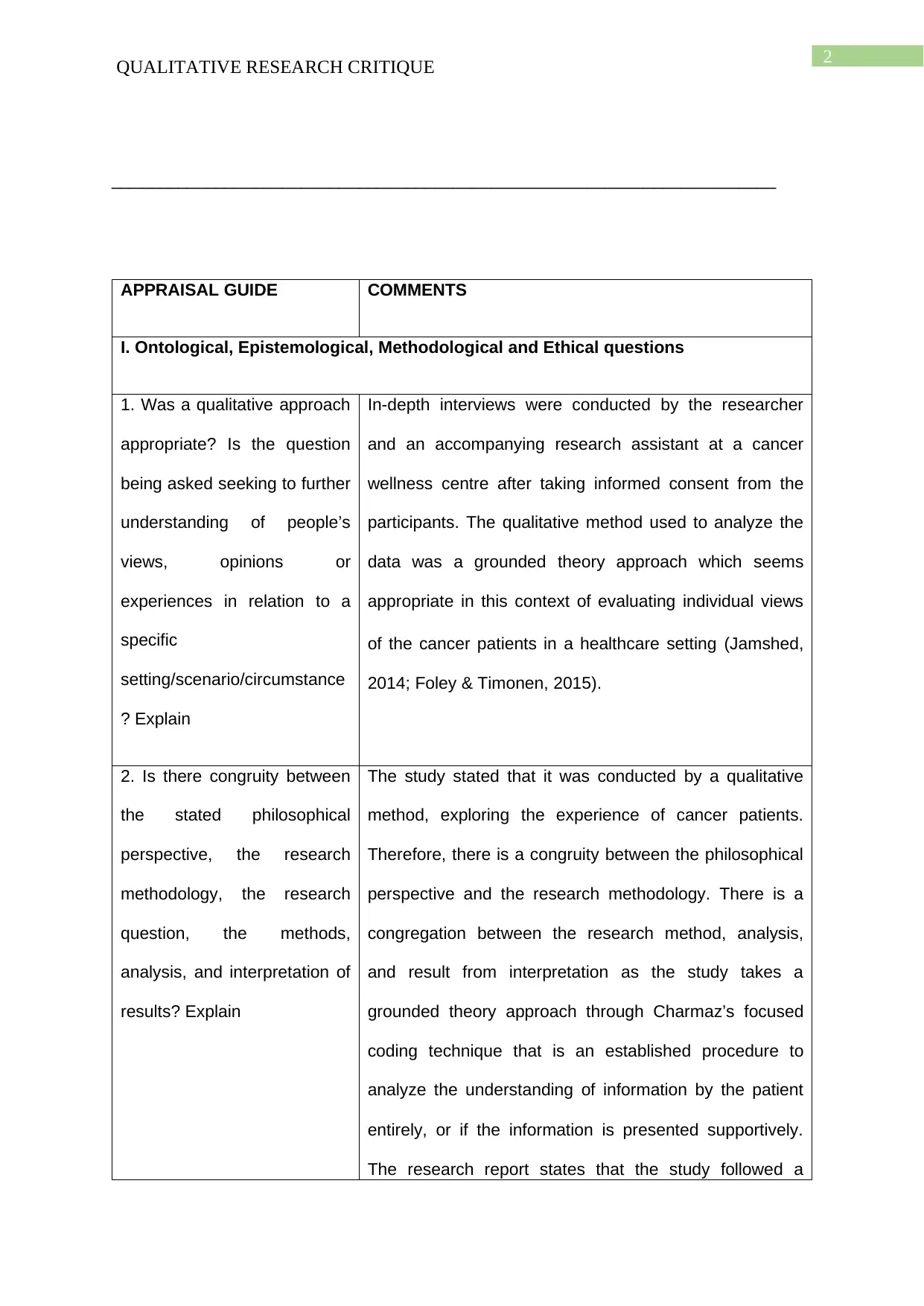
APPRAISAL GUIDE COMMENTS
I. Ontological, Epistemological, Methodological and Ethical questions
1. Was a qualitative approach
appropriate? Is the question
being asked seeking to further
understanding of people’s
views, opinions or
experiences in relation to a
specific
setting/scenario/circumstance
? Explain
In-depth interviews were conducted by the researcher
and an accompanying research assistant at a cancer
wellness centre after taking informed consent from the
participants. The qualitative method used to analyze the
data was a grounded theory approach which seems
appropriate in this context of evaluating individual views
of the cancer patients in a healthcare setting (Jamshed,
2014; Foley & Timonen, 2015).
2. Is there congruity between
the stated philosophical
perspective, the research
methodology, the research
question, the methods,
analysis, and interpretation of
results? Explain
The study stated that it was conducted by a qualitative
method, exploring the experience of cancer patients.
Therefore, there is a congruity between the philosophical
perspective and the research methodology. There is a
congregation between the research method, analysis,
and result from interpretation as the study takes a
grounded theory approach through Charmaz’s focused
coding technique that is an established procedure to
analyze the understanding of information by the patient
entirely, or if the information is presented supportively.
The research report states that the study followed a
QUALITATIVE RESEARCH CRITIQUE
______________________________________________________________________
APPRAISAL GUIDE COMMENTS
I. Ontological, Epistemological, Methodological and Ethical questions
1. Was a qualitative approach
appropriate? Is the question
being asked seeking to further
understanding of people’s
views, opinions or
experiences in relation to a
specific
setting/scenario/circumstance
? Explain
In-depth interviews were conducted by the researcher
and an accompanying research assistant at a cancer
wellness centre after taking informed consent from the
participants. The qualitative method used to analyze the
data was a grounded theory approach which seems
appropriate in this context of evaluating individual views
of the cancer patients in a healthcare setting (Jamshed,
2014; Foley & Timonen, 2015).
2. Is there congruity between
the stated philosophical
perspective, the research
methodology, the research
question, the methods,
analysis, and interpretation of
results? Explain
The study stated that it was conducted by a qualitative
method, exploring the experience of cancer patients.
Therefore, there is a congruity between the philosophical
perspective and the research methodology. There is a
congregation between the research method, analysis,
and result from interpretation as the study takes a
grounded theory approach through Charmaz’s focused
coding technique that is an established procedure to
analyze the understanding of information by the patient
entirely, or if the information is presented supportively.
The research report states that the study followed a
⊘ This is a preview!⊘
Do you want full access?
Subscribe today to unlock all pages.

Trusted by 1+ million students worldwide

3
QUALITATIVE RESEARCH CRITIQUE
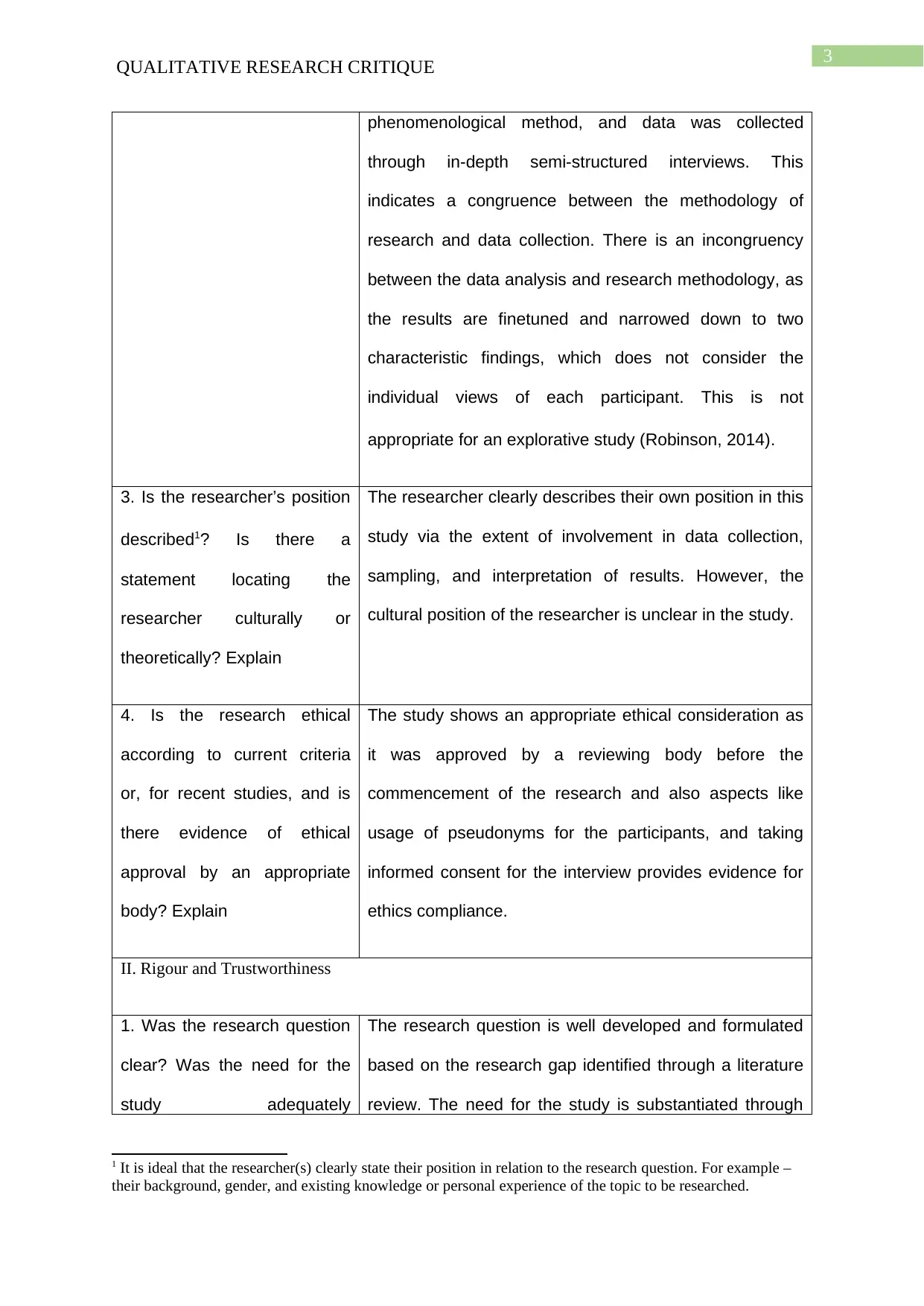
phenomenological method, and data was collected
through in-depth semi-structured interviews. This
indicates a congruence between the methodology of
research and data collection. There is an incongruency
between the data analysis and research methodology, as
the results are finetuned and narrowed down to two
characteristic findings, which does not consider the
individual views of each participant. This is not
appropriate for an explorative study (Robinson, 2014).
3. Is the researcher’s position
described1? Is there a
statement locating the
researcher culturally or
theoretically? Explain
The researcher clearly describes their own position in this
study via the extent of involvement in data collection,
sampling, and interpretation of results. However, the
cultural position of the researcher is unclear in the study.
4. Is the research ethical
according to current criteria
or, for recent studies, and is
there evidence of ethical
approval by an appropriate
body? Explain
The study shows an appropriate ethical consideration as
it was approved by a reviewing body before the
commencement of the research and also aspects like
usage of pseudonyms for the participants, and taking
informed consent for the interview provides evidence for
ethics compliance.
II. Rigour and Trustworthiness
1. Was the research question
clear? Was the need for the
study adequately
The research question is well developed and formulated
based on the research gap identified through a literature
review. The need for the study is substantiated through
1 It is ideal that the researcher(s) clearly state their position in relation to the research question. For example –
their background, gender, and existing knowledge or personal experience of the topic to be researched.
QUALITATIVE RESEARCH CRITIQUE
phenomenological method, and data was collected
through in-depth semi-structured interviews. This
indicates a congruence between the methodology of
research and data collection. There is an incongruency
between the data analysis and research methodology, as
the results are finetuned and narrowed down to two
characteristic findings, which does not consider the
individual views of each participant. This is not
appropriate for an explorative study (Robinson, 2014).
3. Is the researcher’s position
described1? Is there a
statement locating the
researcher culturally or
theoretically? Explain
The researcher clearly describes their own position in this
study via the extent of involvement in data collection,
sampling, and interpretation of results. However, the
cultural position of the researcher is unclear in the study.
4. Is the research ethical
according to current criteria
or, for recent studies, and is
there evidence of ethical
approval by an appropriate
body? Explain
The study shows an appropriate ethical consideration as
it was approved by a reviewing body before the
commencement of the research and also aspects like
usage of pseudonyms for the participants, and taking
informed consent for the interview provides evidence for
ethics compliance.
II. Rigour and Trustworthiness
1. Was the research question
clear? Was the need for the
study adequately
The research question is well developed and formulated
based on the research gap identified through a literature
review. The need for the study is substantiated through
1 It is ideal that the researcher(s) clearly state their position in relation to the research question. For example –
their background, gender, and existing knowledge or personal experience of the topic to be researched.
Paraphrase This Document
Need a fresh take? Get an instant paraphrase of this document with our AI Paraphraser

4
QUALITATIVE RESEARCH CRITIQUE
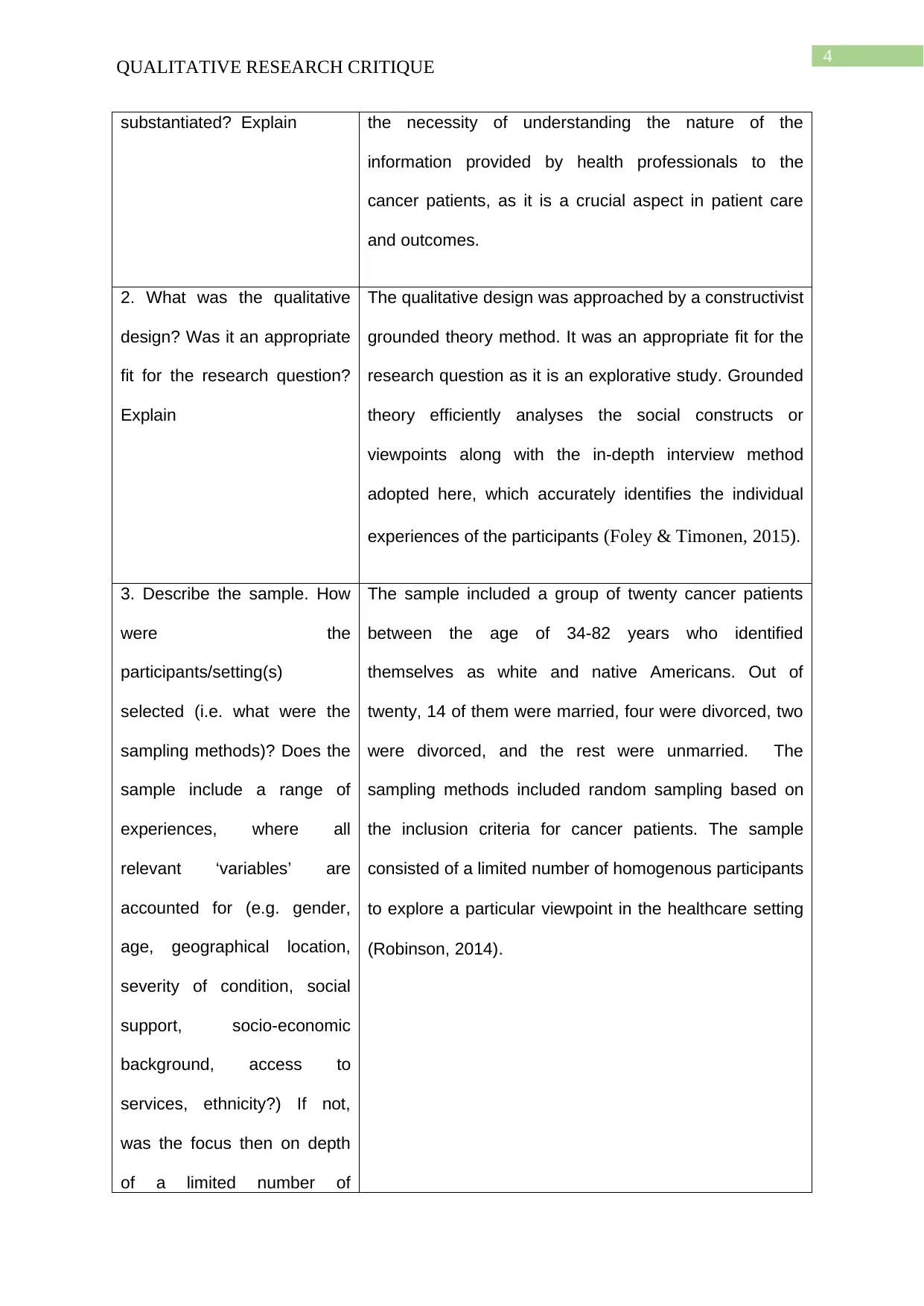
substantiated? Explain the necessity of understanding the nature of the
information provided by health professionals to the
cancer patients, as it is a crucial aspect in patient care
and outcomes.
2. What was the qualitative
design? Was it an appropriate
fit for the research question?
Explain
The qualitative design was approached by a constructivist
grounded theory method. It was an appropriate fit for the
research question as it is an explorative study. Grounded
theory efficiently analyses the social constructs or
viewpoints along with the in-depth interview method
adopted here, which accurately identifies the individual
experiences of the participants (Foley & Timonen, 2015).
3. Describe the sample. How
were the
participants/setting(s)
selected (i.e. what were the
sampling methods)? Does the
sample include a range of
experiences, where all
relevant ‘variables’ are
accounted for (e.g. gender,
age, geographical location,
severity of condition, social
support, socio-economic
background, access to
services, ethnicity?) If not,
was the focus then on depth
of a limited number of
The sample included a group of twenty cancer patients
between the age of 34-82 years who identified
themselves as white and native Americans. Out of
twenty, 14 of them were married, four were divorced, two
were divorced, and the rest were unmarried. The
sampling methods included random sampling based on
the inclusion criteria for cancer patients. The sample
consisted of a limited number of homogenous participants
to explore a particular viewpoint in the healthcare setting
(Robinson, 2014).
QUALITATIVE RESEARCH CRITIQUE
substantiated? Explain the necessity of understanding the nature of the
information provided by health professionals to the
cancer patients, as it is a crucial aspect in patient care
and outcomes.
2. What was the qualitative
design? Was it an appropriate
fit for the research question?
Explain
The qualitative design was approached by a constructivist
grounded theory method. It was an appropriate fit for the
research question as it is an explorative study. Grounded
theory efficiently analyses the social constructs or
viewpoints along with the in-depth interview method
adopted here, which accurately identifies the individual
experiences of the participants (Foley & Timonen, 2015).
3. Describe the sample. How
were the
participants/setting(s)
selected (i.e. what were the
sampling methods)? Does the
sample include a range of
experiences, where all
relevant ‘variables’ are
accounted for (e.g. gender,
age, geographical location,
severity of condition, social
support, socio-economic
background, access to
services, ethnicity?) If not,
was the focus then on depth
of a limited number of
The sample included a group of twenty cancer patients
between the age of 34-82 years who identified
themselves as white and native Americans. Out of
twenty, 14 of them were married, four were divorced, two
were divorced, and the rest were unmarried. The
sampling methods included random sampling based on
the inclusion criteria for cancer patients. The sample
consisted of a limited number of homogenous participants
to explore a particular viewpoint in the healthcare setting
(Robinson, 2014).

5
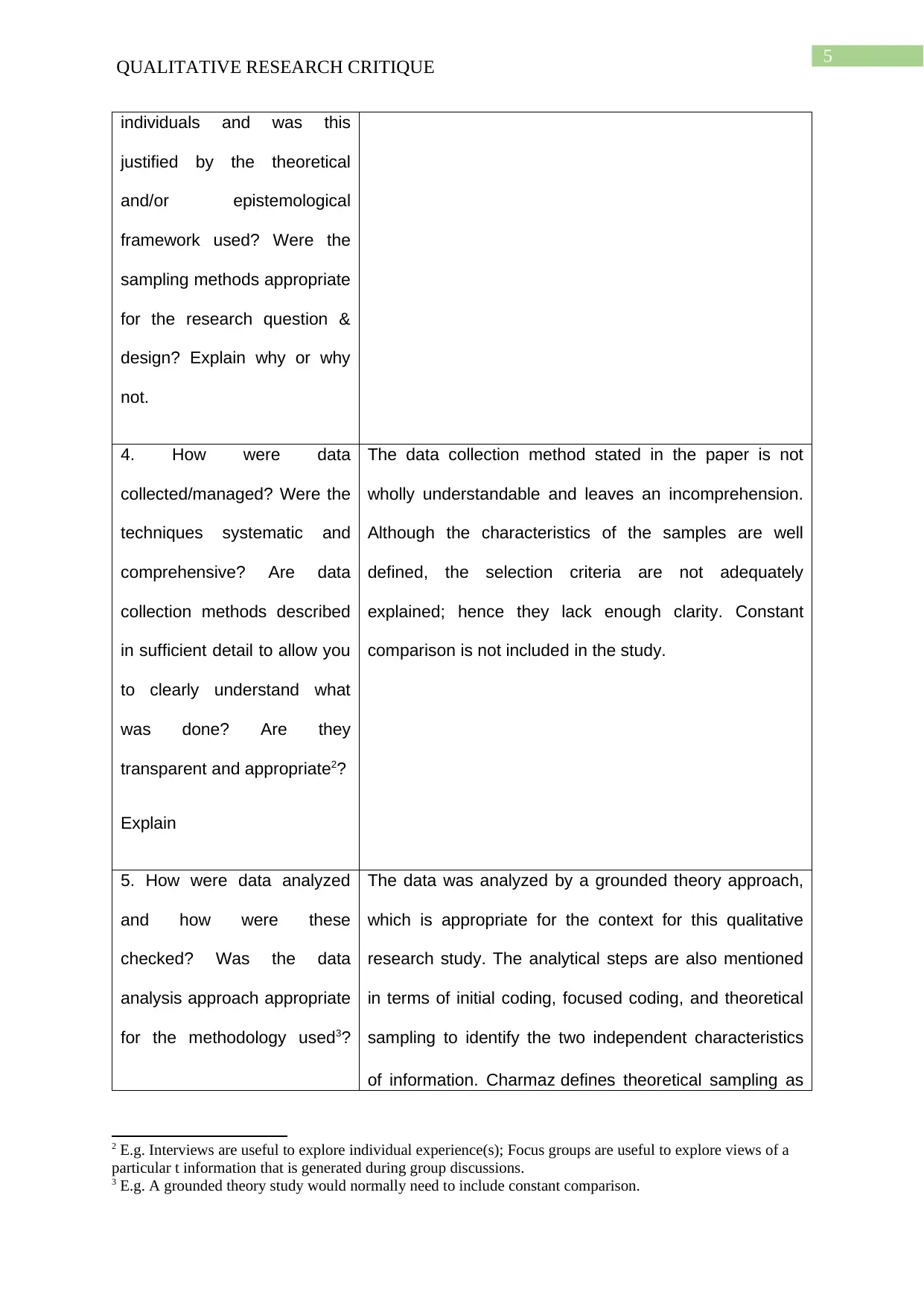
QUALITATIVE RESEARCH CRITIQUE
individuals and was this
justified by the theoretical
and/or epistemological
framework used? Were the
sampling methods appropriate
for the research question &
design? Explain why or why
not.
4. How were data
collected/managed? Were the
techniques systematic and
comprehensive? Are data
collection methods described
in sufficient detail to allow you
to clearly understand what
was done? Are they
transparent and appropriate2?
Explain
The data collection method stated in the paper is not
wholly understandable and leaves an incomprehension.
Although the characteristics of the samples are well
defined, the selection criteria are not adequately
explained; hence they lack enough clarity. Constant
comparison is not included in the study.
5. How were data analyzed
and how were these
checked? Was the data
analysis approach appropriate
for the methodology used3?
The data was analyzed by a grounded theory approach,
which is appropriate for the context for this qualitative
research study. The analytical steps are also mentioned
in terms of initial coding, focused coding, and theoretical
sampling to identify the two independent characteristics
of information. Charmaz defines theoretical sampling as
2 E.g. Interviews are useful to explore individual experience(s); Focus groups are useful to explore views of a
particular t information that is generated during group discussions.
3 E.g. A grounded theory study would normally need to include constant comparison.
QUALITATIVE RESEARCH CRITIQUE
individuals and was this
justified by the theoretical
and/or epistemological
framework used? Were the
sampling methods appropriate
for the research question &
design? Explain why or why
not.
4. How were data
collected/managed? Were the
techniques systematic and
comprehensive? Are data
collection methods described
in sufficient detail to allow you
to clearly understand what
was done? Are they
transparent and appropriate2?
Explain
The data collection method stated in the paper is not
wholly understandable and leaves an incomprehension.
Although the characteristics of the samples are well
defined, the selection criteria are not adequately
explained; hence they lack enough clarity. Constant
comparison is not included in the study.
5. How were data analyzed
and how were these
checked? Was the data
analysis approach appropriate
for the methodology used3?
The data was analyzed by a grounded theory approach,
which is appropriate for the context for this qualitative
research study. The analytical steps are also mentioned
in terms of initial coding, focused coding, and theoretical
sampling to identify the two independent characteristics
of information. Charmaz defines theoretical sampling as
2 E.g. Interviews are useful to explore individual experience(s); Focus groups are useful to explore views of a
particular t information that is generated during group discussions.
3 E.g. A grounded theory study would normally need to include constant comparison.
⊘ This is a preview!⊘
Do you want full access?
Subscribe today to unlock all pages.

Trusted by 1+ million students worldwide

6
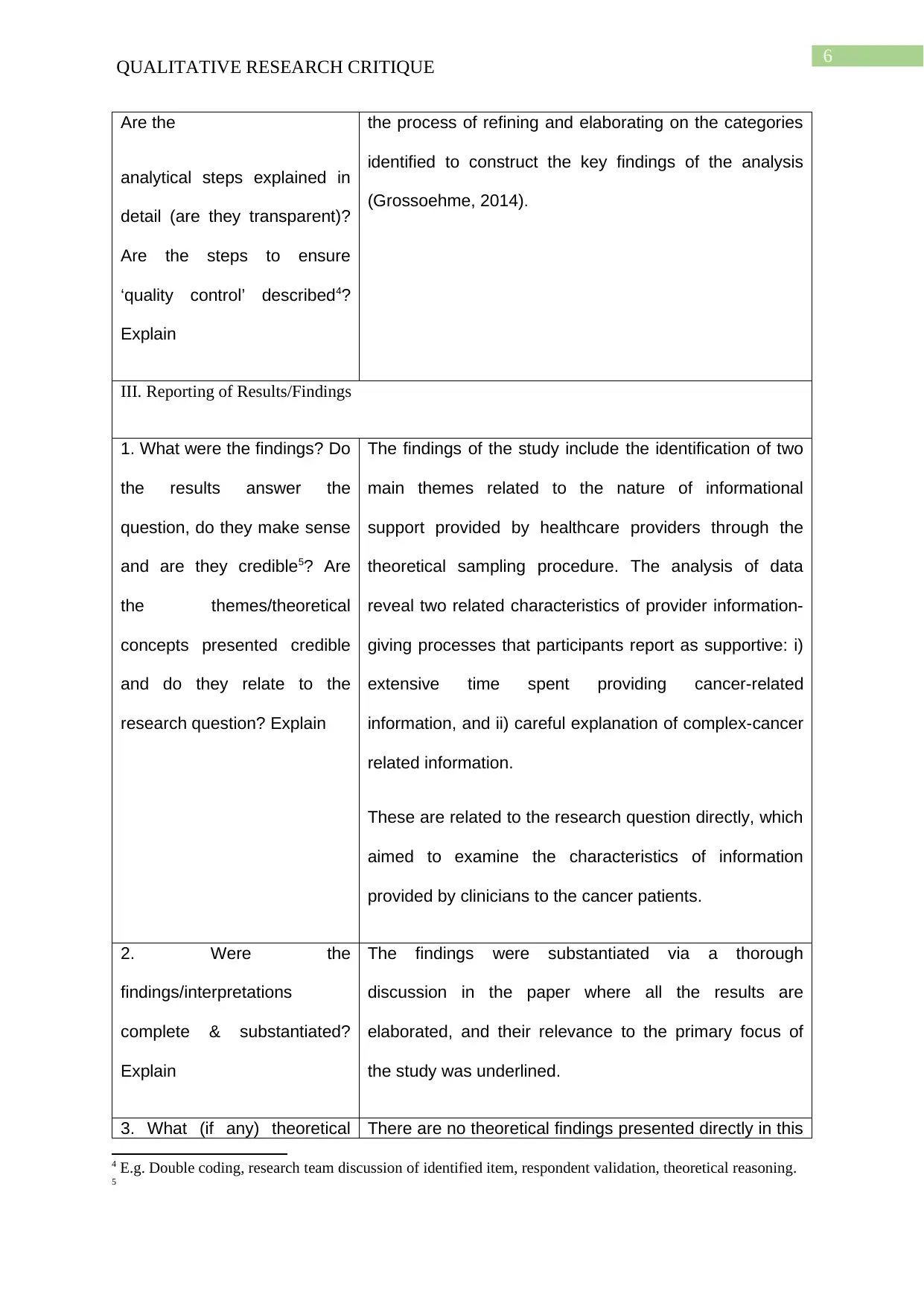
QUALITATIVE RESEARCH CRITIQUE
Are the
analytical steps explained in
detail (are they transparent)?
Are the steps to ensure
‘quality control’ described4?
Explain
the process of refining and elaborating on the categories
identified to construct the key findings of the analysis
(Grossoehme, 2014).
III. Reporting of Results/Findings
1. What were the findings? Do
the results answer the
question, do they make sense
and are they credible5? Are
the themes/theoretical
concepts presented credible
and do they relate to the
research question? Explain
The findings of the study include the identification of two
main themes related to the nature of informational
support provided by healthcare providers through the
theoretical sampling procedure. The analysis of data
reveal two related characteristics of provider information-
giving processes that participants report as supportive: i)
extensive time spent providing cancer-related
information, and ii) careful explanation of complex-cancer
related information.
These are related to the research question directly, which
aimed to examine the characteristics of information
provided by clinicians to the cancer patients.
2. Were the
findings/interpretations
complete & substantiated?
Explain
The findings were substantiated via a thorough
discussion in the paper where all the results are
elaborated, and their relevance to the primary focus of
the study was underlined.
3. What (if any) theoretical There are no theoretical findings presented directly in this
4 E.g. Double coding, research team discussion of identified item, respondent validation, theoretical reasoning.
5
QUALITATIVE RESEARCH CRITIQUE
Are the
analytical steps explained in
detail (are they transparent)?
Are the steps to ensure
‘quality control’ described4?
Explain
the process of refining and elaborating on the categories
identified to construct the key findings of the analysis
(Grossoehme, 2014).
III. Reporting of Results/Findings
1. What were the findings? Do
the results answer the
question, do they make sense
and are they credible5? Are
the themes/theoretical
concepts presented credible
and do they relate to the
research question? Explain
The findings of the study include the identification of two
main themes related to the nature of informational
support provided by healthcare providers through the
theoretical sampling procedure. The analysis of data
reveal two related characteristics of provider information-
giving processes that participants report as supportive: i)
extensive time spent providing cancer-related
information, and ii) careful explanation of complex-cancer
related information.
These are related to the research question directly, which
aimed to examine the characteristics of information
provided by clinicians to the cancer patients.
2. Were the
findings/interpretations
complete & substantiated?
Explain
The findings were substantiated via a thorough
discussion in the paper where all the results are
elaborated, and their relevance to the primary focus of
the study was underlined.
3. What (if any) theoretical There are no theoretical findings presented directly in this
4 E.g. Double coding, research team discussion of identified item, respondent validation, theoretical reasoning.
5
Paraphrase This Document
Need a fresh take? Get an instant paraphrase of this document with our AI Paraphraser

7
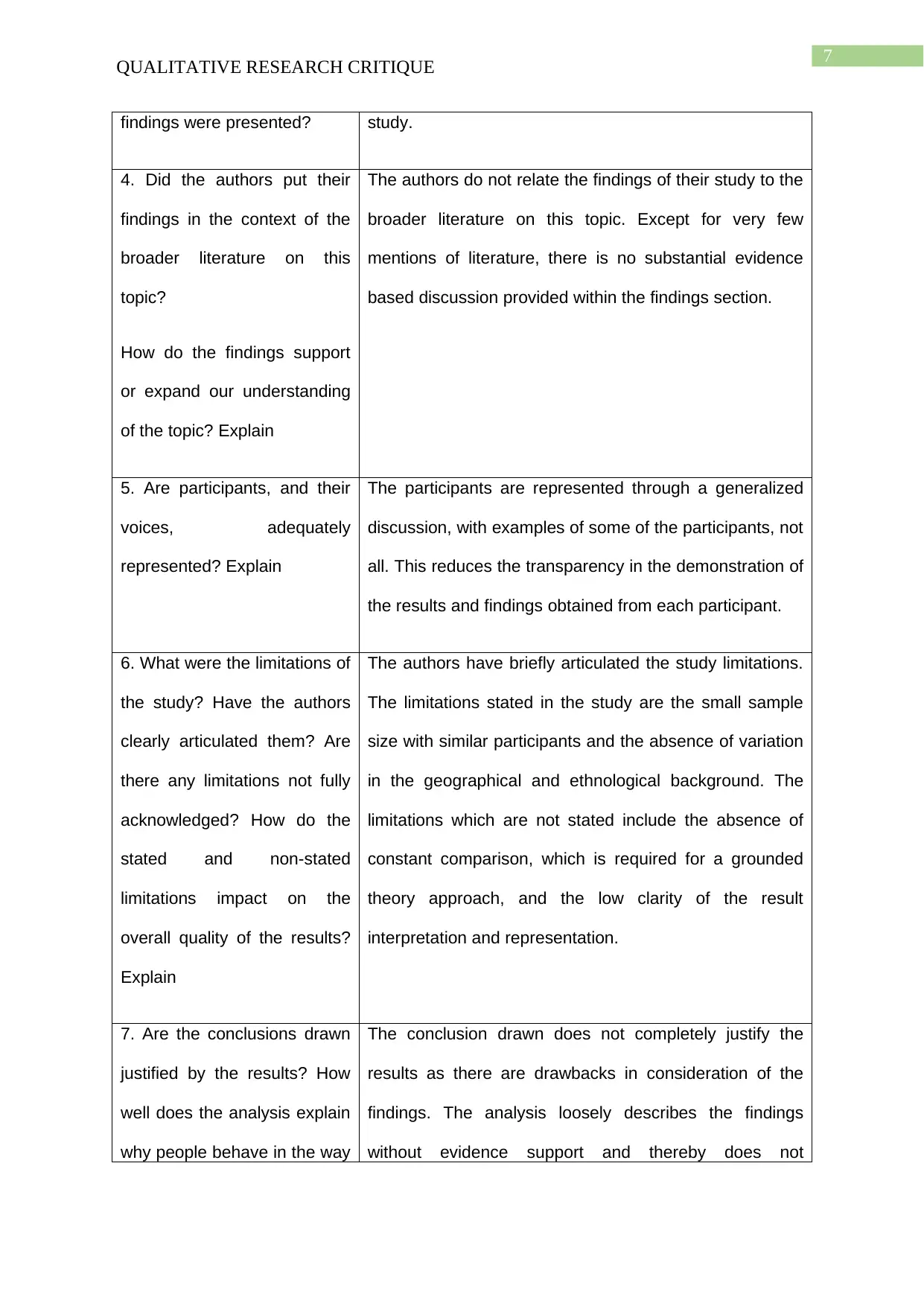
QUALITATIVE RESEARCH CRITIQUE
findings were presented? study.
4. Did the authors put their
findings in the context of the
broader literature on this
topic?
How do the findings support
or expand our understanding
of the topic? Explain
The authors do not relate the findings of their study to the
broader literature on this topic. Except for very few
mentions of literature, there is no substantial evidence
based discussion provided within the findings section.
5. Are participants, and their
voices, adequately
represented? Explain
The participants are represented through a generalized
discussion, with examples of some of the participants, not
all. This reduces the transparency in the demonstration of
the results and findings obtained from each participant.
6. What were the limitations of
the study? Have the authors
clearly articulated them? Are
there any limitations not fully
acknowledged? How do the
stated and non-stated
limitations impact on the
overall quality of the results?
Explain
The authors have briefly articulated the study limitations.
The limitations stated in the study are the small sample
size with similar participants and the absence of variation
in the geographical and ethnological background. The
limitations which are not stated include the absence of
constant comparison, which is required for a grounded
theory approach, and the low clarity of the result
interpretation and representation.
7. Are the conclusions drawn
justified by the results? How
well does the analysis explain
why people behave in the way
The conclusion drawn does not completely justify the
results as there are drawbacks in consideration of the
findings. The analysis loosely describes the findings
without evidence support and thereby does not
QUALITATIVE RESEARCH CRITIQUE
findings were presented? study.
4. Did the authors put their
findings in the context of the
broader literature on this
topic?
How do the findings support
or expand our understanding
of the topic? Explain
The authors do not relate the findings of their study to the
broader literature on this topic. Except for very few
mentions of literature, there is no substantial evidence
based discussion provided within the findings section.
5. Are participants, and their
voices, adequately
represented? Explain
The participants are represented through a generalized
discussion, with examples of some of the participants, not
all. This reduces the transparency in the demonstration of
the results and findings obtained from each participant.
6. What were the limitations of
the study? Have the authors
clearly articulated them? Are
there any limitations not fully
acknowledged? How do the
stated and non-stated
limitations impact on the
overall quality of the results?
Explain
The authors have briefly articulated the study limitations.
The limitations stated in the study are the small sample
size with similar participants and the absence of variation
in the geographical and ethnological background. The
limitations which are not stated include the absence of
constant comparison, which is required for a grounded
theory approach, and the low clarity of the result
interpretation and representation.
7. Are the conclusions drawn
justified by the results? How
well does the analysis explain
why people behave in the way
The conclusion drawn does not completely justify the
results as there are drawbacks in consideration of the
findings. The analysis loosely describes the findings
without evidence support and thereby does not

8
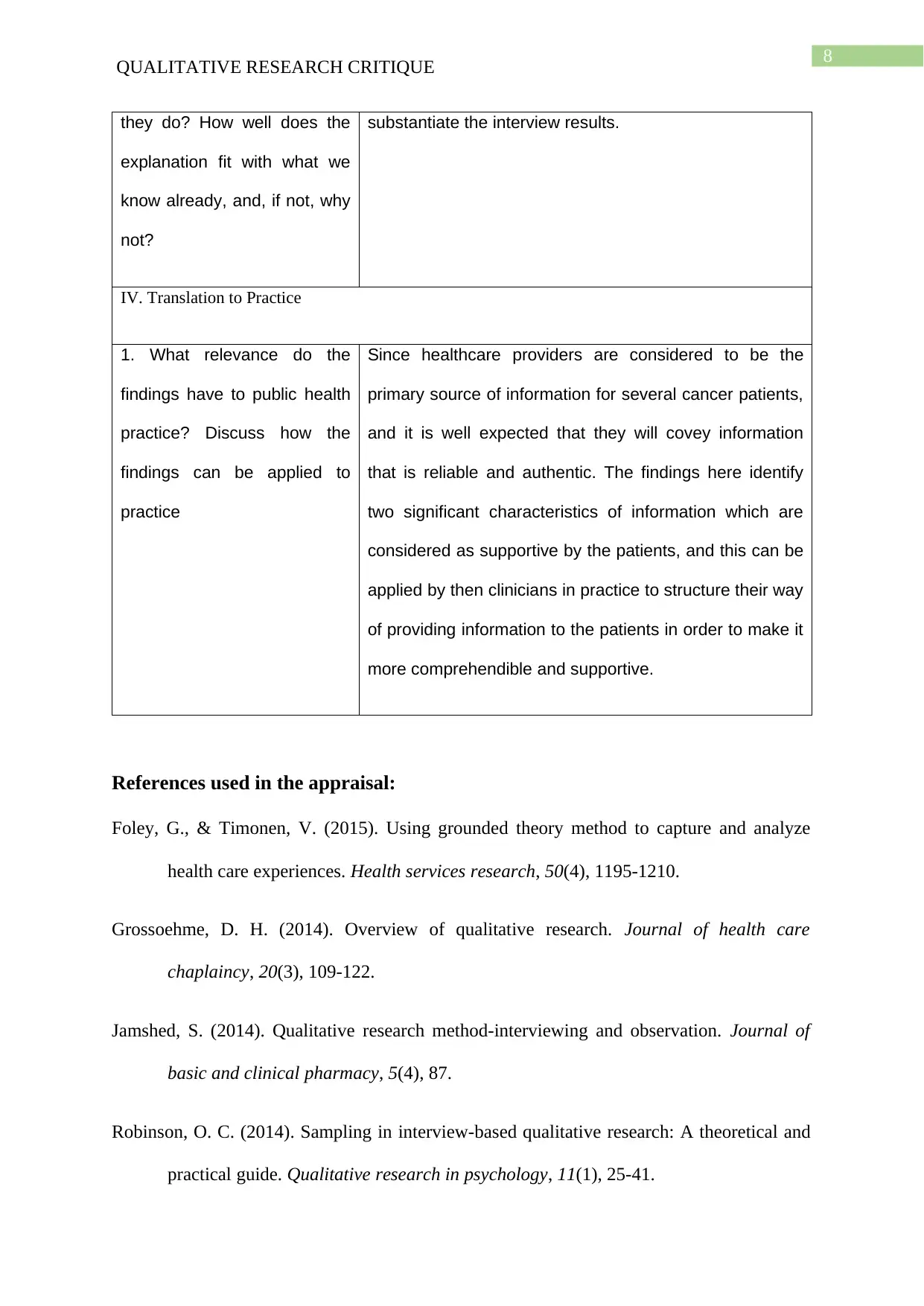
QUALITATIVE RESEARCH CRITIQUE
they do? How well does the
explanation fit with what we
know already, and, if not, why
not?
substantiate the interview results.
IV. Translation to Practice
1. What relevance do the
findings have to public health
practice? Discuss how the
findings can be applied to
practice
Since healthcare providers are considered to be the
primary source of information for several cancer patients,
and it is well expected that they will covey information
that is reliable and authentic. The findings here identify
two significant characteristics of information which are
considered as supportive by the patients, and this can be
applied by then clinicians in practice to structure their way
of providing information to the patients in order to make it
more comprehendible and supportive.
References used in the appraisal:
Foley, G., & Timonen, V. (2015). Using grounded theory method to capture and analyze
health care experiences. Health services research, 50(4), 1195-1210.
Grossoehme, D. H. (2014). Overview of qualitative research. Journal of health care
chaplaincy, 20(3), 109-122.
Jamshed, S. (2014). Qualitative research method-interviewing and observation. Journal of
basic and clinical pharmacy, 5(4), 87.
Robinson, O. C. (2014). Sampling in interview-based qualitative research: A theoretical and
practical guide. Qualitative research in psychology, 11(1), 25-41.
QUALITATIVE RESEARCH CRITIQUE
they do? How well does the
explanation fit with what we
know already, and, if not, why
not?
substantiate the interview results.
IV. Translation to Practice
1. What relevance do the
findings have to public health
practice? Discuss how the
findings can be applied to
practice
Since healthcare providers are considered to be the
primary source of information for several cancer patients,
and it is well expected that they will covey information
that is reliable and authentic. The findings here identify
two significant characteristics of information which are
considered as supportive by the patients, and this can be
applied by then clinicians in practice to structure their way
of providing information to the patients in order to make it
more comprehendible and supportive.
References used in the appraisal:
Foley, G., & Timonen, V. (2015). Using grounded theory method to capture and analyze
health care experiences. Health services research, 50(4), 1195-1210.
Grossoehme, D. H. (2014). Overview of qualitative research. Journal of health care
chaplaincy, 20(3), 109-122.
Jamshed, S. (2014). Qualitative research method-interviewing and observation. Journal of
basic and clinical pharmacy, 5(4), 87.
Robinson, O. C. (2014). Sampling in interview-based qualitative research: A theoretical and
practical guide. Qualitative research in psychology, 11(1), 25-41.
⊘ This is a preview!⊘
Do you want full access?
Subscribe today to unlock all pages.

Trusted by 1+ million students worldwide

9
QUALITATIVE RESEARCH CRITIQUE
1 out of 10
Related Documents
Your All-in-One AI-Powered Toolkit for Academic Success.
+13062052269
info@desklib.com
Available 24*7 on WhatsApp / Email
Unlock your academic potential
Copyright © 2020–2025 A2Z Services. All Rights Reserved. Developed and managed by ZUCOL.