Management Research Report: Qualitative, Mixed Methods, and Review
VerifiedAdded on 2022/08/22
|14
|3432
|21
Report
AI Summary
This report provides a comprehensive analysis of management research, divided into three key parts. The first part defines and describes systematic literature reviews, outlining their process and importance in addressing research problems. The second part explores various qualitative research strategies, such as ethnography, narrative, phenomenology, grounded theory, and case studies, and explains their application in business and management research. The final part compares and contrasts different types of mixed methods research designs, with a focus on triangulation design, providing examples of their use in the business context. The report uses critical analysis to provide a clear understanding of the concepts and their implications.

Running head: MANAGEMENT RESEARCH
Management Research
Sabiha saiyed
500566821
Author note
Management Research
Sabiha saiyed
500566821
Author note

Paraphrase This Document
Need a fresh take? Get an instant paraphrase of this document with our AI Paraphraser
1MANAGEMENT RESEARCH
Introduction
The report has evaluated the different aspects of management research, where it has been
divided into three parts. The first section of the report examines the systematic review of the
literature and the process of conducting an investigation. The second section of the report
highlights the different qualitative research strategies and their application in business and
management. Finally, the third section of the research deals with the different types of mixed
methods and triangulation design. Examples are used to describe each of the theories and
processes identified, and it helps in illustrating the implication of these research methods in
business and management research. The report uses a perspective of critical analysis to provide a
distinct understanding of all the concepts chosen in the study.
Part I
Definition of Systematic literature review
Every year numerous studies are conducted, resulting in conflicting findings. There are
significant differences in researches due to their diversity, sampling variations, and flaws.
Therefore, it becomes highly challenging to understand the reliability of various studies and
which results can be relied upon for policy formulation and developing business practices.
Okoli and Schabram (2010) has defined a systematic review of literature as the process of
addressing the research problem by classifying, critically examining, and assimilating results
from various academic peer-reviewed journals. A systematic literature review is performed to
address one or more research questions (Levy and Ellis 2006). The author suggested that these
factors are relevant characteristics of a useful systematic review of literature:
Establishing the extent to which research has come close to expounding the problem of
research
Identifying relationships between variables, research gap identification, inconsistencies
and contradiction within past literature and discover the reasons behind these aspects
Developing a conceptual framework and formulating a general statement for presenting
the overarching research problem
Commenting on and evaluating recent theories to extend and generate theories
Providing widespread implications for policy development and various practices
Introduction
The report has evaluated the different aspects of management research, where it has been
divided into three parts. The first section of the report examines the systematic review of the
literature and the process of conducting an investigation. The second section of the report
highlights the different qualitative research strategies and their application in business and
management. Finally, the third section of the research deals with the different types of mixed
methods and triangulation design. Examples are used to describe each of the theories and
processes identified, and it helps in illustrating the implication of these research methods in
business and management research. The report uses a perspective of critical analysis to provide a
distinct understanding of all the concepts chosen in the study.
Part I
Definition of Systematic literature review
Every year numerous studies are conducted, resulting in conflicting findings. There are
significant differences in researches due to their diversity, sampling variations, and flaws.
Therefore, it becomes highly challenging to understand the reliability of various studies and
which results can be relied upon for policy formulation and developing business practices.
Okoli and Schabram (2010) has defined a systematic review of literature as the process of
addressing the research problem by classifying, critically examining, and assimilating results
from various academic peer-reviewed journals. A systematic literature review is performed to
address one or more research questions (Levy and Ellis 2006). The author suggested that these
factors are relevant characteristics of a useful systematic review of literature:
Establishing the extent to which research has come close to expounding the problem of
research
Identifying relationships between variables, research gap identification, inconsistencies
and contradiction within past literature and discover the reasons behind these aspects
Developing a conceptual framework and formulating a general statement for presenting
the overarching research problem
Commenting on and evaluating recent theories to extend and generate theories
Providing widespread implications for policy development and various practices
2MANAGEMENT RESEARCH
Describing the future direction for any research study
As stated by Okoli (2015), a systematic review can be considered as a piece of research that
has the capability of addressing a broader aspect of research, which is impossible to achieve by
performing an empirical study. In terms of the hierarchy of evidence, a systematic review is at
the top of all the different types of research designs as they can offer the most relevant practical
implications in business and management.
On the contrary, Fink (2019) states that a systematic review includes a question that is
formulated clearly and uses explicit and systematic research methods to select, appraise, and
identify significant research. It also gathers and evaluates data from the studies chosen for the
review. Different statistical methods, like meta-analysis, may or may not be used to examine and
summarise the findings of all the selected studies. Levy and Ellis (2006) states that a systematic
review can be classified based on its objectivity, systematic nature, transparency, and
replicability. It uses a systematic process for identifying past researches relevant to address the
research question. A systematic synthesis and presentation of the study findings are performed
for addressing the research question. There are criteria for including and excluding a research
topic, which improves the objectivity of the research. It is necessary to scrutinise and evaluate
evidence to accumulate contradicting arguments within the research.
Process of a systematic review
The critical stages of performing a systematic literature review have been described
below:
Scoping
Planning
Searching
Screening
Eligibility
When these stages of the research are accomplished, the systematic review decides to choose
between qualitative and quantitative research synthesis and the structure of the review. Scoping
starts with formulating a research question that will be based on the aspect of the study and the
audience they want to address (Okoli and Schabram 2010). The next step is clarifying the
Describing the future direction for any research study
As stated by Okoli (2015), a systematic review can be considered as a piece of research that
has the capability of addressing a broader aspect of research, which is impossible to achieve by
performing an empirical study. In terms of the hierarchy of evidence, a systematic review is at
the top of all the different types of research designs as they can offer the most relevant practical
implications in business and management.
On the contrary, Fink (2019) states that a systematic review includes a question that is
formulated clearly and uses explicit and systematic research methods to select, appraise, and
identify significant research. It also gathers and evaluates data from the studies chosen for the
review. Different statistical methods, like meta-analysis, may or may not be used to examine and
summarise the findings of all the selected studies. Levy and Ellis (2006) states that a systematic
review can be classified based on its objectivity, systematic nature, transparency, and
replicability. It uses a systematic process for identifying past researches relevant to address the
research question. A systematic synthesis and presentation of the study findings are performed
for addressing the research question. There are criteria for including and excluding a research
topic, which improves the objectivity of the research. It is necessary to scrutinise and evaluate
evidence to accumulate contradicting arguments within the research.
Process of a systematic review
The critical stages of performing a systematic literature review have been described
below:
Scoping
Planning
Searching
Screening
Eligibility
When these stages of the research are accomplished, the systematic review decides to choose
between qualitative and quantitative research synthesis and the structure of the review. Scoping
starts with formulating a research question that will be based on the aspect of the study and the
audience they want to address (Okoli and Schabram 2010). The next step is clarifying the
⊘ This is a preview!⊘
Do you want full access?
Subscribe today to unlock all pages.

Trusted by 1+ million students worldwide
3MANAGEMENT RESEARCH
existence of thorough systematic research on the formulated question. It facilitates in
understanding whether a current review is required based on the analysis of the last review.
The planning stage breaks down the research question into relevant theories and concepts
for developing key search terms. It helps in identifying literature relevant to the current research
topic. It provides a new direction to the research and identifies alternate theories and models
relevant to the research (Vom Brocke et al. 2009). A preliminary criterion for exclusion and
inclusion is developed to ensure that similar studies are chosen for the study. It helps in defining
the boundary of the current research. The inclusion and exclusion criterion includes factors such
as the scope of the research, conceptualisation, essential variables, and design of the research,
participants, data, and time frame.
The identification stage is also known as the search stage and uses the search terms to
identify relevant electronic sources which have addressed the research question. It includes
searching for high-quality research journals and the portion of the journal relevant to the
research. The search results need to be examined to improve the quality and relevancy of the
literature chosen (Okoli and Schabram 2010). The screening stage collaborates the results by
evaluating the title and abstract of each of the research articles. Information is extracted from
each of the articles based on the inclusion and the exclusion criterion. However, choosing
between qualitative and quantitative research synthesis is one of the critical aspects of the
research (Vom Brocke et al. 2009). A study has to choose between meta-analysis and qualitative
research synthesis based on the width of the topic. A methodologically diverse study is not
suitable for performing a meta-analysis where qualitative research is appropriate.
Part II
Types of qualitative research strategies
A qualitative research method is a process of gathering data through conversational
communication and open-ended questions (Tesch 2013). It helps in understanding not only what
the people are thinking but also the why behind it. Therefore, qualitative analysis facilitates
performing an in-depth analysis of data to understand the motivation and feelings behind the
responses. In order to understand the different types of qualitative research strategies, the data
collection instruments also need to be understood (Bahari 2010). It includes questionnaires,
existence of thorough systematic research on the formulated question. It facilitates in
understanding whether a current review is required based on the analysis of the last review.
The planning stage breaks down the research question into relevant theories and concepts
for developing key search terms. It helps in identifying literature relevant to the current research
topic. It provides a new direction to the research and identifies alternate theories and models
relevant to the research (Vom Brocke et al. 2009). A preliminary criterion for exclusion and
inclusion is developed to ensure that similar studies are chosen for the study. It helps in defining
the boundary of the current research. The inclusion and exclusion criterion includes factors such
as the scope of the research, conceptualisation, essential variables, and design of the research,
participants, data, and time frame.
The identification stage is also known as the search stage and uses the search terms to
identify relevant electronic sources which have addressed the research question. It includes
searching for high-quality research journals and the portion of the journal relevant to the
research. The search results need to be examined to improve the quality and relevancy of the
literature chosen (Okoli and Schabram 2010). The screening stage collaborates the results by
evaluating the title and abstract of each of the research articles. Information is extracted from
each of the articles based on the inclusion and the exclusion criterion. However, choosing
between qualitative and quantitative research synthesis is one of the critical aspects of the
research (Vom Brocke et al. 2009). A study has to choose between meta-analysis and qualitative
research synthesis based on the width of the topic. A methodologically diverse study is not
suitable for performing a meta-analysis where qualitative research is appropriate.
Part II
Types of qualitative research strategies
A qualitative research method is a process of gathering data through conversational
communication and open-ended questions (Tesch 2013). It helps in understanding not only what
the people are thinking but also the why behind it. Therefore, qualitative analysis facilitates
performing an in-depth analysis of data to understand the motivation and feelings behind the
responses. In order to understand the different types of qualitative research strategies, the data
collection instruments also need to be understood (Bahari 2010). It includes questionnaires,
Paraphrase This Document
Need a fresh take? Get an instant paraphrase of this document with our AI Paraphraser
4MANAGEMENT RESEARCH
observation, interviews, and documents review. These instruments are chosen based on the
appropriate research strategy for each research. The types of research designs have been
described as below:
Ethnography
Narrative
Phenomenology
Grounded Theory
Case study
Ethnographic is the most popular qualitative research strategy where the researcher engages
in the environment of the target participants to evaluate the cultures, behaviour, challenges,
themes, and motivations taking place in research (Sangasubana 2011). Ethnography has its roots
in the cultural aspect of anthropology, where researchers immerse themselves within a culture
over the years. Therefore, the researcher tries to derive the first-hand experience of the
environment. It is mainly relevant for cultural description.
The narrative approach uses sequences of events from one or more individuals to develop
a consistent story. In the narrative approach, in-depth interviews are conducted to search for
themes to illustrate the bigger picture. Interviews are conducted over a specified period and may
last until a year (McCormack 2004). However, chronological order is not followed within the
results to ensure an adequate flow within the research. Various themes are used to present a
story, and reconciliation of conflicting stories is possible. It also highlights challenges and
tensions, presenting opportunities for innovation. The narrative approach is used to portray past
events to comprehend the present and forecast the future possibilities.
Phenomenology describes an event, phenomenon, or an activity where a combination of
methods such as interviews, documents, visiting places, events and watching videos to evaluate
the responses of the participants depending on the objective of the research. In this qualitative
method, the perspective of the respondents is used to provide insight and motivation on the
research (Friberg et al. 2007). It helps in understanding the uniqueness of the personal situations
of various individuals. It facilitates performing a subjective point of view, and various themes are
described in the research.
observation, interviews, and documents review. These instruments are chosen based on the
appropriate research strategy for each research. The types of research designs have been
described as below:
Ethnography
Narrative
Phenomenology
Grounded Theory
Case study
Ethnographic is the most popular qualitative research strategy where the researcher engages
in the environment of the target participants to evaluate the cultures, behaviour, challenges,
themes, and motivations taking place in research (Sangasubana 2011). Ethnography has its roots
in the cultural aspect of anthropology, where researchers immerse themselves within a culture
over the years. Therefore, the researcher tries to derive the first-hand experience of the
environment. It is mainly relevant for cultural description.
The narrative approach uses sequences of events from one or more individuals to develop
a consistent story. In the narrative approach, in-depth interviews are conducted to search for
themes to illustrate the bigger picture. Interviews are conducted over a specified period and may
last until a year (McCormack 2004). However, chronological order is not followed within the
results to ensure an adequate flow within the research. Various themes are used to present a
story, and reconciliation of conflicting stories is possible. It also highlights challenges and
tensions, presenting opportunities for innovation. The narrative approach is used to portray past
events to comprehend the present and forecast the future possibilities.
Phenomenology describes an event, phenomenon, or an activity where a combination of
methods such as interviews, documents, visiting places, events and watching videos to evaluate
the responses of the participants depending on the objective of the research. In this qualitative
method, the perspective of the respondents is used to provide insight and motivation on the
research (Friberg et al. 2007). It helps in understanding the uniqueness of the personal situations
of various individuals. It facilitates performing a subjective point of view, and various themes are
described in the research.
5MANAGEMENT RESEARCH
When a phenomenology study describes an event or any activity, grounded theory is to
explain the theory responsible for the phenomena. In this qualitative research strategy, primary
interviews, and existing literature on the topic is used for theory formulation. Qualitative coding
is performed in grounded theory, where the interview is evaluated to identify the patterns among
the data (Lambert 2019). Open coding is used to identify phrases within the transcript for
identifying the initial codes for the research. Axial coding is used to link the codes collected
from the transcript to link with the theories and develop a causal relationship. Finally, selective
coding is used to develop based on the link identified with the existing literature. It facilitates in
formulating new generalisations and frameworks.
The case study method revolves around a single organisation or individual which
describes the case accurately and completely. The main benefit of using a case study is that can
enhance the researcher’s knowledge regarding attitude and human behaviour. It is used in cases
of complex cases that require special attention (Harrison et al. 2017). The case study method
includes an in-depth interview with respondents, which provides an opportunity to perform an
intensive analysis of aspects that have been overlooked in other studies.
Application in business and management research
Qualitative research strategies have a significant contribution to modern business and
management due to the increase in naturalistic movement in performing research on consumer
behaviour. Even though quantitative research has been the prime tool for analysing events and
cases, but none of them has been able to provide an in depth analysis of the reason behind
phenomena. Moreover, the emerging business has been using qualitative research to understand
their consumer profiling and initial branding of a product. Qualitative research proves to be
more effective in case of the change in consumer behaviour and disruption in the market.
Part III
Compare and contrast between different types of mixed methods
A mixed method research design uses both qualitative and qualitative research methods
for gathering data and investigating it. The four different types of mixed method design in
research include embedded design, the triangulation design, the exploratory design, and the
explanatory design (Morse 2016).
When a phenomenology study describes an event or any activity, grounded theory is to
explain the theory responsible for the phenomena. In this qualitative research strategy, primary
interviews, and existing literature on the topic is used for theory formulation. Qualitative coding
is performed in grounded theory, where the interview is evaluated to identify the patterns among
the data (Lambert 2019). Open coding is used to identify phrases within the transcript for
identifying the initial codes for the research. Axial coding is used to link the codes collected
from the transcript to link with the theories and develop a causal relationship. Finally, selective
coding is used to develop based on the link identified with the existing literature. It facilitates in
formulating new generalisations and frameworks.
The case study method revolves around a single organisation or individual which
describes the case accurately and completely. The main benefit of using a case study is that can
enhance the researcher’s knowledge regarding attitude and human behaviour. It is used in cases
of complex cases that require special attention (Harrison et al. 2017). The case study method
includes an in-depth interview with respondents, which provides an opportunity to perform an
intensive analysis of aspects that have been overlooked in other studies.
Application in business and management research
Qualitative research strategies have a significant contribution to modern business and
management due to the increase in naturalistic movement in performing research on consumer
behaviour. Even though quantitative research has been the prime tool for analysing events and
cases, but none of them has been able to provide an in depth analysis of the reason behind
phenomena. Moreover, the emerging business has been using qualitative research to understand
their consumer profiling and initial branding of a product. Qualitative research proves to be
more effective in case of the change in consumer behaviour and disruption in the market.
Part III
Compare and contrast between different types of mixed methods
A mixed method research design uses both qualitative and qualitative research methods
for gathering data and investigating it. The four different types of mixed method design in
research include embedded design, the triangulation design, the exploratory design, and the
explanatory design (Morse 2016).
⊘ This is a preview!⊘
Do you want full access?
Subscribe today to unlock all pages.
Trusted by 1+ million students worldwide
6MANAGEMENT RESEARCH
Triangulation design
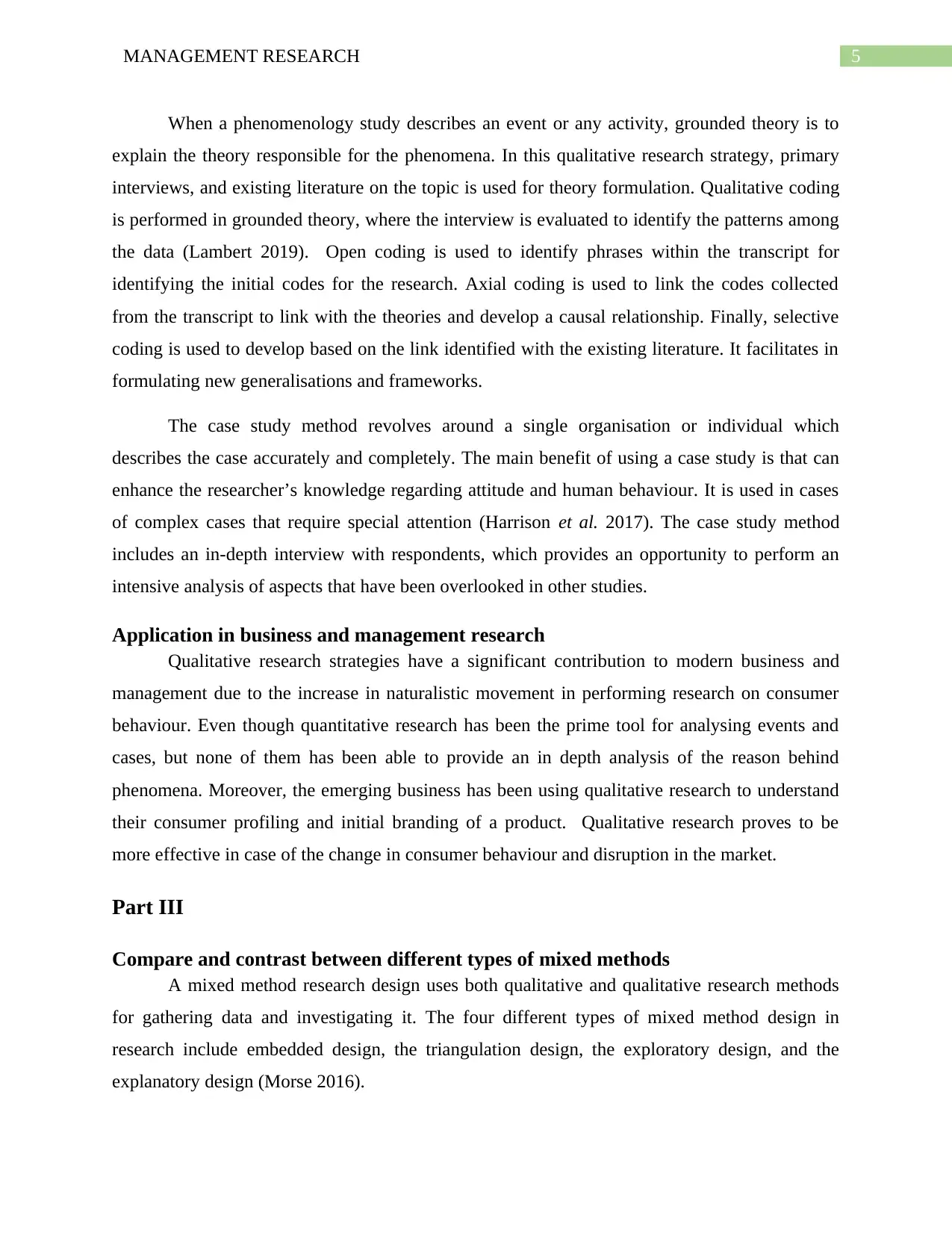
The triangulation design is the most common form of mixed-method research design. The
purpose of this method is to gather complementary data on a particular topic. It facilitates in
developing a better understanding of the research problem. The intent of using this method is to
bring along the non-overlapping weaknesses and strengths of the different quantitative methods
with qualitative methods (Flick 2018). The purpose of using this method is to compare the
findings from quantitative statistical analysis with the in-depth qualitative analysis. It is a one-
phase research design where researches implement both qualitative and quantitative methods
during the same time with equal weightage (Turner, Cardinal and Burton 2017). Therefore, it is
also known as the concurrent triangulation design, where simultaneously qualitative and
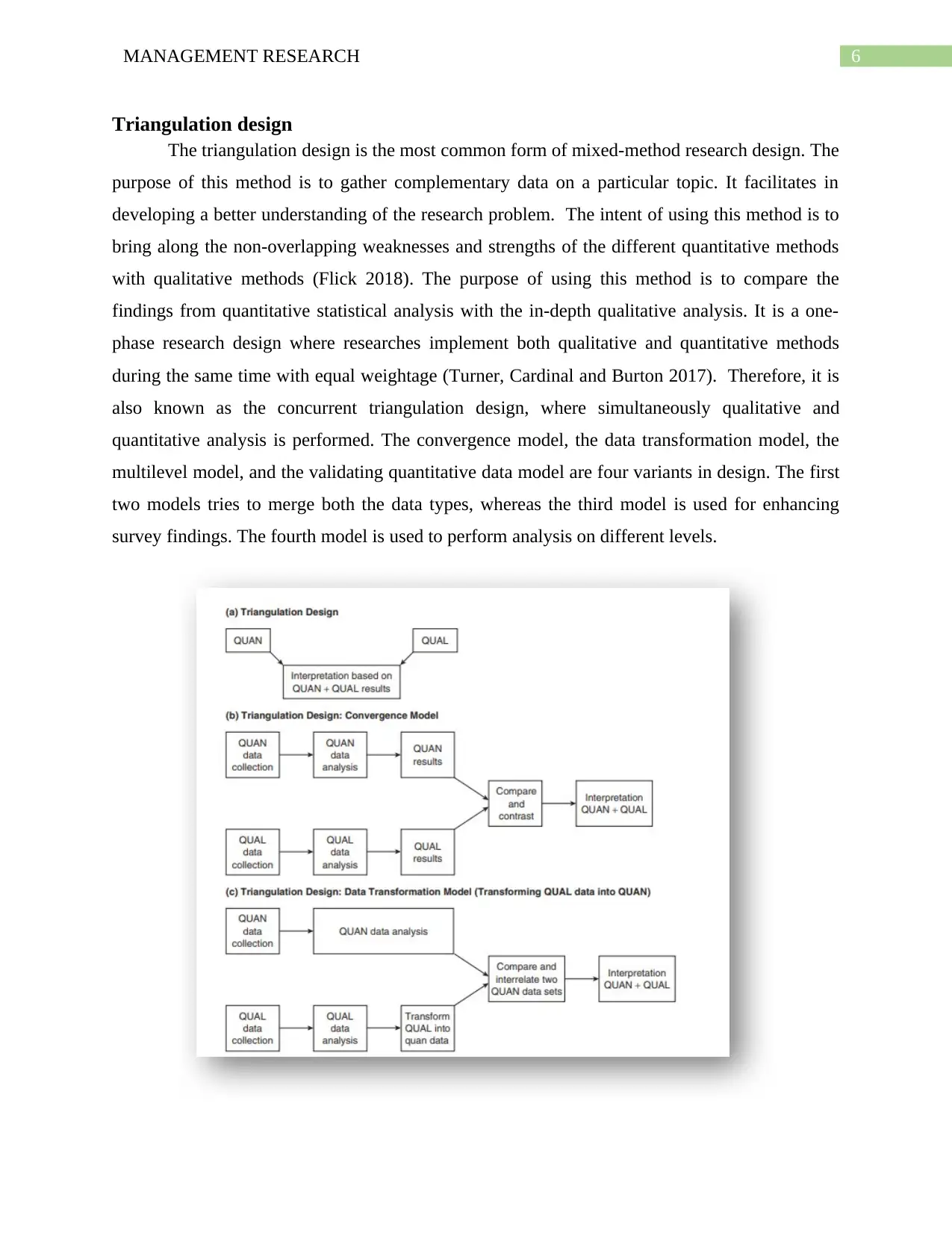
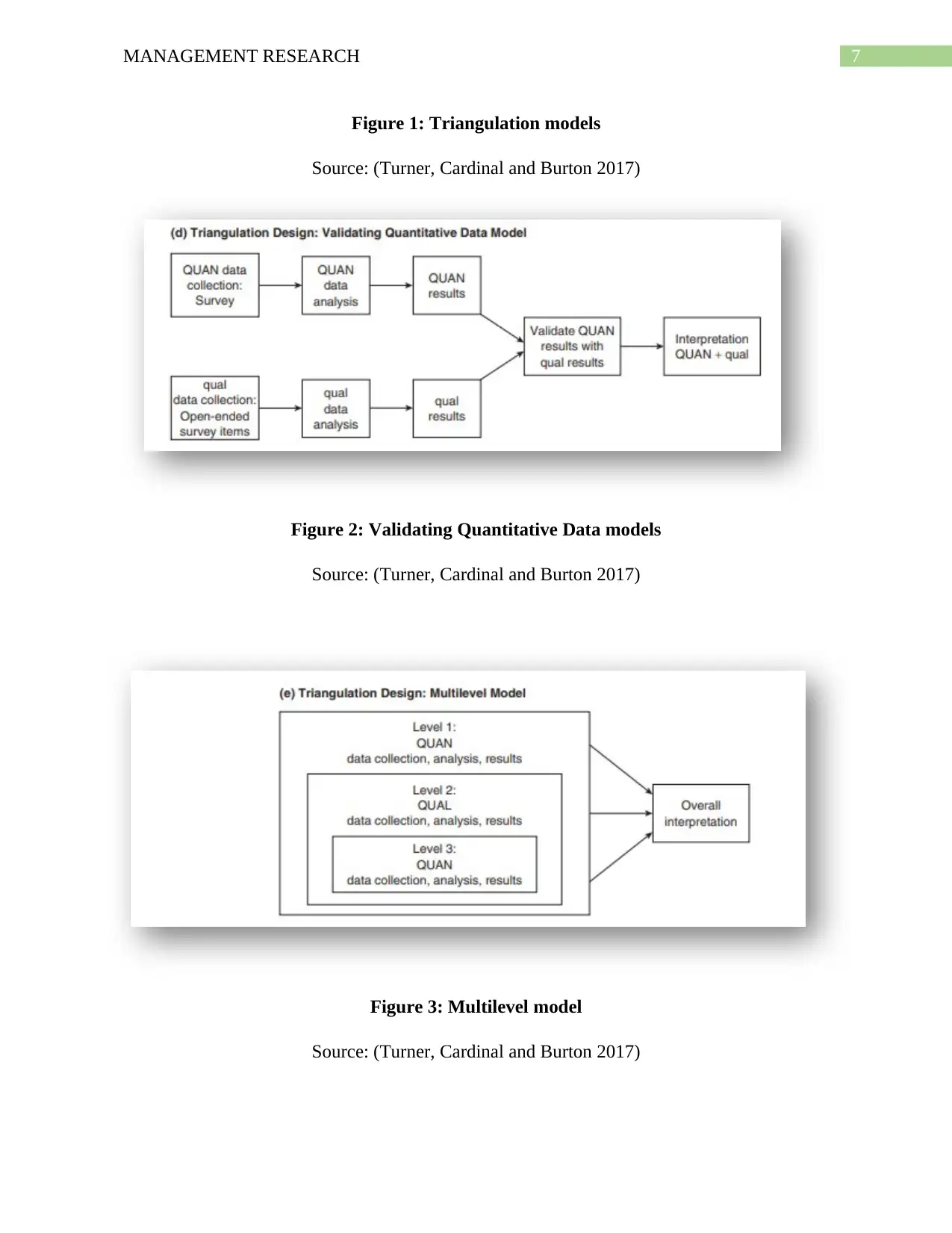
quantitative analysis is performed. The convergence model, the data transformation model, the
multilevel model, and the validating quantitative data model are four variants in design. The first
two models tries to merge both the data types, whereas the third model is used for enhancing
survey findings. The fourth model is used to perform analysis on different levels.
Triangulation design
The triangulation design is the most common form of mixed-method research design. The
purpose of this method is to gather complementary data on a particular topic. It facilitates in
developing a better understanding of the research problem. The intent of using this method is to
bring along the non-overlapping weaknesses and strengths of the different quantitative methods
with qualitative methods (Flick 2018). The purpose of using this method is to compare the
findings from quantitative statistical analysis with the in-depth qualitative analysis. It is a one-
phase research design where researches implement both qualitative and quantitative methods
during the same time with equal weightage (Turner, Cardinal and Burton 2017). Therefore, it is
also known as the concurrent triangulation design, where simultaneously qualitative and
quantitative analysis is performed. The convergence model, the data transformation model, the
multilevel model, and the validating quantitative data model are four variants in design. The first
two models tries to merge both the data types, whereas the third model is used for enhancing
survey findings. The fourth model is used to perform analysis on different levels.
Paraphrase This Document
Need a fresh take? Get an instant paraphrase of this document with our AI Paraphraser
7MANAGEMENT RESEARCH
Figure 1: Triangulation models
Source: (Turner, Cardinal and Burton 2017)
Figure 2: Validating Quantitative Data models
Source: (Turner, Cardinal and Burton 2017)
Figure 3: Multilevel model
Source: (Turner, Cardinal and Burton 2017)
Figure 1: Triangulation models
Source: (Turner, Cardinal and Burton 2017)
Figure 2: Validating Quantitative Data models
Source: (Turner, Cardinal and Burton 2017)
Figure 3: Multilevel model
Source: (Turner, Cardinal and Burton 2017)
8MANAGEMENT RESEARCH
Embedded research design
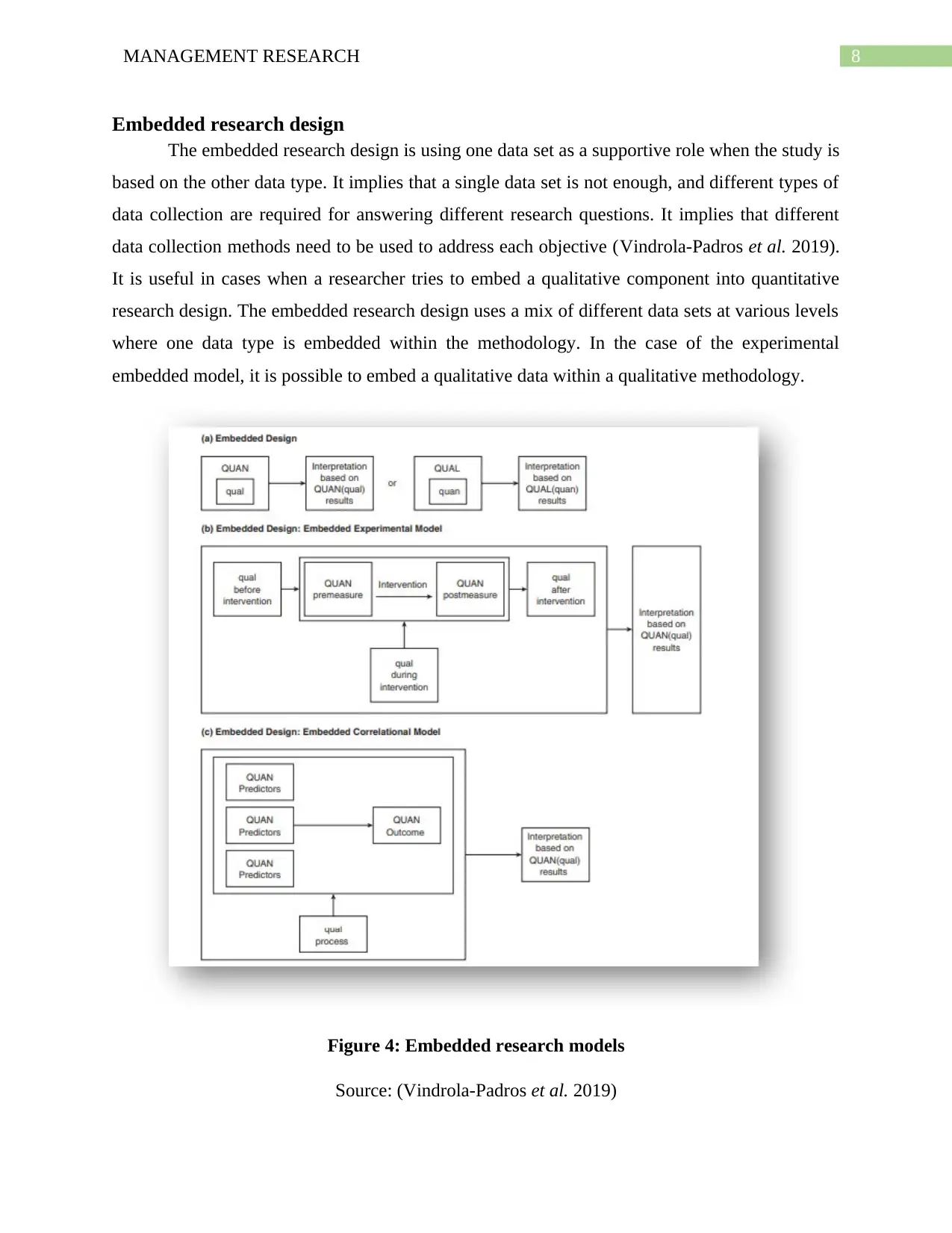
The embedded research design is using one data set as a supportive role when the study is
based on the other data type. It implies that a single data set is not enough, and different types of
data collection are required for answering different research questions. It implies that different
data collection methods need to be used to address each objective (Vindrola-Padros et al. 2019).
It is useful in cases when a researcher tries to embed a qualitative component into quantitative
research design. The embedded research design uses a mix of different data sets at various levels
where one data type is embedded within the methodology. In the case of the experimental
embedded model, it is possible to embed a qualitative data within a qualitative methodology.
Figure 4: Embedded research models
Source: (Vindrola-Padros et al. 2019)
Embedded research design
The embedded research design is using one data set as a supportive role when the study is
based on the other data type. It implies that a single data set is not enough, and different types of
data collection are required for answering different research questions. It implies that different
data collection methods need to be used to address each objective (Vindrola-Padros et al. 2019).
It is useful in cases when a researcher tries to embed a qualitative component into quantitative
research design. The embedded research design uses a mix of different data sets at various levels
where one data type is embedded within the methodology. In the case of the experimental
embedded model, it is possible to embed a qualitative data within a qualitative methodology.
Figure 4: Embedded research models
Source: (Vindrola-Padros et al. 2019)
⊘ This is a preview!⊘
Do you want full access?
Subscribe today to unlock all pages.
Trusted by 1+ million students worldwide
9MANAGEMENT RESEARCH
Explanatory design
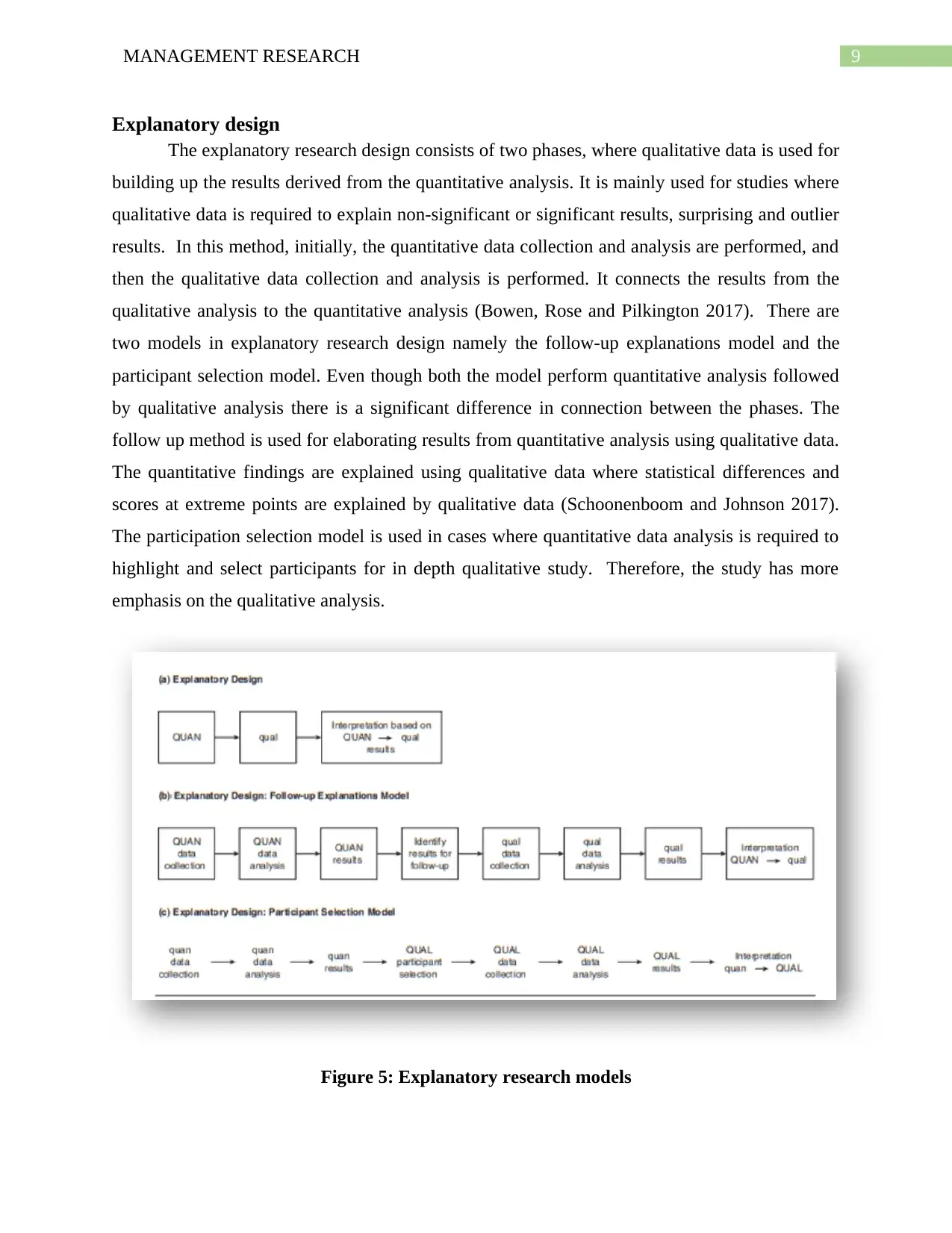
The explanatory research design consists of two phases, where qualitative data is used for
building up the results derived from the quantitative analysis. It is mainly used for studies where
qualitative data is required to explain non-significant or significant results, surprising and outlier
results. In this method, initially, the quantitative data collection and analysis are performed, and
then the qualitative data collection and analysis is performed. It connects the results from the
qualitative analysis to the quantitative analysis (Bowen, Rose and Pilkington 2017). There are
two models in explanatory research design namely the follow-up explanations model and the
participant selection model. Even though both the model perform quantitative analysis followed
by qualitative analysis there is a significant difference in connection between the phases. The
follow up method is used for elaborating results from quantitative analysis using qualitative data.
The quantitative findings are explained using qualitative data where statistical differences and
scores at extreme points are explained by qualitative data (Schoonenboom and Johnson 2017).
The participation selection model is used in cases where quantitative data analysis is required to
highlight and select participants for in depth qualitative study. Therefore, the study has more
emphasis on the qualitative analysis.
Figure 5: Explanatory research models
Explanatory design
The explanatory research design consists of two phases, where qualitative data is used for
building up the results derived from the quantitative analysis. It is mainly used for studies where
qualitative data is required to explain non-significant or significant results, surprising and outlier
results. In this method, initially, the quantitative data collection and analysis are performed, and
then the qualitative data collection and analysis is performed. It connects the results from the
qualitative analysis to the quantitative analysis (Bowen, Rose and Pilkington 2017). There are
two models in explanatory research design namely the follow-up explanations model and the
participant selection model. Even though both the model perform quantitative analysis followed
by qualitative analysis there is a significant difference in connection between the phases. The
follow up method is used for elaborating results from quantitative analysis using qualitative data.
The quantitative findings are explained using qualitative data where statistical differences and
scores at extreme points are explained by qualitative data (Schoonenboom and Johnson 2017).
The participation selection model is used in cases where quantitative data analysis is required to
highlight and select participants for in depth qualitative study. Therefore, the study has more
emphasis on the qualitative analysis.
Figure 5: Explanatory research models
Paraphrase This Document
Need a fresh take? Get an instant paraphrase of this document with our AI Paraphraser
10MANAGEMENT RESEARCH
Source: (Bowen, Rose and Pilkington 2017)
Exploratory Design
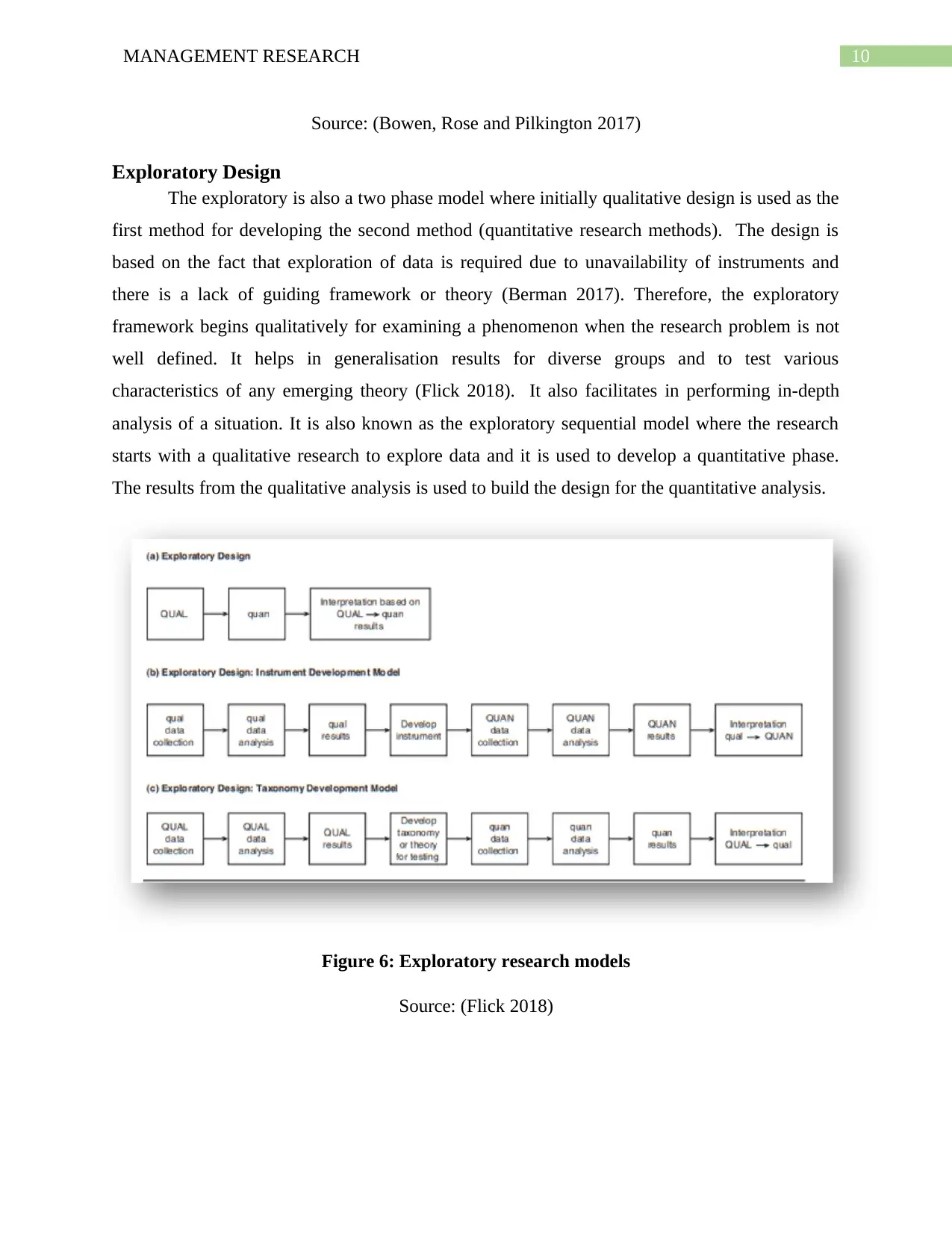
The exploratory is also a two phase model where initially qualitative design is used as the
first method for developing the second method (quantitative research methods). The design is
based on the fact that exploration of data is required due to unavailability of instruments and
there is a lack of guiding framework or theory (Berman 2017). Therefore, the exploratory
framework begins qualitatively for examining a phenomenon when the research problem is not
well defined. It helps in generalisation results for diverse groups and to test various
characteristics of any emerging theory (Flick 2018). It also facilitates in performing in-depth
analysis of a situation. It is also known as the exploratory sequential model where the research
starts with a qualitative research to explore data and it is used to develop a quantitative phase.
The results from the qualitative analysis is used to build the design for the quantitative analysis.
Figure 6: Exploratory research models
Source: (Flick 2018)
Source: (Bowen, Rose and Pilkington 2017)
Exploratory Design
The exploratory is also a two phase model where initially qualitative design is used as the
first method for developing the second method (quantitative research methods). The design is
based on the fact that exploration of data is required due to unavailability of instruments and
there is a lack of guiding framework or theory (Berman 2017). Therefore, the exploratory
framework begins qualitatively for examining a phenomenon when the research problem is not
well defined. It helps in generalisation results for diverse groups and to test various
characteristics of any emerging theory (Flick 2018). It also facilitates in performing in-depth
analysis of a situation. It is also known as the exploratory sequential model where the research
starts with a qualitative research to explore data and it is used to develop a quantitative phase.
The results from the qualitative analysis is used to build the design for the quantitative analysis.
Figure 6: Exploratory research models
Source: (Flick 2018)
11MANAGEMENT RESEARCH
Conclusion
Thus, it can be concluded from the report that systematic literature review is one of the
most effective way of addressing a research question and perform an in-depth analysis which
cannot be addressed by the quantitative study. The different qualitative research strategies have
been described which shows that the emerging business has been using qualitative research to
understand their consumer profiling and initial branding of a product. Mixed method analysis is
one of the most effective ways of addressing the limitations of other research designs where both
qualitative and quantitative methods has been used to perform multi-dimensional studies and link
all the objectives in a research. The different sequences of using mixed method design and the
models have been briefly described to provide a contrast and comparison among them.
Conclusion
Thus, it can be concluded from the report that systematic literature review is one of the
most effective way of addressing a research question and perform an in-depth analysis which
cannot be addressed by the quantitative study. The different qualitative research strategies have
been described which shows that the emerging business has been using qualitative research to
understand their consumer profiling and initial branding of a product. Mixed method analysis is
one of the most effective ways of addressing the limitations of other research designs where both
qualitative and quantitative methods has been used to perform multi-dimensional studies and link
all the objectives in a research. The different sequences of using mixed method design and the
models have been briefly described to provide a contrast and comparison among them.
⊘ This is a preview!⊘
Do you want full access?
Subscribe today to unlock all pages.
Trusted by 1+ million students worldwide

1 out of 14


Related Documents


Your All-in-One AI-Powered Toolkit for Academic Success.
+13062052269
info@desklib.com
Available 24*7 on WhatsApp / Email
![[object Object]](/_next/static/media/star-bottom.7253800d.svg)
Unlock your academic potential
Copyright © 2020–2026 A2Z Services. All Rights Reserved. Developed and managed by ZUCOL.