Report: Analysis of Qualitative Research on MOOC Trends and Patterns
VerifiedAdded on 2022/10/10
|6
|1066
|403
Report
AI Summary
This report analyzes a qualitative research project focusing on trends and patterns in Massive Open Online Courses (MOOCs). The study, based on a literature review, examines the central research question concerning current trends and ancillary questions about the most researched types of MOOCs and cited articles. The research accesses secondary data, including articles on MOOCs, and employs document analysis, involving initial screening, skimming, and detailed analysis of peer-reviewed journals. Content analysis and discourse analysis are used to interpret the data, coding content into relevant themes and categorizing discourses. The results reveal that many research papers failed to describe MOOC types adequately, with most articles relying on conceptual, theoretical, and descriptive methodologies. The study concludes by discussing the implications for learners and highlights the reliability of the results based on in-depth secondary data analysis. The report underscores the project's appropriate methodology and reliable findings, which can be useful in understanding the perspectives of authors related to MOOCs.

Running Head: Qualitative Research
QUALITATIVE RESEARCH
Paraphrase This Document
Need a fresh take? Get an instant paraphrase of this document with our AI Paraphraser

2
Qualitative Research
Table of Contents
1. Central question and any ancillary question................................................................................3
2. Types of accessed data.................................................................................................................3
3. Method of data collection............................................................................................................3
4. Interpretation of data....................................................................................................................4
5. Results..........................................................................................................................................5
Reference list...................................................................................................................................6
Qualitative Research
Table of Contents
1. Central question and any ancillary question................................................................................3
2. Types of accessed data.................................................................................................................3
3. Method of data collection............................................................................................................3
4. Interpretation of data....................................................................................................................4
5. Results..........................................................................................................................................5
Reference list...................................................................................................................................6

3
Qualitative Research
1. Central question and any ancillary question
There are some research questions in this study that were formulated to achieve the aim.
Main research question is regarding the latest trends in research areas. In addition, other ancillary
questions were framed. Questions about most researched types of MOOCs (Massive Open
Online Courses) and about articles that are cited in paper about MOOCs.
2. Types of accessed data
In case of this research paper, secondary data has been accessed and analyzed with proper
method. According to Johnston (2017), collection and review of secondary data help researchers
to analyze different aspects related to research topic. In this case, secondary data related to the
research topic has been selected. This secondary data has helped in understanding the concept of
MOOC. Articles on MOOC and related aspects have been considered as relevant for this
research project. Aim of selecting this type of data was to understand potential issues related to
the topic and possible solutions to each topic.
3. Method of data collection
In this study, document analysis was adopted to collect data and gain valid answers to
research questions. Document analysis is a process that involves skimming of relevant articles,
which is followed by reading and interpretation (Bretschneider, Cirilli, Jones, Lynch, & Wilson,
2017). During initial screening process, a total of 888 papers were chosen. After conducting the
skimming process a total of 526 articles were found irrelevant. After this process, 362 articles,
which were published as peer-reviewed journals were considered for conducting the data
Qualitative Research
1. Central question and any ancillary question
There are some research questions in this study that were formulated to achieve the aim.
Main research question is regarding the latest trends in research areas. In addition, other ancillary
questions were framed. Questions about most researched types of MOOCs (Massive Open
Online Courses) and about articles that are cited in paper about MOOCs.
2. Types of accessed data
In case of this research paper, secondary data has been accessed and analyzed with proper
method. According to Johnston (2017), collection and review of secondary data help researchers
to analyze different aspects related to research topic. In this case, secondary data related to the
research topic has been selected. This secondary data has helped in understanding the concept of
MOOC. Articles on MOOC and related aspects have been considered as relevant for this
research project. Aim of selecting this type of data was to understand potential issues related to
the topic and possible solutions to each topic.
3. Method of data collection
In this study, document analysis was adopted to collect data and gain valid answers to
research questions. Document analysis is a process that involves skimming of relevant articles,
which is followed by reading and interpretation (Bretschneider, Cirilli, Jones, Lynch, & Wilson,
2017). During initial screening process, a total of 888 papers were chosen. After conducting the
skimming process a total of 526 articles were found irrelevant. After this process, 362 articles,
which were published as peer-reviewed journals were considered for conducting the data
⊘ This is a preview!⊘
Do you want full access?
Subscribe today to unlock all pages.

Trusted by 1+ million students worldwide

4
Qualitative Research
collection process. In those articles, different methods like qualitative and quantitative analysis
were done.
Analysis of documents incorporated coding the content into various relevant themes. Use
of coding is also done in data collection process through a focus group or by interview. The
process of document analysis is chosen because it helps in saving valuable resources like time
and money. Different relevant data has been collected from previous researchers, which has
helped to gain desired objectives.
4. Interpretation of data
After this, the researchers have adopted the technique of content analysis that has helped
them to analyze the elected papers properly and collect relevant data that can help to achieve
desired objectives. As opined by Neuendorf (2016), content analysis helps researchers to gain
information about a study topic by proper interpretation and coding of textual materials. Coding
was also used to divide the data according to different preset categories. This has helped in
sorting of data and loss of data has been prevented. After choosing 326 articles, the researchers
made valid and replicable inferences that are relevant to their context. These articles were coded
on the basis of basic rules of coding that is relevant to the purpose of research. The results were
reported by using different graphs and proper descriptive analysis.
Moreover, discourse analysis was adopted to analyze different perspectives and views in
the collected text. For accomplishing this purpose, the conclusion sections were coded according
to different predetermined categories. Different negative, positive and neutral discourses are
Qualitative Research
collection process. In those articles, different methods like qualitative and quantitative analysis
were done.
Analysis of documents incorporated coding the content into various relevant themes. Use
of coding is also done in data collection process through a focus group or by interview. The
process of document analysis is chosen because it helps in saving valuable resources like time
and money. Different relevant data has been collected from previous researchers, which has
helped to gain desired objectives.
4. Interpretation of data
After this, the researchers have adopted the technique of content analysis that has helped
them to analyze the elected papers properly and collect relevant data that can help to achieve
desired objectives. As opined by Neuendorf (2016), content analysis helps researchers to gain
information about a study topic by proper interpretation and coding of textual materials. Coding
was also used to divide the data according to different preset categories. This has helped in
sorting of data and loss of data has been prevented. After choosing 326 articles, the researchers
made valid and replicable inferences that are relevant to their context. These articles were coded
on the basis of basic rules of coding that is relevant to the purpose of research. The results were
reported by using different graphs and proper descriptive analysis.
Moreover, discourse analysis was adopted to analyze different perspectives and views in
the collected text. For accomplishing this purpose, the conclusion sections were coded according
to different predetermined categories. Different negative, positive and neutral discourses are
Paraphrase This Document
Need a fresh take? Get an instant paraphrase of this document with our AI Paraphraser

5
Qualitative Research
categorized that has helped in finding the relationship between the document and underlying
message.
5. Results
Result of this paper has been drawn from the analysis of the data. The result has been
revealed that many of the research papers failed to describe different types of MOOCs. They
have gone out of focus and due to this reason, those papers are not appropriate for review.
Discourse analysis has helped in understanding negative, neutral and positive approaches of
selected articles. It has been found that most of the articles are relying on conceptual, theoretical
and descriptive methodology. It means that most of the researchers believe that qualitative
methodology is more efficient than quantitative. This qualitative research project may help in
understanding the perspective of authors related to MOOC.
The result of this article is believable as an in-depth analysis of secondary data has helped
in drawing the result. Research trends and process regarding MOOC has been reviewed properly.
Reason behind every methodology used in previous research papers has been reviewed properly.
In addition, the result of this paper has mentioned three implications of this topic on learners.
This qualitative research project has been completed with an appropriate methodology. The
process of collecting and sorting of secondary data has helped in getting authentic information
regarding MOOC. Scope for further research can be understood clearly after reviewing the
results of this study. Hence, it can be stated that the results of this research project are reliable
and this research paper can be considered as a good example of literature-review based
qualitative paper of research.
Qualitative Research
categorized that has helped in finding the relationship between the document and underlying
message.
5. Results
Result of this paper has been drawn from the analysis of the data. The result has been
revealed that many of the research papers failed to describe different types of MOOCs. They
have gone out of focus and due to this reason, those papers are not appropriate for review.
Discourse analysis has helped in understanding negative, neutral and positive approaches of
selected articles. It has been found that most of the articles are relying on conceptual, theoretical
and descriptive methodology. It means that most of the researchers believe that qualitative
methodology is more efficient than quantitative. This qualitative research project may help in
understanding the perspective of authors related to MOOC.
The result of this article is believable as an in-depth analysis of secondary data has helped
in drawing the result. Research trends and process regarding MOOC has been reviewed properly.
Reason behind every methodology used in previous research papers has been reviewed properly.
In addition, the result of this paper has mentioned three implications of this topic on learners.
This qualitative research project has been completed with an appropriate methodology. The
process of collecting and sorting of secondary data has helped in getting authentic information
regarding MOOC. Scope for further research can be understood clearly after reviewing the
results of this study. Hence, it can be stated that the results of this research project are reliable
and this research paper can be considered as a good example of literature-review based
qualitative paper of research.

6
Qualitative Research
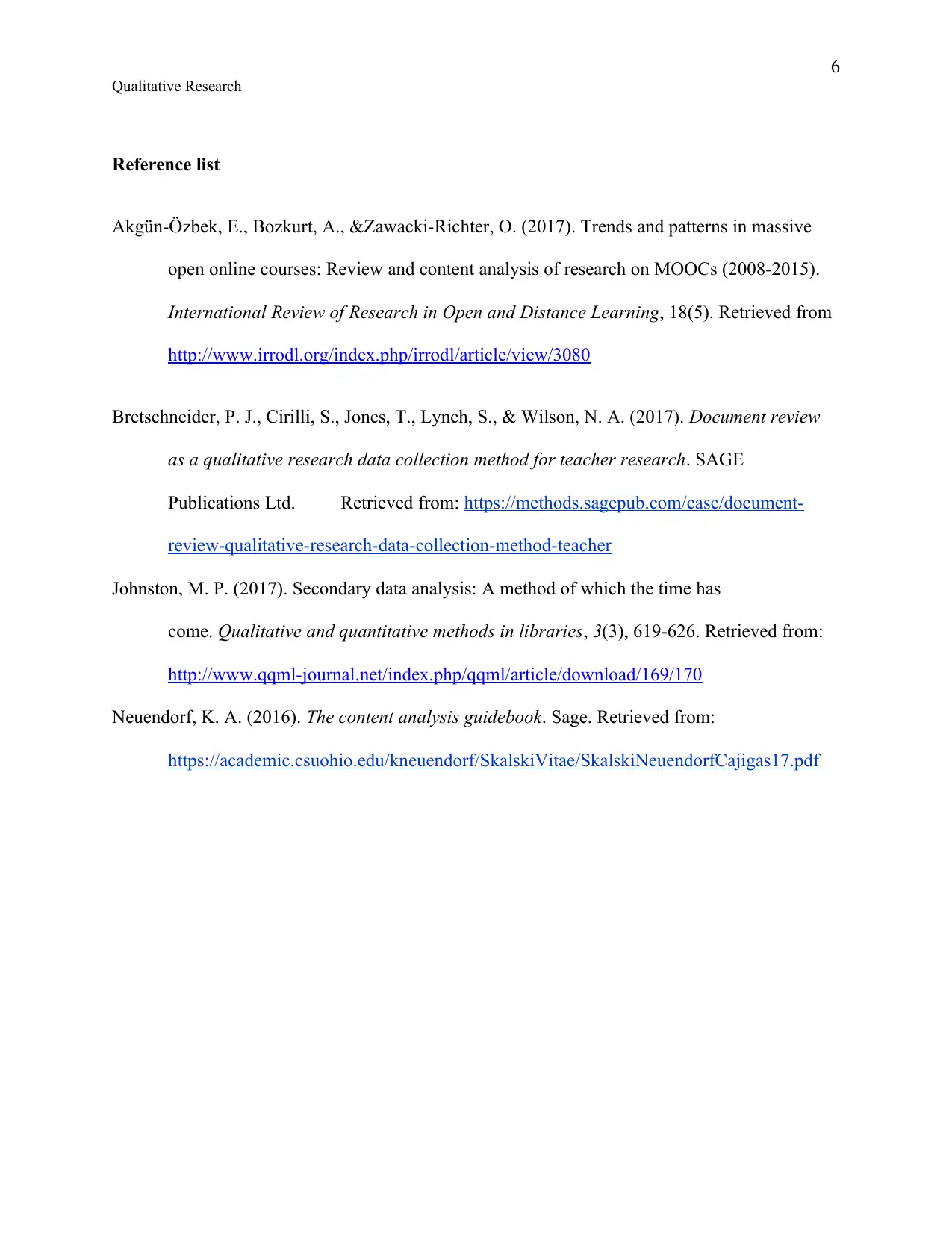
Reference list
Akgün-Özbek, E., Bozkurt, A., &Zawacki-Richter, O. (2017). Trends and patterns in massive
open online courses: Review and content analysis of research on MOOCs (2008-2015).
International Review of Research in Open and Distance Learning, 18(5). Retrieved from
http://www.irrodl.org/index.php/irrodl/article/view/3080
Bretschneider, P. J., Cirilli, S., Jones, T., Lynch, S., & Wilson, N. A. (2017). Document review
as a qualitative research data collection method for teacher research. SAGE
Publications Ltd. Retrieved from: https://methods.sagepub.com/case/document-
review-qualitative-research-data-collection-method-teacher
Johnston, M. P. (2017). Secondary data analysis: A method of which the time has
come. Qualitative and quantitative methods in libraries, 3(3), 619-626. Retrieved from:
http://www.qqml-journal.net/index.php/qqml/article/download/169/170
Neuendorf, K. A. (2016). The content analysis guidebook. Sage. Retrieved from:
https://academic.csuohio.edu/kneuendorf/SkalskiVitae/SkalskiNeuendorfCajigas17.pdf
Qualitative Research
Reference list
Akgün-Özbek, E., Bozkurt, A., &Zawacki-Richter, O. (2017). Trends and patterns in massive
open online courses: Review and content analysis of research on MOOCs (2008-2015).
International Review of Research in Open and Distance Learning, 18(5). Retrieved from
http://www.irrodl.org/index.php/irrodl/article/view/3080
Bretschneider, P. J., Cirilli, S., Jones, T., Lynch, S., & Wilson, N. A. (2017). Document review
as a qualitative research data collection method for teacher research. SAGE
Publications Ltd. Retrieved from: https://methods.sagepub.com/case/document-
review-qualitative-research-data-collection-method-teacher
Johnston, M. P. (2017). Secondary data analysis: A method of which the time has
come. Qualitative and quantitative methods in libraries, 3(3), 619-626. Retrieved from:
http://www.qqml-journal.net/index.php/qqml/article/download/169/170
Neuendorf, K. A. (2016). The content analysis guidebook. Sage. Retrieved from:
https://academic.csuohio.edu/kneuendorf/SkalskiVitae/SkalskiNeuendorfCajigas17.pdf
⊘ This is a preview!⊘
Do you want full access?
Subscribe today to unlock all pages.

Trusted by 1+ million students worldwide
1 out of 6
Related Documents
Your All-in-One AI-Powered Toolkit for Academic Success.
+13062052269
info@desklib.com
Available 24*7 on WhatsApp / Email
Unlock your academic potential
Copyright © 2020–2025 A2Z Services. All Rights Reserved. Developed and managed by ZUCOL.