Reflective Nursing Essay: Qualitative vs. Quantitative Study

Verified

Added on  2022/10/10

|4
|601
|398
Essay
AI Summary
This essay delves into the advantages of qualitative research over quantitative methods within the context of a nursing study. It analyzes Tourigny's (1998) research on HIV/AIDS, which employed a qualitative approach to understand the motivations of individuals from a poor socio-economic background who deliberately sought HIV exposure. The essay highlights how qualitative research, through methods like in-home interviews, provides richer and more nuanced data compared to quantitative approaches. It emphasizes the importance of context, flexibility in sampling, and the ability to capture complex behaviors and motivations, which are crucial for improving healthcare outcomes and understanding the socio-economic factors influencing health risks. The essay also discusses the implications of the research, particularly in relation to the cultural, racial, and economic factors that contribute to the spread of HIV/AIDS. The essay concludes by emphasizing the importance of qualitative research in providing a deeper understanding of healthcare issues and improving the quality of care within targeted populations.

Document Page
Running head: REFLECTIVE NURSING
Reflective Nursing
Student name:
Student ID:
Author’s name:
tabler-icon-diamond-filled.svg

Paraphrase This Document

Need a fresh take? Get an instant paraphrase of this document with our AI Paraphraser
Document Page
REFLECTIVE NURSING
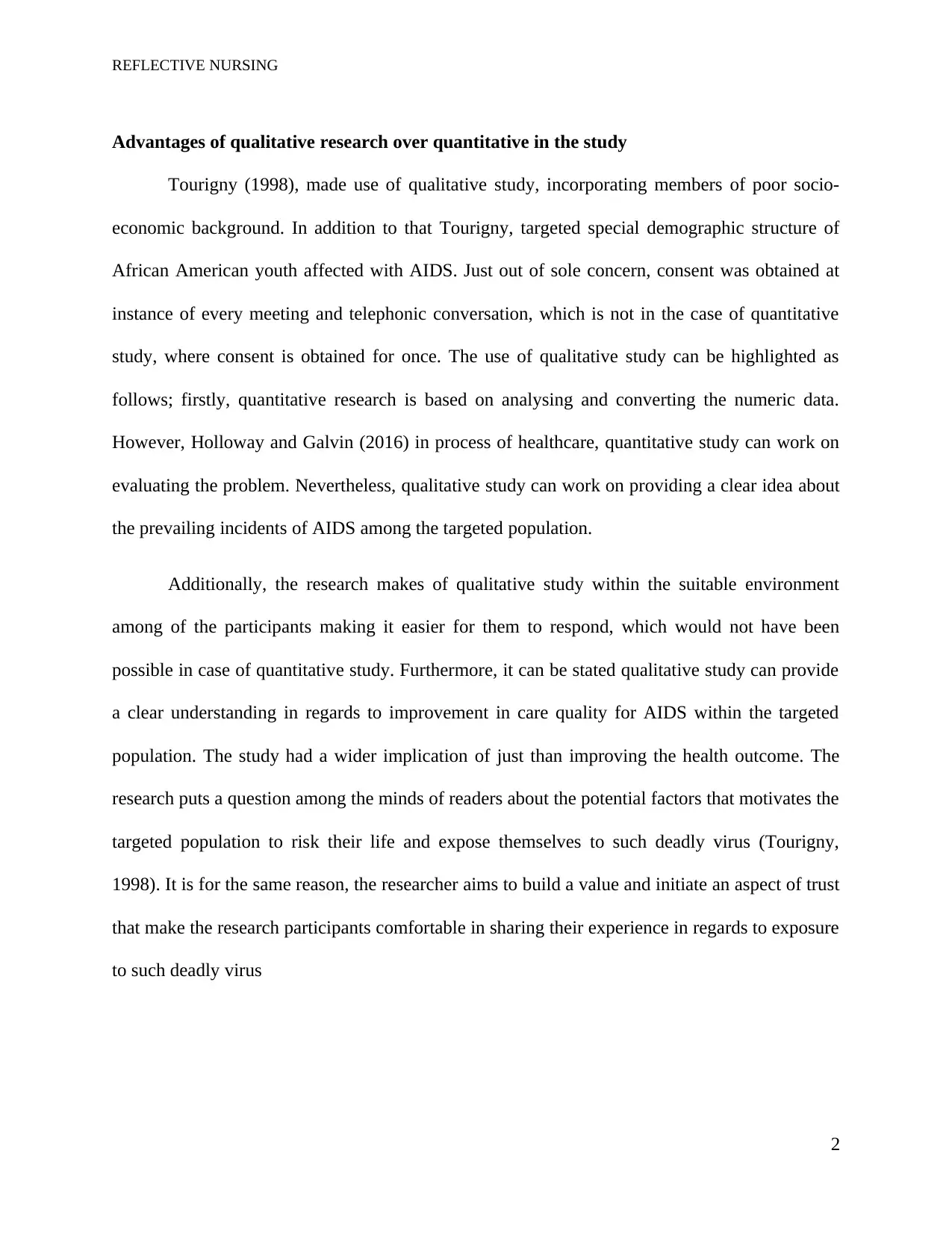
Advantages of qualitative research over quantitative in the study
Tourigny (1998), made use of qualitative study, incorporating members of poor socio-
economic background. In addition to that Tourigny, targeted special demographic structure of
African American youth affected with AIDS. Just out of sole concern, consent was obtained at
instance of every meeting and telephonic conversation, which is not in the case of quantitative
study, where consent is obtained for once. The use of qualitative study can be highlighted as
follows; firstly, quantitative research is based on analysing and converting the numeric data.
However, Holloway and Galvin (2016) in process of healthcare, quantitative study can work on
evaluating the problem. Nevertheless, qualitative study can work on providing a clear idea about
the prevailing incidents of AIDS among the targeted population.
Additionally, the research makes of qualitative study within the suitable environment
among of the participants making it easier for them to respond, which would not have been
possible in case of quantitative study. Furthermore, it can be stated qualitative study can provide
a clear understanding in regards to improvement in care quality for AIDS within the targeted
population. The study had a wider implication of just than improving the health outcome. The
research puts a question among the minds of readers about the potential factors that motivates the
targeted population to risk their life and expose themselves to such deadly virus (Tourigny,
1998). It is for the same reason, the researcher aims to build a value and initiate an aspect of trust
that make the research participants comfortable in sharing their experience in regards to exposure
to such deadly virus
2
Document Page
REFLECTIVE NURSING
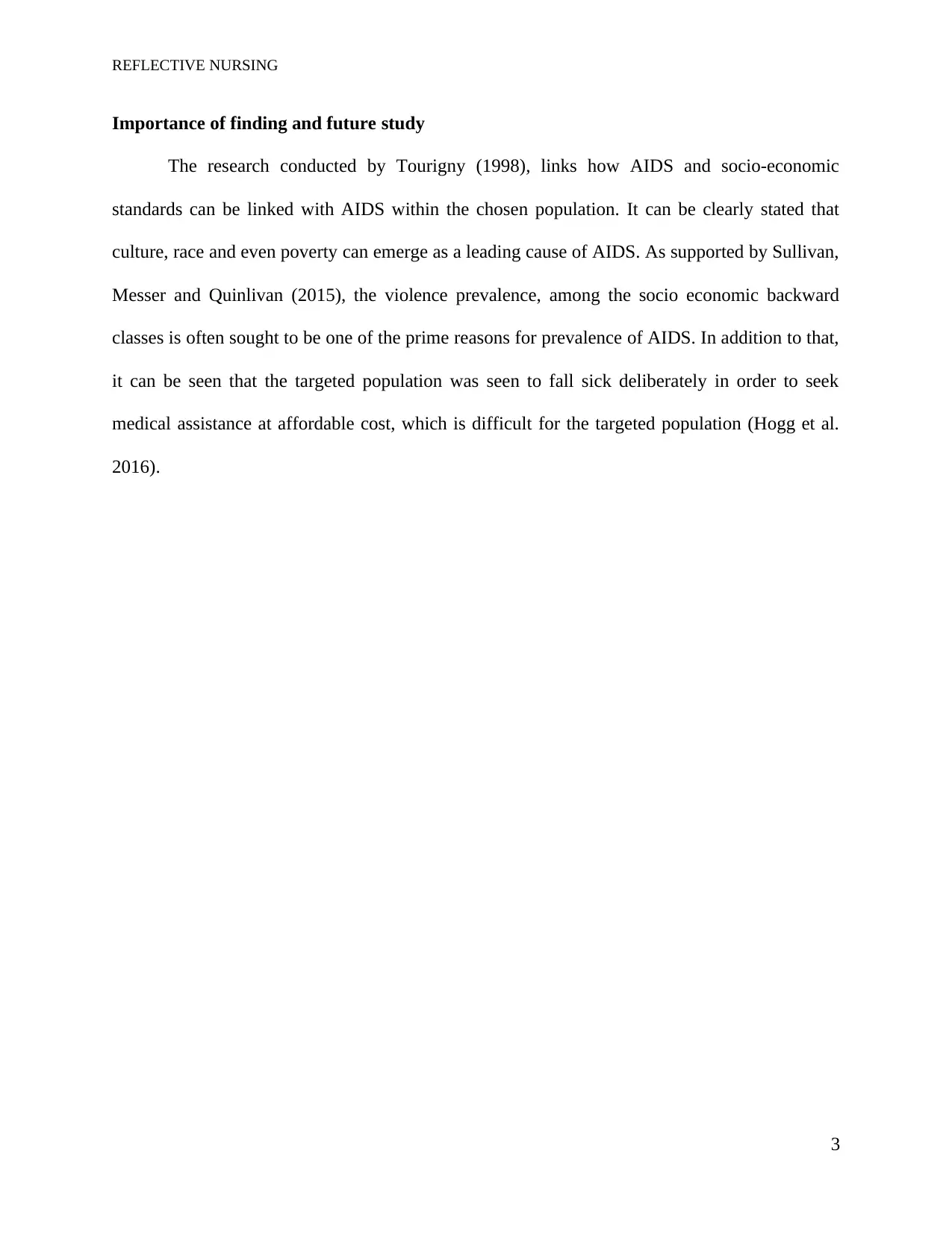
Importance of finding and future study
The research conducted by Tourigny (1998), links how AIDS and socio-economic
standards can be linked with AIDS within the chosen population. It can be clearly stated that
culture, race and even poverty can emerge as a leading cause of AIDS. As supported by Sullivan,
Messer and Quinlivan (2015), the violence prevalence, among the socio economic backward
classes is often sought to be one of the prime reasons for prevalence of AIDS. In addition to that,
it can be seen that the targeted population was seen to fall sick deliberately in order to seek
medical assistance at affordable cost, which is difficult for the targeted population (Hogg et al.
2016).
3
Document Page
REFLECTIVE NURSING
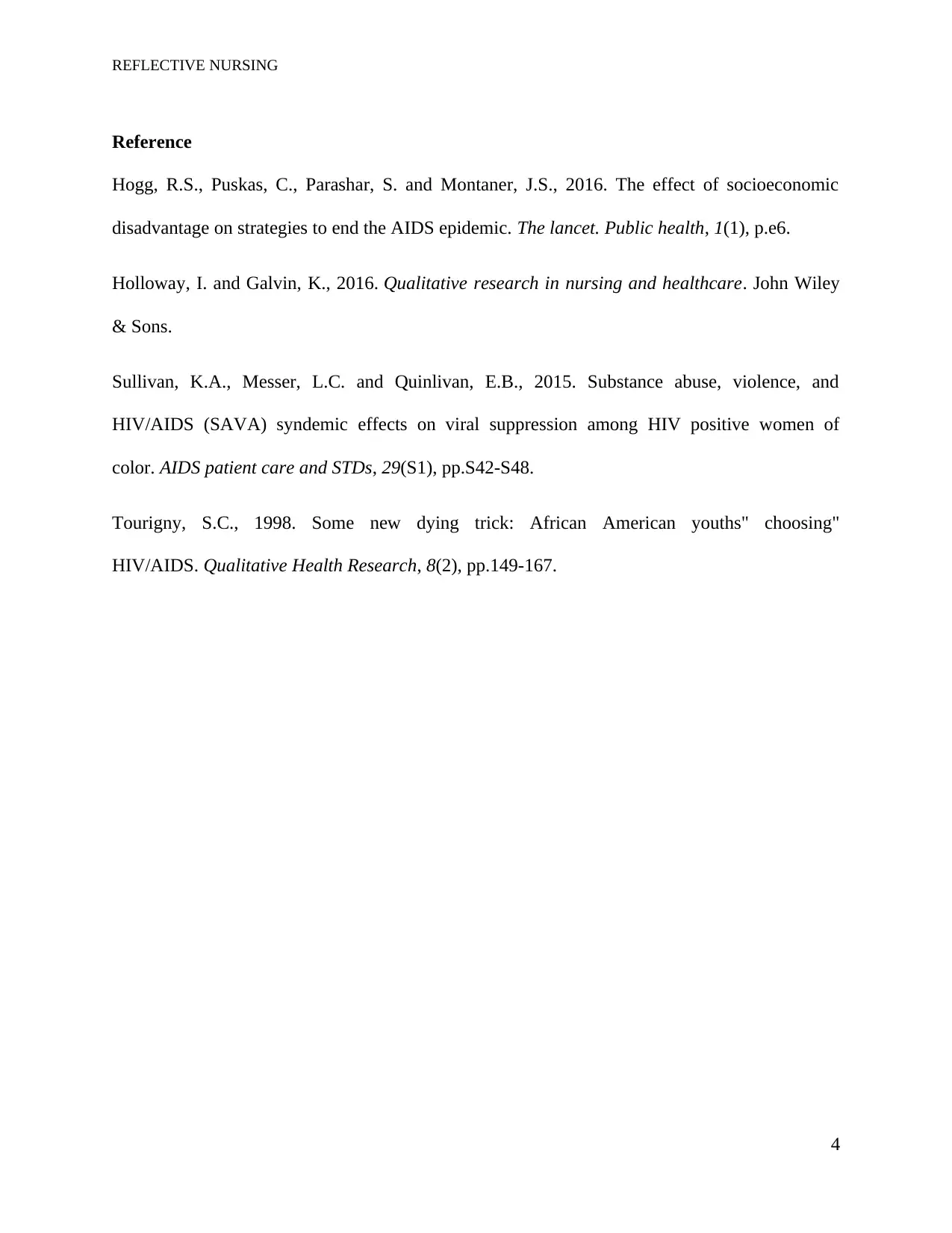
Reference
Hogg, R.S., Puskas, C., Parashar, S. and Montaner, J.S., 2016. The effect of socioeconomic
disadvantage on strategies to end the AIDS epidemic. The lancet. Public health, 1(1), p.e6.
Holloway, I. and Galvin, K., 2016. Qualitative research in nursing and healthcare. John Wiley
& Sons.
Sullivan, K.A., Messer, L.C. and Quinlivan, E.B., 2015. Substance abuse, violence, and
HIV/AIDS (SAVA) syndemic effects on viral suppression among HIV positive women of
color. AIDS patient care and STDs, 29(S1), pp.S42-S48.
Tourigny, S.C., 1998. Some new dying trick: African American youths" choosing"
HIV/AIDS. Qualitative Health Research, 8(2), pp.149-167.
4
chevron_up_icon
1 out of 4
circle_padding
hide_on_mobile
zoom_out_icon
[object Object]