Qualitative Research Methods: Application in Social Science
VerifiedAdded on 2023/06/18
|7
|1709
|269
Essay
AI Summary
This essay provides an overview of qualitative research methods in social science, highlighting their importance in understanding human behavior and social phenomena. It discusses various qualitative research methods, including the inductive research approach, data collection methods like interviews, observations, and case studies, and data analysis techniques such as thematic analysis, narrative analysis, and grounded theory. The essay also examines the strengths and weaknesses of these methods, emphasizing their role in gaining in-depth insights into social issues. The study concludes that qualitative research is a hallmark in the field of social science due to its ability to capture the perspectives and viewpoints of individuals and groups, ultimately contributing to a more profound understanding of the social world.
Qualitative research methods
in the social sciences
Paraphrase This Document
Need a fresh take? Get an instant paraphrase of this document with our AI Paraphraser

TABLE OF CONTENTS
INTRODUCTION...........................................................................................................................3
MAIN BODY...................................................................................................................................3
CONCLUSION................................................................................................................................5
REFERENCES................................................................................................................................7
INTRODUCTION...........................................................................................................................3
MAIN BODY...................................................................................................................................3
CONCLUSION................................................................................................................................5
REFERENCES................................................................................................................................7

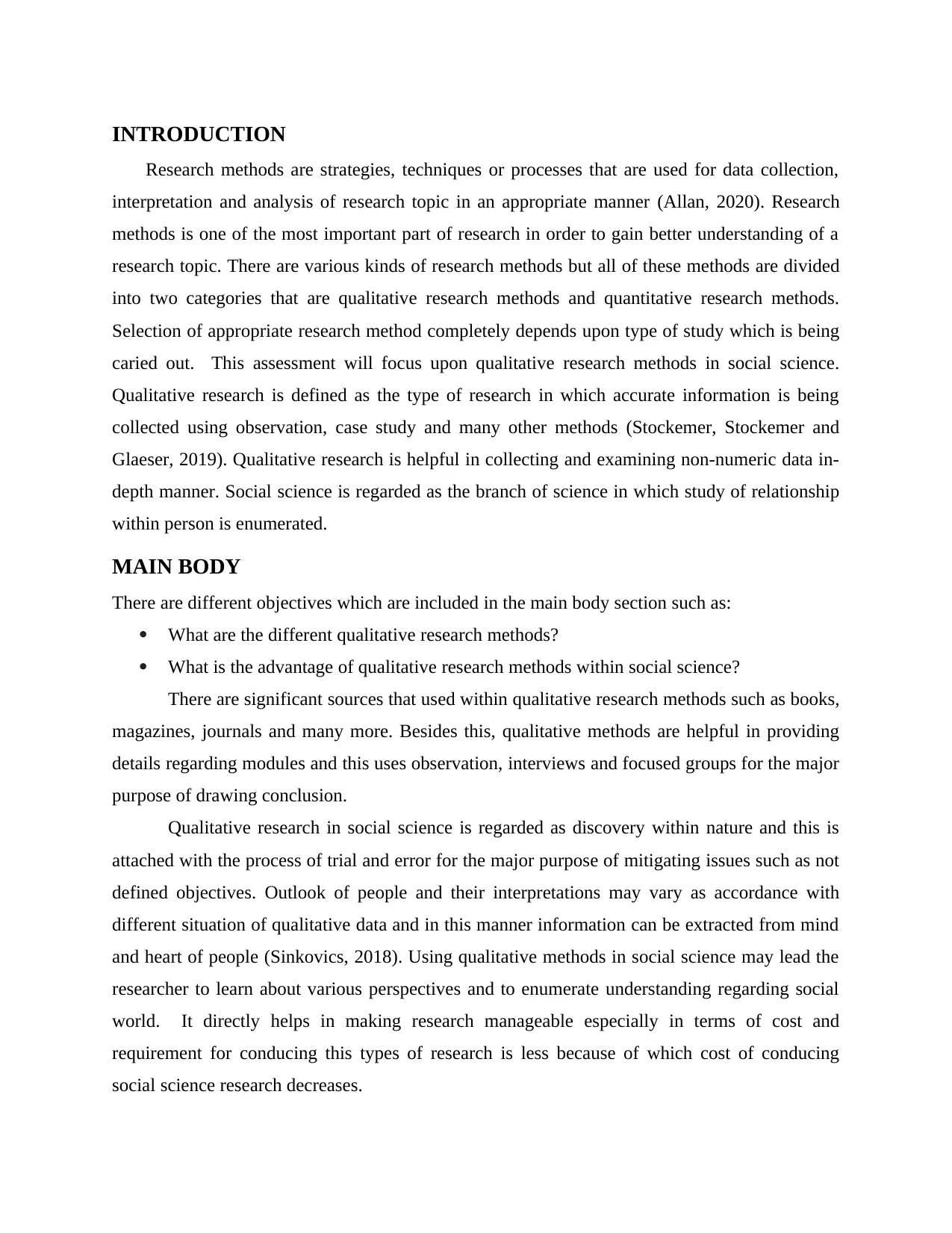
INTRODUCTION
Research methods are strategies, techniques or processes that are used for data collection,
interpretation and analysis of research topic in an appropriate manner (Allan, 2020). Research
methods is one of the most important part of research in order to gain better understanding of a
research topic. There are various kinds of research methods but all of these methods are divided
into two categories that are qualitative research methods and quantitative research methods.
Selection of appropriate research method completely depends upon type of study which is being
caried out. This assessment will focus upon qualitative research methods in social science.
Qualitative research is defined as the type of research in which accurate information is being
collected using observation, case study and many other methods (Stockemer, Stockemer and
Glaeser, 2019). Qualitative research is helpful in collecting and examining non-numeric data in-
depth manner. Social science is regarded as the branch of science in which study of relationship
within person is enumerated.
MAIN BODY
There are different objectives which are included in the main body section such as:
What are the different qualitative research methods?
What is the advantage of qualitative research methods within social science?
There are significant sources that used within qualitative research methods such as books,
magazines, journals and many more. Besides this, qualitative methods are helpful in providing
details regarding modules and this uses observation, interviews and focused groups for the major
purpose of drawing conclusion.
Qualitative research in social science is regarded as discovery within nature and this is
attached with the process of trial and error for the major purpose of mitigating issues such as not
defined objectives. Outlook of people and their interpretations may vary as accordance with
different situation of qualitative data and in this manner information can be extracted from mind
and heart of people (Sinkovics, 2018). Using qualitative methods in social science may lead the
researcher to learn about various perspectives and to enumerate understanding regarding social
world. It directly helps in making research manageable especially in terms of cost and
requirement for conducing this types of research is less because of which cost of conducing
social science research decreases.
Research methods are strategies, techniques or processes that are used for data collection,
interpretation and analysis of research topic in an appropriate manner (Allan, 2020). Research
methods is one of the most important part of research in order to gain better understanding of a
research topic. There are various kinds of research methods but all of these methods are divided
into two categories that are qualitative research methods and quantitative research methods.
Selection of appropriate research method completely depends upon type of study which is being
caried out. This assessment will focus upon qualitative research methods in social science.
Qualitative research is defined as the type of research in which accurate information is being
collected using observation, case study and many other methods (Stockemer, Stockemer and
Glaeser, 2019). Qualitative research is helpful in collecting and examining non-numeric data in-
depth manner. Social science is regarded as the branch of science in which study of relationship
within person is enumerated.
MAIN BODY
There are different objectives which are included in the main body section such as:
What are the different qualitative research methods?
What is the advantage of qualitative research methods within social science?
There are significant sources that used within qualitative research methods such as books,
magazines, journals and many more. Besides this, qualitative methods are helpful in providing
details regarding modules and this uses observation, interviews and focused groups for the major
purpose of drawing conclusion.
Qualitative research in social science is regarded as discovery within nature and this is
attached with the process of trial and error for the major purpose of mitigating issues such as not
defined objectives. Outlook of people and their interpretations may vary as accordance with
different situation of qualitative data and in this manner information can be extracted from mind
and heart of people (Sinkovics, 2018). Using qualitative methods in social science may lead the
researcher to learn about various perspectives and to enumerate understanding regarding social
world. It directly helps in making research manageable especially in terms of cost and
requirement for conducing this types of research is less because of which cost of conducing
social science research decreases.
⊘ This is a preview!⊘
Do you want full access?
Subscribe today to unlock all pages.

Trusted by 1+ million students worldwide

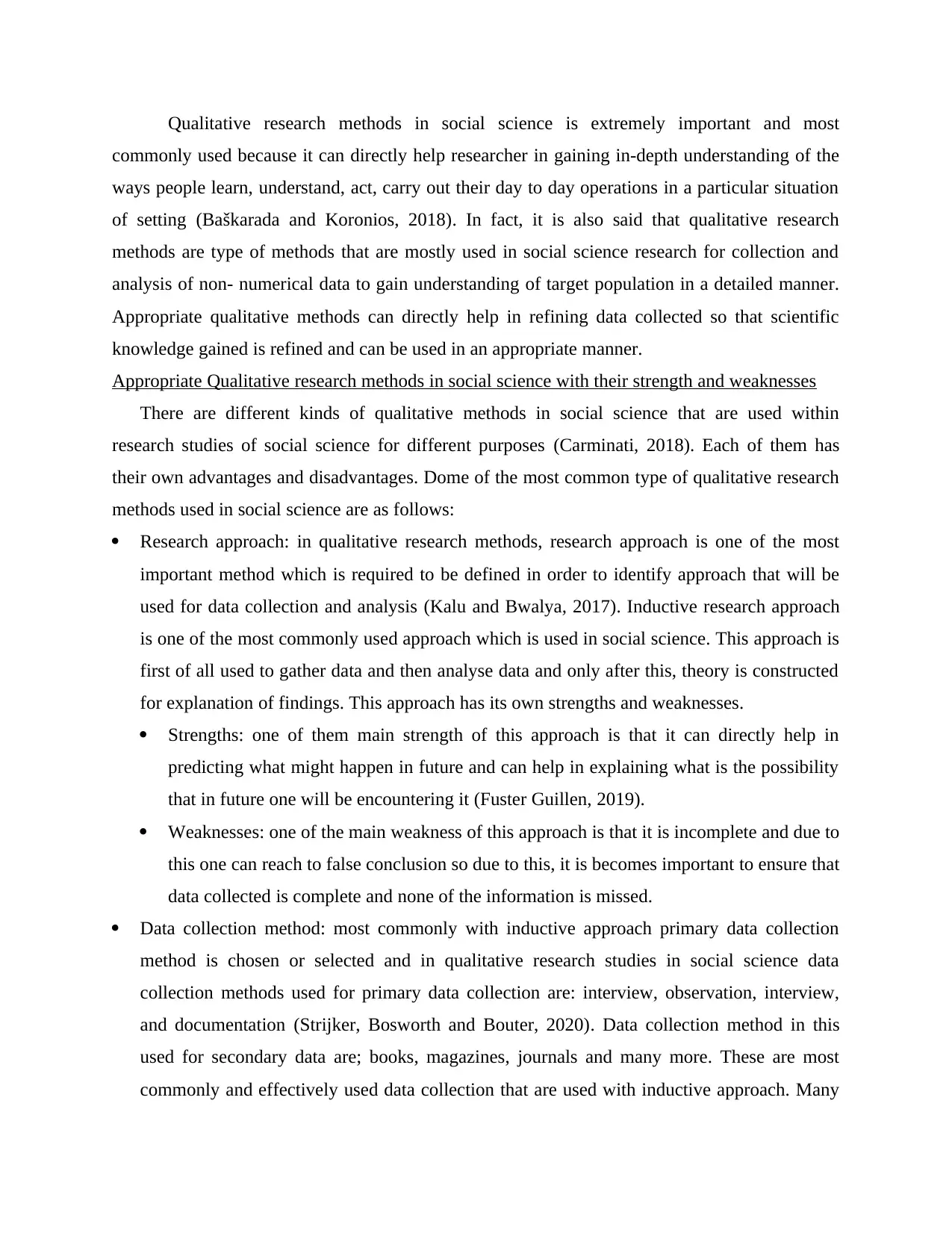
Qualitative research methods in social science is extremely important and most
commonly used because it can directly help researcher in gaining in-depth understanding of the
ways people learn, understand, act, carry out their day to day operations in a particular situation
of setting (Baškarada and Koronios, 2018). In fact, it is also said that qualitative research
methods are type of methods that are mostly used in social science research for collection and
analysis of non- numerical data to gain understanding of target population in a detailed manner.
Appropriate qualitative methods can directly help in refining data collected so that scientific
knowledge gained is refined and can be used in an appropriate manner.
Appropriate Qualitative research methods in social science with their strength and weaknesses
There are different kinds of qualitative methods in social science that are used within
research studies of social science for different purposes (Carminati, 2018). Each of them has
their own advantages and disadvantages. Dome of the most common type of qualitative research
methods used in social science are as follows:
Research approach: in qualitative research methods, research approach is one of the most
important method which is required to be defined in order to identify approach that will be
used for data collection and analysis (Kalu and Bwalya, 2017). Inductive research approach
is one of the most commonly used approach which is used in social science. This approach is
first of all used to gather data and then analyse data and only after this, theory is constructed
for explanation of findings. This approach has its own strengths and weaknesses.
Strengths: one of them main strength of this approach is that it can directly help in
predicting what might happen in future and can help in explaining what is the possibility
that in future one will be encountering it (Fuster Guillen, 2019).
Weaknesses: one of the main weakness of this approach is that it is incomplete and due to
this one can reach to false conclusion so due to this, it is becomes important to ensure that
data collected is complete and none of the information is missed.
Data collection method: most commonly with inductive approach primary data collection
method is chosen or selected and in qualitative research studies in social science data
collection methods used for primary data collection are: interview, observation, interview,
and documentation (Strijker, Bosworth and Bouter, 2020). Data collection method in this
used for secondary data are; books, magazines, journals and many more. These are most
commonly and effectively used data collection that are used with inductive approach. Many
commonly used because it can directly help researcher in gaining in-depth understanding of the
ways people learn, understand, act, carry out their day to day operations in a particular situation
of setting (Baškarada and Koronios, 2018). In fact, it is also said that qualitative research
methods are type of methods that are mostly used in social science research for collection and
analysis of non- numerical data to gain understanding of target population in a detailed manner.
Appropriate qualitative methods can directly help in refining data collected so that scientific
knowledge gained is refined and can be used in an appropriate manner.
Appropriate Qualitative research methods in social science with their strength and weaknesses
There are different kinds of qualitative methods in social science that are used within
research studies of social science for different purposes (Carminati, 2018). Each of them has
their own advantages and disadvantages. Dome of the most common type of qualitative research
methods used in social science are as follows:
Research approach: in qualitative research methods, research approach is one of the most
important method which is required to be defined in order to identify approach that will be
used for data collection and analysis (Kalu and Bwalya, 2017). Inductive research approach
is one of the most commonly used approach which is used in social science. This approach is
first of all used to gather data and then analyse data and only after this, theory is constructed
for explanation of findings. This approach has its own strengths and weaknesses.
Strengths: one of them main strength of this approach is that it can directly help in
predicting what might happen in future and can help in explaining what is the possibility
that in future one will be encountering it (Fuster Guillen, 2019).
Weaknesses: one of the main weakness of this approach is that it is incomplete and due to
this one can reach to false conclusion so due to this, it is becomes important to ensure that
data collected is complete and none of the information is missed.
Data collection method: most commonly with inductive approach primary data collection
method is chosen or selected and in qualitative research studies in social science data
collection methods used for primary data collection are: interview, observation, interview,
and documentation (Strijker, Bosworth and Bouter, 2020). Data collection method in this
used for secondary data are; books, magazines, journals and many more. These are most
commonly and effectively used data collection that are used with inductive approach. Many
Paraphrase This Document
Need a fresh take? Get an instant paraphrase of this document with our AI Paraphraser

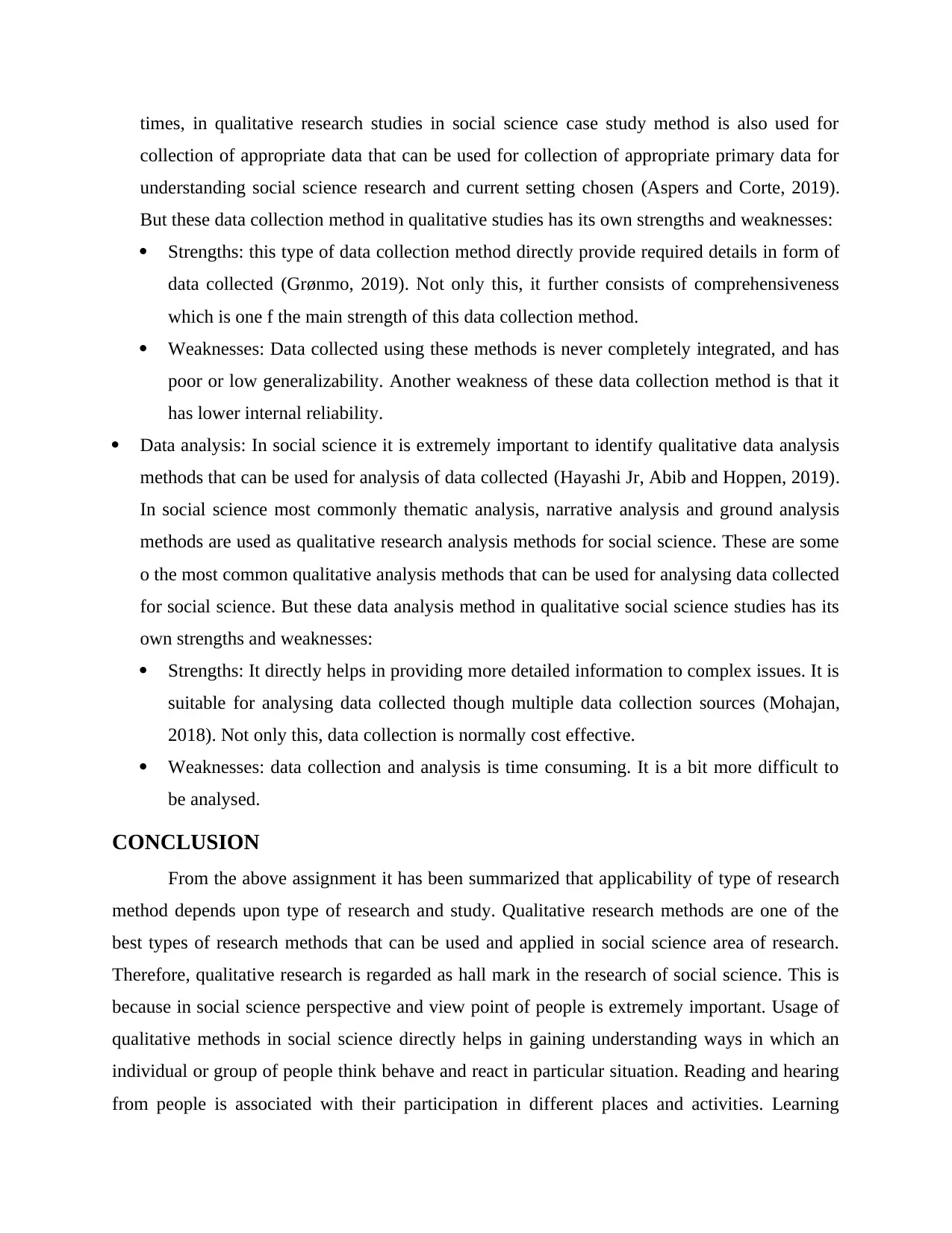
times, in qualitative research studies in social science case study method is also used for
collection of appropriate data that can be used for collection of appropriate primary data for
understanding social science research and current setting chosen (Aspers and Corte, 2019).
But these data collection method in qualitative studies has its own strengths and weaknesses:
Strengths: this type of data collection method directly provide required details in form of
data collected (Grønmo, 2019). Not only this, it further consists of comprehensiveness
which is one f the main strength of this data collection method.
Weaknesses: Data collected using these methods is never completely integrated, and has
poor or low generalizability. Another weakness of these data collection method is that it
has lower internal reliability.
Data analysis: In social science it is extremely important to identify qualitative data analysis
methods that can be used for analysis of data collected (Hayashi Jr, Abib and Hoppen, 2019).
In social science most commonly thematic analysis, narrative analysis and ground analysis
methods are used as qualitative research analysis methods for social science. These are some
o the most common qualitative analysis methods that can be used for analysing data collected
for social science. But these data analysis method in qualitative social science studies has its
own strengths and weaknesses:
Strengths: It directly helps in providing more detailed information to complex issues. It is
suitable for analysing data collected though multiple data collection sources (Mohajan,
2018). Not only this, data collection is normally cost effective.
Weaknesses: data collection and analysis is time consuming. It is a bit more difficult to
be analysed.
CONCLUSION
From the above assignment it has been summarized that applicability of type of research
method depends upon type of research and study. Qualitative research methods are one of the
best types of research methods that can be used and applied in social science area of research.
Therefore, qualitative research is regarded as hall mark in the research of social science. This is
because in social science perspective and view point of people is extremely important. Usage of
qualitative methods in social science directly helps in gaining understanding ways in which an
individual or group of people think behave and react in particular situation. Reading and hearing
from people is associated with their participation in different places and activities. Learning
collection of appropriate data that can be used for collection of appropriate primary data for
understanding social science research and current setting chosen (Aspers and Corte, 2019).
But these data collection method in qualitative studies has its own strengths and weaknesses:
Strengths: this type of data collection method directly provide required details in form of
data collected (Grønmo, 2019). Not only this, it further consists of comprehensiveness
which is one f the main strength of this data collection method.
Weaknesses: Data collected using these methods is never completely integrated, and has
poor or low generalizability. Another weakness of these data collection method is that it
has lower internal reliability.
Data analysis: In social science it is extremely important to identify qualitative data analysis
methods that can be used for analysis of data collected (Hayashi Jr, Abib and Hoppen, 2019).
In social science most commonly thematic analysis, narrative analysis and ground analysis
methods are used as qualitative research analysis methods for social science. These are some
o the most common qualitative analysis methods that can be used for analysing data collected
for social science. But these data analysis method in qualitative social science studies has its
own strengths and weaknesses:
Strengths: It directly helps in providing more detailed information to complex issues. It is
suitable for analysing data collected though multiple data collection sources (Mohajan,
2018). Not only this, data collection is normally cost effective.
Weaknesses: data collection and analysis is time consuming. It is a bit more difficult to
be analysed.
CONCLUSION
From the above assignment it has been summarized that applicability of type of research
method depends upon type of research and study. Qualitative research methods are one of the
best types of research methods that can be used and applied in social science area of research.
Therefore, qualitative research is regarded as hall mark in the research of social science. This is
because in social science perspective and view point of people is extremely important. Usage of
qualitative methods in social science directly helps in gaining understanding ways in which an
individual or group of people think behave and react in particular situation. Reading and hearing
from people is associated with their participation in different places and activities. Learning

within social science is all about generating persuasive understanding due to which social world
modifications can be enlightened.
⊘ This is a preview!⊘
Do you want full access?
Subscribe today to unlock all pages.

Trusted by 1+ million students worldwide

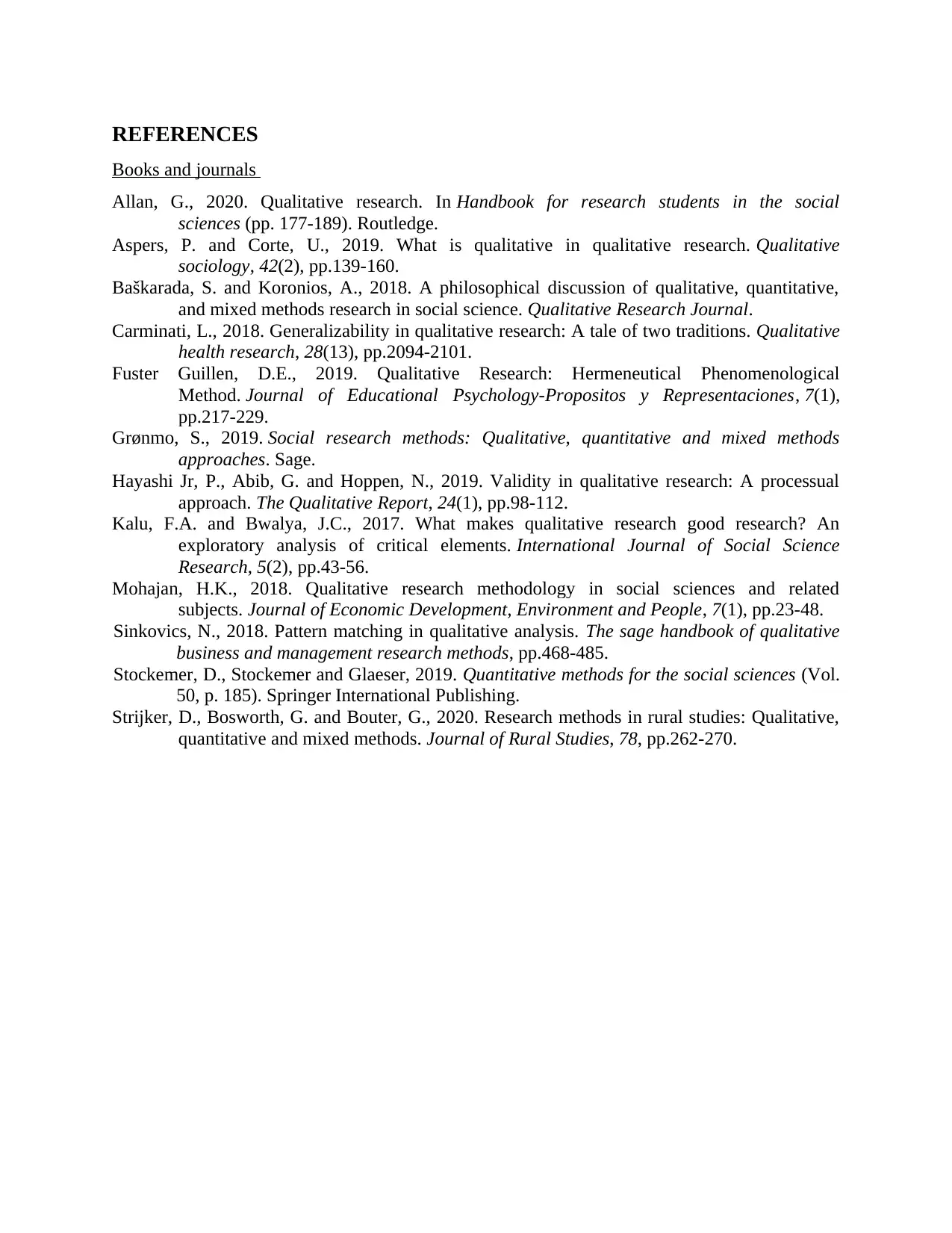
REFERENCES
Books and journals
Allan, G., 2020. Qualitative research. In Handbook for research students in the social
sciences (pp. 177-189). Routledge.
Aspers, P. and Corte, U., 2019. What is qualitative in qualitative research. Qualitative
sociology, 42(2), pp.139-160.
Baškarada, S. and Koronios, A., 2018. A philosophical discussion of qualitative, quantitative,
and mixed methods research in social science. Qualitative Research Journal.
Carminati, L., 2018. Generalizability in qualitative research: A tale of two traditions. Qualitative
health research, 28(13), pp.2094-2101.
Fuster Guillen, D.E., 2019. Qualitative Research: Hermeneutical Phenomenological
Method. Journal of Educational Psychology-Propositos y Representaciones, 7(1),
pp.217-229.
Grønmo, S., 2019. Social research methods: Qualitative, quantitative and mixed methods
approaches. Sage.
Hayashi Jr, P., Abib, G. and Hoppen, N., 2019. Validity in qualitative research: A processual
approach. The Qualitative Report, 24(1), pp.98-112.
Kalu, F.A. and Bwalya, J.C., 2017. What makes qualitative research good research? An
exploratory analysis of critical elements. International Journal of Social Science
Research, 5(2), pp.43-56.
Mohajan, H.K., 2018. Qualitative research methodology in social sciences and related
subjects. Journal of Economic Development, Environment and People, 7(1), pp.23-48.
Sinkovics, N., 2018. Pattern matching in qualitative analysis. The sage handbook of qualitative
business and management research methods, pp.468-485.
Stockemer, D., Stockemer and Glaeser, 2019. Quantitative methods for the social sciences (Vol.
50, p. 185). Springer International Publishing.
Strijker, D., Bosworth, G. and Bouter, G., 2020. Research methods in rural studies: Qualitative,
quantitative and mixed methods. Journal of Rural Studies, 78, pp.262-270.
Books and journals
Allan, G., 2020. Qualitative research. In Handbook for research students in the social
sciences (pp. 177-189). Routledge.
Aspers, P. and Corte, U., 2019. What is qualitative in qualitative research. Qualitative
sociology, 42(2), pp.139-160.
Baškarada, S. and Koronios, A., 2018. A philosophical discussion of qualitative, quantitative,
and mixed methods research in social science. Qualitative Research Journal.
Carminati, L., 2018. Generalizability in qualitative research: A tale of two traditions. Qualitative
health research, 28(13), pp.2094-2101.
Fuster Guillen, D.E., 2019. Qualitative Research: Hermeneutical Phenomenological
Method. Journal of Educational Psychology-Propositos y Representaciones, 7(1),
pp.217-229.
Grønmo, S., 2019. Social research methods: Qualitative, quantitative and mixed methods
approaches. Sage.
Hayashi Jr, P., Abib, G. and Hoppen, N., 2019. Validity in qualitative research: A processual
approach. The Qualitative Report, 24(1), pp.98-112.
Kalu, F.A. and Bwalya, J.C., 2017. What makes qualitative research good research? An
exploratory analysis of critical elements. International Journal of Social Science
Research, 5(2), pp.43-56.
Mohajan, H.K., 2018. Qualitative research methodology in social sciences and related
subjects. Journal of Economic Development, Environment and People, 7(1), pp.23-48.
Sinkovics, N., 2018. Pattern matching in qualitative analysis. The sage handbook of qualitative
business and management research methods, pp.468-485.
Stockemer, D., Stockemer and Glaeser, 2019. Quantitative methods for the social sciences (Vol.
50, p. 185). Springer International Publishing.
Strijker, D., Bosworth, G. and Bouter, G., 2020. Research methods in rural studies: Qualitative,
quantitative and mixed methods. Journal of Rural Studies, 78, pp.262-270.
1 out of 7
Related Documents
Your All-in-One AI-Powered Toolkit for Academic Success.
+13062052269
info@desklib.com
Available 24*7 on WhatsApp / Email
Unlock your academic potential
Copyright © 2020–2025 A2Z Services. All Rights Reserved. Developed and managed by ZUCOL.