Qualitative Analysis of Adolescent Suicide Attempts and Revenge
VerifiedAdded on 2022/08/26
|8
|8089
|412
Report
AI Summary
This report presents a qualitative study that investigated the experiences of adolescents and young adults who had attempted suicide. Conducted using Interpretative Phenomenological Analysis (IPA), the study involved semi-structured interviews with sixteen participants, with a focus on understanding their perspectives on the suicidal acts. The research identified two main themes: individual dimensions, encompassing negative self-emotions and the need for control, and relational dimensions, including interpersonal impasses, communication issues, and the often-neglected role of revenge. The study highlights that adolescents often feel trapped in both personal and relational dead-ends, with revenge emerging as a crucial, yet overlooked, factor bridging this gap and transforming personal distress into a relational matter. This research underscores the importance of considering relational dynamics and the powerful emotion of revenge in clinical and research contexts when addressing adolescent suicidal behavior. The study was approved by the institutional review boards of three hospitals in northeastern Italy.
Qualitative Approach to Attempted Suicide by
Adolescents and Young Adults:The (Neglected) Role of
Revenge
Massimiliano Orri1*, Matteo Paduanello2, Jonathan Lachal1,3, Bruno Falissard1, Jordan Sibeoni 1,3,
Anne Revah-Levy1,4
1 INSERM 669 research unit,Paris-Sud University and Paris-Descartes University,Paris,France,2 DepartmentApplied Psychology,University ofPadua,Padua,Italy,
3 Maison de Solenn, AP-HP Cochin Hospital, Paris, France, 4 Centre de Soins Psychothe´rapeutiques de Transition pour Adolescents, Argenteuil Hospital Centre, Argenteuil,
France
Abstract
Background:Suicide by adolescents and young adults is a major public health concern,and repetition of self-harm is an
important risk factor for future suicide attempts.
Objective:Our purpose is to explore the perspective of adolescents directly involved in suicidalacts.
Methods:Qualitative study involving 16 purposively selected adolescents (sex ratio1:1) from 3 different centers.Half had
been involved in repeated suicidal acts, and the other half only one. Data were gathered through semistructured interv
and analyzed according to Interpretative PhenomenologicalAnalysis.
Results:We found five main themes, organized in two superordinate themes.The first theme (individual dimensions of the
suicide attempt) describes the issues and explanations that the adolescents saw as related to themselves;it includes the
subthemes: (1) negative emotions toward the self and individual impasse, and (2) the need for some control over their
The second main theme (relational dimensions of attempted suicide) describes issues that adolescents mentioned that
related to others and includes three subthemes:(3) perceived impasse in interpersonalrelationships,(4) communication,
and (5) revenge.
Conclusions:Adolescents involved in suicidal behavior are stuck in both an individual and a relational impasse from whic
there is no exit and no apparent way to reach the other. Revenge can bridge this gap and thus transforms personal dis
into a relationalmatter.This powerfulemotion has been neglected by both clinicians and researchers.
Citation: OrriM, Paduanello M,LachalJ, Falissard B,SibeoniJ, et al.(2014) Qualitative Approach to Attempted Suicide by Adolescents and Young Adults:The
(Neglected) Role of Revenge.PLoS ONE 9(5):e96716.doi:10.1371/journal.pone.0096716
Editor: Fiona Harris,University of Stirling,United Kingdom
Received November 21,2013;Accepted April9, 2014;Published May 6,2014
Copyright: ß 2014 Orri et al. This is an open-access article distributed under the terms of the Creative Commons Attribution License, which permits unrestrict
use,distribution,and reproduction in any medium,provided the originalauthor and source are credited.
Funding: The authors have no support or funding to report.
Competing Interests: The authors have declared that no competing interests exist.
* E-mail:massimiliano.orri@inserm.fr
Introduction
Adolescentsuicideis a major publichealth concern in all
western countries. Epidemiologicaldata show that it is one of the
three leading causesof death worldwide among those younger
than 25 years [1,2].A more statistically widespread phenomenon
is attempted suicide:its prevalence is about7.8% in the United
States [2] and 10.5% in Europe [3]. The highest attempted suicide
rate is recorded amongthoseaged 15–24years,and their
attempted/completed suicide ratio is estimated to be between 50:1
and 100:1 [4].The prevention of suicidalbehavior is therefore a
primary socialand medicalconcern throughoutthe world [1,5].
Nonetheless,despite a large number ofresearch and prevention
programs,the attempted suicide rate among youth is increasing
[6], and secondary prevention interventions have thus far achieved
limited results[7,8]. The numerousstudies,conducted from
multipleperspectives(including psychological,psychiatric,and
sociological),show that one of the most important risk factors for
attempted suicide isa previousattempt[9–11].According to a
recent English study,repetition of self-harm occurs in about 27%
of adolescents,and the four major risk factors for repetition are
age,prior psychiatric treatment,self-cutting,and previousself-
harm.This study also found thatyouthswho soughtcare ata
hospitalfor self-harm are 10 times more likely to die by suicide
than would be expected in this age group [12].
Although an understanding ofthe adolescentperspective is
essentialin preventingthe relapseof suicidalbehaviors,the
subjective experience of those directly involved in suicidal acts ha
not been sufficientlyexplored [13].Qualitativemethodsare
particularly suited to investigating participants’viewpoints,their
lived experiences,and their interior worlds [14,15].Nevertheless,
qualitative research in adolescent suicidology is rare [16].To our
knowledge,only two qualitativestudies[17,18]havedirectly
addressed theproblem ofrelapseof suicidalor self-harming
PLOS ONE |www.plosone.org 1 May 2014 |Volume 9 |Issue 5 | e96716
Adolescents and Young Adults:The (Neglected) Role of
Revenge
Massimiliano Orri1*, Matteo Paduanello2, Jonathan Lachal1,3, Bruno Falissard1, Jordan Sibeoni 1,3,
Anne Revah-Levy1,4
1 INSERM 669 research unit,Paris-Sud University and Paris-Descartes University,Paris,France,2 DepartmentApplied Psychology,University ofPadua,Padua,Italy,
3 Maison de Solenn, AP-HP Cochin Hospital, Paris, France, 4 Centre de Soins Psychothe´rapeutiques de Transition pour Adolescents, Argenteuil Hospital Centre, Argenteuil,
France
Abstract
Background:Suicide by adolescents and young adults is a major public health concern,and repetition of self-harm is an
important risk factor for future suicide attempts.
Objective:Our purpose is to explore the perspective of adolescents directly involved in suicidalacts.
Methods:Qualitative study involving 16 purposively selected adolescents (sex ratio1:1) from 3 different centers.Half had
been involved in repeated suicidal acts, and the other half only one. Data were gathered through semistructured interv
and analyzed according to Interpretative PhenomenologicalAnalysis.
Results:We found five main themes, organized in two superordinate themes.The first theme (individual dimensions of the
suicide attempt) describes the issues and explanations that the adolescents saw as related to themselves;it includes the
subthemes: (1) negative emotions toward the self and individual impasse, and (2) the need for some control over their
The second main theme (relational dimensions of attempted suicide) describes issues that adolescents mentioned that
related to others and includes three subthemes:(3) perceived impasse in interpersonalrelationships,(4) communication,
and (5) revenge.
Conclusions:Adolescents involved in suicidal behavior are stuck in both an individual and a relational impasse from whic
there is no exit and no apparent way to reach the other. Revenge can bridge this gap and thus transforms personal dis
into a relationalmatter.This powerfulemotion has been neglected by both clinicians and researchers.
Citation: OrriM, Paduanello M,LachalJ, Falissard B,SibeoniJ, et al.(2014) Qualitative Approach to Attempted Suicide by Adolescents and Young Adults:The
(Neglected) Role of Revenge.PLoS ONE 9(5):e96716.doi:10.1371/journal.pone.0096716
Editor: Fiona Harris,University of Stirling,United Kingdom
Received November 21,2013;Accepted April9, 2014;Published May 6,2014
Copyright: ß 2014 Orri et al. This is an open-access article distributed under the terms of the Creative Commons Attribution License, which permits unrestrict
use,distribution,and reproduction in any medium,provided the originalauthor and source are credited.
Funding: The authors have no support or funding to report.
Competing Interests: The authors have declared that no competing interests exist.
* E-mail:massimiliano.orri@inserm.fr
Introduction
Adolescentsuicideis a major publichealth concern in all
western countries. Epidemiologicaldata show that it is one of the
three leading causesof death worldwide among those younger
than 25 years [1,2].A more statistically widespread phenomenon
is attempted suicide:its prevalence is about7.8% in the United
States [2] and 10.5% in Europe [3]. The highest attempted suicide
rate is recorded amongthoseaged 15–24years,and their
attempted/completed suicide ratio is estimated to be between 50:1
and 100:1 [4].The prevention of suicidalbehavior is therefore a
primary socialand medicalconcern throughoutthe world [1,5].
Nonetheless,despite a large number ofresearch and prevention
programs,the attempted suicide rate among youth is increasing
[6], and secondary prevention interventions have thus far achieved
limited results[7,8]. The numerousstudies,conducted from
multipleperspectives(including psychological,psychiatric,and
sociological),show that one of the most important risk factors for
attempted suicide isa previousattempt[9–11].According to a
recent English study,repetition of self-harm occurs in about 27%
of adolescents,and the four major risk factors for repetition are
age,prior psychiatric treatment,self-cutting,and previousself-
harm.This study also found thatyouthswho soughtcare ata
hospitalfor self-harm are 10 times more likely to die by suicide
than would be expected in this age group [12].
Although an understanding ofthe adolescentperspective is
essentialin preventingthe relapseof suicidalbehaviors,the
subjective experience of those directly involved in suicidal acts ha
not been sufficientlyexplored [13].Qualitativemethodsare
particularly suited to investigating participants’viewpoints,their
lived experiences,and their interior worlds [14,15].Nevertheless,
qualitative research in adolescent suicidology is rare [16].To our
knowledge,only two qualitativestudies[17,18]havedirectly
addressed theproblem ofrelapseof suicidalor self-harming
PLOS ONE |www.plosone.org 1 May 2014 |Volume 9 |Issue 5 | e96716

Paraphrase This Document
Need a fresh take? Get an instant paraphrase of this document with our AI Paraphraser
behavior among youth.In particular,one ofthem showed that
currentservicesrespond inadequately to self-harming behaviors
among young people and struggle to dealwith the needsthis
population experiences [18].
The aim of this qualitative study is to explore the perspective of
adolescents(for clarity’ssake,we referto our participantsas
adolescents)who have directly engaged in suicidalacts (in either
single or repeated suicide attempts).Exploring the factors related
to their success or failure in overcoming and moving beyond the
suicidalperiod mightprovide clinicianswith importantinsights
usefulin caring for young people involved in suicidalbehavior,
especially in a perspective of preventing repetition.
Methods
Participants and Setting
Participantsreceived complete written information aboutthe
scope of the research, the identity and affiliation of the researchers,
the possibilityof withdrawingfrom the studyat any point,
confidentiality,and allother information required in accordance
with Italian policiesfor psychologicalresearch and with the
HelsinkiDeclaration,as revised in 1989.Participants (and their
parents,for minors)provided written consent.This research
received approval from the institutional review boards of the three
hospitalsinvolved:Santa Giuliana Hospital, Verona; Este
Hospital,Padua;Monselice Hospital,Padua.These were two
localgeneralhospitals (with inpatientand outpatientadolescent
psychiatric departments)and one psychiatric hospitalin north-
eastern Italy.Physicians or psychologists atthese hospitals were
contacted and asked if they had patients who might be appropriate
subjects for a study ofadolescent suicide attempts.Subjects were
eligible only if they had attempted suicide during adolescence or in
the postadolescent period and were aged 15 to 25 years old at the
time of the interview.Eligible subjects were then contacted.
Purposivesampling[19] was undertaken,and inclusion of
subjects continued untilsaturation was reached [20].As recom-
mended for Interpretive Phenomenological Analysis (IPA) [21,22],
we chose to focus on only a few cases and to analyze their accounts
in depth.Moreover,to includea heterogeneoussamplewith
maximum variation [19], we included both adolescents with only a
single suicidal act and those with multiple acts. We were therefore
ableto considera wide rangeof situationsand experiences.
SixteenItalian adolescents(sex ratio 1:1) freelyagreedto
participate in the study (two refused,one male and one female).
Their median age was 20 years atthe interview,and 16 atthe
suicide attempt.Half had a history of previous attempts ($1,see
Table 1).
Data Collection
Data were collected through 16 individual semi-structured face-
to-faceinterviews.The interviewswere audio-recordedand
subsequentlytranscribedverbatim,with all nuancesof the
participants’expressionrecorded.An interview topicguide
(Table 2)was developed in advance and included 8 open-ended
questionsand severalprompts.The logic underpinningthe
construction ofthe interview guide wasto elicitin-depth and
detailed accountsof the subjects’feelingsbeforethe suicide
attempt and afterwards, as wellas the expectations and meanings
that they connected to this action.Our overallobjective in using
this qualitative method was to put ourselves in the lived world of
each participantand explore the meaning ofthe experience to
each ofthem.Fourteen interviews took place atthe adolescents’
treatmentfacility,one atthe adolescent’s home,and one atthe
residentialfacility wherethe adolescentwas living.Sincethe
sensitive topic of our interviews,considerable attention was given
to the evaluation of participants’ opinion about the interview after
its end. All adolescents felt comfortable discussing their experienc
and explaining their perspective withoutreceiving any judgment
from the researcher.Referentpsychologistsor physiciansnever
reportedany concern.In addition,researchersthemselves
discussed theirown feelingsaboutthe interviewsduring study
group meetings, in order to take into account potentialinfluences
on data collection and analysis (reflexivity).
Data Analysis
Qualitative analysis was performed according to IPA method-
ology. The aim of this method is to understand how people make
sense oftheir majorlife experiencesby adopting an ‘‘insider
perspective’’[23].Three epistemologicalpointsunderpin IPA:
first,it is a phenomenologicalmethod thatseeks to explore the
informants’views ofthe world.As Husserlpointed out [24],the
objective of phenomenology is to understand how a phenomenon
appears in the individual’s conscious experience.Hence,experi-
ence is conceived as uniquely perspectival, embodied, and situate
[21]. Second, IPA is based on hermeneutics: interpretative activity
as defined by Smith & Osborn [22], is a dual process in which the
‘‘researcher istrying to make sense ofthe participanttrying to
make sense of what is happening to them’’. In practice, during the
analysis,the researchermightmovedialectically between the
wholeand the parts,as well as between understandingand
interpretation. Third, the idiographic approach emphasizes a deep
understandingof the individualcases.IPA is committed to
understanding the way in which participants understand particula
phenomena from their perspective and in their context [21].
The analyticprocessproceeded through severalstages:we
began by reading and rereading the entirety of each interview, to
familiarize ourselves with the participant’s expressive style and to
obtain an overall impression.We took initial notes that
corresponded to the fundamentalunits of meaning.At this stage,
the notes were descriptive and used the participants’own words;
particular attention was paid to linguistic details, including the use
of expressions(especiallyyouth slang)and metaphors.Then
conceptual/psychological notes were drafted, through processes o
condensation,comparison,and abstractingthe initial notes.
Connectionswith noteswere mappedand synthesized,and
emergentthemesdeveloped.Each interview wasseparately
analyzed in this way and then compared to enable us to cluster
themesinto superordinate categories.Through thisprocess,the
analysis moved through different interpretative levels,from more
descriptive stages to more interpretative ones;every conceptnot
supported by data waseliminated.The primary concern for
researchersis to maintain thelink between theirconceptual
organization and the participants’ words [25]. For this reason, the
categoriesof analysisare notworked outin advance,but are
derived inductively from the empiricaldata.
To ensure validity,two researchers (MO and MP,both expert
psychologists trained in qualitative research)conducted separate
analysesof these interviewsand compared them afterwards.A
third researcher(ARL, psychiatristspecialistin qualitative
research)triangulatedthe analysis.Every discrepancywas
negotiated during study group meetings, and the final organizatio
emerged from the work in concertof all the researchers.We
agreed to considered data saturation to be reached because no
new aspects emerged from the interviews (i.e. no more coded we
added to our codebook) in each of our themes, and last interviews
did not provideadditionalunderstanding ofour participants’
experience.
Qualitative Approach to Attempted Suicide by Youth
PLOS ONE |www.plosone.org 2 May 2014 |Volume 9 |Issue 5 | e96716
currentservicesrespond inadequately to self-harming behaviors
among young people and struggle to dealwith the needsthis
population experiences [18].
The aim of this qualitative study is to explore the perspective of
adolescents(for clarity’ssake,we referto our participantsas
adolescents)who have directly engaged in suicidalacts (in either
single or repeated suicide attempts).Exploring the factors related
to their success or failure in overcoming and moving beyond the
suicidalperiod mightprovide clinicianswith importantinsights
usefulin caring for young people involved in suicidalbehavior,
especially in a perspective of preventing repetition.
Methods
Participants and Setting
Participantsreceived complete written information aboutthe
scope of the research, the identity and affiliation of the researchers,
the possibilityof withdrawingfrom the studyat any point,
confidentiality,and allother information required in accordance
with Italian policiesfor psychologicalresearch and with the
HelsinkiDeclaration,as revised in 1989.Participants (and their
parents,for minors)provided written consent.This research
received approval from the institutional review boards of the three
hospitalsinvolved:Santa Giuliana Hospital, Verona; Este
Hospital,Padua;Monselice Hospital,Padua.These were two
localgeneralhospitals (with inpatientand outpatientadolescent
psychiatric departments)and one psychiatric hospitalin north-
eastern Italy.Physicians or psychologists atthese hospitals were
contacted and asked if they had patients who might be appropriate
subjects for a study ofadolescent suicide attempts.Subjects were
eligible only if they had attempted suicide during adolescence or in
the postadolescent period and were aged 15 to 25 years old at the
time of the interview.Eligible subjects were then contacted.
Purposivesampling[19] was undertaken,and inclusion of
subjects continued untilsaturation was reached [20].As recom-
mended for Interpretive Phenomenological Analysis (IPA) [21,22],
we chose to focus on only a few cases and to analyze their accounts
in depth.Moreover,to includea heterogeneoussamplewith
maximum variation [19], we included both adolescents with only a
single suicidal act and those with multiple acts. We were therefore
ableto considera wide rangeof situationsand experiences.
SixteenItalian adolescents(sex ratio 1:1) freelyagreedto
participate in the study (two refused,one male and one female).
Their median age was 20 years atthe interview,and 16 atthe
suicide attempt.Half had a history of previous attempts ($1,see
Table 1).
Data Collection
Data were collected through 16 individual semi-structured face-
to-faceinterviews.The interviewswere audio-recordedand
subsequentlytranscribedverbatim,with all nuancesof the
participants’expressionrecorded.An interview topicguide
(Table 2)was developed in advance and included 8 open-ended
questionsand severalprompts.The logic underpinningthe
construction ofthe interview guide wasto elicitin-depth and
detailed accountsof the subjects’feelingsbeforethe suicide
attempt and afterwards, as wellas the expectations and meanings
that they connected to this action.Our overallobjective in using
this qualitative method was to put ourselves in the lived world of
each participantand explore the meaning ofthe experience to
each ofthem.Fourteen interviews took place atthe adolescents’
treatmentfacility,one atthe adolescent’s home,and one atthe
residentialfacility wherethe adolescentwas living.Sincethe
sensitive topic of our interviews,considerable attention was given
to the evaluation of participants’ opinion about the interview after
its end. All adolescents felt comfortable discussing their experienc
and explaining their perspective withoutreceiving any judgment
from the researcher.Referentpsychologistsor physiciansnever
reportedany concern.In addition,researchersthemselves
discussed theirown feelingsaboutthe interviewsduring study
group meetings, in order to take into account potentialinfluences
on data collection and analysis (reflexivity).
Data Analysis
Qualitative analysis was performed according to IPA method-
ology. The aim of this method is to understand how people make
sense oftheir majorlife experiencesby adopting an ‘‘insider
perspective’’[23].Three epistemologicalpointsunderpin IPA:
first,it is a phenomenologicalmethod thatseeks to explore the
informants’views ofthe world.As Husserlpointed out [24],the
objective of phenomenology is to understand how a phenomenon
appears in the individual’s conscious experience.Hence,experi-
ence is conceived as uniquely perspectival, embodied, and situate
[21]. Second, IPA is based on hermeneutics: interpretative activity
as defined by Smith & Osborn [22], is a dual process in which the
‘‘researcher istrying to make sense ofthe participanttrying to
make sense of what is happening to them’’. In practice, during the
analysis,the researchermightmovedialectically between the
wholeand the parts,as well as between understandingand
interpretation. Third, the idiographic approach emphasizes a deep
understandingof the individualcases.IPA is committed to
understanding the way in which participants understand particula
phenomena from their perspective and in their context [21].
The analyticprocessproceeded through severalstages:we
began by reading and rereading the entirety of each interview, to
familiarize ourselves with the participant’s expressive style and to
obtain an overall impression.We took initial notes that
corresponded to the fundamentalunits of meaning.At this stage,
the notes were descriptive and used the participants’own words;
particular attention was paid to linguistic details, including the use
of expressions(especiallyyouth slang)and metaphors.Then
conceptual/psychological notes were drafted, through processes o
condensation,comparison,and abstractingthe initial notes.
Connectionswith noteswere mappedand synthesized,and
emergentthemesdeveloped.Each interview wasseparately
analyzed in this way and then compared to enable us to cluster
themesinto superordinate categories.Through thisprocess,the
analysis moved through different interpretative levels,from more
descriptive stages to more interpretative ones;every conceptnot
supported by data waseliminated.The primary concern for
researchersis to maintain thelink between theirconceptual
organization and the participants’ words [25]. For this reason, the
categoriesof analysisare notworked outin advance,but are
derived inductively from the empiricaldata.
To ensure validity,two researchers (MO and MP,both expert
psychologists trained in qualitative research)conducted separate
analysesof these interviewsand compared them afterwards.A
third researcher(ARL, psychiatristspecialistin qualitative
research)triangulatedthe analysis.Every discrepancywas
negotiated during study group meetings, and the final organizatio
emerged from the work in concertof all the researchers.We
agreed to considered data saturation to be reached because no
new aspects emerged from the interviews (i.e. no more coded we
added to our codebook) in each of our themes, and last interviews
did not provideadditionalunderstanding ofour participants’
experience.
Qualitative Approach to Attempted Suicide by Youth
PLOS ONE |www.plosone.org 2 May 2014 |Volume 9 |Issue 5 | e96716
We reportthe study according to theCOREQ statement.
(Table S1)
Results
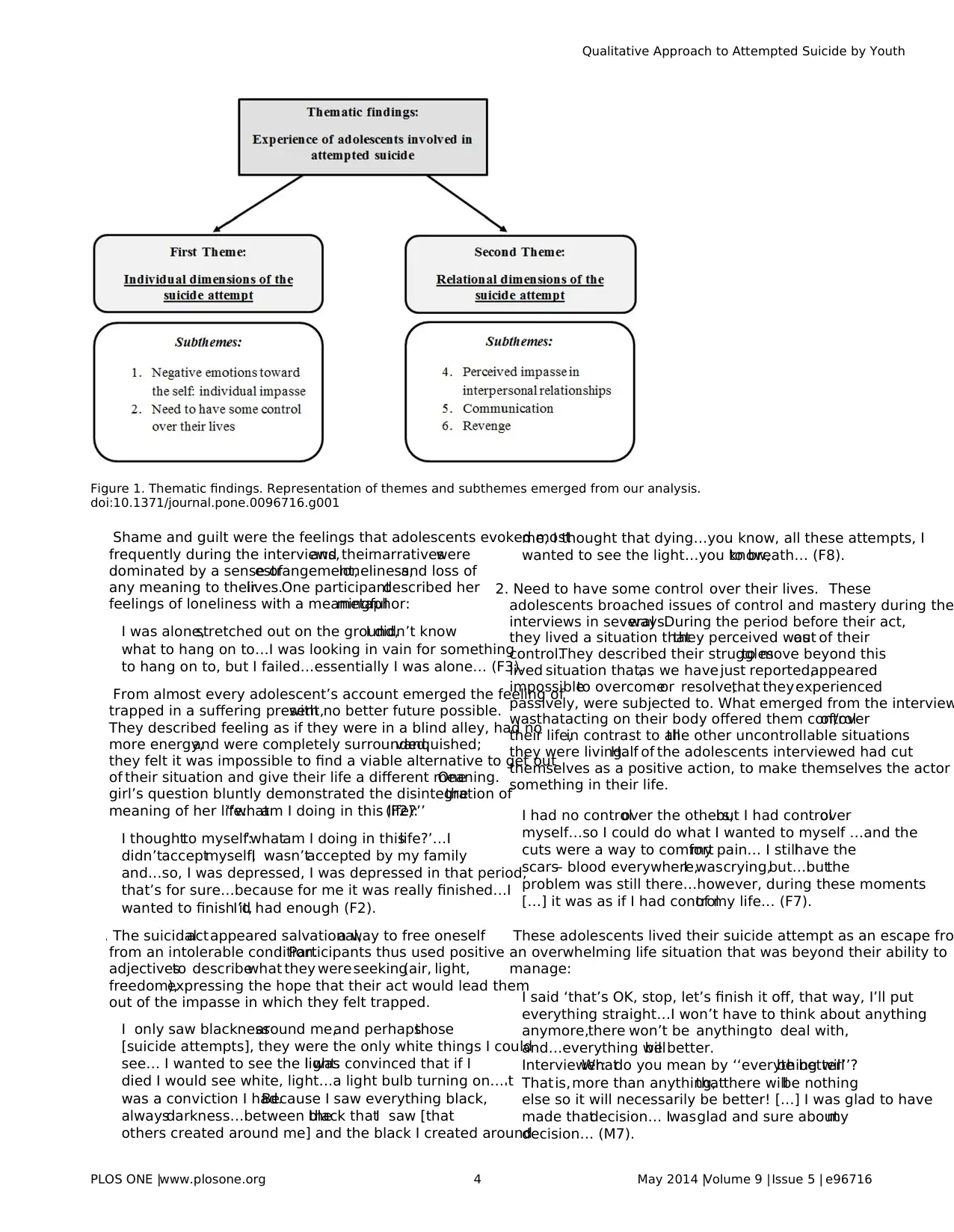
We identifiedfive themesdescribingthe experienceof
attempted suicide as narrated by participants and organized them
into two superordinate themes,according to the meaning the
adolescentsattributed to theirsuicidalact (Figure 1):the first
superordinate theme (Individualdimensionsof the suicidalact)
comprises the issues and explanations that the adolescents saw as
related to themselves; it includes the themes: (1) negative emotions
toward the self: the experience of an impasse with no exit, and (2)
need to have some control over their lives. The second
superordinate theme (relationaldimensionsof the suicidalact)
involves issues with others in the three subthemes:(3)perceived
impasse in family and peer relationships,(4)communication, and
(5)revenge.
Theme I:Individualdimensions of the suicide attempt
Two subthemes comprised this first theme: (i) negative emotion
toward the self: the experience of an impasse with no exit, and (ii
the need to have some controlover their lives.
1. Negative emotions toward the self: individual im-
passe. During the interviewsall participantsgave detailed
descriptions of themselves, their state of mind, and the though
that led to the decision to attempt suicide. The words they used
to talk aboutthemselves described a devalued self,in which
their dominant feeling was that they were not accepted.
That day, I took the pills looking myself in the mirror…I
keptrepeating thatI was disgusting,thatno one really
cared about me…[I was thinking] that everything about
me waswrong!That nothing Idid came outright…I
don’t know, I continued this thing of not feeling accepted,
not feeling that anybody cared about me… (F4).
Table 1. Participants’characteristics.
Name Gender (male/female) Age at the interview (y) Age at (first) suicidal act (y) Repeated suicidal act (yes/no)
M1 male 18 16 no
M2 male 21 17 no
M3 male 19 17 no
M4 male 20 16 no
M5 male 20 18 no
M6 male 20 16 yes
M7 male 18 16 no
M8 male 19 16 yes
F1 female 17 16 no
F2 female 25 15 no
F3 female 18 17 no
F4 female 20 19 yes
F5 female 18 16 yes
F6 female 20 19 no
F7 female 24 15 yes
F8 female 20 19 yes
doi:10.1371/journal.pone.0096716.t001
Table 2. Interview topic guide.
Questions and prompts
1. What do you remember about the episode that led you to this emergency [suicidalact]? Possible prompts:how did you feel? What was your state of mind?
2. Let us talk about the previous period…Can you tell me something about your family? Possible prompts:what about your family life? Can you tell me more about the
relationship with…?
3. Can you tellme something about your friends? Possible prompts:how do you feelwithin your peer group? Can you tellme more about the relationship with…?
4. Can you describe your wishes about the future?
5. After your suicide attempt,when you realize what happened,how do you feel? Possible prompts:can you tellme more about the moment when you met…?
6. What kind of changes there were in your life? Possible prompts:in your family life? Between your friends? How do you react to these changes?
7. What has it changed for you today?
8. When you made that decision [to attempt suicide],what did you think would happen? Possible prompts:what did you think people would understand?
Possible generalprompts:Can you tellme more about that? How did you feel? Can you recalla particular example of that?
doi:10.1371/journal.pone.0096716.t002
Qualitative Approach to Attempted Suicide by Youth
PLOS ONE |www.plosone.org 3 May 2014 |Volume 9 |Issue 5 | e96716
(Table S1)
Results
We identifiedfive themesdescribingthe experienceof
attempted suicide as narrated by participants and organized them
into two superordinate themes,according to the meaning the
adolescentsattributed to theirsuicidalact (Figure 1):the first
superordinate theme (Individualdimensionsof the suicidalact)
comprises the issues and explanations that the adolescents saw as
related to themselves; it includes the themes: (1) negative emotions
toward the self: the experience of an impasse with no exit, and (2)
need to have some control over their lives. The second
superordinate theme (relationaldimensionsof the suicidalact)
involves issues with others in the three subthemes:(3)perceived
impasse in family and peer relationships,(4)communication, and
(5)revenge.
Theme I:Individualdimensions of the suicide attempt
Two subthemes comprised this first theme: (i) negative emotion
toward the self: the experience of an impasse with no exit, and (ii
the need to have some controlover their lives.
1. Negative emotions toward the self: individual im-
passe. During the interviewsall participantsgave detailed
descriptions of themselves, their state of mind, and the though
that led to the decision to attempt suicide. The words they used
to talk aboutthemselves described a devalued self,in which
their dominant feeling was that they were not accepted.
That day, I took the pills looking myself in the mirror…I
keptrepeating thatI was disgusting,thatno one really
cared about me…[I was thinking] that everything about
me waswrong!That nothing Idid came outright…I
don’t know, I continued this thing of not feeling accepted,
not feeling that anybody cared about me… (F4).
Table 1. Participants’characteristics.
Name Gender (male/female) Age at the interview (y) Age at (first) suicidal act (y) Repeated suicidal act (yes/no)
M1 male 18 16 no
M2 male 21 17 no
M3 male 19 17 no
M4 male 20 16 no
M5 male 20 18 no
M6 male 20 16 yes
M7 male 18 16 no
M8 male 19 16 yes
F1 female 17 16 no
F2 female 25 15 no
F3 female 18 17 no
F4 female 20 19 yes
F5 female 18 16 yes
F6 female 20 19 no
F7 female 24 15 yes
F8 female 20 19 yes
doi:10.1371/journal.pone.0096716.t001
Table 2. Interview topic guide.
Questions and prompts
1. What do you remember about the episode that led you to this emergency [suicidalact]? Possible prompts:how did you feel? What was your state of mind?
2. Let us talk about the previous period…Can you tell me something about your family? Possible prompts:what about your family life? Can you tell me more about the
relationship with…?
3. Can you tellme something about your friends? Possible prompts:how do you feelwithin your peer group? Can you tellme more about the relationship with…?
4. Can you describe your wishes about the future?
5. After your suicide attempt,when you realize what happened,how do you feel? Possible prompts:can you tellme more about the moment when you met…?
6. What kind of changes there were in your life? Possible prompts:in your family life? Between your friends? How do you react to these changes?
7. What has it changed for you today?
8. When you made that decision [to attempt suicide],what did you think would happen? Possible prompts:what did you think people would understand?
Possible generalprompts:Can you tellme more about that? How did you feel? Can you recalla particular example of that?
doi:10.1371/journal.pone.0096716.t002
Qualitative Approach to Attempted Suicide by Youth
PLOS ONE |www.plosone.org 3 May 2014 |Volume 9 |Issue 5 | e96716
⊘ This is a preview!⊘
Do you want full access?
Subscribe today to unlock all pages.

Trusted by 1+ million students worldwide
1. Shame and guilt were the feelings that adolescents evoked most
frequently during the interviews,and theirnarrativeswere
dominated by a sense ofestrangement,loneliness,and loss of
any meaning to theirlives.One participantdescribed her
feelings of loneliness with a meaningfulmetaphor:
I was alone,stretched out on the ground,I didn’t know
what to hang on to…I was looking in vain for something
to hang on to, but I failed…essentially I was alone… (F3).
1. From almost every adolescent’s account emerged the feeling of
trapped in a suffering present,with no better future possible.
They described feeling as if they were in a blind alley, had no
more energy,and were completely surrounded,vanquished;
they felt it was impossible to find a viable alternative to get out
of their situation and give their life a different meaning.One
girl’s question bluntly demonstrated the disintegration ofthe
meaning of her life:‘‘whatam I doing in this life?’’(F2):
I thoughtto myself:‘whatam I doing in thislife?’…I
didn’tacceptmyself,I wasn’taccepted by my family
and…so, I was depressed, I was depressed in that period,
that’s for sure…because for me it was really finished…I
wanted to finish it,I’d had enough (F2).
1. The suicidalactappeared salvational,a way to free oneself
from an intolerable condition.Participants thus used positive
adjectivesto describewhat they were seeking(air, light,
freedom),expressing the hope that their act would lead them
out of the impasse in which they felt trapped.
I only saw blacknessaround me,and perhapsthose
[suicide attempts], they were the only white things I could
see… I wanted to see the light.I was convinced that if I
died I would see white, light…a light bulb turning on…it
was a conviction I had.Because I saw everything black,
alwaysdarkness…between theblack thatI saw [that
others created around me] and the black I created around
me, I thought that dying…you know, all these attempts, I
wanted to see the light…you know,to breath… (F8).
2. Need to have some control over their lives. These
adolescents broached issues of control and mastery during the
interviews in severalways.During the period before their act,
they lived a situation thatthey perceived wasout of their
control.They described their strugglesto move beyond this
lived situation that,as we have just reported,appeared
impossibleto overcomeor resolve,that theyexperienced
passively, were subjected to. What emerged from the interview
wasthatacting on their body offered them controlof/over
their life,in contrast to allthe other uncontrollable situations
they were living.Half of the adolescents interviewed had cut
themselves as a positive action, to make themselves the actor
something in their life.
I had no controlover the others,but I had controlover
myself…so I could do what I wanted to myself …and the
cuts were a way to comfortmy pain… I stillhave the
scars– blood everywhere,I wascrying,but…butthe
problem was still there…however, during these moments
[…] it was as if I had controlof my life… (F7).
2. These adolescents lived their suicide attempt as an escape fro
an overwhelming life situation that was beyond their ability to
manage:
I said ‘that’s OK, stop, let’s finish it off, that way, I’ll put
everything straight…I won’t have to think about anything
anymore,there won’t be anythingto deal with,
and…everything willbe better.
Interviewer:Whatdo you mean by ‘‘everything willbe better’’?
Thatis, more than anything,thatthere willbe nothing
else so it will necessarily be better! […] I was glad to have
made thatdecision… Iwasglad and sure aboutmy
decision… (M7).
Figure 1. Thematic findings. Representation of themes and subthemes emerged from our analysis.
doi:10.1371/journal.pone.0096716.g001
Qualitative Approach to Attempted Suicide by Youth
PLOS ONE |www.plosone.org 4 May 2014 |Volume 9 |Issue 5 | e96716
frequently during the interviews,and theirnarrativeswere
dominated by a sense ofestrangement,loneliness,and loss of
any meaning to theirlives.One participantdescribed her
feelings of loneliness with a meaningfulmetaphor:
I was alone,stretched out on the ground,I didn’t know
what to hang on to…I was looking in vain for something
to hang on to, but I failed…essentially I was alone… (F3).
1. From almost every adolescent’s account emerged the feeling of
trapped in a suffering present,with no better future possible.
They described feeling as if they were in a blind alley, had no
more energy,and were completely surrounded,vanquished;
they felt it was impossible to find a viable alternative to get out
of their situation and give their life a different meaning.One
girl’s question bluntly demonstrated the disintegration ofthe
meaning of her life:‘‘whatam I doing in this life?’’(F2):
I thoughtto myself:‘whatam I doing in thislife?’…I
didn’tacceptmyself,I wasn’taccepted by my family
and…so, I was depressed, I was depressed in that period,
that’s for sure…because for me it was really finished…I
wanted to finish it,I’d had enough (F2).
1. The suicidalactappeared salvational,a way to free oneself
from an intolerable condition.Participants thus used positive
adjectivesto describewhat they were seeking(air, light,
freedom),expressing the hope that their act would lead them
out of the impasse in which they felt trapped.
I only saw blacknessaround me,and perhapsthose
[suicide attempts], they were the only white things I could
see… I wanted to see the light.I was convinced that if I
died I would see white, light…a light bulb turning on…it
was a conviction I had.Because I saw everything black,
alwaysdarkness…between theblack thatI saw [that
others created around me] and the black I created around
me, I thought that dying…you know, all these attempts, I
wanted to see the light…you know,to breath… (F8).
2. Need to have some control over their lives. These
adolescents broached issues of control and mastery during the
interviews in severalways.During the period before their act,
they lived a situation thatthey perceived wasout of their
control.They described their strugglesto move beyond this
lived situation that,as we have just reported,appeared
impossibleto overcomeor resolve,that theyexperienced
passively, were subjected to. What emerged from the interview
wasthatacting on their body offered them controlof/over
their life,in contrast to allthe other uncontrollable situations
they were living.Half of the adolescents interviewed had cut
themselves as a positive action, to make themselves the actor
something in their life.
I had no controlover the others,but I had controlover
myself…so I could do what I wanted to myself …and the
cuts were a way to comfortmy pain… I stillhave the
scars– blood everywhere,I wascrying,but…butthe
problem was still there…however, during these moments
[…] it was as if I had controlof my life… (F7).
2. These adolescents lived their suicide attempt as an escape fro
an overwhelming life situation that was beyond their ability to
manage:
I said ‘that’s OK, stop, let’s finish it off, that way, I’ll put
everything straight…I won’t have to think about anything
anymore,there won’t be anythingto deal with,
and…everything willbe better.
Interviewer:Whatdo you mean by ‘‘everything willbe better’’?
Thatis, more than anything,thatthere willbe nothing
else so it will necessarily be better! […] I was glad to have
made thatdecision… Iwasglad and sure aboutmy
decision… (M7).
Figure 1. Thematic findings. Representation of themes and subthemes emerged from our analysis.
doi:10.1371/journal.pone.0096716.g001
Qualitative Approach to Attempted Suicide by Youth
PLOS ONE |www.plosone.org 4 May 2014 |Volume 9 |Issue 5 | e96716
Paraphrase This Document
Need a fresh take? Get an instant paraphrase of this document with our AI Paraphraser
2. Narratives related to the post-suicidalperiod shed light on the
failure ofthe adolescents’attempts to achieve controlof their
own lives.They talked aboutfeeling ofanger,described as a
physicaland violentrage closely linked to the failure oftheir
act, and about finding themselves in a situation they perceived
as stillmore difficult.They lived the failure of their act as yet
another demonstration oftheir ineptitude,justone more in
their long string of personalfailures.
Interviewer:Whataboutthe changes in your life [after the suicide
attempt]?
Nothing…maybe,I began to see thingsdarker[…], I
thoughtI wasn’table to do anything,that I was
afraid…now I’m tired,I can’t take it anymore,before it
wasn’tlike this […]. I began tosee everythingas
darker…I began to think thatI was wrong,thatI was
the problem…because when there is a problem now,I
give up…and before it wasn’t so. From that, I feel my life
has changed (F6).
Theme II:Relationaldimensions of the suicide attempt
The second superordinate theme is the relationaldimension of
the suicidal act. The three subthemes belonging to this domain are
described below:
3. Perceived impasse in interpersonal relationships.
Our participants’narrativesof their family relationships
focused on the description ofan impasse,a sortof gridlock
dominated by the absence ofacceptance ortrustand the
perception ofbeing written down oreven off.It seemsto
parallel the negative emotions toward the self and the perceived
impasse described above (theme 1).
Because I was changing and they didn’t realize that, they
only realized it when I ran away from home […] at the
beginning,I did it because…thatis, I didn’teven think
about it much, but then, as the hours were going by I kept
on thinking aboutit and…I don’tknow,butit was like
running away to make myself visible… (M1).
3. Theparticipantsdescribed rigid and overwhelming family
dynamics and their perception that it was impossible to escape
an unbearable situation. They also directly linked their need to
escape and their choice to attempt suicide:
‘‘When I began to make her understand thatI wasn’t
going to acceptthissituation anymore,all hell broke
loose…and then, from that, my act…since I began to tell
her ‘look, Mama, I can’t take that anymore.’ …she didn’t
acceptthat…maybe she understood I’m no longer the
baby who’s happy with a new pair ofshoes so she’llbe
good,keep quiet and make believe she’s happy…I don’t
know…’’
Interviewer: can you tell me more about the relationship between that
and your act?
I think that it is… the fundamentalrelationship…I think
that is the main reason that I did it, fundamentally… (F6).
3. The peergroup wasalso described asa source ofintense
emotions.Although thenarrativesrevealed thatthe teens
hoped their peer group might supply what their families failed
to give them,these textsalso demonstrated fragility.Some-
times,they feltthatbeing partof their peer group produced
emotions very like to those about their family life; this increase
the feelings of loneliness and of not being understood:
I felt they were superficial,and I didn’t want to keep on
pretending to be like that…I didn’t feel at ease with them,
and slowly I lost the people I went out with (M5).
3. A frequenttopic wasthe emotionalinvestmentin one core
relationship, an investment the adolescents perceived as a way
to cope with the instability and difficulties of their lives. It was
described in terms of dependency: the relationship became the
repository oftheir hopes,and the person they were involved
with,the reference point of their life:
My ex-boyfriend F. was my first one…I was sixteen…my
first sexual relationship, my first love story, it lasted 3 and
a halfyears.He was my reference,because my parents
are separated, my father is far away, and I have an awful
relationship with my mother…and he was like… like an
older brother… a father…his mother was like a mother to
me,and she was almost my mother for three and a half
year[…]. With F. I had finally found thatkind of
stability…but,I guess itwas only a stopgap,a stopgap
that covered up allmy problems…and in fact,when he
was gone,they allreappeared on the surface (F3).
4. Communication. All the participants explicitly described the
communicative issues related to their suicide attempt. It is clea
that each suicidalact was primarilyan interpersonalact,
concerning notonly theselfbut also theenvironmentof
significant others.The suicide attempt was closely linked to a
situation with which the adolescent could not deal — all efforts
were in vain. Suicide thus became the only possible way to get
the person to listen to the adolescent’s difficulties and to send
message that was impossible to deliver otherwise. The suicidal
act was described asthe only choice,once everyother
communicative possibility had failed.
I was sick and tired ofmy mother’sbehavior…and to
keep on talking was useless. I went on for several months
and kepttalkingand talkingand…thatwas hurting
me…and I was tired. And so I finally did something like
that[attempted suicide],but itwas mainly to make her
understand that she was killing me!…either she would kill
me, or…or I had to find another way […]. If I tried to do
thatthere,it’s because I had already talked aboutit in
every other way… (F4).
4. Our analysisof the narrativesaboutthe period afterthe
suicidalact found these youth travelled two differentpaths.
Those who successfullyemergedfrom the suicidalcrisis
described the firstas a progressive opening ofthe line of
communication with others,a process that established a basis
for a change in the family relationship:
Before,I didn’t even talk to her,while now we can talk
fairly peacefully…aboutschool,or work…thatkind of
thing…we alwaysspoke aboutmy past,and we each
understood … whatshe feltand whatI felt…yeah,we
talked about that […] I told her what I had been doing in
[thattown],whatI wasdoing,whatsubstancesI was
taking…and she told me she was always crying,that she
was desperate,alwaysworrying,that she had done
everything possible to make me come back home again
Qualitative Approach to Attempted Suicide by Youth
PLOS ONE |www.plosone.org 5 May 2014 |Volume 9 |Issue 5 | e96716
failure ofthe adolescents’attempts to achieve controlof their
own lives.They talked aboutfeeling ofanger,described as a
physicaland violentrage closely linked to the failure oftheir
act, and about finding themselves in a situation they perceived
as stillmore difficult.They lived the failure of their act as yet
another demonstration oftheir ineptitude,justone more in
their long string of personalfailures.
Interviewer:Whataboutthe changes in your life [after the suicide
attempt]?
Nothing…maybe,I began to see thingsdarker[…], I
thoughtI wasn’table to do anything,that I was
afraid…now I’m tired,I can’t take it anymore,before it
wasn’tlike this […]. I began tosee everythingas
darker…I began to think thatI was wrong,thatI was
the problem…because when there is a problem now,I
give up…and before it wasn’t so. From that, I feel my life
has changed (F6).
Theme II:Relationaldimensions of the suicide attempt
The second superordinate theme is the relationaldimension of
the suicidal act. The three subthemes belonging to this domain are
described below:
3. Perceived impasse in interpersonal relationships.
Our participants’narrativesof their family relationships
focused on the description ofan impasse,a sortof gridlock
dominated by the absence ofacceptance ortrustand the
perception ofbeing written down oreven off.It seemsto
parallel the negative emotions toward the self and the perceived
impasse described above (theme 1).
Because I was changing and they didn’t realize that, they
only realized it when I ran away from home […] at the
beginning,I did it because…thatis, I didn’teven think
about it much, but then, as the hours were going by I kept
on thinking aboutit and…I don’tknow,butit was like
running away to make myself visible… (M1).
3. Theparticipantsdescribed rigid and overwhelming family
dynamics and their perception that it was impossible to escape
an unbearable situation. They also directly linked their need to
escape and their choice to attempt suicide:
‘‘When I began to make her understand thatI wasn’t
going to acceptthissituation anymore,all hell broke
loose…and then, from that, my act…since I began to tell
her ‘look, Mama, I can’t take that anymore.’ …she didn’t
acceptthat…maybe she understood I’m no longer the
baby who’s happy with a new pair ofshoes so she’llbe
good,keep quiet and make believe she’s happy…I don’t
know…’’
Interviewer: can you tell me more about the relationship between that
and your act?
I think that it is… the fundamentalrelationship…I think
that is the main reason that I did it, fundamentally… (F6).
3. The peergroup wasalso described asa source ofintense
emotions.Although thenarrativesrevealed thatthe teens
hoped their peer group might supply what their families failed
to give them,these textsalso demonstrated fragility.Some-
times,they feltthatbeing partof their peer group produced
emotions very like to those about their family life; this increase
the feelings of loneliness and of not being understood:
I felt they were superficial,and I didn’t want to keep on
pretending to be like that…I didn’t feel at ease with them,
and slowly I lost the people I went out with (M5).
3. A frequenttopic wasthe emotionalinvestmentin one core
relationship, an investment the adolescents perceived as a way
to cope with the instability and difficulties of their lives. It was
described in terms of dependency: the relationship became the
repository oftheir hopes,and the person they were involved
with,the reference point of their life:
My ex-boyfriend F. was my first one…I was sixteen…my
first sexual relationship, my first love story, it lasted 3 and
a halfyears.He was my reference,because my parents
are separated, my father is far away, and I have an awful
relationship with my mother…and he was like… like an
older brother… a father…his mother was like a mother to
me,and she was almost my mother for three and a half
year[…]. With F. I had finally found thatkind of
stability…but,I guess itwas only a stopgap,a stopgap
that covered up allmy problems…and in fact,when he
was gone,they allreappeared on the surface (F3).
4. Communication. All the participants explicitly described the
communicative issues related to their suicide attempt. It is clea
that each suicidalact was primarilyan interpersonalact,
concerning notonly theselfbut also theenvironmentof
significant others.The suicide attempt was closely linked to a
situation with which the adolescent could not deal — all efforts
were in vain. Suicide thus became the only possible way to get
the person to listen to the adolescent’s difficulties and to send
message that was impossible to deliver otherwise. The suicidal
act was described asthe only choice,once everyother
communicative possibility had failed.
I was sick and tired ofmy mother’sbehavior…and to
keep on talking was useless. I went on for several months
and kepttalkingand talkingand…thatwas hurting
me…and I was tired. And so I finally did something like
that[attempted suicide],but itwas mainly to make her
understand that she was killing me!…either she would kill
me, or…or I had to find another way […]. If I tried to do
thatthere,it’s because I had already talked aboutit in
every other way… (F4).
4. Our analysisof the narrativesaboutthe period afterthe
suicidalact found these youth travelled two differentpaths.
Those who successfullyemergedfrom the suicidalcrisis
described the firstas a progressive opening ofthe line of
communication with others,a process that established a basis
for a change in the family relationship:
Before,I didn’t even talk to her,while now we can talk
fairly peacefully…aboutschool,or work…thatkind of
thing…we alwaysspoke aboutmy past,and we each
understood … whatshe feltand whatI felt…yeah,we
talked about that […] I told her what I had been doing in
[thattown],whatI wasdoing,whatsubstancesI was
taking…and she told me she was always crying,that she
was desperate,alwaysworrying,that she had done
everything possible to make me come back home again
Qualitative Approach to Attempted Suicide by Youth
PLOS ONE |www.plosone.org 5 May 2014 |Volume 9 |Issue 5 | e96716
[…] So,I realized that I had made her suffer so much,
and that she had done so much for me…to help me, but I
didn’trealize that… I wasn’tgoing to listen to her,or
even give a damn,… because I believed that she couldn’t
possibly succeed in understanding me… (F1).
4. Thisexcerptshowsthatthe communication thatdeveloped
afterthe suicide attemptled to the explicitrecognition of
feelings,emotions,and thoughts that had been present before
the attempt,but neversuccessfullycommunicated.It is
important to note that it was not a dialogue about the suicidal
act,but an attempt at mutualunderstanding.
4. The second path was that of the adolescents who described a
situation in which dialogue and communication remained as
impossible after the suicide attempt as it has been before. The
communication so unambiguously embedded in the attempt
remained unanswered.The indifferencedescribed bythe
participants— including,for some,theirfamily’srefusalto
admit they had attemptedsuicide— had the effectof
reinforcing the feelings that led to the attempt.
They didn’tcreate a good situation…they actlike they
did when I crashed the car when I was drunk… They rub
it in thatthey can’teven fallasleep atnight,they rub
everything in,they were really fullof hatred…and every
time I did it [attempted suicide],it wasalwaysworse,
because they were increasingly irritated,and I increas-
ingly hated them…and so…the situation just kept getting
worse (F7).
5. Revenge.A strong relationalthemethat the participants
described explicitly was revenge. Several adolescents explained
the aggressiveness oftheir act as a way to make other people
feel guilty for their deaths and made the vindictive intent of the
attempted suicide very plain,as the following excerpt shows:
I was convinced,utterly convinced…yeah,yeah,I want
to do it…revenge!Revenge!
Interviewer: can you explain to me a little better, revenge? What were
you thinking?
So, it means…this is what you’ve gotten by behaving like
this to me all these years…you’ve gotten only my hatred,
my contempt…my contempt for life…and…and now you
look at me…look at me and suffer (F5).
5. Revenge carries a message,one intended to make the others
aware oftheirmistakes,theircarelessness.One adolescent
described itas a communication thatwas impossibleto
misunderstand:findingher body will causeher parents
‘‘suffering,crying,andregret’’(F5).It almostappearsthatshe
expects to be present to witness the scene. It is a way to put the
blame on others and make them feelguilty through remorse:
I can’t fully understandwhy I did it [attempted
suicide]…butif I think aboutit, I honestly would say
thatI did it to punish her[my mother]…to pay her
back… (F4).
I wanted to die, I wanted to die to make my ex feel guilty,
to make my parents feelguilty,thatthey hadn’tknown
how to listen to me when I needed… I also wanted to
make others feelguilty…I wanted to die,yes,because I
wassuffering,but at the same time I wanted to make
them feel guilty … make them feel like shit…I wanted to
make them cry,I wanted to destroy their lives…(F5).
…I’ve thoughta lot aboutit…severaldaysor weeks
before, I was thinking, but not about how to do it or what
to do…butonly how to revenge myselfon them.They
made me sufferso much and now they were sitting
around calmly,as if nothing had happened…allright.
They had ruined my life and did not even realize it. So, I
had no other choice…to make them understand (M4).
Discussion
Our phenomenologicalanalysisof young adults’accountsof
their suicideattemptselicited fivethemesthat described the
experiencesthey lived.These themeswere organized into two
superordinate themes,according to whether they concerned the
individualor the relationaldimensionsthatemerged from the
narratives.We showedthat the attemptsto link the two
dimensions — to communicate their anguish —were a key aspect
of our participants’experience.The vengefulmeaning ofsuicide
that we found exemplifiesthis attemptto reach a relational
dimension, to hurt someone else by hurting oneself. Accordingly t
Knoll [26],revenge is an intense and pervasive emotion that has
nevertheless received little attention,especially in the domain of
youthfulsuicidalbehavior.Our findings showed that revenge is a
strong other-directed emotion,which aimsto communicate an
individual’s own internal state by inflicting permanent suffering on
others — by suicide. This revenge, moreover, is not only directed
at otherbut is also a meansof relieving one’sown intense
experience of internalstruggle and helplessness.
Clinicians caring for suicidaladolescents need to acknowledge
the violence (aggressiveness and revenge)inherent in the suicidal
act. It is not obvious for them to think about violence, aggression,
and revenge when they are confronted with these teens. This stud
provides an opportunity to illuminate this aspectof suicide and
make clinicians aware ofthe role ofthis powerfulemotion.We
argue that openly addressing this issue with adolescents themselv
and their familiesmay play an essentialrole helpingthem
recognize the multiple factors (both individualand relational,as
we showed) that led to a particular suicide attempt, to put things
perspective (clarifying the individual/relationalconfusion),and
begin the processof moving beyond the crisisand avoiding a
repetition.
Comparison with the literature
Our findings are consistent with previous work. The subthemes
of the first theme (individual dimension of attempted suicide) sho
the subjective experience ofloneliness,isolation,and negative
emotions toward the self. The experience of suicidal acts describe
by adolescents is primarily a solitary experience involving the loss
of any meaning in life and the impossibility of finding another way
to exit a perceived impasse. Studies focusing on the internal world
of the suicidal adolescent have consistently demonstrated negativ
emotionalexperiences[17,27,28].We show thatthe need to
recover controlover one’s own life plays an important role in the
decision to killoneself,as others have found [9,18,28] for people
involved in non-suicidalself-harming behaviors [29].
The subthemesof the second theme dealwith the relational
dimensions ofthe act.Adolescents described the meaning ofthe
situation thatled to their decision toattemptsuicidewith
interpersonalexplanations,such as a lack of communication with
their family and peers,a sense ofnot belonging to either group,
and the impossibility they feltof overcoming an interpersonal
Qualitative Approach to Attempted Suicide by Youth
PLOS ONE |www.plosone.org 6 May 2014 |Volume 9 |Issue 5 | e96716
and that she had done so much for me…to help me, but I
didn’trealize that… I wasn’tgoing to listen to her,or
even give a damn,… because I believed that she couldn’t
possibly succeed in understanding me… (F1).
4. Thisexcerptshowsthatthe communication thatdeveloped
afterthe suicide attemptled to the explicitrecognition of
feelings,emotions,and thoughts that had been present before
the attempt,but neversuccessfullycommunicated.It is
important to note that it was not a dialogue about the suicidal
act,but an attempt at mutualunderstanding.
4. The second path was that of the adolescents who described a
situation in which dialogue and communication remained as
impossible after the suicide attempt as it has been before. The
communication so unambiguously embedded in the attempt
remained unanswered.The indifferencedescribed bythe
participants— including,for some,theirfamily’srefusalto
admit they had attemptedsuicide— had the effectof
reinforcing the feelings that led to the attempt.
They didn’tcreate a good situation…they actlike they
did when I crashed the car when I was drunk… They rub
it in thatthey can’teven fallasleep atnight,they rub
everything in,they were really fullof hatred…and every
time I did it [attempted suicide],it wasalwaysworse,
because they were increasingly irritated,and I increas-
ingly hated them…and so…the situation just kept getting
worse (F7).
5. Revenge.A strong relationalthemethat the participants
described explicitly was revenge. Several adolescents explained
the aggressiveness oftheir act as a way to make other people
feel guilty for their deaths and made the vindictive intent of the
attempted suicide very plain,as the following excerpt shows:
I was convinced,utterly convinced…yeah,yeah,I want
to do it…revenge!Revenge!
Interviewer: can you explain to me a little better, revenge? What were
you thinking?
So, it means…this is what you’ve gotten by behaving like
this to me all these years…you’ve gotten only my hatred,
my contempt…my contempt for life…and…and now you
look at me…look at me and suffer (F5).
5. Revenge carries a message,one intended to make the others
aware oftheirmistakes,theircarelessness.One adolescent
described itas a communication thatwas impossibleto
misunderstand:findingher body will causeher parents
‘‘suffering,crying,andregret’’(F5).It almostappearsthatshe
expects to be present to witness the scene. It is a way to put the
blame on others and make them feelguilty through remorse:
I can’t fully understandwhy I did it [attempted
suicide]…butif I think aboutit, I honestly would say
thatI did it to punish her[my mother]…to pay her
back… (F4).
I wanted to die, I wanted to die to make my ex feel guilty,
to make my parents feelguilty,thatthey hadn’tknown
how to listen to me when I needed… I also wanted to
make others feelguilty…I wanted to die,yes,because I
wassuffering,but at the same time I wanted to make
them feel guilty … make them feel like shit…I wanted to
make them cry,I wanted to destroy their lives…(F5).
…I’ve thoughta lot aboutit…severaldaysor weeks
before, I was thinking, but not about how to do it or what
to do…butonly how to revenge myselfon them.They
made me sufferso much and now they were sitting
around calmly,as if nothing had happened…allright.
They had ruined my life and did not even realize it. So, I
had no other choice…to make them understand (M4).
Discussion
Our phenomenologicalanalysisof young adults’accountsof
their suicideattemptselicited fivethemesthat described the
experiencesthey lived.These themeswere organized into two
superordinate themes,according to whether they concerned the
individualor the relationaldimensionsthatemerged from the
narratives.We showedthat the attemptsto link the two
dimensions — to communicate their anguish —were a key aspect
of our participants’experience.The vengefulmeaning ofsuicide
that we found exemplifiesthis attemptto reach a relational
dimension, to hurt someone else by hurting oneself. Accordingly t
Knoll [26],revenge is an intense and pervasive emotion that has
nevertheless received little attention,especially in the domain of
youthfulsuicidalbehavior.Our findings showed that revenge is a
strong other-directed emotion,which aimsto communicate an
individual’s own internal state by inflicting permanent suffering on
others — by suicide. This revenge, moreover, is not only directed
at otherbut is also a meansof relieving one’sown intense
experience of internalstruggle and helplessness.
Clinicians caring for suicidaladolescents need to acknowledge
the violence (aggressiveness and revenge)inherent in the suicidal
act. It is not obvious for them to think about violence, aggression,
and revenge when they are confronted with these teens. This stud
provides an opportunity to illuminate this aspectof suicide and
make clinicians aware ofthe role ofthis powerfulemotion.We
argue that openly addressing this issue with adolescents themselv
and their familiesmay play an essentialrole helpingthem
recognize the multiple factors (both individualand relational,as
we showed) that led to a particular suicide attempt, to put things
perspective (clarifying the individual/relationalconfusion),and
begin the processof moving beyond the crisisand avoiding a
repetition.
Comparison with the literature
Our findings are consistent with previous work. The subthemes
of the first theme (individual dimension of attempted suicide) sho
the subjective experience ofloneliness,isolation,and negative
emotions toward the self. The experience of suicidal acts describe
by adolescents is primarily a solitary experience involving the loss
of any meaning in life and the impossibility of finding another way
to exit a perceived impasse. Studies focusing on the internal world
of the suicidal adolescent have consistently demonstrated negativ
emotionalexperiences[17,27,28].We show thatthe need to
recover controlover one’s own life plays an important role in the
decision to killoneself,as others have found [9,18,28] for people
involved in non-suicidalself-harming behaviors [29].
The subthemesof the second theme dealwith the relational
dimensions ofthe act.Adolescents described the meaning ofthe
situation thatled to their decision toattemptsuicidewith
interpersonalexplanations,such as a lack of communication with
their family and peers,a sense ofnot belonging to either group,
and the impossibility they feltof overcoming an interpersonal
Qualitative Approach to Attempted Suicide by Youth
PLOS ONE |www.plosone.org 6 May 2014 |Volume 9 |Issue 5 | e96716
⊘ This is a preview!⊘
Do you want full access?
Subscribe today to unlock all pages.
Trusted by 1+ million students worldwide
stalemate.Moreover,they recounted changesthatthe primary
suicidalact produced (or failed to produce)in their interpersonal
world that eventuallyenabledimportantrelationshipsto be
restructuredin ways that, for example,increasedmutual
understanding.Severalauthorshave investigated the relational
aspects of suicide attempts in various populations, including LGBT
[30], ethnicminorities[31], and depressed adolescents[32].
Consistentlywith our findings,thesestudiespointed outthe
importance ofinterpersonalrelations in understanding both the
reasonsfor suicideattemptsand the patternsof recovery in
adolescent suicidalbehavior.
We go further,however.Althoughpreviousstudieshave
mentioned the relation between the individualand interpersonal
dimensions of suicidalacts, they have not discussed it clearly, and
severalgaps remain.The hypothesis we propose,which emerges
from ourfindings,is thatconfusion existsbetween these two
dimensions.Adolescentscontinually try to link theirindividual
stateof personaldistress,helplessness,and lonelinessto the
presence of others, seeking to connect. They described situations in
which their unhappinessis not recognized or acknowledged by
others. Our findings suggest that for adolescents suicidal behavior
representsa meansof establishing a connection between their
personal distress and the others, through the act itself. Revenge, as
discussed above,is one way to do that.
Moreover,failure to establish thatlink appears to be a major
factor responsible for keeping the adolescent in the same state of
mind that led to the initial act and thus keeps him or her at risk for
repeating it.
Limitations
This study hastwo main limitations.The firstconcernsits
generalizability.Our purposive sampling procedure allowed us to
include a wide sample ofexperiencesamong young men and
women,with both single and multiple suicidalacts,of different
durations of time since the act,and initially treated at 3 different
hospitals.Nonetheless,our findingscan be generalized only to
young Italian adults, and attitudes may differ in other countries or
even in otherregionsof Italy. However,our methodological
precautions assure the trustworthiness of our findings. Because th
socio-culturalenvironmenthas a strong influenceon suicidal
behaviors [31], further research needs to be conducted to compar
and integrate perspectivesfrom severalcountries.The second
limitation isthatall the participantswere contacted through a
healthcare facility where they underwent a period of psychiatric o
psychologicaltreatment.This mighthave affected the way that
they retrospectively understood their act
Conclusion and perspectives for future research
Adolescent suicidalbehavior appears to be a relationalact that
aims to bridge a gap between the adolescents and their significan
others in order to resolve a perceived impasse.Failure – by the
others and by the therapist – to recognize this intent and take it
into accountappearsto be a key factorfor repetition ofthis
behavior. Revenge assumes a particular role that appears to have
been neglected by both clinicians and researchers untilnow,and
further research should address this issue. Additionally, qualitativ
studies should be conducted to understand both caregivers’and
health-care professionals’ perspectives about the issue of revenge
adolescent suicide attempts.
Supporting Information
Table S1 COREQ checklist.
(DOCX)
Acknowledgments
We would like to thank: all participants in this research, the heads and staff
of the departments in which the research had been conducted (especially,
Dr Marco Previdiand Dr Maria Grazia Covre, Santa Giuliana Hospital,
Verona),and Ms JoAnn Cahn for revision of the English.
Author Contributions
Conceived and designed theexperiments:MO MP. Performed the
experiments:MO MP. Analyzed the data:MO MP ARL JL JS BF.
Wrote the paper:MO MP ARL JL JS BF.
References
1. WHO | Suicide prevention (SUPRE).WHO. Available:http://www.who.int/
mental_health/prevention/suicide/suicideprevent/en/. Accessed 2 May 2013.
2. Eaton DK, Kann L, Kinchen S, Shanklin S, Flint KH, et al.(2012)Youth risk
behavior surveillance -United States,2011.Morb MortalWkly Rep Surveill
Summ Wash DC 2002 61:1–162.
3. Kaess M, Brunner R (2012) Prevalence of adolescents’ suicide attempts and self-
harm thoughts vary across Europe.Evid Based Ment Health 15:66.
4. Hawton K, Arensman E, Wasserman D, Hulten A, Bille-Brahe U, et al. (1998)
Relation between attempted suicide and suicide rates among young people in
Europe.J EpidemiolCommunity Health 52:191–194.
5. Council of Europe (2008) Child and teenage suicide in Europe: A serious public-
healthissue.Available:http://assembly.coe.int/ASP/Doc/XrefViewPDF.
asp?FileID = 17639&Language = EN.Accessed 2 May 2013.
6. Hawton K, Hall S, Simkin S, Bale L, Bond A, et al. (2003) Deliberate self-harm
in adolescents:a study ofcharacteristicsand trendsin Oxford,1990–2000.
J Child PsycholPsychiatry 44:1191–1198.
7. Scottish Executive SAH (2008) Effectiveness of Interventions to Prevent Suicide
and SuicidalBehaviour: A Systematic Review. Available: http://www.scotland.
gov.uk/Publications/2008/01/15102257/0.Accessed 2 July 2013.
8. Tyrer P, Thompson S, Schmidt U, Jones V, Knapp M, et al. (2003) Randomized
controlled trialof brief cognitive behaviour therapy versus treatment as usualin
recurrent deliberate self-harm: the POPMACT study. Psychol Med 33: 969–976.
9. Hawton K,Bergen H,Kapur N,Cooper J,Steeg S,et al.(2012)Repetition of
self-harm and suicide following self-harm in children and adolescents:findings
from the Multicentre Study of Self-harm in England. J Child Psychol Psychiatry
53:1212–1219.
10. Chitsabesan P,Harrington R,Harrington V,Tomenson B (2003)Predicting
repeatself-harm in children—how accurate can we expectto be? Eur Child
Adolesc Psychiatry 12:23–29.
11. Cash SJ, Bridge JA (2009) Epidemiology of youth suicide and suicidal behavior.
Curr Opin Pediatr 21:613–619.
12. Hawton K,Harriss L (2007)Deliberate self-harm in young people:character-
isticsand subsequentmortality in a 20-year cohortof patientspresenting to
hospital.J Clin Psychiatry 68:1574–1583.
13. Connor J, Rueter M (2009) Predicting adolescent suicidality: comparing multiple
informants and assessment techniques.J Adolesc 32:619–631.
14. Pope C,Mays N (1995)Reaching the parts other methods cannotreach:an
introduction to qualitative methods in health and health services research. BMJ
311:42–45.
15. Malterud K (2001)The art and science of clinicalknowledge:evidence beyond
measures and numbers.Lancet 358:397–400.
16. Hjelmeland H,Knizek BL (2010) Why we need qualitativeresearch in
suicidology.Suicide Life Threat Behav 40:74–80.
17. Bergmans Y,Langley J,Links P,Lavery JV (2009)The perspectives ofyoung
adultson recovery from repeated suicide-related behavior.Crisis 30: 120–
127.
18. SinclairJ, Green J (2005)Understanding resolution ofdeliberate selfharm:
qualitative interview study of patients’experiences.BMJ 330:1112.
19. Patton MQ (2001) Qualitative Research & Evaluation Methods. 3rd ed. SAGE
Publications,Inc.
20. Morse JM (1995)The significance of saturation.QualHealth Res 5:147–149.
21. Smith J,Flower P,Larkin M (2009)Interpretative PhenomenologicalAnalysis:
Theory,Method and Research.London:SAGE.
22. Smith J, Osborn M (2003) Interpretative phenomenological analysis. Qualitative
Psychology:A PracticalGuide to Methods.London:SAGE.
23. Smith JA (1996)Beyond the divide between cognition and discourse:Using
interpretative phenomenologicalanalysis in health psychology.PsycholHealth
11:261–271.
24. HusserlE (1977)Cartesian Meditations:An Introduction to Phenomenology.
1977th ed.Martinus Nijhoff Pub.
25. Smith LK, Pope C, Botha JL (2005) Patients’ help-seeking experiences and delay
in cancer presentation:a qualitative synthesis.Lancet 366:825–831.
Qualitative Approach to Attempted Suicide by Youth
PLOS ONE |www.plosone.org 7 May 2014 |Volume 9 |Issue 5 | e96716
suicidalact produced (or failed to produce)in their interpersonal
world that eventuallyenabledimportantrelationshipsto be
restructuredin ways that, for example,increasedmutual
understanding.Severalauthorshave investigated the relational
aspects of suicide attempts in various populations, including LGBT
[30], ethnicminorities[31], and depressed adolescents[32].
Consistentlywith our findings,thesestudiespointed outthe
importance ofinterpersonalrelations in understanding both the
reasonsfor suicideattemptsand the patternsof recovery in
adolescent suicidalbehavior.
We go further,however.Althoughpreviousstudieshave
mentioned the relation between the individualand interpersonal
dimensions of suicidalacts, they have not discussed it clearly, and
severalgaps remain.The hypothesis we propose,which emerges
from ourfindings,is thatconfusion existsbetween these two
dimensions.Adolescentscontinually try to link theirindividual
stateof personaldistress,helplessness,and lonelinessto the
presence of others, seeking to connect. They described situations in
which their unhappinessis not recognized or acknowledged by
others. Our findings suggest that for adolescents suicidal behavior
representsa meansof establishing a connection between their
personal distress and the others, through the act itself. Revenge, as
discussed above,is one way to do that.
Moreover,failure to establish thatlink appears to be a major
factor responsible for keeping the adolescent in the same state of
mind that led to the initial act and thus keeps him or her at risk for
repeating it.
Limitations
This study hastwo main limitations.The firstconcernsits
generalizability.Our purposive sampling procedure allowed us to
include a wide sample ofexperiencesamong young men and
women,with both single and multiple suicidalacts,of different
durations of time since the act,and initially treated at 3 different
hospitals.Nonetheless,our findingscan be generalized only to
young Italian adults, and attitudes may differ in other countries or
even in otherregionsof Italy. However,our methodological
precautions assure the trustworthiness of our findings. Because th
socio-culturalenvironmenthas a strong influenceon suicidal
behaviors [31], further research needs to be conducted to compar
and integrate perspectivesfrom severalcountries.The second
limitation isthatall the participantswere contacted through a
healthcare facility where they underwent a period of psychiatric o
psychologicaltreatment.This mighthave affected the way that
they retrospectively understood their act
Conclusion and perspectives for future research
Adolescent suicidalbehavior appears to be a relationalact that
aims to bridge a gap between the adolescents and their significan
others in order to resolve a perceived impasse.Failure – by the
others and by the therapist – to recognize this intent and take it
into accountappearsto be a key factorfor repetition ofthis
behavior. Revenge assumes a particular role that appears to have
been neglected by both clinicians and researchers untilnow,and
further research should address this issue. Additionally, qualitativ
studies should be conducted to understand both caregivers’and
health-care professionals’ perspectives about the issue of revenge
adolescent suicide attempts.
Supporting Information
Table S1 COREQ checklist.
(DOCX)
Acknowledgments
We would like to thank: all participants in this research, the heads and staff
of the departments in which the research had been conducted (especially,
Dr Marco Previdiand Dr Maria Grazia Covre, Santa Giuliana Hospital,
Verona),and Ms JoAnn Cahn for revision of the English.
Author Contributions
Conceived and designed theexperiments:MO MP. Performed the
experiments:MO MP. Analyzed the data:MO MP ARL JL JS BF.
Wrote the paper:MO MP ARL JL JS BF.
References
1. WHO | Suicide prevention (SUPRE).WHO. Available:http://www.who.int/
mental_health/prevention/suicide/suicideprevent/en/. Accessed 2 May 2013.
2. Eaton DK, Kann L, Kinchen S, Shanklin S, Flint KH, et al.(2012)Youth risk
behavior surveillance -United States,2011.Morb MortalWkly Rep Surveill
Summ Wash DC 2002 61:1–162.
3. Kaess M, Brunner R (2012) Prevalence of adolescents’ suicide attempts and self-
harm thoughts vary across Europe.Evid Based Ment Health 15:66.
4. Hawton K, Arensman E, Wasserman D, Hulten A, Bille-Brahe U, et al. (1998)
Relation between attempted suicide and suicide rates among young people in
Europe.J EpidemiolCommunity Health 52:191–194.
5. Council of Europe (2008) Child and teenage suicide in Europe: A serious public-
healthissue.Available:http://assembly.coe.int/ASP/Doc/XrefViewPDF.
asp?FileID = 17639&Language = EN.Accessed 2 May 2013.
6. Hawton K, Hall S, Simkin S, Bale L, Bond A, et al. (2003) Deliberate self-harm
in adolescents:a study ofcharacteristicsand trendsin Oxford,1990–2000.
J Child PsycholPsychiatry 44:1191–1198.
7. Scottish Executive SAH (2008) Effectiveness of Interventions to Prevent Suicide
and SuicidalBehaviour: A Systematic Review. Available: http://www.scotland.
gov.uk/Publications/2008/01/15102257/0.Accessed 2 July 2013.
8. Tyrer P, Thompson S, Schmidt U, Jones V, Knapp M, et al. (2003) Randomized
controlled trialof brief cognitive behaviour therapy versus treatment as usualin
recurrent deliberate self-harm: the POPMACT study. Psychol Med 33: 969–976.
9. Hawton K,Bergen H,Kapur N,Cooper J,Steeg S,et al.(2012)Repetition of
self-harm and suicide following self-harm in children and adolescents:findings
from the Multicentre Study of Self-harm in England. J Child Psychol Psychiatry
53:1212–1219.
10. Chitsabesan P,Harrington R,Harrington V,Tomenson B (2003)Predicting
repeatself-harm in children—how accurate can we expectto be? Eur Child
Adolesc Psychiatry 12:23–29.
11. Cash SJ, Bridge JA (2009) Epidemiology of youth suicide and suicidal behavior.
Curr Opin Pediatr 21:613–619.
12. Hawton K,Harriss L (2007)Deliberate self-harm in young people:character-
isticsand subsequentmortality in a 20-year cohortof patientspresenting to
hospital.J Clin Psychiatry 68:1574–1583.
13. Connor J, Rueter M (2009) Predicting adolescent suicidality: comparing multiple
informants and assessment techniques.J Adolesc 32:619–631.
14. Pope C,Mays N (1995)Reaching the parts other methods cannotreach:an
introduction to qualitative methods in health and health services research. BMJ
311:42–45.
15. Malterud K (2001)The art and science of clinicalknowledge:evidence beyond
measures and numbers.Lancet 358:397–400.
16. Hjelmeland H,Knizek BL (2010) Why we need qualitativeresearch in
suicidology.Suicide Life Threat Behav 40:74–80.
17. Bergmans Y,Langley J,Links P,Lavery JV (2009)The perspectives ofyoung
adultson recovery from repeated suicide-related behavior.Crisis 30: 120–
127.
18. SinclairJ, Green J (2005)Understanding resolution ofdeliberate selfharm:
qualitative interview study of patients’experiences.BMJ 330:1112.
19. Patton MQ (2001) Qualitative Research & Evaluation Methods. 3rd ed. SAGE
Publications,Inc.
20. Morse JM (1995)The significance of saturation.QualHealth Res 5:147–149.
21. Smith J,Flower P,Larkin M (2009)Interpretative PhenomenologicalAnalysis:
Theory,Method and Research.London:SAGE.
22. Smith J, Osborn M (2003) Interpretative phenomenological analysis. Qualitative
Psychology:A PracticalGuide to Methods.London:SAGE.
23. Smith JA (1996)Beyond the divide between cognition and discourse:Using
interpretative phenomenologicalanalysis in health psychology.PsycholHealth
11:261–271.
24. HusserlE (1977)Cartesian Meditations:An Introduction to Phenomenology.
1977th ed.Martinus Nijhoff Pub.
25. Smith LK, Pope C, Botha JL (2005) Patients’ help-seeking experiences and delay
in cancer presentation:a qualitative synthesis.Lancet 366:825–831.
Qualitative Approach to Attempted Suicide by Youth
PLOS ONE |www.plosone.org 7 May 2014 |Volume 9 |Issue 5 | e96716
Paraphrase This Document
Need a fresh take? Get an instant paraphrase of this document with our AI Paraphraser
26. Knoll JL 4th (2010)The ‘‘pseudocommando’’massmurderer:part I, the
psychology of revenge and obliteration.J Am Acad Psychiatry Law 38:87–94.
27. Herrera A,Dahlblom K,Dahlgren L,Kullgren G (2006)Pathways to suicidal
behaviour among adolescent girls in Nicaragua.Soc SciMed 62:805–814.
28. Everall RD (2000) The meaning of suicide attempts by young adults. Can J Couns
34:111.
29. McLane J (1996)The Voice on the Skin:Self-Mutilation and Merleau-Ponty’s
Theory of Language.Hypatia 11:107–118.
30. Fenaughty J,Harre´ N (2003)Life on the seesaw:a qualitative study ofsuicide
resiliency factors for young gay men.J Homosex 45:1–22.
31. ZayasL, GulbasLE, FedoraviciusN, Cabassa LJ (2010)Patternsof distress,
precipitating events,and reflections on suicide attempts by young Latinas.Soc
SciMed 1982 70:1773–1779.
32. ConsoliA, Peyre H,Speranza M,Hassler C,Falissard B,et al.(2013)Suicidal
behaviors in depressed adolescents: role of perceived relationships in the family.
Child Adolesc Psychiatry Ment Health 7:8.
Qualitative Approach to Attempted Suicide by Youth
PLOS ONE |www.plosone.org 8 May 2014 |Volume 9 |Issue 5 | e96716
psychology of revenge and obliteration.J Am Acad Psychiatry Law 38:87–94.
27. Herrera A,Dahlblom K,Dahlgren L,Kullgren G (2006)Pathways to suicidal
behaviour among adolescent girls in Nicaragua.Soc SciMed 62:805–814.
28. Everall RD (2000) The meaning of suicide attempts by young adults. Can J Couns
34:111.
29. McLane J (1996)The Voice on the Skin:Self-Mutilation and Merleau-Ponty’s
Theory of Language.Hypatia 11:107–118.
30. Fenaughty J,Harre´ N (2003)Life on the seesaw:a qualitative study ofsuicide
resiliency factors for young gay men.J Homosex 45:1–22.
31. ZayasL, GulbasLE, FedoraviciusN, Cabassa LJ (2010)Patternsof distress,
precipitating events,and reflections on suicide attempts by young Latinas.Soc
SciMed 1982 70:1773–1779.
32. ConsoliA, Peyre H,Speranza M,Hassler C,Falissard B,et al.(2013)Suicidal
behaviors in depressed adolescents: role of perceived relationships in the family.
Child Adolesc Psychiatry Ment Health 7:8.
Qualitative Approach to Attempted Suicide by Youth
PLOS ONE |www.plosone.org 8 May 2014 |Volume 9 |Issue 5 | e96716

1 out of 8


Your All-in-One AI-Powered Toolkit for Academic Success.
+13062052269
info@desklib.com
Available 24*7 on WhatsApp / Email
![[object Object]](/_next/static/media/star-bottom.7253800d.svg)
Unlock your academic potential
Copyright © 2020–2025 A2Z Services. All Rights Reserved. Developed and managed by ZUCOL.