Quality Management Report: Analysis of Key Concepts and Models
VerifiedAdded on 2020/04/21
|22
|4064
|436
Report
AI Summary
This report provides a comprehensive analysis of quality management, covering key concepts, tools, and frameworks. It begins with an overview of Total Quality Management (TQM), including the planning and doing phases, and the Kaizen approach for continuous improvement. The report then explores quality awards such as the Malcolm Baldrige National Quality Award, the European Quality Award, and the Deming Prize, comparing and contrasting their focuses. The Six Sigma methodology is examined, including its core elements of customers and employees, and its relationship with Lean principles. The report further delves into practical tools like the Pareto diagram and checksheet, using case studies to illustrate their application in identifying and addressing defects and customer complaints. Finally, the report utilizes a cause and effect diagram to analyze the root causes of customer complaints, offering insights into potential solutions for improving quality and customer satisfaction. The report emphasizes the importance of customer focus, employee involvement, and continuous improvement in achieving effective quality management.
Running Head: QUALITY MANAGEMENT 1
Quality Management
By Name
Course
Instructor
Institution
Location
Date
Quality Management
By Name
Course
Instructor
Institution
Location
Date
Paraphrase This Document
Need a fresh take? Get an instant paraphrase of this document with our AI Paraphraser

QUALITY MANAGEMENT 2
PART A
Question 3: Quality management
Question 3.1
Total quality management is the consistent and continuous effort by both the management
and employees to ensure customer satisfaction and continued loyalty. Employees, as well as the
management, ensure proper research and good feedback when seeking to improve the products
and services of the organization. Total quality management is divided into six categories.
Two of the six categories include the planning phase and the doing phase. The planning
phase is the most significant aspect of quality management. It involves employees coming up
with the problems and issues facing them that need to be addressed by the organization needs .
This involves outlining the main challenges in the organization and looking into the root cause of
the problems facing them. Employees engage in research to help come up with the best possible
remedies to the problems facing them.
On the other hand, the doing phase category plays a major role in transforming into
quality management. It involves establishing the solutions to the problems and implementing
them. Employees develop meaningful strategies to handle their problems. It is in this category
that the efficiency and effectiveness of the solutions and strategies established are measured.
These two categories play a major role in transforming the Japanese approach to quality
management.
PART A
Question 3: Quality management
Question 3.1
Total quality management is the consistent and continuous effort by both the management
and employees to ensure customer satisfaction and continued loyalty. Employees, as well as the
management, ensure proper research and good feedback when seeking to improve the products
and services of the organization. Total quality management is divided into six categories.
Two of the six categories include the planning phase and the doing phase. The planning
phase is the most significant aspect of quality management. It involves employees coming up
with the problems and issues facing them that need to be addressed by the organization needs .
This involves outlining the main challenges in the organization and looking into the root cause of
the problems facing them. Employees engage in research to help come up with the best possible
remedies to the problems facing them.
On the other hand, the doing phase category plays a major role in transforming into
quality management. It involves establishing the solutions to the problems and implementing
them. Employees develop meaningful strategies to handle their problems. It is in this category
that the efficiency and effectiveness of the solutions and strategies established are measured.
These two categories play a major role in transforming the Japanese approach to quality
management.

QUALITY MANAGEMENT 3
Question 3.2
KAIZEN approach is known for continuous improvement in the business. It has several
benefits, which include, employee satisfaction, where employees are invited to look into the
business processes and give out their suggestions for improvement. Secondly, it improves safety
on the working floor for employees (Jaccard, 2013). This is possible when you incorporate ideas
that help to clean the working area of the workforce, which also allows better use and control of
business processes and equipment. Finally, the KAIZEN approach ensures increased efficiency
where it creates a strong running business. It enables employees to work with speed increasing
productivity in the business.
Question 3.2
KAIZEN approach is known for continuous improvement in the business. It has several
benefits, which include, employee satisfaction, where employees are invited to look into the
business processes and give out their suggestions for improvement. Secondly, it improves safety
on the working floor for employees (Jaccard, 2013). This is possible when you incorporate ideas
that help to clean the working area of the workforce, which also allows better use and control of
business processes and equipment. Finally, the KAIZEN approach ensures increased efficiency
where it creates a strong running business. It enables employees to work with speed increasing
productivity in the business.
⊘ This is a preview!⊘
Do you want full access?
Subscribe today to unlock all pages.

Trusted by 1+ million students worldwide

QUALITY MANAGEMENT 4
PART B
Question 2: Improvement and quality awards
Question 2.1
1. Malcolm Baldrige National Quality Award
It is a formal recognition of both public and private U.S organizations’ performance. It
recognizes organizations in the following sectors education, business, non-profit and
healthcare. This award is constituted by (a) concepts and core values, (b) scoring guidelines,
and (c) criteria for performance excellence. One of its major elements is that it uses the
seven-category point scoring program and the three-level process in judging. Each business
is required to submit applications of at least 75 pages, in which the seven categories are
covered. These seven areas include customer satisfaction, leadership, quality results, analysis
and information, a quality guarantee of services and products, human resource utilization and
strategic quality planning.
2. European Quality Award
European Quality Award is awarded to businesses that demonstrate excellence in their
management of quality and ensure stakeholder, employees, and customer satisfaction in
Europe (Jaccard, & Ljundberg, 2013). Nine categories; people management, customer
PART B
Question 2: Improvement and quality awards
Question 2.1
1. Malcolm Baldrige National Quality Award
It is a formal recognition of both public and private U.S organizations’ performance. It
recognizes organizations in the following sectors education, business, non-profit and
healthcare. This award is constituted by (a) concepts and core values, (b) scoring guidelines,
and (c) criteria for performance excellence. One of its major elements is that it uses the
seven-category point scoring program and the three-level process in judging. Each business
is required to submit applications of at least 75 pages, in which the seven categories are
covered. These seven areas include customer satisfaction, leadership, quality results, analysis
and information, a quality guarantee of services and products, human resource utilization and
strategic quality planning.
2. European Quality Award
European Quality Award is awarded to businesses that demonstrate excellence in their
management of quality and ensure stakeholder, employees, and customer satisfaction in
Europe (Jaccard, & Ljundberg, 2013). Nine categories; people management, customer
Paraphrase This Document
Need a fresh take? Get an instant paraphrase of this document with our AI Paraphraser

QUALITY MANAGEMENT 5
satisfaction, business results, impact on society, resources, policy and strategy, leadership,
people satisfaction and processes, constitutes it.
The major elements of European Quality Award include award applications,
management systems, and improvement systems. These elements seek to analyze the
possible internal connection among winner and further develop the maximum, minimum
number of elements awarded; a total number of common awards in the same organization,
and the maximum and minimum time, an organization takes to win awards.
3. Deming Prize
One major element of Deming prize is that it recognizes both businesses and individuals
in total quality management globally. Another element is that, it does not establish a model
for businesses to follow to measure quality excellence but instead the applicants to this award
are expected to develop their objectives and goals and transform while improving themselves
widely (Sgroi, 2016). The objective of the organization is now measured to see whether they
have been meeting or not.
The following major components constitute it.: institute leadership, adopting own unique
philosophy, ending the norm of awarding businesses on prices alone, breaking obstacles
between the workforce, eliminating numerical quotas, and finally ensuring that everyone
works towards achieving the transformation of the organization.
Question 2.2
Both Baldrige National Quality Award and ISO certification are basic requirements for
establishing a quality system in the business. However, they both have different focuses. While
Baldrige National Quality Award is limited to organizations in the United States only, ISO
satisfaction, business results, impact on society, resources, policy and strategy, leadership,
people satisfaction and processes, constitutes it.
The major elements of European Quality Award include award applications,
management systems, and improvement systems. These elements seek to analyze the
possible internal connection among winner and further develop the maximum, minimum
number of elements awarded; a total number of common awards in the same organization,
and the maximum and minimum time, an organization takes to win awards.
3. Deming Prize
One major element of Deming prize is that it recognizes both businesses and individuals
in total quality management globally. Another element is that, it does not establish a model
for businesses to follow to measure quality excellence but instead the applicants to this award
are expected to develop their objectives and goals and transform while improving themselves
widely (Sgroi, 2016). The objective of the organization is now measured to see whether they
have been meeting or not.
The following major components constitute it.: institute leadership, adopting own unique
philosophy, ending the norm of awarding businesses on prices alone, breaking obstacles
between the workforce, eliminating numerical quotas, and finally ensuring that everyone
works towards achieving the transformation of the organization.
Question 2.2
Both Baldrige National Quality Award and ISO certification are basic requirements for
establishing a quality system in the business. However, they both have different focuses. While
Baldrige National Quality Award is limited to organizations in the United States only, ISO

QUALITY MANAGEMENT 6
Certification is a quality standard that is recognized in the whole world (De, 2016). When it
comes to Baldrige Award, it can be self-assessed without necessarily applying for the award.
However, ISO Certification needs to be reviewed and audited by a certification body externally.
For an organization that seeks to adopt both strategies, ISO Certification should be the first to be
adopted. This is because it forms a good foundation for the quality management system for the
organization. The Baldrige Award should be adopted later to go past improvement in
establishing processes that help achieve high-performance excellence.
Question 3: Six Sigma
Question 3.1
There are two important elements of Six Sigma. They include customers and employees.
Customers are behind the definition of quality. Customers always expect service, reliability,
accurate transaction processing, on-time delivery and competitive prices (Brue, 2015). Thus to
gain customer delight and preference, an organization needs to produce what the customer wants.
Employees comprise of the other key component. Every organization should involve employees
in the Six Sigma program. It is the role of the business to provide incentives to the employees to
improve their skills in the business.
In a Six Sigma program, all the elements should have clear and well-defined objectives to
attain success. It helps an organization to embrace the change that it should be run in a better
different way.
Question 3.2
Both Lean Operation Principles and Six Sigma have a shared goal. They aim at eliminating
waste and creating the most efficient system for an organization. However, both strategies adopt
Certification is a quality standard that is recognized in the whole world (De, 2016). When it
comes to Baldrige Award, it can be self-assessed without necessarily applying for the award.
However, ISO Certification needs to be reviewed and audited by a certification body externally.
For an organization that seeks to adopt both strategies, ISO Certification should be the first to be
adopted. This is because it forms a good foundation for the quality management system for the
organization. The Baldrige Award should be adopted later to go past improvement in
establishing processes that help achieve high-performance excellence.
Question 3: Six Sigma
Question 3.1
There are two important elements of Six Sigma. They include customers and employees.
Customers are behind the definition of quality. Customers always expect service, reliability,
accurate transaction processing, on-time delivery and competitive prices (Brue, 2015). Thus to
gain customer delight and preference, an organization needs to produce what the customer wants.
Employees comprise of the other key component. Every organization should involve employees
in the Six Sigma program. It is the role of the business to provide incentives to the employees to
improve their skills in the business.
In a Six Sigma program, all the elements should have clear and well-defined objectives to
attain success. It helps an organization to embrace the change that it should be run in a better
different way.
Question 3.2
Both Lean Operation Principles and Six Sigma have a shared goal. They aim at eliminating
waste and creating the most efficient system for an organization. However, both strategies adopt
⊘ This is a preview!⊘
Do you want full access?
Subscribe today to unlock all pages.

Trusted by 1+ million students worldwide

QUALITY MANAGEMENT 7
different approaches to achieving this goal. Lean principles is a philosophy that seeks to focus
more on the organizational culture and seek to change the behavior of employees permanently in
order to identify and eliminate waste in the organization. On the other hand, six sigma is a
program that does not seek to alter organizational culture nor change behavior but seeks to
eliminate waste variations in the output processes. In the process of eliminating waste, Lean
Principles believes in continuous improvement in the entire organization, in all operations and
areas, while six sigma focuses on eliminating waste on a specific area of operations, and the
results are only significant to the specific area and not the entire organization.
Both of these methods integrate well with business in continuous quality improvement. They
often work together to make the organization better. Despite six sigma being the best when it
comes to solving emergent and quick customer needs, it cannot bring improvement to the entire
organization thus Lean Principles is needed.
Six Sigma is better aimed for business because it seeks to get perfect results that will cut cost
but help to achieve higher customer satisfaction levels and it focuses more on achieving
continuous and consistent results for the business.
different approaches to achieving this goal. Lean principles is a philosophy that seeks to focus
more on the organizational culture and seek to change the behavior of employees permanently in
order to identify and eliminate waste in the organization. On the other hand, six sigma is a
program that does not seek to alter organizational culture nor change behavior but seeks to
eliminate waste variations in the output processes. In the process of eliminating waste, Lean
Principles believes in continuous improvement in the entire organization, in all operations and
areas, while six sigma focuses on eliminating waste on a specific area of operations, and the
results are only significant to the specific area and not the entire organization.
Both of these methods integrate well with business in continuous quality improvement. They
often work together to make the organization better. Despite six sigma being the best when it
comes to solving emergent and quick customer needs, it cannot bring improvement to the entire
organization thus Lean Principles is needed.
Six Sigma is better aimed for business because it seeks to get perfect results that will cut cost
but help to achieve higher customer satisfaction levels and it focuses more on achieving
continuous and consistent results for the business.
Paraphrase This Document
Need a fresh take? Get an instant paraphrase of this document with our AI Paraphraser

QUALITY MANAGEMENT 8
PART C
Question 1: Pareto diagram
Question 1.2
The most defects that were realized include unacceptable taste, recording as the highest,
followed by the missing label and spill/mixed category. To avoid these defects in future, Jen
should use the Six Sigma that involves the use of the five principles to ensure that customer
needs are met through the product, and zero defects are detected. These principles include 1) the
unacceptable taste missing label spill/mixed improperly sealed underfilled
0
5
10
15
20
25
30
35
0
2
4
6
8
10
12
Chart Title
percentages
PART C
Question 1: Pareto diagram
Question 1.2
The most defects that were realized include unacceptable taste, recording as the highest,
followed by the missing label and spill/mixed category. To avoid these defects in future, Jen
should use the Six Sigma that involves the use of the five principles to ensure that customer
needs are met through the product, and zero defects are detected. These principles include 1) the
unacceptable taste missing label spill/mixed improperly sealed underfilled
0
5
10
15
20
25
30
35
0
2
4
6
8
10
12
Chart Title
percentages

QUALITY MANAGEMENT 9
law of the market that states the customer should come first. 2) The law of flexibility that states
that any process should be maneuverable and should be ready for a change. 3) The law of focus
that states that focus should be on the problems of the organization and not the entire
organization. 4) The law of velocity that states that the effort put in a process should be
proportional to the results the organization achieves. 5) Finally, is the law of complexity that
states that all processes in a company should be simple.
Question 1.3
7:12 8:24 9:36 10:48 12:00 13:12 14:24 15:36 16:48
0
2
4
6
8
10
12
14
16
scatter plot for defects occurence
law of the market that states the customer should come first. 2) The law of flexibility that states
that any process should be maneuverable and should be ready for a change. 3) The law of focus
that states that focus should be on the problems of the organization and not the entire
organization. 4) The law of velocity that states that the effort put in a process should be
proportional to the results the organization achieves. 5) Finally, is the law of complexity that
states that all processes in a company should be simple.
Question 1.3
7:12 8:24 9:36 10:48 12:00 13:12 14:24 15:36 16:48
0
2
4
6
8
10
12
14
16
scatter plot for defects occurence
⊘ This is a preview!⊘
Do you want full access?
Subscribe today to unlock all pages.

Trusted by 1+ million students worldwide

QUALITY MANAGEMENT 10
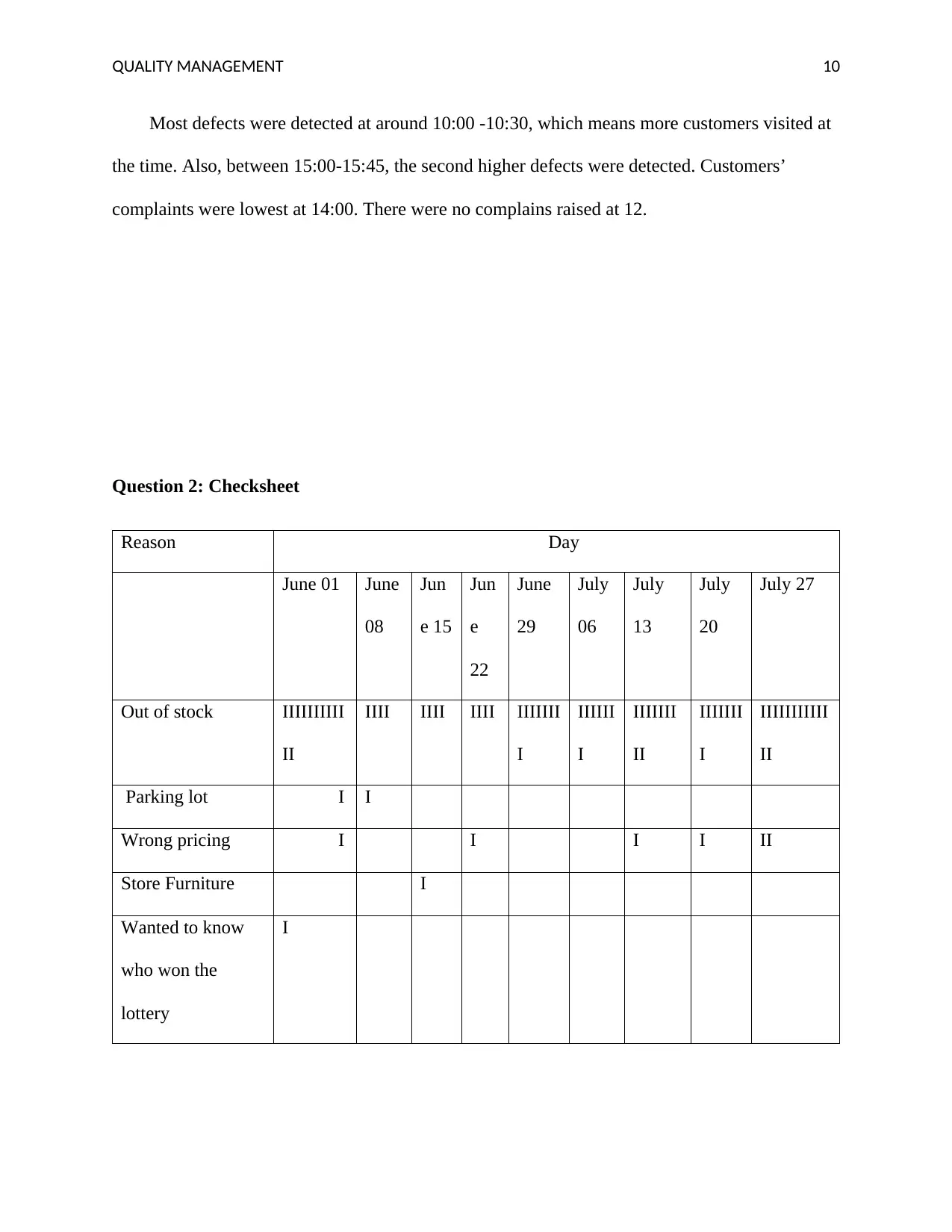
Most defects were detected at around 10:00 -10:30, which means more customers visited at
the time. Also, between 15:00-15:45, the second higher defects were detected. Customers’
complaints were lowest at 14:00. There were no complains raised at 12.
Question 2: Checksheet
Reason Day
June 01 June
08
Jun
e 15
Jun
e
22
June
29
July
06
July
13
July
20
July 27
Out of stock IIIIIIIIII
II
IIII IIII IIII IIIIIII
I
IIIIII
I
IIIIIII
II
IIIIIII
I
IIIIIIIIIII
II
Parking lot I I
Wrong pricing I I I I II
Store Furniture I
Wanted to know
who won the
lottery
I
Most defects were detected at around 10:00 -10:30, which means more customers visited at
the time. Also, between 15:00-15:45, the second higher defects were detected. Customers’
complaints were lowest at 14:00. There were no complains raised at 12.
Question 2: Checksheet
Reason Day
June 01 June
08
Jun
e 15
Jun
e
22
June
29
July
06
July
13
July
20
July 27
Out of stock IIIIIIIIII
II
IIII IIII IIII IIIIIII
I
IIIIII
I
IIIIIII
II
IIIIIII
I
IIIIIIIIIII
II
Parking lot I I
Wrong pricing I I I I II
Store Furniture I
Wanted to know
who won the
lottery
I
Paraphrase This Document
Need a fresh take? Get an instant paraphrase of this document with our AI Paraphraser

QUALITY MANAGEMENT 11
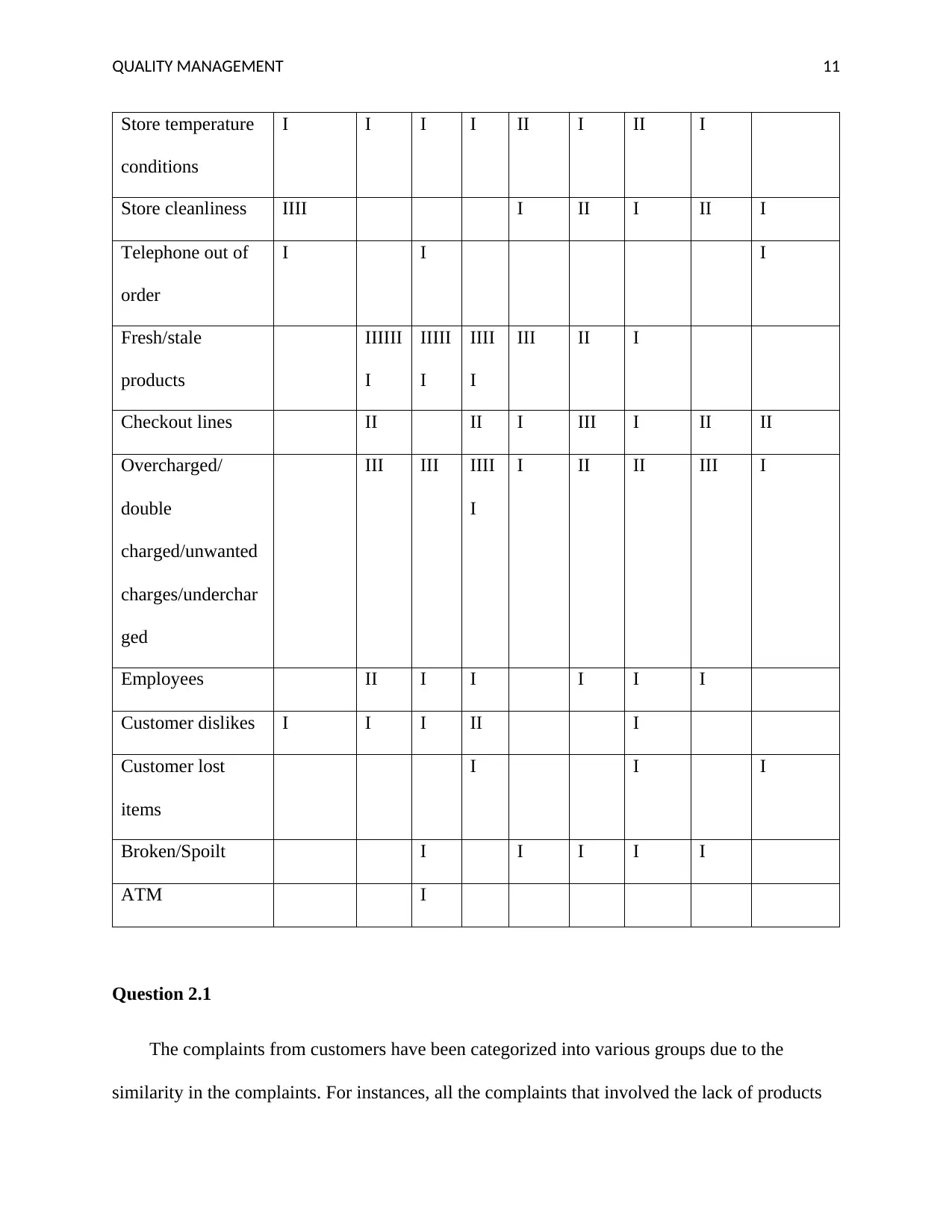
Store temperature
conditions
I I I I II I II I
Store cleanliness IIII I II I II I
Telephone out of
order
I I I
Fresh/stale
products
IIIIII
I
IIIII
I
IIII
I
III II I
Checkout lines II II I III I II II
Overcharged/
double
charged/unwanted
charges/underchar
ged
III III IIII
I
I II II III I
Employees II I I I I I
Customer dislikes I I I II I
Customer lost
items
I I I
Broken/Spoilt I I I I I
ATM I
Question 2.1
The complaints from customers have been categorized into various groups due to the
similarity in the complaints. For instances, all the complaints that involved the lack of products
Store temperature
conditions
I I I I II I II I
Store cleanliness IIII I II I II I
Telephone out of
order
I I I
Fresh/stale
products
IIIIII
I
IIIII
I
IIII
I
III II I
Checkout lines II II I III I II II
Overcharged/
double
charged/unwanted
charges/underchar
ged
III III IIII
I
I II II III I
Employees II I I I I I
Customer dislikes I I I II I
Customer lost
items
I I I
Broken/Spoilt I I I I I
ATM I
Question 2.1
The complaints from customers have been categorized into various groups due to the
similarity in the complaints. For instances, all the complaints that involved the lack of products

QUALITY MANAGEMENT 12
in the store and those that could not be found were categorized into out of stock category. There
were a few complaints in the parking lot thus; it was categorized on its own. Other complaints
that pertained to the wrong price in items were categorized under wrong pricing.
There were complaints about the room temperature of the store severally. Thus, these were
placed under the temperature category. Another broad category was on the fresh or stale
products. There were numerous complaints about some produce been stale, tasting bad or
smelling bad. The issue of overcharging, undercharging, and double charging fell under one
category. Also, there is the category of employees, where customers raised concerns over rude or
slow employees. The final category that recorded a slightly high number of complaints is the
checkout lines, where customers were concerned on long and slow queues. In the rest of the
categories, complaints appeared few times. These categories include broken or spoilt items,
ATM card, lost items, lottery winner, telephone out of order, and customers’ dislikes. In these
categories, minor complaints were raised in the period.
Question 2.2
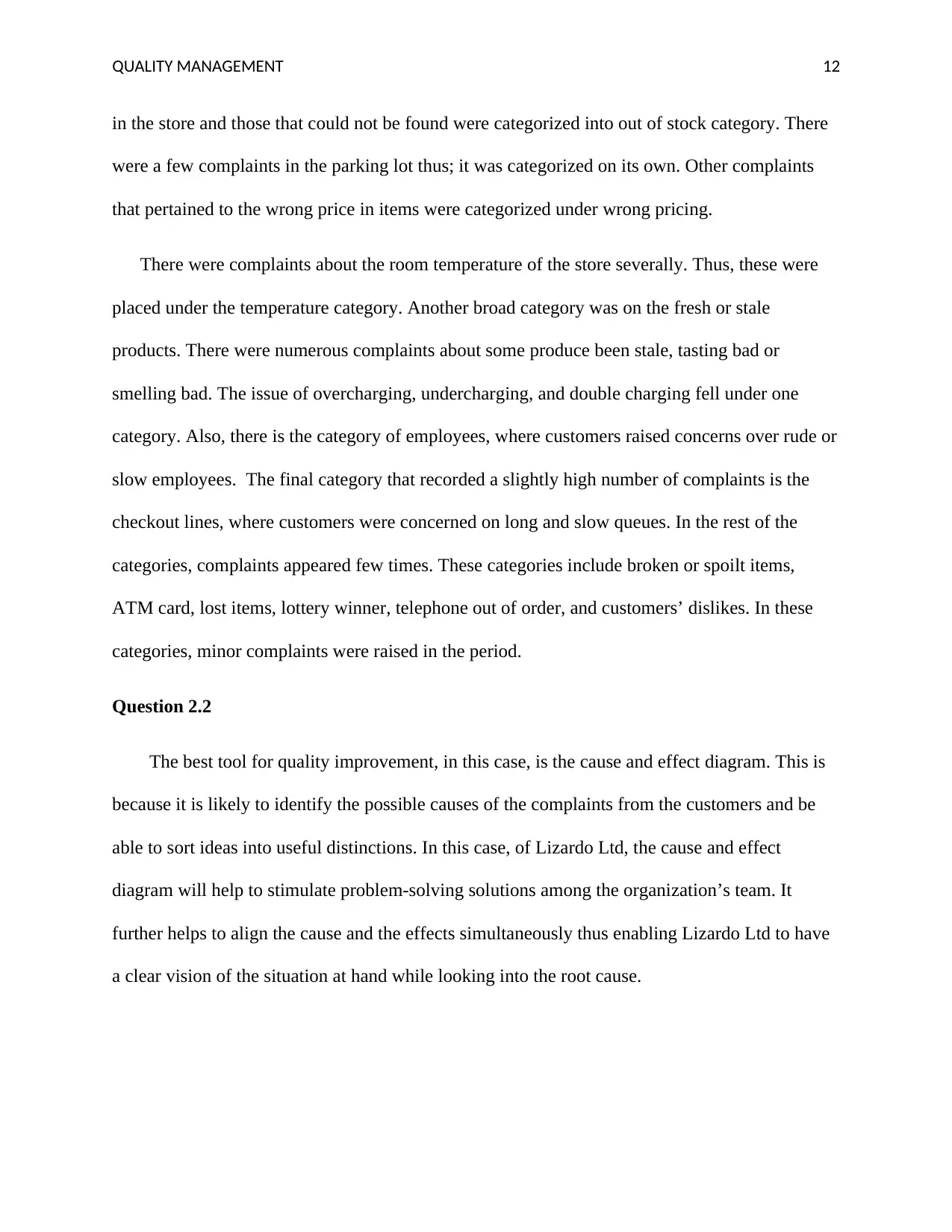
The best tool for quality improvement, in this case, is the cause and effect diagram. This is
because it is likely to identify the possible causes of the complaints from the customers and be
able to sort ideas into useful distinctions. In this case, of Lizardo Ltd, the cause and effect
diagram will help to stimulate problem-solving solutions among the organization’s team. It
further helps to align the cause and the effects simultaneously thus enabling Lizardo Ltd to have
a clear vision of the situation at hand while looking into the root cause.
in the store and those that could not be found were categorized into out of stock category. There
were a few complaints in the parking lot thus; it was categorized on its own. Other complaints
that pertained to the wrong price in items were categorized under wrong pricing.
There were complaints about the room temperature of the store severally. Thus, these were
placed under the temperature category. Another broad category was on the fresh or stale
products. There were numerous complaints about some produce been stale, tasting bad or
smelling bad. The issue of overcharging, undercharging, and double charging fell under one
category. Also, there is the category of employees, where customers raised concerns over rude or
slow employees. The final category that recorded a slightly high number of complaints is the
checkout lines, where customers were concerned on long and slow queues. In the rest of the
categories, complaints appeared few times. These categories include broken or spoilt items,
ATM card, lost items, lottery winner, telephone out of order, and customers’ dislikes. In these
categories, minor complaints were raised in the period.
Question 2.2
The best tool for quality improvement, in this case, is the cause and effect diagram. This is
because it is likely to identify the possible causes of the complaints from the customers and be
able to sort ideas into useful distinctions. In this case, of Lizardo Ltd, the cause and effect
diagram will help to stimulate problem-solving solutions among the organization’s team. It
further helps to align the cause and the effects simultaneously thus enabling Lizardo Ltd to have
a clear vision of the situation at hand while looking into the root cause.
⊘ This is a preview!⊘
Do you want full access?
Subscribe today to unlock all pages.

Trusted by 1+ million students worldwide
1 out of 22
Related Documents
Your All-in-One AI-Powered Toolkit for Academic Success.
+13062052269
info@desklib.com
Available 24*7 on WhatsApp / Email
Unlock your academic potential
Copyright © 2020–2025 A2Z Services. All Rights Reserved. Developed and managed by ZUCOL.