University Project: Quality of Project Management Process Assessment
VerifiedAdded on 2020/03/16
|37
|5491
|45
Project
AI Summary
This project management assignment delves into ensuring the quality of project management processes. It begins with a literature review of various methods, including the Organisational Project Management Maturity Model (OPM3), Capability Assessment Model, Project Management Office Function Model (PMO), and Project Management Performance Assessment Model (PMPA), each designed to assess and improve project quality. The assignment then details the development of an audit checklist template covering initiating, planning, executing, monitoring and controlling, and closing processes. This template includes specific indicators and remarks for each step. Furthermore, the assignment outlines a checklist for monitoring and controlling live projects, ensuring adherence to the established procedures. Finally, the project concludes with the development of two metrics, providing acceptance criteria for project work, thus offering a comprehensive approach to project quality assurance.
ASSIGNMENT 2: QUALITY OF THE PROJECT MANAGEMENT PROCESS
Student’s Name
University
Course ID
Date
Student’s Name
University
Course ID
Date

Paraphrase This Document
Need a fresh take? Get an instant paraphrase of this document with our AI Paraphraser
2
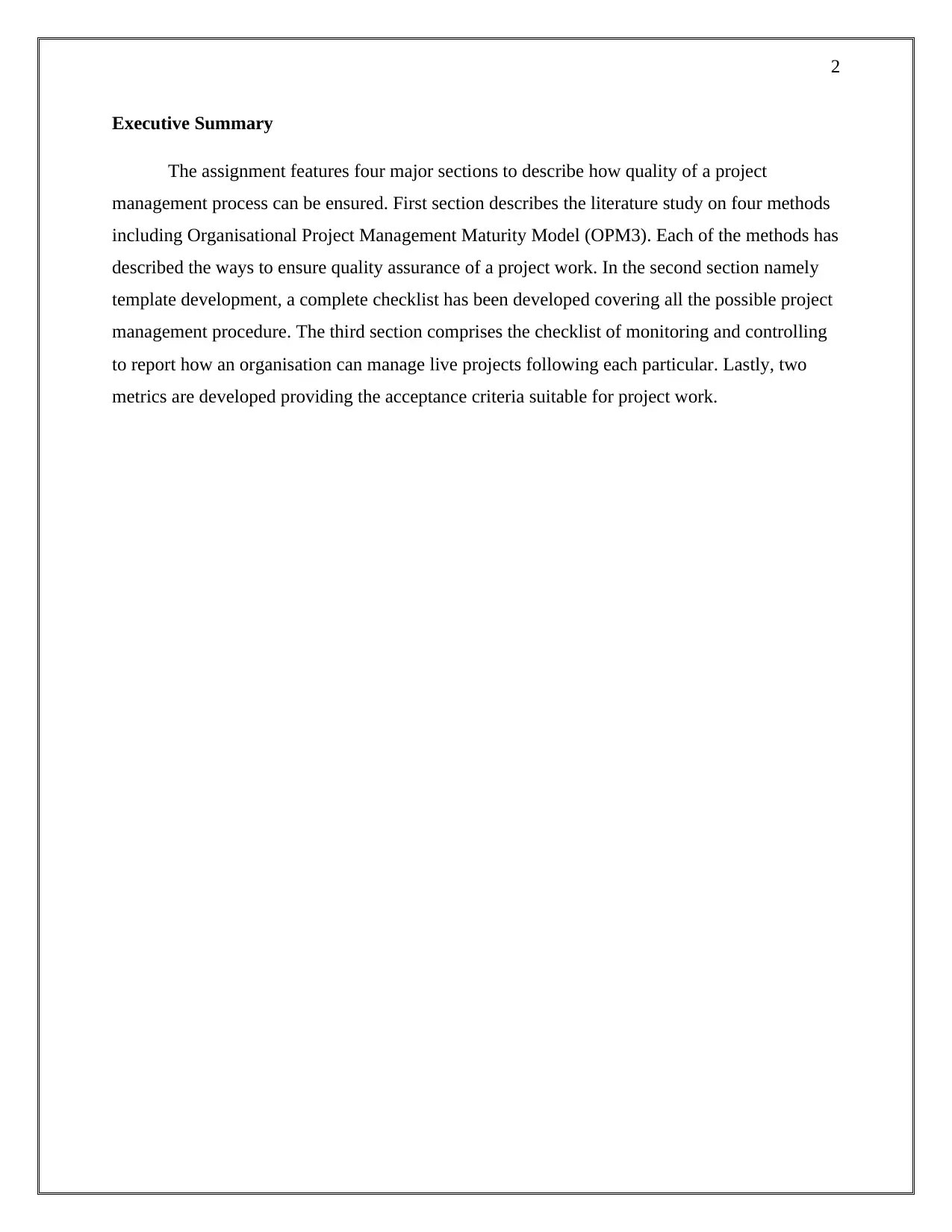
Executive Summary
The assignment features four major sections to describe how quality of a project
management process can be ensured. First section describes the literature study on four methods
including Organisational Project Management Maturity Model (OPM3). Each of the methods has
described the ways to ensure quality assurance of a project work. In the second section namely
template development, a complete checklist has been developed covering all the possible project
management procedure. The third section comprises the checklist of monitoring and controlling
to report how an organisation can manage live projects following each particular. Lastly, two
metrics are developed providing the acceptance criteria suitable for project work.
Executive Summary
The assignment features four major sections to describe how quality of a project
management process can be ensured. First section describes the literature study on four methods
including Organisational Project Management Maturity Model (OPM3). Each of the methods has
described the ways to ensure quality assurance of a project work. In the second section namely
template development, a complete checklist has been developed covering all the possible project
management procedure. The third section comprises the checklist of monitoring and controlling
to report how an organisation can manage live projects following each particular. Lastly, two
metrics are developed providing the acceptance criteria suitable for project work.
3
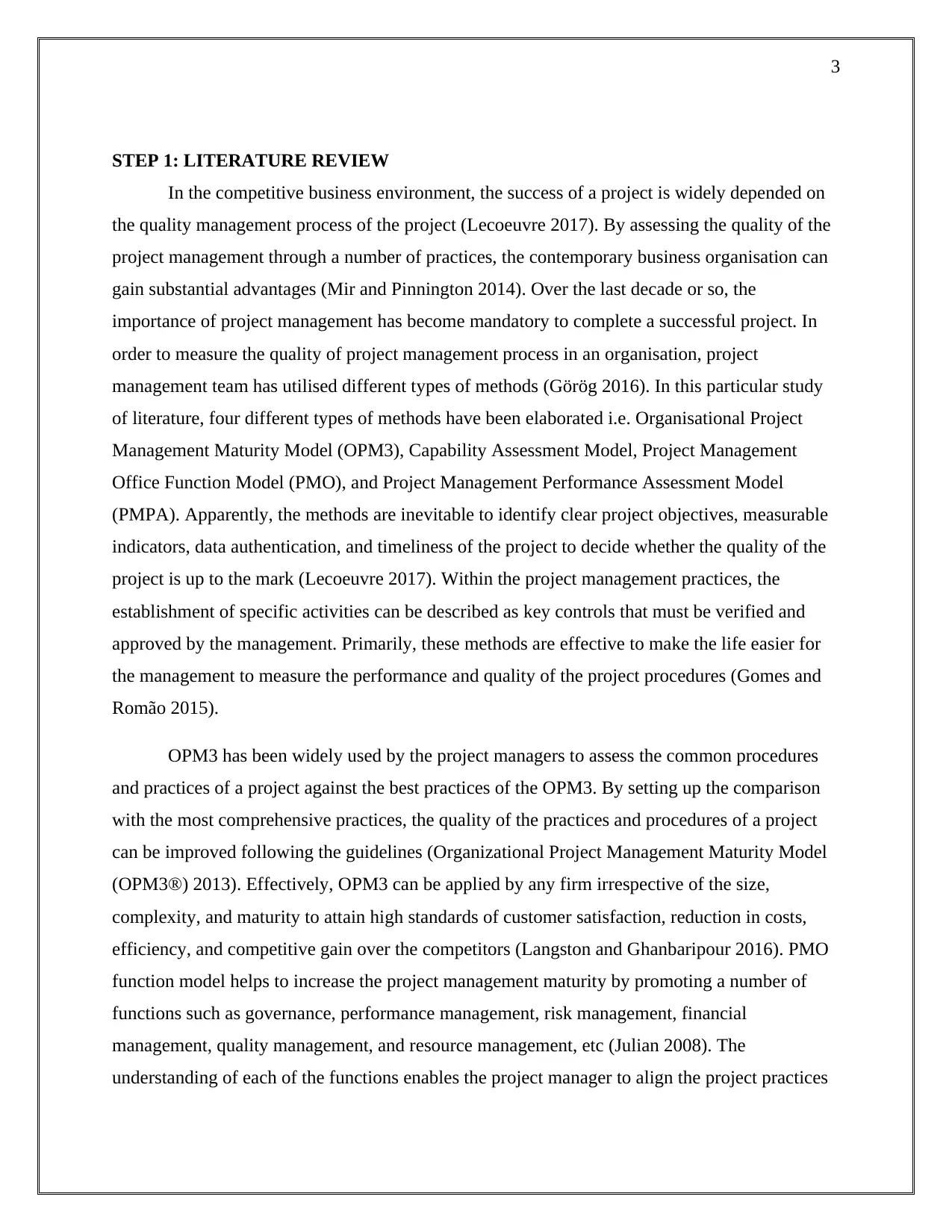
STEP 1: LITERATURE REVIEW
In the competitive business environment, the success of a project is widely depended on
the quality management process of the project (Lecoeuvre 2017). By assessing the quality of the
project management through a number of practices, the contemporary business organisation can
gain substantial advantages (Mir and Pinnington 2014). Over the last decade or so, the
importance of project management has become mandatory to complete a successful project. In
order to measure the quality of project management process in an organisation, project
management team has utilised different types of methods (Görög 2016). In this particular study
of literature, four different types of methods have been elaborated i.e. Organisational Project
Management Maturity Model (OPM3), Capability Assessment Model, Project Management
Office Function Model (PMO), and Project Management Performance Assessment Model
(PMPA). Apparently, the methods are inevitable to identify clear project objectives, measurable
indicators, data authentication, and timeliness of the project to decide whether the quality of the
project is up to the mark (Lecoeuvre 2017). Within the project management practices, the
establishment of specific activities can be described as key controls that must be verified and
approved by the management. Primarily, these methods are effective to make the life easier for
the management to measure the performance and quality of the project procedures (Gomes and
Romão 2015).
OPM3 has been widely used by the project managers to assess the common procedures
and practices of a project against the best practices of the OPM3. By setting up the comparison
with the most comprehensive practices, the quality of the practices and procedures of a project
can be improved following the guidelines (Organizational Project Management Maturity Model
(OPM3®) 2013). Effectively, OPM3 can be applied by any firm irrespective of the size,
complexity, and maturity to attain high standards of customer satisfaction, reduction in costs,
efficiency, and competitive gain over the competitors (Langston and Ghanbaripour 2016). PMO
function model helps to increase the project management maturity by promoting a number of
functions such as governance, performance management, risk management, financial
management, quality management, and resource management, etc (Julian 2008). The
understanding of each of the functions enables the project manager to align the project practices
STEP 1: LITERATURE REVIEW
In the competitive business environment, the success of a project is widely depended on
the quality management process of the project (Lecoeuvre 2017). By assessing the quality of the
project management through a number of practices, the contemporary business organisation can
gain substantial advantages (Mir and Pinnington 2014). Over the last decade or so, the
importance of project management has become mandatory to complete a successful project. In
order to measure the quality of project management process in an organisation, project
management team has utilised different types of methods (Görög 2016). In this particular study
of literature, four different types of methods have been elaborated i.e. Organisational Project
Management Maturity Model (OPM3), Capability Assessment Model, Project Management
Office Function Model (PMO), and Project Management Performance Assessment Model
(PMPA). Apparently, the methods are inevitable to identify clear project objectives, measurable
indicators, data authentication, and timeliness of the project to decide whether the quality of the
project is up to the mark (Lecoeuvre 2017). Within the project management practices, the
establishment of specific activities can be described as key controls that must be verified and
approved by the management. Primarily, these methods are effective to make the life easier for
the management to measure the performance and quality of the project procedures (Gomes and
Romão 2015).
OPM3 has been widely used by the project managers to assess the common procedures
and practices of a project against the best practices of the OPM3. By setting up the comparison
with the most comprehensive practices, the quality of the practices and procedures of a project
can be improved following the guidelines (Organizational Project Management Maturity Model
(OPM3®) 2013). Effectively, OPM3 can be applied by any firm irrespective of the size,
complexity, and maturity to attain high standards of customer satisfaction, reduction in costs,
efficiency, and competitive gain over the competitors (Langston and Ghanbaripour 2016). PMO
function model helps to increase the project management maturity by promoting a number of
functions such as governance, performance management, risk management, financial
management, quality management, and resource management, etc (Julian 2008). The
understanding of each of the functions enables the project manager to align the project practices
⊘ This is a preview!⊘
Do you want full access?
Subscribe today to unlock all pages.

Trusted by 1+ million students worldwide
4
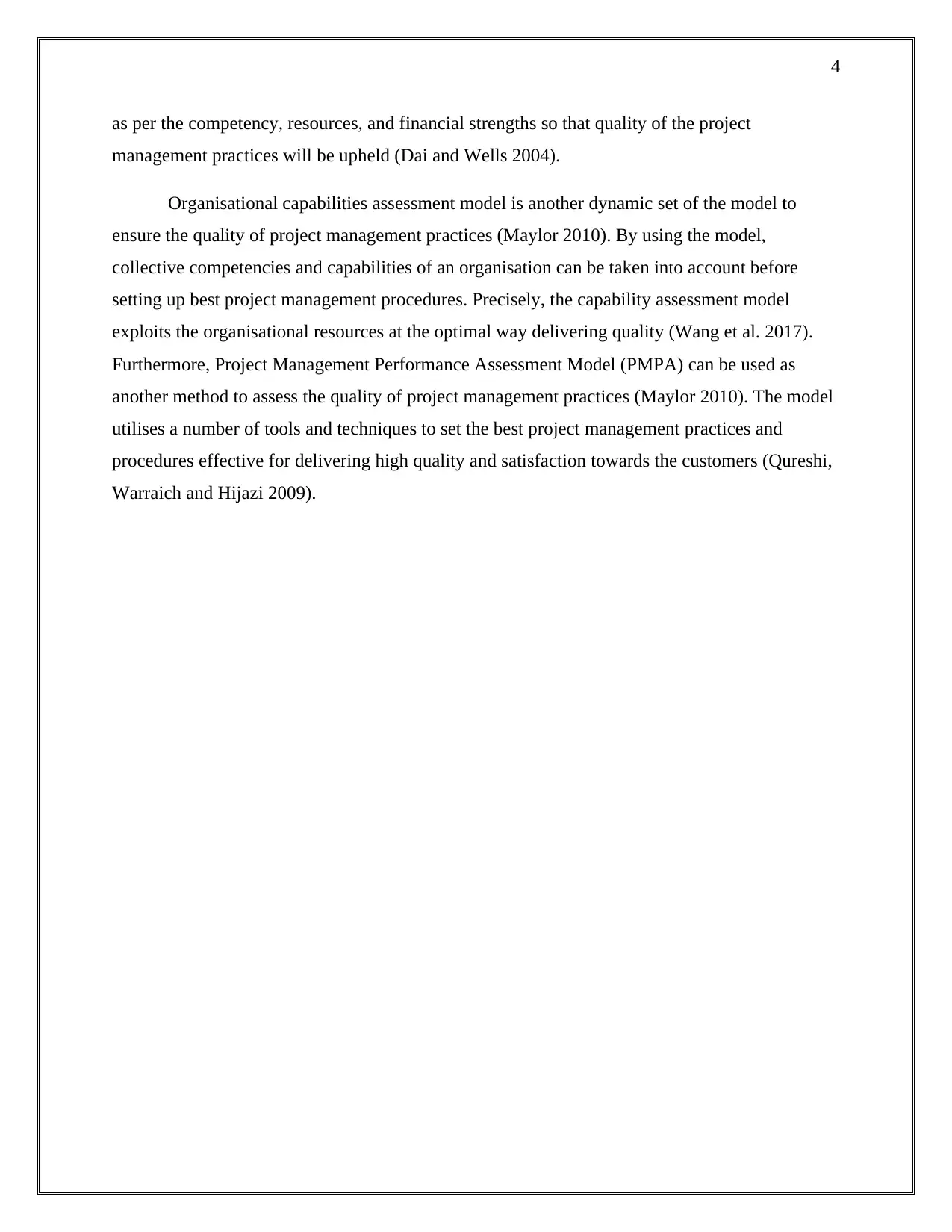
as per the competency, resources, and financial strengths so that quality of the project
management practices will be upheld (Dai and Wells 2004).
Organisational capabilities assessment model is another dynamic set of the model to
ensure the quality of project management practices (Maylor 2010). By using the model,
collective competencies and capabilities of an organisation can be taken into account before
setting up best project management procedures. Precisely, the capability assessment model
exploits the organisational resources at the optimal way delivering quality (Wang et al. 2017).
Furthermore, Project Management Performance Assessment Model (PMPA) can be used as
another method to assess the quality of project management practices (Maylor 2010). The model
utilises a number of tools and techniques to set the best project management practices and
procedures effective for delivering high quality and satisfaction towards the customers (Qureshi,
Warraich and Hijazi 2009).
as per the competency, resources, and financial strengths so that quality of the project
management practices will be upheld (Dai and Wells 2004).
Organisational capabilities assessment model is another dynamic set of the model to
ensure the quality of project management practices (Maylor 2010). By using the model,
collective competencies and capabilities of an organisation can be taken into account before
setting up best project management procedures. Precisely, the capability assessment model
exploits the organisational resources at the optimal way delivering quality (Wang et al. 2017).
Furthermore, Project Management Performance Assessment Model (PMPA) can be used as
another method to assess the quality of project management practices (Maylor 2010). The model
utilises a number of tools and techniques to set the best project management practices and
procedures effective for delivering high quality and satisfaction towards the customers (Qureshi,
Warraich and Hijazi 2009).
Paraphrase This Document
Need a fresh take? Get an instant paraphrase of this document with our AI Paraphraser
5
STEP 2: TEMPLATE
2. A: Template of Audit Checklist
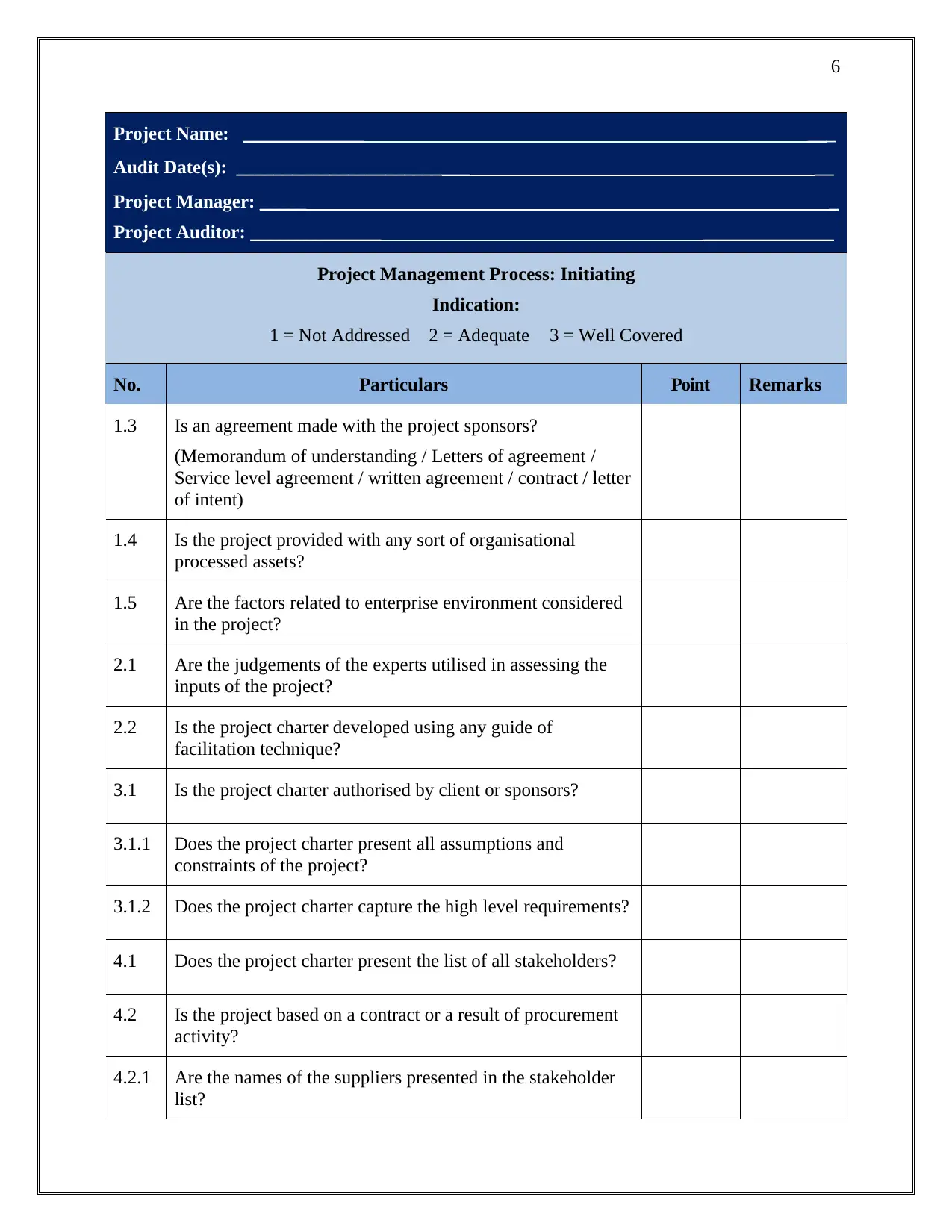
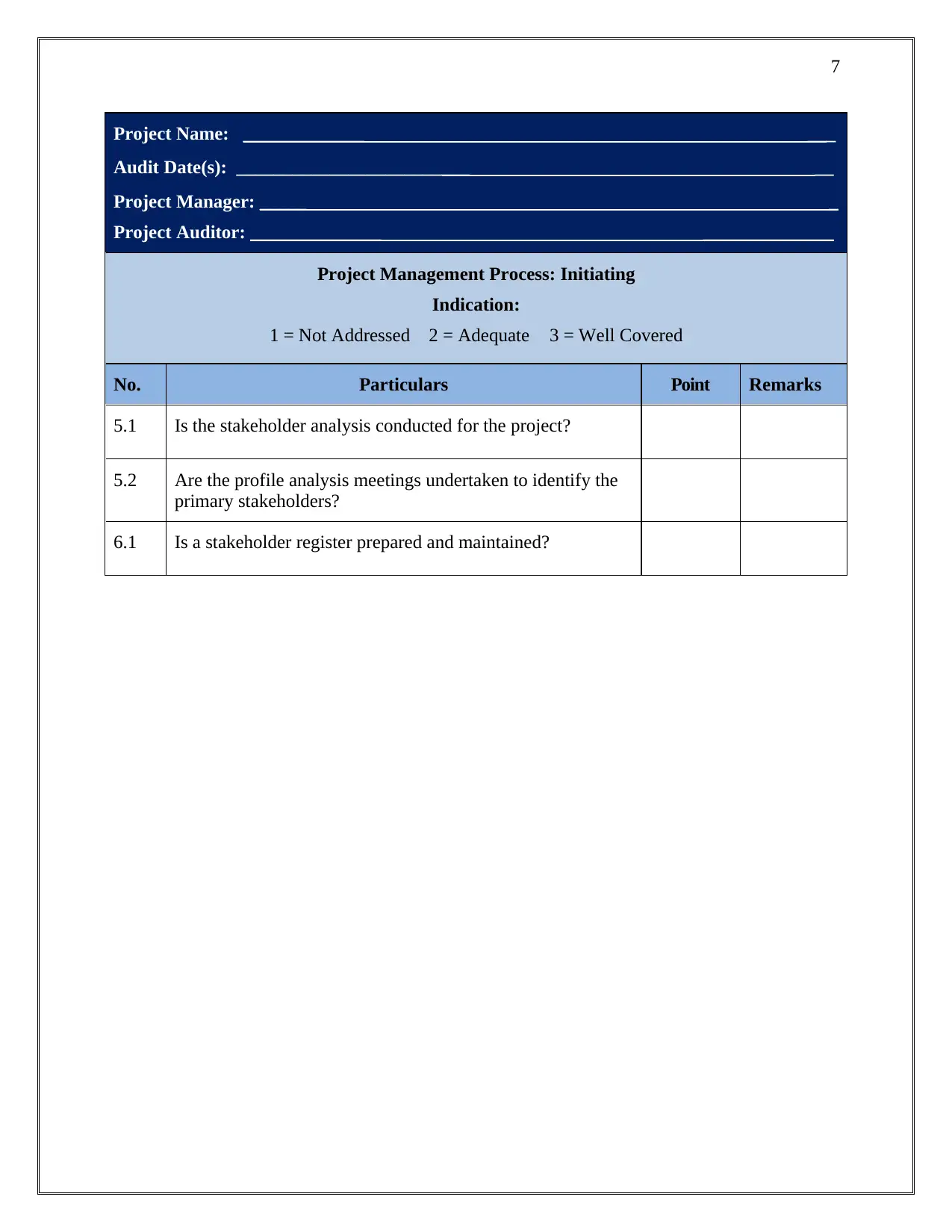
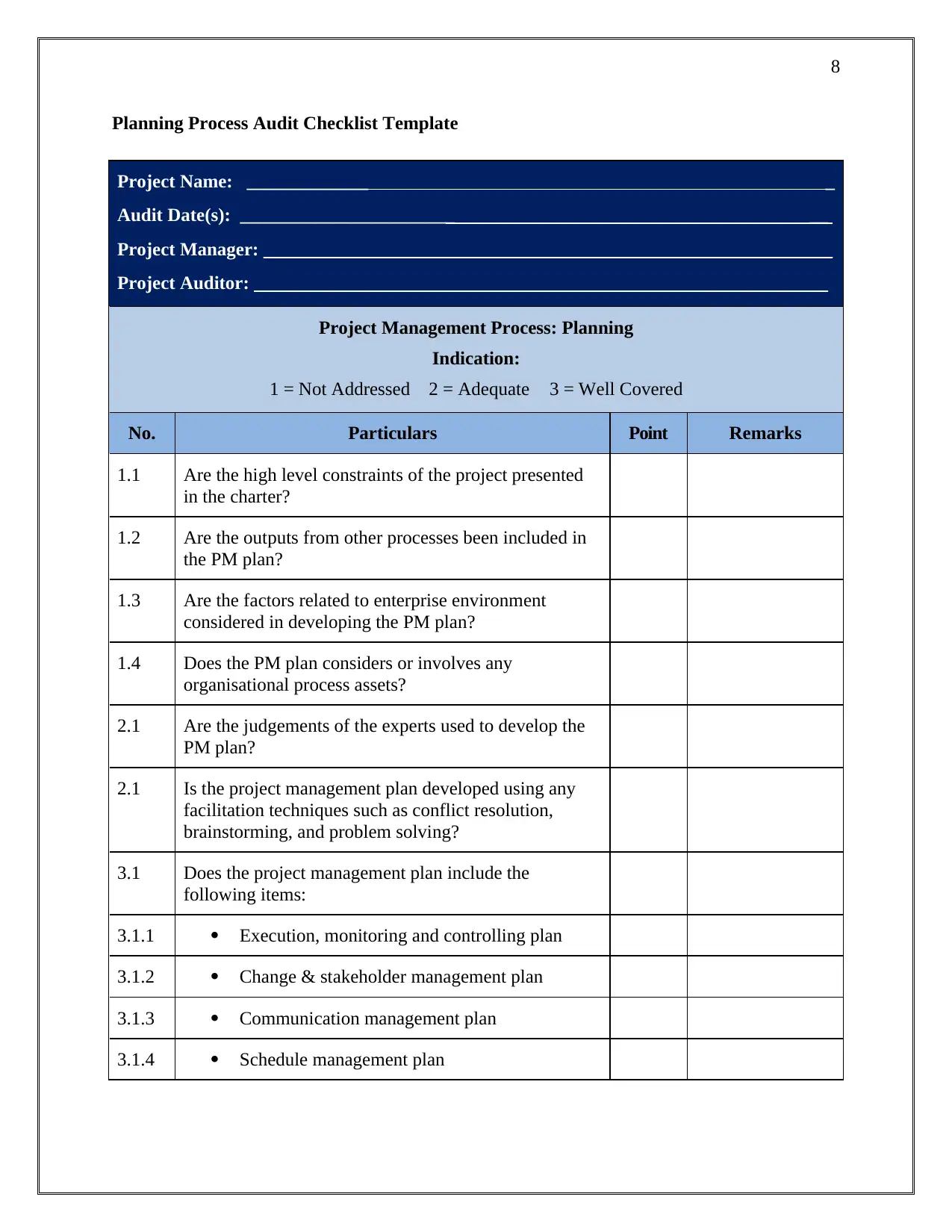
In order to maintain the quality of the project management process, the checklist of the
particulars involving five steps i.e. initiating, planning, executing, monitoring and controlling,
and closing has been described. By commencing the audit, the auditor must deliver indicative
points to verify whether the process rightly involves each of the particulars. Leading to this, the
non-conformance report (NCR) has also been addressed at the end of the section.
Initiating Process Audit Checklist Template
Project Name: _____________ ___
Audit Date(s): _________________________ __
Project Manager: _____ _
Project Auditor: ______________ ______________
Project Management Process: Initiating
Indication:
1 = Not Addressed 2 = Adequate 3 = Well Covered
No. Particulars Point Remarks
1.1 Is the project statement of work received from the project
sponsor or initiator?
1.1.1 Does the project idea have been initiated to meet a business
need?
1.1.2 Does the project align with the strategic plan of the
organisation?
1.1.3 Is the product scope document clearly presented?
1.2 Is the business case created and approved?
STEP 2: TEMPLATE
2. A: Template of Audit Checklist
In order to maintain the quality of the project management process, the checklist of the
particulars involving five steps i.e. initiating, planning, executing, monitoring and controlling,
and closing has been described. By commencing the audit, the auditor must deliver indicative
points to verify whether the process rightly involves each of the particulars. Leading to this, the
non-conformance report (NCR) has also been addressed at the end of the section.
Initiating Process Audit Checklist Template
Project Name: _____________ ___
Audit Date(s): _________________________ __
Project Manager: _____ _
Project Auditor: ______________ ______________
Project Management Process: Initiating
Indication:
1 = Not Addressed 2 = Adequate 3 = Well Covered
No. Particulars Point Remarks
1.1 Is the project statement of work received from the project
sponsor or initiator?
1.1.1 Does the project idea have been initiated to meet a business
need?
1.1.2 Does the project align with the strategic plan of the
organisation?
1.1.3 Is the product scope document clearly presented?
1.2 Is the business case created and approved?
6
Project Name: _____________ ___
Audit Date(s): _________________________ __
Project Manager: _____ _
Project Auditor: ______________ ______________
Project Management Process: Initiating
Indication:
1 = Not Addressed 2 = Adequate 3 = Well Covered
No. Particulars Point Remarks
1.3 Is an agreement made with the project sponsors?
(Memorandum of understanding / Letters of agreement /
Service level agreement / written agreement / contract / letter
of intent)
1.4 Is the project provided with any sort of organisational
processed assets?
1.5 Are the factors related to enterprise environment considered
in the project?
2.1 Are the judgements of the experts utilised in assessing the
inputs of the project?
2.2 Is the project charter developed using any guide of
facilitation technique?
3.1 Is the project charter authorised by client or sponsors?
3.1.1 Does the project charter present all assumptions and
constraints of the project?
3.1.2 Does the project charter capture the high level requirements?
4.1 Does the project charter present the list of all stakeholders?
4.2 Is the project based on a contract or a result of procurement
activity?
4.2.1 Are the names of the suppliers presented in the stakeholder
list?
Project Name: _____________ ___
Audit Date(s): _________________________ __
Project Manager: _____ _
Project Auditor: ______________ ______________
Project Management Process: Initiating
Indication:
1 = Not Addressed 2 = Adequate 3 = Well Covered
No. Particulars Point Remarks
1.3 Is an agreement made with the project sponsors?
(Memorandum of understanding / Letters of agreement /
Service level agreement / written agreement / contract / letter
of intent)
1.4 Is the project provided with any sort of organisational
processed assets?
1.5 Are the factors related to enterprise environment considered
in the project?
2.1 Are the judgements of the experts utilised in assessing the
inputs of the project?
2.2 Is the project charter developed using any guide of
facilitation technique?
3.1 Is the project charter authorised by client or sponsors?
3.1.1 Does the project charter present all assumptions and
constraints of the project?
3.1.2 Does the project charter capture the high level requirements?
4.1 Does the project charter present the list of all stakeholders?
4.2 Is the project based on a contract or a result of procurement
activity?
4.2.1 Are the names of the suppliers presented in the stakeholder
list?
⊘ This is a preview!⊘
Do you want full access?
Subscribe today to unlock all pages.
Trusted by 1+ million students worldwide
7
Project Name: _____________ ___
Audit Date(s): _________________________ __
Project Manager: _____ _
Project Auditor: ______________ ______________
Project Management Process: Initiating
Indication:
1 = Not Addressed 2 = Adequate 3 = Well Covered
No. Particulars Point Remarks
5.1 Is the stakeholder analysis conducted for the project?
5.2 Are the profile analysis meetings undertaken to identify the
primary stakeholders?
6.1 Is a stakeholder register prepared and maintained?
Project Name: _____________ ___
Audit Date(s): _________________________ __
Project Manager: _____ _
Project Auditor: ______________ ______________
Project Management Process: Initiating
Indication:
1 = Not Addressed 2 = Adequate 3 = Well Covered
No. Particulars Point Remarks
5.1 Is the stakeholder analysis conducted for the project?
5.2 Are the profile analysis meetings undertaken to identify the
primary stakeholders?
6.1 Is a stakeholder register prepared and maintained?
Paraphrase This Document
Need a fresh take? Get an instant paraphrase of this document with our AI Paraphraser
8
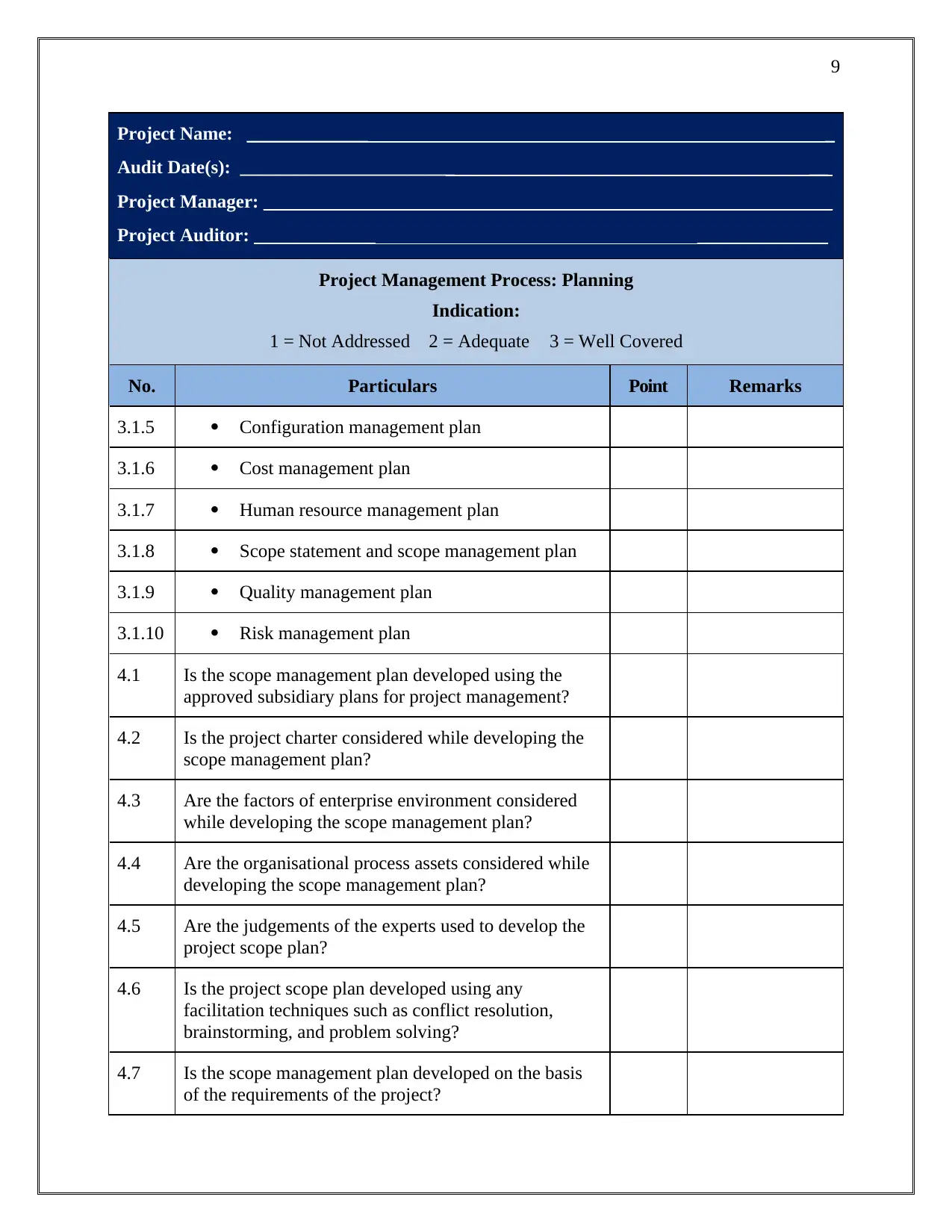
Planning Process Audit Checklist Template
Project Name: _____________ _
Audit Date(s): _______________________ __
Project Manager: ____ _
Project Auditor: _____________ ______________
Project Management Process: Planning
Indication:
1 = Not Addressed 2 = Adequate 3 = Well Covered
No. Particulars Point Remarks
1.1 Are the high level constraints of the project presented
in the charter?
1.2 Are the outputs from other processes been included in
the PM plan?
1.3 Are the factors related to enterprise environment
considered in developing the PM plan?
1.4 Does the PM plan considers or involves any
organisational process assets?
2.1 Are the judgements of the experts used to develop the
PM plan?
2.1 Is the project management plan developed using any
facilitation techniques such as conflict resolution,
brainstorming, and problem solving?
3.1 Does the project management plan include the
following items:
3.1.1 Execution, monitoring and controlling plan
3.1.2 Change & stakeholder management plan
3.1.3 Communication management plan
3.1.4 Schedule management plan
Planning Process Audit Checklist Template
Project Name: _____________ _
Audit Date(s): _______________________ __
Project Manager: ____ _
Project Auditor: _____________ ______________
Project Management Process: Planning
Indication:
1 = Not Addressed 2 = Adequate 3 = Well Covered
No. Particulars Point Remarks
1.1 Are the high level constraints of the project presented
in the charter?
1.2 Are the outputs from other processes been included in
the PM plan?
1.3 Are the factors related to enterprise environment
considered in developing the PM plan?
1.4 Does the PM plan considers or involves any
organisational process assets?
2.1 Are the judgements of the experts used to develop the
PM plan?
2.1 Is the project management plan developed using any
facilitation techniques such as conflict resolution,
brainstorming, and problem solving?
3.1 Does the project management plan include the
following items:
3.1.1 Execution, monitoring and controlling plan
3.1.2 Change & stakeholder management plan
3.1.3 Communication management plan
3.1.4 Schedule management plan
9
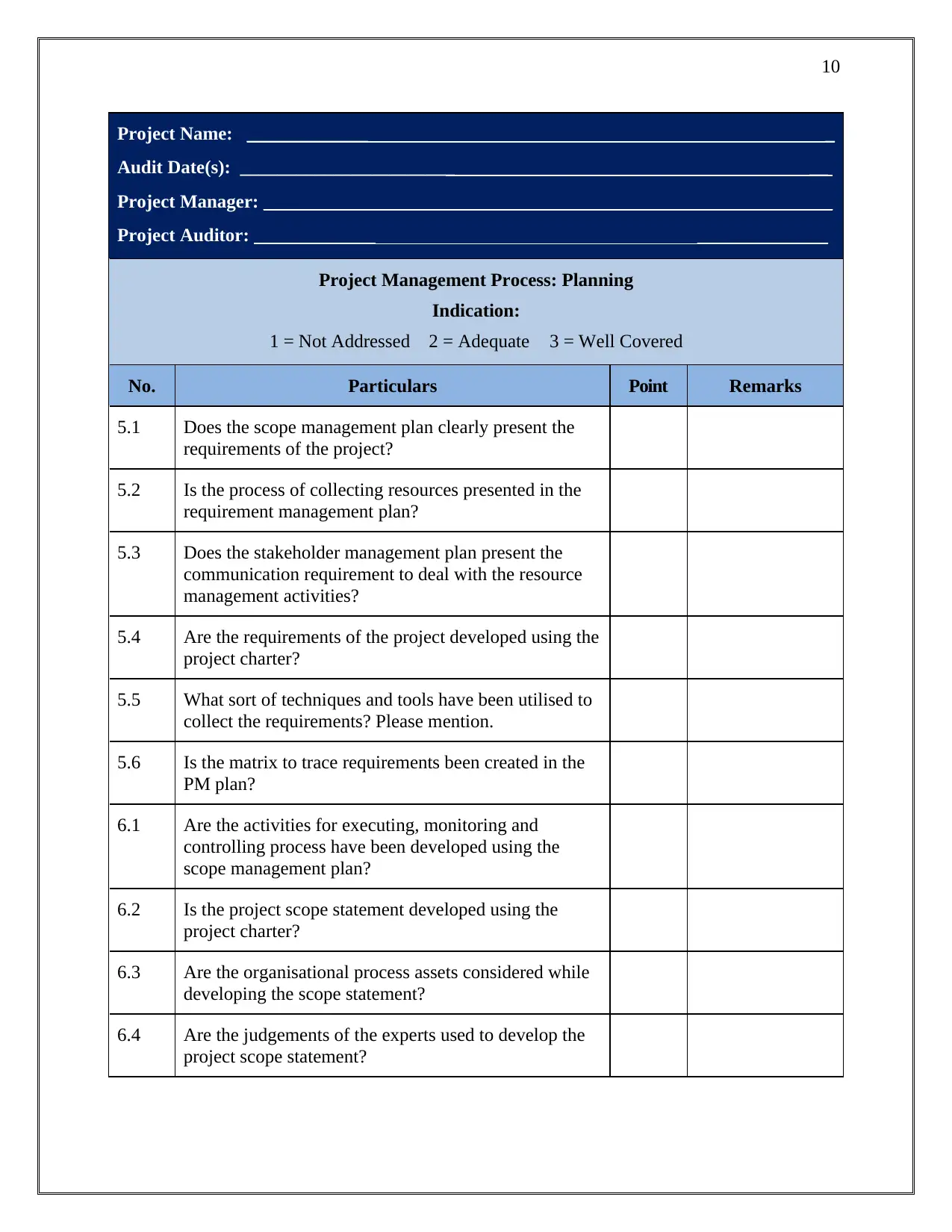
Project Name: _____________ _
Audit Date(s): _______________________ __
Project Manager: ____ _
Project Auditor: _____________ ______________
Project Management Process: Planning
Indication:
1 = Not Addressed 2 = Adequate 3 = Well Covered
No. Particulars Point Remarks
3.1.5 Configuration management plan
3.1.6 Cost management plan
3.1.7 Human resource management plan
3.1.8 Scope statement and scope management plan
3.1.9 Quality management plan
3.1.10 Risk management plan
4.1 Is the scope management plan developed using the
approved subsidiary plans for project management?
4.2 Is the project charter considered while developing the
scope management plan?
4.3 Are the factors of enterprise environment considered
while developing the scope management plan?
4.4 Are the organisational process assets considered while
developing the scope management plan?
4.5 Are the judgements of the experts used to develop the
project scope plan?
4.6 Is the project scope plan developed using any
facilitation techniques such as conflict resolution,
brainstorming, and problem solving?
4.7 Is the scope management plan developed on the basis
of the requirements of the project?
Project Name: _____________ _
Audit Date(s): _______________________ __
Project Manager: ____ _
Project Auditor: _____________ ______________
Project Management Process: Planning
Indication:
1 = Not Addressed 2 = Adequate 3 = Well Covered
No. Particulars Point Remarks
3.1.5 Configuration management plan
3.1.6 Cost management plan
3.1.7 Human resource management plan
3.1.8 Scope statement and scope management plan
3.1.9 Quality management plan
3.1.10 Risk management plan
4.1 Is the scope management plan developed using the
approved subsidiary plans for project management?
4.2 Is the project charter considered while developing the
scope management plan?
4.3 Are the factors of enterprise environment considered
while developing the scope management plan?
4.4 Are the organisational process assets considered while
developing the scope management plan?
4.5 Are the judgements of the experts used to develop the
project scope plan?
4.6 Is the project scope plan developed using any
facilitation techniques such as conflict resolution,
brainstorming, and problem solving?
4.7 Is the scope management plan developed on the basis
of the requirements of the project?
⊘ This is a preview!⊘
Do you want full access?
Subscribe today to unlock all pages.
Trusted by 1+ million students worldwide
10
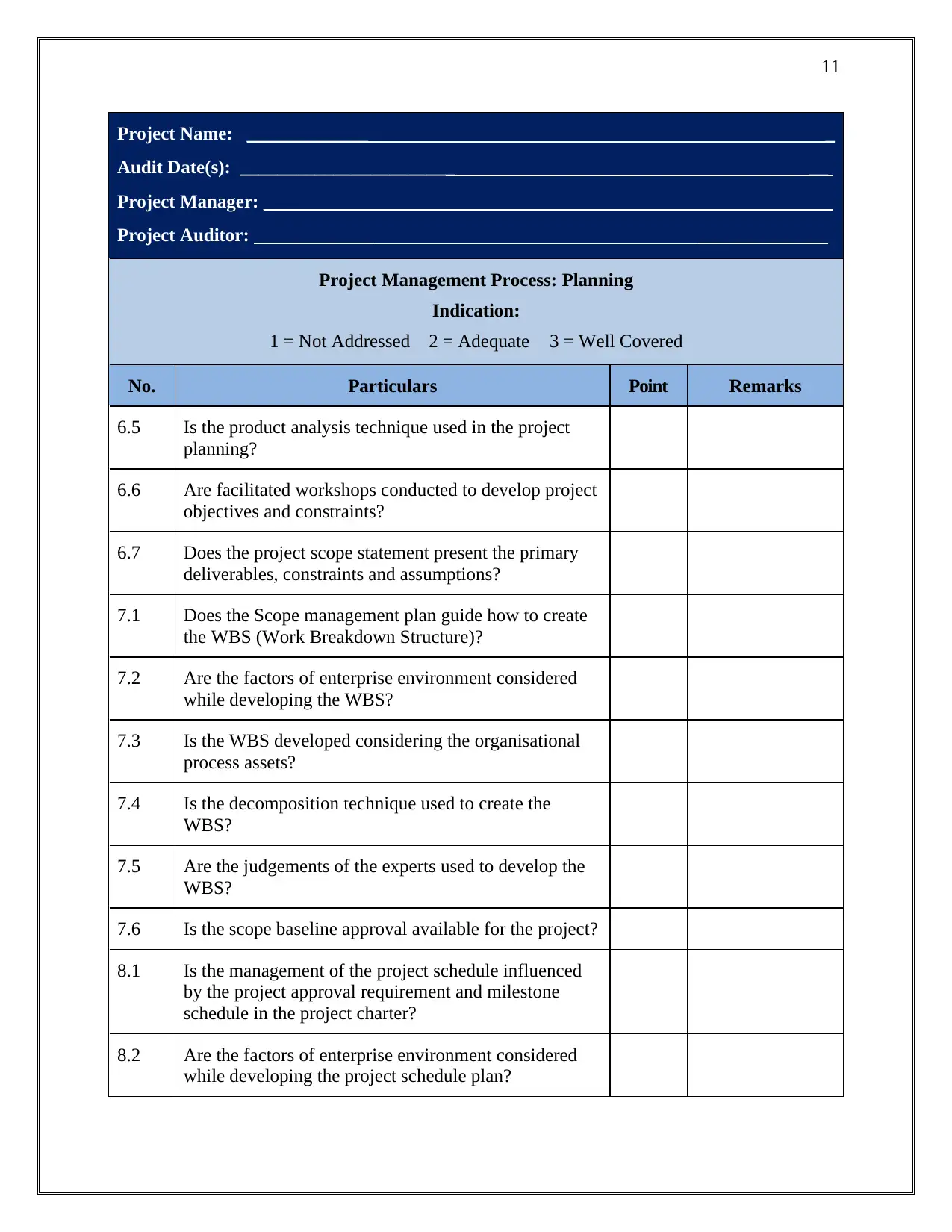
Project Name: _____________ _
Audit Date(s): _______________________ __
Project Manager: ____ _
Project Auditor: _____________ ______________
Project Management Process: Planning
Indication:
1 = Not Addressed 2 = Adequate 3 = Well Covered
No. Particulars Point Remarks
5.1 Does the scope management plan clearly present the
requirements of the project?
5.2 Is the process of collecting resources presented in the
requirement management plan?
5.3 Does the stakeholder management plan present the
communication requirement to deal with the resource
management activities?
5.4 Are the requirements of the project developed using the
project charter?
5.5 What sort of techniques and tools have been utilised to
collect the requirements? Please mention.
5.6 Is the matrix to trace requirements been created in the
PM plan?
6.1 Are the activities for executing, monitoring and
controlling process have been developed using the
scope management plan?
6.2 Is the project scope statement developed using the
project charter?
6.3 Are the organisational process assets considered while
developing the scope statement?
6.4 Are the judgements of the experts used to develop the
project scope statement?
Project Name: _____________ _
Audit Date(s): _______________________ __
Project Manager: ____ _
Project Auditor: _____________ ______________
Project Management Process: Planning
Indication:
1 = Not Addressed 2 = Adequate 3 = Well Covered
No. Particulars Point Remarks
5.1 Does the scope management plan clearly present the
requirements of the project?
5.2 Is the process of collecting resources presented in the
requirement management plan?
5.3 Does the stakeholder management plan present the
communication requirement to deal with the resource
management activities?
5.4 Are the requirements of the project developed using the
project charter?
5.5 What sort of techniques and tools have been utilised to
collect the requirements? Please mention.
5.6 Is the matrix to trace requirements been created in the
PM plan?
6.1 Are the activities for executing, monitoring and
controlling process have been developed using the
scope management plan?
6.2 Is the project scope statement developed using the
project charter?
6.3 Are the organisational process assets considered while
developing the scope statement?
6.4 Are the judgements of the experts used to develop the
project scope statement?
Paraphrase This Document
Need a fresh take? Get an instant paraphrase of this document with our AI Paraphraser
11
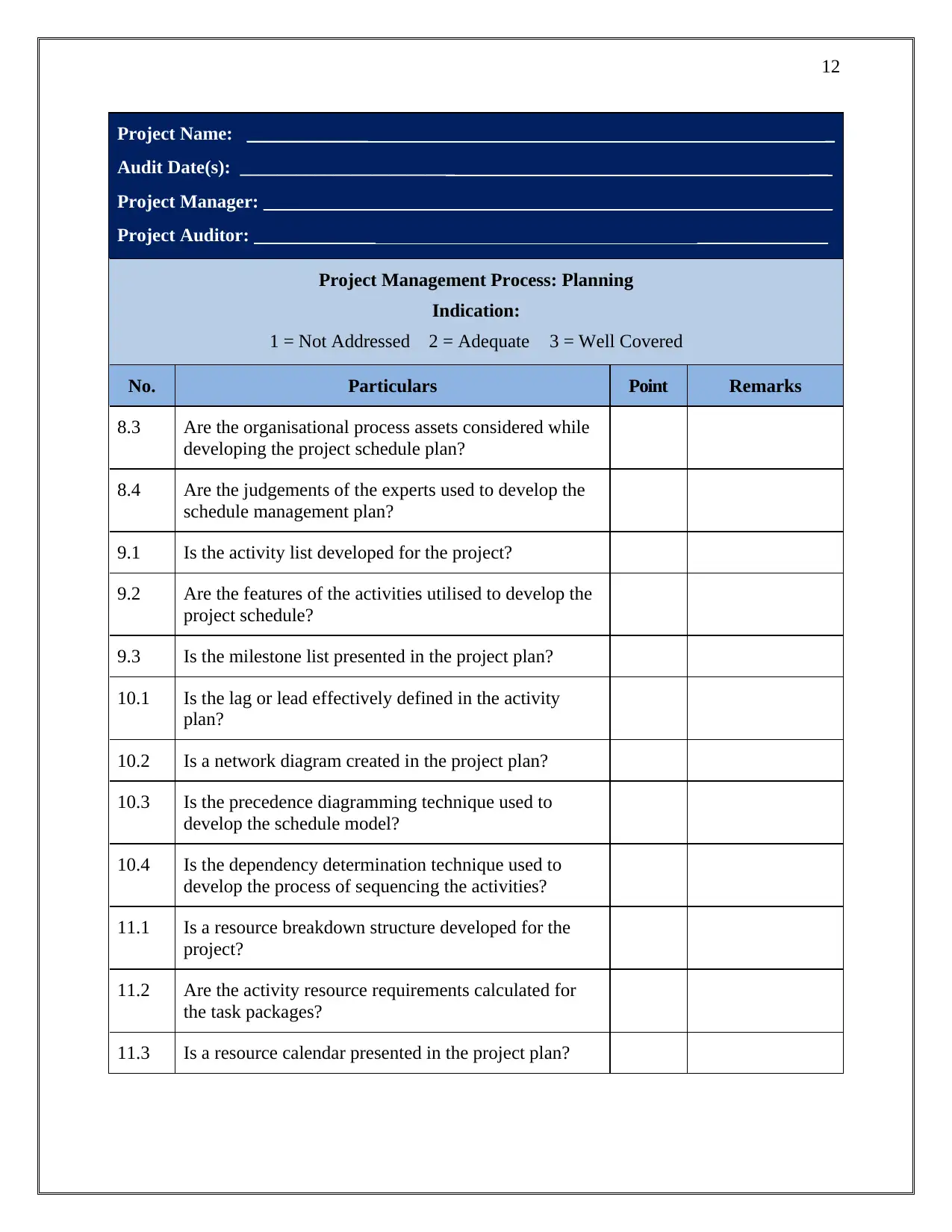
Project Name: _____________ _
Audit Date(s): _______________________ __
Project Manager: ____ _
Project Auditor: _____________ ______________
Project Management Process: Planning
Indication:
1 = Not Addressed 2 = Adequate 3 = Well Covered
No. Particulars Point Remarks
6.5 Is the product analysis technique used in the project
planning?
6.6 Are facilitated workshops conducted to develop project
objectives and constraints?
6.7 Does the project scope statement present the primary
deliverables, constraints and assumptions?
7.1 Does the Scope management plan guide how to create
the WBS (Work Breakdown Structure)?
7.2 Are the factors of enterprise environment considered
while developing the WBS?
7.3 Is the WBS developed considering the organisational
process assets?
7.4 Is the decomposition technique used to create the
WBS?
7.5 Are the judgements of the experts used to develop the
WBS?
7.6 Is the scope baseline approval available for the project?
8.1 Is the management of the project schedule influenced
by the project approval requirement and milestone
schedule in the project charter?
8.2 Are the factors of enterprise environment considered
while developing the project schedule plan?
Project Name: _____________ _
Audit Date(s): _______________________ __
Project Manager: ____ _
Project Auditor: _____________ ______________
Project Management Process: Planning
Indication:
1 = Not Addressed 2 = Adequate 3 = Well Covered
No. Particulars Point Remarks
6.5 Is the product analysis technique used in the project
planning?
6.6 Are facilitated workshops conducted to develop project
objectives and constraints?
6.7 Does the project scope statement present the primary
deliverables, constraints and assumptions?
7.1 Does the Scope management plan guide how to create
the WBS (Work Breakdown Structure)?
7.2 Are the factors of enterprise environment considered
while developing the WBS?
7.3 Is the WBS developed considering the organisational
process assets?
7.4 Is the decomposition technique used to create the
WBS?
7.5 Are the judgements of the experts used to develop the
WBS?
7.6 Is the scope baseline approval available for the project?
8.1 Is the management of the project schedule influenced
by the project approval requirement and milestone
schedule in the project charter?
8.2 Are the factors of enterprise environment considered
while developing the project schedule plan?
12
Project Name: _____________ _
Audit Date(s): _______________________ __
Project Manager: ____ _
Project Auditor: _____________ ______________
Project Management Process: Planning
Indication:
1 = Not Addressed 2 = Adequate 3 = Well Covered
No. Particulars Point Remarks
8.3 Are the organisational process assets considered while
developing the project schedule plan?
8.4 Are the judgements of the experts used to develop the
schedule management plan?
9.1 Is the activity list developed for the project?
9.2 Are the features of the activities utilised to develop the
project schedule?
9.3 Is the milestone list presented in the project plan?
10.1 Is the lag or lead effectively defined in the activity
plan?
10.2 Is a network diagram created in the project plan?
10.3 Is the precedence diagramming technique used to
develop the schedule model?
10.4 Is the dependency determination technique used to
develop the process of sequencing the activities?
11.1 Is a resource breakdown structure developed for the
project?
11.2 Are the activity resource requirements calculated for
the task packages?
11.3 Is a resource calendar presented in the project plan?
Project Name: _____________ _
Audit Date(s): _______________________ __
Project Manager: ____ _
Project Auditor: _____________ ______________
Project Management Process: Planning
Indication:
1 = Not Addressed 2 = Adequate 3 = Well Covered
No. Particulars Point Remarks
8.3 Are the organisational process assets considered while
developing the project schedule plan?
8.4 Are the judgements of the experts used to develop the
schedule management plan?
9.1 Is the activity list developed for the project?
9.2 Are the features of the activities utilised to develop the
project schedule?
9.3 Is the milestone list presented in the project plan?
10.1 Is the lag or lead effectively defined in the activity
plan?
10.2 Is a network diagram created in the project plan?
10.3 Is the precedence diagramming technique used to
develop the schedule model?
10.4 Is the dependency determination technique used to
develop the process of sequencing the activities?
11.1 Is a resource breakdown structure developed for the
project?
11.2 Are the activity resource requirements calculated for
the task packages?
11.3 Is a resource calendar presented in the project plan?
⊘ This is a preview!⊘
Do you want full access?
Subscribe today to unlock all pages.
Trusted by 1+ million students worldwide

1 out of 37


Related Documents


Your All-in-One AI-Powered Toolkit for Academic Success.
+13062052269
info@desklib.com
Available 24*7 on WhatsApp / Email
![[object Object]](/_next/static/media/star-bottom.7253800d.svg)
Unlock your academic potential
Copyright © 2020–2026 A2Z Services. All Rights Reserved. Developed and managed by ZUCOL.