Quantitative Analysis of Woolworths: Strategies and Customer Base
VerifiedAdded on 2023/03/30
|17
|3564
|126
Report
AI Summary
This report presents a quantitative analysis of Woolworths, a major Australian grocery retailer, examining its pricing strategies and their impact on customer loyalty and market standing. The analysis explores the organizational background, focusing on the shift from promotional strategies to consistent low pricing and the resulting customer backlash. The literature review defines and measures the dependent variable (customer base) using nominal, ordinal, interval, and ratio scales. Independent and moderating variables, such as internal communication and market competition, are also discussed. Hypotheses are formulated to test the relationships between variables, leading to a proposed conceptual model that integrates pricing strategy, internal communication, and market competition. The report outlines a questionnaire design and research plan to test the model and provides a conclusion based on the findings. The study aims to provide insights into how Woolworths can address its challenges and maintain a strong market position.
0
Running Head: Quantitative Analysis Of Woolworths
QUANTITATIVE ANALYSIS OF WOOLWORTHS
Running Head: Quantitative Analysis Of Woolworths
QUANTITATIVE ANALYSIS OF WOOLWORTHS

Paraphrase This Document
Need a fresh take? Get an instant paraphrase of this document with our AI Paraphraser
1
Quantitative Analysis Of Woolworths
Table of Contents
Introduction................................................................................................................................2
1. Organizational Background of Business Problem.................................................................2
2. Literature Review...................................................................................................................3
a) Dependent Variable of Interest..............................................................................................3
Measuring Dependent Variable of Interest................................................................................3
b) Independent and Moderating Variables of Interest................................................................6
3. Hypotheses Relating the Dependent Variable to Other Variables and Conceptual Model....7
Conceptual Model......................................................................................................................9
4. Questionnaire to Test Proposed Conceptual Model.............................................................10
5. Research Plan.......................................................................................................................11
Conclusion................................................................................................................................13
References................................................................................................................................14
Quantitative Analysis Of Woolworths
Table of Contents
Introduction................................................................................................................................2
1. Organizational Background of Business Problem.................................................................2
2. Literature Review...................................................................................................................3
a) Dependent Variable of Interest..............................................................................................3
Measuring Dependent Variable of Interest................................................................................3
b) Independent and Moderating Variables of Interest................................................................6
3. Hypotheses Relating the Dependent Variable to Other Variables and Conceptual Model....7
Conceptual Model......................................................................................................................9
4. Questionnaire to Test Proposed Conceptual Model.............................................................10
5. Research Plan.......................................................................................................................11
Conclusion................................................................................................................................13
References................................................................................................................................14
2
Quantitative Analysis Of Woolworths
Introduction
Woolworths is one of the major grocery retailers in Australia, providing services to a major
section of the Australian population through around 1000 stores spread across the country. A
variety of household and grocery products available at extremely affordable prices and
cleverly set pricing strategies make it the preferred brand of grocery retail for a major section
of the population. The almost 100 years of history have made it an extremely trustworthy
brand for multiple generations of Australian families.
However, the successful retailer is now faced with a problem that can prove to be detrimental
for the market standing of the retailer. In this study, the problem of pricing strategy that the
retailer is currently facing has been explored in great detail. The dependent and independent
variables that have a direct and indirect impact due to these changes have been analysed as
well. Carrying out a quantitative analysis will, therefore, assist in analysing and realising the
main aspects of the problem and how these problems can be solved through the feedback
received. A conceptual model has also been proposed in this study, which can help the
retailer to develop a concept to bring great profits.
1. Organizational Background of Business Problem
Woolworths has been extremely reliant on discounts and promotional strategies in the past to
attract customers and gain a major share of the Australian retail market. However, in recent
times, the retail store has been facing immense problems, especially due to the erratic and
unfavourable pricing strategies determined by the management. According to the retailer
itself, it had become exceedingly dependent on discounts and promotional strategies,
compelling it to become more inclined towards introducing a more consistently low pricing
structure (Afr.com, 2019). This is not the only issue currently being faced by Woolworths, as
its competitor Coles has also been compelled to introduce more consistent pricing strategies.
However, the main issue that comes along with this problem is the backlash that the retailer
has been facing from its loyal customer base (Smh.com.au, 2019). Straying away from the
methods of determining prices that have long become familiar to the people in society has
resulted in serious problems for the retailer. This is due to the fact that it had been able to
establish a loyal customer base in the first place due to the heavily beneficial promotional
strategies like being able to buy products for half the original prices on select days of the
week (Woolworths.com.au, 2019).
Quantitative Analysis Of Woolworths
Introduction
Woolworths is one of the major grocery retailers in Australia, providing services to a major
section of the Australian population through around 1000 stores spread across the country. A
variety of household and grocery products available at extremely affordable prices and
cleverly set pricing strategies make it the preferred brand of grocery retail for a major section
of the population. The almost 100 years of history have made it an extremely trustworthy
brand for multiple generations of Australian families.
However, the successful retailer is now faced with a problem that can prove to be detrimental
for the market standing of the retailer. In this study, the problem of pricing strategy that the
retailer is currently facing has been explored in great detail. The dependent and independent
variables that have a direct and indirect impact due to these changes have been analysed as
well. Carrying out a quantitative analysis will, therefore, assist in analysing and realising the
main aspects of the problem and how these problems can be solved through the feedback
received. A conceptual model has also been proposed in this study, which can help the
retailer to develop a concept to bring great profits.
1. Organizational Background of Business Problem
Woolworths has been extremely reliant on discounts and promotional strategies in the past to
attract customers and gain a major share of the Australian retail market. However, in recent
times, the retail store has been facing immense problems, especially due to the erratic and
unfavourable pricing strategies determined by the management. According to the retailer
itself, it had become exceedingly dependent on discounts and promotional strategies,
compelling it to become more inclined towards introducing a more consistently low pricing
structure (Afr.com, 2019). This is not the only issue currently being faced by Woolworths, as
its competitor Coles has also been compelled to introduce more consistent pricing strategies.
However, the main issue that comes along with this problem is the backlash that the retailer
has been facing from its loyal customer base (Smh.com.au, 2019). Straying away from the
methods of determining prices that have long become familiar to the people in society has
resulted in serious problems for the retailer. This is due to the fact that it had been able to
establish a loyal customer base in the first place due to the heavily beneficial promotional
strategies like being able to buy products for half the original prices on select days of the
week (Woolworths.com.au, 2019).
⊘ This is a preview!⊘
Do you want full access?
Subscribe today to unlock all pages.

Trusted by 1+ million students worldwide
3
Quantitative Analysis Of Woolworths
According to McMahon-Beattie et al. (2016), in the age where quality living has become
extremely difficult to afford, the citizens had become extremely dependent on these half-
priced products, which enabled them to get the desired products at extremely low rates.
However, this backlash can mean that loyal customers will now choose to go to more
adequately priced local stores or competitors like ALDI which provide them with products of
better or equal quality than these giant conglomerate retail stores.
2. Literature Review
a) Dependent Variable of Interest
In the retail industry, the most prevalent dependent variable of interest is the customer base of
the organisation. As stated by Spicker (2018), consumers are the most essential factors in the
organisational structure, especially in the case of retail organisations. This is due to the fact
that retailers solely depend on the customers’ response to the strategies and decisions
implemented by the organisation. Ensuring proper customer satisfaction can lead to positive
effects on the sales of Woolworths. Additionally, the provision of high quality products at
low or standard prices can also be effective in gaining high customer satisfaction.
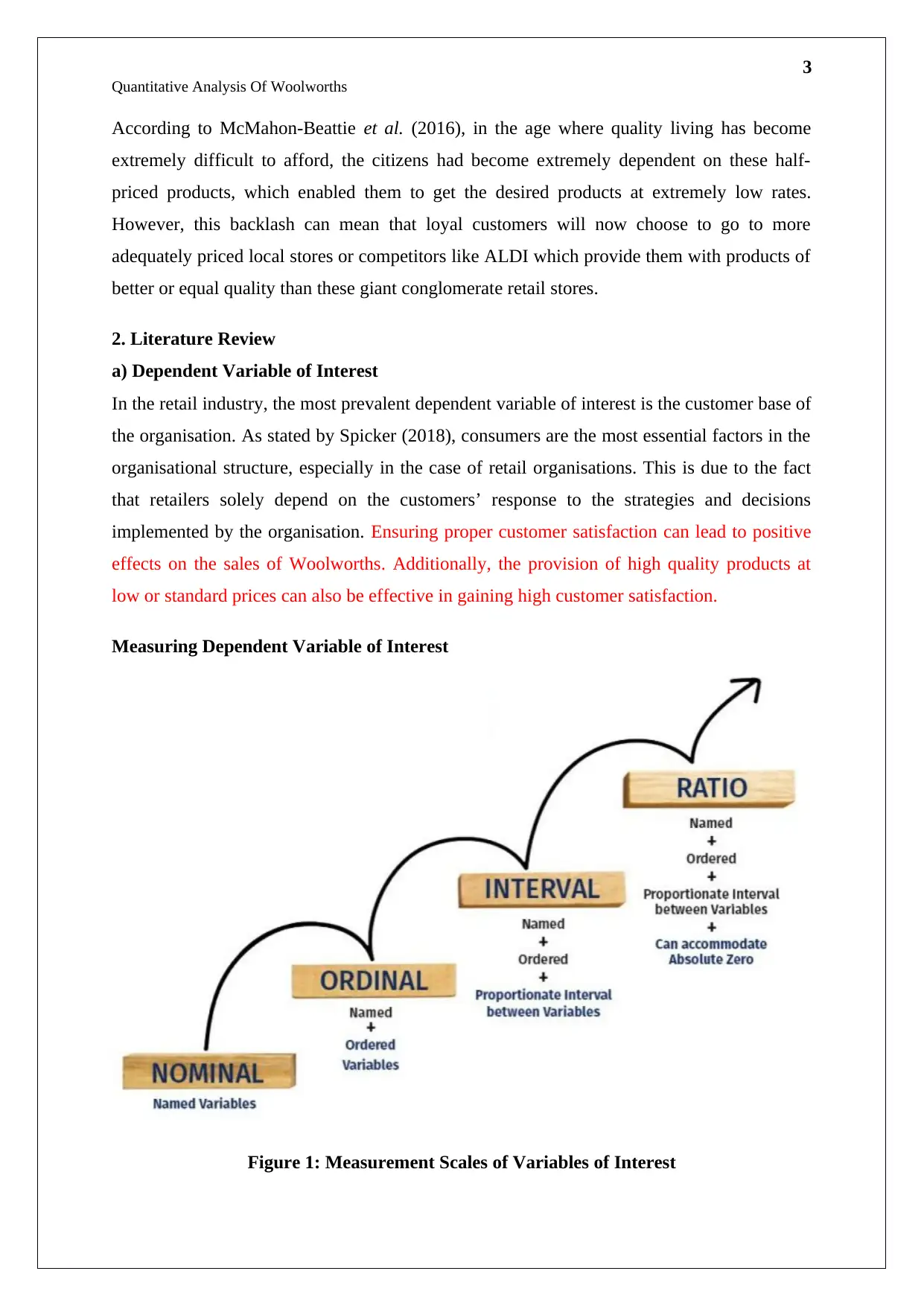
Measuring Dependent Variable of Interest
Figure 1: Measurement Scales of Variables of Interest
Quantitative Analysis Of Woolworths
According to McMahon-Beattie et al. (2016), in the age where quality living has become
extremely difficult to afford, the citizens had become extremely dependent on these half-
priced products, which enabled them to get the desired products at extremely low rates.
However, this backlash can mean that loyal customers will now choose to go to more
adequately priced local stores or competitors like ALDI which provide them with products of
better or equal quality than these giant conglomerate retail stores.
2. Literature Review
a) Dependent Variable of Interest
In the retail industry, the most prevalent dependent variable of interest is the customer base of
the organisation. As stated by Spicker (2018), consumers are the most essential factors in the
organisational structure, especially in the case of retail organisations. This is due to the fact
that retailers solely depend on the customers’ response to the strategies and decisions
implemented by the organisation. Ensuring proper customer satisfaction can lead to positive
effects on the sales of Woolworths. Additionally, the provision of high quality products at
low or standard prices can also be effective in gaining high customer satisfaction.
Measuring Dependent Variable of Interest
Figure 1: Measurement Scales of Variables of Interest
Paraphrase This Document
Need a fresh take? Get an instant paraphrase of this document with our AI Paraphraser
4
Quantitative Analysis Of Woolworths
(Source: Questionpro.com, 2019)
According to Awang, Afthanorhan & Mamat (2016), variables of interest can be measured
through the different measurement scales, consisting of the Nominal Scale, Ordinal Scale,
Interval Scale and Ratio Scale.
Nominal Scale
Nominal scale refers to the way of measuring qualitative variables, rather than quantitative,
with quantitative data acting as labels for the purpose of classification of objects. According
to Zapf et al. (2016), in cases where the scale is used for the classification of objects, the
numerical quantity is specifically associated with a particular category under which certain
objects will be arranged.
In the case of Woolworths, the nominal scale of measurement can be used for the purpose of
determining customer satisfaction levels in surveys and questionnaires. For instance, asking
the customers to choose either yes or no for certain questions, or choosing 1 for city and 2 for
town is considered a way of measuring the satisfaction levels of customers through the
nominal scale (Sekaran & Bougie, 2016). The Nominal scale can be effective in analysing the
degree of issues relating faced by Woolworths. This scale evaluates various issues based on
the scale of 1-Mild, 2-Moderate and 3-Severe. The issue relating to a lack of proper costing
strategies can be stated as a severe risk. This issue can lead to a significant decrease in the
number of customers of the brand and can lead to lower customer satisfaction and brand
loyalty as well.
Ordinal Scale
The ordinal scale is a level higher than the nominal scale and places slightly greater
importance on the numerical value of the variables. However, according to Hu et al. (2017),
these numerical values are given an order, with a higher number entailing a higher level of
the required variable and a lower number depicting lower levels of the variable in question.
For instance, Woolworths can decide to distribute questionnaires among consumers or
employees to get an idea about the service they are providing. In this case, they can include
areas that ask the individual to choose a number from one to ten, with one being the least
satisfied and ten being the most satisfied. In the recent case of changing pricing strategies and
Quantitative Analysis Of Woolworths
(Source: Questionpro.com, 2019)
According to Awang, Afthanorhan & Mamat (2016), variables of interest can be measured
through the different measurement scales, consisting of the Nominal Scale, Ordinal Scale,
Interval Scale and Ratio Scale.
Nominal Scale
Nominal scale refers to the way of measuring qualitative variables, rather than quantitative,
with quantitative data acting as labels for the purpose of classification of objects. According
to Zapf et al. (2016), in cases where the scale is used for the classification of objects, the
numerical quantity is specifically associated with a particular category under which certain
objects will be arranged.
In the case of Woolworths, the nominal scale of measurement can be used for the purpose of
determining customer satisfaction levels in surveys and questionnaires. For instance, asking
the customers to choose either yes or no for certain questions, or choosing 1 for city and 2 for
town is considered a way of measuring the satisfaction levels of customers through the
nominal scale (Sekaran & Bougie, 2016). The Nominal scale can be effective in analysing the
degree of issues relating faced by Woolworths. This scale evaluates various issues based on
the scale of 1-Mild, 2-Moderate and 3-Severe. The issue relating to a lack of proper costing
strategies can be stated as a severe risk. This issue can lead to a significant decrease in the
number of customers of the brand and can lead to lower customer satisfaction and brand
loyalty as well.
Ordinal Scale
The ordinal scale is a level higher than the nominal scale and places slightly greater
importance on the numerical value of the variables. However, according to Hu et al. (2017),
these numerical values are given an order, with a higher number entailing a higher level of
the required variable and a lower number depicting lower levels of the variable in question.
For instance, Woolworths can decide to distribute questionnaires among consumers or
employees to get an idea about the service they are providing. In this case, they can include
areas that ask the individual to choose a number from one to ten, with one being the least
satisfied and ten being the most satisfied. In the recent case of changing pricing strategies and
5
Quantitative Analysis Of Woolworths
removing promotions and offers, Woolworths can use surveys to assess the opinions of the
customers regarding the monumental changes (Smh.com.au, 2019).
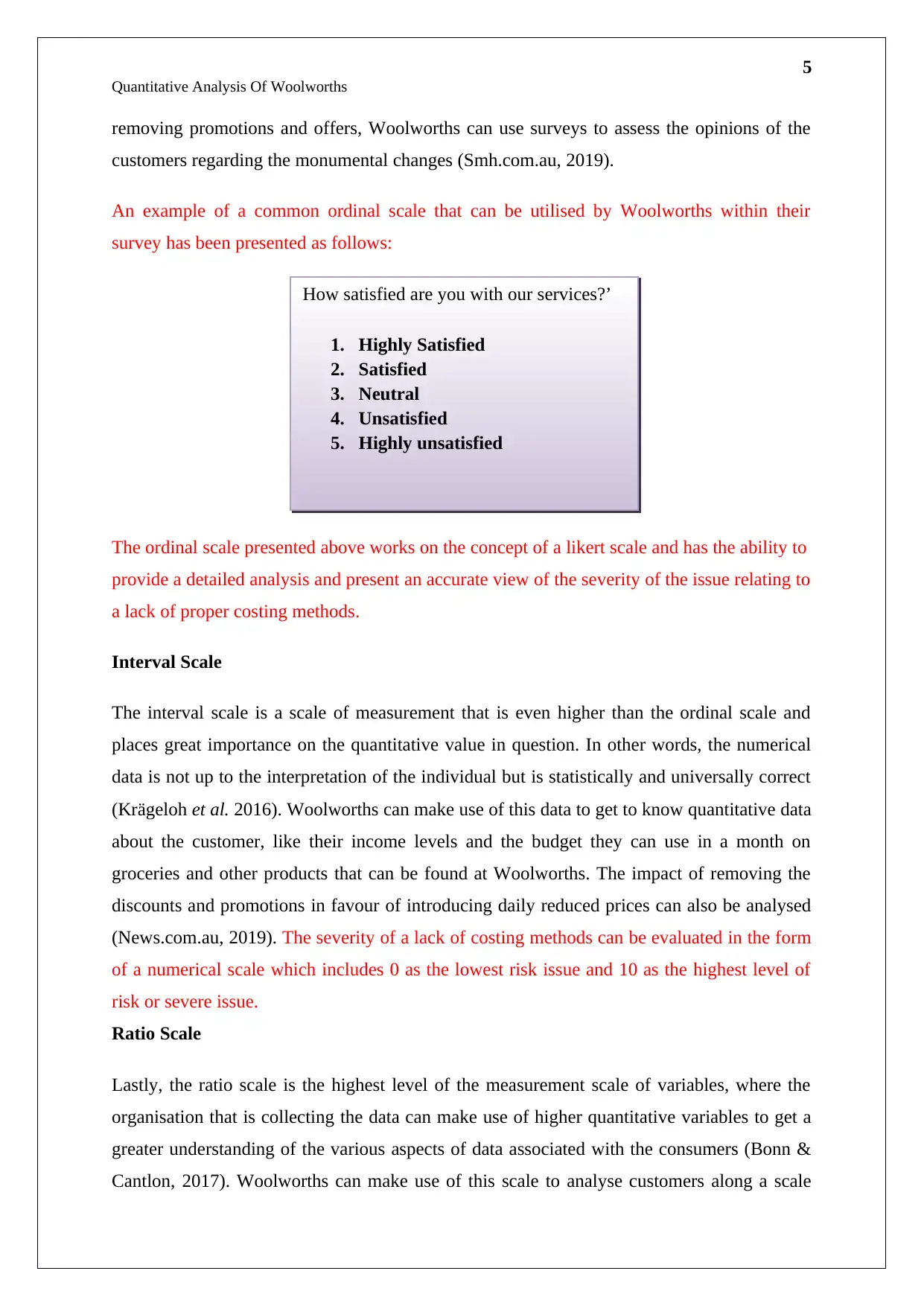
An example of a common ordinal scale that can be utilised by Woolworths within their
survey has been presented as follows:
The ordinal scale presented above works on the concept of a likert scale and has the ability to
provide a detailed analysis and present an accurate view of the severity of the issue relating to
a lack of proper costing methods.
Interval Scale
The interval scale is a scale of measurement that is even higher than the ordinal scale and
places great importance on the quantitative value in question. In other words, the numerical
data is not up to the interpretation of the individual but is statistically and universally correct
(Krägeloh et al. 2016). Woolworths can make use of this data to get to know quantitative data
about the customer, like their income levels and the budget they can use in a month on
groceries and other products that can be found at Woolworths. The impact of removing the
discounts and promotions in favour of introducing daily reduced prices can also be analysed
(News.com.au, 2019). The severity of a lack of costing methods can be evaluated in the form
of a numerical scale which includes 0 as the lowest risk issue and 10 as the highest level of
risk or severe issue.
Ratio Scale
Lastly, the ratio scale is the highest level of the measurement scale of variables, where the
organisation that is collecting the data can make use of higher quantitative variables to get a
greater understanding of the various aspects of data associated with the consumers (Bonn &
Cantlon, 2017). Woolworths can make use of this scale to analyse customers along a scale
How satisfied are you with our services?’
1. Highly Satisfied
2. Satisfied
3. Neutral
4. Unsatisfied
5. Highly unsatisfied
Quantitative Analysis Of Woolworths
removing promotions and offers, Woolworths can use surveys to assess the opinions of the
customers regarding the monumental changes (Smh.com.au, 2019).
An example of a common ordinal scale that can be utilised by Woolworths within their
survey has been presented as follows:
The ordinal scale presented above works on the concept of a likert scale and has the ability to
provide a detailed analysis and present an accurate view of the severity of the issue relating to
a lack of proper costing methods.
Interval Scale
The interval scale is a scale of measurement that is even higher than the ordinal scale and
places great importance on the quantitative value in question. In other words, the numerical
data is not up to the interpretation of the individual but is statistically and universally correct
(Krägeloh et al. 2016). Woolworths can make use of this data to get to know quantitative data
about the customer, like their income levels and the budget they can use in a month on
groceries and other products that can be found at Woolworths. The impact of removing the
discounts and promotions in favour of introducing daily reduced prices can also be analysed
(News.com.au, 2019). The severity of a lack of costing methods can be evaluated in the form
of a numerical scale which includes 0 as the lowest risk issue and 10 as the highest level of
risk or severe issue.
Ratio Scale
Lastly, the ratio scale is the highest level of the measurement scale of variables, where the
organisation that is collecting the data can make use of higher quantitative variables to get a
greater understanding of the various aspects of data associated with the consumers (Bonn &
Cantlon, 2017). Woolworths can make use of this scale to analyse customers along a scale
How satisfied are you with our services?’
1. Highly Satisfied
2. Satisfied
3. Neutral
4. Unsatisfied
5. Highly unsatisfied
⊘ This is a preview!⊘
Do you want full access?
Subscribe today to unlock all pages.
Trusted by 1+ million students worldwide
6
Quantitative Analysis Of Woolworths
that has equal intervals and is based on a true zero point of analysis. This will allow the
retailer to get a better understanding of the customer base through deeper analysis, while also
finding out their feelings regarding the change in pricing strategies the retailer wishes to
introduce (Afr.com, 2019).
b) Independent and Moderating Variables of Interest
Independent Variable of Interest
The independent variable of interest refers to the factors that determine and impact the
dependent variables. The main difference between dependent and independent variables is
that a multitude of independent variables can work together to influence a single dependent
variable.
Some of the independent variables that can impact the customer base of Woolworths is the
internal communication factor within the management structure of the organisation. Lack of
appropriate communication among the management can result in the organisation coming to
decisions that are not the most beneficial for the customer base. This can be seen in the recent
pricing strategy of the organisation, where the decision to get rid of the promotional strategies
and discounts can be seen to have extremely negative feedback from the customers
(Dailymail.co.uk, 2019).
This same factor can be attributed to poor management strategies employed by the
organisation. Implementing such strategies, that only benefit the organisation while being
disadvantageous to the customers, can result in Woolworths losing a major portion of the
loyal customer base (Fnarena.com, 2019).
Moderating Variable of Interest
Quantitative Analysis Of Woolworths
that has equal intervals and is based on a true zero point of analysis. This will allow the
retailer to get a better understanding of the customer base through deeper analysis, while also
finding out their feelings regarding the change in pricing strategies the retailer wishes to
introduce (Afr.com, 2019).
b) Independent and Moderating Variables of Interest
Independent Variable of Interest
The independent variable of interest refers to the factors that determine and impact the
dependent variables. The main difference between dependent and independent variables is
that a multitude of independent variables can work together to influence a single dependent
variable.
Some of the independent variables that can impact the customer base of Woolworths is the
internal communication factor within the management structure of the organisation. Lack of
appropriate communication among the management can result in the organisation coming to
decisions that are not the most beneficial for the customer base. This can be seen in the recent
pricing strategy of the organisation, where the decision to get rid of the promotional strategies
and discounts can be seen to have extremely negative feedback from the customers
(Dailymail.co.uk, 2019).
This same factor can be attributed to poor management strategies employed by the
organisation. Implementing such strategies, that only benefit the organisation while being
disadvantageous to the customers, can result in Woolworths losing a major portion of the
loyal customer base (Fnarena.com, 2019).
Moderating Variable of Interest
Paraphrase This Document
Need a fresh take? Get an instant paraphrase of this document with our AI Paraphraser
7
Quantitative Analysis Of Woolworths
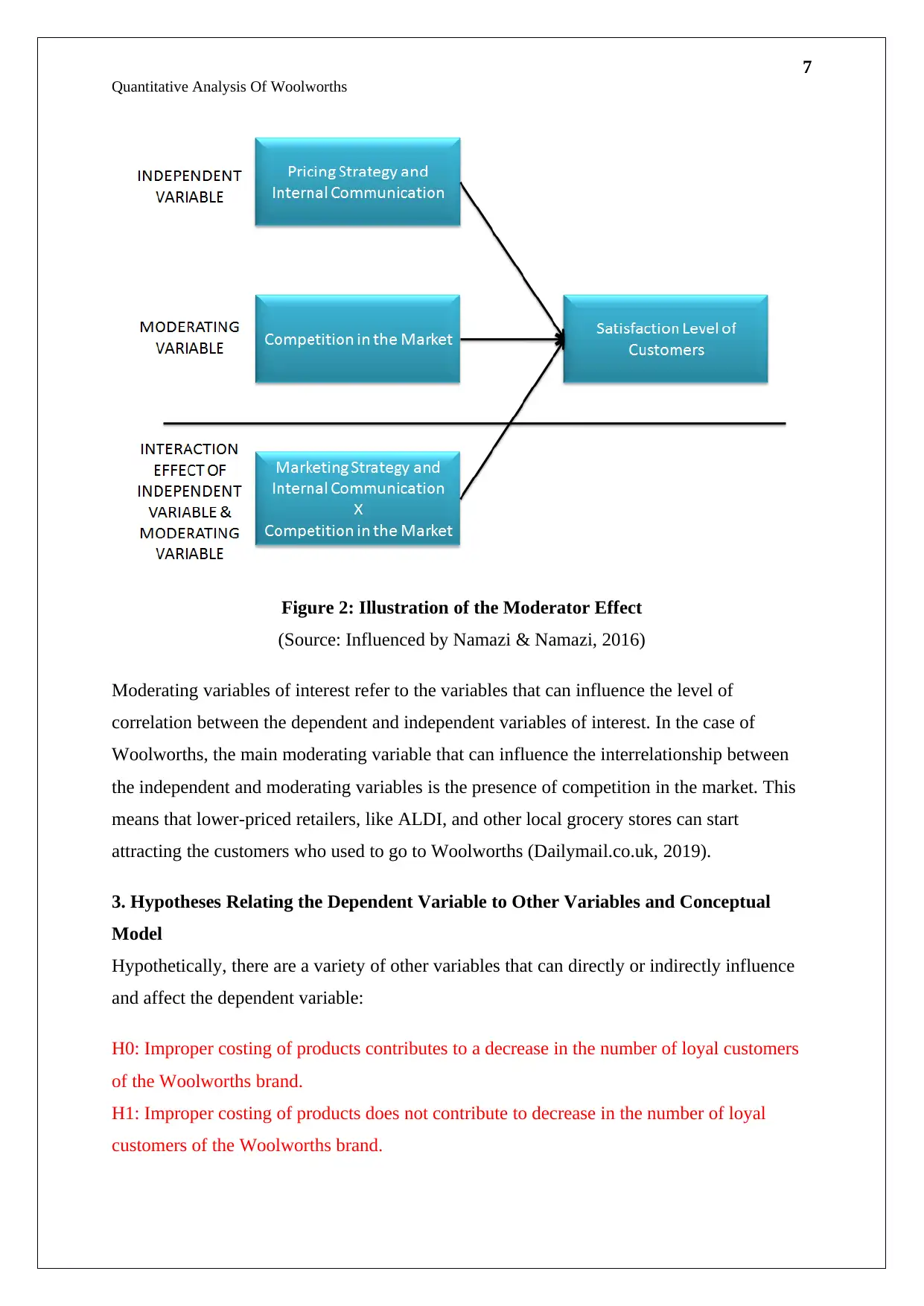
Figure 2: Illustration of the Moderator Effect
(Source: Influenced by Namazi & Namazi, 2016)
Moderating variables of interest refer to the variables that can influence the level of
correlation between the dependent and independent variables of interest. In the case of
Woolworths, the main moderating variable that can influence the interrelationship between
the independent and moderating variables is the presence of competition in the market. This
means that lower-priced retailers, like ALDI, and other local grocery stores can start
attracting the customers who used to go to Woolworths (Dailymail.co.uk, 2019).
3. Hypotheses Relating the Dependent Variable to Other Variables and Conceptual
Model
Hypothetically, there are a variety of other variables that can directly or indirectly influence
and affect the dependent variable:
H0: Improper costing of products contributes to a decrease in the number of loyal customers
of the Woolworths brand.
H1: Improper costing of products does not contribute to decrease in the number of loyal
customers of the Woolworths brand.
Quantitative Analysis Of Woolworths
Figure 2: Illustration of the Moderator Effect
(Source: Influenced by Namazi & Namazi, 2016)
Moderating variables of interest refer to the variables that can influence the level of
correlation between the dependent and independent variables of interest. In the case of
Woolworths, the main moderating variable that can influence the interrelationship between
the independent and moderating variables is the presence of competition in the market. This
means that lower-priced retailers, like ALDI, and other local grocery stores can start
attracting the customers who used to go to Woolworths (Dailymail.co.uk, 2019).
3. Hypotheses Relating the Dependent Variable to Other Variables and Conceptual
Model
Hypothetically, there are a variety of other variables that can directly or indirectly influence
and affect the dependent variable:
H0: Improper costing of products contributes to a decrease in the number of loyal customers
of the Woolworths brand.
H1: Improper costing of products does not contribute to decrease in the number of loyal
customers of the Woolworths brand.

8
Quantitative Analysis Of Woolworths
H0: Providing products at low prices at a daily basis rather than providing with offers is more
effective in retaining the customer base of Woolworths.
H1: Providing products at low prices at a daily basis rather than providing with offers is not
effective in retaining the customer base of Woolworths.
H0: Not being able to satisfy customer needs will result in customers turning to other retailers
providing equal or better prices and greater service quality.
H1: Not being able to satisfy customer needs will not result in customers turning to other
retailers providing equal or better prices and greater service quality.
Quantitative Analysis Of Woolworths
H0: Providing products at low prices at a daily basis rather than providing with offers is more
effective in retaining the customer base of Woolworths.
H1: Providing products at low prices at a daily basis rather than providing with offers is not
effective in retaining the customer base of Woolworths.
H0: Not being able to satisfy customer needs will result in customers turning to other retailers
providing equal or better prices and greater service quality.
H1: Not being able to satisfy customer needs will not result in customers turning to other
retailers providing equal or better prices and greater service quality.
⊘ This is a preview!⊘
Do you want full access?
Subscribe today to unlock all pages.
Trusted by 1+ million students worldwide
DEPENDENT VARIABLE
Assessment of issue using Quantitative Analysis
Pricing Strategy and
Internal Communication
Consumer Satisfaction and Loyalty Competition in the Market
Ways and methods that can be used for developing a proper pricing strategy
INDEPENDENT VARIABLEMODERATING VARIABLE
9
Quantitative Analysis Of Woolworths
Conceptual Model
Assessment of issue using Quantitative Analysis
Pricing Strategy and
Internal Communication
Consumer Satisfaction and Loyalty Competition in the Market
Ways and methods that can be used for developing a proper pricing strategy
INDEPENDENT VARIABLEMODERATING VARIABLE
9
Quantitative Analysis Of Woolworths
Conceptual Model
Paraphrase This Document
Need a fresh take? Get an instant paraphrase of this document with our AI Paraphraser
10
Quantitative Analysis Of Woolworths
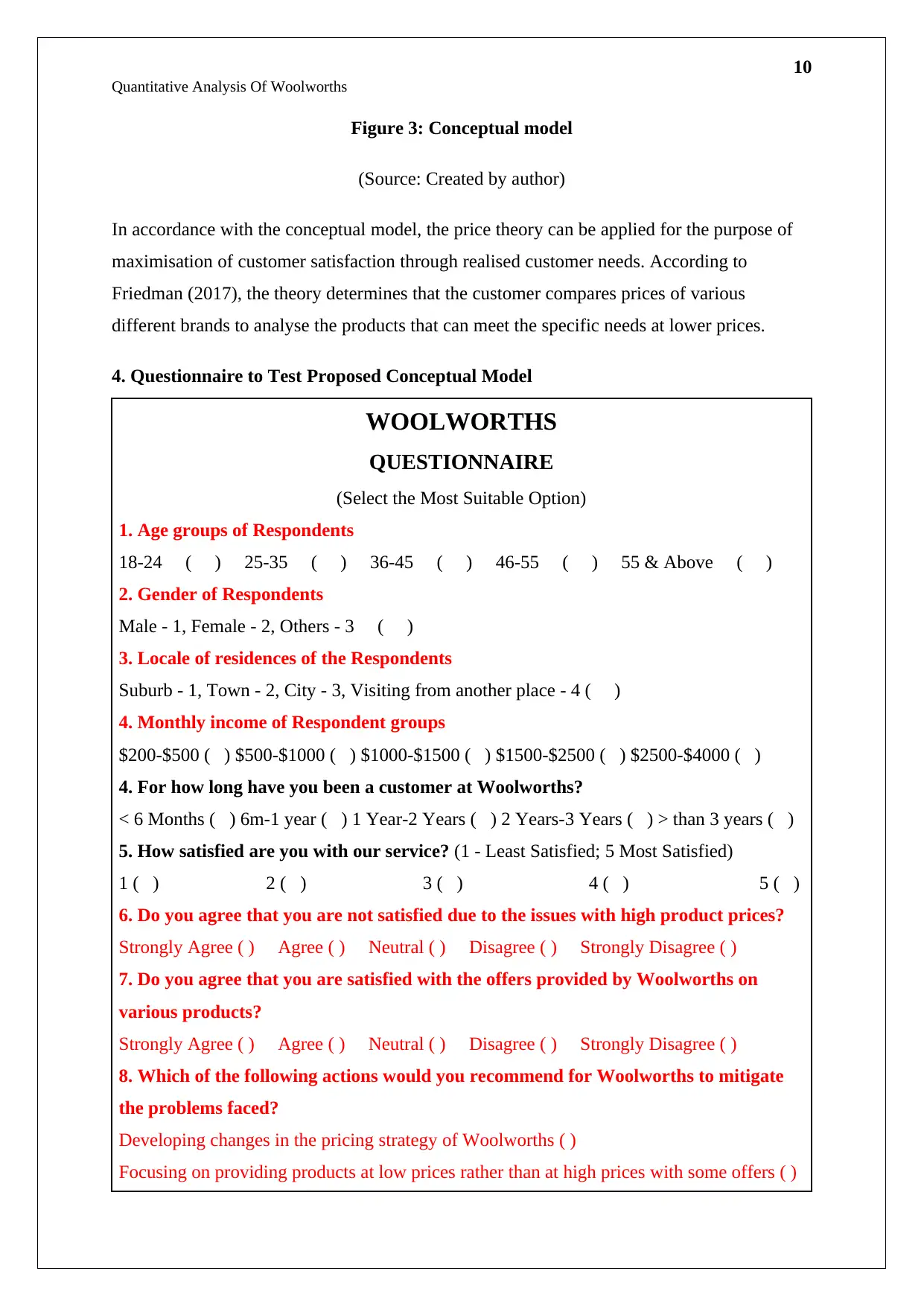
Figure 3: Conceptual model
(Source: Created by author)
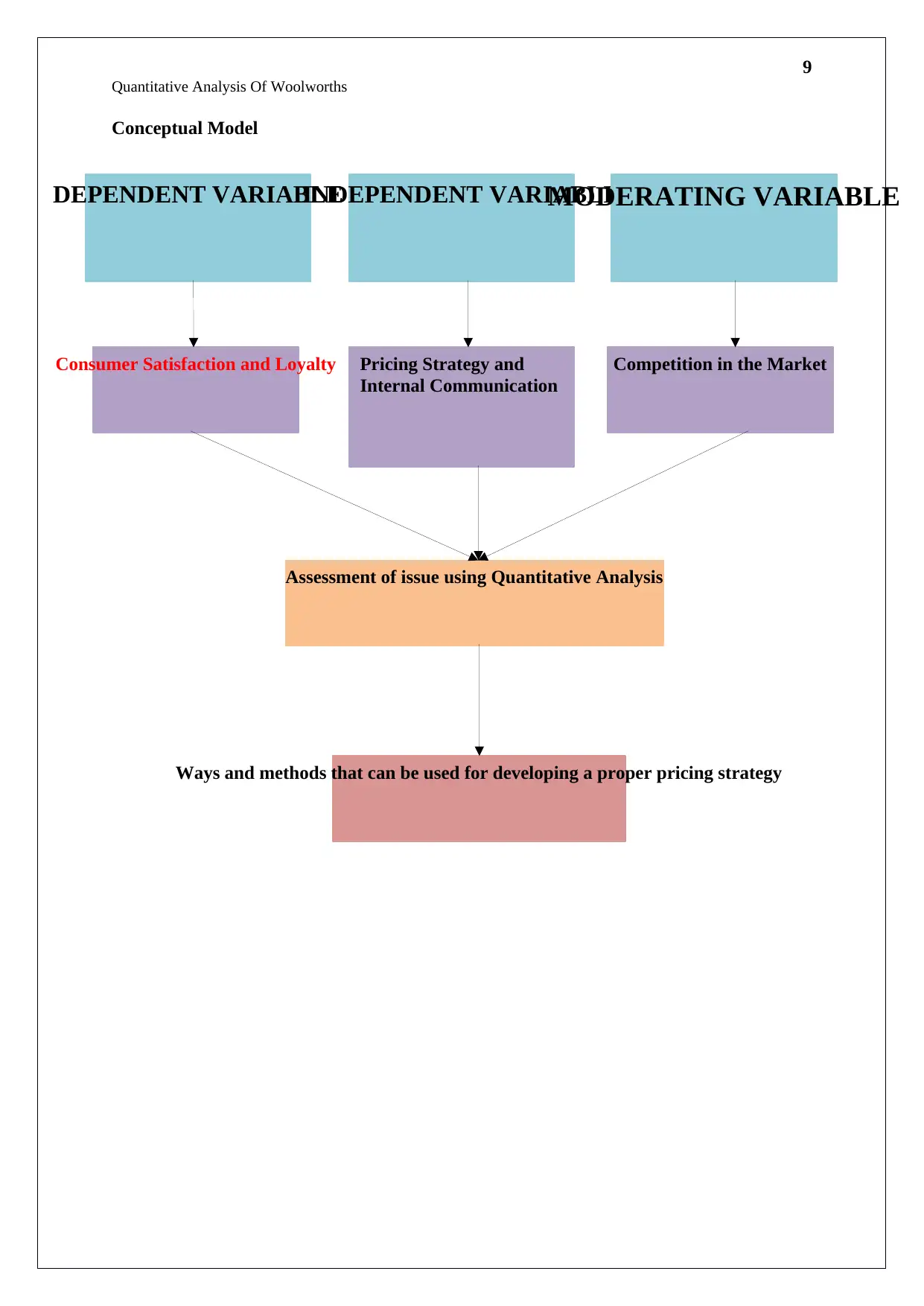
In accordance with the conceptual model, the price theory can be applied for the purpose of
maximisation of customer satisfaction through realised customer needs. According to
Friedman (2017), the theory determines that the customer compares prices of various
different brands to analyse the products that can meet the specific needs at lower prices.
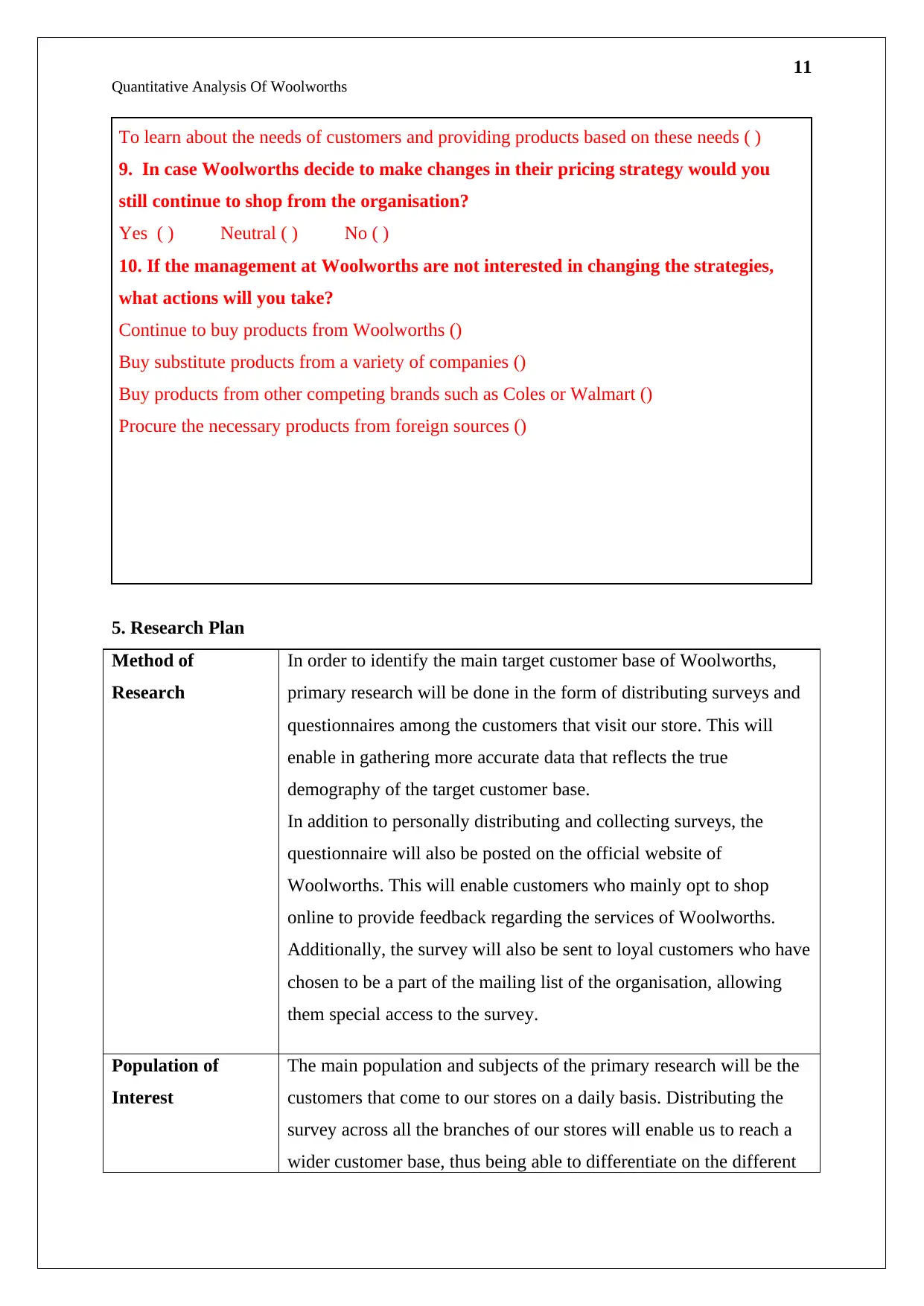
4. Questionnaire to Test Proposed Conceptual Model
WOOLWORTHS
QUESTIONNAIRE
(Select the Most Suitable Option)
1. Age groups of Respondents
18-24 ( ) 25-35 ( ) 36-45 ( ) 46-55 ( ) 55 & Above ( )
2. Gender of Respondents
Male - 1, Female - 2, Others - 3 ( )
3. Locale of residences of the Respondents
Suburb - 1, Town - 2, City - 3, Visiting from another place - 4 ( )
4. Monthly income of Respondent groups
$200-$500 ( ) $500-$1000 ( ) $1000-$1500 ( ) $1500-$2500 ( ) $2500-$4000 ( )
4. For how long have you been a customer at Woolworths?
< 6 Months ( ) 6m-1 year ( ) 1 Year-2 Years ( ) 2 Years-3 Years ( ) > than 3 years ( )
5. How satisfied are you with our service? (1 - Least Satisfied; 5 Most Satisfied)
1 ( ) 2 ( ) 3 ( ) 4 ( ) 5 ( )
6. Do you agree that you are not satisfied due to the issues with high product prices?
Strongly Agree ( ) Agree ( ) Neutral ( ) Disagree ( ) Strongly Disagree ( )
7. Do you agree that you are satisfied with the offers provided by Woolworths on
various products?
Strongly Agree ( ) Agree ( ) Neutral ( ) Disagree ( ) Strongly Disagree ( )
8. Which of the following actions would you recommend for Woolworths to mitigate
the problems faced?
Developing changes in the pricing strategy of Woolworths ( )
Focusing on providing products at low prices rather than at high prices with some offers ( )
Quantitative Analysis Of Woolworths
Figure 3: Conceptual model
(Source: Created by author)
In accordance with the conceptual model, the price theory can be applied for the purpose of
maximisation of customer satisfaction through realised customer needs. According to
Friedman (2017), the theory determines that the customer compares prices of various
different brands to analyse the products that can meet the specific needs at lower prices.
4. Questionnaire to Test Proposed Conceptual Model
WOOLWORTHS
QUESTIONNAIRE
(Select the Most Suitable Option)
1. Age groups of Respondents
18-24 ( ) 25-35 ( ) 36-45 ( ) 46-55 ( ) 55 & Above ( )
2. Gender of Respondents
Male - 1, Female - 2, Others - 3 ( )
3. Locale of residences of the Respondents
Suburb - 1, Town - 2, City - 3, Visiting from another place - 4 ( )
4. Monthly income of Respondent groups
$200-$500 ( ) $500-$1000 ( ) $1000-$1500 ( ) $1500-$2500 ( ) $2500-$4000 ( )
4. For how long have you been a customer at Woolworths?
< 6 Months ( ) 6m-1 year ( ) 1 Year-2 Years ( ) 2 Years-3 Years ( ) > than 3 years ( )
5. How satisfied are you with our service? (1 - Least Satisfied; 5 Most Satisfied)
1 ( ) 2 ( ) 3 ( ) 4 ( ) 5 ( )
6. Do you agree that you are not satisfied due to the issues with high product prices?
Strongly Agree ( ) Agree ( ) Neutral ( ) Disagree ( ) Strongly Disagree ( )
7. Do you agree that you are satisfied with the offers provided by Woolworths on
various products?
Strongly Agree ( ) Agree ( ) Neutral ( ) Disagree ( ) Strongly Disagree ( )
8. Which of the following actions would you recommend for Woolworths to mitigate
the problems faced?
Developing changes in the pricing strategy of Woolworths ( )
Focusing on providing products at low prices rather than at high prices with some offers ( )
11
Quantitative Analysis Of Woolworths
To learn about the needs of customers and providing products based on these needs ( )
9. In case Woolworths decide to make changes in their pricing strategy would you
still continue to shop from the organisation?
Yes ( ) Neutral ( ) No ( )
10. If the management at Woolworths are not interested in changing the strategies,
what actions will you take?
Continue to buy products from Woolworths ()
Buy substitute products from a variety of companies ()
Buy products from other competing brands such as Coles or Walmart ()
Procure the necessary products from foreign sources ()
5. Research Plan
Method of
Research
In order to identify the main target customer base of Woolworths,
primary research will be done in the form of distributing surveys and
questionnaires among the customers that visit our store. This will
enable in gathering more accurate data that reflects the true
demography of the target customer base.
In addition to personally distributing and collecting surveys, the
questionnaire will also be posted on the official website of
Woolworths. This will enable customers who mainly opt to shop
online to provide feedback regarding the services of Woolworths.
Additionally, the survey will also be sent to loyal customers who have
chosen to be a part of the mailing list of the organisation, allowing
them special access to the survey.
Population of
Interest
The main population and subjects of the primary research will be the
customers that come to our stores on a daily basis. Distributing the
survey across all the branches of our stores will enable us to reach a
wider customer base, thus being able to differentiate on the different
Quantitative Analysis Of Woolworths
To learn about the needs of customers and providing products based on these needs ( )
9. In case Woolworths decide to make changes in their pricing strategy would you
still continue to shop from the organisation?
Yes ( ) Neutral ( ) No ( )
10. If the management at Woolworths are not interested in changing the strategies,
what actions will you take?
Continue to buy products from Woolworths ()
Buy substitute products from a variety of companies ()
Buy products from other competing brands such as Coles or Walmart ()
Procure the necessary products from foreign sources ()
5. Research Plan
Method of
Research
In order to identify the main target customer base of Woolworths,
primary research will be done in the form of distributing surveys and
questionnaires among the customers that visit our store. This will
enable in gathering more accurate data that reflects the true
demography of the target customer base.
In addition to personally distributing and collecting surveys, the
questionnaire will also be posted on the official website of
Woolworths. This will enable customers who mainly opt to shop
online to provide feedback regarding the services of Woolworths.
Additionally, the survey will also be sent to loyal customers who have
chosen to be a part of the mailing list of the organisation, allowing
them special access to the survey.
Population of
Interest
The main population and subjects of the primary research will be the
customers that come to our stores on a daily basis. Distributing the
survey across all the branches of our stores will enable us to reach a
wider customer base, thus being able to differentiate on the different
⊘ This is a preview!⊘
Do you want full access?
Subscribe today to unlock all pages.
Trusted by 1+ million students worldwide

1 out of 17


Related Documents


Your All-in-One AI-Powered Toolkit for Academic Success.
+13062052269
info@desklib.com
Available 24*7 on WhatsApp / Email
![[object Object]](/_next/static/media/star-bottom.7253800d.svg)
Unlock your academic potential
Copyright © 2020–2026 A2Z Services. All Rights Reserved. Developed and managed by ZUCOL.