PMAN635 - Quantitative Methods in Project Management Mid-term Exam
VerifiedAdded on 2023/06/10
|22
|3382
|166
Quiz and Exam
AI Summary
This document presents a solved mid-term exam for the course PMAN635, Quantitative Methods in Project Management. The exam covers topics such as scoring models for project selection, payback period calculation, project characteristics, project manager responsibilities, work breakdown structure, risk management, budgeting, Gantt charts, task duration estimation, resource allocation, learning curves, and critical path analysis. The solutions include calculations for expected time, variance, and probability of completing a network within a specified timeframe. Additionally, the exam addresses investment analysis using Net Present Value (NPV) and payback period methods, incorporating uncertainty through Crystal Ball simulations to assess the probability of meeting NPV targets for different investment options. The document also contrasts project plans with work breakdown structures, highlighting their respective purposes and components.
PROJECT MANAGEMENT
1
1

Paraphrase This Document
Need a fresh take? Get an instant paraphrase of this document with our AI Paraphraser

Table of Contents
PART 1............................................................................................................................................3
PART 2..........................................................................................................................................10
2
PART 1............................................................................................................................................3
PART 2..........................................................................................................................................10
2
PART 1
1. Which of the following can be included in scoring models for selecting projects?
a) potential profitability of the project
b) potential impact on the firm’s competitive position
c) the organization’s ability to market the output of a project
d) All of the above can be included
e) only a and b above
1. d) All of the above can be included
2. If the initial investment in a project is $100,000 and the expected annual net profit for the
project is $20,000, the payback period is:
a) 5 years
b) 4 years
c) One fifth of a year
d) 10 years
e) insufficient information to determine the payback period
2. a) 5 years
3. Which of the following is NOT a characteristic of a project?
a) They are unique.
b) They are routine.
c) They have specific due date.
d) They have a specific deliverable.
e) They have a purpose.
3. b) They are routine
4. The project manager is responsible to:
a) the parent organization
b) the project team
c) the project’s client
3
1. Which of the following can be included in scoring models for selecting projects?
a) potential profitability of the project
b) potential impact on the firm’s competitive position
c) the organization’s ability to market the output of a project
d) All of the above can be included
e) only a and b above
1. d) All of the above can be included
2. If the initial investment in a project is $100,000 and the expected annual net profit for the
project is $20,000, the payback period is:
a) 5 years
b) 4 years
c) One fifth of a year
d) 10 years
e) insufficient information to determine the payback period
2. a) 5 years
3. Which of the following is NOT a characteristic of a project?
a) They are unique.
b) They are routine.
c) They have specific due date.
d) They have a specific deliverable.
e) They have a purpose.
3. b) They are routine
4. The project manager is responsible to:
a) the parent organization
b) the project team
c) the project’s client
3
⊘ This is a preview!⊘
Do you want full access?
Subscribe today to unlock all pages.

Trusted by 1+ million students worldwide
d) the project manager’s immediate supervisor
e) all of the above
4. e) all of the above
5. What is the primary purpose of creating a work breakdown structure?
a) to draw the project plan as a chart or tree
b) to make sure important tasks aren’t overlooked
c) so that all team members can see what others are working on
d) to assign budget numbers to tasks
e) to identify important precedence relationships
5. a) to draw the project plan as a chart or tree
6. Which of the following is used to show linkages between people and tasks?
a) the Work Breakdown Structure
b) the RACI Matrix
c) the Project Action Plan
d) the Project Resource Diagram
e) the Concurrent Engineering Chart
6. d) the Project Resource Diagram
7. Which of the following is NOT a sub-process associated with risk management?
a) risk identification
b) risk measurement
c) qualitative risk analysis
d) quantitative risk analysis
e) risk response planning
7. d) quantitative risk analysis
8. Which of the following is NOT true regarding top-down budgeting?
a) It is based on the collective judgments of top and middle managers.
4
e) all of the above
4. e) all of the above
5. What is the primary purpose of creating a work breakdown structure?
a) to draw the project plan as a chart or tree
b) to make sure important tasks aren’t overlooked
c) so that all team members can see what others are working on
d) to assign budget numbers to tasks
e) to identify important precedence relationships
5. a) to draw the project plan as a chart or tree
6. Which of the following is used to show linkages between people and tasks?
a) the Work Breakdown Structure
b) the RACI Matrix
c) the Project Action Plan
d) the Project Resource Diagram
e) the Concurrent Engineering Chart
6. d) the Project Resource Diagram
7. Which of the following is NOT a sub-process associated with risk management?
a) risk identification
b) risk measurement
c) qualitative risk analysis
d) quantitative risk analysis
e) risk response planning
7. d) quantitative risk analysis
8. Which of the following is NOT true regarding top-down budgeting?
a) It is based on the collective judgments of top and middle managers.
4
Paraphrase This Document
Need a fresh take? Get an instant paraphrase of this document with our AI Paraphraser
b) Overall project costs are estimated by top and middle managers and then passed
on
c) to the next lower level.
d) The overall budget cost is generally not very accurate.
e) Overlooking small but important tasks can lead to a serious budgetary problem.
f) All of the above are true concerning top-down budgeting.
8. f) All of the above are true concerning top-down budgeting
9. Which of the following is NOT an element of the Gantt chart?
a) actual progress
b) variance of the critical path
c) the current date
d) scheduled milestones
e) all of the above are elements
9. e) all of the above are elements
10. Which of the following is typically used as the best estimate of task duration?
a) expected time
b) pessimistic time
c) optimistic time
d) most likely time
e) none of the above
Ans. 10) b) pessimistic time
11. In MS Project, in order to set a deadline for a particular task, which of the following is the
proper sequence from the Task Information dialog box?
a) General > Percent Complete
b) Resources > Assignment Owner
5
on
c) to the next lower level.
d) The overall budget cost is generally not very accurate.
e) Overlooking small but important tasks can lead to a serious budgetary problem.
f) All of the above are true concerning top-down budgeting.
8. f) All of the above are true concerning top-down budgeting
9. Which of the following is NOT an element of the Gantt chart?
a) actual progress
b) variance of the critical path
c) the current date
d) scheduled milestones
e) all of the above are elements
9. e) all of the above are elements
10. Which of the following is typically used as the best estimate of task duration?
a) expected time
b) pessimistic time
c) optimistic time
d) most likely time
e) none of the above
Ans. 10) b) pessimistic time
11. In MS Project, in order to set a deadline for a particular task, which of the following is the
proper sequence from the Task Information dialog box?
a) General > Percent Complete
b) Resources > Assignment Owner
5

c) Advanced tab > Calendar
d) Advanced tab > Deadline
11. d) Advanced tab > Deadline
12. Why is it necessary to consider the learning curve of resources on a project?
a) to estimate labor costs properly
b) to improve project team morale
c) because it always takes less time to do a task after someone has done it a few times
d) collective bargaining contracts require it
e) All of the above
12. a) to estimate labor costs properly
13. The name given to the budget process that aggregates income and expenditures across
projects is:
a) activity-oriented budget
b) top-down budget
c) bottom-up budget
d) program-oriented budget
e) activity-based costing
13. d) program-oriented budget
14. Which of the following linkages is used to start two or more activities at the same time?
a) finish-to-start
b) start-to-start
c) finish-to-finish
d) start-to-finish
e) They can all be used to start two or more activities at the same time
14. b) start-to-start
15. Altering the specifications of an ongoing project is referred to as
6
d) Advanced tab > Deadline
11. d) Advanced tab > Deadline
12. Why is it necessary to consider the learning curve of resources on a project?
a) to estimate labor costs properly
b) to improve project team morale
c) because it always takes less time to do a task after someone has done it a few times
d) collective bargaining contracts require it
e) All of the above
12. a) to estimate labor costs properly
13. The name given to the budget process that aggregates income and expenditures across
projects is:
a) activity-oriented budget
b) top-down budget
c) bottom-up budget
d) program-oriented budget
e) activity-based costing
13. d) program-oriented budget
14. Which of the following linkages is used to start two or more activities at the same time?
a) finish-to-start
b) start-to-start
c) finish-to-finish
d) start-to-finish
e) They can all be used to start two or more activities at the same time
14. b) start-to-start
15. Altering the specifications of an ongoing project is referred to as
6
⊘ This is a preview!⊘
Do you want full access?
Subscribe today to unlock all pages.
Trusted by 1+ million students worldwide
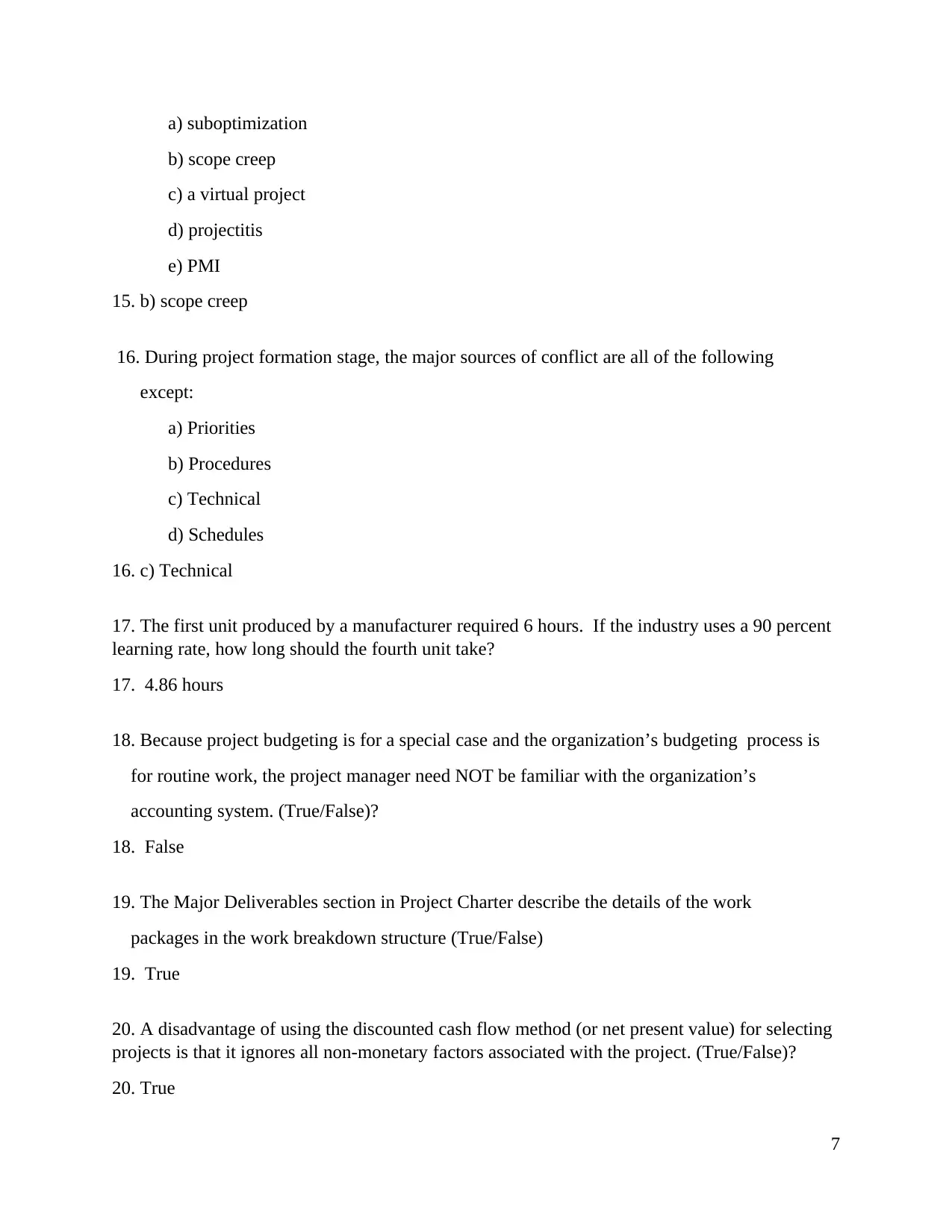
a) suboptimization
b) scope creep
c) a virtual project
d) projectitis
e) PMI
15. b) scope creep
16. During project formation stage, the major sources of conflict are all of the following
except:
a) Priorities
b) Procedures
c) Technical
d) Schedules
16. c) Technical
17. The first unit produced by a manufacturer required 6 hours. If the industry uses a 90 percent
learning rate, how long should the fourth unit take?
17. 4.86 hours
18. Because project budgeting is for a special case and the organization’s budgeting process is
for routine work, the project manager need NOT be familiar with the organization’s
accounting system. (True/False)?
18. False
19. The Major Deliverables section in Project Charter describe the details of the work
packages in the work breakdown structure (True/False)
19. True
20. A disadvantage of using the discounted cash flow method (or net present value) for selecting
projects is that it ignores all non-monetary factors associated with the project. (True/False)?
20. True
7
b) scope creep
c) a virtual project
d) projectitis
e) PMI
15. b) scope creep
16. During project formation stage, the major sources of conflict are all of the following
except:
a) Priorities
b) Procedures
c) Technical
d) Schedules
16. c) Technical
17. The first unit produced by a manufacturer required 6 hours. If the industry uses a 90 percent
learning rate, how long should the fourth unit take?
17. 4.86 hours
18. Because project budgeting is for a special case and the organization’s budgeting process is
for routine work, the project manager need NOT be familiar with the organization’s
accounting system. (True/False)?
18. False
19. The Major Deliverables section in Project Charter describe the details of the work
packages in the work breakdown structure (True/False)
19. True
20. A disadvantage of using the discounted cash flow method (or net present value) for selecting
projects is that it ignores all non-monetary factors associated with the project. (True/False)?
20. True
7
Paraphrase This Document
Need a fresh take? Get an instant paraphrase of this document with our AI Paraphraser
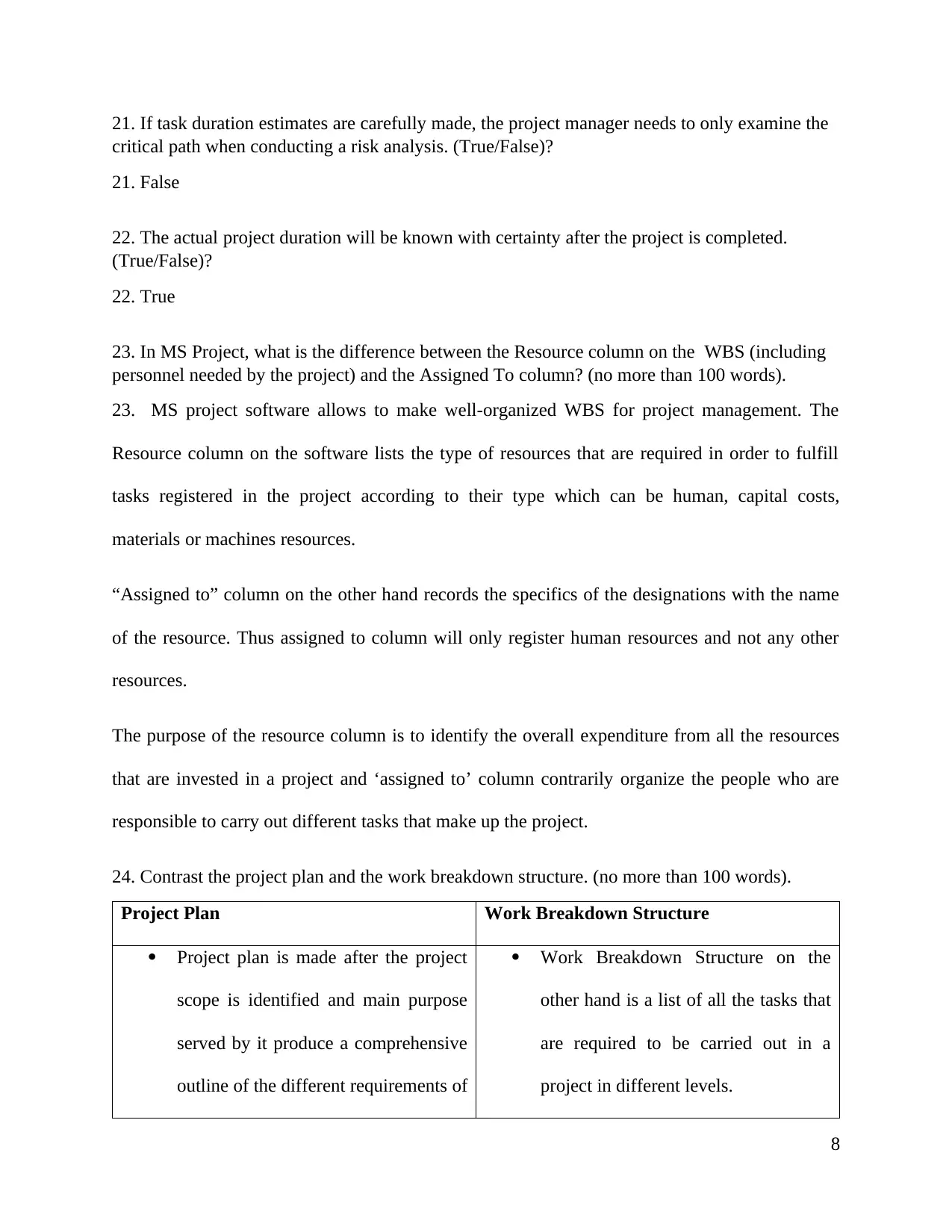
21. If task duration estimates are carefully made, the project manager needs to only examine the
critical path when conducting a risk analysis. (True/False)?
21. False
22. The actual project duration will be known with certainty after the project is completed.
(True/False)?
22. True
23. In MS Project, what is the difference between the Resource column on the WBS (including
personnel needed by the project) and the Assigned To column? (no more than 100 words).
23. MS project software allows to make well-organized WBS for project management. The
Resource column on the software lists the type of resources that are required in order to fulfill
tasks registered in the project according to their type which can be human, capital costs,
materials or machines resources.
“Assigned to” column on the other hand records the specifics of the designations with the name
of the resource. Thus assigned to column will only register human resources and not any other
resources.
The purpose of the resource column is to identify the overall expenditure from all the resources
that are invested in a project and ‘assigned to’ column contrarily organize the people who are
responsible to carry out different tasks that make up the project.
24. Contrast the project plan and the work breakdown structure. (no more than 100 words).
Project Plan Work Breakdown Structure
Project plan is made after the project
scope is identified and main purpose
served by it produce a comprehensive
outline of the different requirements of
Work Breakdown Structure on the
other hand is a list of all the tasks that
are required to be carried out in a
project in different levels.
8
critical path when conducting a risk analysis. (True/False)?
21. False
22. The actual project duration will be known with certainty after the project is completed.
(True/False)?
22. True
23. In MS Project, what is the difference between the Resource column on the WBS (including
personnel needed by the project) and the Assigned To column? (no more than 100 words).
23. MS project software allows to make well-organized WBS for project management. The
Resource column on the software lists the type of resources that are required in order to fulfill
tasks registered in the project according to their type which can be human, capital costs,
materials or machines resources.
“Assigned to” column on the other hand records the specifics of the designations with the name
of the resource. Thus assigned to column will only register human resources and not any other
resources.
The purpose of the resource column is to identify the overall expenditure from all the resources
that are invested in a project and ‘assigned to’ column contrarily organize the people who are
responsible to carry out different tasks that make up the project.
24. Contrast the project plan and the work breakdown structure. (no more than 100 words).
Project Plan Work Breakdown Structure
Project plan is made after the project
scope is identified and main purpose
served by it produce a comprehensive
outline of the different requirements of
Work Breakdown Structure on the
other hand is a list of all the tasks that
are required to be carried out in a
project in different levels.
8
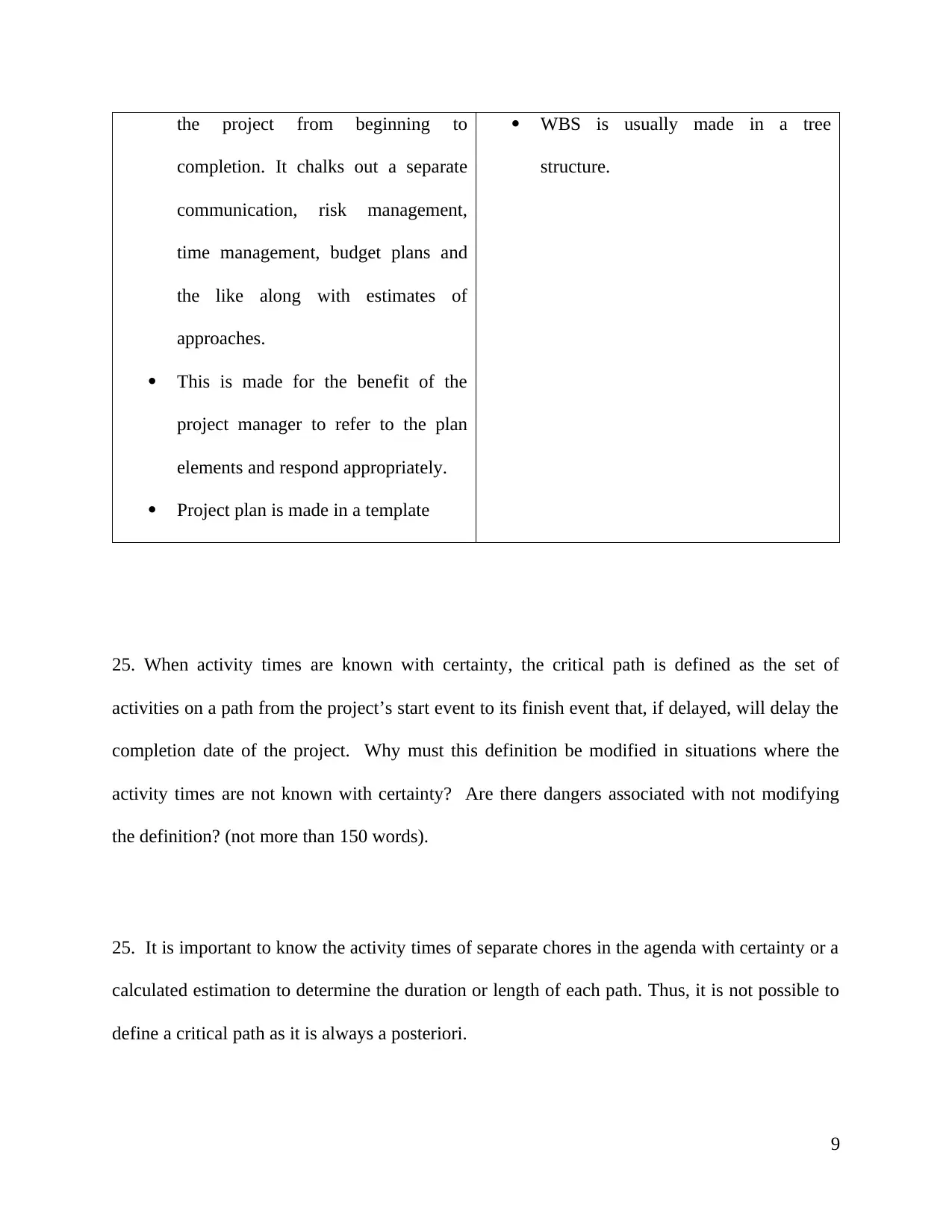
the project from beginning to
completion. It chalks out a separate
communication, risk management,
time management, budget plans and
the like along with estimates of
approaches.
This is made for the benefit of the
project manager to refer to the plan
elements and respond appropriately.
Project plan is made in a template
WBS is usually made in a tree
structure.
25. When activity times are known with certainty, the critical path is defined as the set of
activities on a path from the project’s start event to its finish event that, if delayed, will delay the
completion date of the project. Why must this definition be modified in situations where the
activity times are not known with certainty? Are there dangers associated with not modifying
the definition? (not more than 150 words).
25. It is important to know the activity times of separate chores in the agenda with certainty or a
calculated estimation to determine the duration or length of each path. Thus, it is not possible to
define a critical path as it is always a posteriori.
9
completion. It chalks out a separate
communication, risk management,
time management, budget plans and
the like along with estimates of
approaches.
This is made for the benefit of the
project manager to refer to the plan
elements and respond appropriately.
Project plan is made in a template
WBS is usually made in a tree
structure.
25. When activity times are known with certainty, the critical path is defined as the set of
activities on a path from the project’s start event to its finish event that, if delayed, will delay the
completion date of the project. Why must this definition be modified in situations where the
activity times are not known with certainty? Are there dangers associated with not modifying
the definition? (not more than 150 words).
25. It is important to know the activity times of separate chores in the agenda with certainty or a
calculated estimation to determine the duration or length of each path. Thus, it is not possible to
define a critical path as it is always a posteriori.
9
⊘ This is a preview!⊘
Do you want full access?
Subscribe today to unlock all pages.
Trusted by 1+ million students worldwide
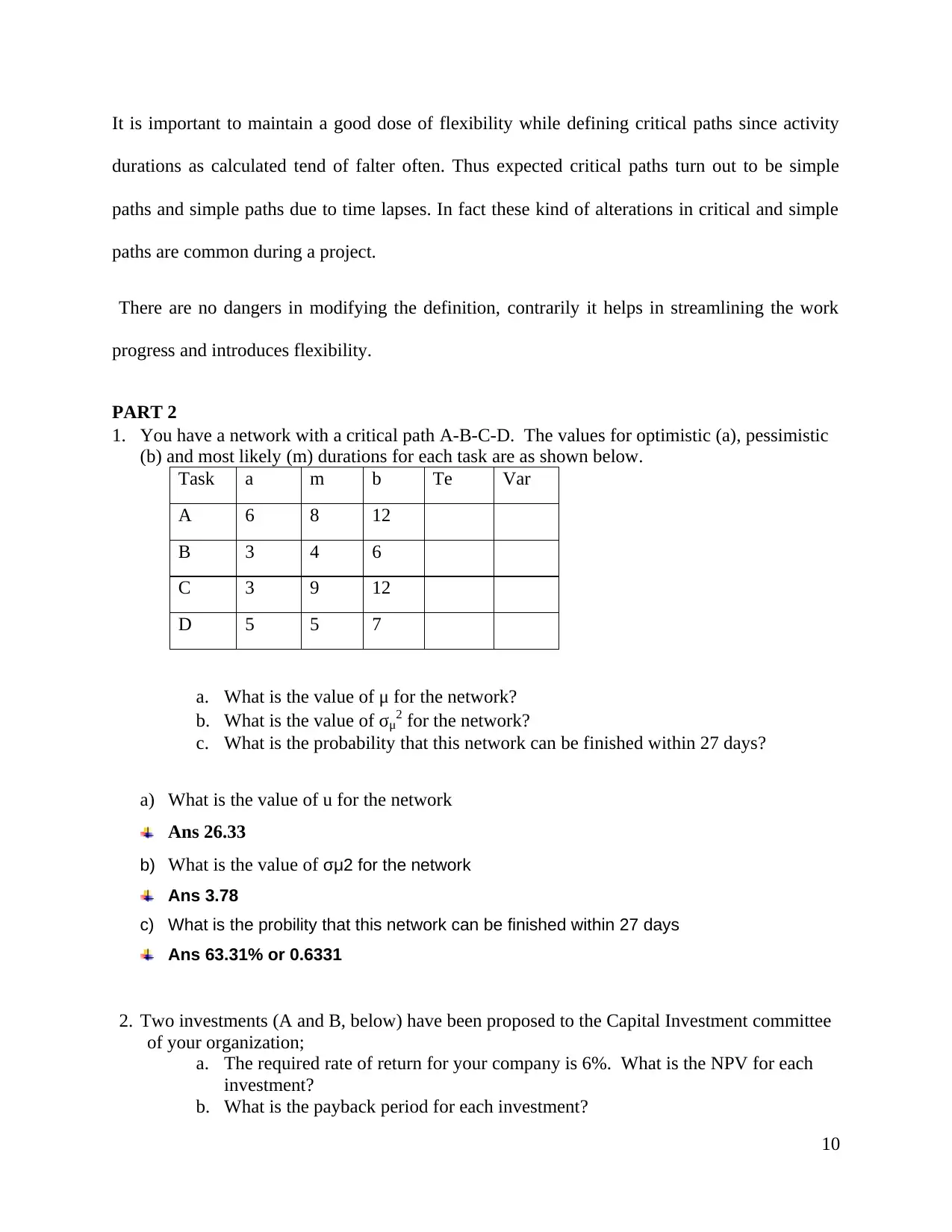
It is important to maintain a good dose of flexibility while defining critical paths since activity
durations as calculated tend of falter often. Thus expected critical paths turn out to be simple
paths and simple paths due to time lapses. In fact these kind of alterations in critical and simple
paths are common during a project.
There are no dangers in modifying the definition, contrarily it helps in streamlining the work
progress and introduces flexibility.
PART 2
1. You have a network with a critical path A-B-C-D. The values for optimistic (a), pessimistic
(b) and most likely (m) durations for each task are as shown below.
Task a m b Te Var
A 6 8 12
B 3 4 6
C 3 9 12
D 5 5 7
a. What is the value of μ for the network?
b. What is the value of σμ2 for the network?
c. What is the probability that this network can be finished within 27 days?
a) What is the value of u for the network
Ans 26.33
b) What is the value of σμ2 for the network
Ans 3.78
c) What is the probility that this network can be finished within 27 days
Ans 63.31% or 0.6331
2. Two investments (A and B, below) have been proposed to the Capital Investment committee
of your organization;
a. The required rate of return for your company is 6%. What is the NPV for each
investment?
b. What is the payback period for each investment?
10
durations as calculated tend of falter often. Thus expected critical paths turn out to be simple
paths and simple paths due to time lapses. In fact these kind of alterations in critical and simple
paths are common during a project.
There are no dangers in modifying the definition, contrarily it helps in streamlining the work
progress and introduces flexibility.
PART 2
1. You have a network with a critical path A-B-C-D. The values for optimistic (a), pessimistic
(b) and most likely (m) durations for each task are as shown below.
Task a m b Te Var
A 6 8 12
B 3 4 6
C 3 9 12
D 5 5 7
a. What is the value of μ for the network?
b. What is the value of σμ2 for the network?
c. What is the probability that this network can be finished within 27 days?
a) What is the value of u for the network
Ans 26.33
b) What is the value of σμ2 for the network
Ans 3.78
c) What is the probility that this network can be finished within 27 days
Ans 63.31% or 0.6331
2. Two investments (A and B, below) have been proposed to the Capital Investment committee
of your organization;
a. The required rate of return for your company is 6%. What is the NPV for each
investment?
b. What is the payback period for each investment?
10
Paraphrase This Document
Need a fresh take? Get an instant paraphrase of this document with our AI Paraphraser
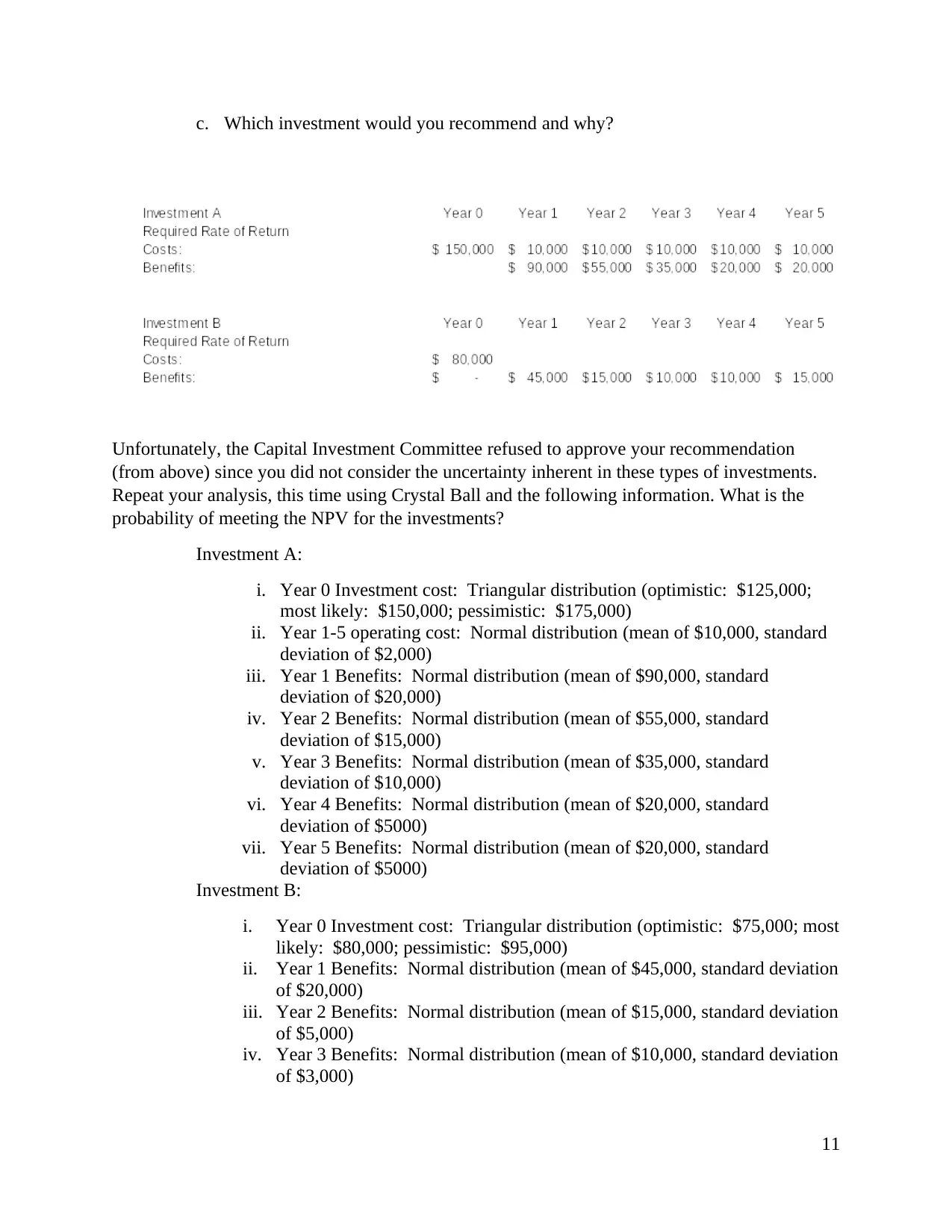
c. Which investment would you recommend and why?
Unfortunately, the Capital Investment Committee refused to approve your recommendation
(from above) since you did not consider the uncertainty inherent in these types of investments.
Repeat your analysis, this time using Crystal Ball and the following information. What is the
probability of meeting the NPV for the investments?
Investment A:
i. Year 0 Investment cost: Triangular distribution (optimistic: $125,000;
most likely: $150,000; pessimistic: $175,000)
ii. Year 1-5 operating cost: Normal distribution (mean of $10,000, standard
deviation of $2,000)
iii. Year 1 Benefits: Normal distribution (mean of $90,000, standard
deviation of $20,000)
iv. Year 2 Benefits: Normal distribution (mean of $55,000, standard
deviation of $15,000)
v. Year 3 Benefits: Normal distribution (mean of $35,000, standard
deviation of $10,000)
vi. Year 4 Benefits: Normal distribution (mean of $20,000, standard
deviation of $5000)
vii. Year 5 Benefits: Normal distribution (mean of $20,000, standard
deviation of $5000)
Investment B:
i. Year 0 Investment cost: Triangular distribution (optimistic: $75,000; most
likely: $80,000; pessimistic: $95,000)
ii. Year 1 Benefits: Normal distribution (mean of $45,000, standard deviation
of $20,000)
iii. Year 2 Benefits: Normal distribution (mean of $15,000, standard deviation
of $5,000)
iv. Year 3 Benefits: Normal distribution (mean of $10,000, standard deviation
of $3,000)
11
Unfortunately, the Capital Investment Committee refused to approve your recommendation
(from above) since you did not consider the uncertainty inherent in these types of investments.
Repeat your analysis, this time using Crystal Ball and the following information. What is the
probability of meeting the NPV for the investments?
Investment A:
i. Year 0 Investment cost: Triangular distribution (optimistic: $125,000;
most likely: $150,000; pessimistic: $175,000)
ii. Year 1-5 operating cost: Normal distribution (mean of $10,000, standard
deviation of $2,000)
iii. Year 1 Benefits: Normal distribution (mean of $90,000, standard
deviation of $20,000)
iv. Year 2 Benefits: Normal distribution (mean of $55,000, standard
deviation of $15,000)
v. Year 3 Benefits: Normal distribution (mean of $35,000, standard
deviation of $10,000)
vi. Year 4 Benefits: Normal distribution (mean of $20,000, standard
deviation of $5000)
vii. Year 5 Benefits: Normal distribution (mean of $20,000, standard
deviation of $5000)
Investment B:
i. Year 0 Investment cost: Triangular distribution (optimistic: $75,000; most
likely: $80,000; pessimistic: $95,000)
ii. Year 1 Benefits: Normal distribution (mean of $45,000, standard deviation
of $20,000)
iii. Year 2 Benefits: Normal distribution (mean of $15,000, standard deviation
of $5,000)
iv. Year 3 Benefits: Normal distribution (mean of $10,000, standard deviation
of $3,000)
11
v. Year 4 Benefits: Normal distribution (mean of $10,000, standard deviation
of $3,000)
vi. Year 5 Benefits: Normal distribution (mean of $15,000, standard deviation
of $5,000)
Ans. : Investment B is recommended as it has a higher Net Present Value in comparison to
Investment A. The Net Present Value of Investment B is $3328.779 whereas of Investment A it
is $1905.54. A higher Net Present Value means that the return on investment is greater and
therefore it is much more preferable.
If it was to go by the payback period analysis, then project A should have been selected as it has
a lower Payback period than Investment B. A lower payback period means that the investment
will be able to recoup the funds invested or a reach a break- even point in the investment in a
shorter time. However Payback period analysis ignores the concept of time value of money.
Thus, an investor cannot rely on such analysis as time value of money is an important factor in
determining whether an investment is to be selected or not.
Thus we would go by the Net Present Value technique as it takes into account the time value of
money. Here, Present Value of all the cash flows are determined (both Inflows and outflows
which are represented by positive and negative figures respectively). If the Net Present Value is
negative then the investment is not acceptable and if it is positive then it is acceptable.
Therefore in the present scenario, Investment B is acceptable as it has a higher Net Present Value
than Investment A.
3. From the week 4 Reading List by Mallak, Kurstedt and Patzak, “Planning for Crises in
Project Management” (found in eReserves), would each of the four tools (Table 1) be of use
in project management in general? How might each be used?
Ans : The tools of PERT and CPM are generally used for the better evaluation and analysis of
the different parametri8c analysis of the concerned subjects. It allows for a better and evaluative
study of the different types of phenomenon of the different phases of the project management.
4. Resource sheet
4. Answer the following using MS Project. You are in charge of the remodeling project for the
kitchen and lunchroom at your office. Your facilities manager has just provided you with the
resource pay rates for this project. You need to enter these pay rates in the project schedule.
12
of $3,000)
vi. Year 5 Benefits: Normal distribution (mean of $15,000, standard deviation
of $5,000)
Ans. : Investment B is recommended as it has a higher Net Present Value in comparison to
Investment A. The Net Present Value of Investment B is $3328.779 whereas of Investment A it
is $1905.54. A higher Net Present Value means that the return on investment is greater and
therefore it is much more preferable.
If it was to go by the payback period analysis, then project A should have been selected as it has
a lower Payback period than Investment B. A lower payback period means that the investment
will be able to recoup the funds invested or a reach a break- even point in the investment in a
shorter time. However Payback period analysis ignores the concept of time value of money.
Thus, an investor cannot rely on such analysis as time value of money is an important factor in
determining whether an investment is to be selected or not.
Thus we would go by the Net Present Value technique as it takes into account the time value of
money. Here, Present Value of all the cash flows are determined (both Inflows and outflows
which are represented by positive and negative figures respectively). If the Net Present Value is
negative then the investment is not acceptable and if it is positive then it is acceptable.
Therefore in the present scenario, Investment B is acceptable as it has a higher Net Present Value
than Investment A.
3. From the week 4 Reading List by Mallak, Kurstedt and Patzak, “Planning for Crises in
Project Management” (found in eReserves), would each of the four tools (Table 1) be of use
in project management in general? How might each be used?
Ans : The tools of PERT and CPM are generally used for the better evaluation and analysis of
the different parametri8c analysis of the concerned subjects. It allows for a better and evaluative
study of the different types of phenomenon of the different phases of the project management.
4. Resource sheet
4. Answer the following using MS Project. You are in charge of the remodeling project for the
kitchen and lunchroom at your office. Your facilities manager has just provided you with the
resource pay rates for this project. You need to enter these pay rates in the project schedule.
12
⊘ This is a preview!⊘
Do you want full access?
Subscribe today to unlock all pages.
Trusted by 1+ million students worldwide

1 out of 22


Related Documents


Your All-in-One AI-Powered Toolkit for Academic Success.
+13062052269
info@desklib.com
Available 24*7 on WhatsApp / Email
![[object Object]](/_next/static/media/star-bottom.7253800d.svg)
Unlock your academic potential
Copyright © 2020–2026 A2Z Services. All Rights Reserved. Developed and managed by ZUCOL.