Research Methods: Comparing Quantitative and Qualitative Approaches
VerifiedAdded on 2019/09/26
|11
|2381
|156
Report
AI Summary
This report explores various research methods, differentiating between quantitative and qualitative approaches. It begins by defining research and outlining different types, including basic and applied research. The report then delves into quantitative research, discussing its positivist paradigm and approaches like pragmatic and participatory methods, with examples. Qualitative research is also examined, highlighting its subjective nature and diverse approaches such as ethnography, phenomenology, field research, grounded theory, and case studies, with examples. The report then contrasts quantitative and qualitative methods, emphasizing their distinct characteristics and data collection techniques. Finally, it discusses survey instruments, detailing their types and the factors influencing their selection, such as research type, cost, target population, research objectives, reliability, data type, and validity, providing a comprehensive overview of the research process.

Standard Methods

Paraphrase This Document
Need a fresh take? Get an instant paraphrase of this document with our AI Paraphraser
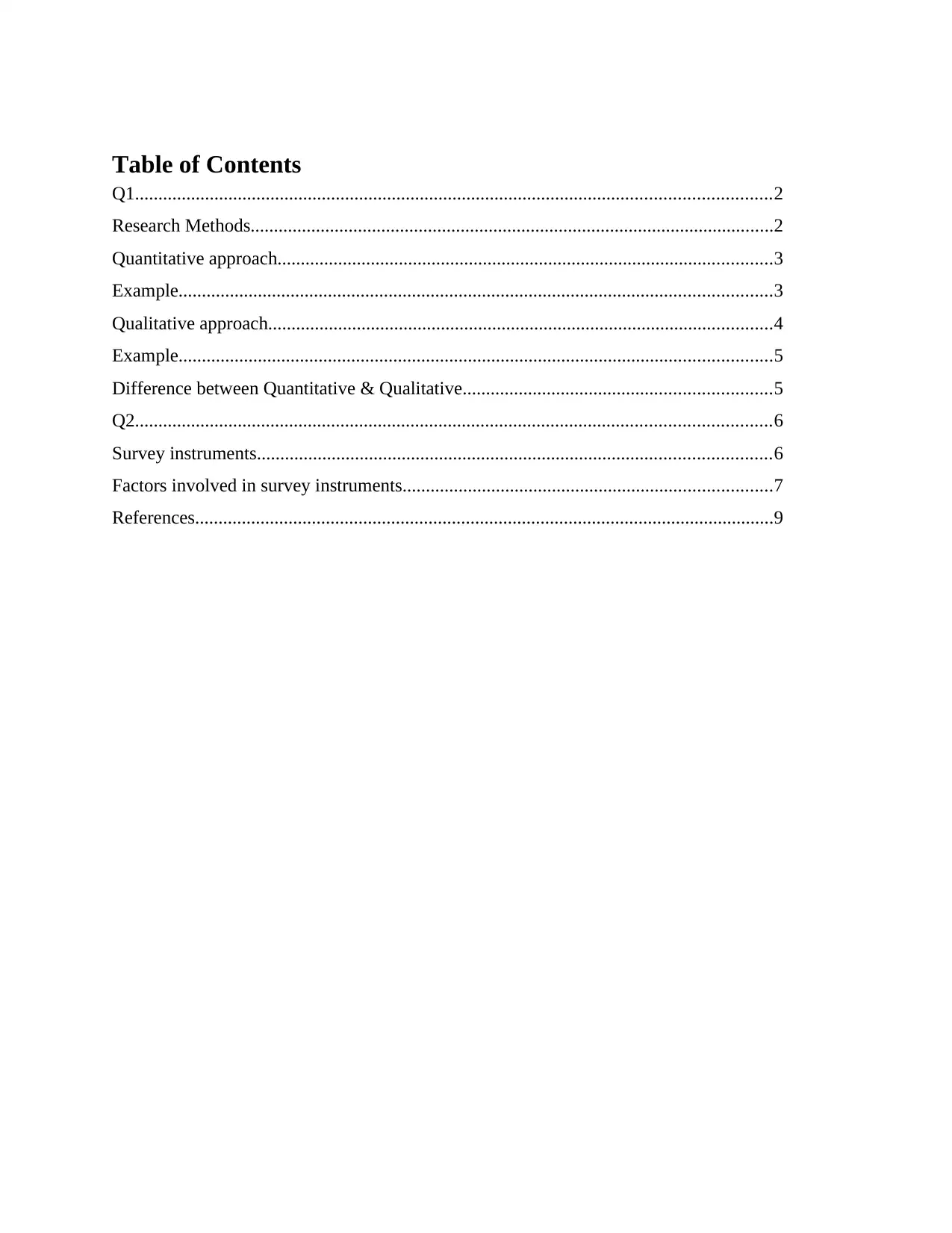
Table of Contents
Q1........................................................................................................................................2
Research Methods................................................................................................................2
Quantitative approach..........................................................................................................3
Example...............................................................................................................................3
Qualitative approach............................................................................................................4
Example...............................................................................................................................5
Difference between Quantitative & Qualitative..................................................................5
Q2........................................................................................................................................6
Survey instruments..............................................................................................................6
Factors involved in survey instruments...............................................................................7
References............................................................................................................................9
Q1........................................................................................................................................2
Research Methods................................................................................................................2
Quantitative approach..........................................................................................................3
Example...............................................................................................................................3
Qualitative approach............................................................................................................4
Example...............................................................................................................................5
Difference between Quantitative & Qualitative..................................................................5
Q2........................................................................................................................................6
Survey instruments..............................................................................................................6
Factors involved in survey instruments...............................................................................7
References............................................................................................................................9
Q1.
Research Methods
The research is defined as the systematic investigation or a study of sources in order to determine
the new facts and conclusions. The reason is mainly conducted for the enhancement of
knowledge which is not having any immediate commercial potential. Following are the types of
research methods:
1. Basic research is formulated to add scientific knowledge in an organized manner, and it does
not have any immediate practical use. The applied science is mainly conducted to improve
the conditions of human beings. It is conducted by the huge agencies such as government,
UNICEF, and others. It is conducted by the agencies that are having the capability to make
such investments for example research conducted to improve the crop production (Bryman et
al., 2015).
2. The applied research is mainly conducted to solve the practical problem. The objective of the
research is to improve the knowledge of human beings through analyses which help to solve
the problems of real or social life.
3. The problem-oriented research is done by the body of industry apex which solves the
problems of companies through research.
4. The problem-solving research is conducted by an individual organization for solving the
problem of their organization such as market research.
5. The quantitative research is based on numeric figures which have the aim to measure the
quality and quantity based on the previous records.
6. The qualitative research is a subjective research which is done through collecting, analyzing
and data interpretations.
Research Methods
The research is defined as the systematic investigation or a study of sources in order to determine
the new facts and conclusions. The reason is mainly conducted for the enhancement of
knowledge which is not having any immediate commercial potential. Following are the types of
research methods:
1. Basic research is formulated to add scientific knowledge in an organized manner, and it does
not have any immediate practical use. The applied science is mainly conducted to improve
the conditions of human beings. It is conducted by the huge agencies such as government,
UNICEF, and others. It is conducted by the agencies that are having the capability to make
such investments for example research conducted to improve the crop production (Bryman et
al., 2015).
2. The applied research is mainly conducted to solve the practical problem. The objective of the
research is to improve the knowledge of human beings through analyses which help to solve
the problems of real or social life.
3. The problem-oriented research is done by the body of industry apex which solves the
problems of companies through research.
4. The problem-solving research is conducted by an individual organization for solving the
problem of their organization such as market research.
5. The quantitative research is based on numeric figures which have the aim to measure the
quality and quantity based on the previous records.
6. The qualitative research is a subjective research which is done through collecting, analyzing
and data interpretations.
⊘ This is a preview!⊘
Do you want full access?
Subscribe today to unlock all pages.

Trusted by 1+ million students worldwide
Quantitative approach
The quantitative research h is mainly related to the positivist paradigm. The data is collected and
analyzed to convert it into the statistical form which helps to draw a conclusion. The quantitative
research emphasizes on converting general reason to the specific (Taylor et al., 2015). The
approach is situated with the social constructivist paradigm which emphasizes on constructed
nature of reality in a social manner. Following are the two approaches:
1. Pragmatic approach
It is related to the science in which the research method is selected according to the research
problem, and there is a freedom in selecting the method for conducting the research. It
includes the use of data triangulation, investigation triangulation, methodological
triangulation and theory triangulation (Domhoff et al., 2013).
2. Participatory approach
The situation of people is not responded by the reasserting from vulnerable groups. The aim of an
approach is to bring positive change in the life of research subjects. The neutral position is
adopted by the researcher which involves interaction with the research participants informally to
gather the data for conducting the data analysis (Ramondo et al., 2014).
Example
There are various examples of qualitative research such as theory, hypothesis and model
generation, control and manipulation of variables through experiment, data collection of
empirical.
The quantitative research h is mainly related to the positivist paradigm. The data is collected and
analyzed to convert it into the statistical form which helps to draw a conclusion. The quantitative
research emphasizes on converting general reason to the specific (Taylor et al., 2015). The
approach is situated with the social constructivist paradigm which emphasizes on constructed
nature of reality in a social manner. Following are the two approaches:
1. Pragmatic approach
It is related to the science in which the research method is selected according to the research
problem, and there is a freedom in selecting the method for conducting the research. It
includes the use of data triangulation, investigation triangulation, methodological
triangulation and theory triangulation (Domhoff et al., 2013).
2. Participatory approach
The situation of people is not responded by the reasserting from vulnerable groups. The aim of an
approach is to bring positive change in the life of research subjects. The neutral position is
adopted by the researcher which involves interaction with the research participants informally to
gather the data for conducting the data analysis (Ramondo et al., 2014).
Example
There are various examples of qualitative research such as theory, hypothesis and model
generation, control and manipulation of variables through experiment, data collection of
empirical.
Paraphrase This Document
Need a fresh take? Get an instant paraphrase of this document with our AI Paraphraser
Qualitative approach
It is defined as the method of inquiry which is conducted in various academic disciplines. It
includes market research, business research by nonprofit organizations. It is a broad
methodological approach which includes various methods of research. The aim of qualitative
research varies according to the subjects such as in psychological research the in-depth
understanding of human behavior is required. Following are the five approaches:
1. Ethnography
The ethnography approach is defined as the research which comes in the anthropology field.
The research emphasizes on studying the entire culture. The area of research is broad which
is classified on the basis of methods used by practitioners. The common approach is
participant observation, and there is no ending point in the research ((Cakoni et al., 2014).
2. Phenomenology
It is defined as the philosophical perspective to quantitative research. The history is very long
in this approach which comprises of sociology, psychology, social work and others. The
approach focuses on the subjective interpretations and experience of people. The
understanding of world appearance for others is the aim of phenomenologist.
3. Field research
It is a broad approach which collects qualitative data. The researchers go into the field for
doing the research. It is situated with the methods of participant observations. The extensive
notes are taken for the analysis.
4. Grounded theory
It is defined as the iterative process. The research approach starts with asking of generative
questions which guide the process of research. The tentative link is developed between the
data and theories. The theories are based on the observation which results in theory
It is defined as the method of inquiry which is conducted in various academic disciplines. It
includes market research, business research by nonprofit organizations. It is a broad
methodological approach which includes various methods of research. The aim of qualitative
research varies according to the subjects such as in psychological research the in-depth
understanding of human behavior is required. Following are the five approaches:
1. Ethnography
The ethnography approach is defined as the research which comes in the anthropology field.
The research emphasizes on studying the entire culture. The area of research is broad which
is classified on the basis of methods used by practitioners. The common approach is
participant observation, and there is no ending point in the research ((Cakoni et al., 2014).
2. Phenomenology
It is defined as the philosophical perspective to quantitative research. The history is very long
in this approach which comprises of sociology, psychology, social work and others. The
approach focuses on the subjective interpretations and experience of people. The
understanding of world appearance for others is the aim of phenomenologist.
3. Field research
It is a broad approach which collects qualitative data. The researchers go into the field for
doing the research. It is situated with the methods of participant observations. The extensive
notes are taken for the analysis.
4. Grounded theory
It is defined as the iterative process. The research approach starts with asking of generative
questions which guide the process of research. The tentative link is developed between the
data and theories. The theories are based on the observation which results in theory
identification at the time of data identification. The new observations lead to determine the
new linkages, and it is never ending approach (Maxwell et al., 2012).
5. Case study
It is defined as the detailed analysis of a particular case by focusing on specific facet for
example group, person, and others. The development of case study is interdisciplinary, so
various theories and concepts help to interpret the case study.
Example
To study the violence of gun from the gun buyback program then the rate of crime needs to be
determining for its implementation. The research is known as qualitative research.
Difference between Quantitative & Qualitative
The qualitative research is defined as the primary exploratory research. It is conducted to
understand the reason, motivations, and opinions. It helps to create ideas for conducting the
quantitative research. The trends of thoughts are uncovered through qualitative research. The
methods of data collection vary through structured and unstructured techniques. The common
methods of research are interviews, observations, group discussion and others. The size of a
sample is generally small, and respondents are chosen in order to receive the response for
fulfilling the selected quote. It is more flexible than qualitative methods (Punch et al., 2013). It
allows high accommodation for interacting between the respondents and researcher.
The quantitative research is conducted to solve the problem through analysis of numerical data
which can be translated into useable statistics. It is used to calculate the opinions, attitude,
behavior and other variables which generalized results from the huge amount of data. The facts
are formulated through measurable data. The methods of collecting data are more structured than
new linkages, and it is never ending approach (Maxwell et al., 2012).
5. Case study
It is defined as the detailed analysis of a particular case by focusing on specific facet for
example group, person, and others. The development of case study is interdisciplinary, so
various theories and concepts help to interpret the case study.
Example
To study the violence of gun from the gun buyback program then the rate of crime needs to be
determining for its implementation. The research is known as qualitative research.
Difference between Quantitative & Qualitative
The qualitative research is defined as the primary exploratory research. It is conducted to
understand the reason, motivations, and opinions. It helps to create ideas for conducting the
quantitative research. The trends of thoughts are uncovered through qualitative research. The
methods of data collection vary through structured and unstructured techniques. The common
methods of research are interviews, observations, group discussion and others. The size of a
sample is generally small, and respondents are chosen in order to receive the response for
fulfilling the selected quote. It is more flexible than qualitative methods (Punch et al., 2013). It
allows high accommodation for interacting between the respondents and researcher.
The quantitative research is conducted to solve the problem through analysis of numerical data
which can be translated into useable statistics. It is used to calculate the opinions, attitude,
behavior and other variables which generalized results from the huge amount of data. The facts
are formulated through measurable data. The methods of collecting data are more structured than
⊘ This is a preview!⊘
Do you want full access?
Subscribe today to unlock all pages.
Trusted by 1+ million students worldwide
the collection methods of qualitative data (Ragin et al., 2014). The methods include telephonic
survey, online survey, systematic observations and others.
Q2.
Survey instruments
The survey instruments are defined as the tools which are implemented for getting the data from
respondents. The questionnaire is used as the survey instruments for conducting social and
behavioral surveys. The objective of an instrument is to collect the demographic information
from the respondents. The cognitive psychology principles are used to design the questionnaire
(Scott et al., 2016). There are various types of survey instruments such as total station,
graphomotor, total station, cosmolabe, transit, and others. It is mainly a technique for determining
the three-dimensional position. The professionals of the land survey are known as the land
surveyor. The work of survey is conducted with the elements of trigonometry, geometry,
regression, programming languages, engineering, physics, metrology, and others. Much
equipment is used by the surveyor such as 3D scanners, digital level, the software of surveying
and others.
One of the elements in human development from the past history is surveying. The construction
requires surveying. It is also used in communication, mapping, and transportation. It is considered
as an important tool for research. The survey is totally depending upon the equipment’s used by
the surveyor. There are various surveying equipment's which were used in the past such as a
compass, chains, theodolite and others. The compass is used to determine the line at the time of
the survey. The distance between two poles was measured from the surveying tool named as
chain, and for short distance, the metallic measuring tape was used. With the change in
technology the tools of surveying were improved. The simple theodolite equipment was used for
survey, online survey, systematic observations and others.
Q2.
Survey instruments
The survey instruments are defined as the tools which are implemented for getting the data from
respondents. The questionnaire is used as the survey instruments for conducting social and
behavioral surveys. The objective of an instrument is to collect the demographic information
from the respondents. The cognitive psychology principles are used to design the questionnaire
(Scott et al., 2016). There are various types of survey instruments such as total station,
graphomotor, total station, cosmolabe, transit, and others. It is mainly a technique for determining
the three-dimensional position. The professionals of the land survey are known as the land
surveyor. The work of survey is conducted with the elements of trigonometry, geometry,
regression, programming languages, engineering, physics, metrology, and others. Much
equipment is used by the surveyor such as 3D scanners, digital level, the software of surveying
and others.
One of the elements in human development from the past history is surveying. The construction
requires surveying. It is also used in communication, mapping, and transportation. It is considered
as an important tool for research. The survey is totally depending upon the equipment’s used by
the surveyor. There are various surveying equipment's which were used in the past such as a
compass, chains, theodolite and others. The compass is used to determine the line at the time of
the survey. The distance between two poles was measured from the surveying tool named as
chain, and for short distance, the metallic measuring tape was used. With the change in
technology the tools of surveying were improved. The simple theodolite equipment was used for
Paraphrase This Document
Need a fresh take? Get an instant paraphrase of this document with our AI Paraphraser
measuring the vertical and horizontal angles. The long distance is measured through measuring
wheel. The measuring tools were of two types, namely, electronic and mechanical. The various
tools such as plain meters, automatic levels, measuring wheels and theodolites were started to use
in early 1990. The horizontal level is also measured through the auto level which is also a
surveying tool. There are various kinds of leveling surveying tools such as tilting level, auto
level, and self-leveling level.
Factors involved in survey instruments
The selection of survey instruments is based on various factors which impact on conducting the
research. Following are the factors which are considered at the time of selecting survey
instruments.
1. Research type
There is various type of research for example qualitative, quantitative research and others.
The type of research is one the factor which needs to be taken into account at the time of
selecting the instrument for conducting the survey. For example, quantitative research is in a
descriptive form then the suitable instrument for conducting the research is questionnaire
which is an instrument for conducting the survey.
2. Cost
The cost of conducting the research is an important financial aspect which needs to be taken
into account while selecting the instrument for surveying. The budget of research is generally
high of big financial agencies or government, but the research conducted by the individual or
organizations are having the low budget. For example, the research is conducted to know the
impact of inflation at a national level is conducted by any government financial agency which
is having the high budget then the research survey instrument can be chosen easily according
to the financial budget allocated by the government.
wheel. The measuring tools were of two types, namely, electronic and mechanical. The various
tools such as plain meters, automatic levels, measuring wheels and theodolites were started to use
in early 1990. The horizontal level is also measured through the auto level which is also a
surveying tool. There are various kinds of leveling surveying tools such as tilting level, auto
level, and self-leveling level.
Factors involved in survey instruments
The selection of survey instruments is based on various factors which impact on conducting the
research. Following are the factors which are considered at the time of selecting survey
instruments.
1. Research type
There is various type of research for example qualitative, quantitative research and others.
The type of research is one the factor which needs to be taken into account at the time of
selecting the instrument for conducting the survey. For example, quantitative research is in a
descriptive form then the suitable instrument for conducting the research is questionnaire
which is an instrument for conducting the survey.
2. Cost
The cost of conducting the research is an important financial aspect which needs to be taken
into account while selecting the instrument for surveying. The budget of research is generally
high of big financial agencies or government, but the research conducted by the individual or
organizations are having the low budget. For example, the research is conducted to know the
impact of inflation at a national level is conducted by any government financial agency which
is having the high budget then the research survey instrument can be chosen easily according
to the financial budget allocated by the government.
3. Target population
It is one of the most important factors which takes into account at the time of conducting the
research. The target audience is the respondents for the group on the research are conducted.
For example to determine the number of literates in the rural area the question in a survey
must not be in a descriptive form because the illiterate respondents will not be able to
respond. So the instrument is selected according to the convenience of a target population
(Blair et al., 2013).
4. Research objective
The selection of instrument is mainly based on the objective of research, for example, the
research objective is to identify the number of people who like winters then the appropriate
survey instrument would be questionnaire which is suitable according to the objective of the
research.
5. Reliability
It is defined as the reliability of an instrument that yields the same results over multiple trials.
It is examined through ascertaining the results of previous research. For example, the results
are not same in the previous research then the survey instrument will not be selected.
6. Type of data
The type of data impacts on the selection of surveying instrument. The instrument is selected
on the basis of data type so that the appropriate conclusions can be drawn. For example, if
inferential statistics is used then it is beneficial to develop the total score. The creation of
total score depends upon the response collected from all the respondents.
7. Valid
The validity of an instrument is determined by various methods which are done after data
collection. The assessment of instrument is done through conducting research on the
instrument by ascertaining the findings of previous research. For example, the results of
It is one of the most important factors which takes into account at the time of conducting the
research. The target audience is the respondents for the group on the research are conducted.
For example to determine the number of literates in the rural area the question in a survey
must not be in a descriptive form because the illiterate respondents will not be able to
respond. So the instrument is selected according to the convenience of a target population
(Blair et al., 2013).
4. Research objective
The selection of instrument is mainly based on the objective of research, for example, the
research objective is to identify the number of people who like winters then the appropriate
survey instrument would be questionnaire which is suitable according to the objective of the
research.
5. Reliability
It is defined as the reliability of an instrument that yields the same results over multiple trials.
It is examined through ascertaining the results of previous research. For example, the results
are not same in the previous research then the survey instrument will not be selected.
6. Type of data
The type of data impacts on the selection of surveying instrument. The instrument is selected
on the basis of data type so that the appropriate conclusions can be drawn. For example, if
inferential statistics is used then it is beneficial to develop the total score. The creation of
total score depends upon the response collected from all the respondents.
7. Valid
The validity of an instrument is determined by various methods which are done after data
collection. The assessment of instrument is done through conducting research on the
instrument by ascertaining the findings of previous research. For example, the results of
⊘ This is a preview!⊘
Do you want full access?
Subscribe today to unlock all pages.
Trusted by 1+ million students worldwide

previous research data are not ascertained then the survey instrument will not be taken for
conducting the research.
conducting the research.
Paraphrase This Document
Need a fresh take? Get an instant paraphrase of this document with our AI Paraphraser
References
Taylor, S. J., Bogdan, R., & DeVault, M. (2015). Introduction to qualitative research methods: A
guidebook and resource. John Wiley & Sons.
Bryman, A., & Bell, E. (2015). Business research methods. Oxford University Press, USA.
Cakoni, F., & Colton, D. (2014). A qualitative approach to inverse scattering theory. New York
(NY): Springer.
Maxwell, J. A. (2012). Qualitative research design: An interactive approach: An interactive
approach. Sage.
Domhoff, G. W. (2013). Finding meaning in dreams: A quantitative approach. Springer Science
& Business Media.
Ramondo, N. (2014). A quantitative approach to multinational production. Journal of
International Economics, 93(1), 108-122.
Punch, K. F. (2013). Introduction to social research: Quantitative and qualitative approaches.
Sage.
Ragin, C. C. (2014). The comparative method: Moving beyond qualitative and quantitative
strategies. Univ of California Press.
Scott, D. N., Brogan, D. J., Lininger, K. B., Schook, D. M., Daugherty, E. E., Sparacino, M. S., &
Patton, A. I. (2016). Evaluating survey instruments and methods in a steep channel.
Geomorphology, 273, 236-243.
Blair, J., Czaja, R. F., & Blair, E. A. (2013). Designing surveys: A guide to decisions and
procedures. Sage Publications.
Taylor, S. J., Bogdan, R., & DeVault, M. (2015). Introduction to qualitative research methods: A
guidebook and resource. John Wiley & Sons.
Bryman, A., & Bell, E. (2015). Business research methods. Oxford University Press, USA.
Cakoni, F., & Colton, D. (2014). A qualitative approach to inverse scattering theory. New York
(NY): Springer.
Maxwell, J. A. (2012). Qualitative research design: An interactive approach: An interactive
approach. Sage.
Domhoff, G. W. (2013). Finding meaning in dreams: A quantitative approach. Springer Science
& Business Media.
Ramondo, N. (2014). A quantitative approach to multinational production. Journal of
International Economics, 93(1), 108-122.
Punch, K. F. (2013). Introduction to social research: Quantitative and qualitative approaches.
Sage.
Ragin, C. C. (2014). The comparative method: Moving beyond qualitative and quantitative
strategies. Univ of California Press.
Scott, D. N., Brogan, D. J., Lininger, K. B., Schook, D. M., Daugherty, E. E., Sparacino, M. S., &
Patton, A. I. (2016). Evaluating survey instruments and methods in a steep channel.
Geomorphology, 273, 236-243.
Blair, J., Czaja, R. F., & Blair, E. A. (2013). Designing surveys: A guide to decisions and
procedures. Sage Publications.

1 out of 11


Related Documents


Your All-in-One AI-Powered Toolkit for Academic Success.
+13062052269
info@desklib.com
Available 24*7 on WhatsApp / Email
![[object Object]](/_next/static/media/star-bottom.7253800d.svg)
Unlock your academic potential
Copyright © 2020–2026 A2Z Services. All Rights Reserved. Developed and managed by ZUCOL.