Quantitative Research Assignment: Statistical Analysis of Variance

Verified

Added on  2022/11/01

|9
|1010
|258
Homework Assignment
AI Summary
This assignment solution delves into quantitative research, specifically focusing on ANOVA (Analysis of Variance) and t-tests. The student's work addresses two exercises, the first involving a one-way ANOVA to compare four teaching methods, and the second utilizing repeated measures ANOVA to analyze drug effectiveness over time. The solution includes hypothesis testing, interpretation of ANOVA tables, and post-hoc analysis using Tukey's test and paired sample tests. The assignment demonstrates an understanding of independent and dependent variables, assumptions of ANOVA, and the application of statistical tests to draw conclusions from experimental data. The student has also provided the relevant references to support the analysis. The assignment analyzes the experimental design and statistical outcomes to determine the significance of differences between groups and the effectiveness of the drug treatments, including the importance of the alpha value.
Document Page
Running head: QUANTITATIVE RESEARCH
Quantitative Research
Name of the student:
Name of the University:
Author note:
tabler-icon-diamond-filled.svg

Paraphrase This Document

Need a fresh take? Get an instant paraphrase of this document with our AI Paraphraser
Document Page
1
QUANTITATIVE RESEARCH
Table of Contents
Exercise 1...................................................................................................................................2
Answer to the q.no 1..............................................................................................................2
Answer to the q.no. 2.............................................................................................................2
Answer to the q.no. 3.............................................................................................................3
Exercise 2...................................................................................................................................4
Answer to the q.no. 1.............................................................................................................4
Answer to the q.no. 2.............................................................................................................4
Answer to the q.no. 3.............................................................................................................5
Answer to the q.no. 4.............................................................................................................5
Answer to the q.no. 5.............................................................................................................5
Answer to the q.no. 6.............................................................................................................6
Answer to the q.no. 7.............................................................................................................6
References..................................................................................................................................7
Document Page
2
QUANTITATIVE RESEARCH
Exercise 1
Answer to the q.no 1
H0: There are no differences among the four teaching methods.
i.e. μ1=μ2=μ3=μ4
H1: There are differences among the four teaching methods.
i.e. μ1 μ2 μ3 μ4
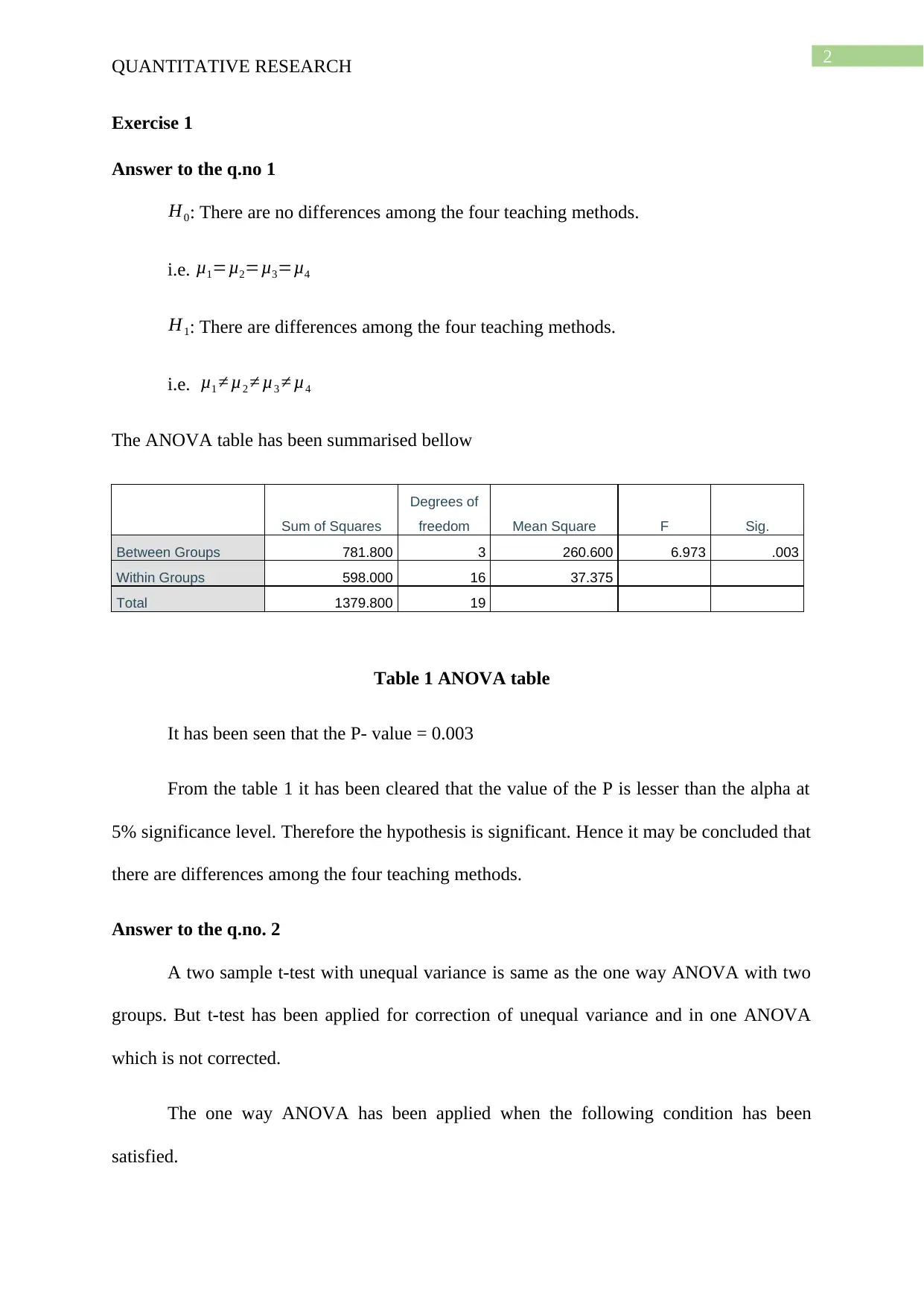
The ANOVA table has been summarised bellow
Table 1 ANOVA table
It has been seen that the P- value = 0.003
From the table 1 it has been cleared that the value of the P is lesser than the alpha at
5% significance level. Therefore the hypothesis is significant. Hence it may be concluded that
there are differences among the four teaching methods.
Answer to the q.no. 2
A two sample t-test with unequal variance is same as the one way ANOVA with two
groups. But t-test has been applied for correction of unequal variance and in one ANOVA
which is not corrected.
The one way ANOVA has been applied when the following condition has been
satisfied.
Sum of Squares
Degrees of
freedom Mean Square F Sig.
Between Groups 781.800 3 260.600 6.973 .003
Within Groups 598.000 16 37.375
Total 1379.800 19
Document Page
3
QUANTITATIVE RESEARCH
Independence of cases
The distribution of the residual has to be normal.
Homoscedasticity.
The conditions of two sample t-test are as bellow
Each of the population has to be normal.
The two population has to be same variance.
The above data has been satisfied all the condition of one way ANOVA. This is the
reason for using this test.
Answer to the q.no. 3
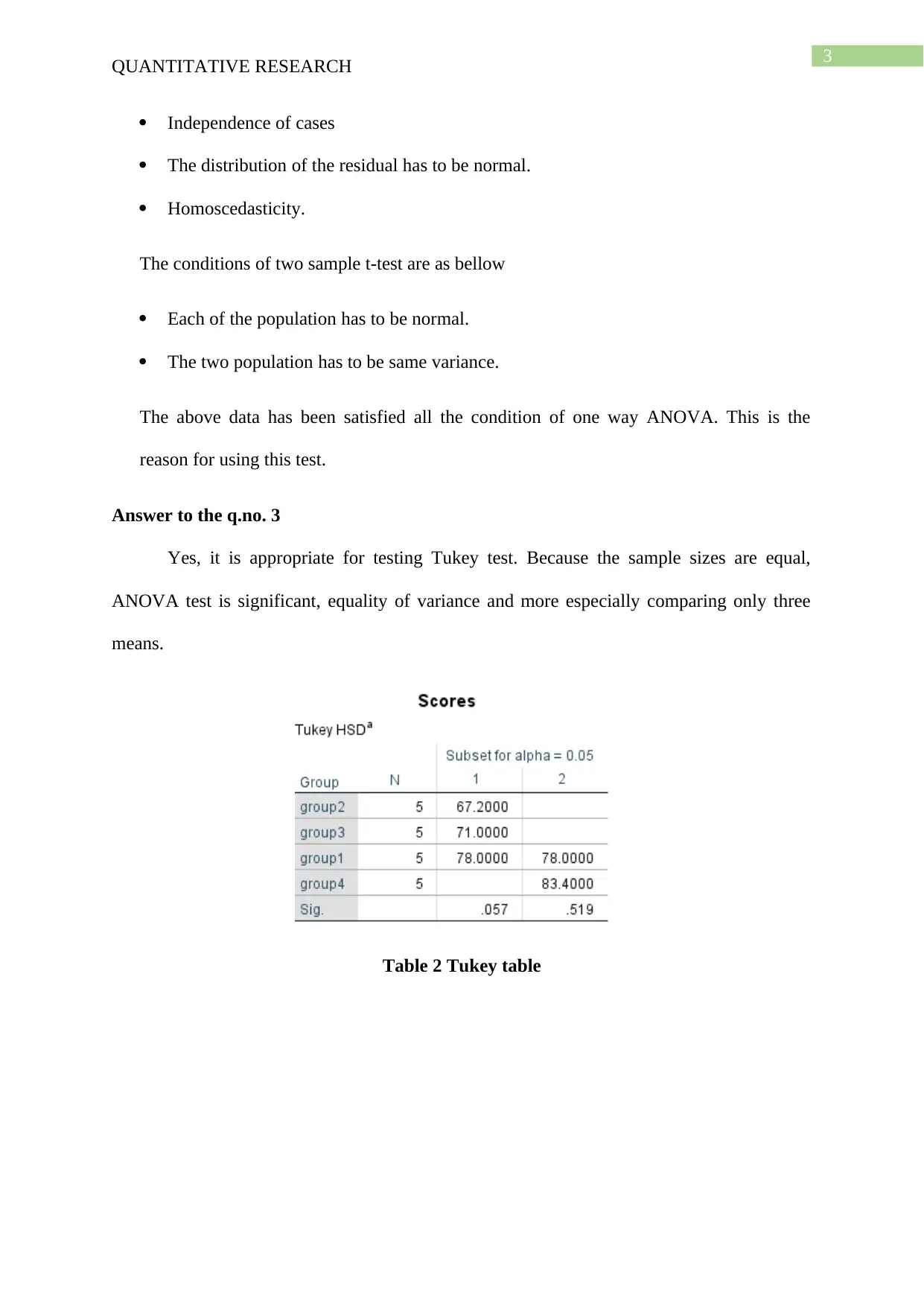
Yes, it is appropriate for testing Tukey test. Because the sample sizes are equal,
ANOVA test is significant, equality of variance and more especially comparing only three
means.
Table 2 Tukey table
tabler-icon-diamond-filled.svg

Paraphrase This Document

Need a fresh take? Get an instant paraphrase of this document with our AI Paraphraser
Document Page
4
QUANTITATIVE RESEARCH
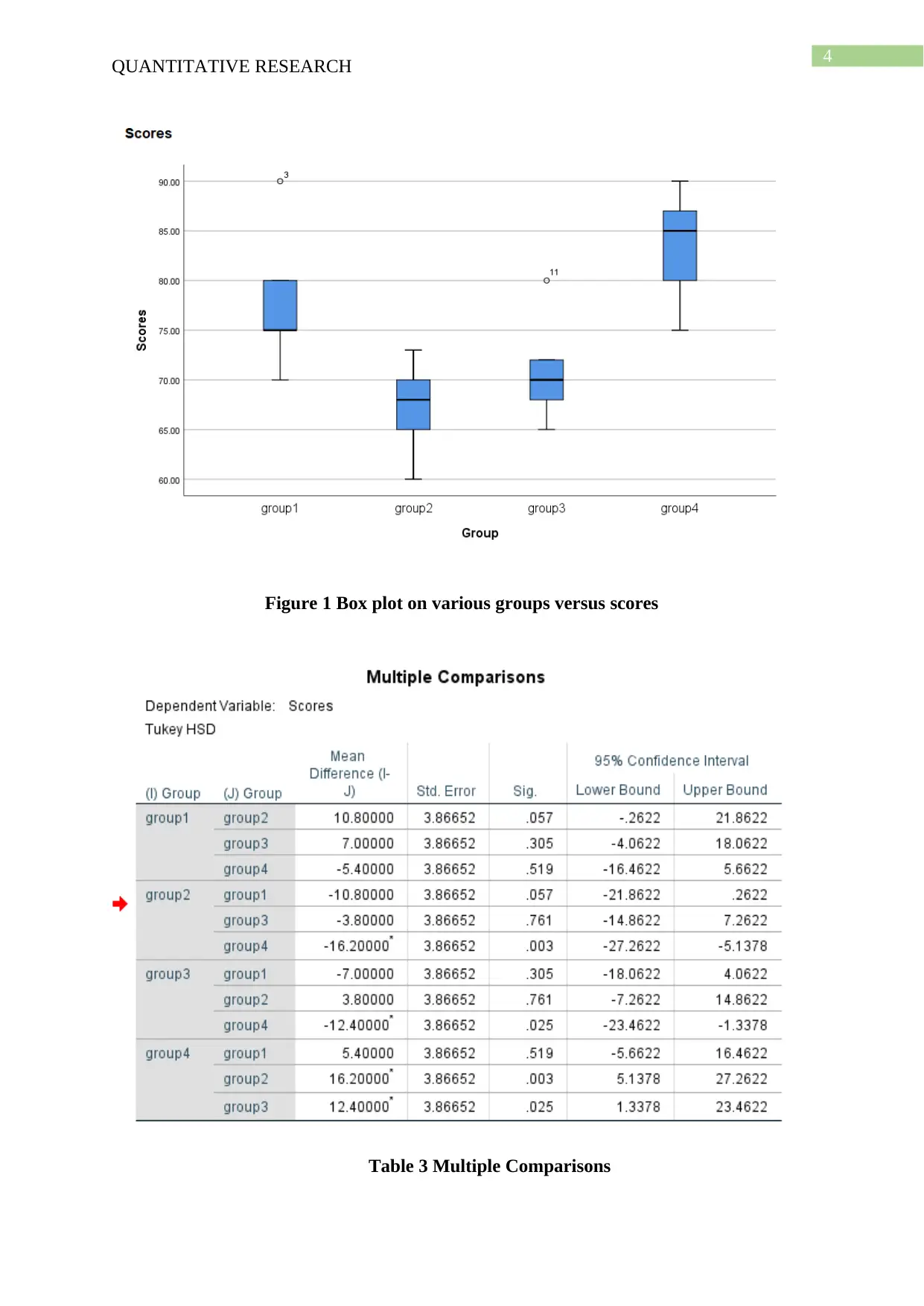
Figure 1 Box plot on various groups versus scores
Table 3 Multiple Comparisons
Document Page
5
QUANTITATIVE RESEARCH
From the above table it is clear that the mean difference between group 1 and group2,
group3 and group 4 is not significant. But the mean difference between Group 2 and group 4
is significant and rest of all not significant. Similarly the mean difference between group 3
and all the other group is not significant.
Exercise 2
Answer to the q.no. 1
The independent variable is drug effect and the dependent variable is participants.
Answer to the q.no. 2
Repeated measures ANOVA is appropriate for this data sheet. Because this data sheet
consist related or dependent samples. When the same individuals has been tested twice or
more times with an inter time than the repeated measures ANOVA is the best test for testing.
Basically in this test the measures are taken repeatedly on the same individuals.
Answer to the q.no. 3
H0: There is no differences on the effectiveness of drug between beginning, ending
and after 3 months period.
i.e. μ1=μ2= μ3
H1: There is a differences on the effectiveness of drug between beginning, ending and
after 3 months period.
i.e. μ1 μ2 μ3
Document Page
6
QUANTITATIVE RESEARCH
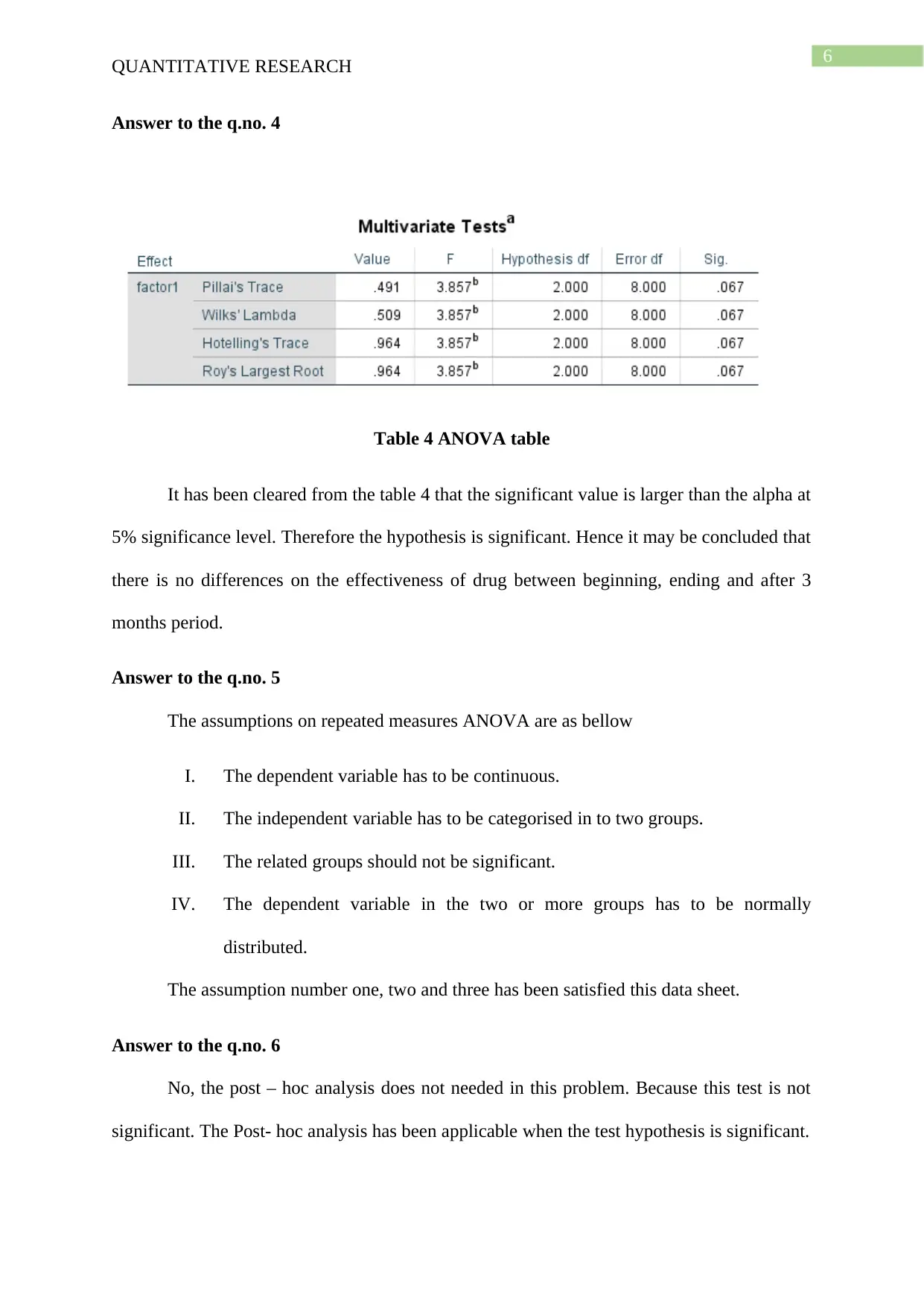
Answer to the q.no. 4
Table 4 ANOVA table
It has been cleared from the table 4 that the significant value is larger than the alpha at
5% significance level. Therefore the hypothesis is significant. Hence it may be concluded that
there is no differences on the effectiveness of drug between beginning, ending and after 3
months period.
Answer to the q.no. 5
The assumptions on repeated measures ANOVA are as bellow
I. The dependent variable has to be continuous.
II. The independent variable has to be categorised in to two groups.
III. The related groups should not be significant.
IV. The dependent variable in the two or more groups has to be normally
distributed.
The assumption number one, two and three has been satisfied this data sheet.
Answer to the q.no. 6
No, the post – hoc analysis does not needed in this problem. Because this test is not
significant. The Post- hoc analysis has been applicable when the test hypothesis is significant.
tabler-icon-diamond-filled.svg

Paraphrase This Document

Need a fresh take? Get an instant paraphrase of this document with our AI Paraphraser
Document Page
7
QUANTITATIVE RESEARCH
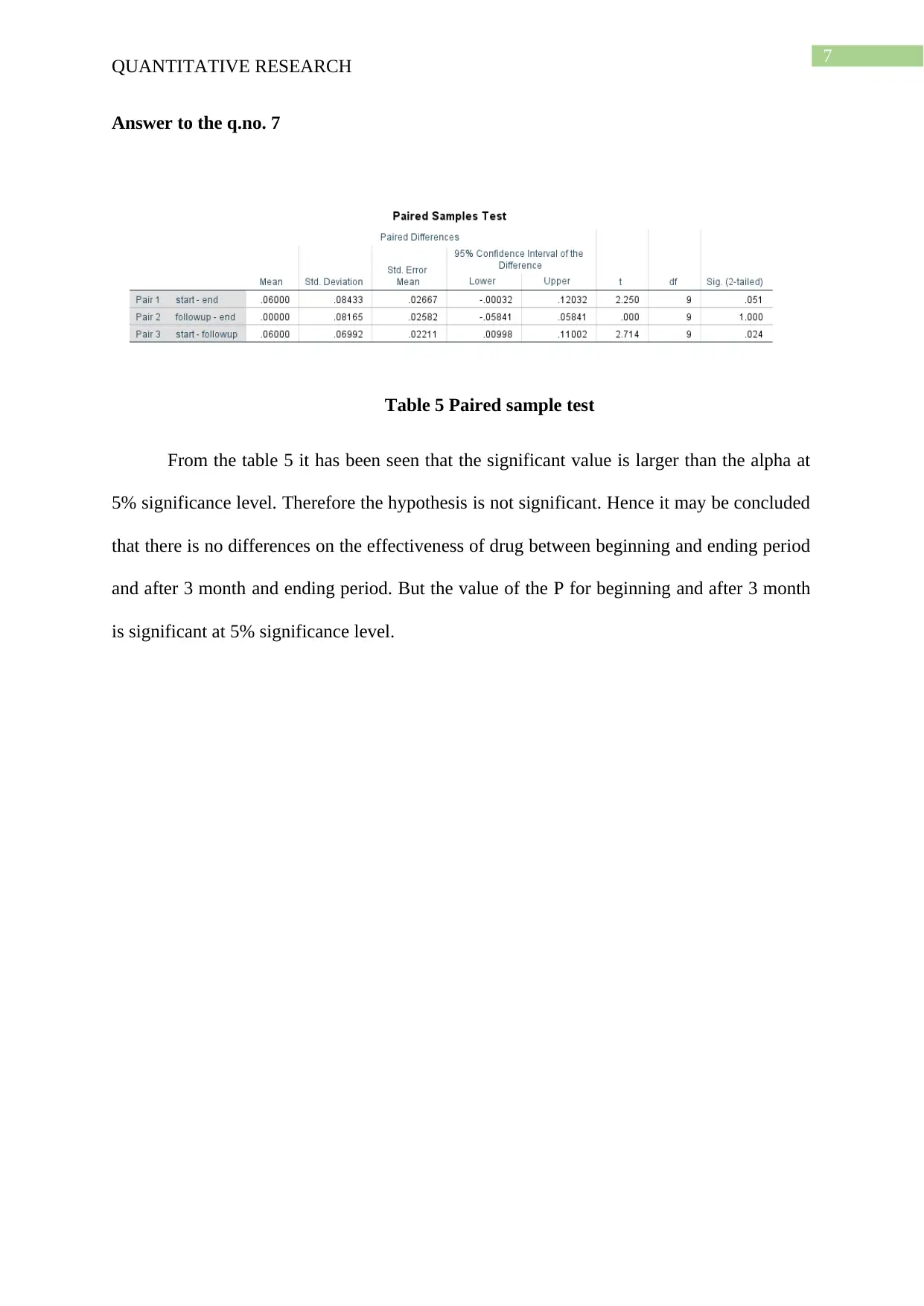
Answer to the q.no. 7
Table 5 Paired sample test
From the table 5 it has been seen that the significant value is larger than the alpha at
5% significance level. Therefore the hypothesis is not significant. Hence it may be concluded
that there is no differences on the effectiveness of drug between beginning and ending period
and after 3 month and ending period. But the value of the P for beginning and after 3 month
is significant at 5% significance level.
Document Page
8
QUANTITATIVE RESEARCH
References
Górecki, T., & Smaga, Ł. (2015). A comparison of tests for the one-way ANOVA problem
for functional data. Computational Statistics, 30(4), 987-1010.
Hedberg, E. C., & Ayers, S. (2015). The power of a paired t-test with a covariate. Social
science research, 50, 277-291.
Konietschke, F., & Pauly, M. (2014). Bootstrapping and permuting paired t-test type
statistics. Statistics and Computing, 24(3), 283-296.
Zhang, J. T., & Liang, X. (2014). One‐way ANOVA for functional data via globalizing the
pointwise F‐test. Scandinavian Journal of Statistics, 41(1), 51-71.
chevron_up_icon
1 out of 9
circle_padding
hide_on_mobile
zoom_out_icon
[object Object]