CONS 0010 - Contract Practice: Analysis of Quantum Meruit Claim

Verified

Added on  2023/06/11

|4
|685
|112
Report
AI Summary
This report provides an analysis of contract practice and administration, focusing on the use of Quantum Meruit claims. It highlights the strengths and weaknesses of unjust enrichment claims and implied promises to pay, emphasizing that unjust enrichment claims do not require a contract between parties. The report details how Coin Builders Ltd can use a Quantum Meruit claim to pursue compensation for services rendered when the contract doesn't stipulate the amount due, differentiating it from unjust enrichment claims by requiring mutual consent for contract changes. Effective strategies for defending against a Quantum Meruit claim, such as demonstrating the absence of a pre-lien notice or lack of owner consent, are discussed. The case study illustrates the superintendent's use of good faith and the prevention principle. Desklib offers more resources for students, including past papers and solved assignments.
Document Page
Contract Practice and Administration
(Author’s name)
(Institutional Affiliation)
1
tabler-icon-diamond-filled.svg

Paraphrase This Document

Need a fresh take? Get an instant paraphrase of this document with our AI Paraphraser
Document Page
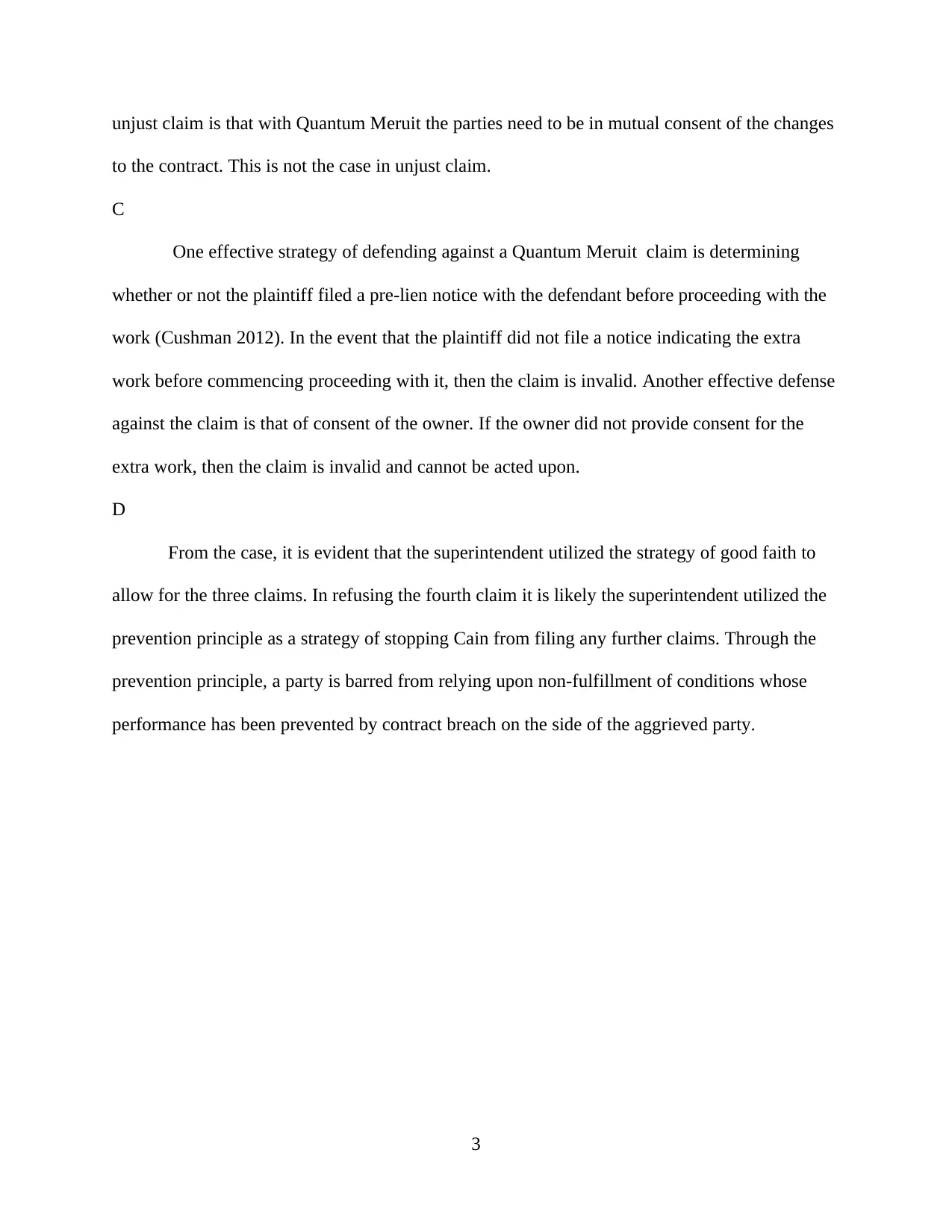
A
A key strength of using the unjust enrichment claim is the fact that there does not need to
be a contract between two parties for an aggrieved party to file this claim. The claim is covered
under the law of restitution and is usually used to cover issues that have not been effectively
covered by the existing contact (Sherwin 2000). Another benefit of the claim is that it provides
restitution for the aggrieved party if the courts find in its favor. A major weakness of the claim is
that the aggrieved party needs to demonstrate that defendant was enriched, the enrichment was as
a result of the claimant expense, the enrichment is unjust and there was no applicable defense or
bar (Sherwin 2000). Another weakness of the claim is the fact that it is not enforceable where
there is an enforceable and applicable contract. A major benefit of implied promise to pay is that
it does not require a written contract. Another benefit is the fact that it covers instances where
there is a lack of explicit terms stipulating the conditions of the contract (Holdsworth 2009). A
major weakness of the claim is the fact that it is difficult to prove given the fact that one needs to
demonstrate the existence of an implied promise.
B
Coin can use the Quantum Meruit claim to pursue his fourth claim. Through the
Quantum Meruit claim, the party that feels aggrieved can be able to be compensated for the
services that he/she rendered when the amount that was due is not stipulated in the contract
(Rendleman 2000). By filling the Quantum Meruit claim, Coin will be able to establish to utilize
the concept of reasonable value for services rendered. This claim will allow for the effective
measure of damages in instances where the express contract has been modified by the mutual
consent of the two parties. The major difference between the concept of Quantum Meruit and
2
Document Page
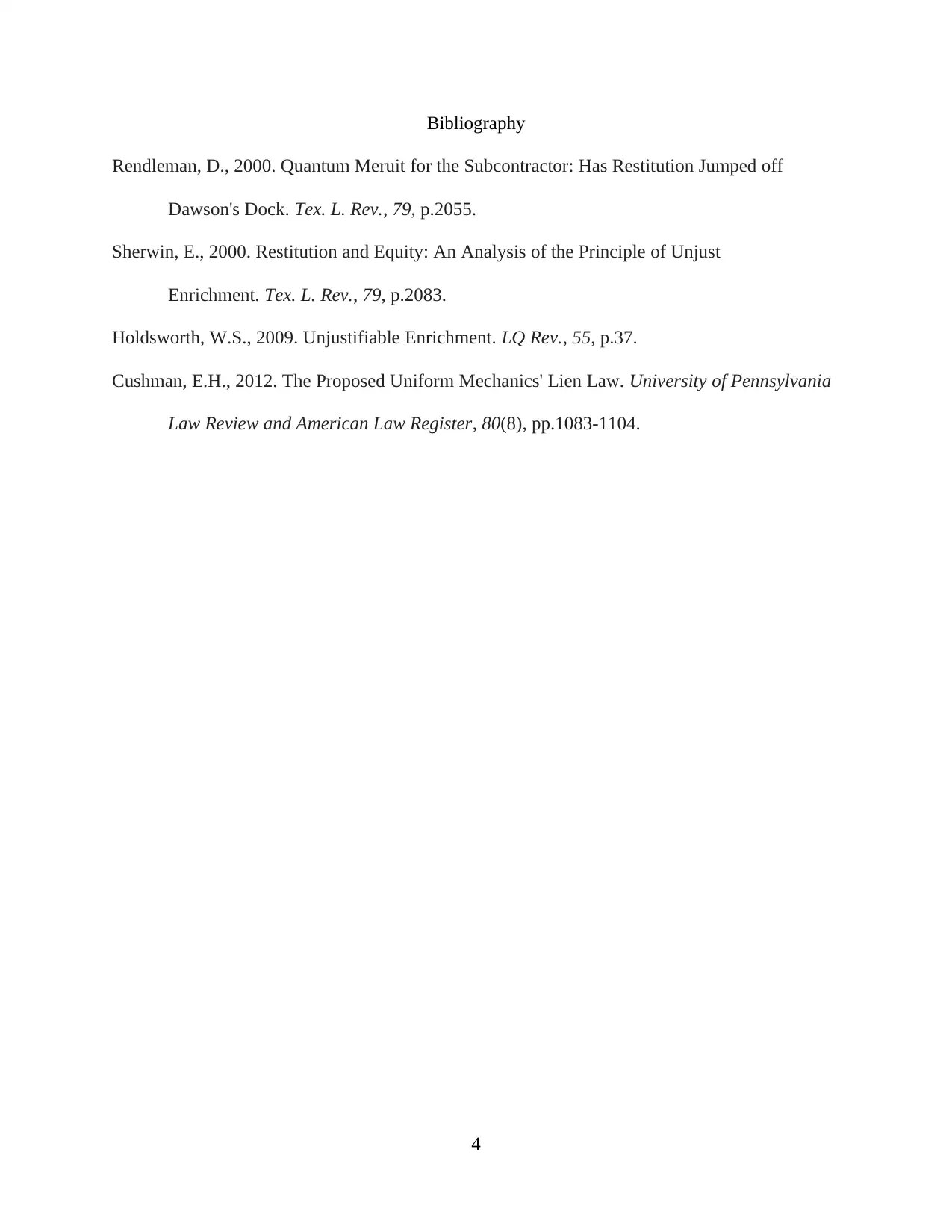
unjust claim is that with Quantum Meruit the parties need to be in mutual consent of the changes
to the contract. This is not the case in unjust claim.
C
One effective strategy of defending against a Quantum Meruit claim is determining
whether or not the plaintiff filed a pre-lien notice with the defendant before proceeding with the
work (Cushman 2012). In the event that the plaintiff did not file a notice indicating the extra
work before commencing proceeding with it, then the claim is invalid. Another effective defense
against the claim is that of consent of the owner. If the owner did not provide consent for the
extra work, then the claim is invalid and cannot be acted upon.
D
From the case, it is evident that the superintendent utilized the strategy of good faith to
allow for the three claims. In refusing the fourth claim it is likely the superintendent utilized the
prevention principle as a strategy of stopping Cain from filing any further claims. Through the
prevention principle, a party is barred from relying upon non-fulfillment of conditions whose
performance has been prevented by contract breach on the side of the aggrieved party.
3
Document Page
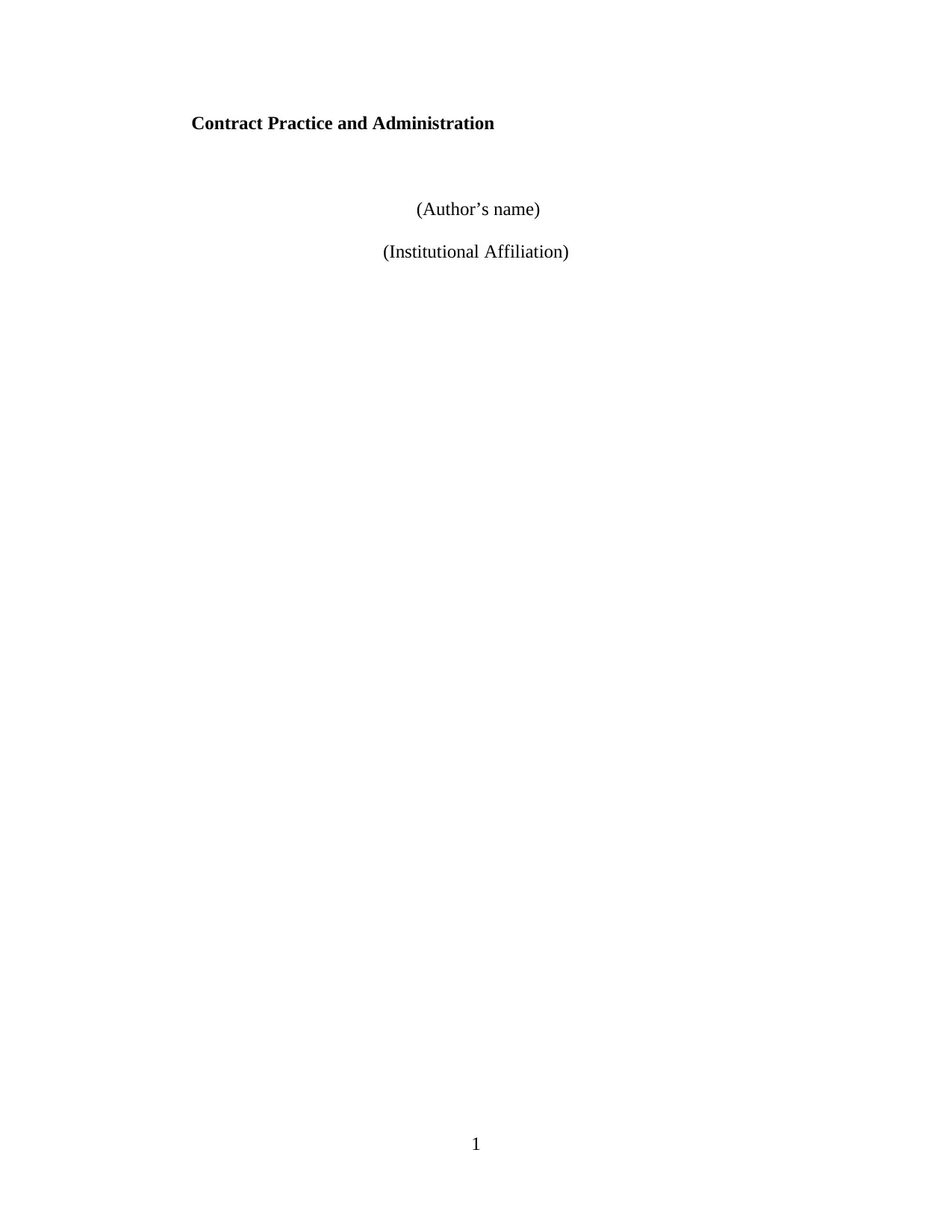
Bibliography
Rendleman, D., 2000. Quantum Meruit for the Subcontractor: Has Restitution Jumped off
Dawson's Dock. Tex. L. Rev., 79, p.2055.
Sherwin, E., 2000. Restitution and Equity: An Analysis of the Principle of Unjust
Enrichment. Tex. L. Rev., 79, p.2083.
Holdsworth, W.S., 2009. Unjustifiable Enrichment. LQ Rev., 55, p.37.
Cushman, E.H., 2012. The Proposed Uniform Mechanics' Lien Law. University of Pennsylvania
Law Review and American Law Register, 80(8), pp.1083-1104.
4
chevron_up_icon
1 out of 4
circle_padding
hide_on_mobile
zoom_out_icon
[object Object]