Analyzing Queuing Models: DK's Call Center and Effective Arrival Rate

Verified

Added on Ā 2021/04/17

|2
|430
|122
Homework Assignment
AI Summary
This assignment delves into the realm of queuing models, exploring their fundamental parameters and applications. It begins by outlining the core concepts of queuing theory, including the order of service, probability distributions of arrival and service times, the number of servers, and queue capacity. The assignment then applies these concepts to a specific case study: DK's call center. It highlights the challenges faced by DK, where a single server (FAZA) handles customer calls, leading to potential bottlenecks. The assignment further discusses the calculation of the effective arrival rate, which is crucial for understanding system efficiency, and emphasizes the importance of probabilities related to the number of customers in the system (PN). Finally, it touches upon the concepts of traffic intensity and utilization factor, which are essential metrics for evaluating the performance of the queuing model.
Document Page
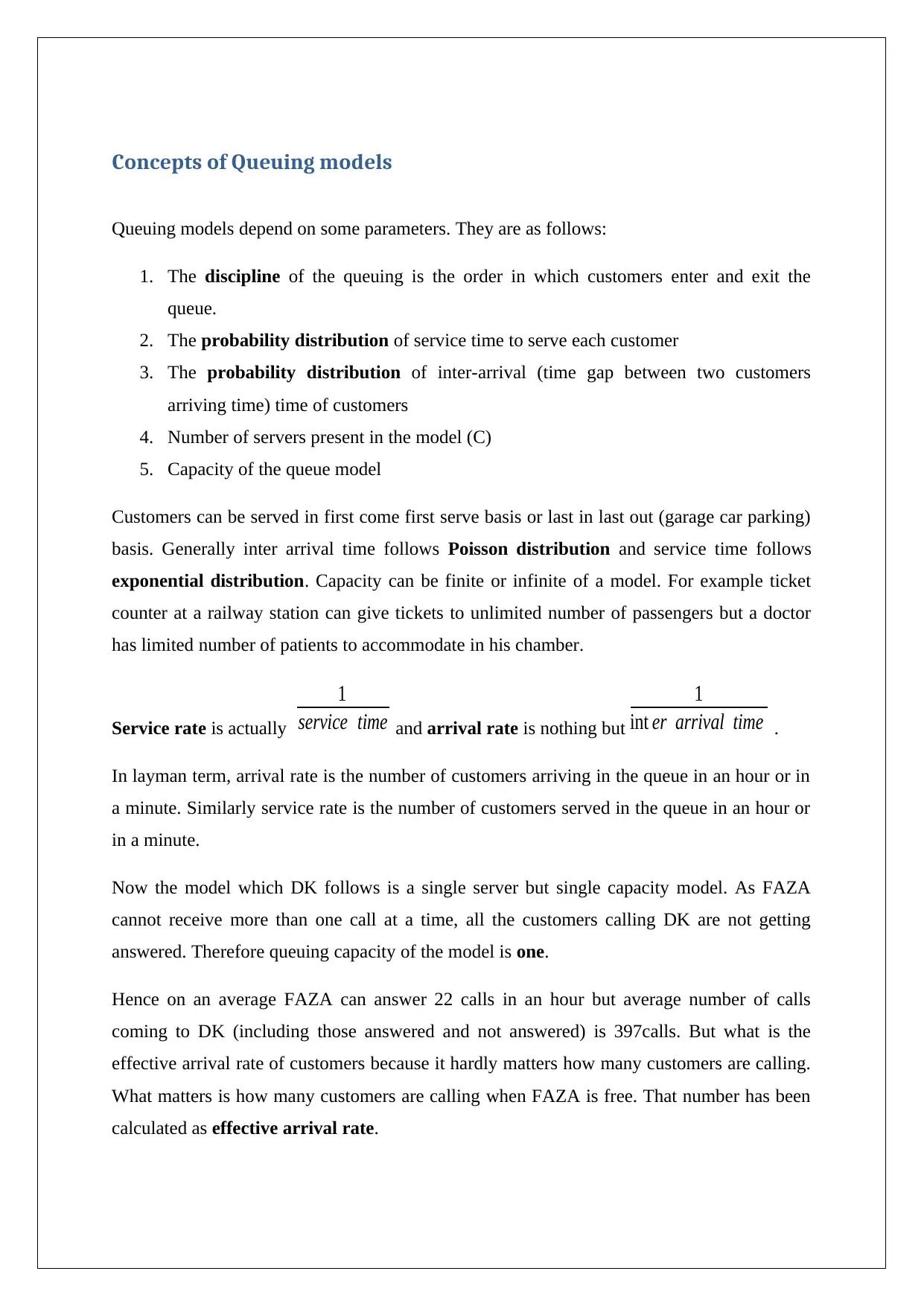
Concepts of Queuing models
Queuing models depend on some parameters. They are as follows:
1. The discipline of the queuing is the order in which customers enter and exit the
queue.
2. The probability distribution of service time to serve each customer
3. The probability distribution of inter-arrival (time gap between two customers
arriving time) time of customers
4. Number of servers present in the model (C)
5. Capacity of the queue model
Customers can be served in first come first serve basis or last in last out (garage car parking)
basis. Generally inter arrival time follows Poisson distribution and service time follows
exponential distribution. Capacity can be finite or infinite of a model. For example ticket
counter at a railway station can give tickets to unlimited number of passengers but a doctor
has limited number of patients to accommodate in his chamber.
Service rate is actually
1
service time and arrival rate is nothing but
1
int er arrival time .
In layman term, arrival rate is the number of customers arriving in the queue in an hour or in
a minute. Similarly service rate is the number of customers served in the queue in an hour or
in a minute.
Now the model which DK follows is a single server but single capacity model. As FAZA
cannot receive more than one call at a time, all the customers calling DK are not getting
answered. Therefore queuing capacity of the model is one.
Hence on an average FAZA can answer 22 calls in an hour but average number of calls
coming to DK (including those answered and not answered) is 397calls. But what is the
effective arrival rate of customers because it hardly matters how many customers are calling.
What matters is how many customers are calling when FAZA is free. That number has been
calculated as effective arrival rate.
tabler-icon-diamond-filled.svg

Paraphrase This Document

Need a fresh take? Get an instant paraphrase of this document with our AI Paraphraser
Document Page
Now to calculate effective arrival rate the probability of number of customers in the system is
required, which is PN. P1 signifies the probability of a single customer present in the queue.
P2 means probability that two customers are present in the queue.
Without finding PN effective arrival rate cannot be found as formula for effective arrival rate
is: arrival rate=arrival rate original (1-PN), where sometimes PN is probability of blocking
(little’s formula).
Traffic intensity and utilization factor are same thing. It signifies the efficiency of a queue
model.
chevron_up_icon
1 out of 2
circle_padding
hide_on_mobile
zoom_out_icon
[object Object]