Data Communication: QUIC Protocol Performance, Benefits, and Impacts

Verified

Added on  2022/09/25

|5
|881
|23
Homework Assignment
AI Summary
This homework assignment provides an analysis of the QUIC protocol, a new internet transfer protocol designed to replace TCP. The assignment details how QUIC improves web traffic performance by mitigating latency and loss issues, offering better loss recovery, and optimizing handshakes. It explains QUIC's use of UDP to reduce round trips and establish faster connections, contrasting it with TCP's three-step connection process. The assignment further explores the benefits of QUIC in the transport layer, such as reduced web latency, improved congestion control, and connection migration, while also addressing its negative impacts, including difficulties in traffic regulation and potential poorer transmission rates. The analysis concludes by suggesting the implementation of QUIC in the application layer due to its significant advantages in enhancing web traffic speed, supported by references to relevant research papers.

Document Page
Running head: DATA COMMUNICATION
Data Communication
Name of the Student
Name of the University
Author Note
tabler-icon-diamond-filled.svg

Paraphrase This Document

Need a fresh take? Get an instant paraphrase of this document with our AI Paraphraser
Document Page
1DATA COMMUNICATION
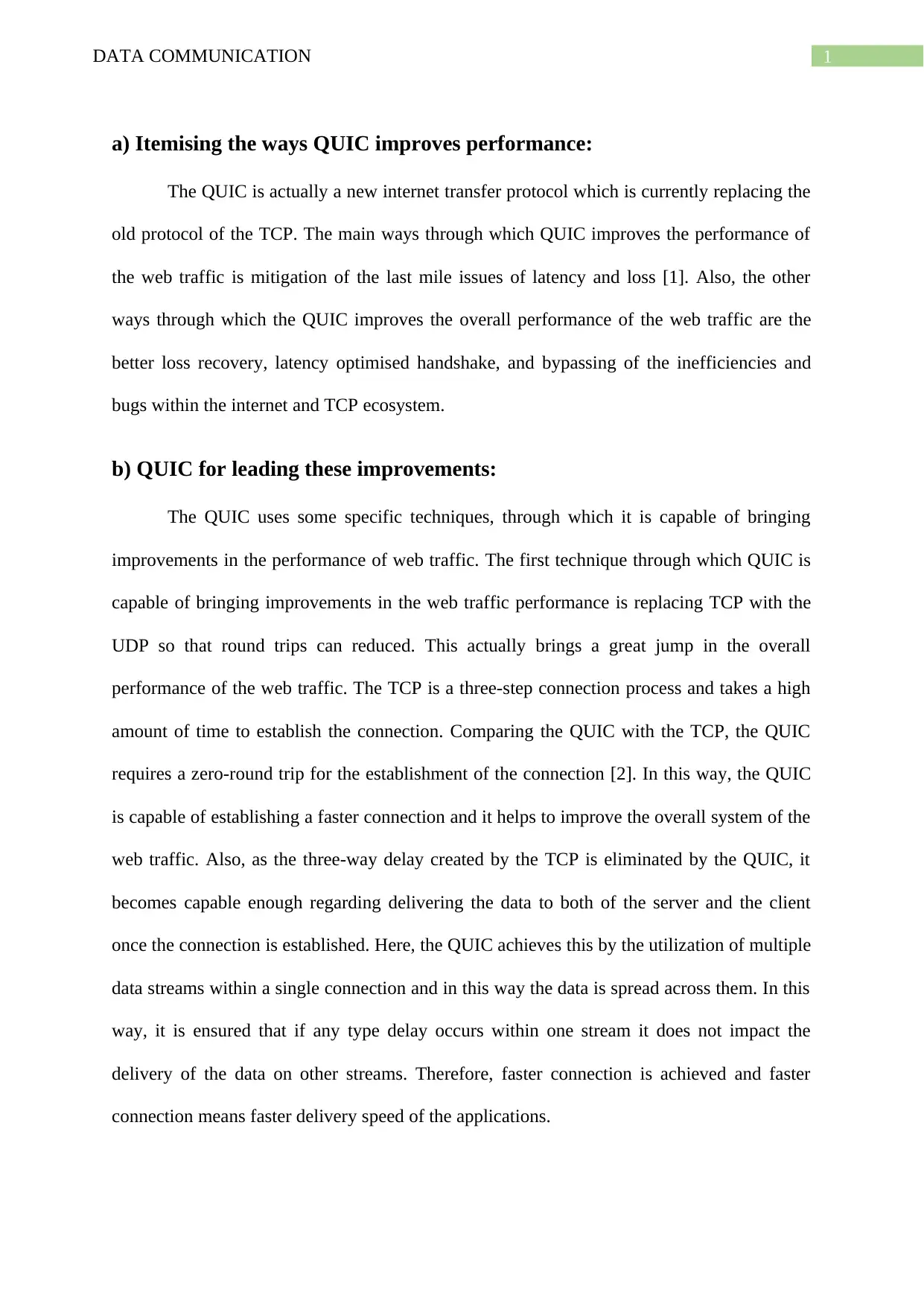
a) Itemising the ways QUIC improves performance:
The QUIC is actually a new internet transfer protocol which is currently replacing the
old protocol of the TCP. The main ways through which QUIC improves the performance of
the web traffic is mitigation of the last mile issues of latency and loss [1]. Also, the other
ways through which the QUIC improves the overall performance of the web traffic are the
better loss recovery, latency optimised handshake, and bypassing of the inefficiencies and
bugs within the internet and TCP ecosystem.
b) QUIC for leading these improvements:
The QUIC uses some specific techniques, through which it is capable of bringing
improvements in the performance of web traffic. The first technique through which QUIC is
capable of bringing improvements in the web traffic performance is replacing TCP with the
UDP so that round trips can reduced. This actually brings a great jump in the overall
performance of the web traffic. The TCP is a three-step connection process and takes a high
amount of time to establish the connection. Comparing the QUIC with the TCP, the QUIC
requires a zero-round trip for the establishment of the connection [2]. In this way, the QUIC
is capable of establishing a faster connection and it helps to improve the overall system of the
web traffic. Also, as the three-way delay created by the TCP is eliminated by the QUIC, it
becomes capable enough regarding delivering the data to both of the server and the client
once the connection is established. Here, the QUIC achieves this by the utilization of multiple
data streams within a single connection and in this way the data is spread across them. In this
way, it is ensured that if any type delay occurs within one stream it does not impact the
delivery of the data on other streams. Therefore, faster connection is achieved and faster
connection means faster delivery speed of the applications.
Document Page
2DATA COMMUNICATION
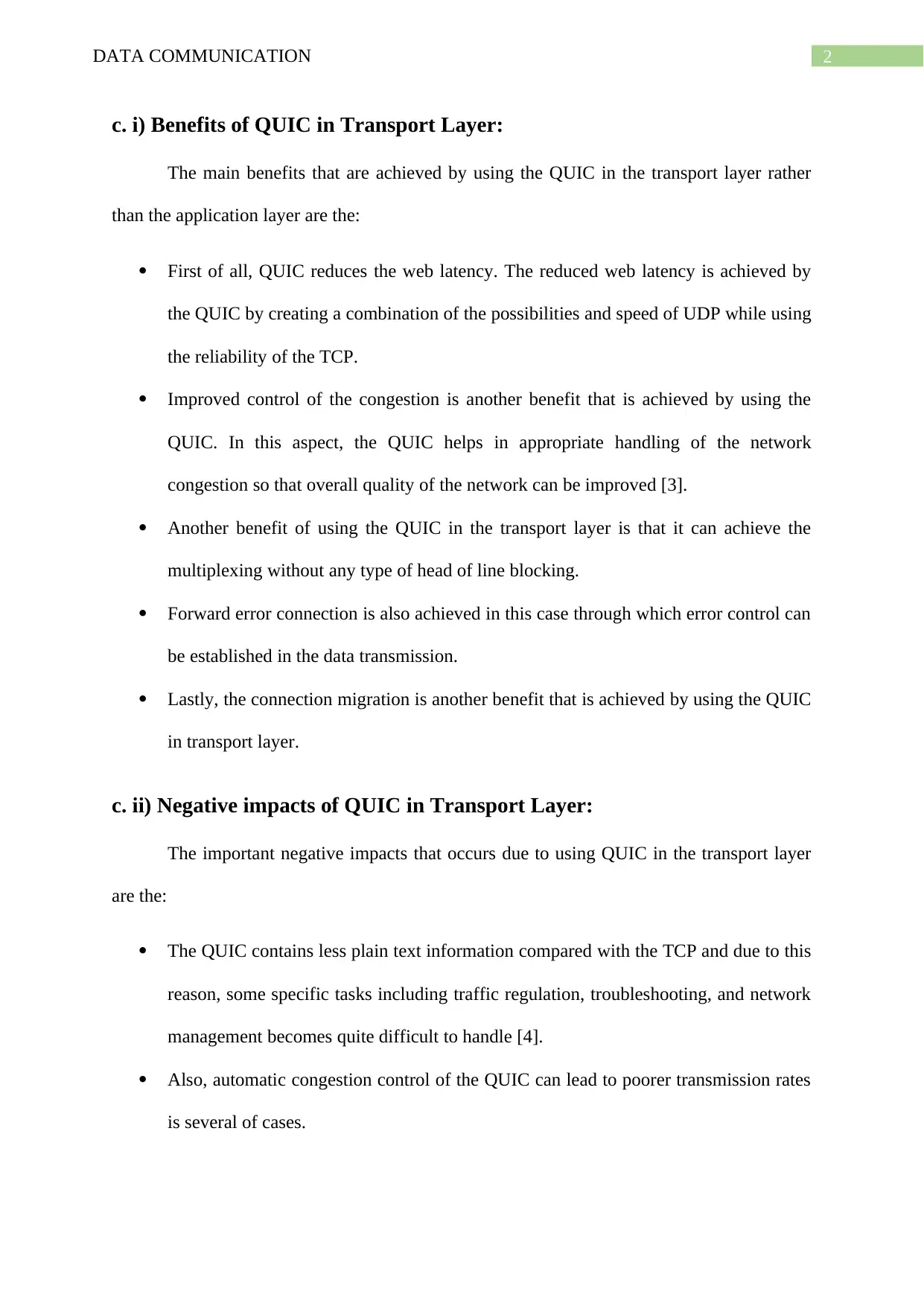
c. i) Benefits of QUIC in Transport Layer:
The main benefits that are achieved by using the QUIC in the transport layer rather
than the application layer are the:
First of all, QUIC reduces the web latency. The reduced web latency is achieved by
the QUIC by creating a combination of the possibilities and speed of UDP while using
the reliability of the TCP.
Improved control of the congestion is another benefit that is achieved by using the
QUIC. In this aspect, the QUIC helps in appropriate handling of the network
congestion so that overall quality of the network can be improved [3].
Another benefit of using the QUIC in the transport layer is that it can achieve the
multiplexing without any type of head of line blocking.
Forward error connection is also achieved in this case through which error control can
be established in the data transmission.
Lastly, the connection migration is another benefit that is achieved by using the QUIC
in transport layer.
c. ii) Negative impacts of QUIC in Transport Layer:
The important negative impacts that occurs due to using QUIC in the transport layer
are the:
The QUIC contains less plain text information compared with the TCP and due to this
reason, some specific tasks including traffic regulation, troubleshooting, and network
management becomes quite difficult to handle [4].
Also, automatic congestion control of the QUIC can lead to poorer transmission rates
is several of cases.
Document Page
3DATA COMMUNICATION
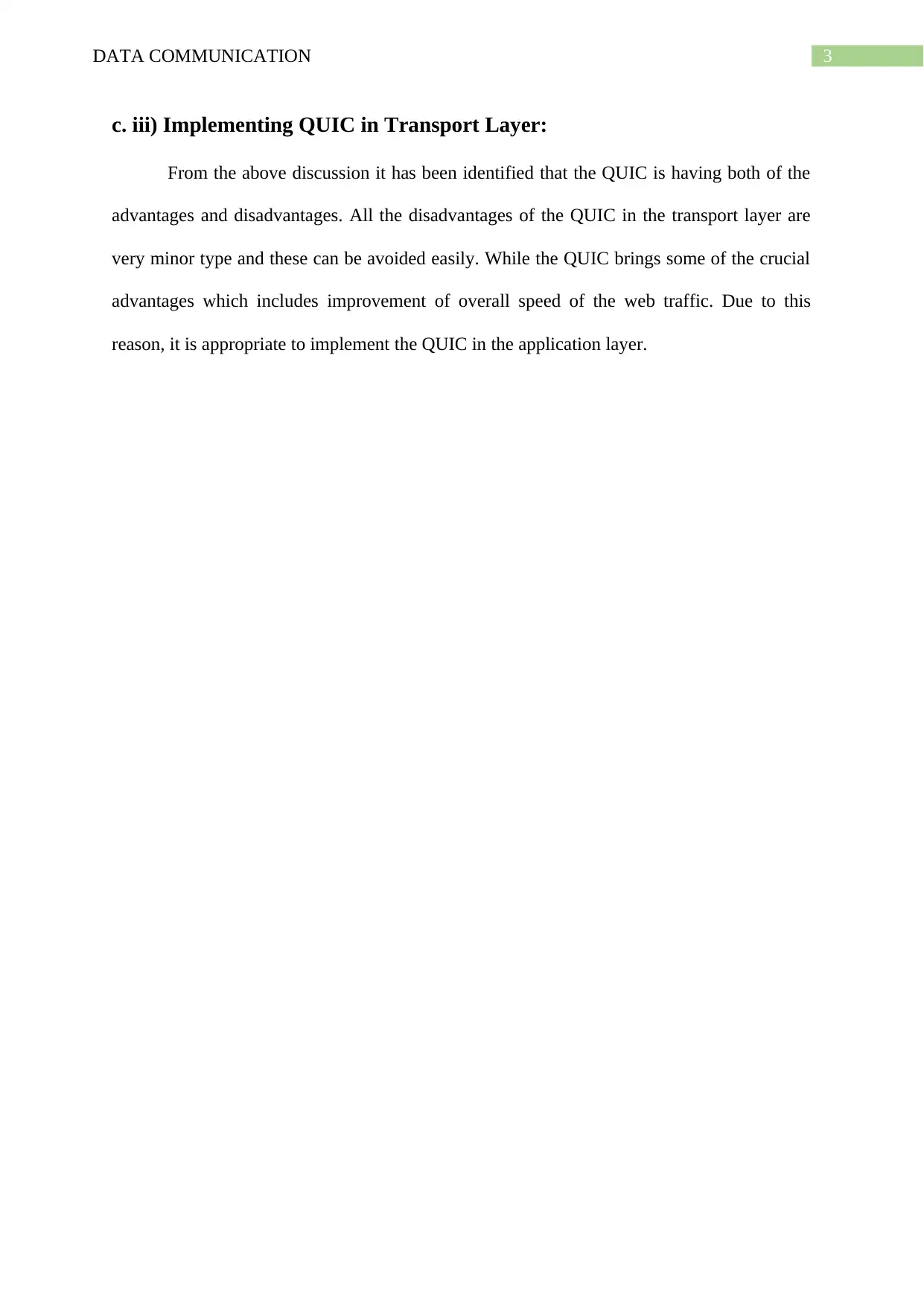
c. iii) Implementing QUIC in Transport Layer:
From the above discussion it has been identified that the QUIC is having both of the
advantages and disadvantages. All the disadvantages of the QUIC in the transport layer are
very minor type and these can be avoided easily. While the QUIC brings some of the crucial
advantages which includes improvement of overall speed of the web traffic. Due to this
reason, it is appropriate to implement the QUIC in the application layer.
tabler-icon-diamond-filled.svg

Paraphrase This Document

Need a fresh take? Get an instant paraphrase of this document with our AI Paraphraser
Document Page
4DATA COMMUNICATION
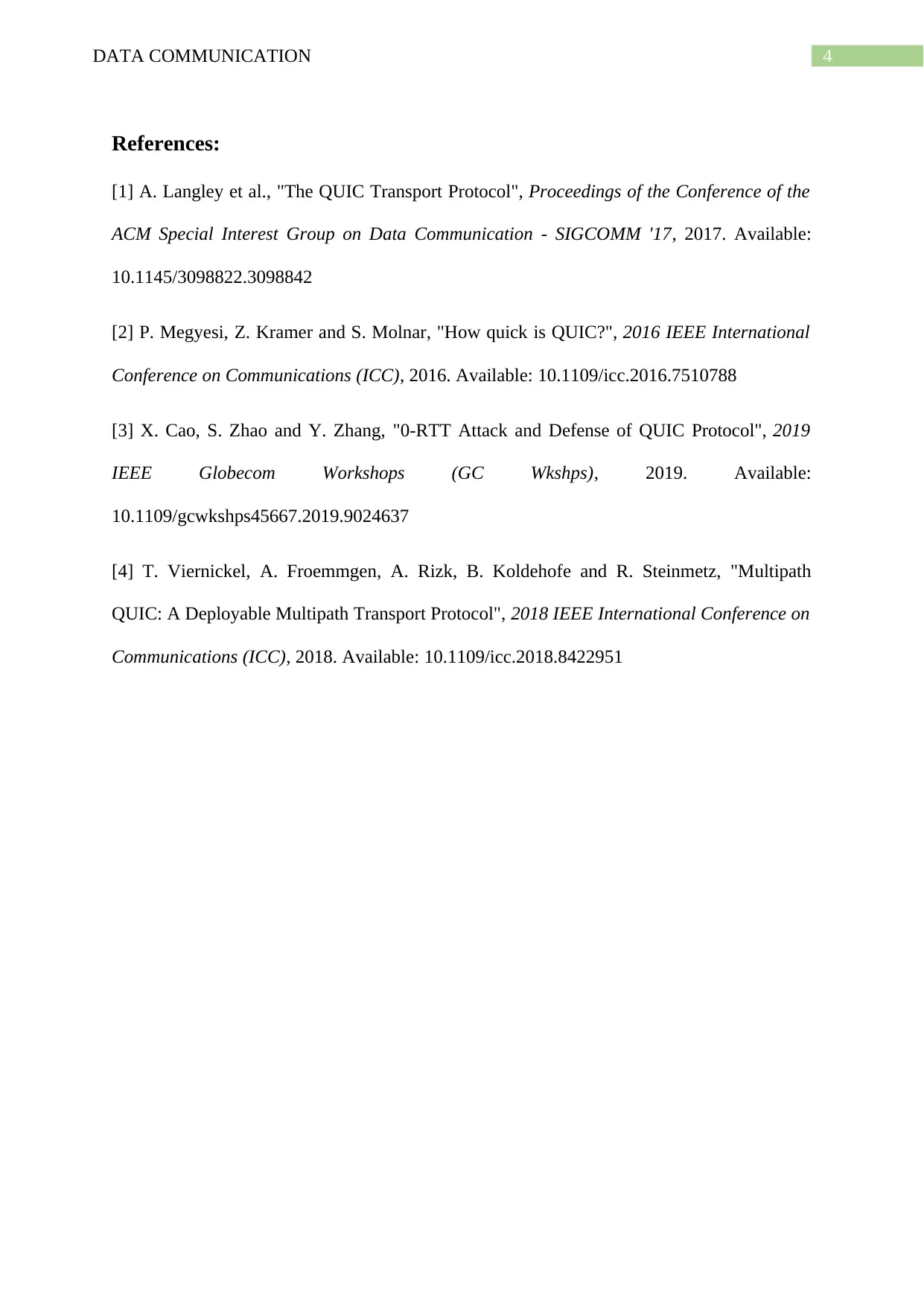
References:
[1] A. Langley et al., "The QUIC Transport Protocol", Proceedings of the Conference of the
ACM Special Interest Group on Data Communication - SIGCOMM '17, 2017. Available:
10.1145/3098822.3098842
[2] P. Megyesi, Z. Kramer and S. Molnar, "How quick is QUIC?", 2016 IEEE International
Conference on Communications (ICC), 2016. Available: 10.1109/icc.2016.7510788
[3] X. Cao, S. Zhao and Y. Zhang, "0-RTT Attack and Defense of QUIC Protocol", 2019
IEEE Globecom Workshops (GC Wkshps), 2019. Available:
10.1109/gcwkshps45667.2019.9024637
[4] T. Viernickel, A. Froemmgen, A. Rizk, B. Koldehofe and R. Steinmetz, "Multipath
QUIC: A Deployable Multipath Transport Protocol", 2018 IEEE International Conference on
Communications (ICC), 2018. Available: 10.1109/icc.2018.8422951
chevron_up_icon
1 out of 5
circle_padding
hide_on_mobile
zoom_out_icon
[object Object]