QUIC and Web Traffic: Performance, Implementation, and Layer Analysis

Verified

Added on  2022/09/18

|8
|1506
|25
Homework Assignment
AI Summary
This assignment delves into the QUIC protocol, examining its advantages in enhancing web traffic performance. It begins by itemizing how QUIC improves web traffic, focusing on its use of UDP to reduce round-trip times compared to TCP and enhancing security. The assignment then explains the mechanisms behind these improvements, highlighting QUIC's ability to negotiate parameters for faster data transmission and its use of encryption. Furthermore, the assignment explores the implications of implementing QUIC within the transport layer rather than the application layer, discussing the potential benefits and negative impacts. It concludes by explaining the rationale behind the choice to implement QUIC within the application layer, emphasizing its role in providing faster and more efficient data transfer for improved user experience. The assignment includes references to support the analysis.

Document Page
Running head: - QUIC AND WEB TRAFFIC
QUIC AND WEB TRAFFIC
Name of the Student
Name of the University
Author Note
tabler-icon-diamond-filled.svg

Paraphrase This Document

Need a fresh take? Get an instant paraphrase of this document with our AI Paraphraser
Document Page
1QUIC AND WEB TRAFFIC
Table of Contents
1. Question-3:.............................................................................................................................2
1.1. Question-a:......................................................................................................................2
1.2. Question-b:......................................................................................................................3
1.3. Question-c:......................................................................................................................4
1.3.1 Question-(i):..............................................................................................................4
1.3.2 Question-(ii):.............................................................................................................4
1.3.3. Question-(iii):...........................................................................................................5
2. References:.............................................................................................................................6
Document Page
2QUIC AND WEB TRAFFIC
1. Question-3:
1.1. Question-a:
Itemise the ways QUIC improves the performance of web traffic?
Answer:
The web as well as the mobile application and the relative space have become to a
common thing in the regular life of humans. The primary difference between the differently
existing applications is that of the user experience, which has a complete dependency upon
the speed in regards to the delivery of the content [1]. Hence, Quick UDP Internet
Connections (QUIC) has come into to play for bettering the speed of the delivery of all
contents that are present on a particular webpage to improve the user experience on a primary
level. The following methods are utilized by QUIC for improving the web traffic,
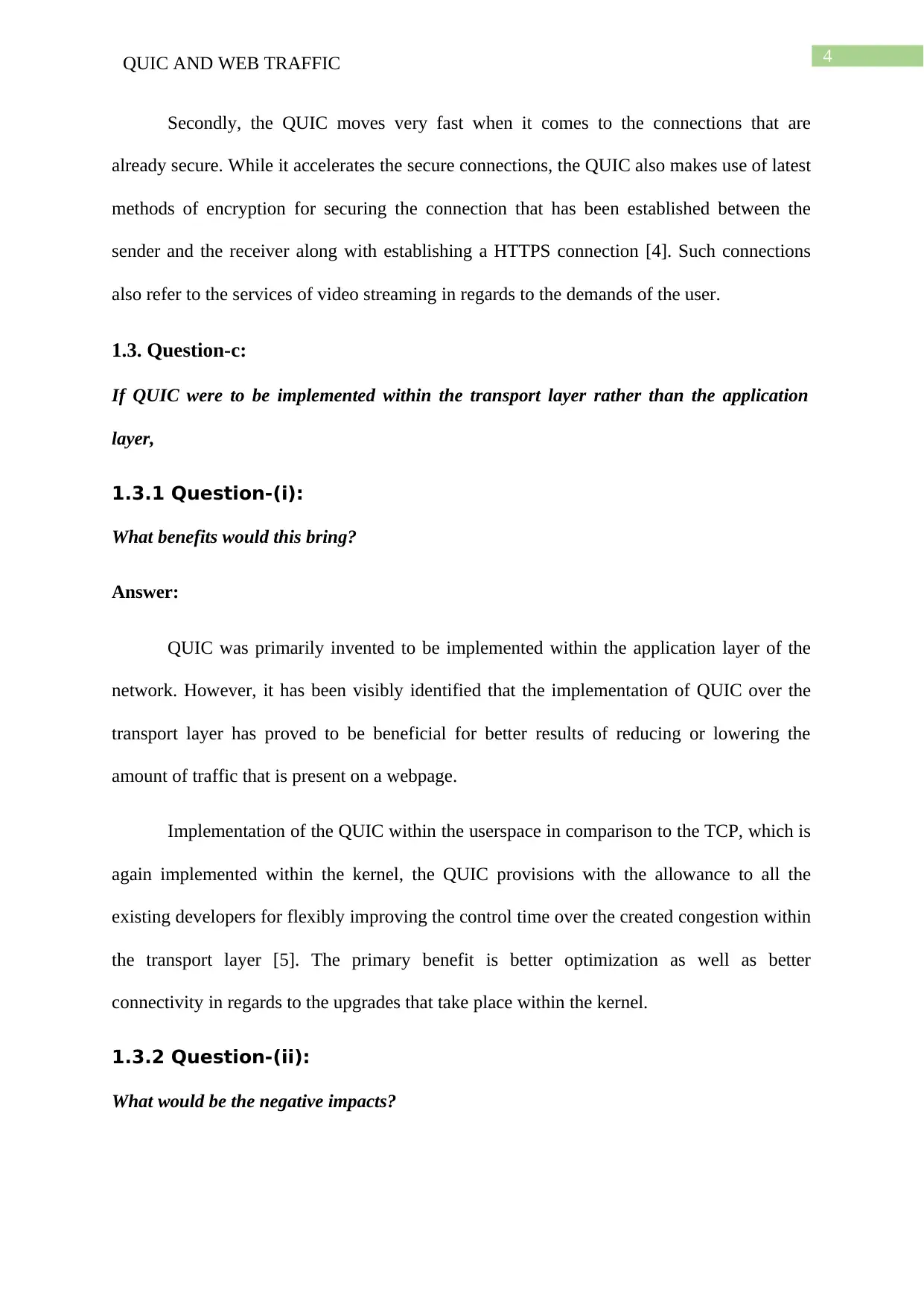
i) Reduction of TCP with that of UDP for reducing the rounded trips- QUIC
primarily requires zero round-trip time (RTT) for the establishment of the
connection. This states that this can initiate a connection as well as negotiate the
existing parameters along with delivering the data to the source, primarily the
client. However, the QUIC is completely based upon UDP that does not have the
requirement of a client or a server for confirming the sending or receiving of data
to or from the client.
Document Page
3QUIC AND WEB TRAFFIC
Figure-1: QUIC with UDP
ii) QUIC maintains the security of data connections- the QUIC makes faster
movements even with the proper utilization of connections that are secure. As
well as at that particular time, the QUIC makes the other connections run faster
making use of the latest methods for encryption for making the connections secure
[2]. The QUIC carries out negotiation with an accelerated connection that exists
within the sender and that of the receiver along with making an establishment of
the HTTPS connection.
1.2. Question-b:
What is it that QUIC does that lead to these improvements?
Answer:
QUIC and the relative methods follow two primary methods for potentially
decreasing the traffic that is caused within the connections slowing down the speed for
transmission and leading to a slower loading of the webpage or the application that has been
searched by the client or the user.
Firstly, the QUIC makes a drastic replacement of transfer control protocol (TCP) with
that of UDP for reducing the potential number of round-trips. This states the fact that the
QUIC primarily requires zero number of round-trip time (RTT) while making the connection.
QUIC can potentially negotiate the existing parameters for increasing the transmission speed
of data while delivering the same to the client or the user in this case [3]. However, this
particular method is carried out with the help of the TCP. On the other hand, with the use of
UDP, there is no primary requirement for QUIC to get hold of confirmation regarding the
transmission of data when it comes to sending or delivering the respective data to or from the
client.
tabler-icon-diamond-filled.svg

Paraphrase This Document

Need a fresh take? Get an instant paraphrase of this document with our AI Paraphraser
Document Page
4QUIC AND WEB TRAFFIC
Secondly, the QUIC moves very fast when it comes to the connections that are
already secure. While it accelerates the secure connections, the QUIC also makes use of latest
methods of encryption for securing the connection that has been established between the
sender and the receiver along with establishing a HTTPS connection [4]. Such connections
also refer to the services of video streaming in regards to the demands of the user.
1.3. Question-c:
If QUIC were to be implemented within the transport layer rather than the application
layer,
1.3.1 Question-(i):
What benefits would this bring?
Answer:
QUIC was primarily invented to be implemented within the application layer of the
network. However, it has been visibly identified that the implementation of QUIC over the
transport layer has proved to be beneficial for better results of reducing or lowering the
amount of traffic that is present on a webpage.
Implementation of the QUIC within the userspace in comparison to the TCP, which is
again implemented within the kernel, the QUIC provisions with the allowance to all the
existing developers for flexibly improving the control time over the created congestion within
the transport layer [5]. The primary benefit is better optimization as well as better
connectivity in regards to the upgrades that take place within the kernel.
1.3.2 Question-(ii):
What would be the negative impacts?
Document Page
5QUIC AND WEB TRAFFIC
With the implementation of the QUIC within the transport layer rather than the
application layer there has been significant identification of various benefits that have proven
to potentially reduce the traffic that is created resulting in greater web traffic. However, the
successful implementation also consists of some negative aspects.
One of the primary impacts that such implementation has highlighted the applications
to be getting neglected in improving the experience of the user [6]. On being implemented on
the transport layer, he transmission of data has undergone improvements in terms of speed
but the application loading time in regards to the loading of the contents have been left out of
improvement procedure[7]. As a result, this has stood out to be the most important negative
impact that needs to be dealt.
1.3.3. Question-(iii):
Given your responses above, why do you think the choice was made to implement QUIC
within the application layer?
Answer:
QUIC was primarily implemented to improve the speed with which the data gets
transmitted over the various channels for communication to provision the users or the clients
with faster content loading on any specific webpage or an application. However, QUIC had
been designed to be implemented on the application layer to provision the applications or the
webpages to be delivering content in a much faster as well as an efficient manner with the use
of UDP protocol [8]. As a reason, the application layer is considered to be the primary acting
site for the QUIC to have a better implementation of the relative protocols and bring in a
faster transferring of data within the client and that of the source without having to receive a
particular confirmation in regards to the receiving or sending of data to or from the client.
Document Page
6QUIC AND WEB TRAFFIC
2. References:
[1] A.M., Kakhki, S., Jero, D., Choffnes, C., Nita-Rotaru, and A., Mislove, November.
Taking a long look at QUIC: an approach for rigorous evaluation of rapidly evolving
transport protocols. In Proceedings of the 2017 Internet Measurement Conference (pp. 290-
303), 2017
[2] S., Jeuk, G., Salgueiro, and D., Hanes. PATH INFORMATION-DRIVEN QUIC
PATH_CHALLENGE TO OPTIMIZE PATH SELECTION IN 5G NETWORKS, 2018.
[3] Q., De Coninck, and O., Bonaventure, November. Multipath quic: Design and evaluation.
In Proceedings of the 13th international conference on emerging networking experiments
and technologies (pp. 160-166) , 2017.
[4] J., Rüth, I., Poese, C., Dietzel, and O., Hohlfeld, March. A First Look at QUIC in the
Wild. In International Conference on Passive and Active Network Measurement (pp. 255-
268). Springer, Cham, 2018.
[5] Y., Cui, T., Li, C., Liu, X., Wang, and M., Kühlewind. Innovating transport with QUIC:
Design approaches and research challenges. IEEE Internet Computing, 21(2), pp.72-76, 2017.
[6] A., Boldyreva. Secure Communication Channel Establishment: TLS 1.3 (Over TCP Fast
Open) vs. QUIC, 2019.
[7] M., Roy, S., Ahsan, G., Kumar, and A., Vimal. Implementation of Quick UDP Internet
Connections. International Journal of Engineering and Computer Science, 9(01), pp.24921-
24924, 2020.
[8] F., Gratzer. Quic-quick udp internet connections. Future Internet and Innovative Internet
Technologies and Mobile Communications, 2016.
tabler-icon-diamond-filled.svg

Paraphrase This Document

Need a fresh take? Get an instant paraphrase of this document with our AI Paraphraser
Document Page
7QUIC AND WEB TRAFFIC
chevron_up_icon
1 out of 8
circle_padding
hide_on_mobile
zoom_out_icon
[object Object]