Financial Network Contagion Simulation and Analysis in R Programming
VerifiedAdded on 2022/11/13
|21
|5953
|377
Project
AI Summary
This project focuses on modeling and simulating financial contagion within banking networks using R programming. The assignment requires generating Erdos-Renyi and Stochastic Block Model networks to represent interbank connections. The core task involves simulating bank failures and analyzing how these failures propagate throughout the network, leading to systemic risk analysis. The project includes implementing specific rules for calculating link weights based on capital buffers and simulating contagion events through Monte Carlo simulations. The goal is to assess the impact of different network structures and parameters on the spread of financial distress, aiming to replicate the results of provided working papers and understand the factors that contribute to financial instability. The analysis includes calculating contagion frequency, average degrees, and visualizing network structures to understand the dynamics of financial contagion.
STATISTICS R

Paraphrase This Document
Need a fresh take? Get an instant paraphrase of this document with our AI Paraphraser

Table of Contents
Abstract................................................................................................................................................2
Introduction.........................................................................................................................................2
Measuring systemic.............................................................................................................................4
Mark-to-Market Values....................................................................................................................11
Primitive Assets, Organizations, & the Cross-Holdings.................................................................13
Values of Organizations....................................................................................................................14
Discontinuities in the Values and the Costs of Failure....................................................................14
Existence of Equilibrium and Multiplicity......................................................................................15
Integration and Diversification.........................................................................................................15
Stochastic Block Model.....................................................................................................................15
Random Networks.............................................................................................................................16
The Consequences of Diversification................................................................................................18
Conclusion..........................................................................................................................................19
References..........................................................................................................................................19
Abstract................................................................................................................................................2
Introduction.........................................................................................................................................2
Measuring systemic.............................................................................................................................4
Mark-to-Market Values....................................................................................................................11
Primitive Assets, Organizations, & the Cross-Holdings.................................................................13
Values of Organizations....................................................................................................................14
Discontinuities in the Values and the Costs of Failure....................................................................14
Existence of Equilibrium and Multiplicity......................................................................................15
Integration and Diversification.........................................................................................................15
Stochastic Block Model.....................................................................................................................15
Random Networks.............................................................................................................................16
The Consequences of Diversification................................................................................................18
Conclusion..........................................................................................................................................19
References..........................................................................................................................................19
Abstract
The main aim of this research is to analyze the financial institution resilience to
determine the techniques that have been employed in complex network theories. The study is
carried out using the Monte Carlos simulations to assess the different networks as well as the
topologies through the contagion model that is applicable in diverse interbank networks. The
banking series is triggered.
We researched a series of different banking crises through each bank in the device and
examined the mechanisms used for propagation which take impact’s the device’s internal
distinctive scenarios. At last, a literature review is conducted to examine the interplay of the
countless imperative drivers of interbank contagions like the interconnectedness, network
topology, homogeneity and leverage throughout the bank sizes and the exposures of the
interbank.
Introduction
The national economy’s complexity has crystal rectifier with several lecturers, for
utilizing the network theory in order to review the results of connectedness and configuration
on money stability. Finding out the national economy as a network is one of the ways which
is accustomed to investigate the general risk’s emergence via the connections of the banks. In
this type of a network structure, each node signifies a bank. Therefore, the links between the
banks area unit is portrayed by the edges. An active interbank market acts as the bond in the
national economy’s stability.
The interbank market’s use has enabled the banks that suffer the shortage of liquidity
to borrow from the banks which have surplus liquidity. Hence, on the national economy, the
interbank market will have an effective result by efficiently sharing the money with the
banks. But, consequently it will make the system vulnerable to the monetary contagion due to
the present linkages of the interbank. For many years, the giant financial establishments were
included as the assorted suspects to destabilize the national economy, whose failure could be
fatal for the bigger national economy (as it is too massive for the fail theory). The
government should support such monetary establishments once they face fiscal distress
because of their general importance and link.
However, if they fail, the smaller money establishments with ample connections
within the interbank market will have an excellent, and highly significant effect on the
The main aim of this research is to analyze the financial institution resilience to
determine the techniques that have been employed in complex network theories. The study is
carried out using the Monte Carlos simulations to assess the different networks as well as the
topologies through the contagion model that is applicable in diverse interbank networks. The
banking series is triggered.
We researched a series of different banking crises through each bank in the device and
examined the mechanisms used for propagation which take impact’s the device’s internal
distinctive scenarios. At last, a literature review is conducted to examine the interplay of the
countless imperative drivers of interbank contagions like the interconnectedness, network
topology, homogeneity and leverage throughout the bank sizes and the exposures of the
interbank.
Introduction
The national economy’s complexity has crystal rectifier with several lecturers, for
utilizing the network theory in order to review the results of connectedness and configuration
on money stability. Finding out the national economy as a network is one of the ways which
is accustomed to investigate the general risk’s emergence via the connections of the banks. In
this type of a network structure, each node signifies a bank. Therefore, the links between the
banks area unit is portrayed by the edges. An active interbank market acts as the bond in the
national economy’s stability.
The interbank market’s use has enabled the banks that suffer the shortage of liquidity
to borrow from the banks which have surplus liquidity. Hence, on the national economy, the
interbank market will have an effective result by efficiently sharing the money with the
banks. But, consequently it will make the system vulnerable to the monetary contagion due to
the present linkages of the interbank. For many years, the giant financial establishments were
included as the assorted suspects to destabilize the national economy, whose failure could be
fatal for the bigger national economy (as it is too massive for the fail theory). The
government should support such monetary establishments once they face fiscal distress
because of their general importance and link.
However, if they fail, the smaller money establishments with ample connections
within the interbank market will have an excellent, and highly significant effect on the
⊘ This is a preview!⊘
Do you want full access?
Subscribe today to unlock all pages.

Trusted by 1+ million students worldwide

financial set-up. The interbank network’s higher links will scale back the chance of default,
because several counterparties share transmission of a shock and so it disperses quickly. In
contrast, once the excitement’s magnitude has crossed a vital threshold due to the increase in
connectedness the collapse can unfold into an oversized part of the system then it might cause
defaults in an oversized cascade. Thus, this can be a questionable "robust-yet-fragile"
property which is exhibited by the money systems.
This paper therefore focuses on the direct contagion channel and studies the
effectiveness of varied drivers on the interbank contagion. The flourishing literature which is
derived until today has helped to develop the theoretical models which aims to address the
assorted problems regarding general risk. Contrary to fact simulations on information are
utilized to check interbank contagion beneath completely different eventualities associated
with the interbank network’s topology, the scale of interbank exposures. Therefore, the
degree of heterogeneousness and interconnection among the system. This research tends to
develop a model with the banks connected to one another based on the claims of the
interbank and is investigated with the help of Monte Carlo simulations, however, the
complexness of an interbank network structure impacts the interbank contagion beneath
completely different testable eventualities. This analysis belongs to a part of the theoretical
literature, as we tend to use laptop simulations to construct an oversized range of bank
networks involving entities by closing down bank claim and obligations. Victimization tools
from the complicated network theory’s aim is to develop a model; however, the reaction of
the AN initial default might also unfold from one establishment to a different.
Second, we tend to utilize solely two parts based on the records of a bank, which
includes the equity and loans of the interbank for constructing a penurious regression model.
The regression model has been employed to test the crucial impact drivers recorded in the
experiments regarding simulations experiments on the interbank. Multivariate analysis is also
conjointly utilized by Krause and Guarantee for assessing the role contend by the network's
topological options and record the positions within the transmission of bank failures. The
authors use a model which is a scale-free network model for reviewing the interbank
contagion with massive parameter ranges, and a plenty of parameters for initializing the
record. But, their model becomes inflexible in terms of operation, because it is tough for
checking the simulations by the variable one amongst the settings.
In contrast, this model is well understandable, reproducible and additionally it is
amenable for the interpretation and analysis. We tend to outline the term contagion because
the state of affairs within that the bank’s initial failure ends up as a failure of a minimum of
because several counterparties share transmission of a shock and so it disperses quickly. In
contrast, once the excitement’s magnitude has crossed a vital threshold due to the increase in
connectedness the collapse can unfold into an oversized part of the system then it might cause
defaults in an oversized cascade. Thus, this can be a questionable "robust-yet-fragile"
property which is exhibited by the money systems.
This paper therefore focuses on the direct contagion channel and studies the
effectiveness of varied drivers on the interbank contagion. The flourishing literature which is
derived until today has helped to develop the theoretical models which aims to address the
assorted problems regarding general risk. Contrary to fact simulations on information are
utilized to check interbank contagion beneath completely different eventualities associated
with the interbank network’s topology, the scale of interbank exposures. Therefore, the
degree of heterogeneousness and interconnection among the system. This research tends to
develop a model with the banks connected to one another based on the claims of the
interbank and is investigated with the help of Monte Carlo simulations, however, the
complexness of an interbank network structure impacts the interbank contagion beneath
completely different testable eventualities. This analysis belongs to a part of the theoretical
literature, as we tend to use laptop simulations to construct an oversized range of bank
networks involving entities by closing down bank claim and obligations. Victimization tools
from the complicated network theory’s aim is to develop a model; however, the reaction of
the AN initial default might also unfold from one establishment to a different.
Second, we tend to utilize solely two parts based on the records of a bank, which
includes the equity and loans of the interbank for constructing a penurious regression model.
The regression model has been employed to test the crucial impact drivers recorded in the
experiments regarding simulations experiments on the interbank. Multivariate analysis is also
conjointly utilized by Krause and Guarantee for assessing the role contend by the network's
topological options and record the positions within the transmission of bank failures. The
authors use a model which is a scale-free network model for reviewing the interbank
contagion with massive parameter ranges, and a plenty of parameters for initializing the
record. But, their model becomes inflexible in terms of operation, because it is tough for
checking the simulations by the variable one amongst the settings.
In contrast, this model is well understandable, reproducible and additionally it is
amenable for the interpretation and analysis. We tend to outline the term contagion because
the state of affairs within that the bank’s initial failure ends up as a failure of a minimum of
Paraphrase This Document
Need a fresh take? Get an instant paraphrase of this document with our AI Paraphraser
one different bank, whereas the extent of contagion is measured based on the complete
financial loss within the banking industry, because of at least one bank’s inability. On the
other hand, we tend to the area unit principally inquisitive about sleuthing the capital losses’
magnitude within the banking network instead of various banks which were impacted highly.
At last, this paper helps to present the prevailing literature which is examined by using a
comprehensive network model, the knock-on effects. AN initial default will bring into the
interbank network below the idea of randomness.
The idea which the interbank network claims and obligations forms indiscriminately,
allows North American country to capture all potential eventualities that will seem in the
real-world things. Additionally, we tend to avoid the matter knowledge of information
inconvenience as a real data on the exposures area unit of the interbank typically is solely on
the market to central bankers and the regulators, so renders the problematic network’s
empirical analysis.
This research’s findings represent that the heterogeneousness in size of the banks and
interbank exposures matter an excellent deal within the financial set-up’s stability, because its
absorption capability is increased. Additionally, the extent of connectedness vastly affects the
resilience of the system, particularly in smaller and extremely interconnected interbank
networks. At last, a proof is provided that extremely leveraged the type of banks the most
channel through that monetary shocks propagate at intervals the system, and similar result is
additionally pronounced in the massive interbank networks when compared to the smaller
banks.
The remaining paper is subdivided into two sections to discuss the connected
literature on the interbank contagion. Chapter three presents the network model of contagion.
Measuring systemic
A network model projected by Eisenberg and Noe comprises of 3 essential ingredients
namely, a group of n nodes N ¼ f1; 2; ... ; ng, associate n liabilities matrix P ¼ wherever
FTO P zero denotes the due payment from the node i to node j; pii ¼ zero, and a vector c ¼
ðc1; c2; ... ; cnÞ two Rn þ wherever ci P zero represents the worth of outdoor assets control
by node i additionally to its claims on alternative nodes within a network. Generally, ci
comprises of money, mortgages, securities, and alternative applications on the external
entities of a system. Additionally, every node i could have liabilities for the external entities
from the network; we tend to let metallic element P zero represents the total of all similar
obligations of i, that we tend to accept to have equivalent priority with i's liabilities for the
financial loss within the banking industry, because of at least one bank’s inability. On the
other hand, we tend to the area unit principally inquisitive about sleuthing the capital losses’
magnitude within the banking network instead of various banks which were impacted highly.
At last, this paper helps to present the prevailing literature which is examined by using a
comprehensive network model, the knock-on effects. AN initial default will bring into the
interbank network below the idea of randomness.
The idea which the interbank network claims and obligations forms indiscriminately,
allows North American country to capture all potential eventualities that will seem in the
real-world things. Additionally, we tend to avoid the matter knowledge of information
inconvenience as a real data on the exposures area unit of the interbank typically is solely on
the market to central bankers and the regulators, so renders the problematic network’s
empirical analysis.
This research’s findings represent that the heterogeneousness in size of the banks and
interbank exposures matter an excellent deal within the financial set-up’s stability, because its
absorption capability is increased. Additionally, the extent of connectedness vastly affects the
resilience of the system, particularly in smaller and extremely interconnected interbank
networks. At last, a proof is provided that extremely leveraged the type of banks the most
channel through that monetary shocks propagate at intervals the system, and similar result is
additionally pronounced in the massive interbank networks when compared to the smaller
banks.
The remaining paper is subdivided into two sections to discuss the connected
literature on the interbank contagion. Chapter three presents the network model of contagion.
Measuring systemic
A network model projected by Eisenberg and Noe comprises of 3 essential ingredients
namely, a group of n nodes N ¼ f1; 2; ... ; ng, associate n liabilities matrix P ¼ wherever
FTO P zero denotes the due payment from the node i to node j; pii ¼ zero, and a vector c ¼
ðc1; c2; ... ; cnÞ two Rn þ wherever ci P zero represents the worth of outdoor assets control
by node i additionally to its claims on alternative nodes within a network. Generally, ci
comprises of money, mortgages, securities, and alternative applications on the external
entities of a system. Additionally, every node i could have liabilities for the external entities
from the network; we tend to let metallic element P zero represents the total of all similar
obligations of i, that we tend to accept to have equivalent priority with i's liabilities for the

alternative nodes within a network. The quality facet of the node i's record is provided by ci þ
P j–ipji, and therefore the liability facet is provided by pi ¼ metallic element þ P j–pig. Its
web value is that the distinction Badger State ¼ ci þX j–ipji pi: ð1Þ the notation related to the
generic node I, which is represented in the Figure 1. Within a network (indicated by the
dotted line), node I have associate obligation FTO to the node j and also has claim PKI on the
node k. This figure additionally depicts the node I's external assets ci and outdoors liabilities
metallic element. The distinction between the total assets and the total liabilities is that the
node's web value Badger State.
Observe that the I's web value is unrestricted in sign; if it's plus in such case it
communicates to the I equity’s value. We tend to decision the "book price" as a result of it's
supported the nominal or face value of the pji liabilities, instead of the ''market" values which
replicate the ability of the nodes to pay. These market prices rely on the ability of the
alternative nodes to pay the conditional on the realized value of their external assets.
Specifically, let every node's external assets be subjected to a random shock which decreases
the worth of its external assets, and similarly impacts the web value. This area unit shocks the
"fundamentals" which propagates via a network of monetary obligations.
To illustrate the result of a shock, we tend to think about the numerical, that follows
the notational conventions. Above all, the central node includes a web value often as a result
of its one hundred fifty in outside assets, a hundred in the external liabilities, and forty in
liabilities to the alternative nodes within a network. A shock of magnitude ten to the surface
assets deletes the web value of the central node, however, leaves it with only sufficient assets
(140) to cowl its liabilities. A shock of magnitude eighty leaves the primary node with the
assets of seventy, [*fr1] the worth of its liabilities. Below a pro-rata allocation, every liability
is cut in [*fr1]. Therefore every peripheral node gets the payment of five that is simple to
balance assets and liabilities of every peripheral node. Hence, during this case, there exists
central node defaults; however, the peripheral nodes don't. A shock to the primary node's
external asset is bigger when compared to eighty, which could scale back the worth of each
node's assets that is lower than the value of its liabilities.
> library(NetworkRiskMeasures)
> ME <- matrix_estimation(rowsums = A, colsums = L, method = "me")
P j–ipji, and therefore the liability facet is provided by pi ¼ metallic element þ P j–pig. Its
web value is that the distinction Badger State ¼ ci þX j–ipji pi: ð1Þ the notation related to the
generic node I, which is represented in the Figure 1. Within a network (indicated by the
dotted line), node I have associate obligation FTO to the node j and also has claim PKI on the
node k. This figure additionally depicts the node I's external assets ci and outdoors liabilities
metallic element. The distinction between the total assets and the total liabilities is that the
node's web value Badger State.
Observe that the I's web value is unrestricted in sign; if it's plus in such case it
communicates to the I equity’s value. We tend to decision the "book price" as a result of it's
supported the nominal or face value of the pji liabilities, instead of the ''market" values which
replicate the ability of the nodes to pay. These market prices rely on the ability of the
alternative nodes to pay the conditional on the realized value of their external assets.
Specifically, let every node's external assets be subjected to a random shock which decreases
the worth of its external assets, and similarly impacts the web value. This area unit shocks the
"fundamentals" which propagates via a network of monetary obligations.
To illustrate the result of a shock, we tend to think about the numerical, that follows
the notational conventions. Above all, the central node includes a web value often as a result
of its one hundred fifty in outside assets, a hundred in the external liabilities, and forty in
liabilities to the alternative nodes within a network. A shock of magnitude ten to the surface
assets deletes the web value of the central node, however, leaves it with only sufficient assets
(140) to cowl its liabilities. A shock of magnitude eighty leaves the primary node with the
assets of seventy, [*fr1] the worth of its liabilities. Below a pro-rata allocation, every liability
is cut in [*fr1]. Therefore every peripheral node gets the payment of five that is simple to
balance assets and liabilities of every peripheral node. Hence, during this case, there exists
central node defaults; however, the peripheral nodes don't. A shock to the primary node's
external asset is bigger when compared to eighty, which could scale back the worth of each
node's assets that is lower than the value of its liabilities.
> library(NetworkRiskMeasures)
> ME <- matrix_estimation(rowsums = A, colsums = L, method = "me")
⊘ This is a preview!⊘
Do you want full access?
Subscribe today to unlock all pages.
Trusted by 1+ million students worldwide
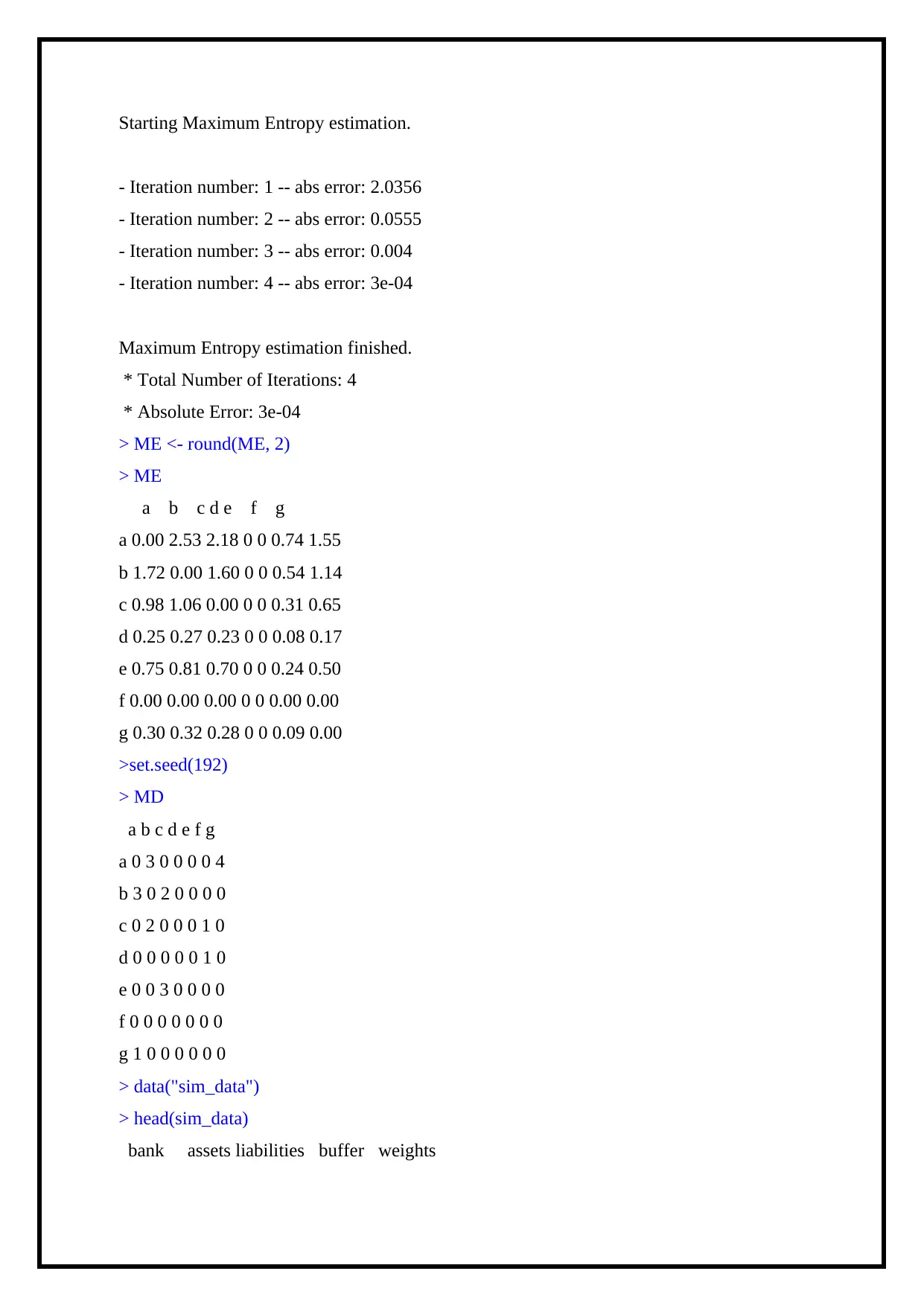
Starting Maximum Entropy estimation.
- Iteration number: 1 -- abs error: 2.0356
- Iteration number: 2 -- abs error: 0.0555
- Iteration number: 3 -- abs error: 0.004
- Iteration number: 4 -- abs error: 3e-04
Maximum Entropy estimation finished.
* Total Number of Iterations: 4
* Absolute Error: 3e-04
> ME <- round(ME, 2)
> ME
a b c d e f g
a 0.00 2.53 2.18 0 0 0.74 1.55
b 1.72 0.00 1.60 0 0 0.54 1.14
c 0.98 1.06 0.00 0 0 0.31 0.65
d 0.25 0.27 0.23 0 0 0.08 0.17
e 0.75 0.81 0.70 0 0 0.24 0.50
f 0.00 0.00 0.00 0 0 0.00 0.00
g 0.30 0.32 0.28 0 0 0.09 0.00
>set.seed(192)
> MD
a b c d e f g
a 0 3 0 0 0 0 4
b 3 0 2 0 0 0 0
c 0 2 0 0 0 1 0
d 0 0 0 0 0 1 0
e 0 0 3 0 0 0 0
f 0 0 0 0 0 0 0
g 1 0 0 0 0 0 0
> data("sim_data")
> head(sim_data)
bank assets liabilities buffer weights
- Iteration number: 1 -- abs error: 2.0356
- Iteration number: 2 -- abs error: 0.0555
- Iteration number: 3 -- abs error: 0.004
- Iteration number: 4 -- abs error: 3e-04
Maximum Entropy estimation finished.
* Total Number of Iterations: 4
* Absolute Error: 3e-04
> ME <- round(ME, 2)
> ME
a b c d e f g
a 0.00 2.53 2.18 0 0 0.74 1.55
b 1.72 0.00 1.60 0 0 0.54 1.14
c 0.98 1.06 0.00 0 0 0.31 0.65
d 0.25 0.27 0.23 0 0 0.08 0.17
e 0.75 0.81 0.70 0 0 0.24 0.50
f 0.00 0.00 0.00 0 0 0.00 0.00
g 0.30 0.32 0.28 0 0 0.09 0.00
>set.seed(192)
> MD
a b c d e f g
a 0 3 0 0 0 0 4
b 3 0 2 0 0 0 0
c 0 2 0 0 0 1 0
d 0 0 0 0 0 1 0
e 0 0 3 0 0 0 0
f 0 0 0 0 0 0 0
g 1 0 0 0 0 0 0
> data("sim_data")
> head(sim_data)
bank assets liabilities buffer weights
Paraphrase This Document
Need a fresh take? Get an instant paraphrase of this document with our AI Paraphraser
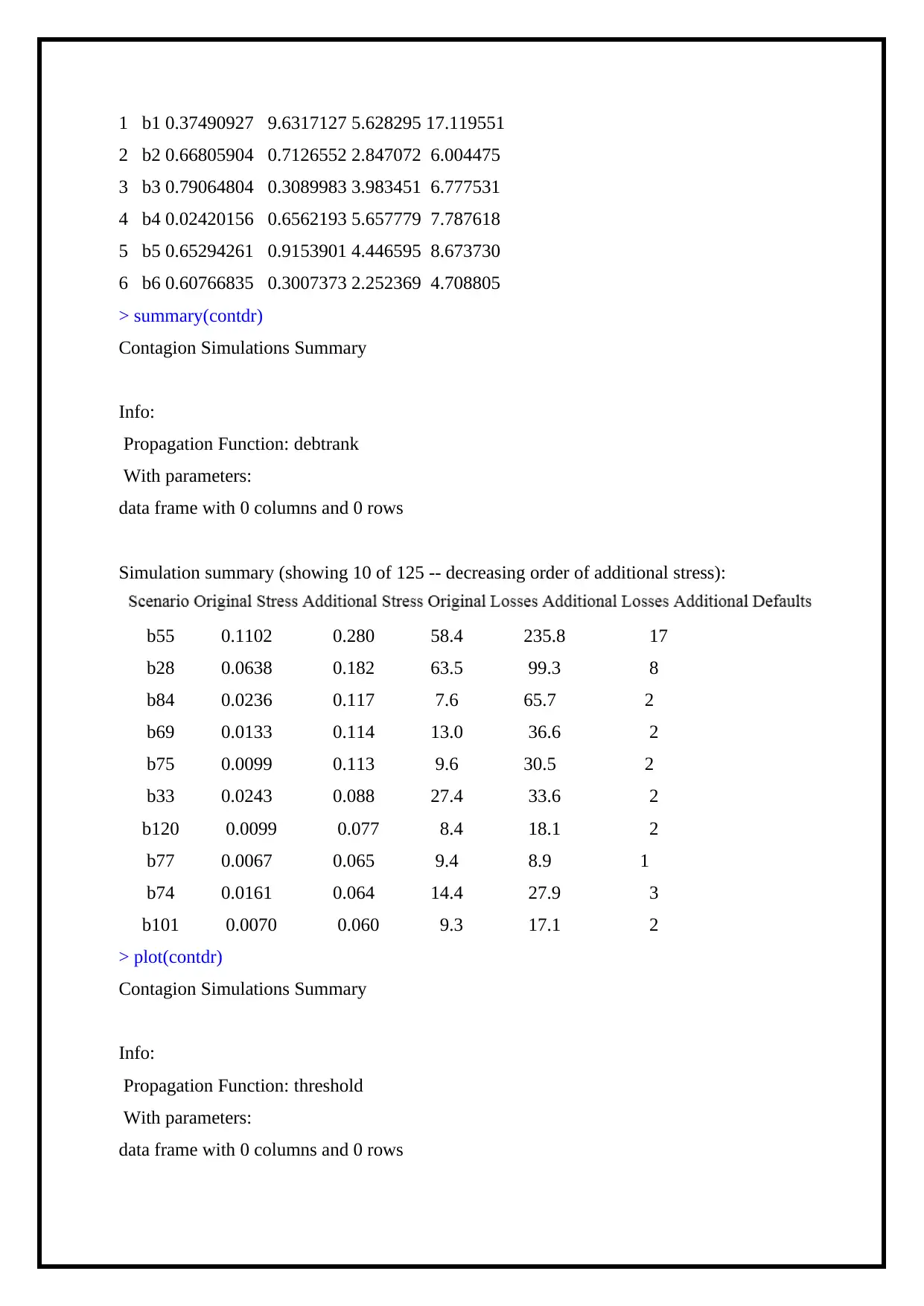
1 b1 0.37490927 9.6317127 5.628295 17.119551
2 b2 0.66805904 0.7126552 2.847072 6.004475
3 b3 0.79064804 0.3089983 3.983451 6.777531
4 b4 0.02420156 0.6562193 5.657779 7.787618
5 b5 0.65294261 0.9153901 4.446595 8.673730
6 b6 0.60766835 0.3007373 2.252369 4.708805
> summary(contdr)
Contagion Simulations Summary
Info:
Propagation Function: debtrank
With parameters:
data frame with 0 columns and 0 rows
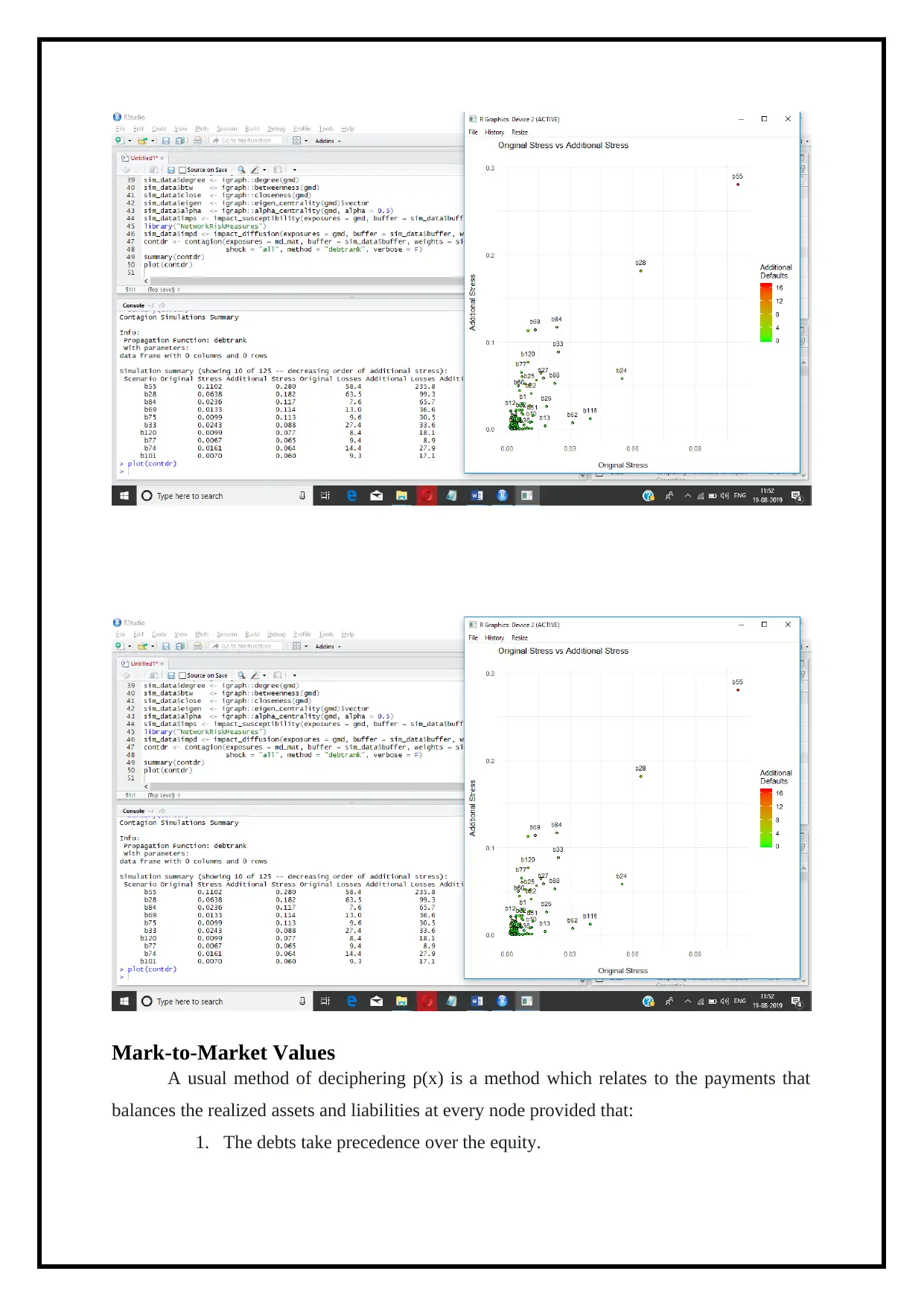
Simulation summary (showing 10 of 125 -- decreasing order of additional stress):
b55 0.1102 0.280 58.4 235.8 17
b28 0.0638 0.182 63.5 99.3 8
b84 0.0236 0.117 7.6 65.7 2
b69 0.0133 0.114 13.0 36.6 2
b75 0.0099 0.113 9.6 30.5 2
b33 0.0243 0.088 27.4 33.6 2
b120 0.0099 0.077 8.4 18.1 2
b77 0.0067 0.065 9.4 8.9 1
b74 0.0161 0.064 14.4 27.9 3
b101 0.0070 0.060 9.3 17.1 2
> plot(contdr)
Contagion Simulations Summary
Info:
Propagation Function: threshold
With parameters:
data frame with 0 columns and 0 rows
2 b2 0.66805904 0.7126552 2.847072 6.004475
3 b3 0.79064804 0.3089983 3.983451 6.777531
4 b4 0.02420156 0.6562193 5.657779 7.787618
5 b5 0.65294261 0.9153901 4.446595 8.673730
6 b6 0.60766835 0.3007373 2.252369 4.708805
> summary(contdr)
Contagion Simulations Summary
Info:
Propagation Function: debtrank
With parameters:
data frame with 0 columns and 0 rows
Simulation summary (showing 10 of 125 -- decreasing order of additional stress):
b55 0.1102 0.280 58.4 235.8 17
b28 0.0638 0.182 63.5 99.3 8
b84 0.0236 0.117 7.6 65.7 2
b69 0.0133 0.114 13.0 36.6 2
b75 0.0099 0.113 9.6 30.5 2
b33 0.0243 0.088 27.4 33.6 2
b120 0.0099 0.077 8.4 18.1 2
b77 0.0067 0.065 9.4 8.9 1
b74 0.0161 0.064 14.4 27.9 3
b101 0.0070 0.060 9.3 17.1 2
> plot(contdr)
Contagion Simulations Summary
Info:
Propagation Function: threshold
With parameters:
data frame with 0 columns and 0 rows
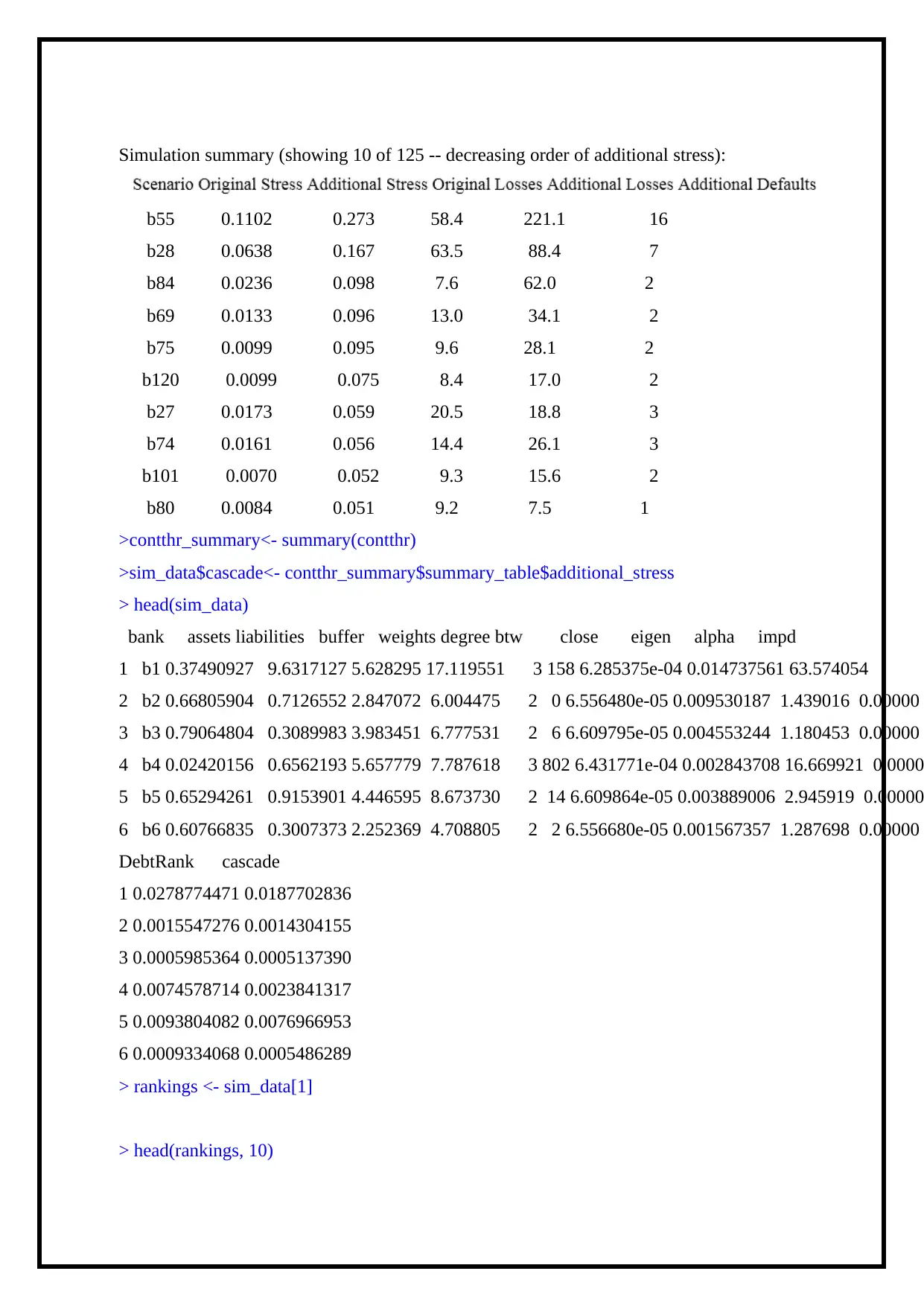
Simulation summary (showing 10 of 125 -- decreasing order of additional stress):
b55 0.1102 0.273 58.4 221.1 16
b28 0.0638 0.167 63.5 88.4 7
b84 0.0236 0.098 7.6 62.0 2
b69 0.0133 0.096 13.0 34.1 2
b75 0.0099 0.095 9.6 28.1 2
b120 0.0099 0.075 8.4 17.0 2
b27 0.0173 0.059 20.5 18.8 3
b74 0.0161 0.056 14.4 26.1 3
b101 0.0070 0.052 9.3 15.6 2
b80 0.0084 0.051 9.2 7.5 1
>contthr_summary<- summary(contthr)
>sim_data$cascade<- contthr_summary$summary_table$additional_stress
> head(sim_data)
bank assets liabilities buffer weights degree btw close eigen alpha impd
1 b1 0.37490927 9.6317127 5.628295 17.119551 3 158 6.285375e-04 0.014737561 63.574054
2 b2 0.66805904 0.7126552 2.847072 6.004475 2 0 6.556480e-05 0.009530187 1.439016 0.00000
3 b3 0.79064804 0.3089983 3.983451 6.777531 2 6 6.609795e-05 0.004553244 1.180453 0.00000
4 b4 0.02420156 0.6562193 5.657779 7.787618 3 802 6.431771e-04 0.002843708 16.669921 0.0000
5 b5 0.65294261 0.9153901 4.446595 8.673730 2 14 6.609864e-05 0.003889006 2.945919 0.00000
6 b6 0.60766835 0.3007373 2.252369 4.708805 2 2 6.556680e-05 0.001567357 1.287698 0.00000
DebtRank cascade
1 0.0278774471 0.0187702836
2 0.0015547276 0.0014304155
3 0.0005985364 0.0005137390
4 0.0074578714 0.0023841317
5 0.0093804082 0.0076966953
6 0.0009334068 0.0005486289
> rankings <- sim_data[1]
> head(rankings, 10)
b55 0.1102 0.273 58.4 221.1 16
b28 0.0638 0.167 63.5 88.4 7
b84 0.0236 0.098 7.6 62.0 2
b69 0.0133 0.096 13.0 34.1 2
b75 0.0099 0.095 9.6 28.1 2
b120 0.0099 0.075 8.4 17.0 2
b27 0.0173 0.059 20.5 18.8 3
b74 0.0161 0.056 14.4 26.1 3
b101 0.0070 0.052 9.3 15.6 2
b80 0.0084 0.051 9.2 7.5 1
>contthr_summary<- summary(contthr)
>sim_data$cascade<- contthr_summary$summary_table$additional_stress
> head(sim_data)
bank assets liabilities buffer weights degree btw close eigen alpha impd
1 b1 0.37490927 9.6317127 5.628295 17.119551 3 158 6.285375e-04 0.014737561 63.574054
2 b2 0.66805904 0.7126552 2.847072 6.004475 2 0 6.556480e-05 0.009530187 1.439016 0.00000
3 b3 0.79064804 0.3089983 3.983451 6.777531 2 6 6.609795e-05 0.004553244 1.180453 0.00000
4 b4 0.02420156 0.6562193 5.657779 7.787618 3 802 6.431771e-04 0.002843708 16.669921 0.0000
5 b5 0.65294261 0.9153901 4.446595 8.673730 2 14 6.609864e-05 0.003889006 2.945919 0.00000
6 b6 0.60766835 0.3007373 2.252369 4.708805 2 2 6.556680e-05 0.001567357 1.287698 0.00000
DebtRank cascade
1 0.0278774471 0.0187702836
2 0.0015547276 0.0014304155
3 0.0005985364 0.0005137390
4 0.0074578714 0.0023841317
5 0.0093804082 0.0076966953
6 0.0009334068 0.0005486289
> rankings <- sim_data[1]
> head(rankings, 10)
⊘ This is a preview!⊘
Do you want full access?
Subscribe today to unlock all pages.
Trusted by 1+ million students worldwide
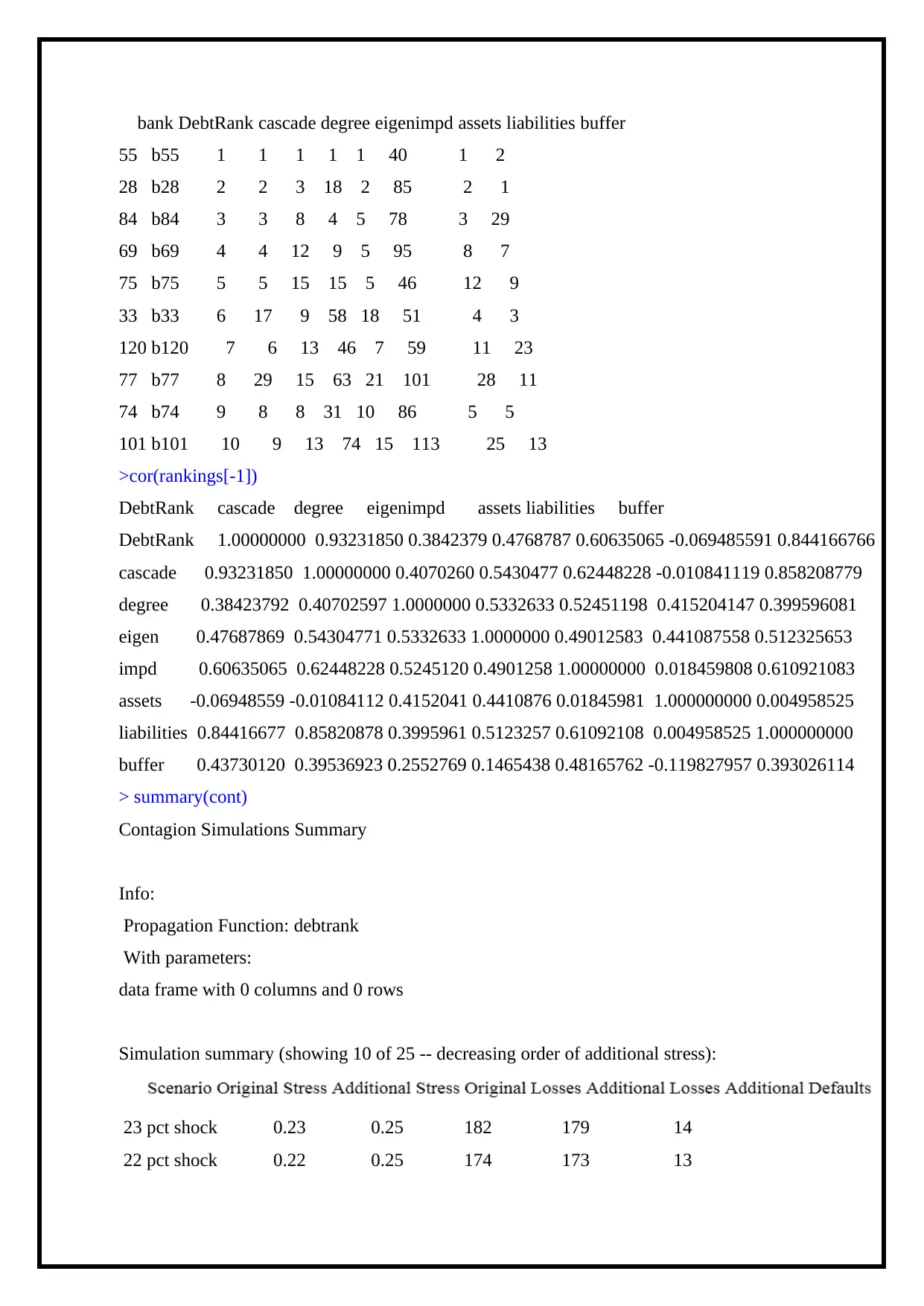
bank DebtRank cascade degree eigenimpd assets liabilities buffer
55 b55 1 1 1 1 1 40 1 2
28 b28 2 2 3 18 2 85 2 1
84 b84 3 3 8 4 5 78 3 29
69 b69 4 4 12 9 5 95 8 7
75 b75 5 5 15 15 5 46 12 9
33 b33 6 17 9 58 18 51 4 3
120 b120 7 6 13 46 7 59 11 23
77 b77 8 29 15 63 21 101 28 11
74 b74 9 8 8 31 10 86 5 5
101 b101 10 9 13 74 15 113 25 13
>cor(rankings[-1])
DebtRank cascade degree eigenimpd assets liabilities buffer
DebtRank 1.00000000 0.93231850 0.3842379 0.4768787 0.60635065 -0.069485591 0.844166766
cascade 0.93231850 1.00000000 0.4070260 0.5430477 0.62448228 -0.010841119 0.858208779
degree 0.38423792 0.40702597 1.0000000 0.5332633 0.52451198 0.415204147 0.399596081
eigen 0.47687869 0.54304771 0.5332633 1.0000000 0.49012583 0.441087558 0.512325653
impd 0.60635065 0.62448228 0.5245120 0.4901258 1.00000000 0.018459808 0.610921083
assets -0.06948559 -0.01084112 0.4152041 0.4410876 0.01845981 1.000000000 0.004958525
liabilities 0.84416677 0.85820878 0.3995961 0.5123257 0.61092108 0.004958525 1.000000000
buffer 0.43730120 0.39536923 0.2552769 0.1465438 0.48165762 -0.119827957 0.393026114
> summary(cont)
Contagion Simulations Summary
Info:
Propagation Function: debtrank
With parameters:
data frame with 0 columns and 0 rows
Simulation summary (showing 10 of 25 -- decreasing order of additional stress):
23 pct shock 0.23 0.25 182 179 14
22 pct shock 0.22 0.25 174 173 13
55 b55 1 1 1 1 1 40 1 2
28 b28 2 2 3 18 2 85 2 1
84 b84 3 3 8 4 5 78 3 29
69 b69 4 4 12 9 5 95 8 7
75 b75 5 5 15 15 5 46 12 9
33 b33 6 17 9 58 18 51 4 3
120 b120 7 6 13 46 7 59 11 23
77 b77 8 29 15 63 21 101 28 11
74 b74 9 8 8 31 10 86 5 5
101 b101 10 9 13 74 15 113 25 13
>cor(rankings[-1])
DebtRank cascade degree eigenimpd assets liabilities buffer
DebtRank 1.00000000 0.93231850 0.3842379 0.4768787 0.60635065 -0.069485591 0.844166766
cascade 0.93231850 1.00000000 0.4070260 0.5430477 0.62448228 -0.010841119 0.858208779
degree 0.38423792 0.40702597 1.0000000 0.5332633 0.52451198 0.415204147 0.399596081
eigen 0.47687869 0.54304771 0.5332633 1.0000000 0.49012583 0.441087558 0.512325653
impd 0.60635065 0.62448228 0.5245120 0.4901258 1.00000000 0.018459808 0.610921083
assets -0.06948559 -0.01084112 0.4152041 0.4410876 0.01845981 1.000000000 0.004958525
liabilities 0.84416677 0.85820878 0.3995961 0.5123257 0.61092108 0.004958525 1.000000000
buffer 0.43730120 0.39536923 0.2552769 0.1465438 0.48165762 -0.119827957 0.393026114
> summary(cont)
Contagion Simulations Summary
Info:
Propagation Function: debtrank
With parameters:
data frame with 0 columns and 0 rows
Simulation summary (showing 10 of 25 -- decreasing order of additional stress):
23 pct shock 0.23 0.25 182 179 14
22 pct shock 0.22 0.25 174 173 13
Paraphrase This Document
Need a fresh take? Get an instant paraphrase of this document with our AI Paraphraser
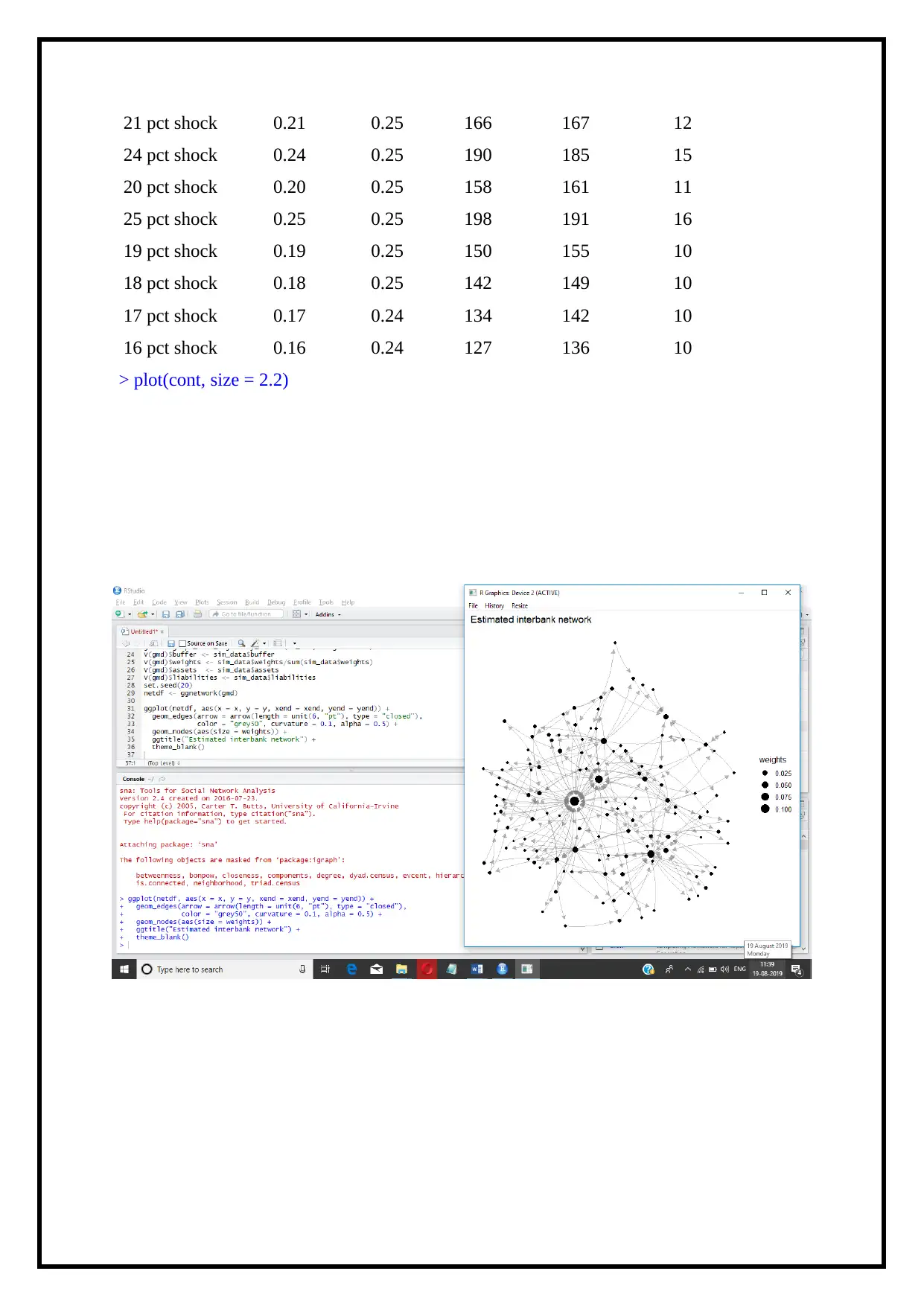
21 pct shock 0.21 0.25 166 167 12
24 pct shock 0.24 0.25 190 185 15
20 pct shock 0.20 0.25 158 161 11
25 pct shock 0.25 0.25 198 191 16
19 pct shock 0.19 0.25 150 155 10
18 pct shock 0.18 0.25 142 149 10
17 pct shock 0.17 0.24 134 142 10
16 pct shock 0.16 0.24 127 136 10
> plot(cont, size = 2.2)
24 pct shock 0.24 0.25 190 185 15
20 pct shock 0.20 0.25 158 161 11
25 pct shock 0.25 0.25 198 191 16
19 pct shock 0.19 0.25 150 155 10
18 pct shock 0.18 0.25 142 149 10
17 pct shock 0.17 0.24 134 142 10
16 pct shock 0.16 0.24 127 136 10
> plot(cont, size = 2.2)
Mark-to-Market Values
A usual method of deciphering p(x) is a method which relates to the payments that
balances the realized assets and liabilities at every node provided that:
1. The debts take precedence over the equity.
A usual method of deciphering p(x) is a method which relates to the payments that
balances the realized assets and liabilities at every node provided that:
1. The debts take precedence over the equity.
⊘ This is a preview!⊘
Do you want full access?
Subscribe today to unlock all pages.
Trusted by 1+ million students worldwide

1 out of 21


Your All-in-One AI-Powered Toolkit for Academic Success.
+13062052269
info@desklib.com
Available 24*7 on WhatsApp / Email
![[object Object]](/_next/static/media/star-bottom.7253800d.svg)
Unlock your academic potential
Copyright © 2020–2026 A2Z Services. All Rights Reserved. Developed and managed by ZUCOL.