Supreme Court Case Analysis: R. v. Marquard and Child Witnesses

Verified

Added on  2022/10/16

|4
|523
|68
Case Study
AI Summary
The assignment analyzes the Supreme Court of Canada case of R. v. Marquard, which involved Debra Marquard being accused of aggravated assault against her granddaughter. The case delves into critical issues surrounding child witness testimony, including the assessment of their competency to testify, the reliability of their statements, and the admissibility of expert opinions. The trial judge had to consider the child's competency as a witness. The case also addresses the limitations of expert testimony, specifically when experts offer opinions outside their area of expertise. The court's decision emphasized the importance of establishing a child's capacity to observe, recollect, and communicate, and the need for caution in evaluating their evidence. The ruling clarified the standards for expert testimony and helped to change attitudes towards children as witnesses in criminal court, allowing them to testify after competency tests.
Document Page
Running head: PSYCHOLOGY AND LAW 1
Psychology and Law
Name
Institution
tabler-icon-diamond-filled.svg

Paraphrase This Document

Need a fresh take? Get an instant paraphrase of this document with our AI Paraphraser
Document Page
PSYCHOLOGY AND LAW 2
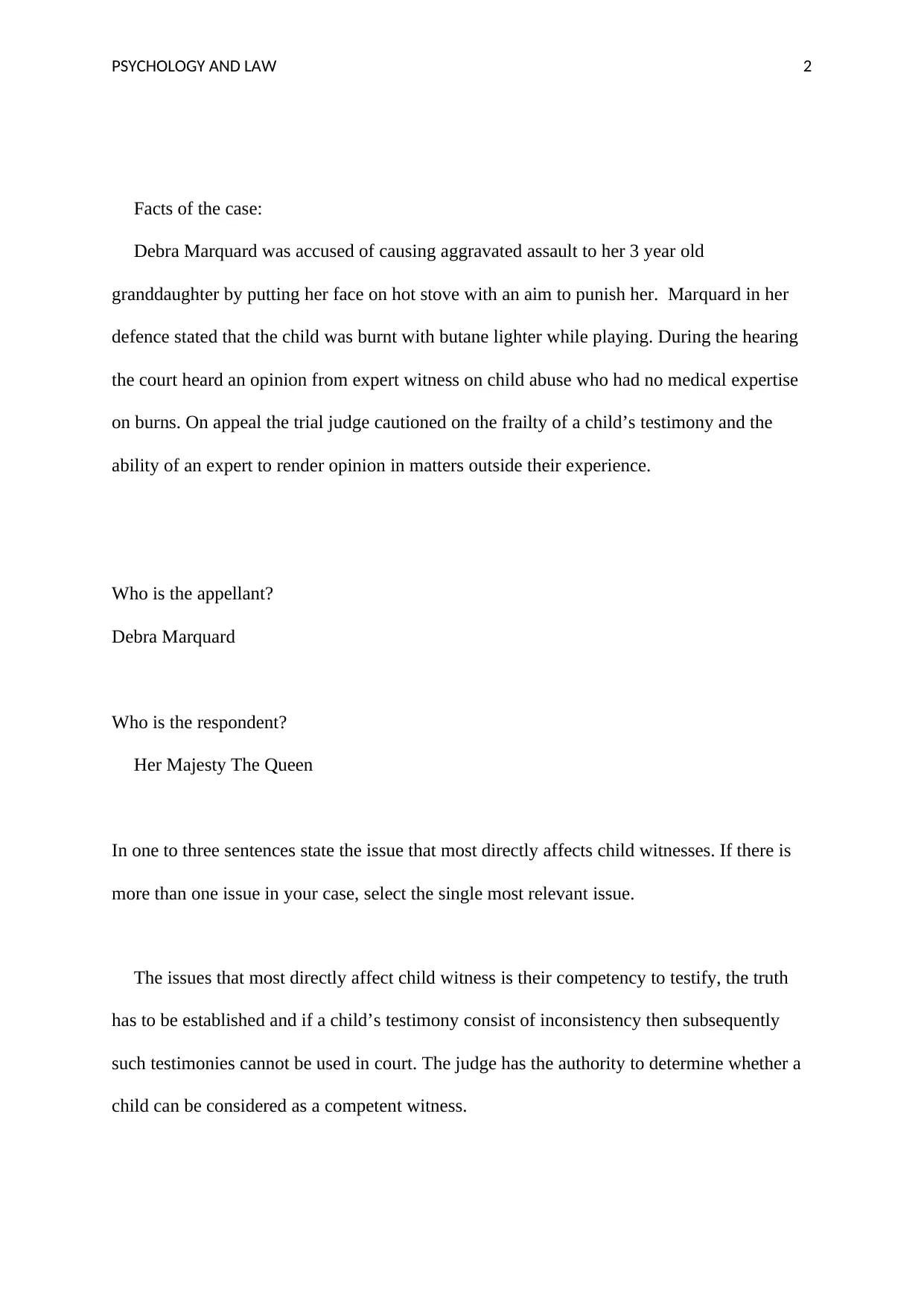
Facts of the case:
Debra Marquard was accused of causing aggravated assault to her 3 year old
granddaughter by putting her face on hot stove with an aim to punish her. Marquard in her
defence stated that the child was burnt with butane lighter while playing. During the hearing
the court heard an opinion from expert witness on child abuse who had no medical expertise
on burns. On appeal the trial judge cautioned on the frailty of a child’s testimony and the
ability of an expert to render opinion in matters outside their experience.
Who is the appellant?
Debra Marquard
Who is the respondent?
Her Majesty The Queen
In one to three sentences state the issue that most directly affects child witnesses. If there is
more than one issue in your case, select the single most relevant issue.
The issues that most directly affect child witness is their competency to testify, the truth
has to be established and if a child’s testimony consist of inconsistency then subsequently
such testimonies cannot be used in court. The judge has the authority to determine whether a
child can be considered as a competent witness.
Document Page
PSYCHOLOGY AND LAW 3
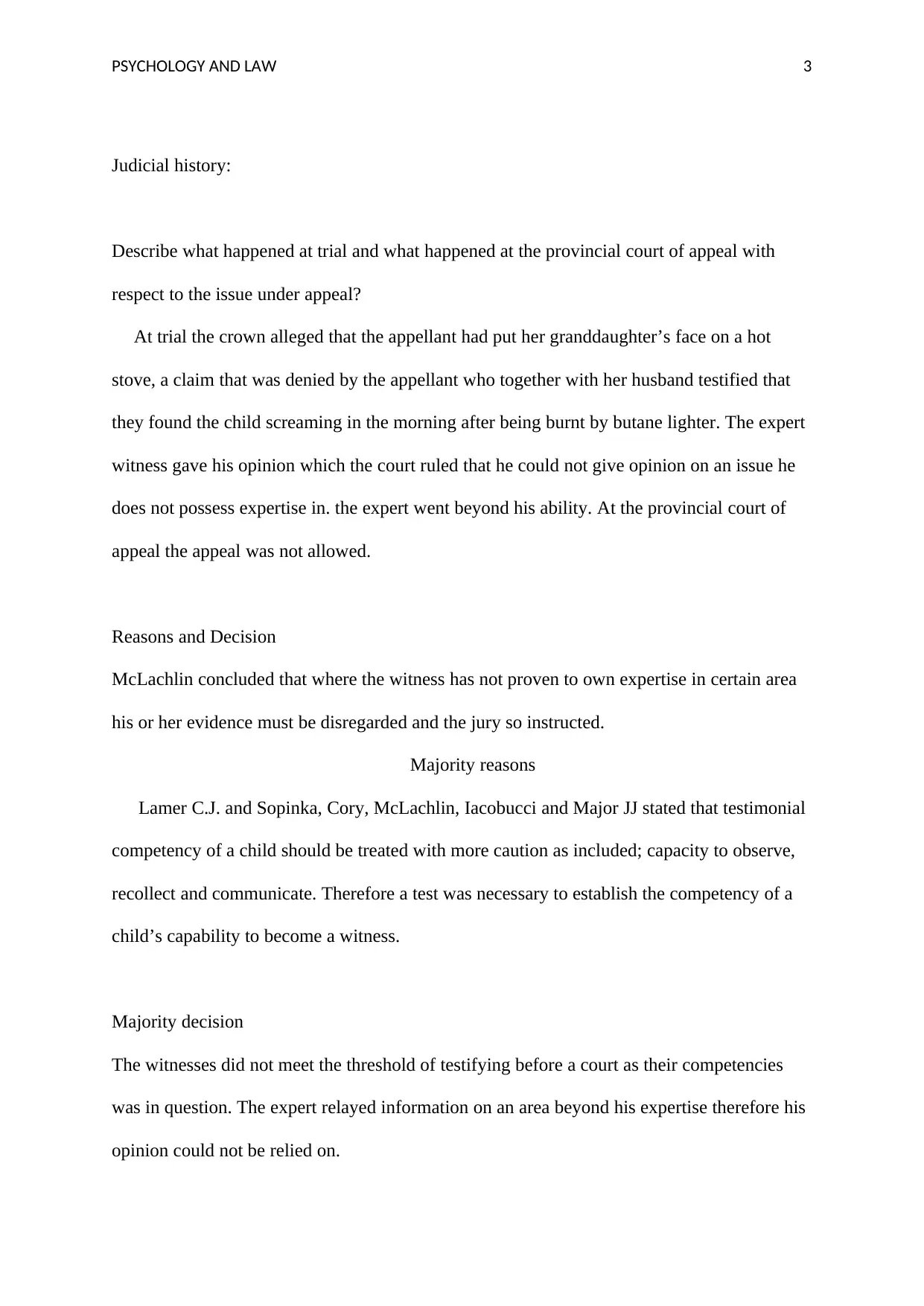
Judicial history:
Describe what happened at trial and what happened at the provincial court of appeal with
respect to the issue under appeal?
At trial the crown alleged that the appellant had put her granddaughter’s face on a hot
stove, a claim that was denied by the appellant who together with her husband testified that
they found the child screaming in the morning after being burnt by butane lighter. The expert
witness gave his opinion which the court ruled that he could not give opinion on an issue he
does not possess expertise in. the expert went beyond his ability. At the provincial court of
appeal the appeal was not allowed.
Reasons and Decision
McLachlin concluded that where the witness has not proven to own expertise in certain area
his or her evidence must be disregarded and the jury so instructed.
Majority reasons
Lamer C.J. and Sopinka, Cory, McLachlin, Iacobucci and Major JJ stated that testimonial
competency of a child should be treated with more caution as included; capacity to observe,
recollect and communicate. Therefore a test was necessary to establish the competency of a
child’s capability to become a witness.
Majority decision
The witnesses did not meet the threshold of testifying before a court as their competencies
was in question. The expert relayed information on an area beyond his expertise therefore his
opinion could not be relied on.
Document Page
PSYCHOLOGY AND LAW 4
Minority decision
Appeal should be allowed.
How did this case help to change attitudes towards children as witnesses in criminal court?
At least now children can be accorded the chance to testify in court after the test to prove
their competency is carried out.
chevron_up_icon
1 out of 4
circle_padding
hide_on_mobile
zoom_out_icon
[object Object]