Bioinformatics Investigation of Rasopathy: Gene Panel Design Study
VerifiedAdded on 2023/04/21
|23
|4282
|62
Case Study
AI Summary
This case study focuses on a one-month-old male infant with bilateral pleural effusions and fetal hydrops, suspected of having a rasopathy. A gene panel was designed to identify the specific gene variant responsible for the condition, given that previous microarray testing was inconclusive. The methodology involves whole-genome sequencing, alignment with a reference genome, and variant calling using bioinformatics tools, particularly the Ensembl Variant Effect Predictor (VEP). The analysis filters variants based on QUAL and VDB values, identifies novel variants, and compares them against the gene panel to pinpoint pathogenic variants. The study identifies a missense variant in the PTPN11 gene, specifically Y63C, associated with Noonan syndrome, supported by multiple publications. This variant, a non-conservative amino acid substitution, is predicted to negatively influence protein structure, suggesting its role in the patient's condition.
RASOPATHY AND CASE STUDY
[Document subtitle]
[DATE]
[Company name]
[Company address]
[Document subtitle]
[DATE]
[Company name]
[Company address]

Paraphrase This Document
Need a fresh take? Get an instant paraphrase of this document with our AI Paraphraser
Contents
INTRODUCTION.......................................................................................................................................2
GENE PANEL................................................................................................................................................5
OTHER USE OF OMICS TECHNIQUES................................................................................................17
REFERENCES..........................................................................................................................................19
INTRODUCTION.......................................................................................................................................2
GENE PANEL................................................................................................................................................5
OTHER USE OF OMICS TECHNIQUES................................................................................................17
REFERENCES..........................................................................................................................................19
INTRODUCTION
Rasopathies is a rare form of genetic condition that occurs because of germ line mutation in the
genes of RAS-MAP Kinase pathways. Costello syndromes, Noonan syndrome, capillary
malformation, neurofibromatosis type 1 are different disorders that occurs when this mutation
occurs. Based on literature, MAPK/Ras pathway and their signal transduction are well studied
and it is quite difficult to have a proper cellular growth, differentiation and regulation in their
absence (Flex et al., 2014). In Rasopathies, there is a deregulation of the Ras/MAPK pathways
and several abnormal characteristics are being shown such as neuro cognitive impairment,
musculoskeletal abnormalities along with a higher risk of causing cancer (Rauen, 2013). If it is
taken altogether permanently, then rasopathy will be considered to be one of the top group of
malformation among the human that affects approx. 1 person in every 1000 (Aoki et al., 2016).
There are several clinical features of this syndrome that are come with each other such as facial
features difference, cardiac defects, developmental delays, neurological issues, cardiac defects
and gastrointestinal difficulties. In this condition, the individual syndromes are quite rare and
RASopathies are quite common that affects approx. 1 person in every 1000. The MAPK pathway
is known to be one of the most complex downstream signaling pathway of RAS (Papke and Der,
2016). On activation of RAS further leads to the activation of RAF, which is the first MAPK
kinase into action. The RAF basically gets phosphorylated and activates the MAPK kinases and
MEK1 and MEK2 further activates the ERK2and ERK1. In the context of oncogenesis, the
RAS/MAPK pathways are having more impact because it causes somatic deregulation and it is
known to be one of the primary cause of causing cancer (Tajan et al., 2018).
Till date nearly 20 genetic mutations has been associated with RASopathies (Tidyman and
Rauen, 2016). Although not all, but most of them are associated with RAS/MAPK kinase
Rasopathies is a rare form of genetic condition that occurs because of germ line mutation in the
genes of RAS-MAP Kinase pathways. Costello syndromes, Noonan syndrome, capillary
malformation, neurofibromatosis type 1 are different disorders that occurs when this mutation
occurs. Based on literature, MAPK/Ras pathway and their signal transduction are well studied
and it is quite difficult to have a proper cellular growth, differentiation and regulation in their
absence (Flex et al., 2014). In Rasopathies, there is a deregulation of the Ras/MAPK pathways
and several abnormal characteristics are being shown such as neuro cognitive impairment,
musculoskeletal abnormalities along with a higher risk of causing cancer (Rauen, 2013). If it is
taken altogether permanently, then rasopathy will be considered to be one of the top group of
malformation among the human that affects approx. 1 person in every 1000 (Aoki et al., 2016).
There are several clinical features of this syndrome that are come with each other such as facial
features difference, cardiac defects, developmental delays, neurological issues, cardiac defects
and gastrointestinal difficulties. In this condition, the individual syndromes are quite rare and
RASopathies are quite common that affects approx. 1 person in every 1000. The MAPK pathway
is known to be one of the most complex downstream signaling pathway of RAS (Papke and Der,
2016). On activation of RAS further leads to the activation of RAF, which is the first MAPK
kinase into action. The RAF basically gets phosphorylated and activates the MAPK kinases and
MEK1 and MEK2 further activates the ERK2and ERK1. In the context of oncogenesis, the
RAS/MAPK pathways are having more impact because it causes somatic deregulation and it is
known to be one of the primary cause of causing cancer (Tajan et al., 2018).
Till date nearly 20 genetic mutations has been associated with RASopathies (Tidyman and
Rauen, 2016). Although not all, but most of them are associated with RAS/MAPK kinase
⊘ This is a preview!⊘
Do you want full access?
Subscribe today to unlock all pages.

Trusted by 1+ million students worldwide
pathway facilitating a genetic background of their pathophysiology and foundations. However
the classification becomes difficult due to simultaneous action of genetic heterogeneity for one
syndrome and allelism for different other syndromes. RAS/MAPK kinase pathway is a universal
signal transduction pathway activated by different external factors not limited to hormones,
growth factors, cell to cell interactions, for modulating various cellular pathways such as
survival, proliferation, differentiation, migration or different metabolism (Tidyman and Rauen,
2016). Different roles are associated with RAS/MAP Kinase pathway that is developmental
roles, endocrine and metabolic functions, and germline mutations (Regad, 2015). The current
report will address only germ line mutations that is relevant for the current case study. Functional
analysis shows increasing number of mutations in both animal models and in-vitro studies and
RAS/MAPK hyperactivation as the pathogenic mechanism (Tajan et al., 2018). Thus, literature
reported sustained activation of RAS/MAPK pathway leads to congential symptoms via
abnormal development of tissues such as craniofacial or cardiac defects, alterations in hormonal
response that in turn give rise to endocrine dysfunctions such as growth retardation and growth
hormone insensitivity. However, scientific controversies exist since independent RAS/MAPK
pathway can also lead to different syndromes that has been demonstrated in different animal
models (Dard et al., 2018).
BIOINFORMATICS STRATEGY AND ANALYSIS
As given in the case study, the infant is speculated for a RASopathy, however the exact gene
variant (mutations in gene that has caused the pathological symptoms) need to be identified for
therapy. Therefore, a gene panel was to be constructed for the same. The rationale behind gene
panel is to identify the genetic variants from number of genes in order to find out mutations that
the classification becomes difficult due to simultaneous action of genetic heterogeneity for one
syndrome and allelism for different other syndromes. RAS/MAPK kinase pathway is a universal
signal transduction pathway activated by different external factors not limited to hormones,
growth factors, cell to cell interactions, for modulating various cellular pathways such as
survival, proliferation, differentiation, migration or different metabolism (Tidyman and Rauen,
2016). Different roles are associated with RAS/MAP Kinase pathway that is developmental
roles, endocrine and metabolic functions, and germline mutations (Regad, 2015). The current
report will address only germ line mutations that is relevant for the current case study. Functional
analysis shows increasing number of mutations in both animal models and in-vitro studies and
RAS/MAPK hyperactivation as the pathogenic mechanism (Tajan et al., 2018). Thus, literature
reported sustained activation of RAS/MAPK pathway leads to congential symptoms via
abnormal development of tissues such as craniofacial or cardiac defects, alterations in hormonal
response that in turn give rise to endocrine dysfunctions such as growth retardation and growth
hormone insensitivity. However, scientific controversies exist since independent RAS/MAPK
pathway can also lead to different syndromes that has been demonstrated in different animal
models (Dard et al., 2018).
BIOINFORMATICS STRATEGY AND ANALYSIS
As given in the case study, the infant is speculated for a RASopathy, however the exact gene
variant (mutations in gene that has caused the pathological symptoms) need to be identified for
therapy. Therefore, a gene panel was to be constructed for the same. The rationale behind gene
panel is to identify the genetic variants from number of genes in order to find out mutations that
Paraphrase This Document
Need a fresh take? Get an instant paraphrase of this document with our AI Paraphraser
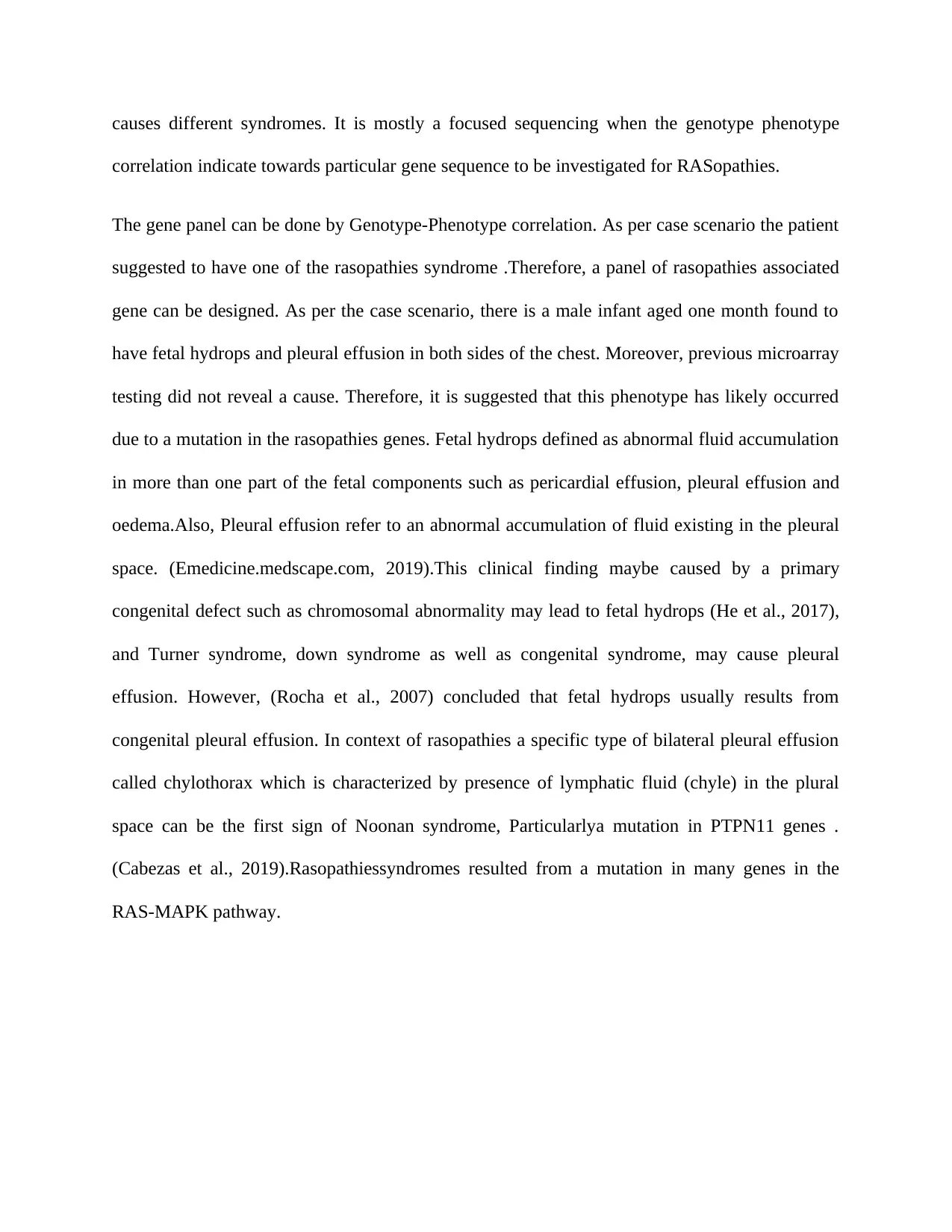
causes different syndromes. It is mostly a focused sequencing when the genotype phenotype
correlation indicate towards particular gene sequence to be investigated for RASopathies.
The gene panel can be done by Genotype-Phenotype correlation. As per case scenario the patient
suggested to have one of the rasopathies syndrome .Therefore, a panel of rasopathies associated
gene can be designed. As per the case scenario, there is a male infant aged one month found to
have fetal hydrops and pleural effusion in both sides of the chest. Moreover, previous microarray
testing did not reveal a cause. Therefore, it is suggested that this phenotype has likely occurred
due to a mutation in the rasopathies genes. Fetal hydrops defined as abnormal fluid accumulation
in more than one part of the fetal components such as pericardial effusion, pleural effusion and
oedema.Also, Pleural effusion refer to an abnormal accumulation of fluid existing in the pleural
space. (Emedicine.medscape.com, 2019).This clinical finding maybe caused by a primary
congenital defect such as chromosomal abnormality may lead to fetal hydrops (He et al., 2017),
and Turner syndrome, down syndrome as well as congenital syndrome, may cause pleural
effusion. However, (Rocha et al., 2007) concluded that fetal hydrops usually results from
congenital pleural effusion. In context of rasopathies a specific type of bilateral pleural effusion
called chylothorax which is characterized by presence of lymphatic fluid (chyle) in the plural
space can be the first sign of Noonan syndrome, Particularlya mutation in PTPN11 genes .
(Cabezas et al., 2019).Rasopathiessyndromes resulted from a mutation in many genes in the
RAS-MAPK pathway.
correlation indicate towards particular gene sequence to be investigated for RASopathies.
The gene panel can be done by Genotype-Phenotype correlation. As per case scenario the patient
suggested to have one of the rasopathies syndrome .Therefore, a panel of rasopathies associated
gene can be designed. As per the case scenario, there is a male infant aged one month found to
have fetal hydrops and pleural effusion in both sides of the chest. Moreover, previous microarray
testing did not reveal a cause. Therefore, it is suggested that this phenotype has likely occurred
due to a mutation in the rasopathies genes. Fetal hydrops defined as abnormal fluid accumulation
in more than one part of the fetal components such as pericardial effusion, pleural effusion and
oedema.Also, Pleural effusion refer to an abnormal accumulation of fluid existing in the pleural
space. (Emedicine.medscape.com, 2019).This clinical finding maybe caused by a primary
congenital defect such as chromosomal abnormality may lead to fetal hydrops (He et al., 2017),
and Turner syndrome, down syndrome as well as congenital syndrome, may cause pleural
effusion. However, (Rocha et al., 2007) concluded that fetal hydrops usually results from
congenital pleural effusion. In context of rasopathies a specific type of bilateral pleural effusion
called chylothorax which is characterized by presence of lymphatic fluid (chyle) in the plural
space can be the first sign of Noonan syndrome, Particularlya mutation in PTPN11 genes .
(Cabezas et al., 2019).Rasopathiessyndromes resulted from a mutation in many genes in the
RAS-MAPK pathway.
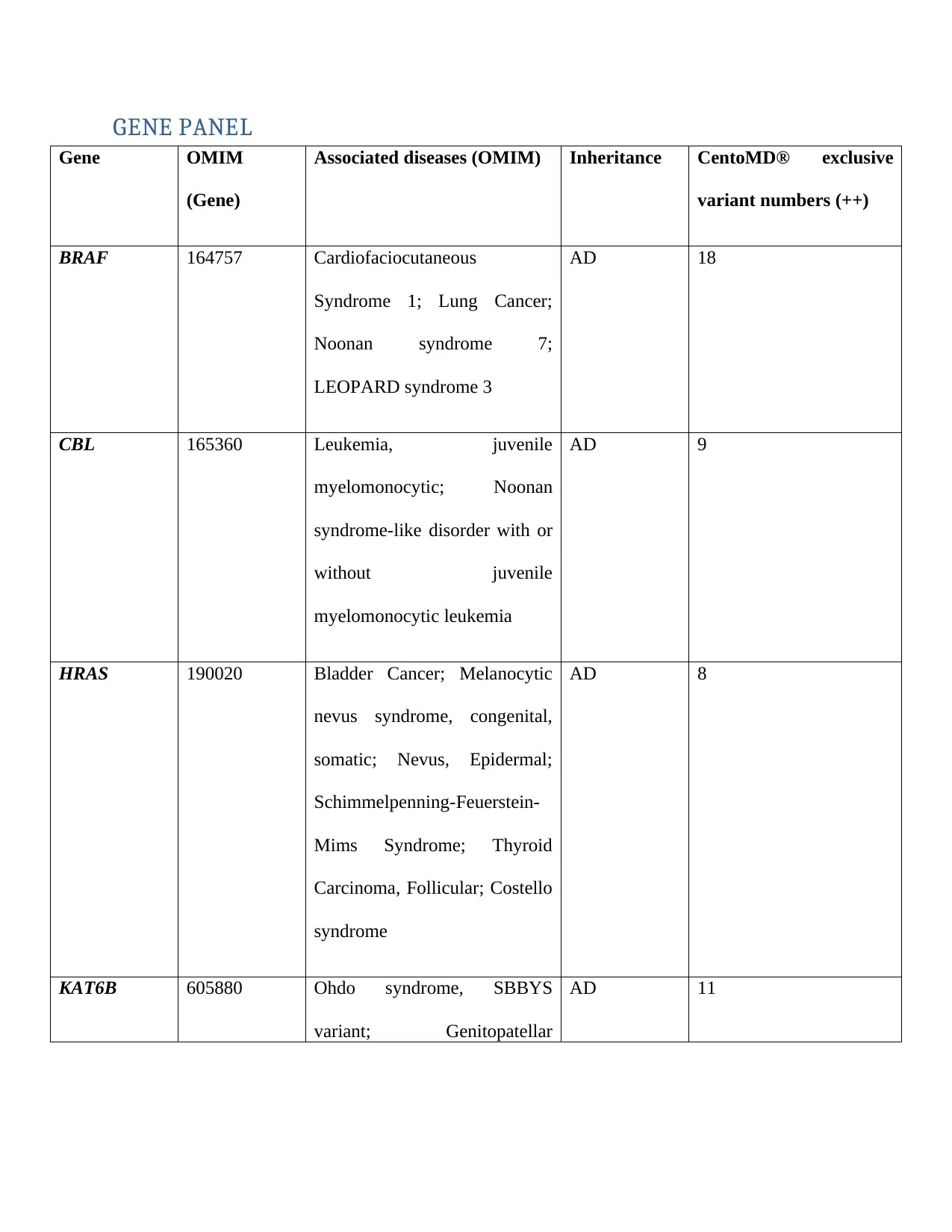
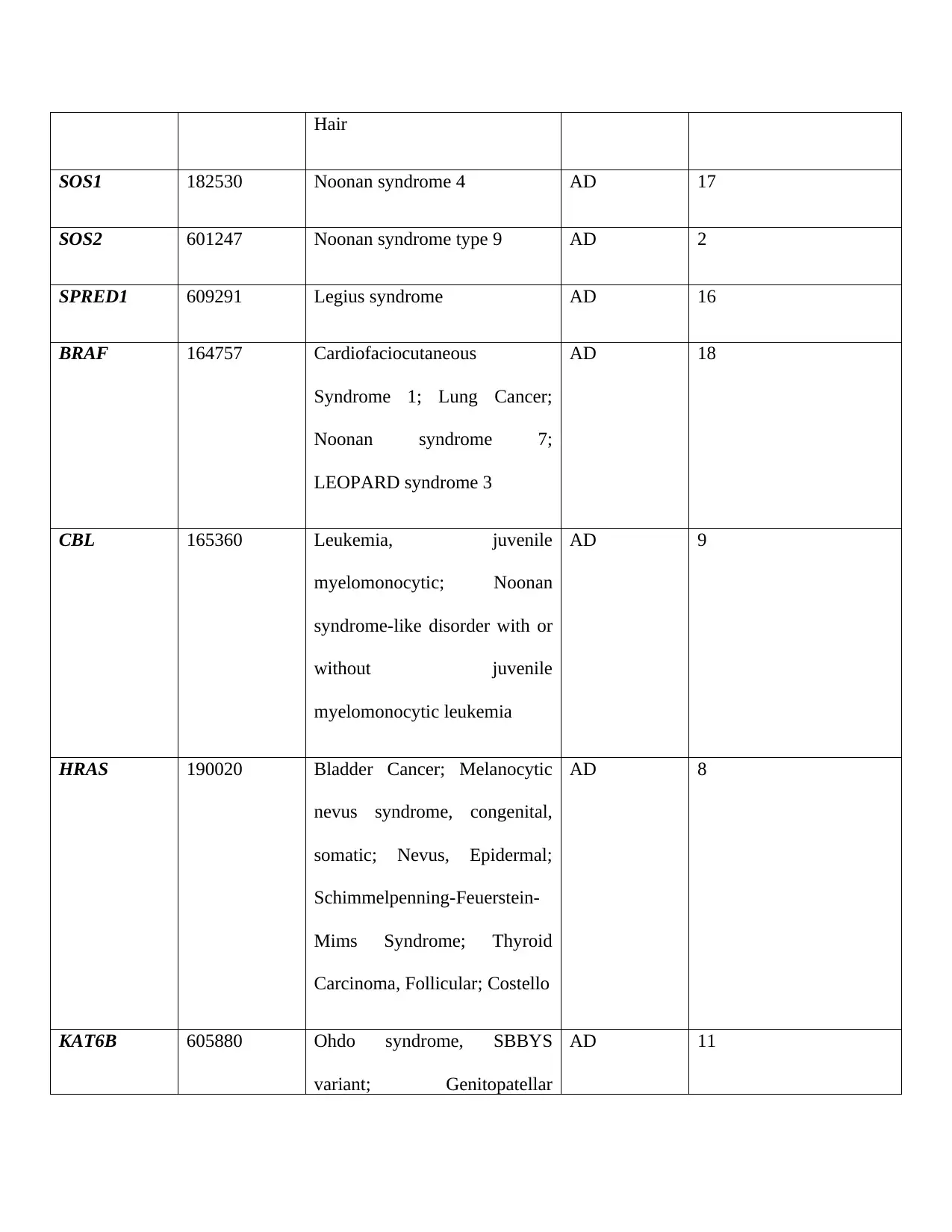
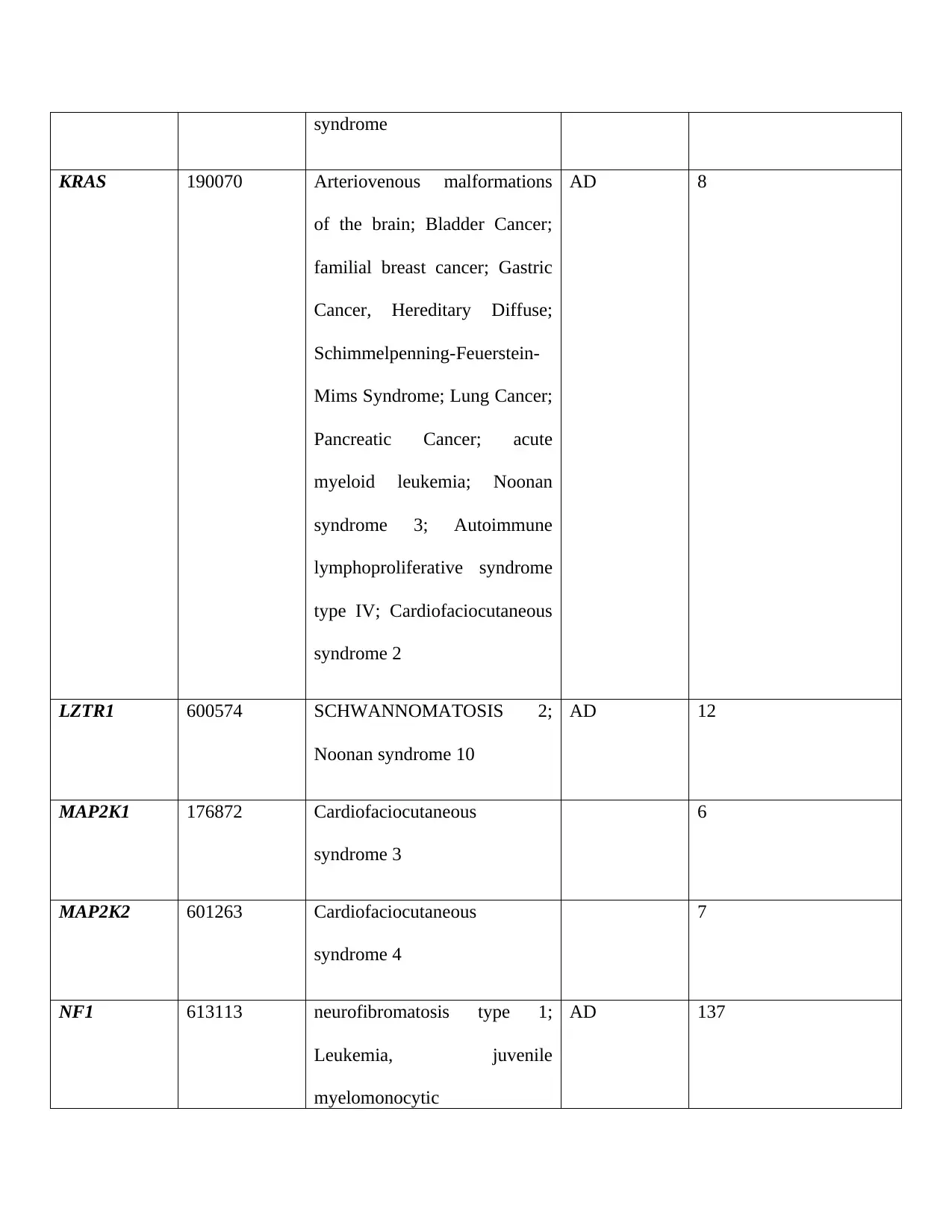
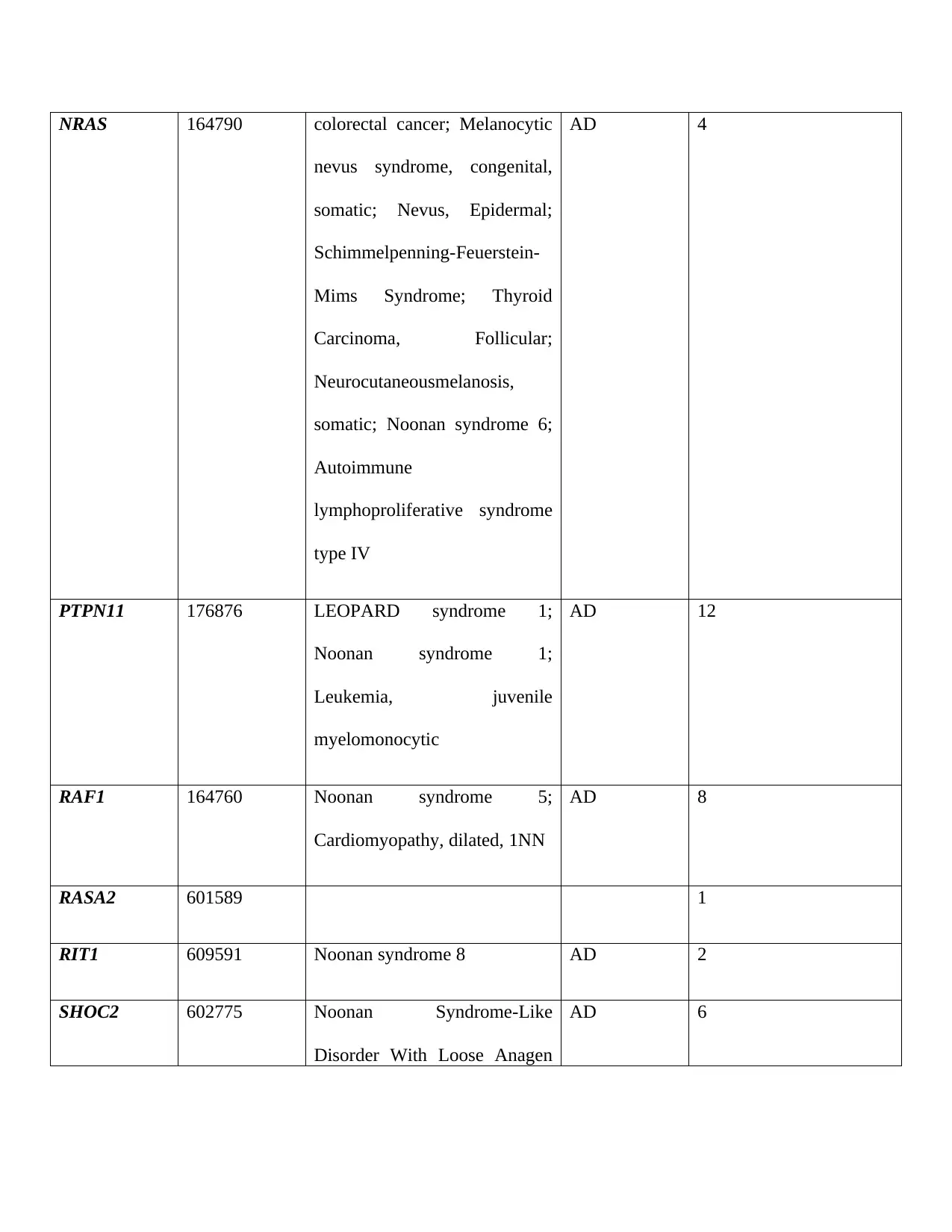
GENE PANEL
Gene OMIM
(Gene)
Associated diseases (OMIM) Inheritance CentoMD® exclusive
variant numbers (++)
BRAF 164757 Cardiofaciocutaneous
Syndrome 1; Lung Cancer;
Noonan syndrome 7;
LEOPARD syndrome 3
AD 18
CBL 165360 Leukemia, juvenile
myelomonocytic; Noonan
syndrome-like disorder with or
without juvenile
myelomonocytic leukemia
AD 9
HRAS 190020 Bladder Cancer; Melanocytic
nevus syndrome, congenital,
somatic; Nevus, Epidermal;
Schimmelpenning-Feuerstein-
Mims Syndrome; Thyroid
Carcinoma, Follicular; Costello
syndrome
AD 8
KAT6B 605880 Ohdo syndrome, SBBYS
variant; Genitopatellar
AD 11
Gene OMIM
(Gene)
Associated diseases (OMIM) Inheritance CentoMD® exclusive
variant numbers (++)
BRAF 164757 Cardiofaciocutaneous
Syndrome 1; Lung Cancer;
Noonan syndrome 7;
LEOPARD syndrome 3
AD 18
CBL 165360 Leukemia, juvenile
myelomonocytic; Noonan
syndrome-like disorder with or
without juvenile
myelomonocytic leukemia
AD 9
HRAS 190020 Bladder Cancer; Melanocytic
nevus syndrome, congenital,
somatic; Nevus, Epidermal;
Schimmelpenning-Feuerstein-
Mims Syndrome; Thyroid
Carcinoma, Follicular; Costello
syndrome
AD 8
KAT6B 605880 Ohdo syndrome, SBBYS
variant; Genitopatellar
AD 11
⊘ This is a preview!⊘
Do you want full access?
Subscribe today to unlock all pages.
Trusted by 1+ million students worldwide
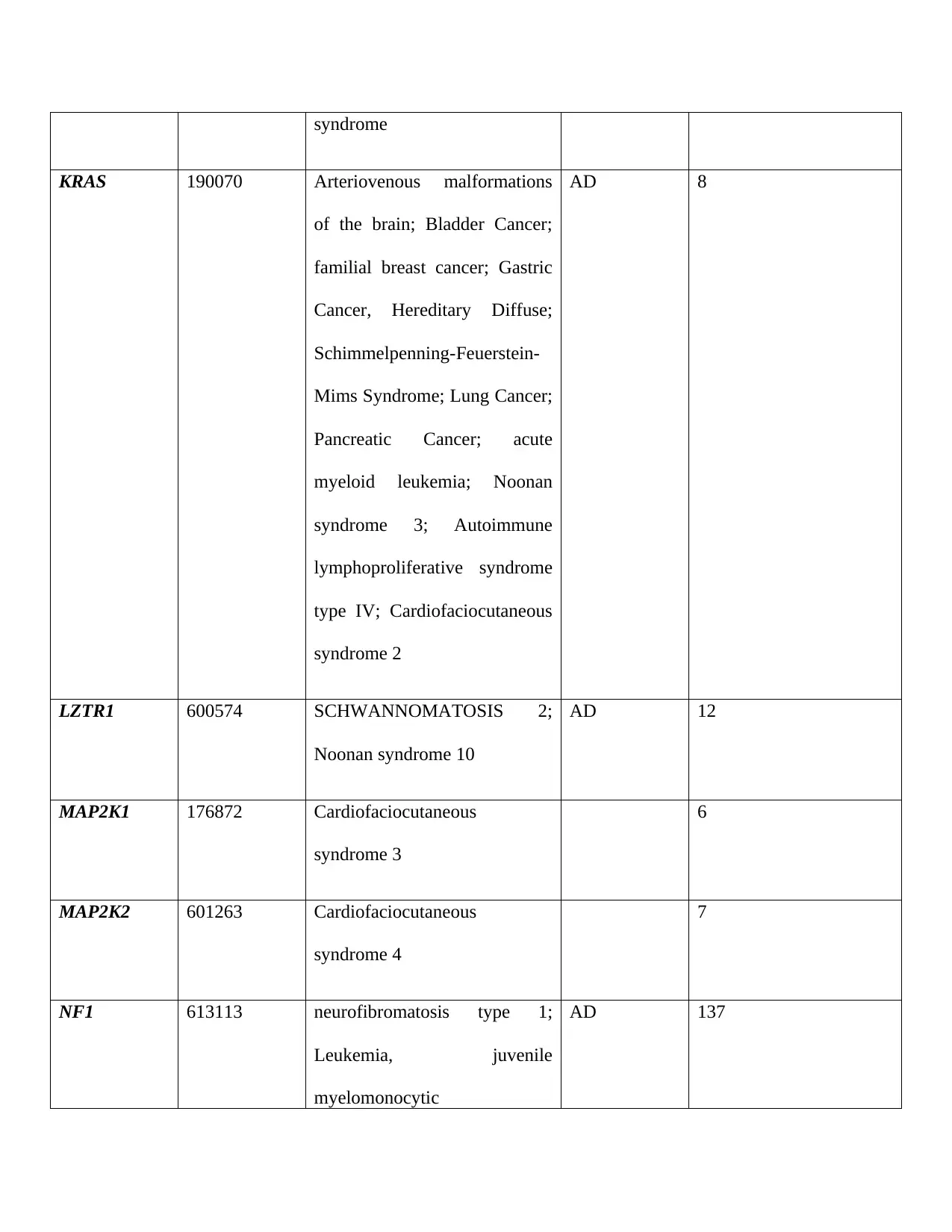
syndrome
KRAS 190070 Arteriovenous malformations
of the brain; Bladder Cancer;
familial breast cancer; Gastric
Cancer, Hereditary Diffuse;
Schimmelpenning-Feuerstein-
Mims Syndrome; Lung Cancer;
Pancreatic Cancer; acute
myeloid leukemia; Noonan
syndrome 3; Autoimmune
lymphoproliferative syndrome
type IV; Cardiofaciocutaneous
syndrome 2
AD 8
LZTR1 600574 SCHWANNOMATOSIS 2;
Noonan syndrome 10
AD 12
MAP2K1 176872 Cardiofaciocutaneous
syndrome 3
6
MAP2K2 601263 Cardiofaciocutaneous
syndrome 4
7
NF1 613113 neurofibromatosis type 1;
Leukemia, juvenile
myelomonocytic
AD 137
KRAS 190070 Arteriovenous malformations
of the brain; Bladder Cancer;
familial breast cancer; Gastric
Cancer, Hereditary Diffuse;
Schimmelpenning-Feuerstein-
Mims Syndrome; Lung Cancer;
Pancreatic Cancer; acute
myeloid leukemia; Noonan
syndrome 3; Autoimmune
lymphoproliferative syndrome
type IV; Cardiofaciocutaneous
syndrome 2
AD 8
LZTR1 600574 SCHWANNOMATOSIS 2;
Noonan syndrome 10
AD 12
MAP2K1 176872 Cardiofaciocutaneous
syndrome 3
6
MAP2K2 601263 Cardiofaciocutaneous
syndrome 4
7
NF1 613113 neurofibromatosis type 1;
Leukemia, juvenile
myelomonocytic
AD 137
Paraphrase This Document
Need a fresh take? Get an instant paraphrase of this document with our AI Paraphraser
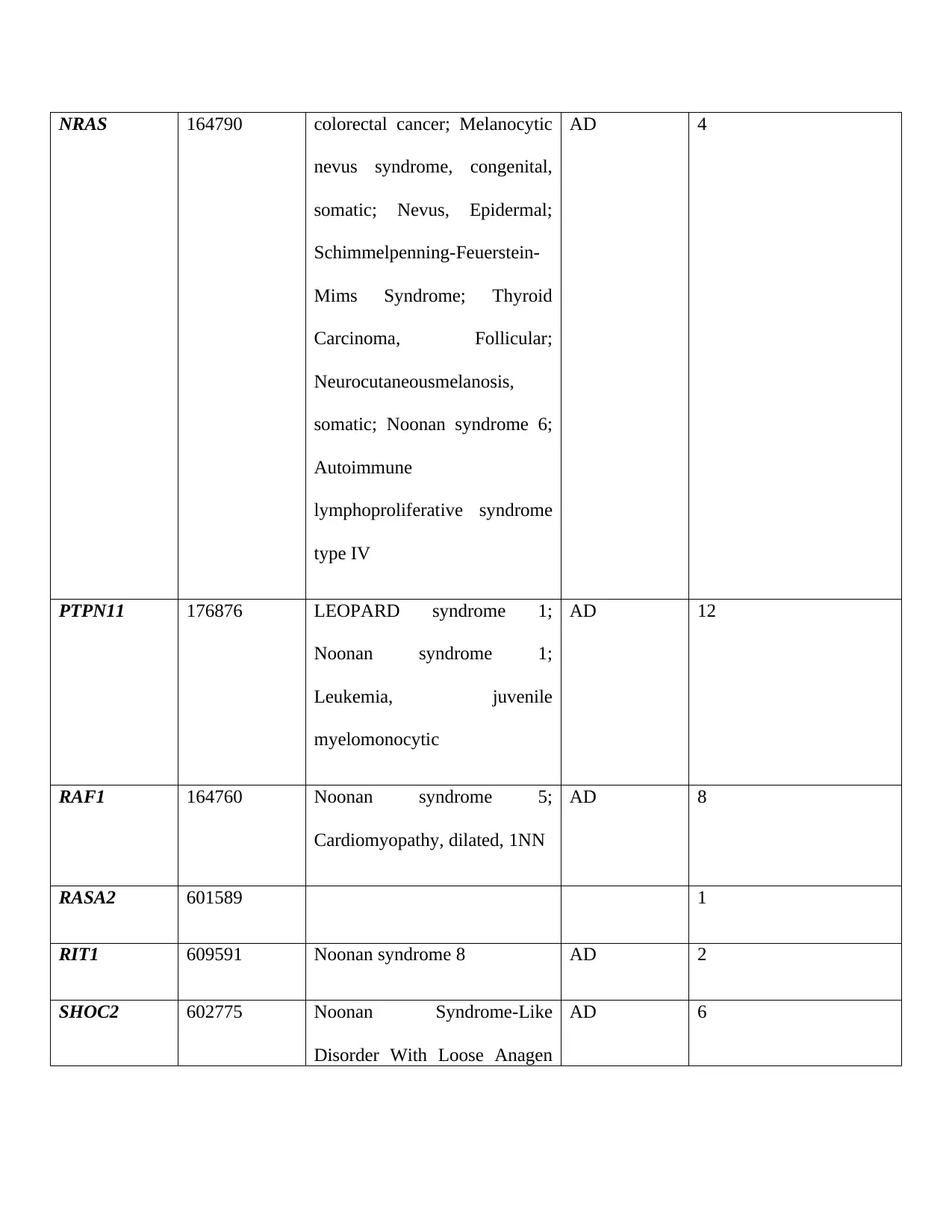
NRAS 164790 colorectal cancer; Melanocytic
nevus syndrome, congenital,
somatic; Nevus, Epidermal;
Schimmelpenning-Feuerstein-
Mims Syndrome; Thyroid
Carcinoma, Follicular;
Neurocutaneousmelanosis,
somatic; Noonan syndrome 6;
Autoimmune
lymphoproliferative syndrome
type IV
AD 4
PTPN11 176876 LEOPARD syndrome 1;
Noonan syndrome 1;
Leukemia, juvenile
myelomonocytic
AD 12
RAF1 164760 Noonan syndrome 5;
Cardiomyopathy, dilated, 1NN
AD 8
RASA2 601589 1
RIT1 609591 Noonan syndrome 8 AD 2
SHOC2 602775 Noonan Syndrome-Like
Disorder With Loose Anagen
AD 6
nevus syndrome, congenital,
somatic; Nevus, Epidermal;
Schimmelpenning-Feuerstein-
Mims Syndrome; Thyroid
Carcinoma, Follicular;
Neurocutaneousmelanosis,
somatic; Noonan syndrome 6;
Autoimmune
lymphoproliferative syndrome
type IV
AD 4
PTPN11 176876 LEOPARD syndrome 1;
Noonan syndrome 1;
Leukemia, juvenile
myelomonocytic
AD 12
RAF1 164760 Noonan syndrome 5;
Cardiomyopathy, dilated, 1NN
AD 8
RASA2 601589 1
RIT1 609591 Noonan syndrome 8 AD 2
SHOC2 602775 Noonan Syndrome-Like
Disorder With Loose Anagen
AD 6
Hair
SOS1 182530 Noonan syndrome 4 AD 17
SOS2 601247 Noonan syndrome type 9 AD 2
SPRED1 609291 Legius syndrome AD 16
BRAF 164757 Cardiofaciocutaneous
Syndrome 1; Lung Cancer;
Noonan syndrome 7;
LEOPARD syndrome 3
AD 18
CBL 165360 Leukemia, juvenile
myelomonocytic; Noonan
syndrome-like disorder with or
without juvenile
myelomonocytic leukemia
AD 9
HRAS 190020 Bladder Cancer; Melanocytic
nevus syndrome, congenital,
somatic; Nevus, Epidermal;
Schimmelpenning-Feuerstein-
Mims Syndrome; Thyroid
Carcinoma, Follicular; Costello
AD 8
KAT6B 605880 Ohdo syndrome, SBBYS
variant; Genitopatellar
AD 11
SOS1 182530 Noonan syndrome 4 AD 17
SOS2 601247 Noonan syndrome type 9 AD 2
SPRED1 609291 Legius syndrome AD 16
BRAF 164757 Cardiofaciocutaneous
Syndrome 1; Lung Cancer;
Noonan syndrome 7;
LEOPARD syndrome 3
AD 18
CBL 165360 Leukemia, juvenile
myelomonocytic; Noonan
syndrome-like disorder with or
without juvenile
myelomonocytic leukemia
AD 9
HRAS 190020 Bladder Cancer; Melanocytic
nevus syndrome, congenital,
somatic; Nevus, Epidermal;
Schimmelpenning-Feuerstein-
Mims Syndrome; Thyroid
Carcinoma, Follicular; Costello
AD 8
KAT6B 605880 Ohdo syndrome, SBBYS
variant; Genitopatellar
AD 11
⊘ This is a preview!⊘
Do you want full access?
Subscribe today to unlock all pages.
Trusted by 1+ million students worldwide
syndrome
KRAS 190070 Arteriovenous malformations
of the brain; Bladder Cancer;
familial breast cancer; Gastric
Cancer, Hereditary Diffuse;
Schimmelpenning-Feuerstein-
Mims Syndrome; Lung Cancer;
Pancreatic Cancer; acute
myeloid leukemia; Noonan
syndrome 3; Autoimmune
lymphoproliferative syndrome
type IV; Cardiofaciocutaneous
syndrome 2
AD 8
LZTR1 600574 SCHWANNOMATOSIS 2;
Noonan syndrome 10
AD 12
MAP2K1 176872 Cardiofaciocutaneous
syndrome 3
6
MAP2K2 601263 Cardiofaciocutaneous
syndrome 4
7
NF1 613113 neurofibromatosis type 1;
Leukemia, juvenile
myelomonocytic
AD 137
KRAS 190070 Arteriovenous malformations
of the brain; Bladder Cancer;
familial breast cancer; Gastric
Cancer, Hereditary Diffuse;
Schimmelpenning-Feuerstein-
Mims Syndrome; Lung Cancer;
Pancreatic Cancer; acute
myeloid leukemia; Noonan
syndrome 3; Autoimmune
lymphoproliferative syndrome
type IV; Cardiofaciocutaneous
syndrome 2
AD 8
LZTR1 600574 SCHWANNOMATOSIS 2;
Noonan syndrome 10
AD 12
MAP2K1 176872 Cardiofaciocutaneous
syndrome 3
6
MAP2K2 601263 Cardiofaciocutaneous
syndrome 4
7
NF1 613113 neurofibromatosis type 1;
Leukemia, juvenile
myelomonocytic
AD 137
Paraphrase This Document
Need a fresh take? Get an instant paraphrase of this document with our AI Paraphraser
NRAS 164790 colorectal cancer; Melanocytic
nevus syndrome, congenital,
somatic; Nevus, Epidermal;
Schimmelpenning-Feuerstein-
Mims Syndrome; Thyroid
Carcinoma, Follicular;
Neurocutaneousmelanosis,
somatic; Noonan syndrome 6;
Autoimmune
lymphoproliferative syndrome
type IV
AD 4
PTPN11 176876 LEOPARD syndrome 1;
Noonan syndrome 1;
Leukemia, juvenile
myelomonocytic
AD 12
RAF1 164760 Noonan syndrome 5;
Cardiomyopathy, dilated, 1NN
AD 8
RASA2 601589 1
RIT1 609591 Noonan syndrome 8 AD 2
SHOC2 602775 Noonan Syndrome-Like
Disorder With Loose Anagen
AD 6
nevus syndrome, congenital,
somatic; Nevus, Epidermal;
Schimmelpenning-Feuerstein-
Mims Syndrome; Thyroid
Carcinoma, Follicular;
Neurocutaneousmelanosis,
somatic; Noonan syndrome 6;
Autoimmune
lymphoproliferative syndrome
type IV
AD 4
PTPN11 176876 LEOPARD syndrome 1;
Noonan syndrome 1;
Leukemia, juvenile
myelomonocytic
AD 12
RAF1 164760 Noonan syndrome 5;
Cardiomyopathy, dilated, 1NN
AD 8
RASA2 601589 1
RIT1 609591 Noonan syndrome 8 AD 2
SHOC2 602775 Noonan Syndrome-Like
Disorder With Loose Anagen
AD 6
Hair
SOS1 182530 Noonan syndrome 4 AD 17
SOS2 601247 Noonan syndrome type 9 AD 2
SPRED1 609291 Legius syndrome AD 16
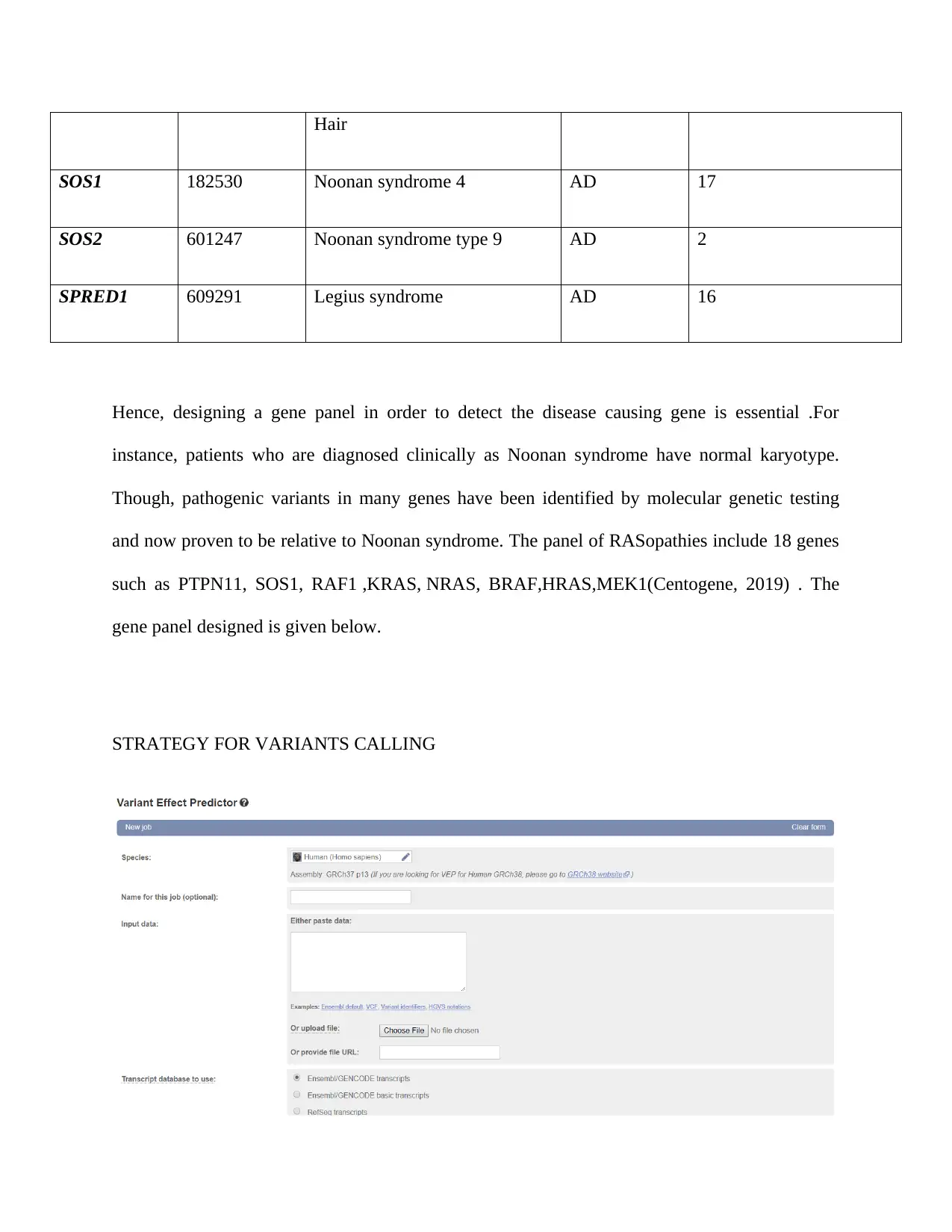
Hence, designing a gene panel in order to detect the disease causing gene is essential .For
instance, patients who are diagnosed clinically as Noonan syndrome have normal karyotype.
Though, pathogenic variants in many genes have been identified by molecular genetic testing
and now proven to be relative to Noonan syndrome. The panel of RASopathies include 18 genes
such as PTPN11, SOS1, RAF1 ,KRAS, NRAS, BRAF,HRAS,MEK1(Centogene, 2019) . The
gene panel designed is given below.
STRATEGY FOR VARIANTS CALLING
SOS1 182530 Noonan syndrome 4 AD 17
SOS2 601247 Noonan syndrome type 9 AD 2
SPRED1 609291 Legius syndrome AD 16
Hence, designing a gene panel in order to detect the disease causing gene is essential .For
instance, patients who are diagnosed clinically as Noonan syndrome have normal karyotype.
Though, pathogenic variants in many genes have been identified by molecular genetic testing
and now proven to be relative to Noonan syndrome. The panel of RASopathies include 18 genes
such as PTPN11, SOS1, RAF1 ,KRAS, NRAS, BRAF,HRAS,MEK1(Centogene, 2019) . The
gene panel designed is given below.
STRATEGY FOR VARIANTS CALLING
⊘ This is a preview!⊘
Do you want full access?
Subscribe today to unlock all pages.
Trusted by 1+ million students worldwide

1 out of 23


Your All-in-One AI-Powered Toolkit for Academic Success.
+13062052269
info@desklib.com
Available 24*7 on WhatsApp / Email
![[object Object]](/_next/static/media/star-bottom.7253800d.svg)
Unlock your academic potential
Copyright © 2020–2026 A2Z Services. All Rights Reserved. Developed and managed by ZUCOL.