Math C Assignment: Rational & Irrational Numbers, Square Roots
VerifiedAdded on 2023/06/15
|7
|1796
|260
Homework Assignment
AI Summary
This Math C assignment delves into the properties of rational and irrational numbers, exploring their behavior in geometric contexts such as rectangles, and investigates the Babylonian method for approximating square roots. It presents a detailed analysis of how rational and irrational side lengths affect the rationality of a rectangle's perimeter and area, providing examples and proofs for various scenarios. The assignment also examines the iterative process of the Babylonian method, demonstrating its application to find the square root of 26 and discussing the impact of the initial estimate on the efficiency of the calculation. Furthermore, the assignment includes simplification of surds using algebraic manipulations, including generalization of surd expressions. Desklib offers a platform for students to access this and other solved assignments for academic support.
Math C Assignment
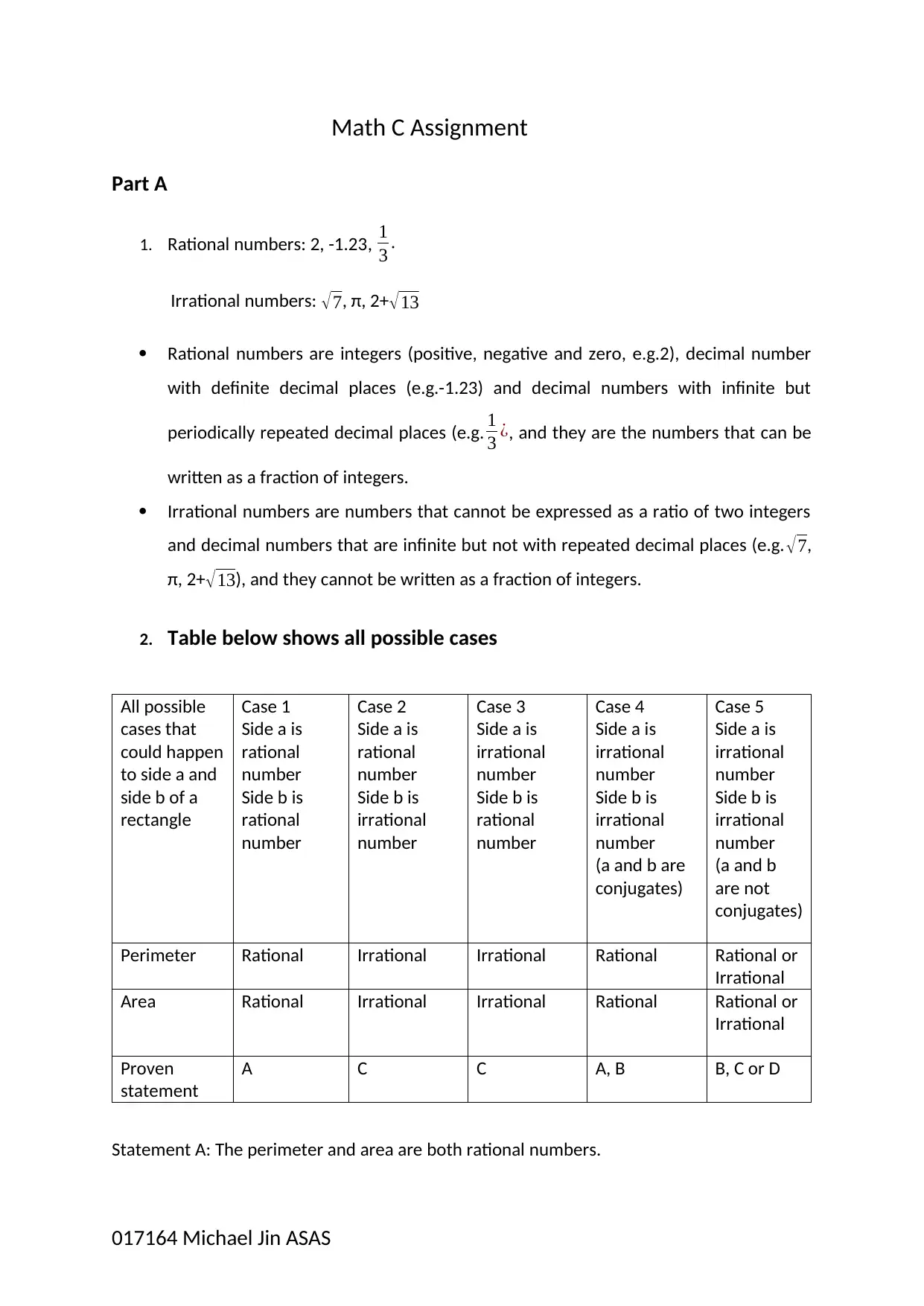
Part A
1. Rational numbers: 2, -1.23, 1
3 .
Irrational numbers: √7, π, 2+√ 13
Rational numbers are integers (positive, negative and zero, e.g.2), decimal number
with definite decimal places (e.g.-1.23) and decimal numbers with infinite but
periodically repeated decimal places (e.g. 1
3 ¿, and they are the numbers that can be
written as a fraction of integers.
Irrational numbers are numbers that cannot be expressed as a ratio of two integers
and decimal numbers that are infinite but not with repeated decimal places (e.g. √7,
π, 2+√ 13), and they cannot be written as a fraction of integers.
2. Table below shows all possible cases
All possible
cases that
could happen
to side a and
side b of a
rectangle
Case 1
Side a is
rational
number
Side b is
rational
number
Case 2
Side a is
rational
number
Side b is
irrational
number
Case 3
Side a is
irrational
number
Side b is
rational
number
Case 4
Side a is
irrational
number
Side b is
irrational
number
(a and b are
conjugates)
Case 5
Side a is
irrational
number
Side b is
irrational
number
(a and b
are not
conjugates)
Perimeter Rational Irrational Irrational Rational Rational or
Irrational
Area Rational Irrational Irrational Rational Rational or
Irrational
Proven
statement
A C C A, B B, C or D
Statement A: The perimeter and area are both rational numbers.
017164 Michael Jin ASAS
Part A
1. Rational numbers: 2, -1.23, 1
3 .
Irrational numbers: √7, π, 2+√ 13
Rational numbers are integers (positive, negative and zero, e.g.2), decimal number
with definite decimal places (e.g.-1.23) and decimal numbers with infinite but
periodically repeated decimal places (e.g. 1
3 ¿, and they are the numbers that can be
written as a fraction of integers.
Irrational numbers are numbers that cannot be expressed as a ratio of two integers
and decimal numbers that are infinite but not with repeated decimal places (e.g. √7,
π, 2+√ 13), and they cannot be written as a fraction of integers.
2. Table below shows all possible cases
All possible
cases that
could happen
to side a and
side b of a
rectangle
Case 1
Side a is
rational
number
Side b is
rational
number
Case 2
Side a is
rational
number
Side b is
irrational
number
Case 3
Side a is
irrational
number
Side b is
rational
number
Case 4
Side a is
irrational
number
Side b is
irrational
number
(a and b are
conjugates)
Case 5
Side a is
irrational
number
Side b is
irrational
number
(a and b
are not
conjugates)
Perimeter Rational Irrational Irrational Rational Rational or
Irrational
Area Rational Irrational Irrational Rational Rational or
Irrational
Proven
statement
A C C A, B B, C or D
Statement A: The perimeter and area are both rational numbers.
017164 Michael Jin ASAS
Paraphrase This Document
Need a fresh take? Get an instant paraphrase of this document with our AI Paraphraser

Statement B: The perimeter is a rational number and the area is an irrational number.
Statement C: The perimeter and area are both irrational numbers.
Statement D: The perimeter is an irrational number and the area is a rational number.
Justification
The table above has listed all the possible cases that could happen for the lengths of a
rectangle sides (whether the side lengths are rational or irrational) and has showed the
rationality of the perimeter and area of a rectangle in all possible cases. As a result, it is
determined that statement a, b, c and d are all true and possible.
In case 1, side a and b are both rational numbers, therefore, the perimeter and area are
both rational number, which proves that statement a is true. For example:
Let the length (b) be 5.
Let the breath (a) be 2.
Therefore, Perimeter = 2(2+5) =14,
Area = 2×5=10.
In case 2, side a is a rational number, side b is an irrational number, therefore, the perimeter
and the area of the rectangle are both irrational, which proves that statement c is true. For
example: perimeter, 2(2+ √ 2 ¿= 6.82842712475, and area, 2×√2=2.828427125…, which are
both irrational numbers.
In case 3, side a is an irrational number and side b is a rational number, therefore, the
perimeter and the area of the rectangle are also both irrational, which also proves that
statement c is correct. (This case is the same as case 2, the example in case 2 can also prove
this case).
In case 4, side a and side b are both irrational number, and they are conjugates, therefore,
the perimeter and area of the rectangle are both rational number because if two numbers
are conjugates, the product and the sum of these two number must be rational. For
example, 2 + √3 and 2 - √3 are conjugates, (2 + √3 ¿ ׿2 - √3) = 4 – 3 = 1, which is a rational
number, (2 + √3 ¿+¿2 - √3) = 4, which is also a rational number. Therefore the area is 1 and
017164 Michael Jin ASAS
Statement C: The perimeter and area are both irrational numbers.
Statement D: The perimeter is an irrational number and the area is a rational number.
Justification
The table above has listed all the possible cases that could happen for the lengths of a
rectangle sides (whether the side lengths are rational or irrational) and has showed the
rationality of the perimeter and area of a rectangle in all possible cases. As a result, it is
determined that statement a, b, c and d are all true and possible.
In case 1, side a and b are both rational numbers, therefore, the perimeter and area are
both rational number, which proves that statement a is true. For example:
Let the length (b) be 5.
Let the breath (a) be 2.
Therefore, Perimeter = 2(2+5) =14,
Area = 2×5=10.
In case 2, side a is a rational number, side b is an irrational number, therefore, the perimeter
and the area of the rectangle are both irrational, which proves that statement c is true. For
example: perimeter, 2(2+ √ 2 ¿= 6.82842712475, and area, 2×√2=2.828427125…, which are
both irrational numbers.
In case 3, side a is an irrational number and side b is a rational number, therefore, the
perimeter and the area of the rectangle are also both irrational, which also proves that
statement c is correct. (This case is the same as case 2, the example in case 2 can also prove
this case).
In case 4, side a and side b are both irrational number, and they are conjugates, therefore,
the perimeter and area of the rectangle are both rational number because if two numbers
are conjugates, the product and the sum of these two number must be rational. For
example, 2 + √3 and 2 - √3 are conjugates, (2 + √3 ¿ ׿2 - √3) = 4 – 3 = 1, which is a rational
number, (2 + √3 ¿+¿2 - √3) = 4, which is also a rational number. Therefore the area is 1 and
017164 Michael Jin ASAS

the perimeter is 8. It also proves statement a is true. In another instance we can consider a =
(2 + √6) and b = (2 - √6). Hence, the perimeter = 2((2 + √6)+(2 - √6)) = 4 and area = 4-6 = -2
but this is not possible hence B is true.
In case 5, side a and side b are both irrational number, but they are not conjugates. The
perimeter of the rectangle can be both a rational number or an irrational number. The sum
of two irrational number (not conjugates) is usually an irrational number (Example: √5 + √7
= 4.881819289...,). However, the perimeter also can be a rational number if it is the sum of
two irrational numbers in which the irrational parts have a zero sum, (Example:
( 4+ √5 ) + ( 2− √5 ) . The area of the rectangle also can be both rational number or irrational
number. The product of two irrational number (not conjugates) is normally an irrational
number (Example: √7×√13 = √91). However, if one number is the multiple of the other
number’s conjugation, then the product of these two number is a rational number, such as
(2+√3)×5(2-√3) = 5.
In overall, there are 2 possible cases 2+5=7, 2×5=10, (2 + √3 ¿ ׿2 - √3) = 1, (2 + √3 ¿+¿2 -
√3) = 4 can prove statement a is true. There is 2 possible case proves that statement b is
true ( 4+ √ 5 ) + ( 2− √ 5 ) =6 , ( 4+ √ 5 ) × ( 2− √ 5 ) =8−2 √ 5−5=3−2 √ 5 . There are 3 possible cases
prove that statement c is true, 2+ √ 2= 3.414213562…, 2×√ 2=2.828427125…, √7×√ 13 = √ 91,
√7+√ 13, and 1 possible case prove that statement d is true, (2+ √3)×5(2-√3) = 5, (2+ √3)+5(2-
√3) = 12 - 4√3.
Using the Babylonian method to find the square root of N , N =26.
N = 26 as 52 = 25 and 62 = 36. Then n1 is between 5 and 6, so let n1 = 5.1 (because 26 is very
close to 25).
Step 1, n1 = 5.1, 26 ÷ 5.1 = 5.098039216
5.098039216+5.1
2 = 5.099019608
So now n2 = 5.099019608
n2 = 5.099019608
017164 Michael Jin ASAS
(2 + √6) and b = (2 - √6). Hence, the perimeter = 2((2 + √6)+(2 - √6)) = 4 and area = 4-6 = -2
but this is not possible hence B is true.
In case 5, side a and side b are both irrational number, but they are not conjugates. The
perimeter of the rectangle can be both a rational number or an irrational number. The sum
of two irrational number (not conjugates) is usually an irrational number (Example: √5 + √7
= 4.881819289...,). However, the perimeter also can be a rational number if it is the sum of
two irrational numbers in which the irrational parts have a zero sum, (Example:
( 4+ √5 ) + ( 2− √5 ) . The area of the rectangle also can be both rational number or irrational
number. The product of two irrational number (not conjugates) is normally an irrational
number (Example: √7×√13 = √91). However, if one number is the multiple of the other
number’s conjugation, then the product of these two number is a rational number, such as
(2+√3)×5(2-√3) = 5.
In overall, there are 2 possible cases 2+5=7, 2×5=10, (2 + √3 ¿ ׿2 - √3) = 1, (2 + √3 ¿+¿2 -
√3) = 4 can prove statement a is true. There is 2 possible case proves that statement b is
true ( 4+ √ 5 ) + ( 2− √ 5 ) =6 , ( 4+ √ 5 ) × ( 2− √ 5 ) =8−2 √ 5−5=3−2 √ 5 . There are 3 possible cases
prove that statement c is true, 2+ √ 2= 3.414213562…, 2×√ 2=2.828427125…, √7×√ 13 = √ 91,
√7+√ 13, and 1 possible case prove that statement d is true, (2+ √3)×5(2-√3) = 5, (2+ √3)+5(2-
√3) = 12 - 4√3.
Using the Babylonian method to find the square root of N , N =26.
N = 26 as 52 = 25 and 62 = 36. Then n1 is between 5 and 6, so let n1 = 5.1 (because 26 is very
close to 25).
Step 1, n1 = 5.1, 26 ÷ 5.1 = 5.098039216
5.098039216+5.1
2 = 5.099019608
So now n2 = 5.099019608
n2 = 5.099019608
017164 Michael Jin ASAS
⊘ This is a preview!⊘
Do you want full access?
Subscribe today to unlock all pages.

Trusted by 1+ million students worldwide

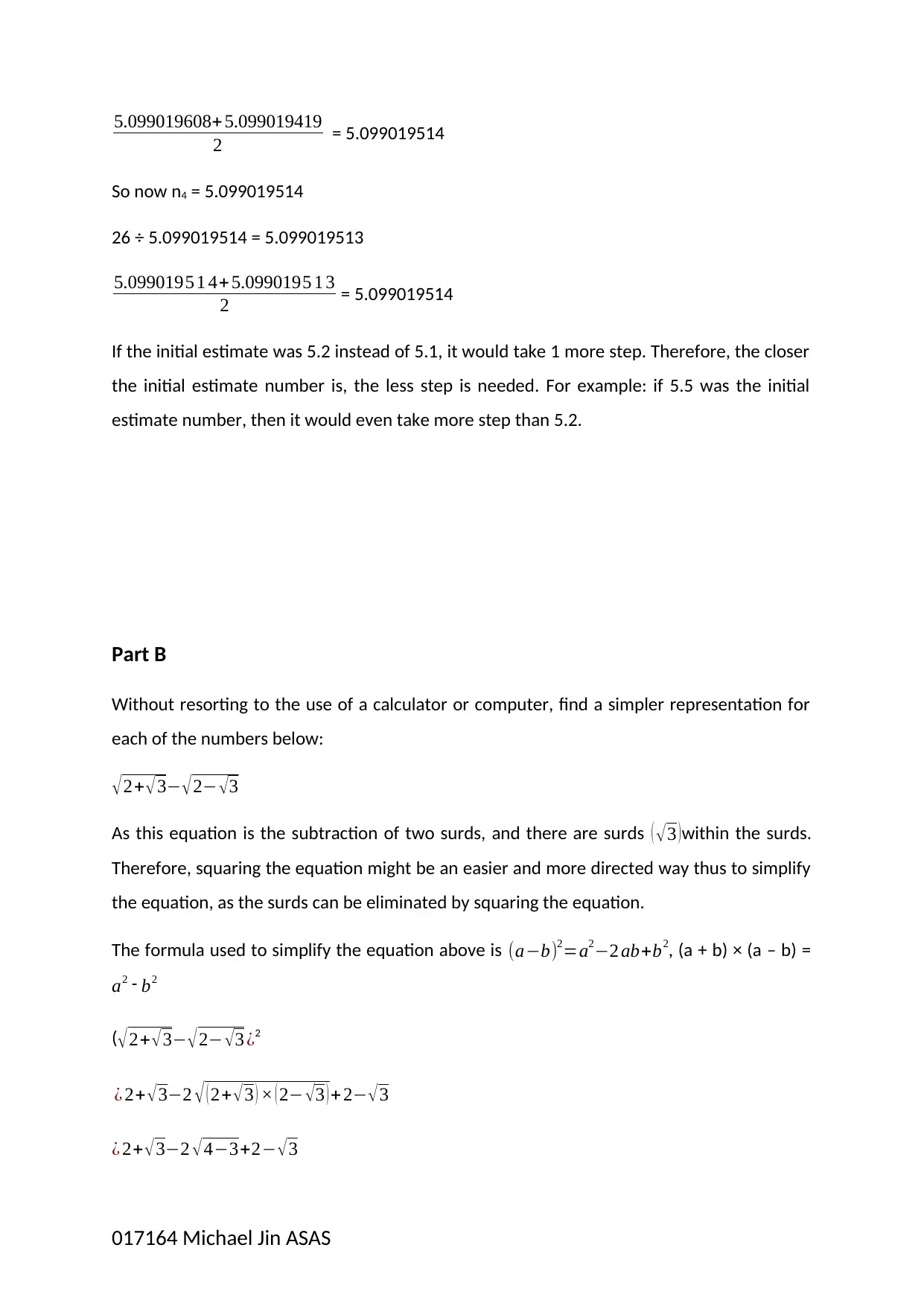
26 ÷ 5.099019608 = 5.099019419
5.099019608+ 5.099019419
2 = 5.099019514
So now n3 = 5.099019514
26 ÷ 5.099019514 = 5.099019513
5.0990195 1 4+5.0990195 1 3
2 = 5.099019514
The approximation of square root of 26 is 5.099019514. It is calculated by using the
Babylonian method which is a particular process to repeat over and over again. The initial
estimate can significantly affect the process of calculating the number as the closer the
initial estimate number is, the less step is needed to use or repeat. For example, in the
calculation of √26 ,if 5.2 was chosen as n1 instead of 5.1, it would take more step to
calculate because the answer is 5.09…, which is closer to 5.1 than 5.2. In contrast, if the
answer was around 5.19…, then let 5.2 be n1 instead of 5.1 is considered to be a more
efficient choice.
Prove that if the initial estimate was 5.2 in this case, it would take more step to get the
approximate answer 5.099019514:
Let n1 =5.2, 26 ÷ 5.2=5
5.+5.2
2 =5.1
So now n2 = 5.1
26 ÷ 5.1 = 5.098039216
5.098039216+5.1
2 = 5.099019608
So now n3 = 5.099019608
26 ÷ 5.099019608 = 5.099019419
017164 Michael Jin ASAS
5.099019608+ 5.099019419
2 = 5.099019514
So now n3 = 5.099019514
26 ÷ 5.099019514 = 5.099019513
5.0990195 1 4+5.0990195 1 3
2 = 5.099019514
The approximation of square root of 26 is 5.099019514. It is calculated by using the
Babylonian method which is a particular process to repeat over and over again. The initial
estimate can significantly affect the process of calculating the number as the closer the
initial estimate number is, the less step is needed to use or repeat. For example, in the
calculation of √26 ,if 5.2 was chosen as n1 instead of 5.1, it would take more step to
calculate because the answer is 5.09…, which is closer to 5.1 than 5.2. In contrast, if the
answer was around 5.19…, then let 5.2 be n1 instead of 5.1 is considered to be a more
efficient choice.
Prove that if the initial estimate was 5.2 in this case, it would take more step to get the
approximate answer 5.099019514:
Let n1 =5.2, 26 ÷ 5.2=5
5.+5.2
2 =5.1
So now n2 = 5.1
26 ÷ 5.1 = 5.098039216
5.098039216+5.1
2 = 5.099019608
So now n3 = 5.099019608
26 ÷ 5.099019608 = 5.099019419
017164 Michael Jin ASAS
Paraphrase This Document
Need a fresh take? Get an instant paraphrase of this document with our AI Paraphraser

5.099019608+ 5.099019419
2 = 5.099019514
So now n4 = 5.099019514
26 ÷ 5.099019514 = 5.099019513
5.0990195 1 4+5.0990195 1 3
2 = 5.099019514
If the initial estimate was 5.2 instead of 5.1, it would take 1 more step. Therefore, the closer
the initial estimate number is, the less step is needed. For example: if 5.5 was the initial
estimate number, then it would even take more step than 5.2.
Part B
Without resorting to the use of a calculator or computer, find a simpler representation for
each of the numbers below:
√2+ √ 3− √2− √3
As this equation is the subtraction of two surds, and there are surds ( √ 3 )within the surds.
Therefore, squaring the equation might be an easier and more directed way thus to simplify
the equation, as the surds can be eliminated by squaring the equation.
The formula used to simplify the equation above is (a−b)2=a2−2 ab+b2, (a + b) × (a – b) =
a2 - b2
(√2+ √3− √2− √3 ¿2
¿ 2+ √3−2 √ ( 2+ √3 ) × ( 2− √3 ) +2− √3
¿ 2+ √ 3−2 √ 4−3+2− √ 3
017164 Michael Jin ASAS
2 = 5.099019514
So now n4 = 5.099019514
26 ÷ 5.099019514 = 5.099019513
5.0990195 1 4+5.0990195 1 3
2 = 5.099019514
If the initial estimate was 5.2 instead of 5.1, it would take 1 more step. Therefore, the closer
the initial estimate number is, the less step is needed. For example: if 5.5 was the initial
estimate number, then it would even take more step than 5.2.
Part B
Without resorting to the use of a calculator or computer, find a simpler representation for
each of the numbers below:
√2+ √ 3− √2− √3
As this equation is the subtraction of two surds, and there are surds ( √ 3 )within the surds.
Therefore, squaring the equation might be an easier and more directed way thus to simplify
the equation, as the surds can be eliminated by squaring the equation.
The formula used to simplify the equation above is (a−b)2=a2−2 ab+b2, (a + b) × (a – b) =
a2 - b2
(√2+ √3− √2− √3 ¿2
¿ 2+ √3−2 √ ( 2+ √3 ) × ( 2− √3 ) +2− √3
¿ 2+ √ 3−2 √ 4−3+2− √ 3
017164 Michael Jin ASAS

¿ 4−2 × √ 1
¿ 4−2 ×1
¿ 4−2
¿ 2
Extend to find:
(√2+ √3+ √2− √3 ¿2
The formula used to simplify the equation above is (a+b)2=a2 +2 ab+b2
¿ 2+ √ 3+2 √ ( 2+ √ 3 ) × ( 2− √ 3 ) +2− √ 3
¿ 2+ √ 3+2 √ 4−3+2− √ 3
¿ 2+ √3+2 √1+2− √3
¿ 4 +2 √1
¿ 6
Generalise to find:
√a+ √b− √a− √b
¿ a+ √b−2 √ ( a+ √ b ) × ( a− √b ) +a− √ b
¿ a+ √b−2 √a2−b +a− √b
¿ 2 a+2 √ a2−b
If (a2−b) is a perfect square, then the answer of this equation will be a rational number
017164 Michael Jin ASAS
¿ 4−2 ×1
¿ 4−2
¿ 2
Extend to find:
(√2+ √3+ √2− √3 ¿2
The formula used to simplify the equation above is (a+b)2=a2 +2 ab+b2
¿ 2+ √ 3+2 √ ( 2+ √ 3 ) × ( 2− √ 3 ) +2− √ 3
¿ 2+ √ 3+2 √ 4−3+2− √ 3
¿ 2+ √3+2 √1+2− √3
¿ 4 +2 √1
¿ 6
Generalise to find:
√a+ √b− √a− √b
¿ a+ √b−2 √ ( a+ √ b ) × ( a− √b ) +a− √ b
¿ a+ √b−2 √a2−b +a− √b
¿ 2 a+2 √ a2−b
If (a2−b) is a perfect square, then the answer of this equation will be a rational number
017164 Michael Jin ASAS
⊘ This is a preview!⊘
Do you want full access?
Subscribe today to unlock all pages.

Trusted by 1+ million students worldwide

017164 Michael Jin ASAS
1 out of 7
Your All-in-One AI-Powered Toolkit for Academic Success.
+13062052269
info@desklib.com
Available 24*7 on WhatsApp / Email
Unlock your academic potential
Copyright © 2020–2025 A2Z Services. All Rights Reserved. Developed and managed by ZUCOL.